

My friend Jimy inspired my earlier essay, Socialism Is Communism Lite, with his original seven reasons to vote Republican. Now he's back with eight. This time, I'm taking his arguments through nearly a century of American history, comparing what Democrat politicians promised with what taxpayers actually received. From the New Deal to California's $35 billion railway, there's plenty of history to examine.
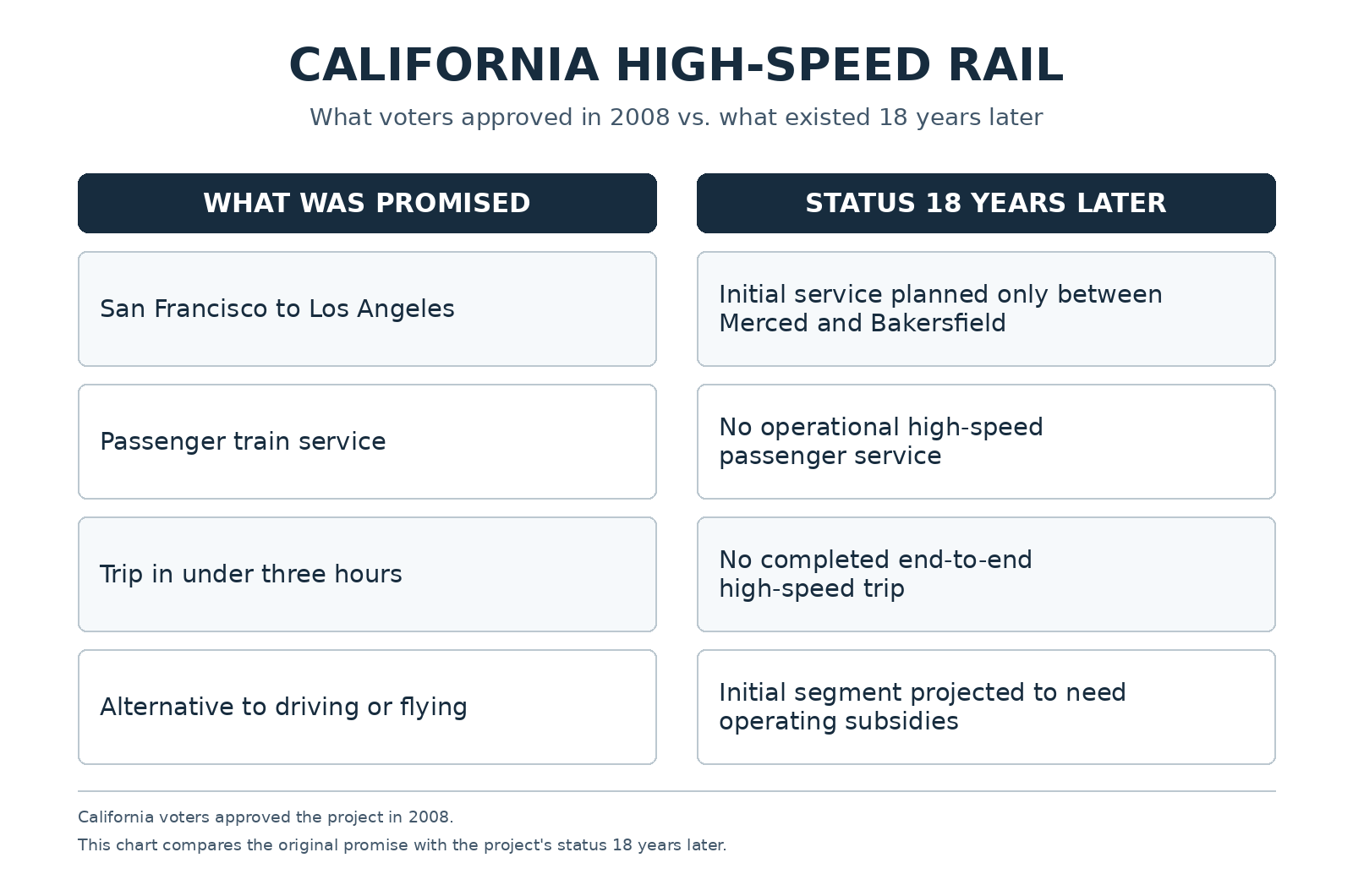
In 2008, California voters approved nearly $10 billion in bonds to help finance a high-speed railway connecting San Francisco and Los Angeles. The trains were supposed to travel between the two metropolitan areas in less than three hours, giving Californians an alternative to driving or flying.
Eighteen years later, Californians are still waiting for their first ride. By the summer of 2026, billions had been spent acquiring property, constructing bridges, building elevated guideways, and preparing the Central Valley corridor. Yet the project still had no completed operational high-speed railway track.
Apparently, building a railroad and building something a train can run on are two separate government programs.
The original estimated cost for the first phase was approximately $33 billion. California’s 2026 planning documents now put the broader San Francisco-to-Los Angeles first phase at roughly $126 billion. Meanwhile, the state hopes to begin passenger service between Merced and Bakersfield in 2033, at an estimated capital cost of nearly $35 billion.
If you’ve spent much time in California, you’ll appreciate the irony.
Before joining the Army, I worked for a company that printed a magazine we had to deliver to Anaheim every month. Overnight shipping was too expensive, and our production deadlines were too tight, so my boss paid me to drive the magazines down from the Bay Area. He covered my time and hotel, and being young, I thought it was a pretty good arrangement.
The obvious route was Interstate 5. Unfortunately, that meant driving through California’s Central Valley, where cattle, agriculture, petroleum production, and stagnant air sometimes combined to create an absolutely magnificent stench. And I-5 doesn’t even run through Bakersfield. It passes miles west of the city, but you could still smell it.
I eventually started taking Highway 101 instead. It added considerable time to the trip, but at least I could roll down the windows without regretting it. So when California announced that its initial high-speed railway would connect Merced and Bakersfield, I had to laugh. I used to drive extra hours to avoid that part of California. Now taxpayers are financing a $35 billion railway that won’t initially reach San Francisco or Los Angeles.
The state envisions the Central Valley segment as the foundation of a larger network. But according to its own 2026 business plan, the initial line is projected to generate enough ticket revenue and related income to cover only 35 to 49 percent of its annual operating expenses. Taxpayers will finance construction, subsidize operations, and hope that someday the trains reach the cities the original project was supposed to connect.
And somehow, the story gets worse.
In September 2026, California’s high-speed rail inspector general released an investigation into travel expenses billed by consultants working on the project. The authority had reimbursed more than $2 million in travel costs for four consulting firms during the period examined. Investigators reviewed approximately $1.15 million and identified hundreds of thousands of dollars in expenses that lacked required approvals or appeared to violate reimbursement rules, with some categories overlapping.
The expenses included premium airline travel, unauthorized international trips, luxury transportation, and rideshare charges to destinations including a nightclub, cigar lounge, and escape room.
These weren’t accusations invented by political opponents. They came from the project’s own inspector general.
After eighteen years, California has an unfinished railway, an initial route dramatically smaller than the one voters were promised, billions in expenditures, projected operating losses, and documented failures in consultant expense oversight.
The contractors have been getting paid. The consultants have been getting paid. The administrative machinery continues operating.
The passengers are still waiting.
Jimy doesn’t spend much time worrying about whether his opinions will make people feel uncomfortable. He looks at the country’s problems, examines the differences between the parties, and tells people what he thinks. I appreciate that.
This time, I want to examine something running through nearly all eight of his arguments. For generations, politicians have promised Americans a better future while continually expanding the government’s responsibilities, authority, and cost. The spending is easy enough to document. Determining what Americans received requires considerably more work.
A Century of Promises
In 1933, Franklin Roosevelt entered the White House during the Great Depression and launched the New Deal, one of the largest expansions of federal economic intervention in American history.
Washington established employment programs, agricultural subsidies, banking regulations, industrial planning initiatives, and an assortment of new federal agencies. Roosevelt promised economic recovery, but when he took office, unemployment was approximately 25 percent. Six years later, in 1939, it remained around 17 percent under conventional historical estimates.
There is also serious economic research suggesting that some of Roosevelt’s policies actually prolonged the Depression.
In a 2004 study published in the Journal of Political Economy, economists Harold Cole and Lee Ohanian examined New Deal policies that restricted competition and encouraged higher wages through industry-wide arrangements.
Roosevelt’s administration believed that raising wages and prices would restore purchasing power and stimulate economic activity. But maintaining wages above competitive levels while allowing businesses to restrict competition could discourage hiring additional workers and expanding production. Cole and Ohanian’s economic model identified these policies as an important reason the recovery remained so weak.
Washington was attempting to revive the economy while interfering with some of the market adjustments that might have helped businesses recover. The New Deal provided work and financial relief to millions of Americans, but providing temporary assistance and restoring a productive economy are different objectives.
One result of the New Deal was the permanent expansion of federal authority. Programs created during an economic emergency developed their own constituencies, employees, budgets, and political defenders. Even after the original crisis passed, many of the institutions remained.
Nearly half a century later, President Jimmy Carter signed legislation establishing the modern Cabinet-level Department of Education, which began operating in 1980. Its mission included improving educational opportunity, coordinating federal programs, and promoting academic achievement.
Forty-four years later, the 2024 National Assessment of Educational Progress found that 40 percent of American fourth graders scored below its Basic benchmark in reading. Only 31 percent reached NAEP Proficient or higher.
America has spent decades administering federal education programs, collecting statistics, imposing requirements, and distributing money to states and school districts. Millions of children still struggle with fundamental reading skills.
State and local governments remain principally responsible for operating schools, but Washington has had decades to demonstrate what its additional layer of administration contributes. The appropriate measurements are student achievement, educational opportunity, and the results of particular federal programs, not the size of the department’s budget.
Politicians regularly announce increases in education spending as though the expenditures themselves constitute an achievement. Parents might prefer hearing how much more their children are learning.
The Civil Rights Record
The Democrat Party’s modern reputation as the champion of civil rights becomes considerably more complicated when examined against its legislative history.
In 1957, Republican President Dwight Eisenhower signed the first major federal civil rights legislation since Reconstruction. Another followed in 1960. When Congress considered the Civil Rights Act of 1964, Southern Democrats launched a prolonged Senate filibuster to prevent its passage.
One of those senators was West Virginia Democrat Robert Byrd, a former Ku Klux Klan member who spoke against the legislation for fourteen hours and thirteen minutes. Republican Senate Minority Leader Everett Dirksen helped assemble the coalition that finally defeated the filibuster.
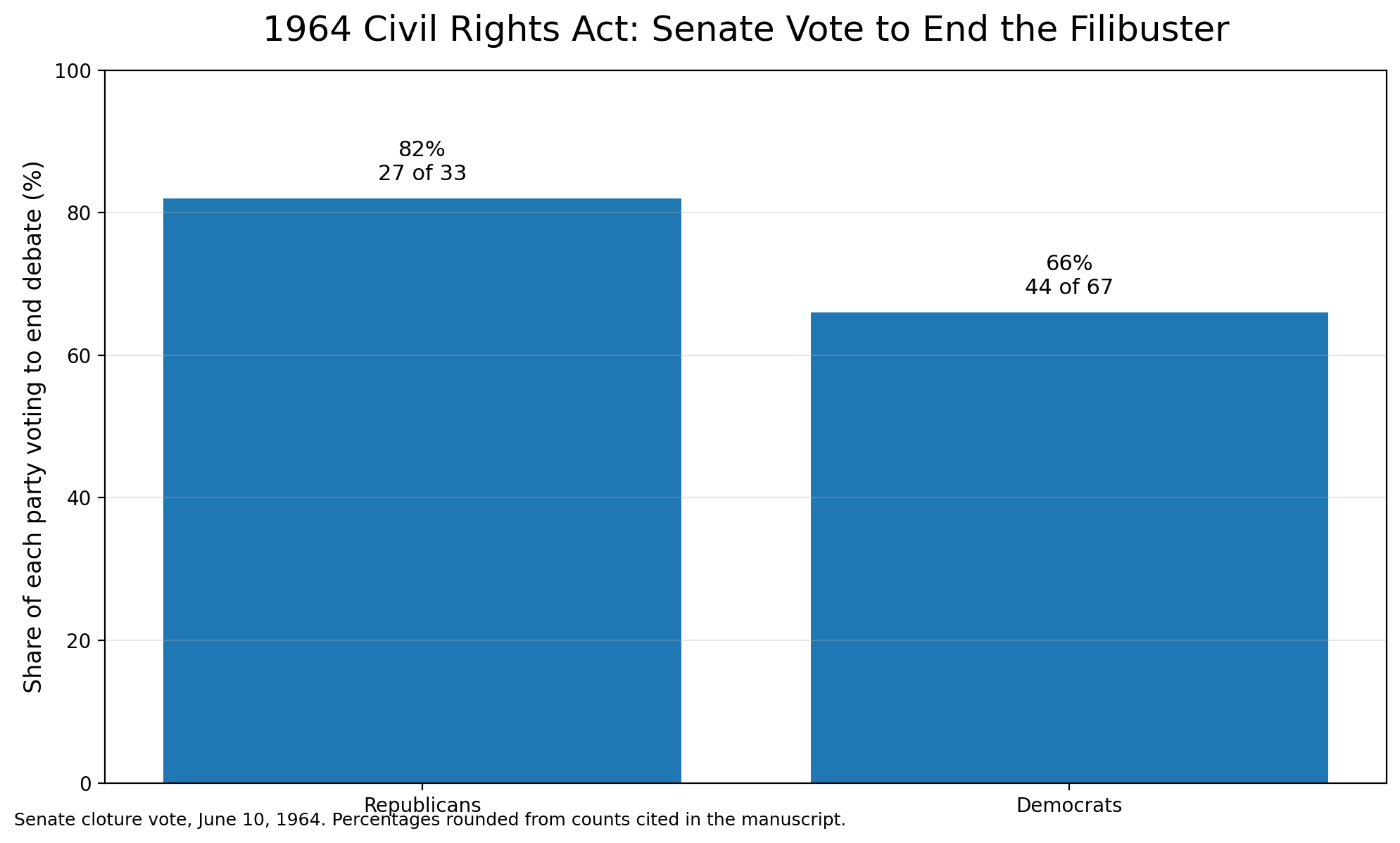
On June 10, 1964, the Senate voted 71 to 29 to end debate. Twenty-seven of the Senate’s thirty-three Republicans supported cloture, approximately 82 percent. Forty-four of sixty-seven Democrats voted the same way, approximately 66 percent.
President Lyndon Johnson signed the legislation on July 2 after substantial efforts by civil rights activists, congressional leaders, and supporters in both parties. The legislation was a landmark achievement, but its passage required overcoming years of resistance from powerful Southern Democrats who had defended segregation and obstructed federal civil rights protections.
Republican votes were indispensable to breaking that opposition.
Political reputations can change much faster than historical records. Johnson’s signature appears on the Civil Rights Act, and he deserves recognition for his role in securing its passage. The congressional record also preserves the names and votes of the politicians who tried to prevent it.
The people who endured segregation didn’t have the luxury of treating that resistance as an interesting episode in political history. They lived with its consequences.
The Business of Government Spending
Jimy is especially concerned about government fraud, waste, and the enormous sums flowing through public programs. One part of that system deserves closer scrutiny: the relationship between government agencies, nonprofit organizations, contractors, political influence, and financial accountability.
Most Americans hear nonprofit and picture an organization helping sick children, feeding hungry families, or providing assistance to people in difficult circumstances. Many do exactly that. But nonprofit status is a legal and financial designation, not a guarantee of competent management, effective programs, or political independence.
Federal and state governments distribute substantial sums through grants and contracts to outside organizations. Those organizations employ administrators, consultants, and subcontractors, and some engage in political advocacy involving the programs they administer.
The financial incentives can become remarkably different from those of the taxpayers.
A taxpayer funding a homeless-services program presumably wants fewer people living on the streets. An organization administering that program needs continuing revenue to pay its employees, maintain its operations, and fulfill its contracts. Its survival may depend on continued appropriations even when the underlying problem persists.
That doesn’t establish that the organization wants homelessness to continue. It does establish that the financial interests of program administrators are not necessarily identical to the interests of the people financing the program or receiving its services.
The distinction becomes more consequential when government agencies use the amount spent, the number of people served, or the number of participating organizations as their principal measures of success.
An agency can report that it distributed another hundred million dollars without establishing that the problem became smaller. Contractors can satisfy their agreements, employees can receive their salaries, and politicians can announce additional funding while the public sees little improvement.
Federal grant rules restrict using public grant funds for partisan campaigns. Yet political influence, ineffective oversight, and conflicts of interest can develop even when no criminal law has been broken. Once a government program supports an extensive network of organizations and employees, terminating it can threaten the livelihoods of people whose interests are far more concentrated than those of individual taxpayers.
California’s railway provides a revealing example. Years after voters approved the project, investigators were reviewing consultant expenses for premium travel and entertainment destinations while the promised passenger service remained undelivered.
The inspector general’s findings establish failures in spending controls, not the theft of the entire project budget. Those failures also demonstrate why public contracts should receive independent scrutiny before additional funds are committed.
Taxpayers shouldn’t have to conduct an archaeological expedition through government accounting records to discover what happened to their money.
The Border Didn’t Move
Immigration provides one of the clearest recent comparisons between different federal policies.
During Biden’s presidency, the United States experienced exceptionally high levels of border encounters and apprehensions. Communities struggled with shelter costs, immigration processing, transportation, and demands on public services.
Americans repeatedly heard explanations about why securing the border required new legislation, additional funding, and more international cooperation. Then the administration changed, and the numbers changed with it.
On October 16, 2026, the Department of Homeland Security announced preliminary fiscal-year figures showing that southwest border apprehensions had fallen approximately 95 percent compared with the Biden administration’s annual average. Border Patrol recorded 98,708 apprehensions during fiscal year 2026, compared with more than 1.8 million annually under Biden.
DHS also reported an entire fiscal year without Border Patrol releasing apprehended migrants into the country at the border.
The border didn’t move. Mexico didn’t disappear. America’s economic opportunities didn’t become less attractive. Federal enforcement and processing policies changed, and apprehensions fell dramatically.
Those numbers demonstrate a substantial change in border enforcement outcomes. They also invite a question about what officials in the previous administration could have accomplished under different policies.
Immigration has consequences extending beyond enforcement. Immigrant communities can become influential political constituencies, advocacy organizations organize around immigration policy, naturalized citizens acquire voting rights, and population counts affect congressional representation.
Those political incentives are worth examining alongside the economic consequences of immigration. Rapid population growth places demands on schools, housing, hospitals, transportation, and local budgets. Communities need time and resources to expand their capacity, regardless of whether newcomers arrived through authorized or unauthorized channels.
Legal immigrants have an interest in consistent enforcement as well. People who follow America’s established procedures reasonably expect those rules to have meaning. Jimy’s concern is that government should administer immigration law consistently rather than continually ask communities to absorb the consequences of inadequate enforcement.
The latest border figures give voters a substantial difference in policy outcomes to examine.
Wealth Has to Be Created Before It Can Be Spent
Jimy’s discussion of affordability concerns something Americans encounter every day: what their earnings can actually buy.
During Biden’s presidency, annual inflation reached 9.1 percent in June 2022, its highest reading in four decades. Food, housing, insurance, transportation, and other necessities became substantially more expensive. A worker can receive a raise and still lose purchasing power when prices increase faster than wages.
Politicians celebrate lower inflation as though that means prices have returned to their previous levels. It generally means they’re continuing to rise, just more slowly. Families know the difference whenever they pay their bills.
Jimy emphasizes domestic energy production, private investment, entrepreneurship, and policies that encourage businesses to expand.
Building a factory requires someone to risk capital, acquire property, obtain permits, purchase equipment, hire employees, secure supplies, and find customers willing to buy what the factory produces.
Its success depends on producing something valuable enough to justify those costs. Productivity improvements can make products more affordable, increase output, and support higher compensation over time.
Government policy influences practically every stage of that process.
A regulation may protect workers, consumers, or the environment while also imposing costs on businesses. Larger companies can often spread those costs across thousands of employees and millions of sales. A small competitor may have to absorb a similar compliance burden with a fraction of the resources.
That creates a problem policymakers rarely advertise. Regulations intended to control large corporations can sometimes strengthen their competitive position by making it harder for smaller businesses to survive.
Energy costs create similar effects throughout the economy. Fuel and electricity influence agriculture, manufacturing, freight transportation, heating, and numerous other industries. When energy becomes more expensive, businesses must absorb those costs, reduce other expenses, or pass some of the increase to customers.
Affordable and reliable energy can therefore improve economic conditions far beyond the companies producing it.
The question for tax and regulatory policy is whether it encourages investment, competition, productivity, and rising real incomes. Announced investments and projected benefits are useful starting points, but factories must actually open, businesses must produce, and workers must receive the income before the economic promises become measurable results.
A politician can announce a new factory. Someone still has to build it and persuade customers to buy what it produces.
Elections, Money, and Government Power
In August 2025, Pew Research Center found that 95 percent of Republicans and 71 percent of Democrats supported requiring government-issued photo identification to vote. Seven out of ten Democrat voters supported the requirement, an unusually broad level of public agreement on an issue that continues to generate political conflict.
Yet when Congress considered the SAVE America Act in 2026, the dispute involved considerably more than showing a photo ID at the polling place.
The House-passed legislation required documentary proof of American citizenship when registering for federal elections, along with specified identification when casting a ballot. That distinction helps explain why a voter who supports photo ID might still have questions about the legislation.
A driver’s license can establish someone’s identity without necessarily establishing citizenship. A passport or birth certificate may establish citizenship, but not everyone has those documents readily available when registering.
The legislation also included a process for applicants unable to present the specified documents to demonstrate citizenship through other evidence.
Supporters argue that stronger documentary requirements would make eligibility checks more reliable. Opponents raise concerns about the availability of records, implementation, and whether eligible citizens could face additional obstacles.
Minnesota provides another example of the questions surrounding election administration. One registered voter can vouch for the residence of as many as eight people registering on Election Day. The procedure includes affidavits and verification measures, but it raises practical questions about how administrators establish eligibility when someone can register and cast a ballot during the same visit.
Election officials must also maintain registration records as people move, change names, die, or register in different jurisdictions. Outdated records require correction, while allegations of illegal voting require evidence that improper ballots were actually cast.
The public’s broad support for photo ID is established. The legislative disagreement concerns how eligibility should be verified, which documents are sufficient, and what procedures should exist for qualified voters who cannot immediately provide them.
Jimy also raises concerns about central bank digital currencies, commonly called CBDCs.
Most Americans already use digital money through banking applications, electronic deposits, and card payments. A CBDC would represent money issued as a direct liability of the central bank, potentially creating a different relationship between citizens and monetary authorities.
Depending on its design, a CBDC could raise significant questions about transaction privacy and government control over payments. On January 23, 2025, President Trump signed an executive order prohibiting federal agencies from establishing, issuing, or promoting a CBDC except where required by law. The order also directed agencies to terminate existing development initiatives.
The limits of executive authority were also tested during the COVID-19 pandemic. Government requirements affected employment, education, travel, and business operations, leading to major constitutional and administrative-law disputes.
In January 2022, the Supreme Court blocked the Biden administration’s broad OSHA vaccine-or-testing requirement for large employers. The Court concluded that Congress had not clearly authorized the agency to impose such a sweeping workplace requirement.
Authority granted to an agency for one purpose can be invoked for another, and emergency measures can establish precedents that remain relevant long after the original emergency has ended. Americans elect new presidents and members of Congress regularly, but the institutions exercising government authority remain.
National Security Doesn’t End at the Border
Jimy’s eighth argument concerns American military power and the strategic waterways through which enormous quantities of international commerce pass.
His document identifies seven important maritime gateways: the Panama Canal, GIUK Gap, Gibraltar, Danish Straits, Turkish Straits, Strait of Hormuz, and Strait of Malacca.
The Strait of Hormuz provides a particularly useful example because approximately one-quarter of the world’s seaborne oil trade normally passes through the narrow waterway connecting the Persian Gulf with the Gulf of Oman.
In May 2026, U.S. Central Command announced Project Freedom, a military operation supporting the restoration of commercial navigation through Hormuz. According to CENTCOM, the mission involved guided-missile destroyers, more than 100 land-based and maritime aircraft, unmanned platforms, and approximately 15,000 service members.
The mission had a specific objective: help commercial vessels navigate a waterway whose disruption threatened international energy and shipping markets.
CENTCOM subsequently reported that American forces had opened a passage through the strait while separately enforcing a blockade involving Iranian ports. American forces were assuming operational risks to restore commercial navigation, not merely announcing another diplomatic initiative.
The distinction between a military objective and its results is important here. Deploying fifteen thousand personnel demonstrates the resources committed. Whether commercial vessels could transit safely and regularly, whether attacks diminished, and whether shipping restrictions were sustained are the measures of what the operation accomplished.
Other maritime gateways present different strategic problems. The Panama Canal shortens voyages between the Atlantic and Pacific. The Strait of Malacca connects major Asian trade routes with the Indian Ocean, while the GIUK Gap remains important for naval movements in the North Atlantic.
Jimy’s map emphasizes American access and influence across these passages. Military access and diplomatic influence are distinct from ownership or exclusive control, but they can still provide substantial strategic advantages.
Maintaining that access requires ships, aircraft, personnel, intelligence, international agreements, and the capacity to operate when waterways are threatened. Those capabilities carry enormous costs, but interruptions to global shipping can impose significant economic costs as well.
For taxpayers, military spending deserves the same scrutiny as other federal expenditures, with the added responsibility of protecting the people placed in harm’s way. The relevant questions concern readiness, the mission assigned, its results, and the resources required to sustain them.
The Promises Were Paid For
Jimy’s eight concerns cover many of government’s central responsibilities: border enforcement, public safety, economic opportunity, election integrity, constitutional rights, financial accountability, and national defense.
Americans have nearly a century of experience against which to examine how those responsibilities have been handled.
The New Deal expanded federal power while economic research identified policies that may have prolonged the Depression. Washington established a Cabinet-level Department of Education, yet millions of children still struggle with basic reading skills.
The Civil Rights Act of 1964 became a landmark achievement after a prolonged legislative fight in which Southern Democrats tried to block it and Republican votes helped defeat their opposition.
During Biden’s presidency, inflation reached a four-decade high, leaving families with price increases that slower inflation has not erased. The dramatic decline in southwest border apprehensions during 2026 provides a contrasting example of how substantially enforcement outcomes can change when government policies change.
Debates over election procedures, digital currencies, and emergency mandates concern the safeguards protecting citizens from government authority. National security requires military capabilities that can respond to actual threats rather than merely promising to discourage them.
Campaign speeches can explain what politicians intend to accomplish. Budgets, legislation, court decisions, and economic outcomes reveal considerably more about what happened after they obtained power.
Jimy believes his eight arguments explain why Republican policies offer a different direction. His document invites readers to examine the priorities of the two parties and compare the records of the officials responsible for carrying them out.
Which brings me back to California.
In 2008, voters authorized billions to help build a railway connecting San Francisco and Los Angeles. Eighteen years later, the state is preparing a much shorter initial route, with projected revenues insufficient to cover its operating expenses.
Consultants have been reimbursed for premium travel, including expenses that violated state rules. Investigators have documented oversight failures, and taxpayers face an extraordinary increase in the projected cost of delivering the original vision.
A lot of people have been paid to help build California’s railway.
The people who paid for it are still waiting to ride it.
Jimy’s Original
My friend Jimy’s updated document, Why You Should Vote Republican, contains all eight of his arguments and the supporting materials he collected. I encourage readers to examine it for themselves.
Why You Should Vote Republican
Independent Writing. Reader Supported.
For nearly two years, I’ve been researching, writing, and publishing essays examining the political promises, policies, and decisions that have shaped America. I don’t have a corporate sponsor, a political organization paying my bills, or a government grant keeping the lights on.
Everything I publish is free to read. I believe the information should be available to everyone, regardless of whether they can afford a subscription. But independent writing takes considerable time, research, and resources.
If you appreciate this work and want to help keep it going, here are three ways to support it:
Become a paid subscriber and help support my ongoing research and writing.
Make a one-time contribution if you’d prefer to help without a recurring commitment.
Join the Resistance Core if you’d like to provide more substantial support.
If you’re unable to contribute financially, sharing this essay with friends, family, or your social networks makes a difference, too.
To everyone already supporting my work, thank you. You’re the reason I can keep doing this.