

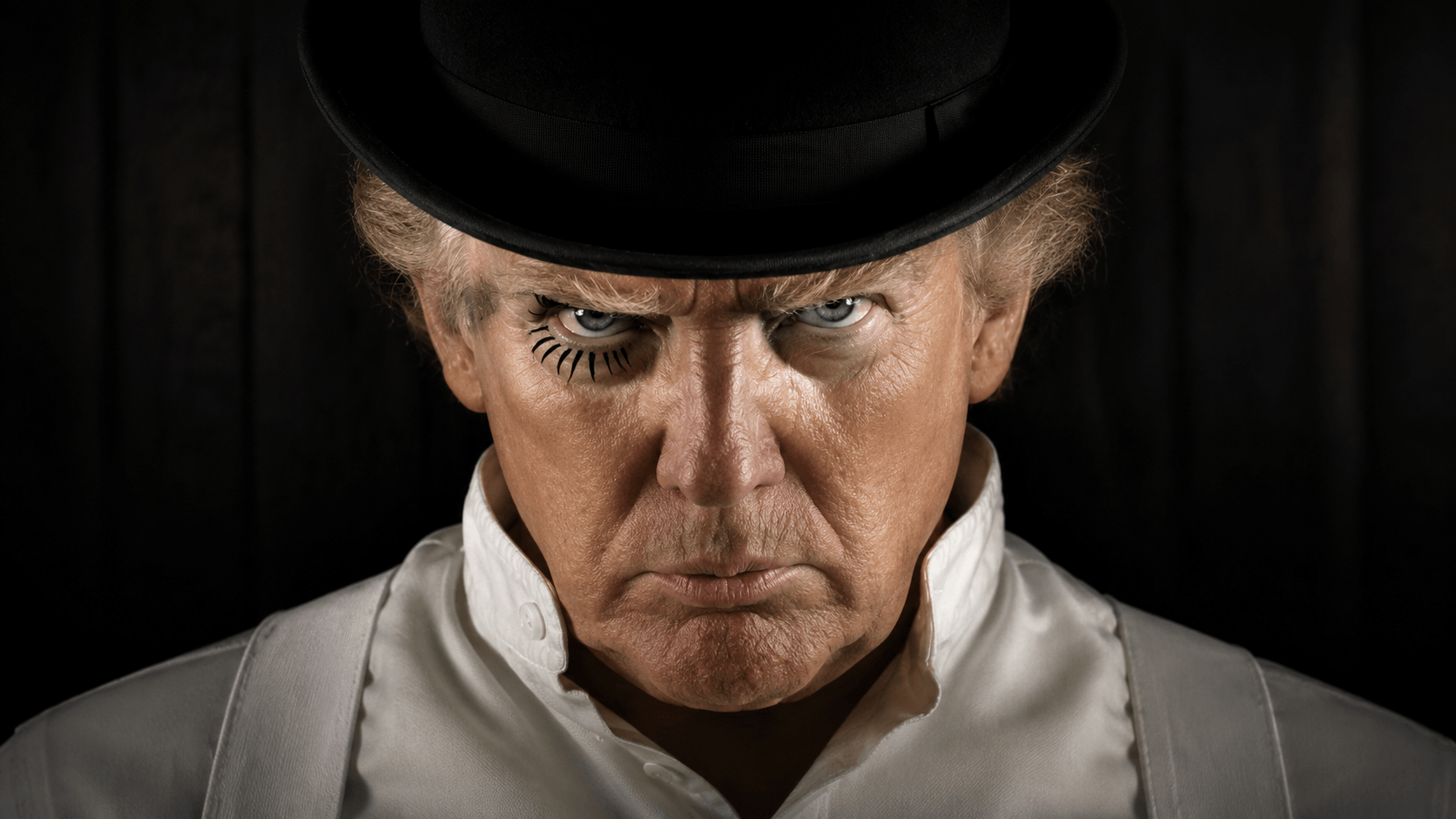
“A man who cannot choose ceases to be a man.”
— A Clockwork Orange
That line is not really about crime. It is about moral agency. It asks whether a man is still human if the state removes his ability to choose good or evil. In A Clockwork Orange, the state does not make the criminal good. It makes him incapable. The criminal becomes a machine.
That is why the movie is still relevant. It is not just a story about crime. It is a story about what happens when a society loses confidence in moral responsibility and then tries to solve evil with systems, procedures, theories, and experiments.
America has been living through its own version of that mistake.
For years, the country has been told it cannot choose its borders. It cannot choose punishment. It cannot choose police. It cannot choose deportation. It cannot choose public order. It cannot choose to protect the decent from the predatory. It cannot even choose to notice what is happening without being accused of hatred, racism, fascism, cruelty, or ignorance.
A country that cannot choose ceases to be the land of the free.
In A Clockwork Orange, the Ludovico Technique does not merely stop Alex from committing violence. It conditions him to become physically sick at the thought of it. Even beauty becomes corrupted in the process. Beethoven, one of the few higher things left in his life, becomes part of the punishment. That is the deeper horror. The state does not make him good. It makes him incapable.
Modern liberalism performed a softer version of that trick on the citizen. It trained decent people to feel moral nausea at the thought of enforcement. Want police? That is racism. Want borders? That is xenophobia. Want prison for violent repeat offenders? That is cruelty. Want public order? That is authoritarianism. The goal was not merely to excuse the criminal. It was to make the citizen feel guilty for wanting protection.
Donald Trump did not return to power because Americans suddenly became cruel. He returned because millions of Americans got tired of being told that cruelty was compassion, disorder was justice, punishment was oppression, borders were hatred, police were villains, and criminals were victims.
The left did not humanize the criminal. It mechanized him.
That sounds harsh only if we have forgotten what responsibility means. It is not compassion to say that a man did not really choose to rob, rape, beat, stab, carjack, loot, shoot, or kill. Nor is it respect to reduce him to poverty, trauma, racism, policing, redlining, bad schools, or whatever explanation happens to be fashionable at the moment.
Some of those things matter. Of course they do. A serious person does not deny that background, environment, and incentives affect behavior. But explanation has its place. Excuse is something else.
A man may grow up poor. He can still choose not to rob an old woman. Poverty may explain the weight on his back. It does not put the knife in his hand. A man may have trauma. He can still choose not to shove a stranger onto train tracks. A person may be addicted. He still does not have a right to turn a public sidewalk into a biohazard. Hardship can explain why virtue is difficult. It does not erase the difference between virtue and vice.
Responsibility is not cruelty. It is civilization’s first compliment to the human being. It says you are not a machine. You are not merely the sum of your conditions. You are capable of choosing, and because you are capable of choosing, you are accountable for what you choose.
Modern liberalism took that principle and turned it upside down. The criminal was relieved of responsibility. The citizen was stripped of options. The victim was pushed behind the theory. Then the voter was told that choosing Trump was not really a choice either. It was ignorance, racism, fascism, misinformation, or some psychological defect waiting to be diagnosed by people who think cable news is a graduate seminar.
They denied the criminal’s moral choice, then denied the voter’s political choice. That is not democracy. That is conditioning.
When Criminals Were Denied Responsibility
Modern liberal crime policy begins with a flattering lie. It tells the public that it is more sophisticated to understand crime than to punish it. Only simpletons want consequences. Only cruel people want prisons. Only racists want police. Only authoritarians want order.
The criminal, we are told, is not really choosing evil. He is expressing trauma. He is responding to inequality. He is surviving capitalism. He is rebelling against oppression. He is a victim of the system, even when his own victim is bleeding on the sidewalk.
This is why the language changed. Criminals became “justice-involved individuals.” Prisoners became “incarcerated persons.” Illegal aliens became “undocumented migrants.” Looting became “protest.” Theft became “survival.” Addiction became only a public health issue. Homeless encampments became “the unhoused community.” Enforcement became “criminalization.”
The trick was always linguistic. Change the word, and you can hide the wound.
The language got cleaner as the streets got dirtier.
The theory calls it “retail shrink.” The shop owner calls it closing early, hiring security, raising prices, or giving up. The theory calls it “sanctuary policy.” The family calls it an empty chair at dinner. The theory calls it “public health.” The parent calls it the fentanyl pill that never should have reached his child. The theory calls it “decarceration.” The victim calls it wondering why the man who hurt her was already free.
There are real causes behind crime. Poverty, family breakdown, bad schools, addiction, fatherlessness, and neighborhood disorder all contribute. But causes are not the same as excuses. A civilization that cannot tell the difference will eventually excuse itself into barbarism.
Once the criminal is no longer responsible, the rest of the system begins to orbit around him. Courts become therapy centers. Prosecutors become social workers. Police become oppressors. Victims become props. The citizen becomes a taxpayer funding the experiment.
The criminal was given a sociology lecture. The victim was given a GoFundMe. And sometimes, the criminal is given both.
When Victims Were Denied Priority
The problem with liberal compassion is not that it cares too much about criminals. The problem is that it so often cares too little about victims.
The victim interrupts the theory. The theory says the criminal is a product of society. The victim asks, “Why was he free to do this to me?” The theory says punishment is cruel. The victim asks, “Was it merciful when he attacked me?” The theory says police are dangerous. The victim asks, “Then who is supposed to come when I call?”
This is not theoretical for ordinary people. The Bureau of Justice Statistics reported that in 2024, there were 6.1 million violent incidents involving victims age 12 or older in the United States, with a violent victimization rate of 23.3 per 1,000 people age 12 or older. The FBI’s 2024 reported-crime data showed violent crime falling nationally from 2023, including a 14.9% drop in murder and non-negligent manslaughter. Early 2025 FBI data showed further declines in violent crime and murder. Those are good trends. They should not be dismissed. But lower national rates do not erase millions of victims, local disorder, repeat offenders, or fear in places where the system keeps failing.
That is not just a number on a government report. That is millions of moments when ordinary life was interrupted by fear. A woman walking faster to her car. A clerk watching the door instead of the register. A commuter choosing the car over the subway. A parent telling a child to avoid a park that used to belong to everyone.
A national trend can improve while a neighborhood deteriorates. A murder rate can fall while a subway still becomes more unsafe. A city can show better statistics while pharmacies close, stores lock up basic items, police staffing remains strained, and ordinary people stop trusting the people in charge.
A shop owner does not experience crime as a national percentage. He experiences it as the same thief walking in again. A commuter does not experience public safety as a chart. She experiences it as the unstable man screaming on the platform while everyone else looks away. A parent does not experience border policy as a Washington debate. He experiences it when fentanyl reaches his child’s school or when someone who had no legal right to be here commits a crime that cannot be undone.
The elites always want the discussion kept at a level of abstraction where nobody has to smell the urine in the stairwell, step over the needles, replace the broken glass, bury the child, or explain to a widow why the man who killed her husband had already been arrested again and again.
The people who pay for elite compassion are rarely the elites.
When Citizens Were Denied Order
Order is one of those words that people with security guards can afford to mock.
To ordinary people, order is not fascism. It is being able to walk from a parking lot to a grocery store without being followed. It is riding public transportation without wondering who will shove whom onto the tracks. It is keeping a small business open without calculating how much theft can be absorbed before closing. It is taking your children to a park without needles in the grass. It is calling the police and believing someone will come.
Only people protected from disorder can afford to sneer at law and order.
That is why the crime debate is so dishonest. The people most eager to excuse disorder are often the least exposed to it. They live in neighborhoods with private security, controlled access, better schools, safer parks, and enough money to move when things deteriorate. Their compassion is billed to someone else’s address.
Retail theft is one example. The National Retail Federation reported in 2024 that retailers saw a 93% increase in the average number of shoplifting incidents in 2023 compared with 2019, and a 90% increase in dollar losses from shoplifting over the same period. There has been legitimate debate over how much retail theft alone explains certain store closures, but the increase in theft, aggression, security costs, locked shelves, and customer frustration became visible enough that voters and businesses stopped treating it as imaginary.
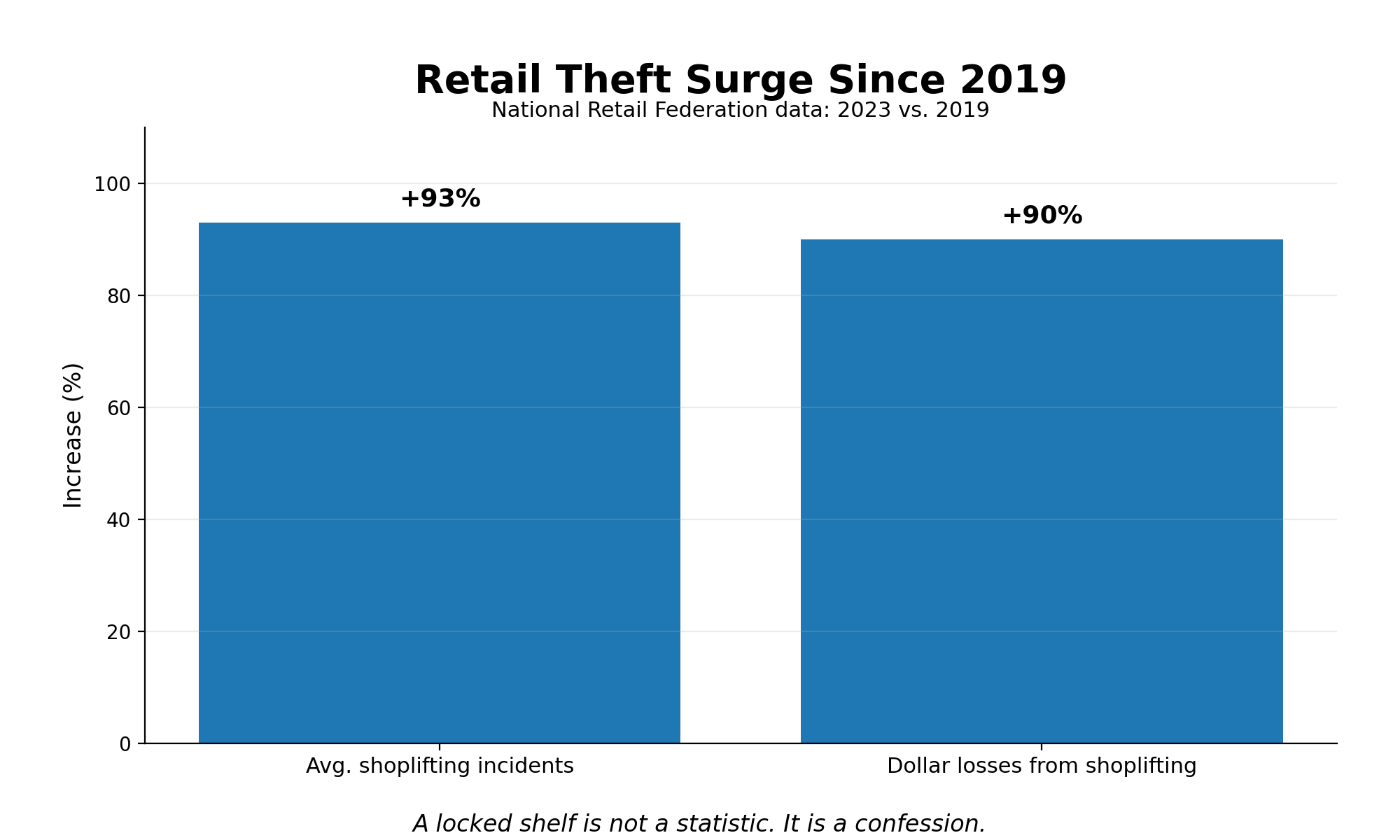
A locked shelf is not a statistic. It is a confession. It says the store no longer trusts the street. It says the customer must now wait for an employee to unlock toothpaste because the people in charge could not unlock a jail cell.
California offered a useful case study. In 2014, Proposition 47 reduced several theft and drug crimes from felonies to misdemeanors. Ten years later, voters approved Proposition 36, which increased penalties for certain drug and theft crimes, including allowing tougher punishment in some repeat-offender cases. That was not a conservative state suddenly discovering talk radio. That was deep-blue California saying the experiment had gone too far.
This is what the political class often misses. Citizens may endure elite theory for a season. They may even repeat the approved slogans. But eventually they notice the locked shampoo, the closed pharmacy, the empty downtown, the security guard told not to intervene, and the thief who seems more protected than the customer.
After a while, people stop debating the theory and start judging the results.
When Police Were Denied Legitimacy
Nobody needs to pretend police are saints. No large profession survives contact with human nature without producing failures. Bad officers should be punished, and no serious person argues otherwise.
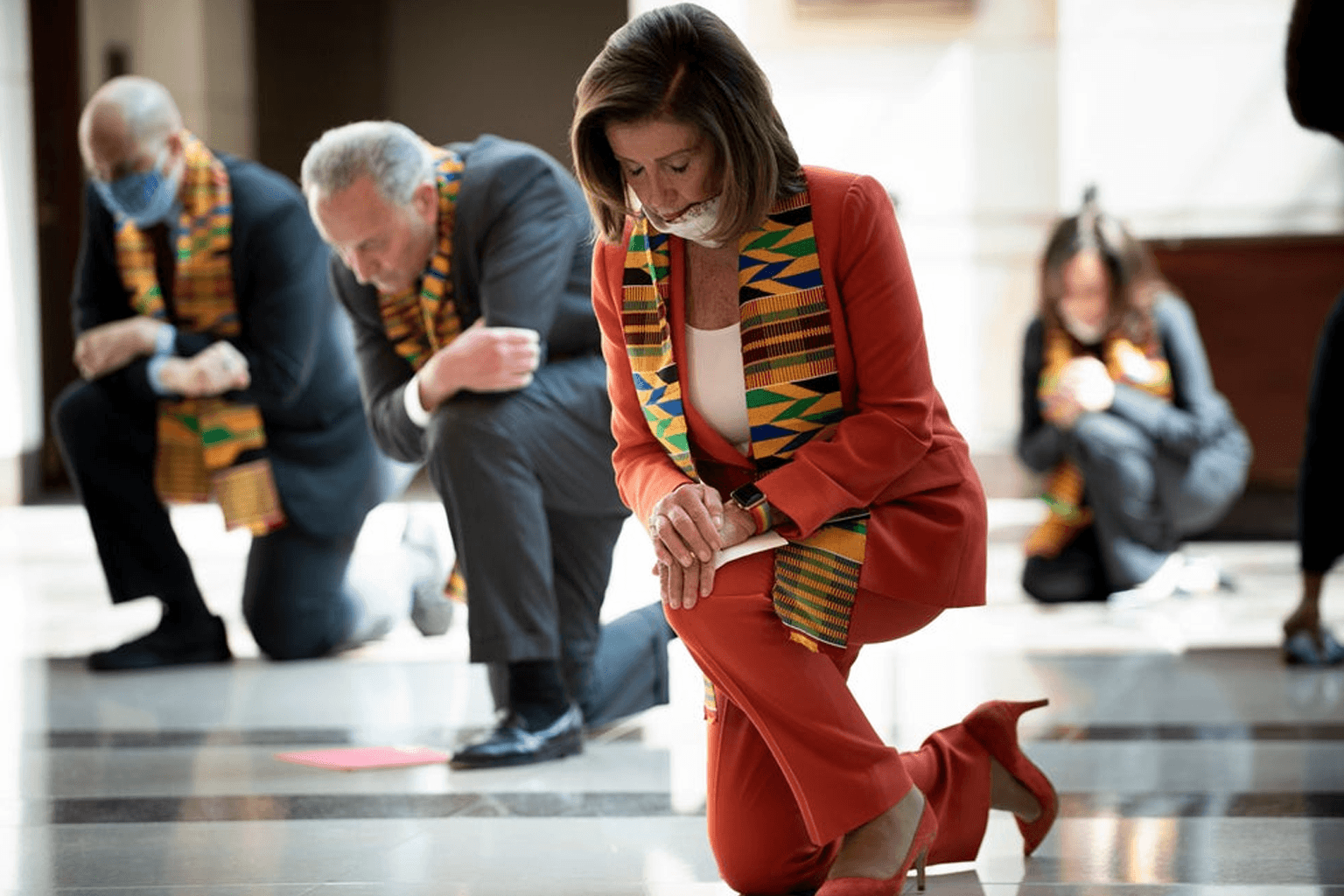
But the left did not stop at criticizing bad policing. It spent years attacking policing itself. After George Floyd, “defund the police” became more than a slogan. It became a moral signal. Politicians and activists told the public that police were not the thin line between order and chaos, but the visible face of oppression. Enforcement became suspect. Restraint by criminals was assumed less realistic than restraint by police.
Then people acted surprised when policing became harder.
The Police Executive Research Forum reported that among responding agencies, overall sworn staffing on January 1, 2025, was still 5.2% lower than on January 1, 2020, even though hiring had started to recover. That’s important because police staffing is not an accounting detail. It is the practical capacity of civilization to defend itself.
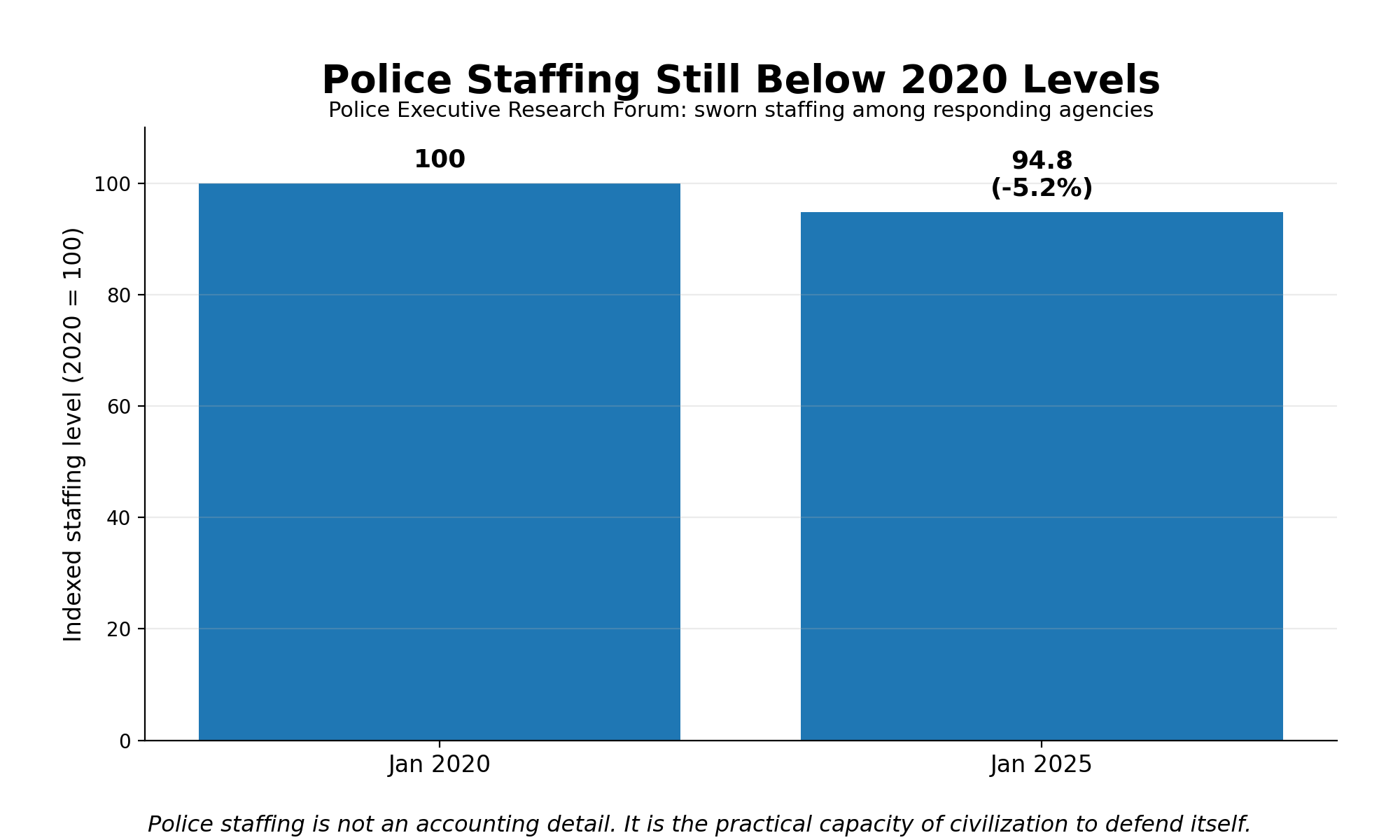
A missing officer is not only a vacant position on a spreadsheet. It is a longer wait when someone calls 911. It is one fewer patrol car in the area where break-ins keep happening. It is one more reason an officer decides not to make a risky stop if the city, the prosecutor, and the media will not back him unless everything goes perfectly.
When politicians tell officers they are villains, fewer people want the job. When prosecutors will not prosecute, officers wonder why they risked their lives making the arrest. When activists treat every police encounter as an atrocity waiting to be edited, officers pull back. When officers pull back, criminals do not need to read a policy memo. They feel the difference.
This is the part polite society does not like to discuss. The police are not merely government employees. They are one of the ways a society announces that rules still mean something. Take away their legitimacy, and you do not get a more compassionate society. You get a more nervous one.
A country that cannot choose police cannot choose safety. A country that cannot choose enforcement cannot choose law. A country that cannot choose law cannot choose civilization.
When Borders Were Denied Meaning
A border is not a symbol of hatred. It is the first promise a government makes to its own people.
That promise is simple: there is a country here, and the people who belong to it have the right to decide who enters, who stays, and who must leave.
The left spent years putting that promise on trial. A secure border became xenophobia. Deportation became cruelty. Sanctuary policies became virtue. Asking whether a person had a legal right to be here became bigotry. The citizen was expected to absorb the cost, the risk, and the lecture.
This does not mean every illegal immigrant is a criminal. That argument is not only false, it is unnecessary. The real question is much simpler: should criminals, traffickers, gang members, repeat offenders, and people with no legal right to be here be allowed to enter, remain, reoffend, and sometimes be protected by sanctuary politics?
A serious country answers no.
The fentanyl crisis made the border debate harder to dismiss. CBP’s drug seizure statistics continue to show fentanyl as a major enforcement issue. It is true that much fentanyl is seized at ports of entry rather than between them, which is an important detail. But that does not make border enforcement irrelevant. It proves the border is one of the major battlegrounds in a drug war that has killed tens of thousands of Americans a year.
There has been encouraging news. CDC provisional data released in May 2026 showed U.S. overdose deaths falling again in 2025, with roughly 70,000 deaths, down about 14% from the previous year. That is a real improvement. But 70,000 dead Americans is not a victory lap. It is a national wound that remains open.
The theory calls it a border management issue. The parent calls it a funeral. The policy expert calls it a migration challenge. The citizen calls it wondering why his own country treats self-protection as a character flaw.
The left often wants to separate every issue into a different moral compartment. Fentanyl is public health. Illegal immigration is compassion. Cartels are foreign policy. Sanctuary cities are local autonomy. Crime by illegal aliens is anecdotal. Deportation is cruelty.
The citizen experiences all of it as one question: does my government still think it owes me protection?
When the answer sounds like no, people choose the candidate who says yes.
When Consequences Were Denied Justice
The word “consequences” now gets treated as if it means revenge. It does not. It is how a society tells the victim that the rules were not decorative.
The progressive prosecutor movement told America that the old system was too punitive. Some of that criticism had merit. There have been people punished too harshly, people held pretrial because they were poor, and policies that did not distinguish well enough between dangerous offenders and low-risk defendants.
But reform became something else in many places. It became a habit of reducing consequences while increasing lectures. It became a politics of mercy for offenders and indifference toward victims. It became a system where the public kept hearing that the person who hurt someone had a long record, open cases, prior arrests, missed court appearances, or earlier chances.
New York’s bail reform is a useful example because the debate around it is complicated. The 2019 law, implemented in January 2020, ended the use of money bail and jail for most cases involving misdemeanors and lower-level felonies, making release rather than detention the default in many cases. Supporters argue that the law was meant to reduce unnecessary detention for people who could not afford bail, while critics point to repeat-offender cases, police frustration, and public concern over judges’ limited ability to consider dangerousness in ways many citizens expect. Both things can be true: not every reform caused a crime wave, and some reforms still taught the public that the system cared more about release than risk.
This is where elites lose ordinary people. They argue averages while citizens remember names. They say the data is mixed while citizens see the same offenders again. They explain the reform while citizens ask why the judge had no authority, the prosecutor declined the charge, or the offender was back outside before the victim had healed.
They did not abolish cruelty. They transferred it from the criminal to the citizen.
The backlash became visible. In 2024, Los Angeles County voters removed George Gascón, one of the country’s best-known progressive prosecutors, and elected Nathan Hochman. Alameda County voters recalled Pamela Price. California voters also approved Proposition 36, a statewide measure increasing penalties for some theft and drug crimes. These were not isolated right-wing revolts in conservative territory. They were signals from voters who had grown tired of criminal justice theory being practiced on their streets.
A free society can choose mercy. But mercy without judgment becomes surrender. Mercy for the dangerous becomes cruelty to the innocent.
When Normal People Were Denied the Right to Notice
The left did not merely deny citizens policy choices. It denied them the right to describe reality.
If you noticed crime, you were fearmongering. If you noticed repeat offenders, you were cherry-picking. If you noticed illegal alien crime, you were xenophobic. If you noticed public disorder, you lacked compassion. If you noticed that police were pulling back, you were defending brutality. If you noticed that certain policies made life worse, you were spreading misinformation.
The first crime was the assault. The second crime was noticing who committed it.
This is how a society becomes dishonest. Not all at once. Not with one big lie. It happens through dozens of small prohibitions on ordinary speech. You may see the thing, but you may not say the thing. You may suffer from the policy, but you may not question the motive. You may bury the victim, but you may not ask why the offender was free. You may watch your city decay, but you may not connect the decay to the people who governed it.
There is a special contempt in that. It is not enough for citizens to pay for elite experiments. They must also pretend the experiments are working.
And if they refuse, they are no longer citizens with judgment. They are deplorables, extremists, authoritarians, racists, fascists, conspiracy theorists, or threats to democracy.
This is the same logic applied to criminals, but inverted. The criminal cannot be blamed because he had no real choice. The voter must be condemned because he made the wrong choice.
The left can forgive a criminal for choosing violence, but it cannot forgive a citizen for choosing Trump.
Trump as the Country Choosing Again
Trump was not the disease. He was the moment the patient refused the diagnosis.
That is what his critics cannot understand, or cannot admit. They want Trump to be the original problem because that lets them avoid looking at what came before him. If Trump is the disease, the ruling class is innocent. If Trump is the reaction, the ruling class is implicated.
Trump’s appeal on crime and order was never hard to understand. He spoke in blunt language because voters were tired of polished excuses. He talked about borders because voters were tired of being told borders were bigotry. He defended police because voters were tired of watching police treated as villains while criminals were treated as victims. He promised consequences because voters were tired of seeing consequences reserved mainly for the law-abiding.
This does not mean every Trump policy was perfect. It does not mean every Trump statement was wise. It does not mean every criticism of him was dishonest. It means that the people most shocked by his appeal were often the people most invested in denying what produced it.
Trump’s great advantage was not that he sounded refined. He did not. His advantage was that he sounded usable. To millions of voters, he became less a statesman than an instrument. A crowbar. A blunt-force object. The thing you reach for when the glass box says “Break in Case of Emergency,” and every polite person in charge insists there is no emergency.
That is why his flaws did not disqualify him for many voters. In normal times, people may prefer a smoother instrument. In abnormal times, they reach for the one that can still break something.
A voter who chose Trump after watching cities decay, police demoralized, borders overwhelmed, stores looted, victims ignored, and criminals excused was not rejecting democracy. He was using democracy.
America chose borders. It chose police. It chose victims over theories. It chose consequences over lectures. It chose order over elite approval. And the people who spent years saying “listen to the people” suddenly decided the people had chosen incorrectly.
Why They Had to Call the Choice Fascism
Trump had to be called fascism because “democratic backlash against liberal failure” was too dangerous an explanation.
If Trump is fascism, then his voters do not need to be understood. They need to be contained. If Trump is authoritarianism, then his supporters are not citizens making a judgment. They are a threat to be managed. If Trump is the end of democracy, then the institutions that created the backlash never have to stand trial.
This is how the word “democracy” gets hollowed out. Democracy no longer means the people choose. It means the people choose from options approved by the people who call themselves defenders of democracy.
When voters choose the Democrat Party, that is democracy. When voters chose Trump again, that became a crisis of democracy.
But a country that cannot choose ceases to be the land of the free.
The ordinary citizen did not need a political science degree to understand the contradiction. He was told democracy was sacred, then told his vote was dangerous. He was told institutions must be trusted, while those same institutions failed to protect his neighborhood, his border, his business, his child, or his right to speak honestly.
So he made the forbidden choice. He chose the Orangeman.
The Clockwork Mechanism
None of this was magic. It was clockwork.
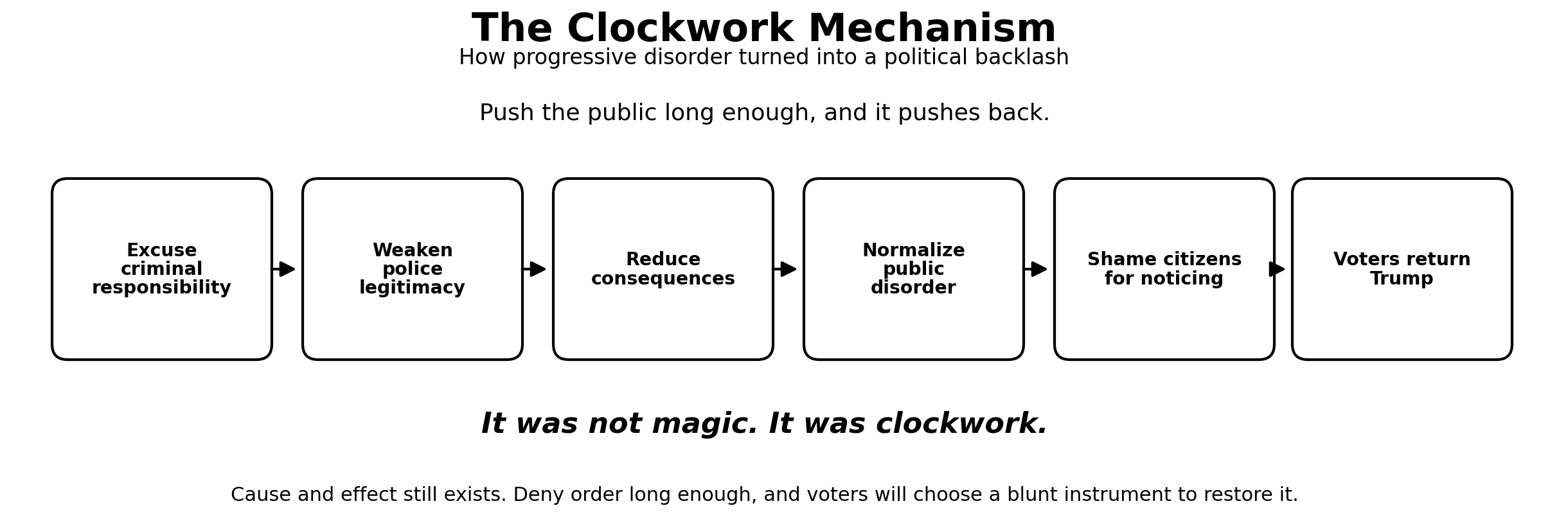
The public did not arrive at Trump by accident. It arrived there through repetition. A repeat offender released. A victim ignored. A prosecutor praised for compassion. A police department short-staffed. A business closed. A border overwhelmed. A school poisoned by drugs. A normal citizen called hateful for asking basic questions.
One incident could be dismissed. Two could be explained away. A decade of them became a pattern.
That is when politics becomes mechanical. Not because voters are machines, but because cause and effect still exists. Push people long enough and they push back. Deny reality long enough and reality finds a spokesman. Tell citizens they cannot choose order long enough, and eventually they choose the man most willing to say the forbidden words out loud.
The left did not create Donald Trump. That is too simple, and it gives them too much credit. They did not invent his personality, his instincts, his flaws, his movement, or his appeal. Democrats created the conditions in which millions of Americans concluded that Trump was the available instrument for choosing again.
That is the argument they fear most. If Trump is merely a monster, the story ends with Trump. If Trump is the consequence, the story begins with them.
It was not magic. It was clockwork.
The Land of the Free Chooses
There is nothing extreme about wanting a country to function.
A free country has the right to choose borders. It has the right to deport people who have no legal right to be there. It has the right to punish criminals. It has the right to defend police. It has the right to protect victims. It has the right to say that civilization is better than disorder.
That used to be common sense. Now it is treated as a dangerous ideology.
But common sense does not disappear because elites rename it. It waits. It watches. It gets mocked. It gets insulted. It gets told to shut up. Then one day it votes.
The left gave criminals excuses. It gave citizens lectures. It gave victims silence. It gave police suspicion. It gave borders contempt. It gave cities decay. It gave voters no acceptable way to choose order without being called monsters.
Then the country chose.
That was not fascism. That was not hysteria. That was not democracy dying. That was a free country remembering that it was still allowed to choose.
Freedom is not the absence of rules. That is anarchy. Freedom is the right of a people to choose the rules that protect civilization from anarchy.
In 2024, the American people decided they were tired of being the lab rats in someone else's utopia. They chose to become the authors again.
And a country that can still choose has not yet ceased to be the land of the free.
Help Keep This Work Free, Independent, and Unafraid
A country that cannot choose ceases to be the land of the free.
That is true in politics. It is also true in media.
For years, Americans were told to accept the narrative handed to them. Accept the crime. Accept the disorder. Accept the border collapse. Accept the lectures. Accept the excuses. Accept the lie that wanting civilization meant wanting tyranny.
I do not accept that.
That is why I write these essays. No corporate sponsor tells me what to say. No institution funds this work. No donor class edits the argument before you read it.
This publication exists because readers decide it should exist.
That means the choice is real.
Become a Paid Subscriber
If this essay gave language to something you have been seeing, feeling, or trying to explain, please become a paid subscriber today.
Paid subscriptions are what allow me to keep this work free for everyone else. I do not want to lock the truth behind a paywall. I want these arguments reaching the people who need them most, including the people who have never heard them stated this plainly before.
Your subscription helps fund the research, writing, data work, graphics, videos, and long-form essays that challenge the approved narrative before it hardens into public memory.
Subscribe here:
https://mrchr.is/help
Make a One-Time Gift
If a monthly or annual subscription is not the right fit, a one-time gift also helps keep this work moving.
Every contribution buys time. Time to research. Time to write. Time to produce the kind of arguments that do not come from cable news panels, political consultants, or recycled talking points.
Give here:
https://mrchr.is/give
Join The Resistance Core
For readers who understand what this project is becoming, The Resistance Core is the highest level of support.
This is for the people who do not merely want to read the work. They want to help build the platform behind it.
The goal is not just to publish essays. The goal is to break through the managed narrative, reach persuadable readers, challenge institutional lies, and build an independent body of work that cannot be ignored.
Join The Resistance Core here:
https://mrchr.is/resist
What Your Support Builds Right Now
Your support helps create more long-form investigations, more data-backed essays, more charts and visuals, more video breakdowns, and more arguments that can travel beyond the choir.
It also helps keep this publication independent.
That matters.
The same institutions that told Americans not to believe their own eyes are not going to fund the people telling them to open them.
If You Cannot Give
If you cannot become a paid subscriber right now, I understand. You can still help by sharing this essay, restacking it, leaving a comment, sending it to one person who needs to read it, or posting it somewhere outside the usual bubble.
The machine depends on silence, isolation, and repetition.
The answer is speech, courage, and distribution.
The point of this essay is not that Trump is perfect, or that every criticism of him is dishonest.
The point is simpler than that.
A country can only be lectured, shamed, ignored, and forced to live with the consequences of elite theory for so long before it chooses the bluntest instrument available.
Trump did not appear in a vacuum. He returned because millions of Americans were tired of being told that wanting borders, police, punishment, public order, and protection for victims made them dangerous.
Excellent post!!! One of your best ever ! So many great lines and all true. Love you brother !