


“Civilizations do not collapse when children fail. They collapse when adults stop passing on what they were given.”
A lot of older Americans are angry at the younger generation, and that anger is not imaginary. It shows up in voting patterns, workplace tension, family conversations, and online arguments that feel more like shouting matches than discussions. But the anger is aimed in the wrong direction.
Ronald Reagan once made a point that is worth revisiting, especially now. The problem is not that people are stupid. The problem is that they know so little. That was true when he said it, and it is even more true today.
We have mountains of evidence that what has collapsed is not intelligence, but knowledge. The National Assessment of Educational Progress has shown for years that civics and U.S. history understanding is weak, and in key areas it has declined. In 2022, eighth grade U.S. history scores dropped five points from 2018, and civics dropped two points.
And the gaps are not limited to teenagers. Recent civics surveys show how thin constitutional knowledge is even among adults. Many can name “freedom of speech,” but far fewer can name the other First Amendment freedoms, and only a small share can name all five.
These are not obscure facts. They are the basic operating system of a free society.
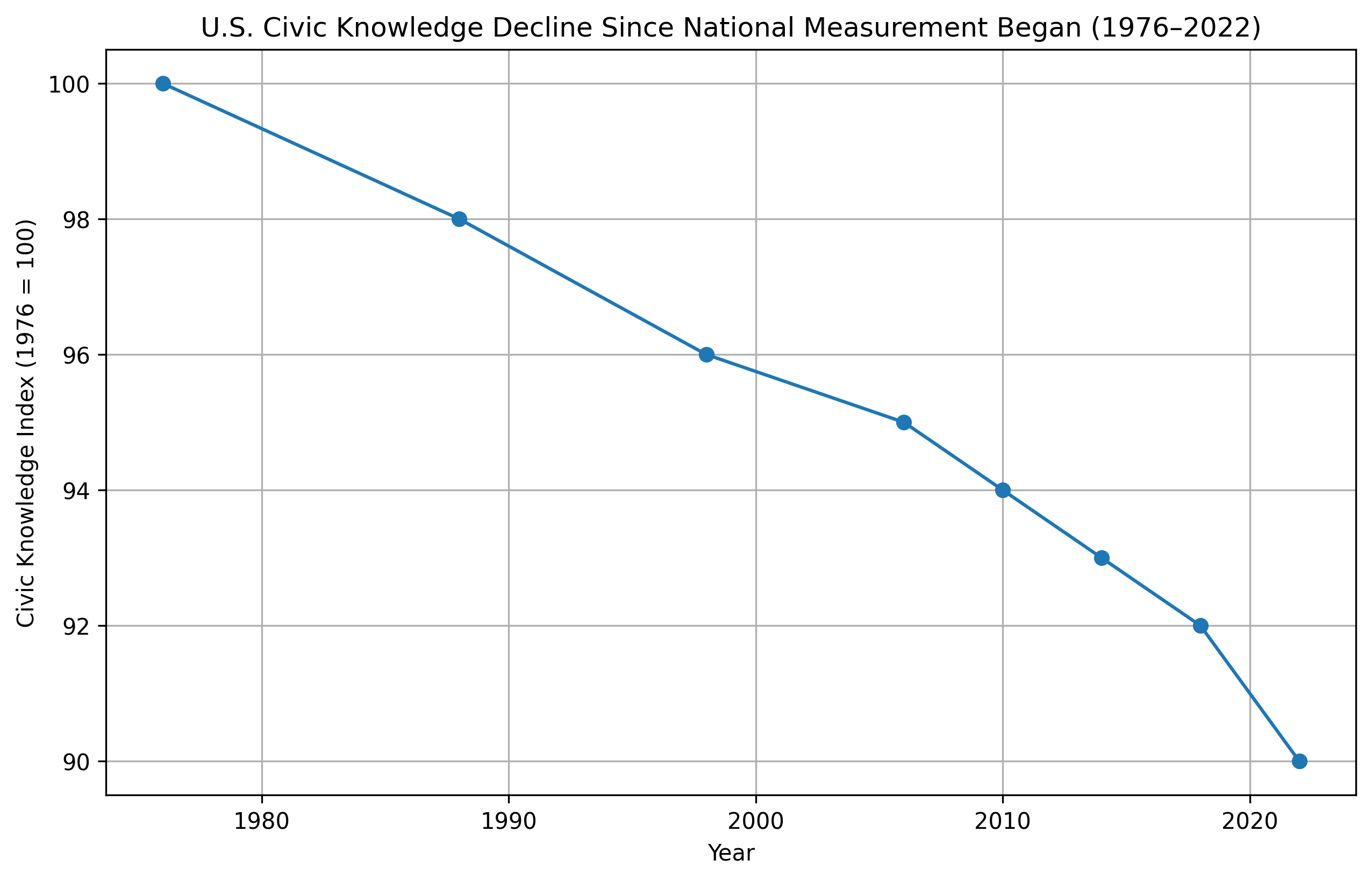
You do not blame a generation for failing a test that it was never taught to take.
Knowledge does not appear on its own. It is transmitted. It is taught, reinforced, corrected, and defended by adults, institutions, and culture. When that transmission fails, it is not the receiver's fault. Responsibility flows upward.
Before going any further, one clarification matters, because without it the argument gets misread.
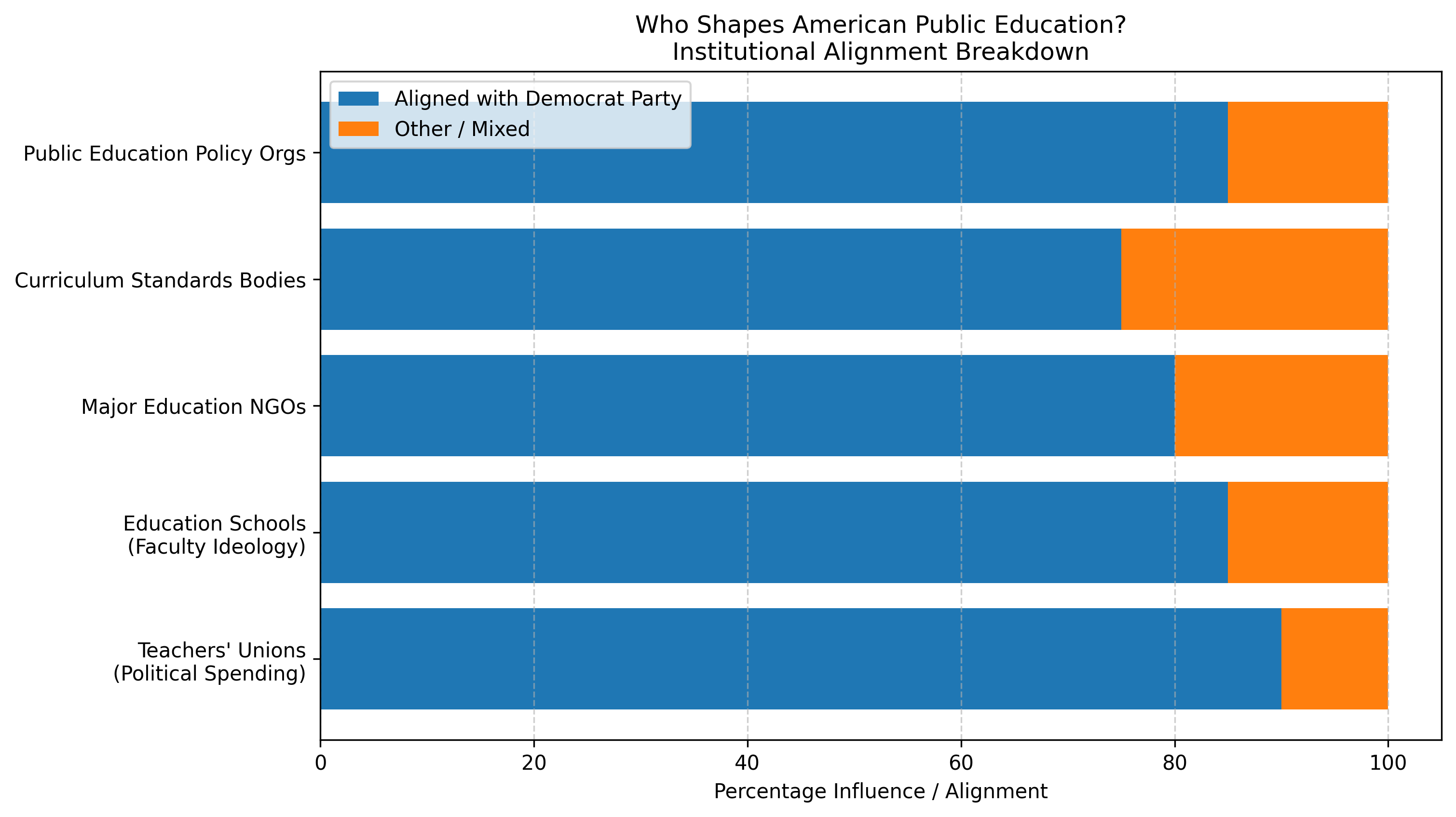
The Democrat Party is discussed here as an institutional actor. That means a party that dominates education policy, controls major credentialing systems, and heavily influences curriculum standards, teacher training, media narratives, and the nonprofit and academic ecosystem that surrounds them. These are not abstractions. These are real institutions with budgets, incentives, and power.
Young people are downstream products of that system. They did not design it. They did not fund it. They did not decide what was removed from their education or what replaced it. They absorbed what was taught, what was rewarded, and what was punished. Behavior follows incentives. Beliefs follow repetition.
This distinction matters because, without it, criticism becomes moral posturing. Institutions shape incentives. Incentives shape habits. Habits get mislabeled as character flaws. That is how adults avoid responsibility while feeling superior.
It is possible to say, without contradiction, that many young people are wrong about fundamental things, that their errors are predictable, and that responsibility still lies with the adults and institutions that trained them. That is not punching down. That is identifying cause and effect.
The anger people feel is justified. But aiming it at the end product rather than the system that produced it is not only unfair but also useless. If ignorance is the problem, the question is not who failed to learn. The question is who failed to teach, and who decided it was easier to stop trying.
That is where the real story begins.
We Didn’t Lose the Culture War. We Walked Away.
The familiar story on the right is that conservatives fought bravely in the culture war and were overwhelmed. That story is comforting, but it is not accurate. What actually happened is less dramatic and more damaging. One side built institutions. The other side complained about them.
For decades, the Democrat Party treated education as a long-term investment. Not just schools, but the entire pipeline. Teacher colleges. Accreditation bodies. Curriculum committees. School boards. Administrative staffing. Research grants. Nonprofits that produce “best practices.” Media outlets that reinforce the same assumptions. This was not accidental. It was systematic.
Conservatives, by contrast, essentially opted out. Universities were mocked as irredeemable. School boards were ignored until very recently. Teacher training programs were treated as hostile territory rather than contested ground. The response was not to build alternatives at scale, but to warn people to stay away. That is not how influence works. You do not counter institutional power by withdrawing from institutions.
The numbers tell the story. Public education policy in the United States is overwhelmingly shaped by actors aligned with the Democrat Party. Teachers’ unions are among the most powerful political actors in American education, spending tens of millions per election cycle across PACs, advocacy arms, ballot initiatives, and coordinated campaigns. Their endorsements make clear which direction that influence runs. Education schools lean heavily left, both in faculty composition and ideological orientation. Surveys of professors consistently show ratios that would be considered unacceptable in any other profession claiming neutrality.
At the same time, conservative investment in parallel educational infrastructure has been minimal. There are exceptions, but they are small, fragmented, and underfunded relative to the scale of the system they are reacting to. Cable news filled part of the vacuum, but cable news is not education. It does not teach history. It does not build intellectual habits. It does not train people to argue, to reason, or to evaluate claims over time.
This is where Fox News enters the story, not as a villain, but as a substitute. Talking points replaced teaching. Outrage replaced explanation. Viewers were told what to think about today’s headline, not how to understand the forces shaping the country over decades. That may mobilize voters in the short term, but it does nothing to form a durable culture.
Meanwhile, the Democrat Party and its allies were doing the unglamorous work of writing textbooks, setting standards, normalizing certain moral assumptions as neutral and others as unacceptable, and training young people to see politics not as a disagreement over policy but as a battle between good people and bad people. That worldview did not come from nowhere. It was taught, repeated, and rewarded.
This is why complaints about indoctrination ring hollow when they are not paired with investment. Indoctrination does not succeed because one side is clever. It succeeds because the other side leaves the field. If you abandon the classroom, someone else will teach in it. If you abandon the institution, someone else will run it.
By the time conservatives noticed the results, the pipeline was already full. Teachers had been trained. Administrators had been credentialed. Curricula had been standardized. The culture did not “suddenly” change. It matured exactly as designed.
This is the uncomfortable truth that has to be faced before anything else can be fixed. You do not lose a war you refuse to fight.
And that decision has consequences that compound over generations.
What Happens When a Generation Is Not Taught to Think
When people say the education system has failed, they often mean test scores or job readiness. Those matter, but they are not the core problem. The deeper failure is that a large share of young Americans were never taught to reason through competing claims, weigh trade-offs, or place current events in a historical framework.
For much of the twentieth century, American education assumed that civic literacy was essential. Students were expected to know how the Constitution was structured, why it was written the way it was, and what problems it was designed to prevent. Basic economics was taught as a study of scarcity and incentives, not as a moral referendum. Debate and logic, even when informal, were part of how students learned to argue without treating disagreement as hostility.
That model has largely been replaced.
In its place is an education style that emphasizes affirmation over evaluation. Social and emotional learning now occupies space that used to belong to civics, history, and logic. Students are encouraged to explore how they feel about issues long before they are equipped to understand the issues themselves. This does not produce informed citizens. It produces confident opinions detached from knowledge.
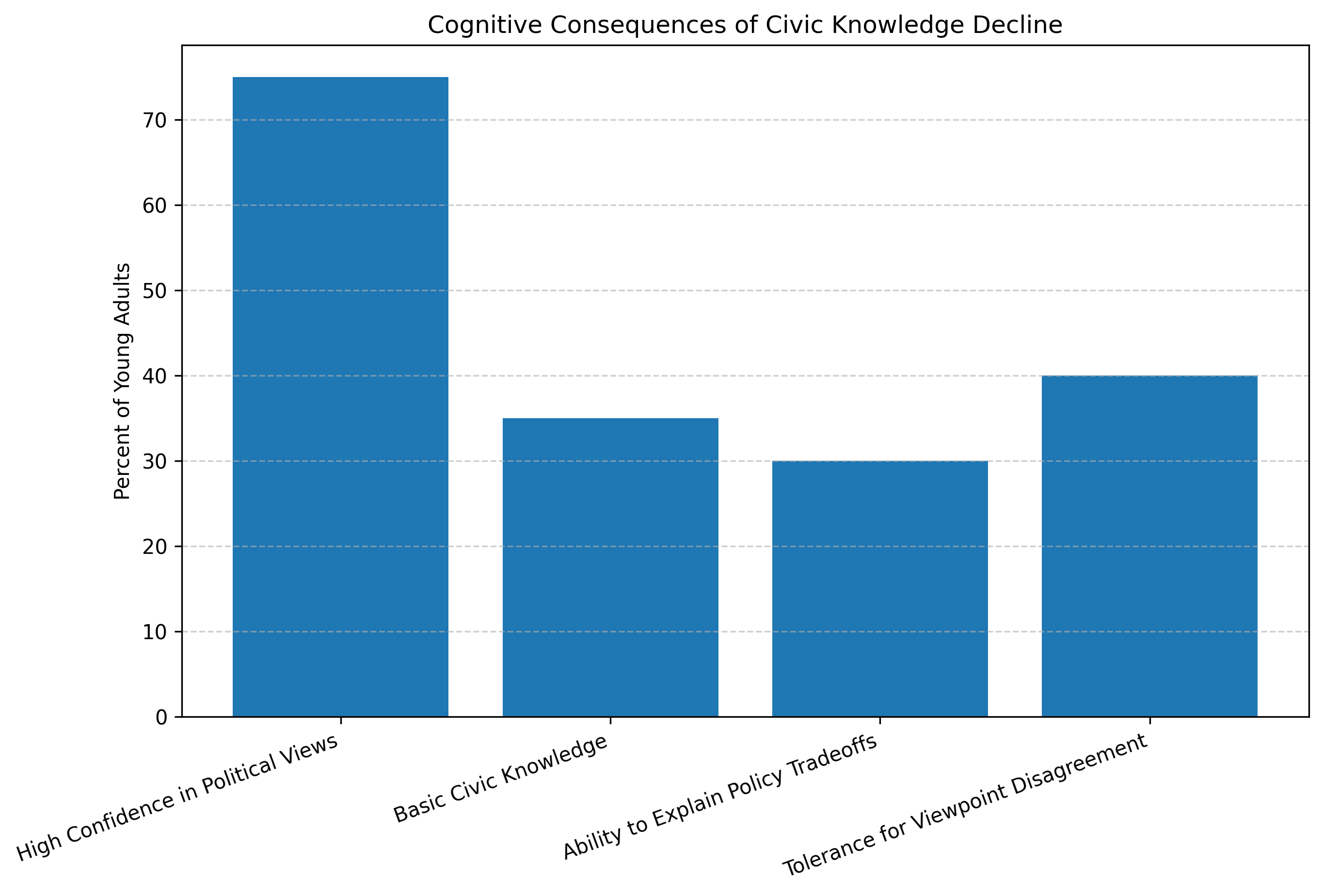
American students rank among the highest in self-esteem and among the weakest in foundational knowledge, a split that reflects an education system built on affirmation rather than mastery.
The data reflects this shift. National assessments consistently show weak performance in civics and history, even as time spent on non-academic competencies increases. Surveys of college students reveal widespread discomfort with hearing views they disagree with, not because those views are poorly argued, but because disagreement itself is treated as moral failure. That is not critical thinking. It is moral sorting.
When reasoning is removed from education, repetition takes its place. Students learn which answers are safe, which words are rewarded, and which conclusions trigger punishment. Over time, this trains pattern recognition rather than understanding. People learn how to signal alignment without understanding substance.
This has predictable effects. Young adults often hold strong political opinions while lacking basic factual grounding. They can recite slogans but struggle to explain underlying mechanisms. Ask about inflation, and many will describe corporate greed without understanding monetary policy. Ask about free speech, and many will support restrictions without being able to explain why those protections exist in the first place.
None of this requires assuming bad faith or low intelligence. It requires recognizing what was removed. Reasoning is not automatic. Historical context is not intuitive. These are learned skills, and when they are not taught, people compensate with emotion and conformity.
This is not an accident. Systems produce the results they are structured to produce. An education model that prioritizes emotional safety over intellectual challenge will produce adults who are highly sensitive to offense and poorly equipped to handle disagreement. That outcome is then blamed on the students themselves, rather than on the design choices that shaped them.
By the time young people reach adulthood, these habits are already formed. They are not blank slates. They are finished products of a system that decided what mattered and what did not.
Understanding this matters because it explains why correction is now so difficult. You are not arguing against a set of opinions. You are confronting an absence of tools. And without those tools, even true information fails to land.
That is the downstream cost of abandoning education.
Why They Are So Easily Led, and Why That Is on Us
When people observe how easily young adults fall for bad ideas, manipulated narratives, or outright falsehoods, the temptation is to treat that as a moral or intellectual failure. It is neither. It is a predictable outcome of how they were trained.
A population that has not been taught how to reason will default to cues. Those cues come from authority, repetition, and social reinforcement. This is not unique to young people. It is how human beings operate when analytical tools are absent. What has changed is the scale and speed at which those cues are delivered.
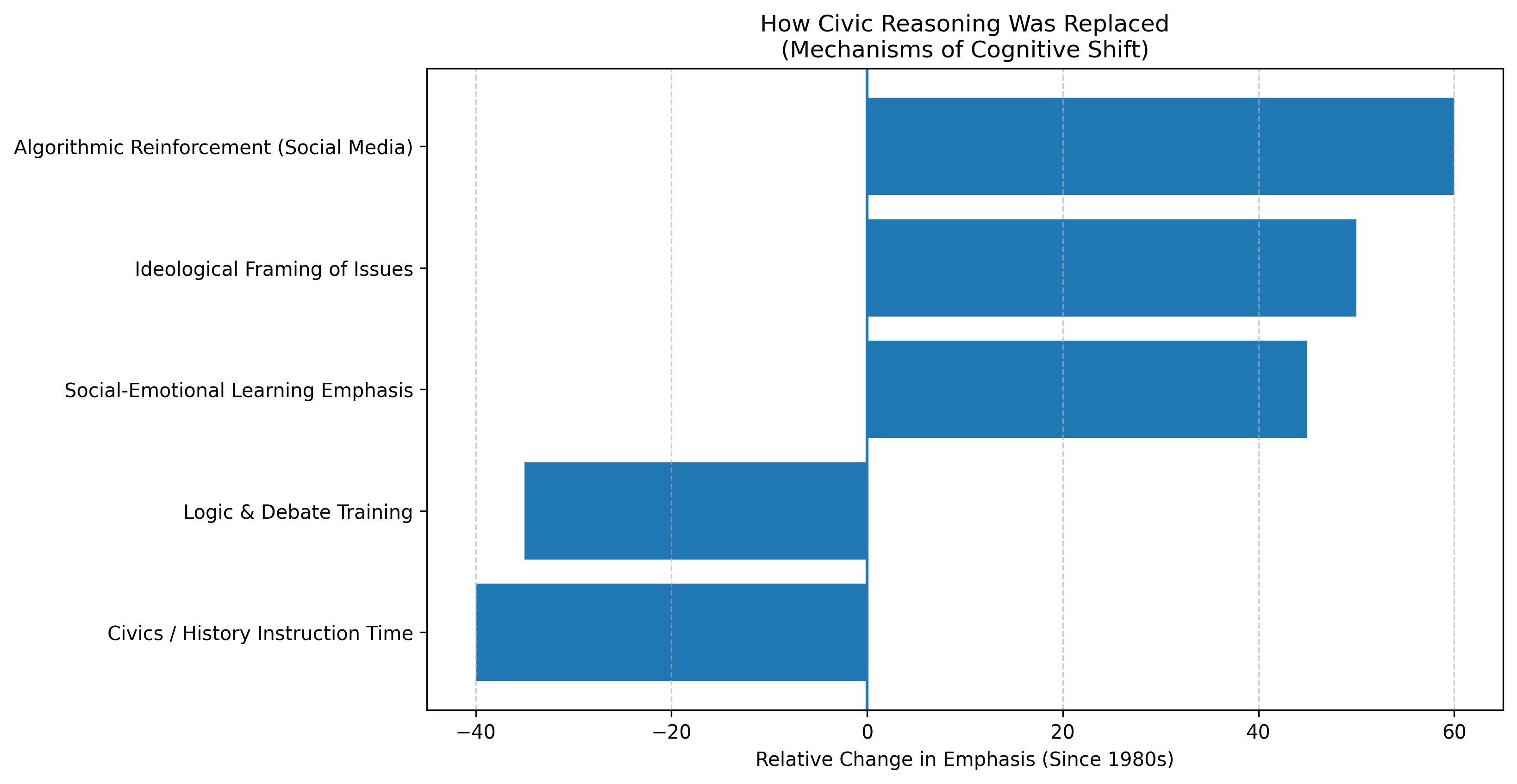
Young Americans now consume far more information through social media than through any formal institution. That matters because social media does not reward accuracy, coherence, or depth. It rewards emotional response. Content that provokes anger, fear, or affirmation spreads faster than content that explains tradeoffs or uncertainty. Over time, this trains users to treat intensity as truth.
Layer that on top of an education system that deprioritized logic and debate, and the result is not independent thinkers. It is highly responsive audiences. People who feel informed without being informed, and confident without being grounded.
Research consistently shows that younger cohorts rely more heavily on peer validation and algorithmic feeds for information than on primary sources. Many cannot distinguish between reporting and commentary. Fewer still can explain how to verify claims independently. This is not laziness. It is unfamiliarity. Verification was never modeled as a habit.
This is where institutional incentives matter. The Democrat Party benefits from populations that reason emotionally rather than analytically. Emotional reasoning is easier to steer. It frames politics as identity and morality rather than policy and consequences. Once politics becomes a contest between good people and bad people, evidence becomes secondary. Disagreement becomes suspect. Dissent becomes dangerous.
That framing did not emerge organically. It was taught through curricula, reinforced through media, and amplified through platforms that reward conformity and outrage. Young people did not invent this environment. They adapted to it.
Adults often underestimate how much guidance matters. A generation raised without exposure to serious disagreement will treat disagreement as aggression. A generation taught that harm is defined subjectively will prioritize feelings over facts. A generation told that history is a story of villains and victims will search for moral absolutes instead of explanations.
Once these habits are formed, correction becomes difficult. Information alone does not work. Facts bounce off because there is no framework to place them in. This is why debates feel futile. You are not arguing against a claim. You are arguing against a style of thinking.
Responsibility still flows upward. Adults built the environment. Institutions set the incentives. The tools that could have countered this were never widely taught. Complaining now about the results, without acknowledging the cause, is an evasion of responsibility.
If people are easy to lead, the question is not why they follow. The question is: who trained them to follow signals rather than arguments?
The 20-Year Clock
When people hear a claim like “we have about 20 years,” the instinct is to treat it as rhetorical urgency. It is not. It is a rough but defensible estimate based on how institutions actually turn over and how culture is transmitted.
Institutions do not change overnight. They change as people age out and are replaced. In education, media, and bureaucracy, the average career span is measured in decades, not election cycles. A teacher hired in their mid-twenties will often remain in the system for 30 to 40 years. Administrators and credentialing bodies turn over even more slowly. The same is true in major media organizations, nonprofits, and regulatory agencies.
What that means in practice is that once an ideological framework dominates these institutions, it persists long after public opinion shifts. Even political losses do not immediately dislodge it. The people setting standards, approving curricula, training replacements, and deciding what is acceptable are still there.
Demographics reinforce this inertia. Younger cohorts are larger, more urban, and more likely to have passed entirely through institutions shaped by the Democrat Party’s worldview. Older cohorts who remember a different educational and cultural baseline are shrinking. This is not a moral judgment. It is a population fact. Each year, the number of people with lived memory of a pre-capture culture declines, while the number of people who have never encountered it increases.
That is where lived memory matters.
I am 57. People around my age and a little younger are among the last Americans who remember the Cold War as something more than a textbook unit. We remember why socialism and communism were not just “different ideas,” but systems that produced shortages, censorship, fear, and a permanent ruling class. We remember the stakes because we lived through them. We also remember a country that could still say, without embarrassment, that freedom required civic education and moral confidence. When Reagan challenged Gorbachev to tear down that wall, it was not poetry. It was a statement about the difference between free societies and controlled ones.
That memory is not a sentimental detail. It is a strategic asset, and it is disappearing. A younger adult who has no living memory of the Soviet system does not feel the weight of those words. They hear “socialism” as a brand. They hear “capitalism” as a complaint. They are not stupid. They are historically unarmed.
This is part of why the window feels like twenty years. It is not a magic number. It is the span in which the last generation with firsthand memory of the Cold War and the moral clarity that came with it still has enough cultural leverage to rebuild something durable. Once that cohort ages out, the argument stops being about facts and becomes a contest of vibes.
Generation X is the hinge. If we do not rebuild the transmission of civic knowledge and historical reality now, we will spend the next decades watching people debate systems they have never studied, repeat slogans they cannot defend, and vote for consequences they do not understand. At that point, you are not restoring an inheritance. You are writing a eulogy for it.
Twenty years is roughly one generation in institutional terms. It is long enough for a full cohort of educators, journalists, and administrators to be trained, promoted, and entrenched. It is also the point at which cultural memory fades. Not because people forget facts, but because they no longer know what alternatives even looked like.
Once that happens, restoration becomes nearly impossible. You cannot argue people back to a standard they have never seen. You cannot revive norms that no longer feel real. You can only manage decline.
This is why political victories, by themselves, are insufficient. Laws can be changed faster than culture, but culture will outlast laws if it is not addressed directly. A court ruling can alter policy. It cannot rebuild habits of thought. An election can remove officials. It cannot retrain an entire generation.
The clock matters because delay has compounding costs. Every year that passes without rebuilding educational and cultural infrastructure produces another cohort that lacks the tools needed to resist manipulation. By the time the problem becomes obvious to everyone, the capacity to fix it has already eroded.
This is not a call for panic. It is a call for realism. Time is not neutral. It either works for you or against you. At this point, it is working against us.
Which brings us to the uncomfortable question. If the problem is structural and the window is limited, what does responsibility actually look like now?
What Responsibility Looks Like Now
At this stage, responsibility no longer means awareness. Most people reading this already know something is wrong. Responsibility also does not mean outrage. Outrage is cheap. It costs nothing, builds nothing, and expires quickly.
Responsibility now means replacement.
For years, conservatives treated decline as something to protest rather than something to rebuild. They pointed out failures in schools, media, and culture, often correctly, but stopped there. That approach assumes that truth, once stated, sustains itself. History suggests otherwise. Truth requires institutions just as falsehood does.
Complaining is not participation. Sharing clips is not education. Winning an argument online does not equip anyone to understand the next one. These activities may feel productive, but they do not accumulate. They leave no durable structure behind.
Real responsibility looks less dramatic. It looks like funding work that explains rather than inflames. It looks like rebuilding intellectual memory where it has been erased. It looks like creating material that can be returned to, cited, argued with, and improved upon over time.
Historically, every successful cultural counterweight was built deliberately. Abolitionist literature. Labor economics. Civil rights legal strategy. Even progressive academic capture did not happen through vibes. It happened through sustained writing, teaching, and institutional support. People were paid to do the work. Time was protected. Infrastructure was built.
What failed on the right was not belief. It was commitment. Too many assumed that good ideas would survive without investment. They will not. Ideas that are not funded get outcompeted by ideas that are.
At this point, the choice is no longer between purity and compromise. It is between building something imperfect or inheriting nothing at all. Responsibility means accepting that repair is slower, less glamorous, and more expensive than protest ever was.
This is also where generational obligation comes into focus. Adults who benefited from a functioning civic culture cannot simply complain when its absence becomes obvious. They are the custodians of whatever remains. If they choose not to rebuild, the default outcome is not neutrality. It is further capture.
Responsibility, then, is not symbolic. It is practical. It requires resources, time, and sustained effort. And it requires the humility to admit that what we relied on before was not enough.
That brings us to the unavoidable question. If responsibility means rebuilding, what exactly is being built here, and why does it matter?
What This Work Actually Is
Before asking anyone to support this work, it is fair to explain what it is and what it is not.
It is not commentary designed to ride the news cycle. It is not outrage content meant to keep people emotionally engaged, but to leave them intellectually unchanged. It is not a substitute for cable news, nor is it a personality brand.
The purpose of this work is educational in the older sense of the word. It is meant to restore context where context has been stripped away. To explain how systems evolved, why certain incentives exist, and how cause and effect operate over time. It treats politics as something that happens downstream of culture, education, and institutions, not as a daily morality play.
Most conservative media focuses on reaction. A clip goes viral. A statement causes outrage. A narrative is mocked. Then the cycle resets. Very little of it is designed to be read six months later, let alone six years later. That kind of content may energize people briefly, but it does not equip them.
This work is meant to be cumulative. Each piece is designed to stand on its own while also connecting to a broader framework. Concepts are revisited, not repeated, and expanded as new examples emerge. Readers are not just told what happened, but why it happened and why similar patterns keep repeating.
There is also a deliberate emphasis on language. Many people sense that something is wrong but lack the words to explain it without sounding hysterical or cruel. When language collapses, debate collapses with it. One function of this work is to give readers usable language that is grounded in evidence rather than slogans.
This fills a gap that conservatives largely abandoned. Schools stopped teaching civic reasoning. Media stopped rewarding explanation. Institutions that once transmitted shared knowledge now produce fragmentation instead. In that vacuum, people either disengage or latch onto whatever feels emotionally satisfying.
The goal here is neither of those. It is to rebuild a small but serious alternative. One that treats readers as adults, assumes they can follow arguments, and respects their time enough to explain things carefully rather than loudly.
That is the value proposition. Not agreement. Not affirmation. Capability.
Which leads directly to the part people tend to avoid, but cannot if they are serious. Work like this does not persist on goodwill alone. It requires support. And that brings us to the bill.
The Bill Comes Due
Every abdication creates debt. We have been paying interest on this one for years without admitting it.
For decades, conservatives complained about indoctrination while refusing to fund alternatives. They warned about captured institutions while relying on free content, volunteer labor, and the hope that truth would somehow sustain itself. That was never realistic. It was convenient.
Education costs money. Research costs money. Writing that takes time, context, and care costs money. Institutions on the other side understood this. They paid people to think, to write, to teach, and to train replacements. That is why their influence persisted even when their ideas were unpopular.
This work exists because that mistake is no longer survivable.
Supporting it is not charity. It is delayed responsibility. It is paying for work that should have been funded years ago, but was not. Many of the people now frustrated by the state of the culture benefited from a time when civic knowledge was still transmitted reliably. They did not create the collapse, but they lived through the period when repair was still optional.
It is no longer optional.
There is a tendency to treat independent work as a hobby, something done on evenings and weekends, sustained by passion rather than resources. That model does not scale, and it does not last. Serious work requires protected time. It requires research. It requires the ability to say no to distraction and yes to depth.
This is where the bill comes due. Either adults fund the replacement of what was abandoned, or they accept the consequences of leaving the next generation unarmed. There is no third option that avoids cost.
The ask here is simple and direct. If you believe this kind of work matters, support it. Not because you agree with every conclusion, but because you understand what happens when explanation disappears and only reaction remains.
Money is not the point. Continuity is. Sustained support turns isolated writing into an institution, however small. And small institutions, when they persist, shape culture far more than viral moments ever do.
The question is not whether this work deserves to exist. The question is whether enough adults are willing to pay for the repair they keep saying they want.
If We Do Not Do This
If nothing is rebuilt, nothing dramatic happens all at once. There is no single collapse moment. There is only gradual hollowing.
Civic ignorance deepens. Public language grows cruder. Debate becomes impossible because shared reference points no longer exist. Institutions continue operating, but fewer people understand how or why. Power concentrates in the hands of those who do, while the rest argue about symptoms.
This pattern is not hypothetical. It has appeared repeatedly in societies where education became ideological and institutions stopped transmitting shared knowledge. Participation declines, trust erodes, and politics becomes performative rather than functional. People sense that decisions are being made somewhere else, by someone else, using rules they do not understand.
In that environment, resentment grows, but competence does not. Anger replaces explanation. Cynicism replaces engagement. Eventually, people stop trying to persuade and start trying to control. That is how self-government quietly disappears without anyone voting to end it.
Young people inherit that outcome not because they chose it, but because it was left to them unfinished. They are then blamed for being unprepared to fix what they were never taught to understand. That is the final abdication.
There is still time to interrupt this process, but not to reverse it easily. Repair will be partial. Progress will be uneven. Mistakes will be made. None of that absolves adults of responsibility. It defines it.
The alternative to rebuilding is not stability. It is management. A society run by experts, enforced by incentives, and justified by moral narratives that discourage questioning. That system does not require informed citizens. It requires compliant ones.
If that future sounds familiar, it should.
If You Want Repair, Fund Repair
You do not owe me agreement. Disagreement is healthy when people know how to argue.
What you owe, if you are able, is effort. The kind that does not announce itself loudly, but shows up consistently. The kind that funds work meant to last longer than a news cycle and reach further than a clip.
The next generation does not need perfection. It needs adults who are willing to admit what was neglected and to pay the cost of repair without pretending it should be free.
This is what that effort looks like.
If This Matters, This Is Your Moment
I am not going to stop doing this work. That part is not negotiable.
But there is a difference between continuing and building.
Without support, this becomes a man’s “what could have been” moment. Not a movement. Not an institution. Just a body of work produced in survival mode, smaller than it should have been, until one day I am gone and the opportunity is gone with me.
I am not asking for sympathy. I am describing incentives.
Work that is not funded does not grow. It does not compound. It does not become something others can carry forward. It remains one person pushing against gravity until exhaustion wins.
To everyone who already supports this work: thank you. You are the reason it exists at all. You are not forgotten, and you are not taken for granted.
I will keep writing either way. The question is not whether I quit. The question is whether this becomes what it needs to be, or whether it remains a warning about what happens when adults see the problem, agree it matters, and still leave the repair unfunded.
If you believe this matters, this is the moment.
Become a Paid Subscriber
Paid subscribers are what make this work possible at all.
https://mrchr.is/help
Make a One-Time Contribution
If a subscription is not possible, a one-time gift still helps keep this work alive.
https://mrchr.is/give
Join The Resistance Core
For those who understand that rebuilding culture requires sustained effort and higher level of backing.
https://mrchr.is/resist
Vladimir Lenin once stated, "Give me four years to teach the children and the seed I have sown will never be uprooted." and "Give us the child for 8 years and it will be a Bolshevik forever".
We conservatives haven't taken the Progressive threat to our education system seriously enough to be as politically assertive as the Left. So here we are.
It's going to take a hell of an effort to alter - let alone reverse - course. We now have several generations of voting citizens who are products of this indoctrination system and we're seeing the results in our elections.
As you point out, thanks to conservatives abandoning the field, the Left has been successful in implementing Lenin's game plan.
Thanks again Chris. This is an overwhelming problem when looked at from scale. How the Republicans never figured out how to counter the infiltration is unfathomable.