

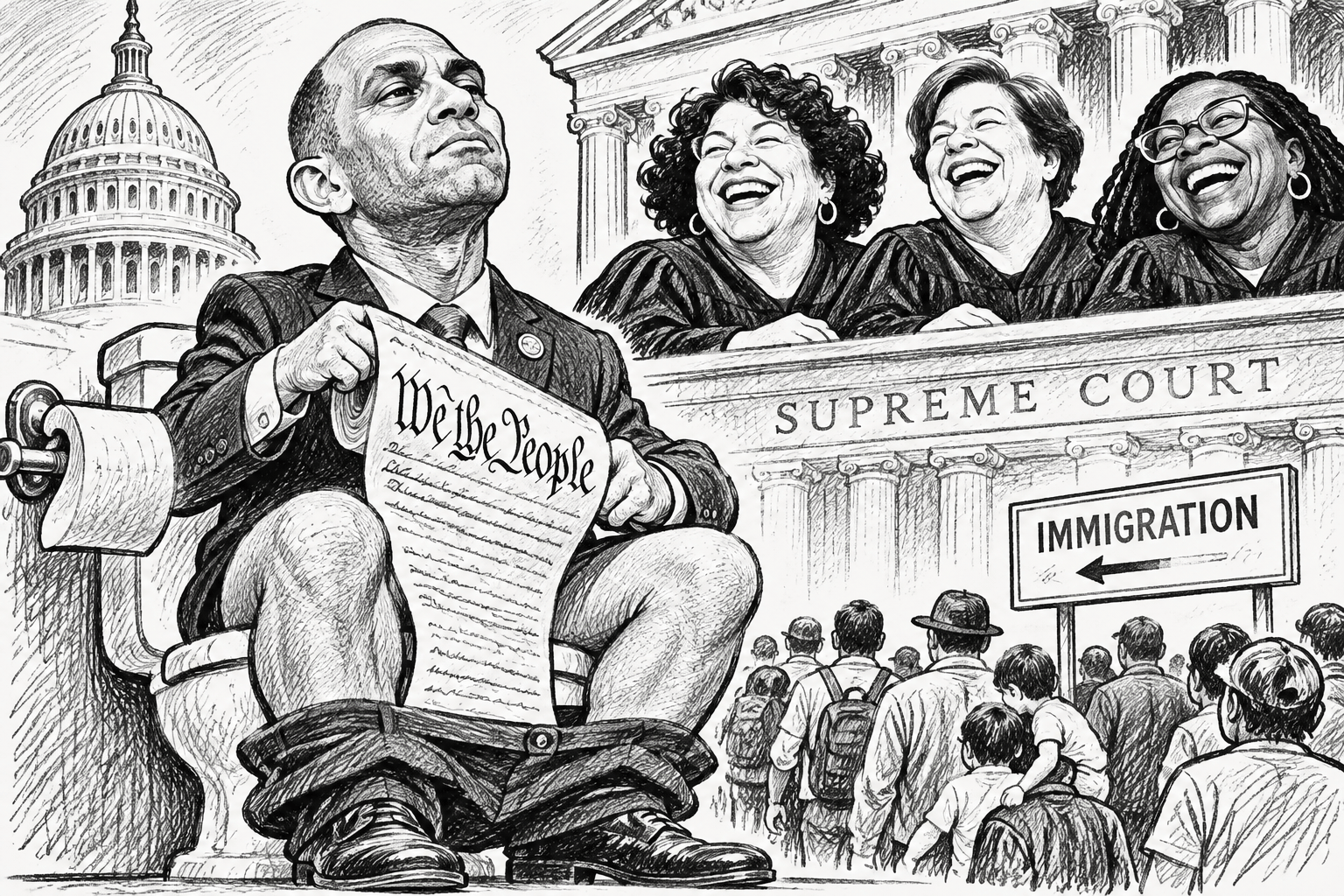
How did a government built on limited, enumerated powers come to exercise such sweeping authority over immigration when the Constitution never explicitly granted it that power?
In June 1887, a Chinese laborer named Chae Chan Ping left San Francisco for China. He had lived in America for approximately twelve years, worked here legally, and carried a certificate issued by the United States government authorizing his return. He had complied with the law and had every reason to believe he could come home.
When his ship arrived in San Francisco on October 8, 1888, things had changed. Seven days earlier, Congress had passed legislation invalidating the return certificates of Chinese laborers who had left the country. Chae’s government-issued document was now worthless, and he was denied permission to land.
He challenged the government’s decision, eventually taking his case to the Supreme Court. On May 13, 1889, all eight participating justices ruled against him. Congress could exclude him, regardless of what the government had previously authorized.
That ruling, Chae Chan Ping v. United States, became one of the foundations of modern federal immigration authority. The Court recognized an exceptionally broad congressional power to exclude foreigners, relying heavily on national sovereignty rather than an express constitutional provision granting Congress general authority over immigration. The case concerned keeping a man out of America, yet the authority it helped establish would eventually support a federal immigration system in which Congress determines the conditions under which millions of foreigners may enter, work, reside, and eventually become citizens.
Today, Congress controls the legal framework governing immigration, while its decisions influence America’s population, housing markets, labor force, schools, healthcare systems, and government finances. States and municipalities must deal with many of the consequences, even though they have little control over federal admissions policy. We argue endlessly about whether Congress should admit more immigrants, fewer immigrants, or different immigrants. But how many Americans have ever questioned where Congress obtained such sweeping authority in the first place?
What the Constitution Actually Says
Article I, Section 8 of the Constitution identifies the powers Congress may exercise. It can levy taxes, borrow money, regulate commerce, establish post offices, declare war, raise armies, and perform numerous other functions specifically assigned to it.
The Framers devoted considerable attention to these powers because they were creating a government whose authority would be limited by a written Constitution. Congress wasn’t supposed to exercise general legislative authority over whatever subjects lawmakers considered important. Its powers were delegated, with the remaining powers reserved to the states or the people. Yet nowhere does the Constitution expressly grant Congress a general power over immigration.
The provision most frequently associated with that authority appears in Article I, Section 8, Clause 4, which authorizes Congress:
“To establish an uniform Rule of Naturalization.”
Naturalization is the process through which a foreign national becomes an American citizen. Immigration concerns entering or residing in the country. The distinction is straightforward, but it has considerable constitutional implications. A foreigner can enter America, live here for years, and never become a citizen. Establishing the qualifications for citizenship does not, by its wording alone, expressly authorize Congress to determine how many foreigners may enter the country, where they may come from, or under what circumstances they may remain.
Congress also possesses the authority to regulate commerce with foreign nations, a provision the Supreme Court eventually interpreted as encompassing immigration regulation. For much of American history, immigrants arrived aboard commercial vessels transporting paying passengers between foreign countries and American ports. Regulating those vessels and their passengers falls naturally within Congress’s foreign commerce authority.
But regulating transportation and exercising comprehensive authority over immigration are not necessarily the same responsibility. The constitutional basis for regulating foreign commerce does not, without further reasoning, answer every question about admitting, excluding, or deporting people.
The Necessary and Proper Clause provides another foundation. It allows Congress to enact laws needed to carry out its constitutionally delegated responsibilities, including powers not individually enumerated. The limitation is that those powers must remain connected to legitimate constitutional responsibilities. Otherwise, Congress could transform a limited delegation into something resembling general authority simply by declaring its legislation necessary.
Article I, Section 9 also restricted Congress from prohibiting the “Migration or Importation” of certain persons before 1808. That provision arose principally from the constitutional compromise concerning the international slave trade. It was hardly a comprehensive grant of immigration authority.
The constitutional text supplies several possible foundations for federal immigration regulation, but no express delegation of a general immigration power. That omission does not settle the constitutional issue by itself. The Framers anticipated that the federal government would exercise legitimate implied powers. The question is whether the sweeping authority Congress now possesses can be justified through those powers and where their constitutional limits lie. For much of America’s early history, the answers were far less settled than they are today.
Who Controlled Immigration Originally?
Shortly after the federal government began operating, Congress passed the Naturalization Act of 1790. The legislation established qualifications for citizenship, including residency, good moral character, and allegiance to the United States. Eligibility was restricted to free white persons, reflecting the racial limitations of the period. Congress promptly exercised its expressly enumerated naturalization power, but it did not establish a comparable nationwide system regulating how many foreigners could enter America.
For much of the nation’s first century, states played substantial roles in regulating arriving immigrants, particularly when questions involved public health, safety, poverty, and the possibility that newcomers would require public assistance. New York, Massachusetts, and other states enacted laws requiring shipping companies to provide information about arriving passengers. Some imposed fees or required financial guarantees intended to protect local taxpayers against the expense of supporting immigrants unable to support themselves.
The reasoning wasn’t complicated. Immigrants arrived in particular communities, and those communities could become responsible for their welfare. Local officials wanted some protection against expenses they might be expected to pay.
In 1798, President John Adams signed the Alien Friends Act, allowing the president to order certain foreigners considered dangerous to leave the United States. The legislation gave the executive branch extraordinary discretion over noncitizens residing in America. Thomas Jefferson and James Madison opposed the law on constitutional grounds. In the Kentucky and Virginia Resolutions of 1798 and Madison’s subsequent Report of 1800, they challenged the federal government’s assumption of powers they believed had not been delegated by the Constitution.
Madison, who had played a central role in drafting the Constitution, specifically questioned Congress’s authority to remove foreigners under the sweeping provisions of the Alien Friends Act. The dispute concerned whether Washington could claim powers not assigned to it simply because federal officials considered those powers necessary.
The Alien Friends Act expired in 1800 without the Supreme Court resolving its constitutionality. The federal government’s power over foreigners remained disputed, with states continuing to exercise substantial authority over matters involving arriving immigrants.
In 1837, the Supreme Court decided Mayor of New York v. Miln. The case involved a New York law requiring shipmasters to report information about arriving passengers. The Court upheld the requirement as an exercise of the state’s authority to protect the welfare of its residents. At that point, the justices recognized that states had legitimate responsibilities involving newcomers, especially when local communities could be required to support people unable to provide for themselves.
By the end of the nineteenth century, immigration regulation had moved from an arrangement involving significant state authority to one dominated by Washington. The change came through judicial decisions interpreting powers already contained in the Constitution, rather than through an amendment expressly transferring comprehensive immigration authority to Congress.
How the Supreme Court Established Broad Federal Immigration Authority
In 1849, the Supreme Court decided the Passenger Cases, striking down taxes imposed by New York and Massachusetts on foreign passengers arriving by ship. The decision was five to four, but although five justices agreed that the state taxes were unconstitutional, they didn’t agree on a single constitutional explanation. Some relied on Congress’s authority over foreign commerce. Others emphasized taxation, naturalization, constitutional provisions concerning migration, or national sovereignty.
The majority had determined that the states could not impose those particular taxes. The precise constitutional foundation for the competing federal authority remained less certain.
In Henderson v. Mayor of New York, decided in 1876, the Court reached a more unified conclusion. New York required shipping companies to post bonds or pay fees intended to protect local governments against expenses associated with arriving immigrants. The Supreme Court unanimously invalidated those requirements, holding that the transportation of passengers from foreign countries constituted foreign commerce and fell within Congress’s exclusive regulatory authority.
The Court reinforced that interpretation in the Head Money Cases of 1884. Congress had required shipowners to pay fifty cents for every foreign passenger brought into an American port. Shipping companies challenged the federal fee, but the justices upheld it as a valid regulation of foreign commerce. By 1884, Congress’s authority over significant aspects of immigration regulation was established under an enumerated constitutional power.
Five years later, the Court adopted broader reasoning in Chae Chan Ping v. United States. Justice Stephen Field wrote the unanimous opinion upholding Congress’s decision to prevent Chinese laborers from returning to America, even when earlier federal law had authorized their return. The legislation was part of a discriminatory exclusion system directed at Chinese laborers, but its constitutional significance extended far beyond the particular group Congress targeted.
Field described the power to exclude foreigners as an incident of national sovereignty. His reasoning began with the proposition that the United States, as an independent nation, must possess the authority necessary to protect its territory, security, and foreign relations. Among those responsibilities was deciding which foreigners could enter the country.
Field referred to several constitutional powers supporting national sovereignty, including foreign commerce, treaties, war, and naturalization. He concluded that the exclusion of foreigners belonged among the sovereign powers delegated to the federal government.
The practical argument is understandable. A country unable to control entry across its borders would struggle to protect its territory or conduct coherent foreign relations. Fifty states establishing conflicting immigration policies could create enormous problems for a nation expected to speak with one voice internationally. But the American constitutional system presents a problem that the general concept of sovereignty cannot resolve by itself.
The United States is a sovereign nation. Congress is a legislative body whose powers are limited by a written Constitution. Those two propositions are perfectly compatible, provided the powers exercised by Congress can be traced to the Constitution’s delegation of authority.
The difficulty begins when the concept of sovereignty is used not merely to identify a national responsibility, but to justify exceptionally broad congressional discretion over that responsibility. Foreign commerce supplies an identifiable constitutional foundation for regulating the arrival of passengers. Foreign affairs and national security provide additional reasons for federal rather than state control.
Those arguments help explain why immigration is a national responsibility. They do not automatically establish that every congressional judgment about immigration deserves extraordinary judicial deference. That was the additional step taken by the Court in 1889.
The justices treated exclusion as a sovereign responsibility vested in the national government and concluded that Congress’s judgment in exercising that responsibility warranted exceptionally limited judicial interference. This was more than deciding which level of government should regulate immigration. It concerned how much freedom Congress would possess once that authority was recognized.
For Chae Chan Ping, the consequences were immediate. Congress could cancel the legal authority under which he had expected to return, and the Court would not prevent it. The case became central to the development of the plenary power doctrine, which recognizes exceptionally broad congressional authority over immigration.
Plenary means full or comprehensive. In immigration law, the doctrine has traditionally allowed Congress substantial freedom to determine who may enter the country and under what conditions, although courts have also recognized constitutional protections and limits in particular circumstances.
In Nishimura Ekiu v. United States (1892), the Supreme Court reinforced federal authority over admission decisions and the limited judicial review available in certain circumstances. Then, in 1893, the Court decided Fong Yue Ting v. United States, extending the sovereignty-based reasoning to the deportation of Chinese residents who had failed to satisfy federal registration requirements.
The decision was six to three, and one of the dissenters was Justice Stephen Field, the very man who had written the 1889 opinion recognizing Congress’s broad power of exclusion. Field defended the government’s authority to prevent foreigners from entering the country, but argued that removing people who had lawfully established their residence in America presented a different constitutional question.
Residents were subject to American law and entitled to its protections. Field believed Congress could not extend the reasoning governing exclusion to their expulsion without confronting those protections. His colleagues disagreed, and the majority upheld the deportation provisions.
Within four years, the justice responsible for one of the doctrine’s foundational opinions believed the Court had extended federal immigration authority too far. Field’s objection exposes a weakness in treating immigration authority as a single, virtually unlimited power. Controlling the admission of foreigners, removing established residents, and determining the legal protections available to those residents involve different governmental actions and potentially different constitutional restraints.
The Supreme Court nevertheless continued recognizing broad federal immigration authority, relying on foreign commerce, national sovereignty, and other constitutional powers. The most consequential development was not simply the recognition that immigration required national regulation. It was the degree of judicial deference attached to Congress’s exercise of that authority.
National sovereignty can explain why the United States must control its borders. It does not, by itself, explain why Congress should receive nearly unlimited discretion in exercising that control. The Court moved from identifying federal authority to recognizing a degree of legislative freedom whose limits were considerably harder to define. Even the justices involved in developing the doctrine disagreed about those limits.
From Exclusion to Admission
Congress initially used much of its developing immigration authority to establish restrictions. The Page Act of 1875 excluded certain categories of foreigners. The Chinese Exclusion Act of 1882 barred most Chinese labor immigration. Additional laws restricted admission based on circumstances involving disease, criminality, and the likelihood of becoming a public charge.
Many early policies reflected racial prejudices that were later rejected. They also helped create the federal administrative machinery through which Congress would exercise immigration control. By 1921, Congress had established numerical immigration quotas, and the Immigration Act of 1924 introduced a restrictive national-origins quota system, sharply limiting immigration from many countries.
The Immigration and Nationality Act of 1952 reorganized federal law while retaining much of that structure. In 1965, Congress took a different direction when President Lyndon Johnson signed legislation eliminating the national-origins quota system and establishing preferences emphasizing family relationships and employment qualifications.
Certain immediate relatives of American citizens were exempted from annual numerical limitations. Other categories remained subject to quotas, but the new system significantly changed how immigrants were selected.
The Refugee Act of 1980 established the modern framework governing refugee admissions. The Immigration Reform and Control Act of 1986 granted legalization opportunities to certain undocumented residents while creating penalties for employers who knowingly hired unauthorized workers. In 1990, Congress expanded opportunities for legal immigration and reorganized admission categories.
Presidents from both parties signed these measures. The changes reflected legislative decisions about America’s economic interests, humanitarian commitments, labor needs, and immigration priorities. None required an amendment expressly granting Congress additional immigration powers because the Supreme Court had already recognized broad federal authority over the subject.
Congress could use that authority to restrict admissions, expand them, create new categories, establish exceptions, and delegate certain responsibilities to the executive branch.
Today, the Immigration and Nationality Act contains a complex system of numerical limits, family preferences, employment categories, temporary visas, refugee admissions, asylum provisions, and other immigration rules. Some categories are capped annually, while others are exempt from those caps. Congress determines much of the legal framework, while the executive branch administers the law and exercises the discretion Congress has provided.
The result is an immigration system whose complexity would probably astonish the lawmakers and judges who helped establish federal authority over arriving foreign passengers in the nineteenth century. Supreme Court decisions concerning passenger transportation and the exclusion of foreigners helped establish the federal authority Congress subsequently used to create an elaborate system of admissions.
The power to regulate immigration does not establish how much immigration America needs or should accept. Congress makes those judgments through legislation. The Supreme Court’s recognition of congressional authority does not make the resulting policies wise, affordable, or consistent with the national interest.
The Consequences of an Implied Power
Immigration policy is frequently debated as though the government’s principal responsibility ends once someone receives permission to enter the country. The people running American cities, schools, hospitals, and public services don’t have that luxury.
Additional residents need housing, transportation, employment opportunities, and access to infrastructure. Children require classrooms and teachers. Communities must accommodate changing populations, often while struggling with existing financial obligations. The costs and benefits vary depending on the people admitted, their circumstances, and the communities receiving them, but Congress’s decisions help determine the scale and distribution of those consequences.
In June 2025, the Congressional Budget Office published an analysis of the immigration surge that began in 2021. CBO estimated that the surge increased state and local government spending by $19.3 billion in 2023, primarily for education, shelter, and related services.
The same population generated approximately $10.1 billion in additional state and local revenues, producing a direct net cost of $9.2 billion in a single year. CBO separately projected that the immigration surge would improve federal finances over the following decade through additional economic activity and tax revenue.
Washington may collect additional revenue while states and cities face immediate expenses associated with accommodating newcomers. A favorable federal budget projection doesn’t build an additional classroom or reduce a city’s shelter expenditures. Someone still has to pay those bills.
Congress also recognizes immigrant self-sufficiency as an explicit national policy. In 1996, it enacted the Personal Responsibility and Work Opportunity Reconciliation Act, signed by President Bill Clinton. Its provisions, including 8 U.S.C. § 1601, declare that immigrants should generally rely on their own resources, families, sponsors, and private organizations rather than public assistance. The statute also identifies removing welfare-related incentives for illegal immigration as a compelling government interest.
Yet other federal rules permit eligible American-citizen children to receive assistance even when their undocumented parents are ineligible. Benefits provided to children can reduce household expenses, allowing the assistance to support families containing adults who cannot receive the same benefits directly. Congress established those eligibility rules alongside its self-sufficiency policy, and the resulting public expenditures are financed by taxpayers.
The broader constitutional problem concerns the distribution of governmental authority and responsibility. Congress establishes the immigration framework nationally, while states and local governments retain extensive responsibilities involving education, public health, infrastructure, and other services affected by population growth.
They cannot establish independent immigration admission policies when federal decisions create financial or administrative pressures. Supreme Court decisions, including Arizona v. United States in 2012, have reinforced federal supremacy in important areas of immigration regulation. Washington makes the decisions governing admission, while local governments often have to figure out how to accommodate the results.
If Congress is going to exercise authority capable of reshaping American communities, the scope of that authority and the accountability accompanying it deserve more scrutiny than either usually receives.
The Constitutional Question That Remains
A country has to control its borders. But that doesn’t explain where Congress gets the sweeping discretion it now exercises over who enters America, how many may be admitted, and the conditions under which they may remain. The Constitution explicitly grants Congress authority over naturalization and foreign commerce. It never expressly grants a general power to determine immigration levels or construct the comprehensive admissions system we have today. The Supreme Court recognized that authority through interpretation, and I believe it went too far.
The federal government has legitimate reasons to control immigration. Fifty states cannot independently manage the nation’s borders or conduct fifty different foreign policies. But establishing federal responsibility is one thing. Granting Congress extraordinary discretion over that responsibility, accompanied by exceptional judicial deference, is quite another. The Court’s interpretation left us with an enormous federal power whose constitutional limits have become increasingly difficult to identify.
Even Justice Stephen Field, who wrote the landmark 1889 opinion recognizing broad federal exclusion powers, objected when the Court extended that reasoning to deporting established residents just four years later. Field understood that recognizing a legitimate power did not automatically justify every extension of it. His colleagues disagreed, and the broader interpretation prevailed. That disagreement should tell us something about how easily constitutional boundaries can shift when the courts begin treating national sovereignty as a source of expansive legislative authority.
In 1887, Lord Acton warned that “Power tends to corrupt, and absolute power corrupts absolutely.” Congress doesn’t need absolute power to abuse the authority it possesses. It needs sufficient discretion to make consequential decisions while leaving others to bear the costs. When courts provide extraordinary deference and the people affected have little practical control over the policies reshaping their communities, the opportunities for abuse become substantial.
Since Congress overhauled immigration law in 1965, successive Congresses and presidents have made decisions that profoundly altered America’s population and the communities absorbing that growth. I believe decades of poorly controlled immigration and failures of enforcement have inflicted serious damage, with particularly devastating consequences in some communities. Recent research has documented how unauthorized immigration increased housing prices and rents in affected markets, while the Congressional Budget Office has identified billions in additional state and local expenses from the surge beginning in 2021. Schools, public services, and taxpayers face costs that Washington’s decisions can impose without Washington having to shoulder the entire bill.
I also believe immigration has been turned into a political weapon. Congress controls the statutory framework, while presidents exercise substantial discretion over enforcement and other powers delegated to them. Those decisions can change the scale and character of immigration, often faster than communities can accommodate. When officials are warned about mounting costs and strained public services but continue the policies contributing to those problems, they cannot pretend the consequences were unforeseeable. Deliberately creating disruption for political advantage would be an abuse of power. Continuing to disregard documented damage is a failure of government even without proof of that intention.
Washington decides the rules, while states and communities are frequently left managing the results. Local taxpayers may have to finance additional classrooms, shelters, infrastructure, and services, but their state and local governments have no comparable authority to determine federal admission levels. Congress can authorize the policies, the executive branch can determine how aggressively to enforce them, and the people paying for the consequences have limited recourse beyond trying to change the officials in Washington.
My objection isn’t to federal control of America’s borders. It’s to the Supreme Court’s interpretation of that responsibility as justification for such sweeping congressional discretion, particularly over admission numbers. The Constitution never clearly delegated a general power to determine how many foreigners America should admit. I believe the courts have permitted Congress to exercise more authority than the constitutional text and its legitimate implied powers adequately justify. A century of precedent does not settle whether that interpretation was correct.
The Supreme Court never required Congress to admit millions of immigrants, create today’s admissions categories, or adopt particular enforcement policies. Congress and successive presidents made those choices, and they should be held accountable for the results. Judicial recognition of a power doesn’t establish the wisdom of using it, much less excuse the damage caused when it is exercised irresponsibly.
Congress may have the legal authority to control America’s doors. That doesn’t mean the Supreme Court was right to recognize such sweeping discretion over how widely those doors can be opened. And it certainly doesn’t give Washington a blank check to reshape the country while leaving Americans to pay for the consequences.
Support Independent Media
I keep my essays free because I believe the information should be available to everyone, not just those who can afford to pay for it. But researching, writing, and publishing independent commentary takes an enormous amount of time, and I depend on readers who believe this work is worth supporting.
I’m struggling financially, and I could really use your help. If you value what I do, please consider supporting the work in whatever way you can.
Become a Paid Subscriber: $8/month or $80/year
Help keep the research, writing, and commentary coming.
Join the Resistance Core: $1,200/year
For readers who want to make a substantial commitment to keeping independent media alive.
Make a One-Time Contribution
Not interested in another subscription? A one-time gift helps just as much.
Venmo: @mrchrisarnell
The most direct way to help, especially when things are tight.
https://account.venmo.com/u/mrchrisarnell
Explore Both Publications
MrChrisArnell.com — My original essays, political commentary, historical investigations, and arguments backed by research.
https://mrchrisarnell.com/
Carnell Knowledge — Less reading, plenty to think about. Shorter versions of my longer essays, essential takeaways, and selected videos worth watching.
https://www.carnellknowledge.com/
Can’t contribute financially? Read, share, restack, comment, and forward my work to someone who might appreciate it. Every new reader helps these publications grow.
Thank you for reading, for supporting independent media, and for helping me keep this work going.
Christopher Arnell
It doesn’t matter what the Constiitution says to democrats. We are going to find out in 2027 how much disdain they have for the constitution. We are also going to find out how useless the protectors of the constitution are. In the end we will suffer for a broken two-party system filled with corruption by self serving “representatives”. Until our military upholds the oath they took, we will continue to circle the drain into communism.