

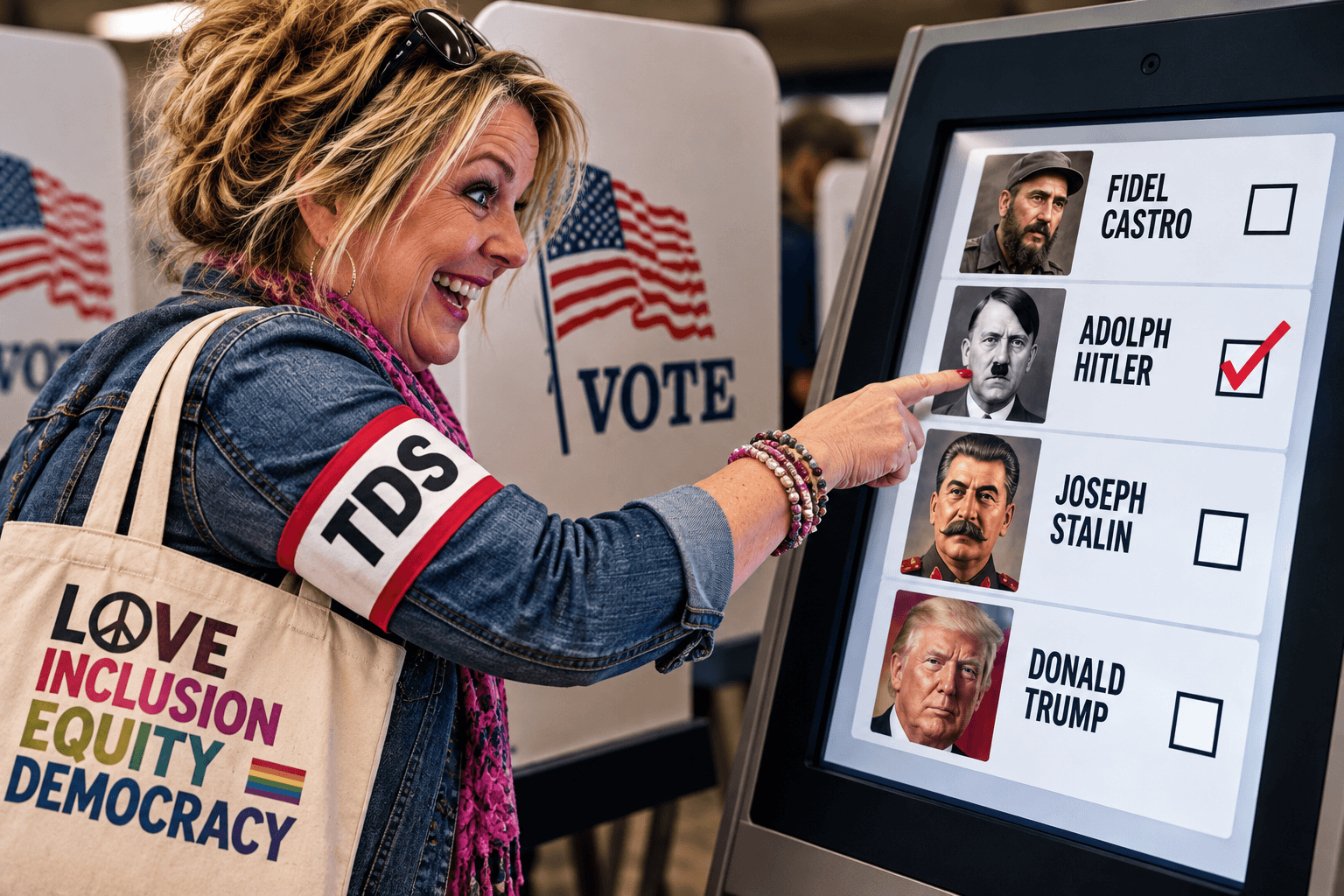
“Imagine every politician in this essay had an R beside their name instead of a D. How many of their defenders would still defend them?”
Democrat voters have returned politicians to office after ethics findings, public scandals and even removal from another public office. Sometimes repeatedly. Somewhere along the way, “What has this person done?” gives way to a much easier question: “At least he’s not a Republican, right?”
The politician gets another term. His defenders get to call it a stand against Republicans. The misconduct stays on the record, but it no longer controls the decision.
Trump has made that bargain easier to sell. A politician facing questions about his own conduct can turn the conversation toward the danger of electing a Republican. His supporters can acknowledge the misconduct and still present another term as a moral necessity. Apparently, the most useful thing a compromised Democrat can have is a Republican to point at.
By October 2026, Trump had spent less than six years in the presidency. Nancy Pelosi entered Congress in 1987. Plenty of Washington’s familiar faces had built careers long before he entered politics. How does the relative newcomer become the explanation for everything wrong with a government these people helped run for decades? What, exactly, were they responsible for while collecting all that seniority?
Imagine Pelosi with an R beside her name. Would her liberal admirers be so forgiving of her decades in power, her family’s financial interests and the wealth accumulated along the way? Apply that question throughout this essay. Change the party affiliation and ask whether the explanation would survive.
The Democrat Party has benefited from voters willing to mistake opposition to Republicans for proof of good character. Bob Menendez demonstrated just how expensive that mistake can become.
The Gold Bars Were a Clue
Bob Menendez had more than $480,000 in cash hidden around his home when federal agents searched it in June 2022. They also found gold bars worth more than $100,000. Apparently, representing New Jersey required a considerable emergency fund.
The Senate Ethics Committee had already given the public a warning. In April 2018, it concluded that Menendez had accepted improper gifts, failed to disclose them and used his office to advance the interests of the wealthy donor providing them. The committee found violations of Senate rules, federal law and standards of conduct. This was an official finding, issued after the criminal prosecution involving that donor had ended without a conviction.
Seven months later, 1,711,654 voters returned Menendez to the Senate. In February 2021, he regained the chairmanship of the Senate Foreign Relations Committee, a position with enormous influence over America’s dealings with other countries. Voters gave him another term. The Senate gave him more authority.
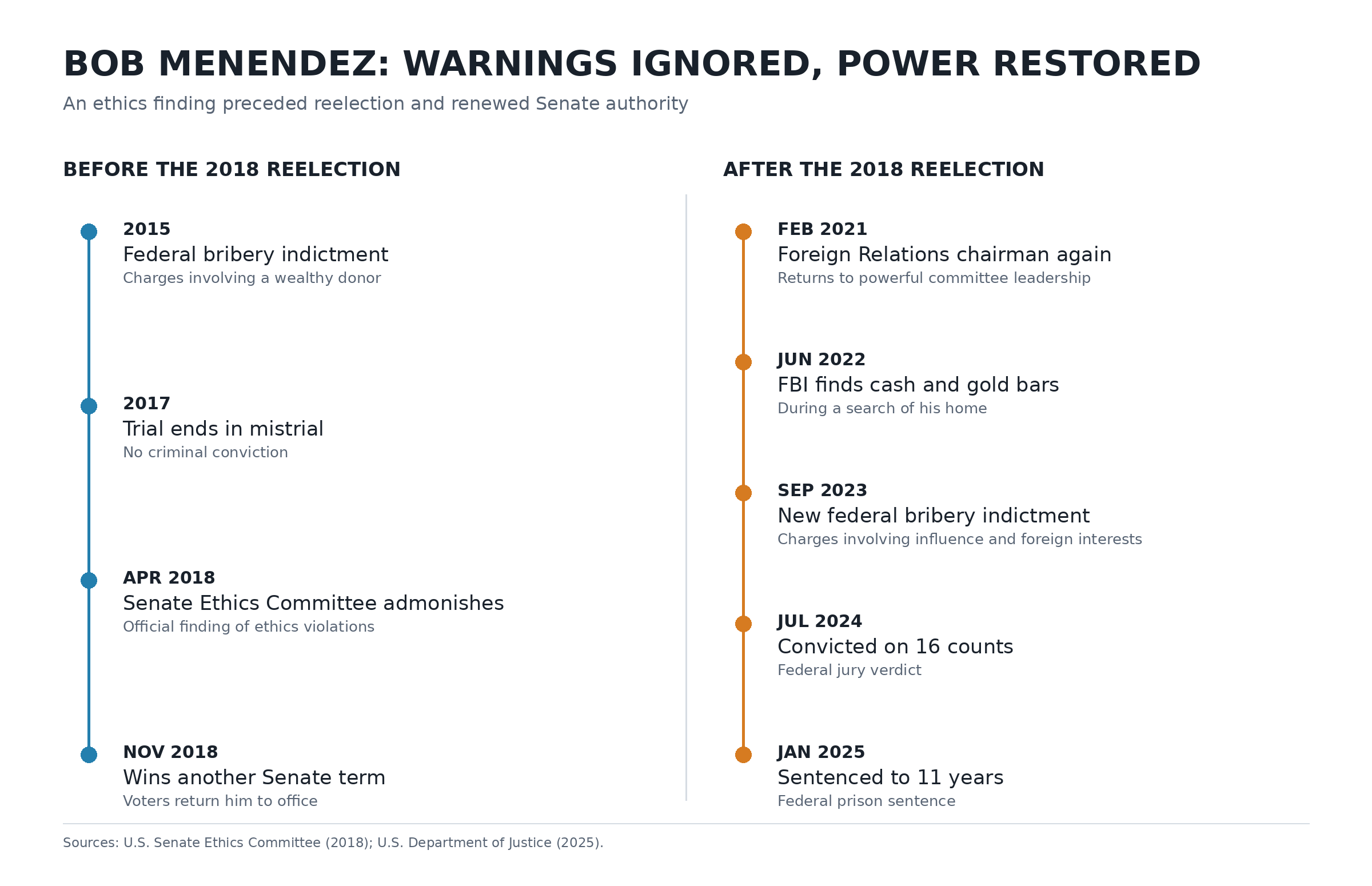
What did they think the ethics finding was, a glowing recommendation? When the next indictment arrived in September 2023, prominent Democrats demanded his resignation. Cory Booker argued that public office required standards beyond avoiding criminal conviction. Fair enough. Where had that standard been when the Ethics Committee published its findings five years earlier?
Menendez refused to leave. A jury convicted him in July 2024 on sixteen counts, including offenses involving his work on behalf of Egypt. He resigned the following month and received an eleven-year prison sentence in January 2025. His Senate career finally ended, but the earlier decisions remain. Yelling fire after the house has burned down does not explain why you ignored the smoke.
There was a particularly impressive touch to his return as Foreign Relations chairman. Menendez announced that Trump had weakened America’s standing and promised to help restore its leadership. The bribery scheme prosecutors later proved operated from 2018 through 2022. While presenting himself as a guardian of American interests, he was participating in a scheme that sold the influence of his office.
At least he wasn’t a Republican. If the opposing party is treated as an intolerable moral threat, almost anything about a useful ally can become negotiable. Corruption becomes a distraction. A record of dishonesty becomes old news. Anyone asking questions is accused of helping the enemy.
The people defending these politicians often speak most loudly about accountability. The test comes when accountability threatens someone they want to keep.
In October 2018, the Star-Ledger endorsed Menendez with an instruction to voters: “choke down their reluctance and vote for Menendez.” The editorial criticized both candidates, including Hugin’s business record, but made opposition to Trump central to its choice. Its reasoning included the extraordinary phrase, “When you get past ethics.”
Getting past ethics was evidently part of defending the republic.
What Does It Take to Get Fired?
Alcee Hastings
Alcee Hastings lost a federal judgeship and gained a seat in Congress. He had been acquitted in a criminal bribery trial, but Congress subsequently pursued impeachment. In 1989, the Senate found him guilty on eight articles and removed him from the bench.
Florida voters elected him to the House in 1992. He remained there until his death in 2021. In the subsequent elections documented by the House’s historical account, he received at least 73 percent of the vote and sometimes ran unopposed. The Senate removed him from the bench. Voters kept sending him to Congress for nearly three decades.
William Jefferson
Federal agents found $90,000 in William Jefferson’s freezer in 2005, money connected to a recorded transaction in a bribery investigation. By his 2006 reelection campaign, the discovery was public. Louisiana voters returned him to Congress anyway.
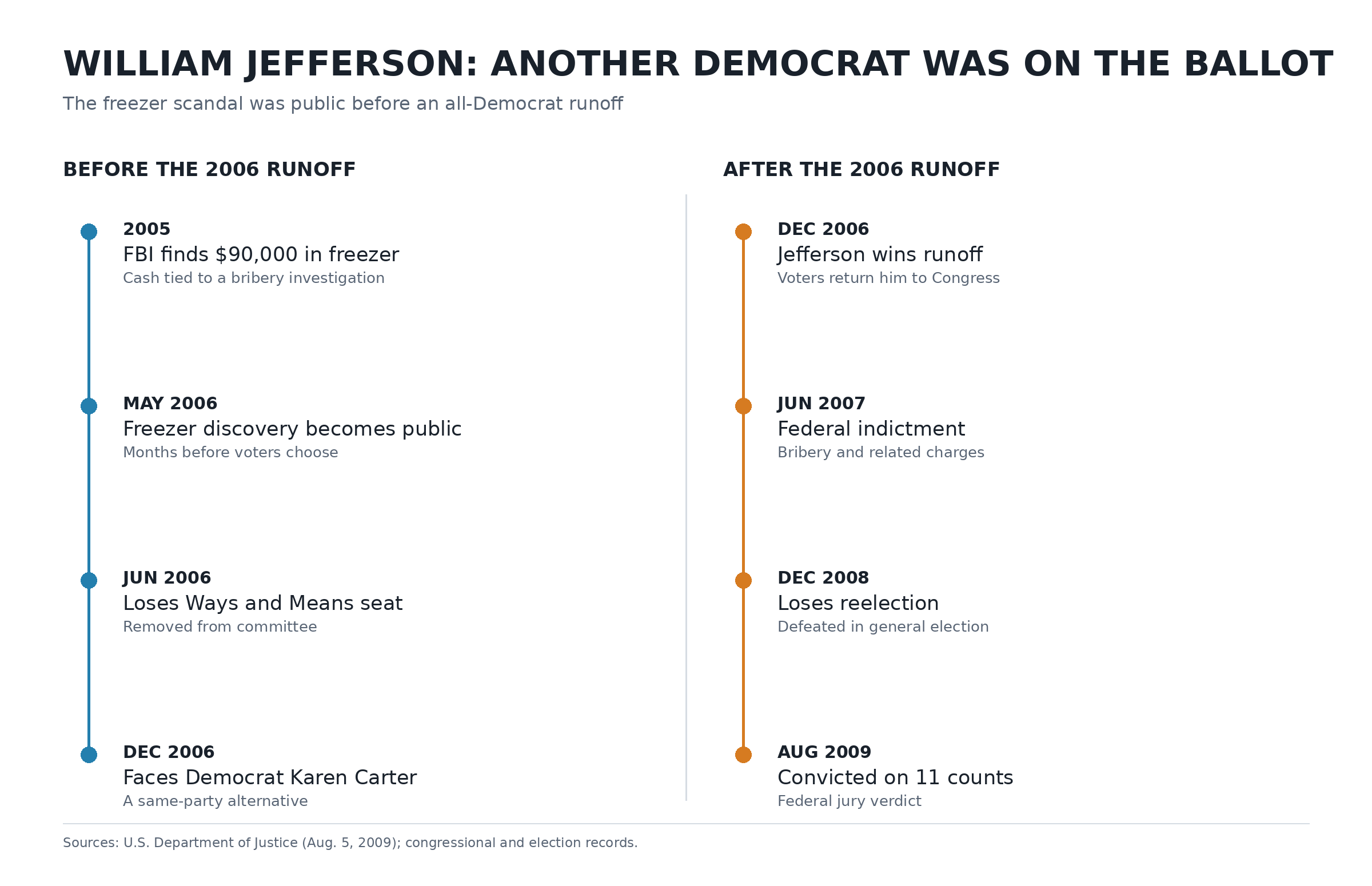
His runoff opponent, Karen Carter, was another Democrat. Voters could have kept the party and changed the politician. They chose the politician. Jefferson eventually lost his seat and was convicted, but his 2006 victory exposes a problem that blaming Republicans cannot explain: even when replacing the incumbent would preserve the party’s seat, loyalty can protect the incumbent.
Marion Barry
After a drug conviction and imprisonment, former Washington mayor Marion Barry won a city council seat in 1992. In 1994, voters elected him mayor again. He had served his sentence; voters supplied the comeback. A person can rebuild a life without being restored to public office. Forgiveness does not require a government salary.
Stacie Laughton
Stacie Laughton, a Democrat who became the nation’s first openly transgender person elected to a state legislature, won election to the New Hampshire House in 2012 but resigned before taking office when earlier felony convictions involving fraud and falsifying evidence became public. State officials determined that Laughton had not completed the sentence and was legally ineligible to serve. In 2015, Laughton received a suspended jail sentence after admitting to making a bomb threat at a hospital.
That record didn’t stop voters from electing Laughton to the House in 2020. In August 2022, Laughton was convicted of repeatedly misusing the state’s 911 system. Three months later, voters reelected the representative. Four days after the election, Laughton was arrested on a stalking charge and jailed. Laughton resigned in December.
Then in 2023, Laughton was arrested and detained in connection with a federal investigation into the sexual exploitation of children. Prosecutors established that Laughton had encouraged a former partner working at a Massachusetts daycare to produce sexually explicit photographs of young children. Laughton pleaded guilty to three federal counts in November 2025. On June 18, 2026, a federal judge imposed a 400-month prison sentence, more than thirty-three years.
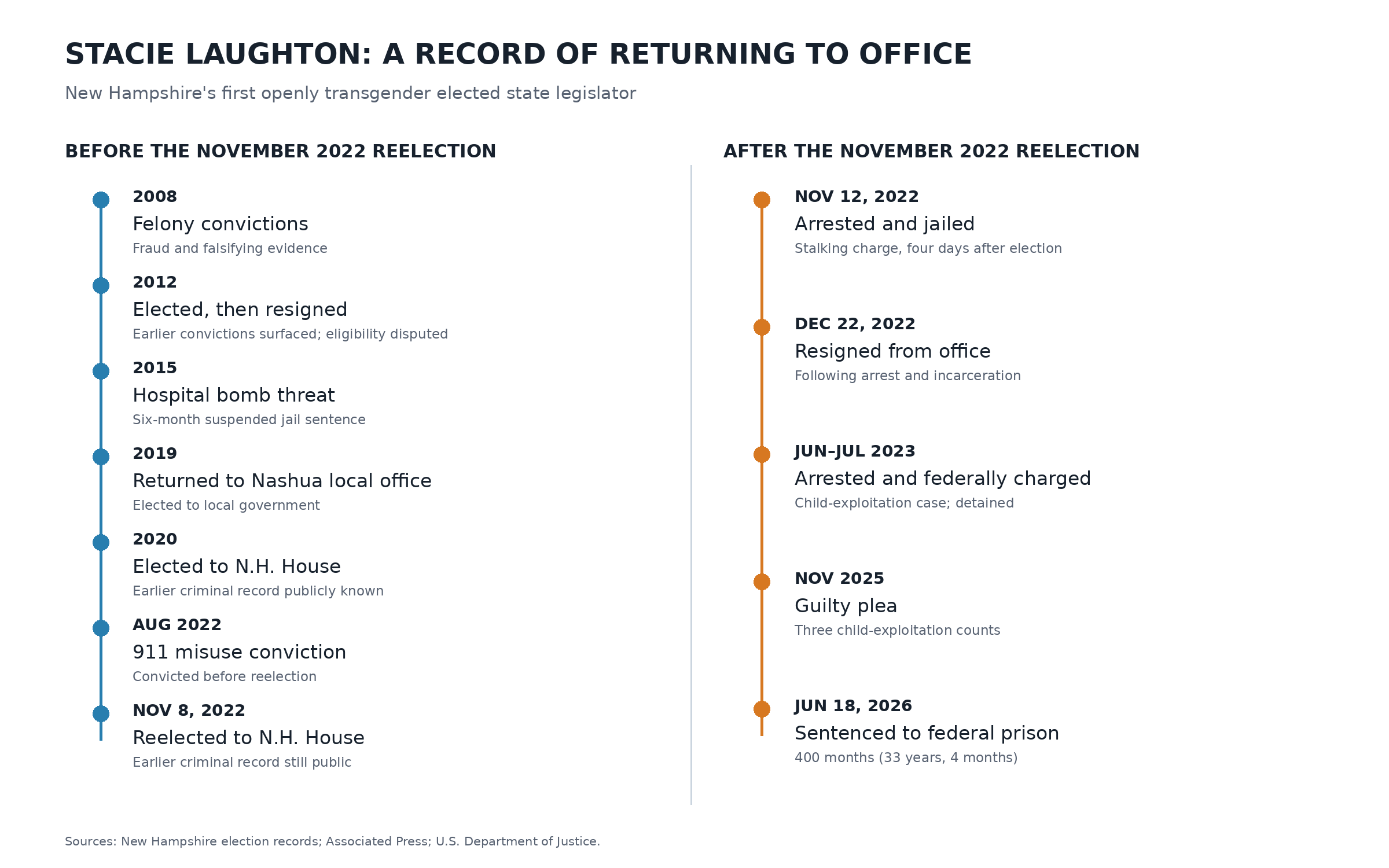
Voters would not have known about the federal child-exploitation case when they elected Laughton. They did, however, have years of publicly reported criminal history to consider. The question is how many chances someone gets at public office before voters decide that the job requires more than winning an election.
Eric Swalwell
In 2015, the FBI warned Eric Swalwell that Christine Fang, whom U.S. counterintelligence officials linked to a Chinese intelligence operation, had been involved in his political career. She helped raise money for his campaign and place an intern in his congressional office. Swalwell cut contact after the warning and cooperated with investigators. What the public didn’t learn until August 2026 was that he had also admitted to the FBI that he had sexual relations with Fang on several occasions.
Swalwell continued serving on the House Intelligence Committee. The Fang connection became public in 2020, and voters reelected him in 2022 and 2024. Speaker Kevin McCarthy blocked his return to the committee in 2023, despite opposition from Democrat leaders. The House Ethics Committee subsequently closed its investigation without disciplinary action. Investigators had not accused Swalwell of knowingly assisting Chinese intelligence or disclosing classified information.
But in November 2025, Swalwell publicly denied ever having sexual relations with Fang, directly contradicting what he had told the FBI a decade earlier. Imagine an Apple executive who became sexually involved with someone linked to a Chinese intelligence operation and allowed that person to help place an intern in his office. Would the company need proof that he had stolen trade secrets before questioning his judgment? Would his subsequent dishonesty make management more confident in him? A person doesn’t have to commit espionage to raise serious questions about whether he belongs anywhere near national-security secrets.
The Lion and the Conscience
Ted Kennedy
Mary Jo Kopechne was twenty-eight when she died in Ted Kennedy’s car at Chappaquiddick in July 1969. Kennedy escaped the submerged vehicle. He did not report the crash to police for roughly ten hours. He pleaded guilty to leaving the scene and received a suspended sentence.
Kennedy won reelection in 1970 and remained in the Senate until his death in 2009. His presidential ambitions suffered, but his career as a powerful legislator continued for another forty years. He became the celebrated Lion of the Senate.
His legislative accomplishments became the answer to questions about his conduct. Kopechne had no future achievements to put on the other side of that scale. Even the familiar account of how Chappaquiddick damaged Kennedy’s presidential ambitions invites us to measure the tragedy by what it cost the man who survived it. He lost a chance at the presidency. She lost the rest of her life.
Robert Byrd
Robert Byrd joined and helped organize the Ku Klux Klan, opposed the Civil Rights Act of 1964 and later repudiated his earlier views.
At Byrd’s memorial service in July 2010, Bill Clinton referred to newspaper accounts of a “fleeting association” with the Klan, then offered his explanation: “He was trying to get elected.” Clinton went on to credit Byrd with spending the rest of his life making amends.
Organizing a Klan chapter was an active choice. Political ambition explains why a man might make that choice; it makes the choice more calculating, not more innocent. Clinton could have honored Byrd’s later repudiation without shrinking his earlier involvement into a passing association. He chose to do both.
Byrd became celebrated as the Senate’s conscience. His rehabilitation shows how much room political allies can find for context, growth and forgiveness. Clinton could explain away a Klan organizer’s past. Remember that when someone tells you a Republican’s worst moment must define him forever.
All in the Family: The Clintons
Bill Clinton
Bill Clinton’s defenders helped popularize the idea that his troubles were essentially about private sexual behavior. The court record tells a less convenient story.
In April 1999, federal Judge Susan Webber Wright held Clinton in civil contempt for willfully violating discovery orders in Paula Jones’s lawsuit. The ruling addressed false and misleading sworn testimony concerning Monica Lewinsky. Clinton later accepted a five-year suspension of his Arkansas law license and a $25,000 fine, acknowledging knowingly evasive and misleading answers.
Paula Jones was trying to obtain evidence in a lawsuit. Calling the controversy an obsession with Clinton’s sex life moved attention from her rights to his inconvenience. His defenders were answering a charge about conduct under oath as though the country had merely caught him cheating on his wife.
The Senate acquitted Clinton in his impeachment trial. Every Democrat senator voted not guilty on both articles. Years later, after the contempt finding and professional discipline were established, he remained a welcome advocate for the party. He was still a featured speaker at its 2024 national convention.
In 2018, Hillary denied Bill abused his power with Lewinsky, emphasized her adulthood, and redirected the interview toward allegations against Trump. A president’s authority over an intern did not disappear because she was legally an adult. Nor did a question about her husband become an answer about him when Hillary supplied the name of a Republican.
Hillary Clinton
As secretary of state, she conducted official business through a private email system. The State Department inspector general found no evidence that she sought or received approval for exclusive reliance on that system. Responsible officials said they would not have approved it.
The FBI identified 110 emails in fifty-two chains containing information classified when sent or received. Eight chains contained Top Secret information. FBI Director James Comey recommended against prosecution while describing the handling as extremely careless. Avoiding prosecution was a very low qualification for promotion to president.
Then there were the deletions. A technician deleted an email archive in late March 2015, after the congressional subpoena and a preservation notice. His explanation was that he had belatedly implemented an earlier retention instruction. The FBI record does not establish a new post-subpoena order from Hillary directing him to destroy it. An email archive was destroyed after its preservation had become an explicit obligation.
Outside government, the foundation, paid speaking, consulting and political relationships occupied overlapping territory. Doug Band’s memorandum described cultivating charitable donors while arranging private business opportunities for Bill. The activities did not exist in separate universes simply because they appeared on different letterheads. An Associated Press review of released calendars found that eighty-five of 154 private-interest contacts had donated to the foundation or pledged support to its programs.
Financial trader and substantial Clinton donor Rajiv Fernando obtained a place on the State Department’s International Security Advisory Board in 2011. Released emails showed career officials struggling to explain his qualifications. When reporters asked questions, officials discussed protecting senior officials’ names. Fernando soon resigned. A donor got the appointment. Career officials got the job of explaining it. Once the questions became public, the arrangement fell apart.
Chelsea Clinton and the Family Institutions
The Clinton name also carried into a second generation of institutional leadership. Chelsea became vice chair of the Clinton Foundation; the Clinton Health Access Initiative’s 2024 annual report lists her as vice chair and chair of its HR and Governance Committee. Alongside those roles, she built a corporate career with substantial board compensation.
For 2025, IAC, Expedia and Clover Health reported combined compensation of $913,596, including $706,031 in stock awards valued at grant. Chelsea left Clover’s board in November 2025. Bill’s sanctions and Hillary’s controversies had not made the Clinton name unusable. The family’s institutions continued into the next generation, with Chelsea in leadership.
All in the Family: The Bidens
Hunter Biden
Before the convictions came the effort to discredit reporting about Hunter’s laptop. In October 2020, fifty-one former intelligence officials signed a statement suggesting that the disclosure of emails attributed to Hunter bore the characteristics of a Russian information operation. They acknowledged that they lacked evidence of Russian involvement. Former acting CIA director Michael Morell later testified that one of his purposes was to help Joe Biden win the election. A conversation with Biden campaign adviser Antony Blinken had prompted him to prepare the statement, although Morell said Blinken had not asked him to write it.
By June 2024, federal prosecutors were presenting the laptop in Hunter’s gun trial. An FBI witness confirmed it belonged to him, and investigators corroborated the communications they used against Apple’s records. That established the authenticity of the trial evidence, not every file that had circulated online. The trial came years after voters had needed to assess the original reporting. In the meantime, an unproven suspicion had received the backing of fifty-one prestigious names, organized in part to help the candidate whose son was under scrutiny.
A jury found Hunter guilty of three firearm felonies. He subsequently pleaded guilty to nine tax counts, including three felonies, without a plea agreement. The tax prosecution involved at least $1.4 million in unpaid taxes and conduct that included false deductions.
Hunter’s former business partner Devon Archer described the Biden association as part of the product foreign business partners valued. He recounted encounters and speakerphone calls involving Joe and Hunter’s associates, while saying Joe did not discuss business on those calls. Representative Dan Goldman pursued a defense based on the distinction between actual influence and the illusion of access. Archer agreed that Hunter sold the latter, with social access accompanying it. A customer does not need to hear a policy discussed to attach value to a call with the vice president. The contact itself can make his son’s sales pitch more convincing.
Joe Biden
On June 13, 2024, Joe Biden said he would respect the jury’s decision in Hunter’s gun case and would not pardon him. On December 1, he signed the pardon.
It covered potential federal offenses from January 1, 2014, through December 1, 2024. That protection extended beyond the two prosecuted cases to nearly eleven years of conduct.
Those cases proceeded while Joe Biden was president. When he issued the pardon, Joe argued that his son had been selectively prosecuted and that politics had corrupted the process. Special counsel David Weiss rejected that characterization in his report, defending the prosecutions as warranted by Hunter’s conduct.
Joe had the constitutional authority to issue the pardon. He had also promised the public he would not. The power to do it did not make his word worth anything afterward.
Before leaving office, Joe also pardoned other relatives, including his brother James. Those grants covered potential nonviolent federal offenses dating back to January 2014. They supplied protection against prosecution within their terms without establishing that the recipients had committed uncharged offenses.
For the final pardons, Chief of Staff Jeff Zients authorized autopen use after a call from his aide, Rosa Po, according to his testimony as presented in the House Oversight majority’s report. Neither had attended the January 19, 2025 meeting where Biden reportedly approved the pardons. Zients did not check with Biden or anyone who had attended before permitting Po to send the authorization from his email account.
Biden maintained that he made the decisions. The disputed question is whether this chain reliably established his approval, not whether a machine can legally reproduce a signature. For decisions protecting members of the president’s own family, Americans were entitled to more than secondhand assurances. An autopen can reproduce a signature. It cannot supply the president’s judgment.
Jill Biden
Jill defended a different family interest: Joe’s continued candidacy. After the June 27, 2024 debate exposed his difficulties to a national audience, she told Vogue the family would “not let those 90 minutes define the four years he’s been president.” Voters were being asked to hire him for four more years. She answered with a defense of the four already served.
By May 2026, Jill acknowledged that he had slowed down while denying she had observed cognitive decline. The presidency did not belong to the family. Her reassurance could not substitute for evidence that he could still do the job.
Ilhan Omar and the Persecution Defense
On May 5, 2026, Minnesota legislators had a chance to compel records concerning communications between Ilhan Omar’s office and people connected to the Feeding Our Future fraud case. Five Republicans voted for the subpoena. Three DFL members voted against it. Six votes were required, so the motion failed. The DFL is Minnesota’s Democrat Party organization; the opposing members were Dave Pinto, Steve Elkins and Emma Greenman.
Pinto doubted the committee would make decent use of the material and argued that Trump would be willing to pursue wrongdoing by Omar. The communications appeared in a trial-exhibit list, but their contents were what the committee sought. Omar’s participation in the fraud had not been established. Obtaining the records could strengthen or weaken the suspicions; distrusting Republicans could do neither.
There was already a separate, established campaign-finance problem in Omar’s record. In 2019, Minnesota’s campaign board ordered reimbursement of $3,469.23 and imposed a $500 civil penalty. Questioned expenditures included work involving joint returns she filed with Ahmed Hirsi while legally married to Ahmed Nur Said Elmi.
Her campaign also paid approximately $2.9 million during the 2019 and 2020 cycle to E Street Group, co-owned by Tim Mynett, whom she married in 2020. The FEC closed the specific personal-use complaint without finding reason to believe the payments violated the prohibition. The payments were gross vendor receipts, not an accounting of Mynett’s personal profit. They nevertheless placed campaign spending and a spouse’s business interests in the same transaction, an arrangement donors could reasonably expect to have explained.
The household’s reported business values later required substantial corrections. A congressional conduct review recommended dismissing that disclosure matter. On October 12, 2026, federal agents searched Omar’s Washington residence as part of an immigration-related criminal investigation. Omar denied wrongdoing, and the inquiry remained unresolved. Claims about her former husband’s biological relationship and her family’s immigration history had not become publicly established findings.
Pinto, Elkins and Greenman did not need to decide whether Omar was guilty of anything to support obtaining the records. Their votes stopped that subpoena. The committee was left without the evidence it sought, while Omar’s defenders retained the ability to dismiss questions as political.
The Flexible Rules of Forgiveness
Graham Platner’s Senate campaign faced criticism over old online remarks and a tattoo resembling the Nazi SS death’s-head symbol. Platner said he had acquired it while drinking during military leave, had not understood its significance and was horrified by the association. He had it covered.
Bernie Sanders continued supporting him. Asked about the controversy, Sanders said there might be “one or two more important issues.” His answer asked voters to weigh the controversy against the other reasons to support Platner. For Sanders, the controversy did not outweigh the reasons to elect him.
By April 2026, an official Platner campaign event had incorporated the tattoo controversy into a trivia question. Associated Press reporting described supporters embracing a redemption story. The campaign had turned a liability into a shared joke.
Sanders decided the controversy wasn't enough to abandon Platner. That's a political trade-off. Republican voters make them, too. Why is it principled when Sanders does it and a character flaw when Republicans do?
The People Who Keep Them in Business
The same Star-Ledger editorial criticized Booker and Governor Phil Murphy for rallying behind Menendez early, when another Democrat might have defeated him in a primary. That criticism reached back to the stage when voters still had a chance to nominate someone else. First, influential supporters help the incumbent hold off a challenge. Then the general election arrives, and voters are told that rejecting him would help the Republican. The people who helped preserve the bad choice present themselves as realists for accepting it.
The advantages of keeping an incumbent are immediate and organized. Advocacy groups have a legislator who knows their priorities. Donors have relationships they would need to rebuild with a replacement. Party leaders have a familiar candidate and an established fundraising operation. All can find reasons to tolerate conduct that would disqualify a stranger asking for their support. A challenger demanding higher standards threatens arrangements that already work for the people inside them.
Chaka Fattah lost his 2016 primary after indictment and resigned shortly after conviction. Menendez faced widespread resignation demands in 2023. The question for those who protected him earlier is why the record they already had was insufficient.
By the time a scandal becomes impossible to defend, years of endorsements, donations and votes may have helped the politician remain in office. The resignation demand makes a fine press release. It does not account for the help that came before it.
What Are Your Principles Worth?
Trump cannot retroactively become responsible for Kennedy’s conduct at Chappaquiddick, Hastings’s removal from the bench or Jefferson’s freezer. Those records existed before his presidency. The habit of forgiving useful Democrats did too. Putting Trump’s face on the campaign literature does not make the incumbent’s record disappear.
Nor does anger at Washington explain returning the same people to it for decades. At some point, the voter has to account for that decision. You cannot keep renewing the contract and pretend you had nothing to do with keeping the contractor.
A party that can count on your vote regardless of its nominee’s conduct has no reason to fear your judgment. You’ve already told it that being a Democrat is qualification enough.
“At least he’s not a Republican” may explain your vote. It does not excuse what you voted to overlook.
If You Want Me to Keep Writing, I Need Your Help. NOW.
I’m going to be painfully direct.
I’m nearly broke. And I’m running out of ways to keep doing this.
I’ve spent two years researching, writing, and publishing work that anyone can read for free. Thousands of hours. Millions of words. I don’t hide my essays behind a paywall because I believe people should have access to the information, whether they have eight dollars to spare or not.
But here’s the ugly reality: I can have a thousand people tell me they loved an essay, and still be sitting here wondering how I’m going to pay the rent. I appreciate the compliments, but I desperately need some of those readers to become paying subscribers.
I’ve lost paying clients. I was seriously injured in a car accident that destroyed the vehicle I was using to earn a living. My family’s finances are in terrible shape. And despite continuing to research and publish, paid subscriptions arrive at a trickle.
I’m still here. I’m still writing. I’m still doing the work. But sheer determination doesn’t pay the rent, buy groceries, or keep the electricity on.
If you’ve ever read one of my essays and thought, “Someone needs to keep saying this,” I’m asking you to help make sure someone can.
Here’s How You Can Help Right Now
Become a Paid Subscriber: $8/month or $80/year
Eight dollars. That’s all it takes to start helping me keep this publication alive. If even a small fraction of my regular readers subscribed, my financial situation would look completely different.
Make a One-Time Contribution
Can’t commit to a subscription? Send what you can. Five dollars, twenty-five dollars, a hundred dollars. Whatever you can comfortably afford. Every contribution helps.
Prefer Venmo?
If you want to help directly, Venmo is one of the quickest ways to get support to me when I need it most.
https://account.venmo.com/u/mrchrisarnell
Join the Resistance Core: $1,200/year
For those who have the means and want to make a serious commitment to keeping this independent voice alive, the Resistance Core is $1,200 annually. Your support helps make it possible for thousands of others to keep reading for free.
And If You Truly Cannot Afford to Help
I understand. Believe me, I understand financial hardship better than I ever wanted to.
Keep reading. Restack my essays. Share them on Facebook, X, and anywhere else people might discover them. Recommend my publication to friends who believe independent writing deserves to survive.
But if you can afford to help, please stop assuming somebody else will. That’s what everybody assumes, and that assumption is slowly strangling the very independent voices people claim they want to protect.
I don’t have a corporate sponsor. I don’t have a wealthy political organization paying my bills. And I don’t have another source of income quietly subsidizing this publication.
I have my writing, my readers, and the hope that enough of you believe this work is worth keeping alive.
I’m asking people who value what I produce to help pay for producing it.
I want to keep every essay free. I want to keep writing. And I’m not finished saying what I have to say.
Please. If you’re able to help, do it today. I genuinely need you.
It’s getting harder to go through all the awfulness in government. And you’re right, the perps often get right back in. And you’re right, they can say, at least he/she isn’t a republican.
I think a vast number of people have been programmed to believe that “The democrats are for the little man, the working man, and the republicans are for the wealthy and businessmen.”
That was what I believed. I grew up in a poor working-class neighborhood and my parents and everyone I knew was a democrat, just like you were Irish or Italian or Polish. I was democrat all through my teens and early adulthood on the East coast. When I moved to Californian to start a new life, Reagan was running for president.
I remember seeing how blatant, unfair, and downright slanderous the press’s treatment of him was. That was the first election I paid any attention to and the more I liked Reagan and thought him intelligent, witty and kind, the more the media slandered him as a greedy republican. That election opened my eyes to the unfairness of the media and the inability or unwillingness of many Americans to ‘think.’ They would rather ‘feel’ and the media gave them plenty of fodder for that.
I’m a Trump supporter. I believe that he knew it would be rough if he ran for office, that he and his family would suffer, but I believe he also knew that no other candidate could or would step in to try and stop the established bureaucracy, or cabal or deep state, whatever, is running the country into the swamp.
I hope and pray that we come out of this election with the house and senate in republican hands. Yes, some republicans are merely in it for the money, no spines, etc., but many, if not most, elected democrats know they are destroying the country and attempting to install a permanent one-party state. God help us if they succeed.
They vote according to their ideology and indoctrination. It simply doesn't matter what they did. Like Yuri Bezmenov said, they are innured to facts. Facts do not penetrate the ideology.