


A country can lose control of immigration without anyone ever climbing a fence.
Before getting into any of this, Michael Savage deserves a shoutout.
Savage was talking about immigration, national identity and assimilation long before those subjects became the center of American politics. When he created the Paul Revere Society in 1994, he needed a simple way to describe what he believed defined a nation.

He came up with three words: Borders. Language. Culture.
That was 32 years ago.
What interests me now is not whether the phrase still makes a good bumper sticker. It is whether Savage was right.
I think he was.
So rather than jam all three subjects into one enormous essay and race through them, I am going to take them one at a time. This first one is about Borders. The next will deal with Language. The third will deal with Culture, which may ultimately be the most important of the three.
The first thing we have to do is stop thinking of a border as simply a fence. A border is really a decision. It is the right of the people already living in a country to decide who may enter, how many may enter, why they may enter, how long they may remain and under what conditions temporary admission can eventually become permanent membership.
Once you look at it that way, the Mexican border is only one part of the story.
A Border Is More Than a Fence
When Savage coined his phrase in 1994, about 8.7 percent of the U.S. population was foreign-born. The Census Bureau described that as nearly one out of every eleven Americans.
By 2024, the foreign-born population had reached 50.2 million people, or 14.8 percent of the country. That is the largest foreign-born population in American history in absolute numbers, and the percentage matched the historical peak reached in 1890.
In other words, the foreign-born share of America is roughly 70 percent higher than it was when Savage started talking about Borders, Language and Culture.
That number does not, by itself, tell us whether immigration is good or bad. Numbers need context, and America has experienced mass immigration before. This isn’t America’s first immigration wave. Not even close. In the late nineteenth and early twentieth centuries, enormous numbers of Italians, Germans, Irish, Jews, Poles and others came here.
But saying, “We’ve had immigration before,” does not end the discussion any more than saying, “We’ve had debt before,” tells you whether today’s debt is a problem.
The scale is different. The speed is different. Where people come from has changed, along with the circumstances under which they arrive. Technology has changed everything too.
The immigrant arriving in New York in 1900 could not FaceTime relatives every night, watch television from his homeland, read his hometown newspaper online, fly home relatively cheaply, join hundreds of WhatsApp groups, use instant translation or spend his entire day inside an online social network populated largely by people from the country he left.
Distance used to do some of the work of assimilation. It does much less of that now.
We’ll come back to that when we get to Language and Culture. For Borders, the first question is simpler: How are people getting here?
The Border Everyone Sees
The southern border gets most of the attention for an obvious reason. At its peak, the numbers were enormous.
In May 2024, U.S. Border Patrol recorded more than 117,900 encounters between ports of entry along the southwest border. These were encounters, not necessarily 117,900 unique people, and an encounter does not automatically mean somebody was admitted permanently.
Then something else happened that deserves just as much attention.
After the Biden administration tightened asylum eligibility for many people crossing irregularly in June 2024, Border Patrol encounters between ports of entry fell 29 percent in a single month, to 83,536.
Then came a much larger decline after the Trump administration imposed substantially tougher border policies in 2025.
Whatever else people want to argue about, the numbers make one thing pretty hard to deny:
Government policy affects immigration.
That sounds ridiculously obvious, but for years Americans were regularly told by Democrats that the border was some uncontrollable force of nature. People were coming, Congress was broken, nothing much could be done.
Apparently quite a bit could be done.
The real question was whether the government wanted to do it.
Still, conservatives make a mistake when they allow the entire immigration argument to end at the Rio Grande.
Suppose tomorrow morning we somehow eliminated every illegal crossing between Brownsville and San Diego. Would American immigration suddenly become small?
Not even close.
We could put soldiers shoulder to shoulder along the Mexican border and still admit enormous numbers of people without one of them ever crawling through brush or crossing a river.
They would simply come through the front door.
The Border You Never See
Some people come as tourists. Some arrive as foreign students. Others receive employment visas, refugee status, asylum, family-sponsored green cards or other legal classifications. Some enter legally and overstay. Some begin in one status, move into another and eventually become permanent residents.
This is where immigration gets confusing because government statistics usually count programs, while normal people experience population.
You hear 85,000 H-1Bs. You hear 363,000 Indian students. You hear green-card numbers, refugee numbers, asylum numbers, temporary-worker numbers and illegal-border numbers.
They sound like separate piles.
They are not always separate people.
One person can move through several categories over ten or fifteen years, and India gives us a particularly good example of how that works because Indian immigration has grown extraordinarily fast while being heavily concentrated in education and employment channels.
About 3.2 million India-born immigrants lived in the United States in 2024, making Indians the country’s second-largest foreign-born group after Mexicans. That population grew 78 percent between 2010 and 2024. Indian immigrants are also exceptionally educated as a group. About 82 percent of Indian immigrant adults held at least a bachelor’s degree, while roughly half held an advanced degree.
Indians are not coming here at the bottom of the educational ladder. Quite the opposite.
It is partly their success at navigating America’s education and employment systems that makes the pipeline so interesting.
During the 2024-25 academic year, there were 363,019 Indian international students in the United States, making India the largest source country. Across all nationalities, OPT participation reached 294,253, and the Indian student population continued to grow even as some other major source countries declined.
OPT, or Optional Practical Training, allows eligible F-1 students to work in jobs related to their education. For qualifying STEM graduates, that work authorization can be extended further.
So the path can look something like this:
An Indian student gets admitted to an American university, arrives on an F-1 visa, earns a master’s degree and moves into OPT. If the degree qualifies, STEM OPT can extend that employment period. An employer may then sponsor the student for H-1B status, and later potentially for permanent residence.
Eventually, permanent residence can lead to citizenship, and citizenship opens additional family-immigration options.
Every step in that sequence can be perfectly legal. In fact, the system is designed to allow it.
But it raises a simple question. When somebody tells you how many “foreign students” are in America, are you looking only at students?
Or are you also looking at the front end of an employment and immigration pipeline?
Those are not quite the same thing.
One Worker Does Not Mean One Person
The H-1B program makes this even clearer.
Most Americans who know anything about H-1B have heard the number 85,000. There are 65,000 slots under the regular annual cap, plus another 20,000 for qualifying recipients with advanced degrees from American universities.
That makes it sound as though America admits 85,000 H-1B workers each year and that is pretty much the story.
It isn’t.
USCIS approved 399,378 H-1B petitions in FY2024 when initial and continuing employment petitions are combined. That does not mean 399,378 new workers entered the United States. Many approvals involved people already here, including extensions and continuing employment. It does show why the 85,000 cap should not be confused with the total size or activity of the program.
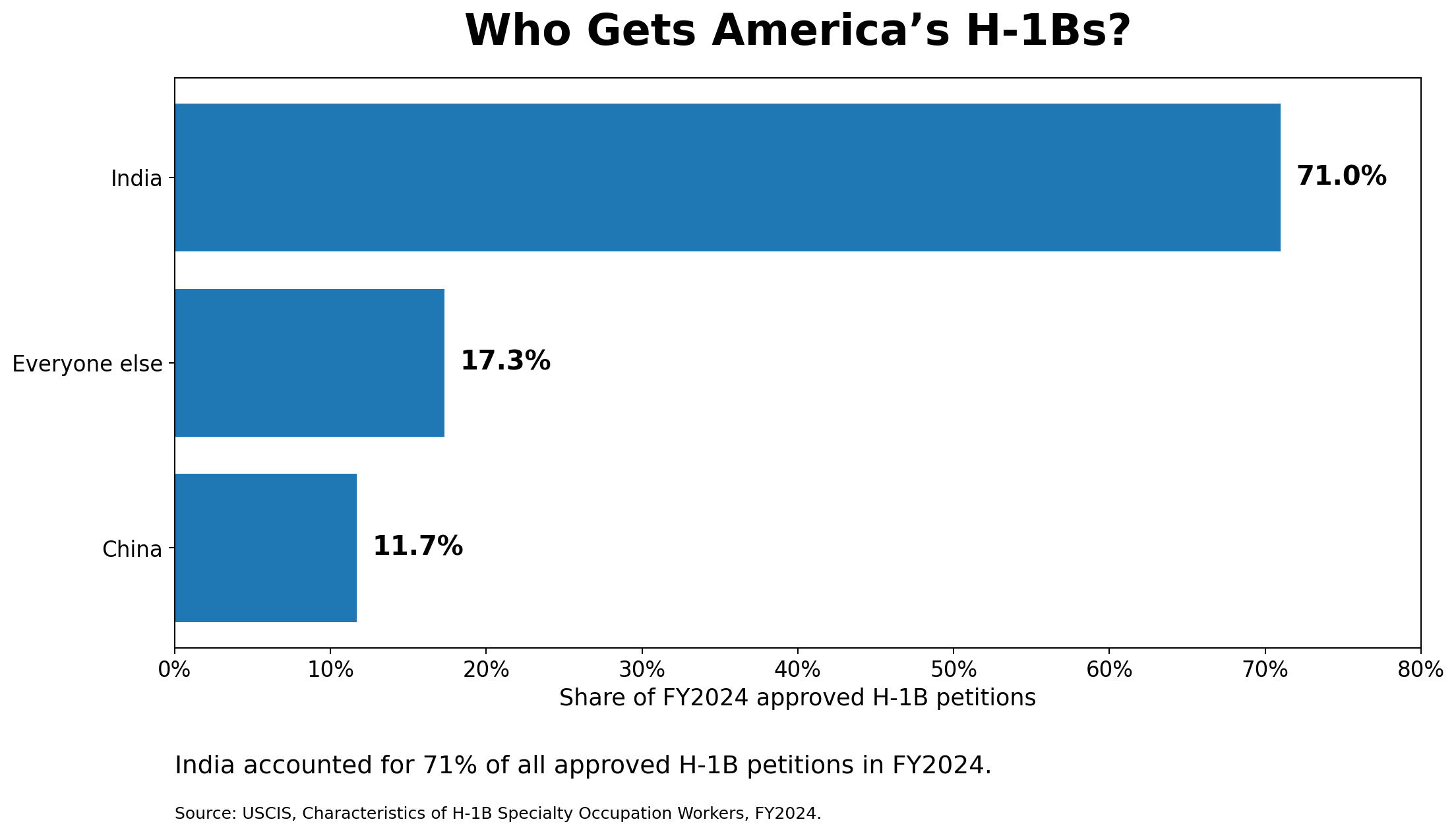
India completely dominates it.
Of those FY2024 approved petitions, 283,755 involved people born in India, or 71 percent of the total. China was a distant second at 11.7 percent.
Now look at visas issued abroad.
In FY2024, the State Department issued 150,647 H-1B visas to Indians and another 108,930 H-4 visas. H-4 is generally the dependent category for qualifying spouses and unmarried children under 21 of H-1B workers.
That works out to roughly 72 H-4 visas for every 100 Indian H-1B visas issued.
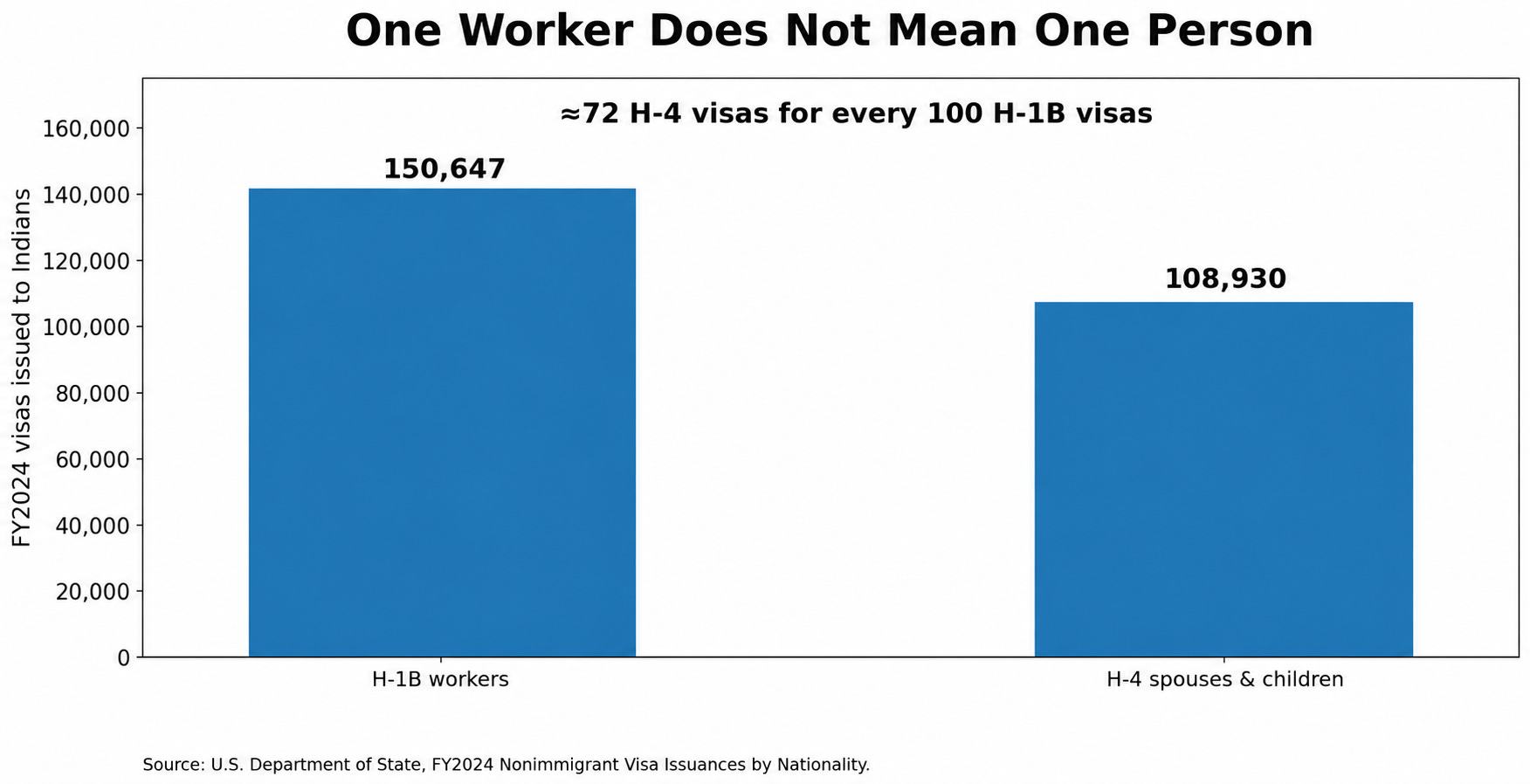
So when we hear 100 H-1B visas, the more complete picture in the Indian case is roughly 172 H-family visa issuances once spouses and children are included.
That does not mean 172 brand-new people entered America for the first time. Some had been here before, some were renewing visas, and families do not necessarily travel together.
But the larger point survives all of those qualifications.
The worker count is not the population count.
Then temporary employment can become permanent.
Once a worker obtains permanent residence and eventually becomes a citizen, another part of the immigration system opens. A citizen who is at least 21 may petition for parents, and those parents are classified as immediate relatives rather than being placed under the ordinary numerical caps that constrain some other family categories.
In FY2024 alone, the State Department issued 9,399 IR-5 immigrant visas to parents from India. Parents accounted for more than 60 percent of all immediate-relative immigrant visas issued to Indians abroad that year.
We cannot trace those 9,399 parents backward and pretend they are all the mothers and fathers of former H-1B workers. The government does not give us data that would support that claim.
But the pathway is real, and thousands of people use it.
A foreign student can become a worker. A worker can become a permanent resident. A permanent resident can become a citizen. A citizen can sponsor parents. Siblings may also be sponsored through a different, capped category, although those waits can be extremely long.
The H-1B is therefore not necessarily the end of an employment transaction. It can be one stage in a much longer immigration process.
Birthright citizenship adds another long-term dimension.
The phrase “anchor baby” tends to make people argue before they even get to the facts, so let’s start with what the law actually says.
A foreign couple does not have a child in America and magically receive green cards the next morning. A U.S.-born child cannot petition for a parent until age 21.
But the child generally becomes an American citizen at birth, and that citizenship can eventually have immigration consequences for the parents.
That question went all the way to the Supreme Court in 2026. On June 30, the Court ruled in Trump v. Barbara that children born in the United States to parents who are unlawfully or temporarily present are covered by the Fourteenth Amendment’s Citizenship Clause.
President Trump responded on August 6 with narrower executive orders targeting birth tourism and certain other categories, including children connected to foreign government officials and enemy aliens. The birth-tourism order also directed federal agencies to take action against people entering on nonimmigrant visas specifically for the purpose of giving birth here. Those measures were already drawing legal challenges by our August 21 cutoff.
Whatever happens with those narrower policies, the Supreme Court settled the broader question for now.
The original visa holder can be only the beginning. Spouses and children come through dependent categories, permanent residence can lead to citizenship, and citizenship opens the door to parents and other relatives. What starts as one temporary worker can eventually become a much larger permanent family presence.
The Company You’ve Never Heard Of
The deeper I looked at H-1B, the stranger the employment side became.
Most people probably imagine the program working like this: Microsoft needs a brilliant engineer, finds one in India, sponsors him and puts him to work at Microsoft.
That certainly happens.
But another structure looks very different.
A consulting or staffing company sponsors the foreign worker. That company may have a name almost nobody outside the industry recognizes. The employee is then assigned to perform his work for another business, sometimes with additional contractors sitting between the sponsor and the ultimate client.
The result can be a worker receiving his paycheck from Company A, being sponsored by Company A and spending every day doing work for Company C.
That arrangement can be perfectly legal. It also explains why a simple question like “Who do you work for?” can sometimes produce a surprisingly complicated answer.
The structure becomes more interesting when you look at the special rules for H-1B-dependent employers.
Federal law classifies employers as H-1B-dependent at certain concentrations of H-1B employees and subjects them to additional obligations involving American-worker recruitment and displacement. But many of those additional requirements do not apply when the foreign worker qualifies as an “exempt” H-1B worker.
A worker can qualify as exempt by having a relevant master’s degree or higher, or by earning at least $60,000 a year.
Here is the part that jumped out at me.
Congress set that $60,000 threshold in 1998. It has never been adjusted.
Think about that.
A salary Congress considered sufficient to identify a highly compensated foreign professional during the Clinton administration still serves as the threshold nearly three decades later.
Sixty thousand dollars may be a perfectly respectable salary depending on the occupation and location. It is hardly an extraordinary technology salary in much of America in 2026.
Yet crossing that old threshold can help remove additional recruitment and non-displacement requirements that otherwise apply to an H-1B-dependent employer.
Maybe Congress still thinks that makes sense.
If so, somebody should explain why.
The system gets uglier when the underlying job is not real.
Federal prosecutors have repeatedly brought cases involving staffing and consulting businesses accused of obtaining H-1Bs using fictitious jobs, fake client letters or other false representations so they could build a pool of workers before genuine positions were available.
The business logic is not difficult to understand. If an IT staffing company waits until a corporate client says, “I need ten programmers now,” and only then starts the immigration process, somebody else may fill the order first.
If that same company already has fifty visa-ready workers sitting in America waiting for assignments, it can respond immediately.
Now it has inventory.
The problem is that you cannot legally invent jobs in order to create that inventory.
Some people did anyway.
In one Virginia case, Raju Kosuri and Smriti Jharia pleaded guilty in a scheme involving more than 900 immigration benefits, primarily H-1Bs. Kosuri agreed to forfeit more than $20 million in proceeds. Other federal cases have documented variations of the same basic benching and fictitious-employment problem.
How common is it?
Nobody knows. That’s part of the problem.
The best-known random USCIS assessment examined 246 H-1B petitions filed in 2005 and 2006. It found fraud in 13.4 percent and technical violations in another 7.3 percent. Problems included document fraud and deliberate misstatements involving work locations, wages and duties.
That study is twenty years old, so I’m not saying 13.4 percent is today’s number.
What it does establish is that H-1B fraud was not imaginary, and the financial incentives for abusing a system like this are not hard to understand.
Which brings me to one of my favorite rules of thumb. A friend of mine who reads this Substack said this to me almost 20 years ago.
If it doesn’t make sense, it makes money.
If It Doesn’t Make Sense, It Makes Money
Follow the immigration pipeline and a lot of people get paid.
Universities collect international tuition. Recruiters and immigration attorneys make money helping people through the process. Staffing and consulting companies make money placing workers. Corporate clients get labor. Foreign workers gain access to American salaries and, potentially, permanent residence.
There is nothing automatically sinister about any of that. Markets are full of people making money by providing legitimate services.
There is a lot of money riding on this pipeline, and people tend to fight pretty hard for things that make them money.
In 2024-25, American colleges and universities hosted nearly 1.2 million international students, including those 363,019 from India. OPT participation was also at a record level. Universities openly cite the financial contributions of international students when explaining why they want those students on campus.
Then the student becomes a worker, and a different set of financial interests enters the picture.
One organization I had never heard of before researching this was ITServe Alliance, a trade association for IT services and consulting firms.
ITServe is unusually open about what political advocacy does for its members. In its own membership material, the organization said $300 of a $1,000 membership fee went toward policy advocacy, including paying a government liaison and litigation attorney, fighting immigration reforms that it said could eliminate its consulting model, and working to pass the HIRE Act.
Nothing illegal about that. They are telling members what they are paying for.
It becomes more interesting when you follow the political strategy.
ITServe created a federal Connected PAC in 2023. The Federal Election Commission classifies it as a trade-association, lobbyist/registrant PAC.
Then read ITServe’s own December 2023 newsletter.
The organization said it identified members of the House Judiciary Committee who could influence the HIRE Act, asked chapter presidents and PAC officials to build relationships with those members and described “facilitating donations to support the cause.” The same newsletter reported that its Atlanta chapter met with Judiciary Committee member Hank Johnson and made $10,000 in donations connected with the effort, including $2,500 from the Connected PAC.
Does that prove Hank Johnson was bribed? No.
It proves an industry group identified a politician who could influence legislation important to the industry, developed a relationship with him and contributed campaign money.
That is normal Washington politics.
You can decide for yourself whether “normal Washington politics” makes you feel better.
The HIRE Act did not disappear. A new version, H.R. 6305, was introduced on November 25, 2025, by Democrat Rep. Raja Krishnamoorthi, joined by Democrat Reps. LaMonica McIver and Shri Thanedar. As of our August 21, 2026 cutoff, it remained at the introduced stage.
The bill would increase the regular H-1B cap from 65,000 to 130,000 and remove the current 20,000 numerical ceiling on the advanced-degree exemption. It would also change the thresholds used to determine when companies become H-1B-dependent.
There is another detail here that I almost missed.
Krishnamoorthi’s own family came to America through the student-visa pipeline. He was three months old when his father came from India to attend graduate school in Buffalo.
Shri Thanedar’s story is even more direct. He came from India in 1979 on an F-1 student visa to earn his Ph.D. in chemistry at the University of Akron.
One came here himself as a foreign student. The other came as an infant because his father was a foreign student. Now one is sponsoring and the other is cosponsoring legislation that would substantially expand one of the employment pipelines that can follow.
Thanedar has been pretty open about how his own experience shaped his thinking. America gave him an education and opportunities he probably would not have had otherwise, and he sees that as an argument for giving more foreign students the opportunity to stay.
I understand that. If America trains some brilliant kid from India to become a world-class engineer and then tells him to get lost so Canada can hire him, that can be pretty stupid.
But a personal success story is not an immigration policy.
Krishnamoorthi and Thanedar can look at their own lives and understandably think, Why wouldn’t we want more of this? An American software engineer competing for the same job might have a different answer.
Then there is LaMonica McIver, the third original backer of the bill.
McIver was born and raised in Newark, so she does not have the same immigrant-student story. Her connection to the immigration issue comes from another direction. She sits on the House Homeland Security Committee and has become one of the more confrontational Democrat voices on immigration enforcement.
In 2025, McIver was federally charged after a confrontation with officers outside the Delaney Hall immigration detention facility in Newark during what she said was a congressional oversight visit. She pleaded not guilty. As of August 2026, the case was still being fought through the courts.
So look at the three original lawmakers behind this bill. Two have personal histories tied directly to the foreign-student pipeline. The third has made opposition to aggressive immigration enforcement a very visible part of her congressional record.
I’m not saying any of that is crooked. I am saying it tells you something about the people deciding how big these programs should get.
I think Washington has the whole immigration argument backward.
Universities want foreign students paying tuition. IT staffing companies want access to workers. Corporations want a larger labor pool. Immigration lawyers have clients, foreign workers want opportunities, families want relatives admitted and advocacy groups want the policies they were created to advocate for. Politicians, meanwhile, know exactly which constituencies they want to keep happy.
Everybody at the table seems to know what he wants.
The American citizen is often the only person nobody bothered to invite.
American elected officials are not members of some international customer-service department. Their first responsibility should be to the citizens who elected them.
That does not mean screwing over every foreign student or refusing to admit anyone from another country. It means the first question should not be, How can we give more people the opportunity to come here? It should be:
How does allowing more people to come here benefit the Americans who are already here?
Maybe doubling H-1B really would make America richer and stronger. Maybe keeping more foreign STEM graduates really does create enough new companies, inventions and jobs to outweigh the additional labor competition and population growth.
If so, show us.
Before doubling the program, we should know how often H-1B fills genuine shortages rather than simply providing another labor pipeline. We should know how much of it runs through third-party staffing, how often the rules are abused, what happens to the supposedly temporary population over the long run and whether American-worker protections written decades ago still make sense in 2026.
Saying “highly skilled” does not answer any of those questions. Neither does pointing to somebody who came here decades ago and became enormously successful.
That may be a wonderful American story.
It still does not tell us how many visas America should issue next year.
The Right to Say No
This brings me back to Michael Savage.
When I hear Borders, I no longer think only about somebody crawling through brush near Eagle Pass.
I think about the whole system: the airport, university, student visa, work authorization, H-1B, spouse and children, green card, family sponsorship, asylum system, consulting company, employer, lobbyist and politician.
They all connect to the same basic question.
Who gets to become part of America, and under what terms?
That is what a border ultimately represents. It is the ability to distinguish between citizens and noncitizens, visitors and residents, temporary admission and permanent settlement, legitimate applications and fraudulent ones.
Most importantly, it is the ability to say no.
There is nothing hateful about that. Every functioning country does it.
No individual has a natural right to move into the United States simply because living here would improve his life. If that were the standard, billions of people could make a perfectly rational argument for admission.
Immigration policy cannot be based solely on what is best for the immigrant.
Of course a man in India may make more money here. A family in Guatemala may be safer here. A student somewhere in Africa or Asia may get a better education here.
All of those things can be true while America still asks the question that ought to come first:
Is admitting this person in America’s interest?
A sensible immigration policy does not require shutting the country down. America can attract exceptional scientists, doctors, engineers and entrepreneurs. It can offer refuge in appropriate cases. It can allow reasonable family reunification and welcome people who genuinely want to become Americans and contribute to the country.
Immigrants have founded companies, created inventions, served in our military, raised good families and become some of the strongest believers in America precisely because they know what life somewhere else can look like.
The issue is not whether immigration can be good. Of course it can.
The issue is whether more immigration is automatically better, whether temporary programs should so easily feed permanent settlement, and whether Americans are still allowed to decide when enough is enough.
For decades, we have concentrated much of the immigration debate on people crossing illegally through the desert while a vast administrative immigration system has been operating in plain sight.
Students become workers. Workers become permanent residents. Permanent residents become citizens. Citizens can sponsor relatives. Universities make money educating people entering the pipeline. Staffing companies make money moving labor through it. Industry groups lobby to expand it. Politicians receive campaign support from people with a direct interest in its future.
Some of that is perfectly legitimate.
Some of it has been criminal.
All of it affects the composition of the United States.
That is why a border cannot merely be a wall. It has to be a functioning national policy through which Americans retain control over who enters their country, in what numbers, for what reasons and with what long-term consequences.
Michael Savage understood that 32 years ago.
But getting into America is only the first part of his warning. Once tens of millions of people from virtually every country on Earth are living inside the same borders, another question becomes unavoidable:
Can we still understand one another?
That brings us to Savage’s second word.
Language.
Coming next: Borders, Language, and Culture: LANGUAGE
Help Keep This Work Independent
Borders. Language. Culture. is going to take three essays to work through because none of these subjects can be reduced to a slogan.
For Borders, that meant digging through visa categories, immigration statistics, government reports, fraud cases, lobbying records, legislation and the money flowing through the system. Language and Culture are next.
If you think this kind of independent work is worth having around, there are a few ways you can help me keep doing it.
Become a Paid Subscriber
A paid subscription is the simplest way to support the writing on an ongoing basis. It helps me keep researching, writing and publishing work that does not depend on advertisers, corporate sponsors or somebody else’s approval.
Become a paid subscriber:
https://mrchr.is/help
Make a One-Time Gift
If you would rather contribute without another subscription, a one-time gift helps too.
Make a one-time gift:
https://mrchr.is/give
Prefer Venmo?
Venmo is simply the fastest direct option for readers who want to contribute without creating another account or recurring commitment.
Venmo:
https://account.venmo.com/u/mrchrisarnell
Join The Resistance Core
Resistance Core is for the small group of readers who want to provide a much larger level of support for where I am trying to take this work.
It is $1,200 per year, charged annually, which works out to the equivalent of $100 a month.
That support is meant to help me grow beyond essays alone, produce more content including video, continue building An Inconvenient Black Truth into a book, and eventually develop some of the educational projects I have talked about.
Join Resistance Core:
https://mrchr.is/resist
If You Cannot Give
Keep reading.
Share this essay. Restack it. Send it to somebody who still thinks a country’s border begins and ends with a fence in Texas.
That helps too.
And stick around. There is a lot more to come.
Savage was always ahead of everyone and that is why mainstream media pretended he did not exist. He was right and they were wrong consistently.
According to my inflation calculator app, $60,000 in 1998 is equivalent to $118,432 in 2026 dollars.