

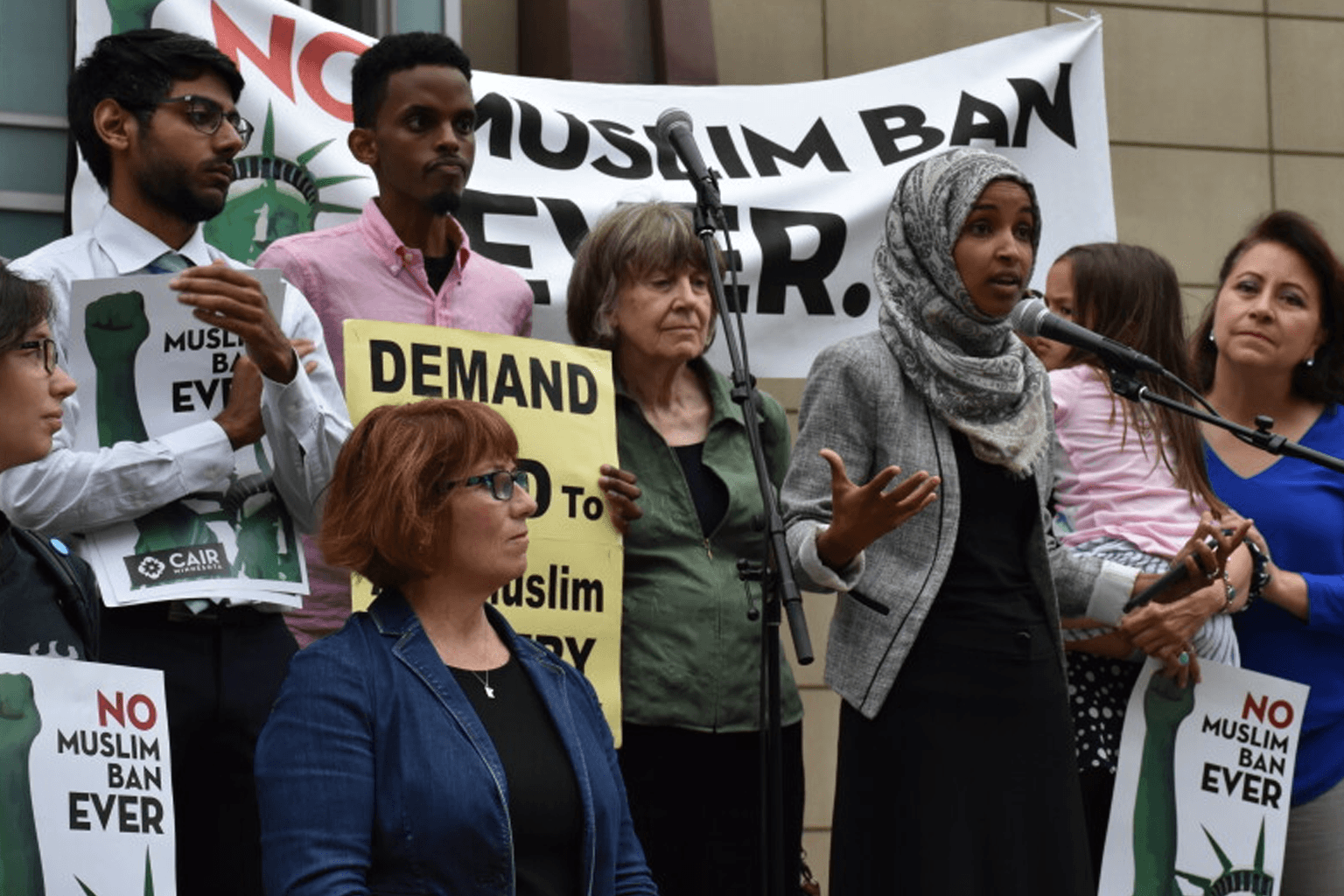
“How many years does a country have to wait before it is allowed to say assimilation failed? Ten? Twenty? A generation? Two?”
Michael Savage’s first word was Borders. The second was Language. Now we get to the third: Culture.
In BORDERS, I argued that a border is not simply a fence. It is the system through which Americans decide who enters, how many enter, why they are coming and when temporary admission becomes permanent membership.
In LANGUAGE, I argued that a country containing hundreds of millions of people from every racial, religious and ethnic background needs a common language through which they can understand one another.
Immigrants do learn English. Their children generally learn it even better. Indians often arrive already speaking it. Hispanic English proficiency improves dramatically across generations. I included those facts because if the evidence complicates my argument, then my argument needs to get better.
Everybody speaks English. Now what?
A man can speak flawless English and still believe women should have fewer rights than men. He can believe insulting his religion should be punished, clan loyalty matters more than impartial law, corruption is simply how business gets done, political violence is justified when elections do not go his way or his first political loyalty belongs to a country 8,000 miles away.
English allows us to understand what he is saying. It does not require us to accept it.
That is why Savage needed a third word, and it is where my patience starts running out.
Culture Has Consequences
Americans have been trained to think about culture in the safest possible way. Culture means tacos, Bollywood, Chinese New Year, saris, mosques, German beer halls and somebody’s grandmother making tamales.
Great. None of that is the problem.
Culture is also the collection of assumptions people carry around about authority, family, religion, honesty, sex, violence, marriage, women, children, government, loyalty, outsiders, work, law and individual freedom.
Some cultural differences make dinner more interesting. Others determine whether your daughter has rights.
We have spent decades flattening the word culture until it means little more than food, festivals and costumes. Somebody says “diversity is our strength,” everyone nods approvingly and apparently the thinking part is over.
It isn’t.
Diversity can mean a Catholic living next door to an atheist, an Indian engineer working beside a black programmer or a Korean family opening a restaurant next to a Jewish deli. It can also mean bringing large numbers of people from societies where assumptions about religious authority, women, free expression, corruption, family obligations, government and individual rights differ sharply from our own.
The first kind of diversity mostly changes what is available for dinner. The second can change what kind of country your grandchildren inherit.
Not every cultural difference deserves applause simply because somebody put the word diversity in front of it.
America Actually Has a Culture
Modern America has developed a strange habit of pretending there is no such thing as American culture, as though we are merely a geographic location with a GDP. Unfortunately, decades of propaganda and an education system that increasingly teaches young Americans to be embarrassed by their own country have produced exactly that.
American culture has never meant that everybody eats the same food, worships the same God, listens to the same music or came from the same bloodline. America was fighting over religion, race, immigration and class long before anybody reading this was born. Underneath all of that developed a civic culture.
The Constitution outranks your religion. The law applies to you whether your grandfather was born in Boston, Bangalore or Mogadishu. Government is not supposed to punish you because you criticized somebody’s faith. Unless, of course, you’re a Baltimore County school board member who posts something critical of Sharia law. A woman has the same legal standing as a man. An individual is not legally owned by his clan, church, tribe, husband, father or racial group. Political power changes through elections rather than coups, machetes or mobs.
You may worship God or decide there is no God. You may call somebody else’s religion wonderful, ridiculous or evil. You may own property, challenge the government and demand due process before the state takes your freedom.
America has violated those principles plenty of times. Slavery and Jim Crow are the obvious examples. But hypocrisy does not erase a principle. In fact, Americans condemned those injustices precisely because the country had violated standards it claimed to believe. The fact that America has sometimes failed to live up to its ideals is not an argument for abandoning the ideals.
Even citizenship law recognizes that becoming American is supposed to mean more than receiving different paperwork. A naturalizing citizen swears to renounce foreign allegiances, support and defend the Constitution and laws of the United States, and bear true faith and allegiance to them.
That sounds suspiciously like a culture to me.
America is not an empty hotel room where everyone who checks in gets to rearrange the furniture.
Assimilation Does Not Mean Becoming a Clone
Assimilation does not mean erasing every custom you brought with you. Keep the food, holidays, religion, family traditions and language you use at home. None of that is the issue.
I lived in Germany and remained American the entire time. Learning German did not erase me. It allowed me to function inside Germany.
Assimilation does not require sameness. It requires compatibility.
You want your religion to dictate what you eat? That’s your business. You want it to dictate what I am allowed to say? No.
You want to arrange a marriage between two consenting adults? None of my business. You want coercion to substitute for consent? No.
A foreign government, religious court, tribal structure or clan elder claiming authority above American law is something else entirely.
We don’t do that here. Or at least we shouldn’t.
The old melting-pot idea never required eliminating every difference among people. It meant putting millions of very different people through enough common institutions, expectations and experiences that eventually they became Americans who happened to have different backgrounds.
Somewhere along the way, we decided expecting the melting pot to actually melt anything was culturally insensitive.
America will change somewhat as immigrants arrive. It always has. Pizza became American. Tacos became American. Irish, Jewish, Italian, Polish, Asian, Hispanic and black cultures have all shaped the country.
The issue is not whether newcomers influence America. They will. The issue is whether America still decides which principles are negotiable.
Some things should not be.
Nobody Factory-Resets at Customs
One of the dumbest assumptions hiding inside modern immigration politics is that crossing a border somehow wipes a person’s mental hard drive.
It doesn’t. People arrive carrying ideas, strengths and weaknesses just like everyone else. They may bring ambition, work ethic, family loyalty and entrepreneurship. They may also bring prejudices, political habits, religious assumptions, tribal conflicts and cultural baggage from the societies they left.
When I lived in Germany, I did not step off the plane and stop thinking like an American. I carried America around in my head. Modern technology makes maintaining the old world easier than at any other point in human history.
In LANGUAGE, I compared an Italian arriving in New York in 1900 with an immigrant living in Texas in 2026. The Italian could write letters home and maybe occasionally travel back. For the most part, America was in his face every day.
The immigrant today can wake up reading Indian news, spend lunch inside Indian social-media groups, FaceTime India after dinner, watch Indian television, follow Indian politics, stream Indian entertainment and remain continuously plugged into the society he physically left. The same principle applies to immigrants from Mexico, Somalia, China, Pakistan or almost anywhere else.
Sometimes you do not have to guess where the emotional attachment still lies. In the 2024 T20 Cricket World Cup on Long Island, India actually played the United States. The stadium was packed with Indian-American fans, some carrying signs that read “USA is home. India is heart” and “I live in the US but my heart always belongs to India.”
One of them was Ankur Barot. He was born in India, became an American citizen and had served six years in the U.S. Army. His 13-year-old son rooted for the United States. Barot rooted for India, wearing the Indian flag. When his son told him he was supporting America instead of India, Barot said it “broke my heart a little bit,” while acknowledging that his son was American and loved the United States.
Then came this summer’s soccer World Cup. When the United States played Bosnia and Herzegovina in California, Lejla Kuhinja, who was born in Bosnia but had lived in America since 1995, described the matchup as “a homeland versus a motherland.” She wanted Bosnia to win. Thirty-one years in America, yet when the two countries finally faced each other, America was still the homeland and Bosnia was still the motherland.
Rooting for a foreign sports team does not make somebody disloyal. But these moments reveal something a questionnaire may not. For some immigrants, America can become the place they live, work, raise their children and become citizens while the country they left remains the place of their deepest national attachment.
How long should that distinction last? Five years? Twenty? Thirty? Forever?
Immigration moves the body immediately. Assimilation has to move the mind.
The evidence says it often does. Second-generation immigrants tend to identify more strongly with America, improve economically, broaden their social networks and marry outside their ancestral groups more often than their parents did.
Muslim Americans are useful here because the cultural distance between American norms and those of some Muslim-majority countries can be considerable. Pew found in 2017 that 92 percent of Muslim Americans said they were proud to be American. Among Muslim immigrants, those who had lived here longer were also far more likely than recent arrivals to say they had a lot in common with other Americans.
But “proud to be American” is not a synonym for culturally assimilated. A person can value American prosperity, citizenship and constitutional protection while simultaneously wanting American institutions or social norms to move closer to his own religious beliefs.
Pew’s findings on homosexuality show why the distinction cannot be ignored. In 2007, only 27 percent of Muslim Americans said homosexuality should be accepted by society. By 2017, that had risen to 52 percent. Yet Pew’s newer 2023-24 Religious Landscape Study found only 41 percent saying homosexuality should be accepted, while 55 percent said it should be discouraged. The surveys use somewhat different methods, so those numbers should not be treated as one perfectly clean trend line.
But they certainly do not support some comforting story in which cultural differences simply disappear with time.
Assimilation can happen. Assuming it inevitably will is something else entirely.
America has assimilated millions of people who arrived with very different assumptions. That makes persistent failure harder to excuse, not easier.
Thirty Years Is Not “New”
Minnesota gives us an uncomfortable example.
The major Somali migration to Minnesota dates to the early 1990s. Minnesota’s own employment agency traces the first large wave to 1992, following the collapse and civil war in Somalia.
That was 34 years ago.
At some point we have to stop describing every persistent problem inside an immigrant community as the temporary struggle of new arrivals.
Minnesota’s Department of Employment and Economic Development published a revealing study in March 2026 examining more than 26,000 Somali students who exited Minnesota high schools between 2006 and 2022. Nearly 97 percent had come from low-income families as measured by eligibility for free or reduced-price lunch. About 73.5 percent had been classified as having limited English proficiency at some point during high school. Only about 27 percent earned a postsecondary credential, and Somali students took roughly nine years after high school to reach a living wage, compared with six years for the white comparison group.
Those are ugly numbers, but the same study also found strong employment participation among Somali young adults, including a higher employment rate than the white comparison group. So this is not simply a story about people refusing to work.
The newest Minnesota demographic report shows this is no longer simply an English problem.
Among Somali Minnesotans age five and older, the state estimates roughly 53,600 speak English well, while about 10,800 do not speak it well or at all. Most of the population in that age group therefore falls on the English-proficient side of the state’s measure.
So if somebody wants to explain every bad outcome by saying, They just need time to learn English, that excuse is starting to wear pretty thin.
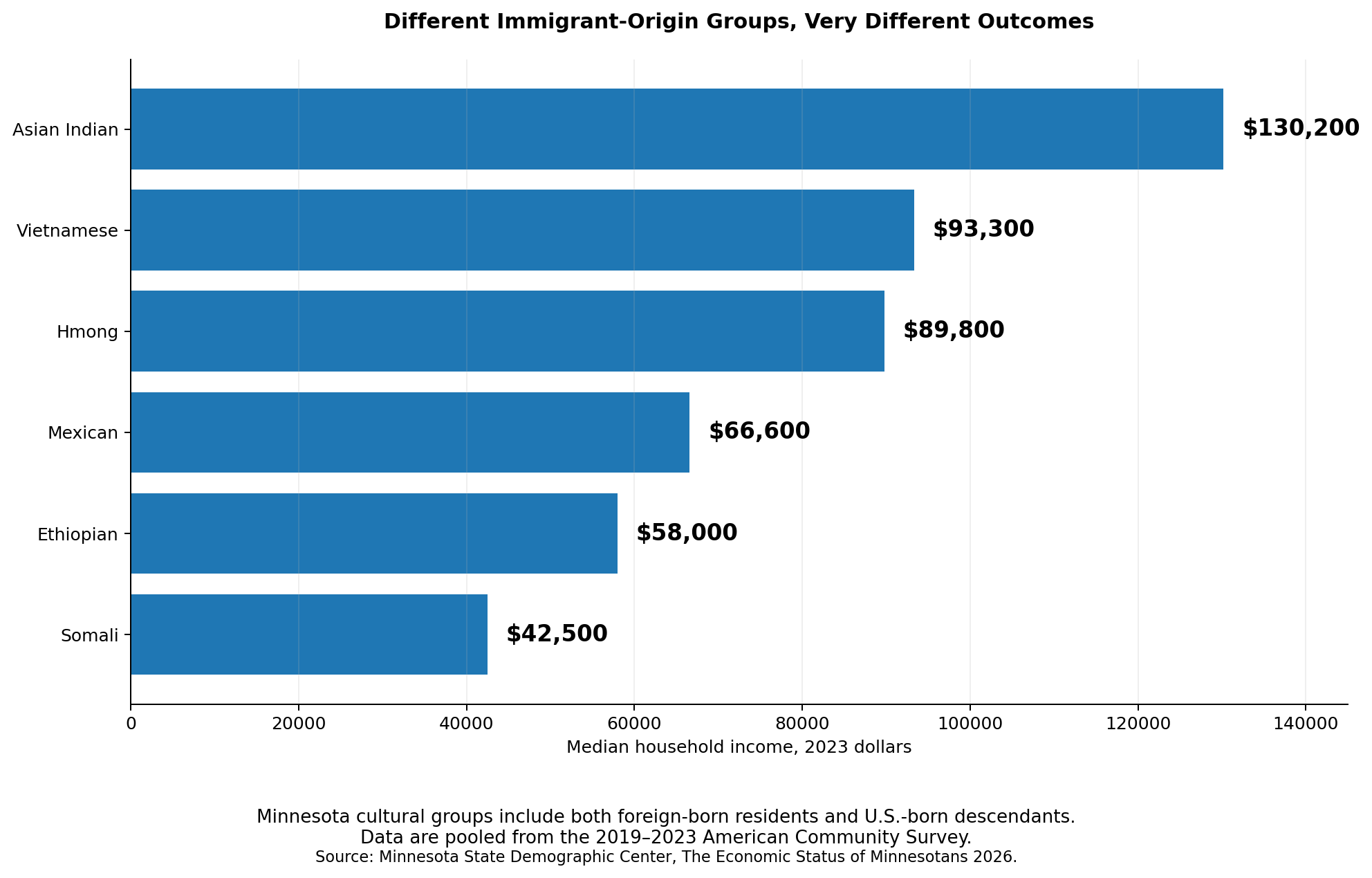
Minnesota’s 2026 report puts Somali median household income at about $42,500, compared with $130,200 for Asian Indian households and $82,700 statewide. Somali households were near the bottom of every cultural group studied, while Asian Indian households were at the top.
The education difference is just as hard to ignore. The state found that 37 percent of Somali adults ages 25 to 64 lacked a high-school diploma or GED, the highest share of any cultural group Minnesota examined. Asian Indians sat at the opposite end of the scale, with exceptionally high college attainment.
Different populations. Same state. Same American economy. Same basic laws.
Very different results.
There is also the public-assistance question.
American Community Survey calculations supplied by Minnesota’s state demographer found that during 2019 through 2023, about 60 percent of Minnesotans reporting Somali ancestry received SNAP and 78 percent were covered by Medicaid. When SNAP, Medicaid and the much narrower category of public-assistance income were combined, about 84 percent received at least one.
That does not mean 84 percent collected cash welfare. Only about 8 percent reported public-assistance income in the narrower Census sense, and Medicaid accounted for a large portion of the overall number, particularly among children.
If I have to lie about the number to make the argument, the argument isn’t worth much.
Even after all those qualifications, what exactly are Americans supposed to call the broader picture?
After more than three decades, most people covered by the state measure speak English well and younger Somalis participate heavily in the workforce. Those facts eliminate some easy explanations. They do not eliminate the problem.
Enormous disparities remain in household income, education and reliance on means-tested programs.
At some point, poor assimilation cannot be blamed on being new, and poor outcomes cannot all be blamed on not speaking English.
When does the clock run out on give it time? Twenty years? Thirty? Fifty?
If those outcomes persist into another generation, Americans are entitled to ask whether immigration policy should care not merely about how many people enter but how effectively particular streams of migration integrate after they arrive.
Refusing to ask that question because somebody might call it racist is not serious policymaking.
Not all immigrant populations produce the same outcomes. If the single label immigrant explained everything, Indians and Somalis living under the same Minnesota government would not produce economic and educational numbers that look as different as they do.
People arrive with different education levels, languages, skills, family structures, migration histories and cultural backgrounds.
Pretending none of that is relevant is not compassion.
It is refusing to look.
The Melting Pot Requires Heat
Assimilation requires pressure. Not police-state pressure, just the ordinary pressure created by social expectations, work, schools, neighbors, language, friendship, marriage and shared institutions.
It also requires a clear understanding that the country you entered existed before you got there and will not apologize for expecting you to become part of it.
That happened to me in Germany. Nobody arrested me for speaking English and nobody threw rocks at me. Germany simply conducted German life in German. The ATM was German. My coworkers spoke German. Television was German. The doctor was German. My girlfriend spoke German to me. The bank operated in German.
I learned German because I had incentives to learn it.
Modern America increasingly creates incentives in the opposite direction.
Translation may sometimes be necessary, and ethnic businesses, religious institutions and foreign-language media are perfectly legal. Legality is not the same question as assimilation.
Put enough of those pieces together, though, and something changes.
A person can potentially find doctors, attorneys, employers, realtors, stores, religious institutions, political organizations, media and a social network largely inside his own community. Add smartphones, instant translation, foreign television, cheap international communication and daily contact with the old country, and the larger American culture becomes much easier to avoid than it was a century ago.
That does not guarantee non-assimilation. It reduces some of the pressure that once made assimilation difficult to escape.
The old melting pot required heat. If everyone enters it and is assured he should never have to change, then the metaphor no longer describes what is happening.
Assimilation means America changes the immigrant more than the immigrant changes America. Otherwise the word has lost its meaning.
America will change too. That is inevitable. But somebody still has to provide the basic rules.
Diversity Is Not a Magic Word
“Diversity is our strength.”
Maybe. Sometimes. Under the right conditions. It certainly is not a law of physics.
A major 2020 review in the Annual Review of Political Science examined 1,001 estimates from 87 studies dealing with ethnic diversity and social trust. The researchers found an overall statistically significant negative relationship, particularly for trust in neighbors and when diversity was measured at the local level.
No study proves every diverse neighborhood will become dysfunctional. That is not the claim. The point is that the endlessly repeated slogan “diversity is our strength” has to be proved, not recited.
Cohesion matters. So does trust, especially the belief that your neighbor generally accepts the same basic rules you do.
A population can contain enormous racial and religious diversity and remain cohesive if people trust the same institutions, obey the same laws and increasingly see one another as fellow citizens. It can also become more tribal as it becomes more diverse.
The danger is not that your neighbor has darker skin, worships differently or eats food you cannot pronounce. The danger begins when politics teaches both of you that his skin and your skin place you in competing political tribes with different grievances, different interests and different claims on government.
At that point diversity stops being merely demographic and becomes political infrastructure.
Culture Has a Price Tag Too
Most immigrants work, but that is not the entire economic calculation. They require housing, schools, roads, medical capacity and government services while also working, paying taxes, opening businesses and creating demand. Both sides of the ledger exist.
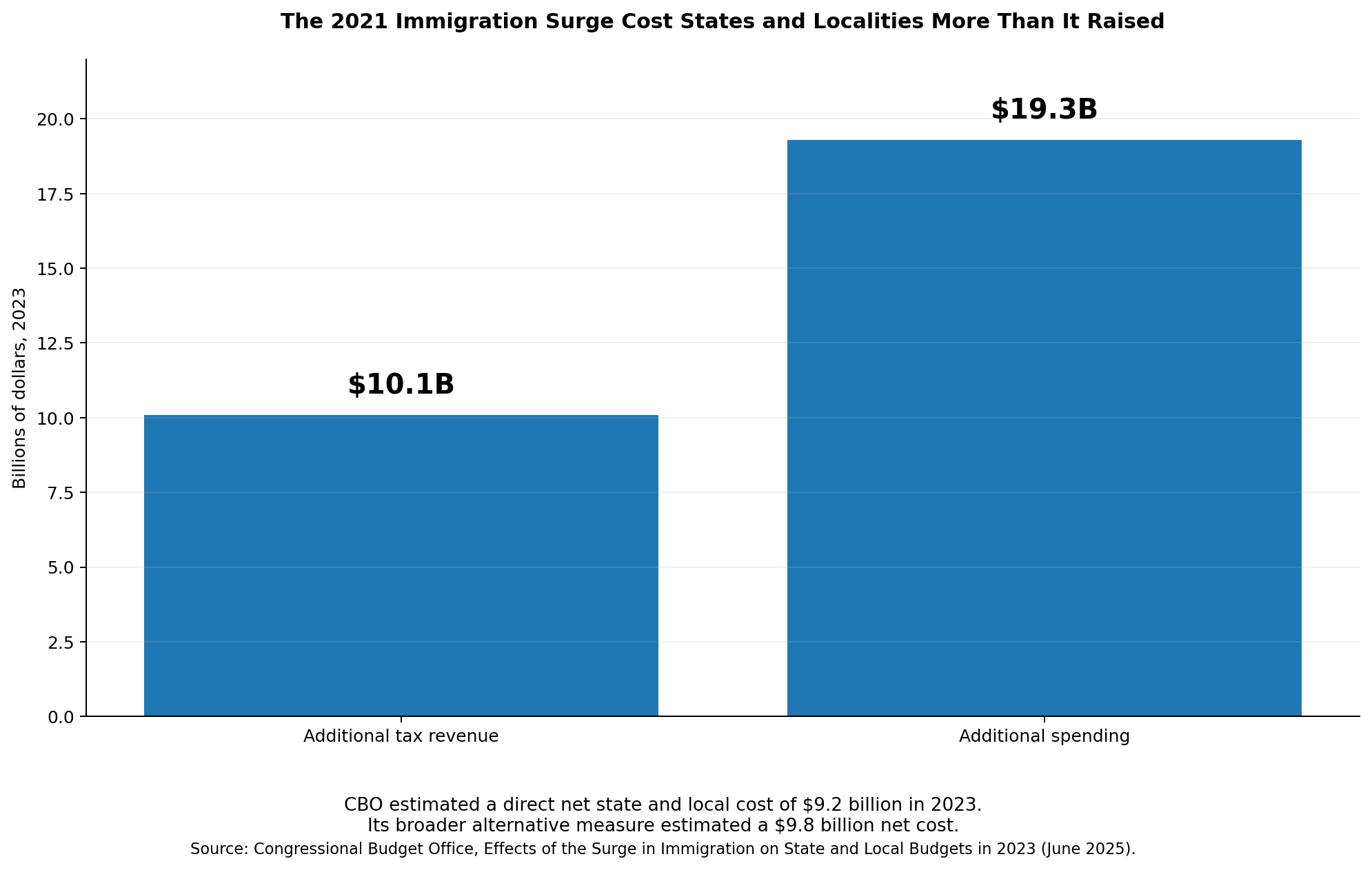
CBO estimated that the immigration surge beginning in 2021 produced $10.1 billion in additional state and local revenue in 2023 but $19.3 billion in direct additional spending, leaving a $9.2 billion direct net cost. Its broader measure put the net cost at $9.8 billion. Major expenses included public schools, shelter and related services, and border security. CBO also estimated an additional $1.2 billion for services to English-language learners.
At the federal level, the picture was different. CBO projected the same immigration surge would reduce federal deficits by roughly $900 billion from 2024 through 2034 while increasing total nominal GDP by about $8.9 trillion over that period.
There is nothing contradictory about those findings. But neither is the federal number some magical rebuttal to the costs Americans experience locally. A larger population can produce more GDP and more federal revenue while simultaneously making housing more expensive and leaving states, cities and lower-skilled workers carrying costs of their own.
CBO also projected that through 2026 the surge would slightly slow wage growth for workers already here with twelve or fewer years of education because the supply of workers with similar skills increased. CBO expects that effect to reverse later as other productivity effects emerge.
Housing is even easier to understand.
CBO has said directly that the immigration surge increased housing demand and put upward pressure on home prices and rents, with larger effects in places where zoning, geography or other constraints prevent supply from expanding quickly.
Apparently supply and demand still works when Congress discusses immigration.
Add millions of people to a country with a housing shortage and those people require somewhere to live. That does not make them evil. It makes them people.
Crime deserves the same honesty. If I tell you immigrants as a whole have higher crime rates than native-born Americans, the best available evidence does not support me. Health-care use complicates the easy story too.
Then don’t make claims the evidence does not support.
There are plenty of real consequences without inventing fake ones. Immigration policy does not require proving immigrants are uniquely criminal, unhealthy or dependent. It requires answering a simpler question: How many people should America admit, which people, and what happens to Americans already here when it does?
Population growth has consequences even when the additional resident is Mother Teresa.
CBO’s newest demographic outlook makes the long-term issue even harder to ignore. Starting in 2030, CBO now projects annual American deaths will exceed births. From that point forward, net immigration accounts for all projected population growth. Without immigration, the population would begin shrinking.
Think about what that means.
Immigration is becoming the mechanism through which America determines whether its population grows and, increasingly, what that future population looks like.
That is not merely labor policy anymore.
It is national policy in the most literal sense.
Eventually national population policy becomes political.
When Diversity Becomes a Tactic
Here comes the part people will hate.
The subtitle says that at some point diversity stops being an experiment and starts becoming a tactic, so let’s talk about the Democrat Party.
I cannot prove Democrat leaders gather in a dark room every Tuesday and ask how they can destroy American cohesion before lunch. I don’t need to. Look at what they publicly support.
The Democrat Party’s most recent national platform supported permanently increasing family-sponsored and employment-based immigration. It backed legislation adding 250,000 immigrant visas over five years, expanded lawful pathways and citizenship opportunities, and touted faster naturalization processing.
That is their policy. Americans are under no obligation to pretend its demographic consequences are accidental or politically irrelevant.
The DNC also openly organizes along demographic and constituency lines. Its own “Who We Serve” operation includes African Americans, Asian Americans and Pacific Islanders, Latinos, Ethnic Americans, the LGBTQ+ community, women and numerous other constituencies. Its Ethnic Americans organization describes itself as working through networks “organized along immigrant and ethnic lines” to foster support for Democrat candidates and causes.
Its Latino operation is even more explicit. The DNC says that as the Latino population grows, those communities have increasingly turned out and organized around shared priorities with Democrats. Its Adelante program is specifically designed to register, organize and mobilize Latino voters in English and Spanish.
None of that is secret. It is on their own website.
Before somebody on the right gets lazy, naturalized citizens are not guaranteed Democrat voters. In 2020 they strongly favored Biden. By 2024 that margin had nearly disappeared. Pew found naturalized voters divided about 51 percent for Harris and 47 percent for Trump.
So stop saying Democrats simply “import voters” as though every immigrant arrives with a DNC membership card tucked into his suitcase.
The Democrat Party supports larger immigration flows, broader citizenship pathways and faster naturalization. It then openly maintains political operations designed to organize many of the ethnic and immigrant-origin constituencies those policies help enlarge.
Some eventually vote Republican. That means the political payoff is not guaranteed. It does not mean demographic politics does not exist.
Every immigration policy eventually becomes a population policy. Population policy changes the electorate. The electorate changes government. Government changes the country.
The more troubling issue is what happens when the political system trains Americans to think primarily as members of competing demographic groups.
A cohesive electorate asks what is good for the country. A fragmented electorate increasingly asks what its particular group gets. Politicians then become brokers of grievances, benefits and identities.
Your grievance for your vote. Your benefit for your turnout. Your identity for their power.
A country becomes harder to govern as one people when politics trains everyone to think of himself as a member of a competing tribe. If immigration continuously adds populations that political organizations immediately classify, court and mobilize as ethnic constituencies, fragmentation can become politically useful.
That is what I mean by tactic.
Not a secret plan scribbled on a napkin somewhere in Washington.
A political system that has learned how to convert demographic difference into power.
The Suicide Part Is Ours
Politicians encouraged it. Activists rationalized it. Some immigrants took full advantage of it. But Americans built the system that made all of it possible.
You cannot assimilate millions of newcomers into a culture you are afraid to defend.
What exactly are immigrants supposed to assimilate into when our own institutions struggle to say America is worth assimilating into?
We teach American history so often through the lens of national shame that achievement can become an afterthought. Patriotism becomes suspicious. Assimilation becomes xenophobic. Expectations become oppression. Borders become cruelty. A common language becomes intolerance.
At the same time, every minority population is encouraged to preserve identity indefinitely while the idea of a common American identity is increasingly treated as vaguely threatening.
Imagine inviting somebody into your family while telling him your family is awful, its history is disgusting, its traditions are embarrassing, its rules are oppressive and he should feel absolutely no obligation to adopt them.
What result would you expect?
Every civilization depends on transmission. Parents teach children. Schools teach history. Institutions reward particular behavior. Citizens enforce expectations informally. Newcomers discover which rules are negotiable and which are not.
Stop transmitting those norms and nothing guarantees they simply float around forever.
A civilization embarrassed by itself is already halfway to surrender.
The immigrant is not solely responsible for assimilation. The host country has a job too.
It needs something worth joining and enough confidence to say so.
There Have to Be Non-Negotiables
What should assimilation actually require?
Not hamburgers, country music, Christianity, white skin or pretending your ancestors came over on the Mayflower.
The standard should be civic.
American constitutional law outranks religious law, clan law and foreign political authority. Men and women possess equal legal rights. Freedom of speech includes the freedom to insult your religion. Freedom of religion includes the freedom to leave your religion. Political disputes get settled through laws, elections and persuasion rather than threats or violence.
No imported caste receives legal recognition. No ethnic or religious population gets veto power over criticism. No immigrant community should come to America, organize politically along ethnic lines, elect its own people and then use that power to recreate the country it left. No husband, father, imam, pastor, activist or clan elder owns another adult citizen. Citizenship should require loyalty to the United States above foreign political causes.
Within those boundaries, do whatever you want.
Keep anything you brought with you that fits inside them.
What does not fit stays behind.
People leave countries for war, poverty, education, persecution, jobs and family. Leaving Somalia does not mean rejecting every Somali custom any more than living in Germany made me reject everything American.
But choosing America does not obligate America to recreate the place you left.
America offers access to one of the largest economies on Earth, universities, courts, property rights, constitutional protections, labor markets, political stability and potentially citizenship.
Assimilation is not some extraordinary favor immigrants perform for America. It should be part of the price of admission.
Who Gets the Keys?
There is one more conclusion I have reached that will probably piss people off. I do not think becoming a naturalized citizen should automatically make someone eligible to hold elected office in the United States.
The Constitution already recognizes the concern. A naturalized citizen can never become president. The Founders were explicitly worried about foreign influence and attachments formed before someone became American. For the House they required seven years of citizenship. For the Senate, nine. In discussing the Senate, the Framers worried about the time necessary to overcome the “affections of education and native attachments,” and Federalist No. 62 argued that senators should be sufficiently removed from the habits and assumptions associated with foreign birth and education.
But think about how strange the logic becomes once you apply it only to the presidency.
Imagine your house has a front door, a side door and a back door. You decide that security is so important that nobody without the proper background can ever have a key to the front door. Then you hand out keys to the side and back doors.
Your house is not secure. You have simply protected one entrance.
Congress writes the laws. Governors wield executive power over entire states. State legislators determine education policy, election rules, taxes and criminal law. Mayors can govern cities larger than some countries. If foreign political attachment is a legitimate concern when somebody wants the keys to the White House, why does it magically become irrelevant when the same person wants the keys to Congress, a governor’s mansion or city hall?
And there is evidence that political assimilation, like cultural assimilation, can take time.
A 2021 Cato Institute survey found that first-generation immigrants leaned Democrat by a substantial margin: 48 percent identified with or leaned toward Democrats, compared with 26 percent Republican and 26 percent independent. More strikingly, 60 percent of first-generation immigrants viewed socialism favorably, compared with 49 percent of the second generation and 39 percent among later generations. Nearly half, 48 percent, said they viewed themselves more as global citizens than as citizens of the United States, more than twice the 21 percent among other native-born Americans.
Those numbers do not prove that most immigrants are Marxists or that naturalized citizens are disloyal. In fact, the same survey found strong attachment to America among many immigrants, and 63 percent of first-generation immigrants also viewed capitalism favorably. The point is more basic: people do not shed an entire lifetime of political assumptions at the naturalization ceremony. Political assimilation appears to change across generations just as language, identity and culture do.
That helps explain why the modern Democrat Party is obviously closer than the Republican Party to many of the larger-government and socialist-leaning preferences reflected in those numbers. That does not require a conspiracy and it certainly does not mean every immigrant votes Democrat. It means the political culture someone brings with him can affect which American political coalition feels familiar.
So I would go further than the Constitution currently does.
I would not allow naturalized citizens to hold elected office.
That is not because naturalized citizens are lesser human beings or because citizenship should be fake. Citizenship would still mean voting, working, owning property, speaking freely, raising a family and enjoying the same constitutional protection as every other citizen. But governing other Americans is not merely another benefit of citizenship. It is the exercise of public power.
There is a difference between saying, Welcome to America. You are one of us, and saying, Here are the keys. Start rewriting the rules.
Someone who immigrates at 35 could become an American citizen after spending the overwhelming majority of his formative life somewhere else. His education, political instincts, religious assumptions and understanding of government were not formed here. Maybe he assimilates completely. Maybe he does not. Either way, America is under no moral obligation to gamble governmental power on the assumption that a passport automatically rewrites a lifetime.
And if that sounds radical, remember that we already apply exactly that principle to the most powerful elected office in the country.
My argument is simply that if the principle is sound, we should stop pretending the other doors can be left unlocked.
How Long?
So we come back to the question at the beginning. How long does assimilation get? Ten years? Twenty? A generation? Two?
I do not know the magic number. Nobody does. What I do know is that eventually cannot be an immigration policy.
At some point outcomes matter.
If one immigrant population becomes overwhelmingly English proficient, economically successful, intermarried and institutionally integrated within a generation while another remains economically isolated, heavily dependent on public assistance or concentrated inside a parallel community decades later, Americans have every right to notice the difference.
More importantly, they have every right to use what they learn when deciding future immigration policy.
That does not mean deporting American citizens because somebody thinks they failed a cultural purity test. Citizens are citizens.
The sensible place to exercise judgment is before temporary admission becomes permanent settlement and before permanent settlement becomes citizenship.
That was the point of BORDERS.
America has the right to say yes, which necessarily means it retains the right to say no.
The criteria should include more than whether somebody can fill a job opening this quarter.
Countries last longer than quarterly earnings reports.
Borders. Language. Culture.
Thirty-two years ago Michael Savage reduced the argument to three words: Borders. Language. Culture.
It sounded harsh then. It sounds considerably less crazy today.
Borders determine who enters. Language determines whether we can understand one another.
Culture determines whether, after we understand one another, there is still an “us.”
America has already proved it can survive different skin colors, foods, accents, religions and places of birth. That was never the real test.
The real test is whether a country remains a country once enough of its people stop agreeing about the basic rules under which everyone is supposed to live.
A nation that imports people faster than it can assimilate them is not celebrating diversity.
It is gambling with its own continuity.
Worse, America has spent decades weakening some of the institutions and expectations that once made assimilation difficult to avoid, while political organizations discovered that demographic fragmentation can be converted into constituencies, constituencies into votes and votes into power.
Then the people who notice are told that noticing itself is hateful.
No.
At some point a civilization gets to defend itself. Citizenship has to mean something, assimilation has to produce an outcome rather than an excuse, and Americans have to be allowed to decide what America is going to remain.
At some point diversity stops being an experiment and starts becoming a tactic.
If saying that is intolerant, fine.
A functioning civilization has to be intolerant of something. It should probably start with the ideas capable of destroying it.
If You Want More Work Like This
Become a Paid Subscriber
A paid subscription helps me keep researching, writing and publishing this work.
Become a paid subscriber:
https://mrchr.is/help
Make a One-Time Gift
Make a one-time gift:
https://mrchr.is/give
Prefer Venmo?
Venmo:
https://account.venmo.com/u/mrchrisarnell
Join The Resistance Core
The Resistance Core is $1,200 per year, charged annually, for readers who want to make a larger commitment to the work.
That support is intended to help me expand what I am doing rather than simply maintain it: more original research, more writing, more video, continued work toward my book An Inconvenient Black Truth, and eventually larger educational projects built around the same mission.
I currently have only a handful of people supporting the work at that level, and I do not take what they have done for granted.
Join Resistance Core:
https://mrchr.is/resist
If You Cannot Give
Keep reading.
Share this essay. Restack it. Forward it to someone, or post it somewhere people who would never otherwise find me might see it.
I spent three essays talking about what makes a country worth preserving.
If you think this kind of work is worth preserving too, I could use your help.
And thank you for reading.
Paid subscribers, I'd love to hear your thoughts after reading all three: Which one do you think America is failing at most right now, and why?
Borders can be fixed with policy. Language can be learned. Culture seems like the hardest one to get back once you’ve lost it.
Interested to hear your opinions.
Great series Chris! We only need to reference England for look at what bad immigration policies lead to.
We should offer every native British/irish Christian US citizenship to get over our birth rate problem and save them from becoming victims of the empire’s murderous depopulation scheme.