

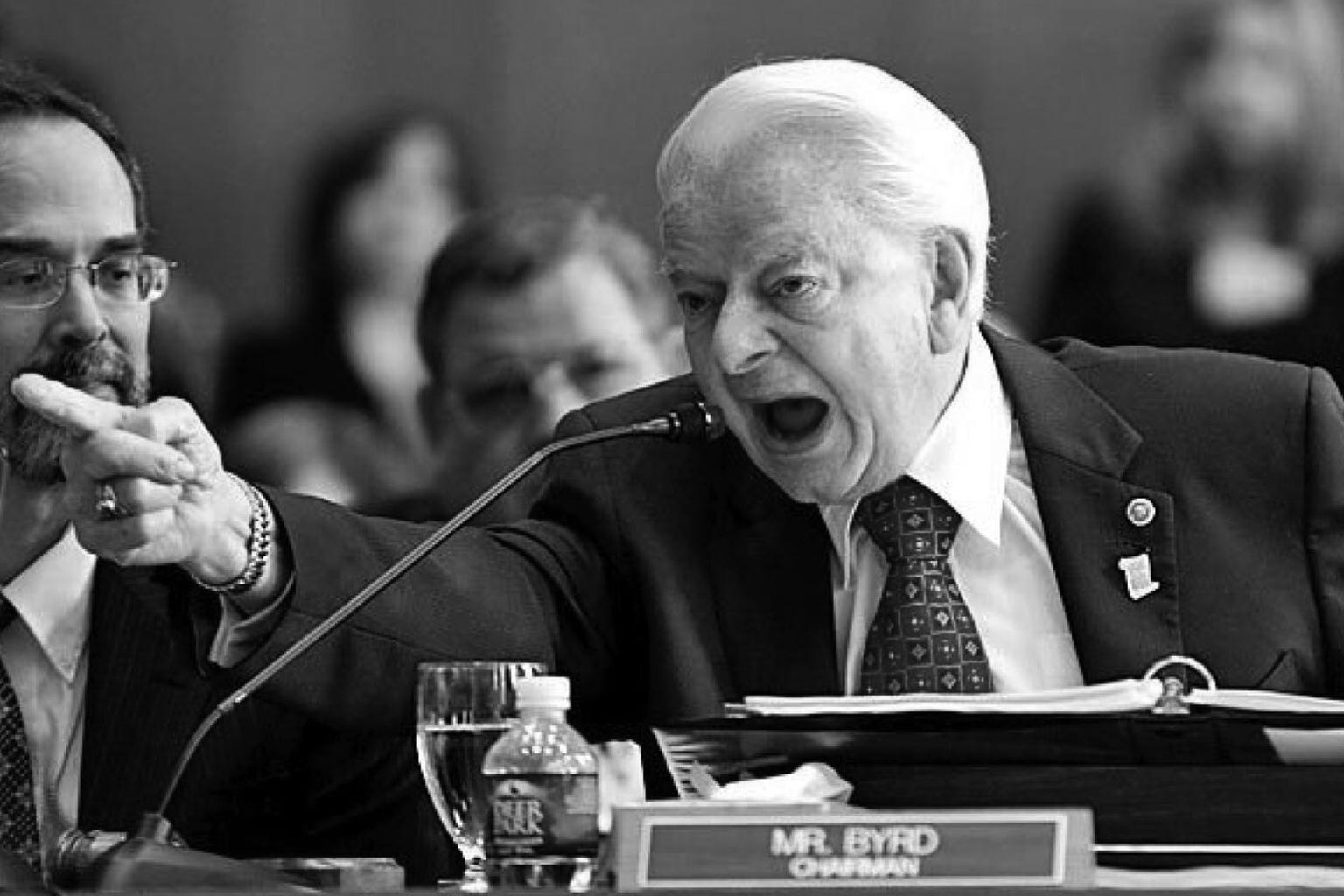
Robert Byrd didn’t betray the Democrat Party by joining the Klan; he embodied it. And when he “changed,” the Party accepted him. It “changed” with him, rewrote both of their racist pasts, and called it progress.
Robert C. Byrd embodies everything contradictory about American politics. He was born in 1917 in the hollows of West Virginia, raised in poverty, and rose to become the longest-serving senator in U.S. history. He memorized parliamentary procedure the way a pianist memorizes scales. He quoted Jefferson, carried a pocket Constitution, and insisted that no man revered the Senate more. Yet this same man began his adult life as a recruiter and leader in the Ku Klux Klan, filibustered the Civil Rights Act of 1964 for fourteen hours, and opposed the Voting Rights Act of 1965.
The story of Byrd is not simply one of personal evolution. It is about how power structures, especially within the Democrat Party, learn to forgive themselves by canonizing figures who embody their contradictions. When Byrd eventually became known as “the Conscience of the Senate,” Washington was not rewarding redemption. It was rewarding continuity wrapped in remorse. Institutions rarely abandon their pasts. They repurpose them.
Byrd’s life began during an era when Democrat dominance in the South was near absolute. The “Solid South” delivered nearly every state to Democrat presidential candidates for generations after Reconstruction. The same machine that kept poor whites loyal also kept Black citizens politically muted. In that environment, an open racial hierarchy was not a scandal. It was structure. Byrd absorbed that worldview wholesale. His later “conversion” away from it would be real enough to sound convincing, yet cautious enough never to threaten the establishment that nurtured him.
By the time he died in 2010, Presidents Bush and Obama (Sidenote: Did you know Obama and Bush are related?) alike celebrated him as a statesman and moral exemplar. Few seemed bothered that his Senate debut was spent defending segregation rather than justice. Byrd’s career reads like the biography of a nation that mistakes longevity for wisdom and apology for virtue. He is the perfect mirror showing how easily American institutions disguise moral inertia as moral growth.
The Cyclops in a Suit
Robert Byrd’s early political apprenticeship began not in a courthouse or campaign office but inside a fraternal order that dressed hate in ceremony. In the early 1940s, while working as a butcher and attending night classes, Byrd organized a chapter of the Ku Klux Klan and was soon elected Exalted Cyclops, the local leader. He did not stumble into it. He built it. He solicited dues, wrote membership letters, and delivered speeches urging white men to “defend Americanism.”
In 1945 he went further, writing to Mississippi’s segregationist Senator Theodore Bilbo that he would “never submit to fight beneath that banner with a Negro by [his] side” and would rather die “a thousand times” than see the flag “degraded by race mongrels.” That was not youthful confusion. It was conviction. Byrd was twenty-seven years old, married, working, articulate, and deliberate enough to commit hatred to paper.
This worldview was not fringe within the Democrat Party of that era. Through the first half of the twentieth century, Democrats dominated the South so completely that Republican primaries barely registered. Segregation was policy, not aberration, defended under the language of states’ rights and local control. By 1940, more than 80 percent of elected state officials in the South were Democrats, many openly affiliated with the Klan or sympathetic civic societies.
The Klan itself, particularly in its second national resurgence, did not present itself as a mob but as a civic movement. Klansmen distributed pocket-size Constitutions and American flags at rallies, claiming to be the Republic’s true guardians while condemning Catholics, Jews, immigrants, and Black Americans. Hate was framed as patriotism. Bigotry was dressed in lawfulness. Byrd absorbed that framework whole: the belief that authority, ritual, and constitutional language could sanctify hierarchy.
When Byrd later entered Congress carrying that same pocket Constitution, reporters found the gesture charming. Few recognized its lineage. The symbolism mattered. Power’s appearance, discipline, patriotism, and reverence for form could neutralize scrutiny more effectively than denial ever could. What changed was not the governing instinct but the acceptable vocabulary. Where the Klan once claimed constitutional purity to enforce hierarchy, modern institutions claim moral necessity to do the same. Authority still cloaks itself in righteousness. Only the costume has changed.
Filibustering Freedom
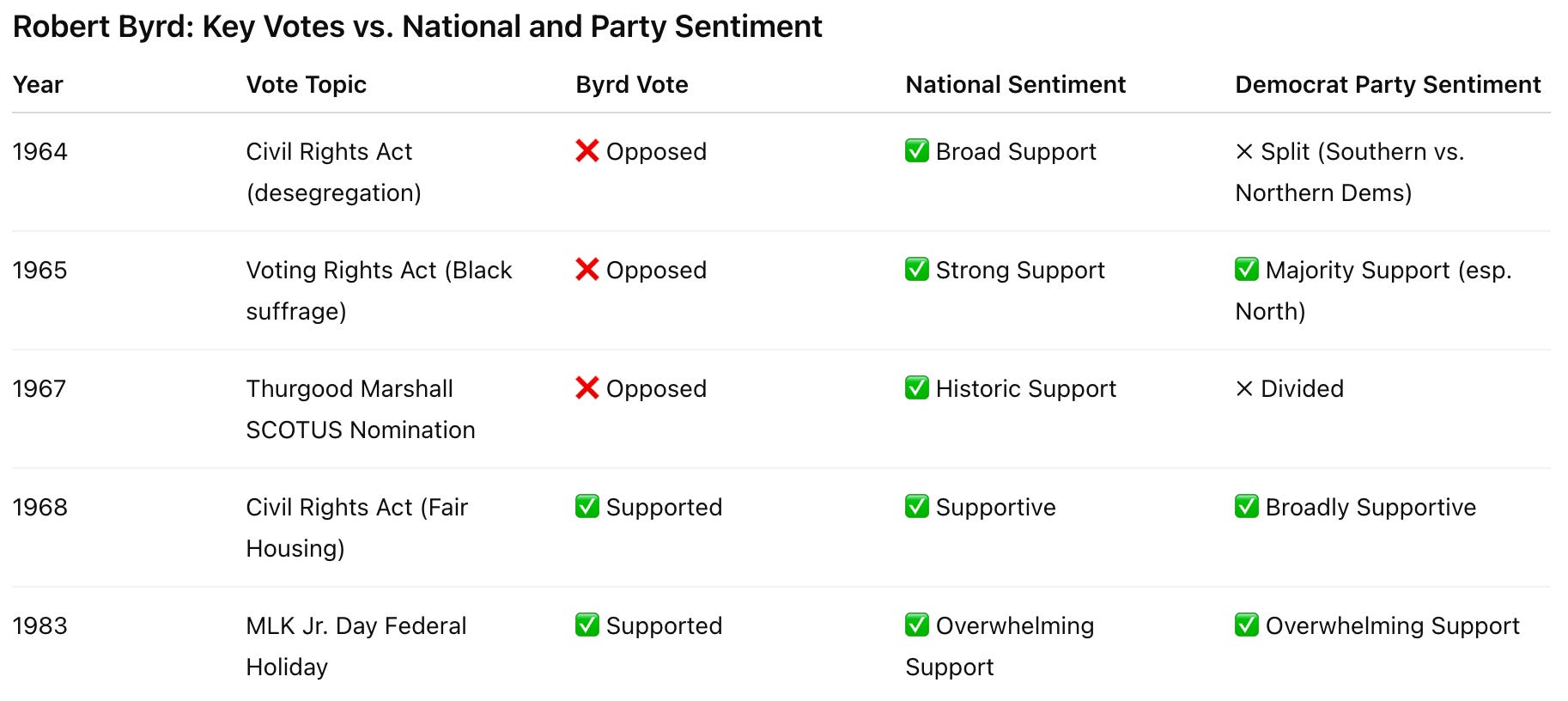
Byrd entered the Senate in 1959 with the quiet assurance of a man who knew procedure better than morality. Within five years, he would become infamous. In June 1964, during the final debate on the Civil Rights Act, Byrd spoke on the Senate floor for fourteen hours and thirteen minutes without pause, attempting to stop the bill that would end legal segregation. He quoted Scripture and the Constitution, treating both as if heaven and history required him to stall equality.
Across the South, his performance was celebrated. In Washington, it was treated as routine. That reaction reveals more about the Democrat Party than about Byrd himself. Of the 21 senators who voted against the Act, 20 were Democrats. In the House, roughly 80 percent of Southern Democrats opposed it while about 80 percent of Republicans supported it. The moral divide ran north and south, not left and right.
Byrd defended his position as a matter of states’ rights. The phrase sounded constitutional, even noble, but everyone understood its function. Federal hands off our segregation. The Democrat machine that had ruled the South since Reconstruction rewarded such arguments. Bigotry expressed through procedure allowed men like Byrd to frame defiance as fidelity to the Founders rather than resistance to justice.
He carried the Constitution into the chamber that night and cited it repeatedly. The document that begins with “We the People” became his instrument of delay. When cloture was finally invoked and the bill passed, Byrd was among the Democrats who still refused to accept it. The record is clear. He did not make a youthful mistake. He chose conviction.
The modern filibuster no longer requires a senator to stand for fourteen hours. It lives inside agencies, compliance regimes, courts, and procedural choke points that delay, dilute, or bury outcomes without ever debating their merits. What Byrd perfected on the Senate floor has since been institutionalized across government itself. Delay remains power. Procedure remains protection. Only the venue has changed.
This record also dismantles the claim that the parties “switched” on race. Most segregationist Democrats remained Democrats for life. Very few ever joined the Republican Party. The real shift unfolded as the Democrat Party replaced open racism with ideological frameworks that preserved the same controlling instinct. Byrd’s career bridges those eras. The name on the door never changed. Only the language did.
It is important to be precise here, because imprecision is how historical myths survive. The Civil Rights Act of 1964 did not fail because of procedural confusion or bipartisan hesitation. It passed only after one of the longest and most aggressive filibusters in Senate history was broken, and the resistance to that bill was overwhelmingly regional and partisan. Southern Democrats opposed it as a bloc. Northern Republicans and Democrats supported it as a bloc. The narrative that later emerged flattened this reality into abstraction, replacing names and votes with the comforting idea that “the parties switched.”
But parties do not switch the way clothes do. Power structures adapt. The same legislators who opposed civil rights did not suddenly embrace individual liberty; they remained in office, retained committee power, and learned to express their governing instincts through new frameworks. Byrd did not become an outlier after 1964. He became an early adapter. His mastery of Senate rules allowed him to continue exercising influence even as the moral vocabulary around him changed.
This is why Byrd’s filibuster matters beyond its duration. It was not merely an attempt to delay a bill. It was a demonstration of how authority defends itself when its moral footing collapses. Delay becomes legitimacy. Procedure becomes principle. And once those habits are institutionalized, they no longer require overt racial language to function. They only require control of the process.
Conversion by Necessity
By 1968, Robert Byrd was politically cornered. The moral climate of the country had shifted, federal civil-rights law was settled, and the Democrat Party’s public image was now shaped by Northern liberals rather than Southern segregationists. Open defiance was no longer sustainable. Survival required recalibration.
That year Byrd voted in favor of the Fair Housing Act, the first civil-rights measure he ever supported. The timing explained the change. The riots of the mid-1960s had frightened voters, enforcement was now unavoidable, and open resistance carried political cost. Byrd adapted. He did not abandon power. He learned how to retain it under new terms.
This was not personal enlightenment so much as institutional fluency. Byrd discovered that discipline, procedural mastery, and carefully framed contrition could replace ideology as tools of longevity. The governing instinct remained intact. Words would change. Control would remain.
The Two Black Nominees
If redemption truly transforms moral instinct, it should appear when principle carries cost. Byrd faced that test twice.
In 1967 the Senate considered President Johnson’s nomination of Thurgood Marshall. Marshall, a Democrat, was not only the first Black nominee to the Supreme Court but a national legal hero. Byrd voted against him. He claimed judicial philosophy as justification, but the explanation rang hollow even then. Marshall’s qualifications were unimpeachable, and Byrd’s rhetoric echoed the same procedural evasions he had always used.
Nearly twenty-five years later, history offered Byrd a second chance. President George H. W. Bush nominated Clarence Thomas. Byrd again voted no. Different nominee. Same result. He ended his career as the only senator to vote against both of the nation’s Black Supreme Court nominees.
The pattern shows consistency, not conversion. When faced with elevating Black independence to the highest judicial authority, Byrd’s answer did not change. Only the language surrounding it did.
The party’s problem has never been race in isolation. It has been independence. A Black man who thinks for himself has always been more dangerous than one who votes correctly. Byrd’s record is not an embarrassment to the Democrat Party. It is a clarification of its priorities.
From Open Racism to Compassionate Control
The transformation of Robert Byrd mirrors the transformation of the Democrat Party itself. As open segregation became indefensible, the Party did not abandon its instinct to manage outcomes from above. It rebuilt hierarchy under the banner of compassion. Federal programs replaced Jim Crow laws. Bureaucrats replaced sheriffs. Supremacy gave way to sympathy. Control remained.
Between 1965 and 2025, inflation-adjusted federal spending on anti-poverty programs grew more than tenfold. Yet Black median household income has remained roughly 60 percent of white median income for decades. Poverty rates have remained stubbornly high. Family instability worsened dramatically. Trillions were spent. Dependency stabilized. Mobility did not.
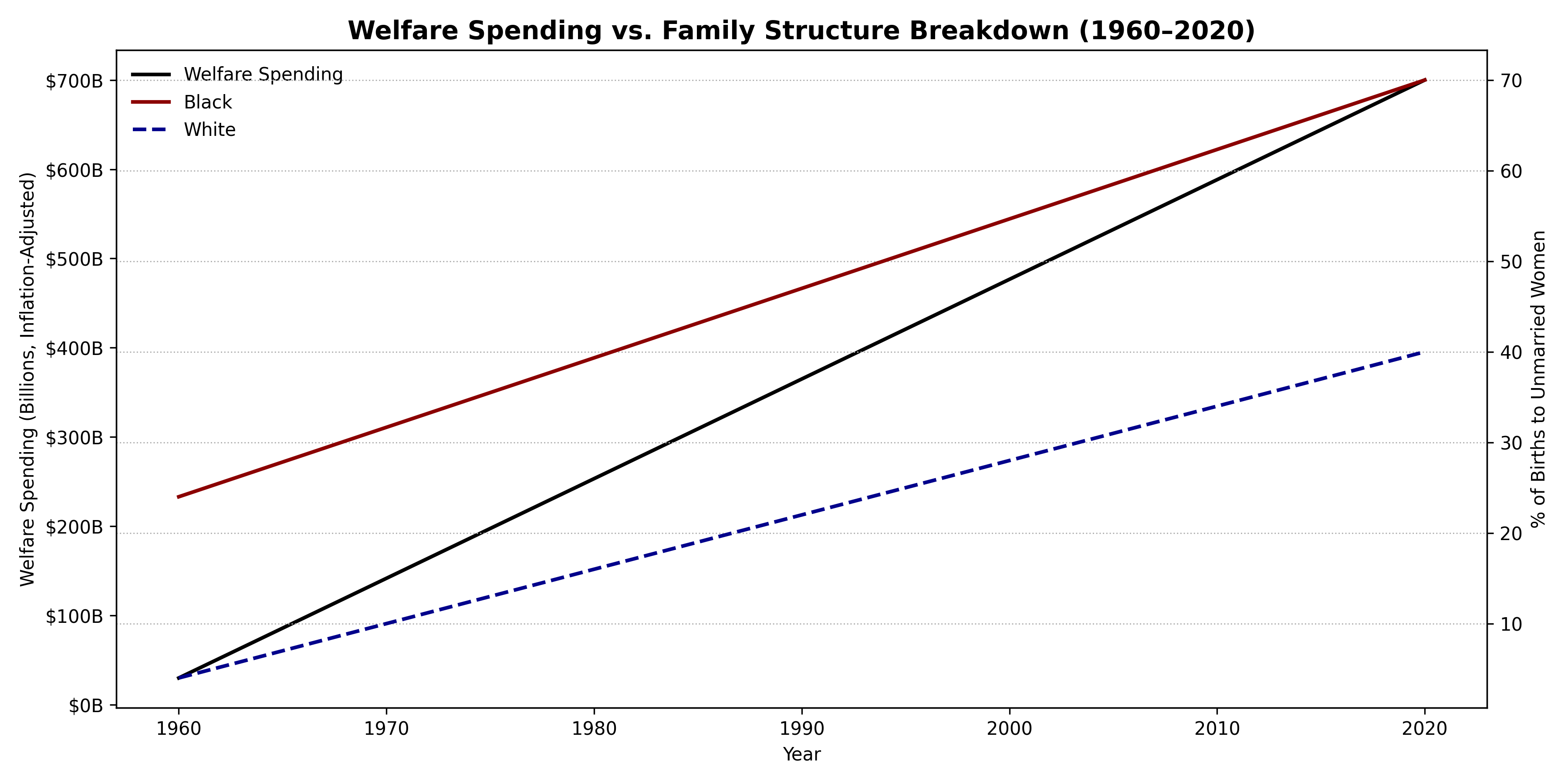
These numbers are often dismissed because they are uncomfortable. Critics argue that spending levels alone cannot explain social outcomes, which is true but incomplete. What the data actually shows is not failure of intention, but success of incentive. Large-scale social programs do not merely transfer resources. They create administrative ecosystems with their own survival logic. Agencies require clients. Programs require justification. Metrics shift from independence to compliance, from mobility to maintenance.
Over time, this produces a subtle inversion of purpose. The stated goal remains uplift, but the functional goal becomes continuity. Communities do not need to fail catastrophically for the system to persist. They only need to remain dependent enough to require management. The result is a permanent moral posture of concern paired with permanent institutional authority. Sympathy replaces expectation. Oversight replaces accountability.
This is not accidental. It is structural. Once assistance becomes a political identity rather than a temporary intervention, withdrawal of that assistance becomes framed as cruelty. Independence itself becomes suspect. Byrd’s genius was recognizing this early. He did not argue against federal power. He mastered it. His appropriations legacy illustrates the paradox perfectly: billions spent, gratitude secured, conditions unchanged.
This is how control survives moral scrutiny. Not through force, but through framing. Not through exclusion, but through supervision. The language is softer. The hierarchy is not.
This system works because it preserves hierarchy while presenting itself as virtue. Instead of denying opportunity by law, it manages outcomes by policy. Instead of saying “stay separate,” it says “stay dependent.” Every benefit requires an administrator. Every administrator sustains the system.
Byrd mastered this world. As appropriations chairman, he routed billions to West Virginia, which remained among the poorest states despite decades of federal attention. Benevolence persisted. Progress did not. Byrd was not an outlier. He was the template.
Byrd and the Democrat Party’s Cleansing Machine
Robert Byrd’s survival inside the Senate was not accidental. It was instructional. The Democrat Party perfected a political laundering process: convert guilt into narrative, turn contradiction into symbolism, and use the offender as evidence of progress.
Byrd’s apologies did not threaten the institution. They fortified it. Each renunciation allowed the Party to present itself as morally evolved without confronting its own continuity. His ascent into leadership cemented the lesson. Control of spending produced loyalty. Ritualized contrition produced absolution.
When Byrd died in 2010, tributes flowed freely. Presidents praised his conscience. The Party praised itself through him. His life became a parable of national redemption, useful precisely because it discouraged deeper examination.
This cleansing machine remains fully operational. Today it absolves different sins with different words, but the logic is identical. Confession replaces accountability. Symbolism replaces reform. The institution survives by declaring progress while preserving structure.
What makes this cleansing machine so effective is that it does not rely on coercion. It relies on narrative closure. Once a figure like Byrd is declared redeemed, further scrutiny becomes impolite. Questioning the institution’s role in his rise sounds like cruelty rather than inquiry. The moral story is considered finished, even if the structure that produced it remains untouched.
This mechanism now operates far beyond individual biographies. Institutions preempt accountability by narrating their own progress. They celebrate symbolic milestones, elevate curated voices, and point to approved journeys as evidence of transformation. The presence of these symbols is treated as proof that deeper examination is unnecessary, even disruptive. Progress becomes a story told about power, not a condition measured against outcomes.
Byrd’s usefulness was not that he changed, but that he could be presented as changed without requiring institutional reckoning. His career allowed the Party to close a chapter without reading it carefully. That is the defining feature of moral laundering: it converts unresolved history into proof of virtue while leaving the underlying architecture intact.
Legacy of a Useful Man
Byrd did not outgrow his institution. His institution evolved to keep him useful. The Democrat Party’s moral vocabulary shifted from exclusion to supervision. The method remained unchanged: authority disguised as care.
If Byrd’s life teaches anything, it is that repentance without reform is rebranding. Institutions can apologize indefinitely while retaining the habits that required apology in the first place. The Democrat Party did not erase its hierarchy. It refined it.
Robert Byrd is not a relic of a defeated past. He is a prototype of a system that learned how to survive moral exposure by improving presentation. The Party did not outgrow him. It learned from him.
The robe and the Constitution were two versions of the same garment. Different fabric. Same purpose. Byrds of a feather, still together.
Help Keep This Work Independent
Some people buried their past. Others rewrote it.
The Democrat Party did both — and called it progress.
If this essay helped you see through the illusion — the party switch myth, the sanitized Klan exits, the weaponized amnesia — then here’s how you can help this kind of work continue.
Become a Paid Subscriber
This project is funded by readers who want long-form, historically grounded analysis — not content filtered to please platforms, institutions, or search engines.
https://mrchr.is/help
Make a One-Time Gift
Even a single contribution helps offset the hours of research, writing, and visual documentation behind essays like this.
https://mrchr.is/give
Join The Resistance Core
For those who see this work as more than a newsletter. The default is $1,200/year, but you can set any amount that works for you — $500, $2,000, or more.
It’s not just support. It’s a statement:
“You don’t get to rewrite history without a fight.”
https://mrchr.is/resist
If You Cannot Give
Forward this essay to someone who still believes truth matters — even when it’s uncomfortable. That matters more than any algorithm.
Sign Up for the Boost Page — Free
One simple action that strengthens distribution without relying on distortion-driven platforms.
https://mrchr.is/boost-form
Thank you for reading. And to those already supporting this work:
You make it possible to keep telling the part of the story they want forgotten.
I believe in this work.
I believe in the fight.
And with your help, I’ll keep going.
Another great post !