


Previous in the series
Part I: Protest U
“Large protest movements rarely run on outrage alone. They run on organization, and organization runs on money.”
Large protest movements require more than anger.
They require organization, and organization requires money.
Transportation must be arranged. Staff must be paid. Legal teams must be available when arrests occur. Communication networks must be maintained. Demonstrations across multiple cities require coordination that rarely appears overnight.
To outside observers, protests often appear to spring up suddenly. Crowds gather quickly, slogans spread across social media, and demonstrations appear in multiple cities at almost the same time.
Large movements rarely emerge that way.
Behind many modern protest campaigns lies an institutional structure comprising nonprofit organizations, philanthropic foundations, advocacy groups, and professional organizers. The demonstrations seen on television are often only the visible surface of a much larger system.
Part I of this series examined how universities increasingly serve as training grounds for activism. Students learn organizing skills, build networks, and graduate with experience coordinating demonstrations.
Training alone does not sustain activism on a national scale.
Sustained activism requires financial infrastructure.
The Institutional Framework Behind Activism
Much of the financial structure supporting modern activism operates within the nonprofit sector.
In the United States, nonprofit organizations generally fall into several legal categories. The most common structures involved in political activism include 501(c)(3) charities, 501(c)(4) advocacy organizations, and political committees connected to electoral campaigns.
Each category serves a different function.
A 501(c)(3) organization focuses on education, research, and charitable activity. Donations to these organizations are tax-deductible, which encourages philanthropic contributions from wealthy individuals and foundations.
A 501(c)(4) organization may engage directly in political advocacy. These groups are permitted to lobby legislators, organize campaigns, and mobilize supporters around public policy issues.
Political committees operate more directly within the electoral process.
A feature of the modern nonprofit system is that these different legal structures often support one another. Donations frequently flow into 501(c)(3) organizations that conduct research, training, and advocacy framed as education. Separate but affiliated 501(c)(4) organizations can then engage directly in lobbying, political organizing, and protest mobilization. Because the entities are legally distinct, charitable funding and political advocacy can operate within the same institutional network. Critics often describe this structure as a form of political “dark money,” not because the money is illegal, but because the layered organizational system can make the original sources difficult for the public to trace.
When these structures operate together, they create a network capable of sustaining political activism over long periods.
Most citizens encounter only the demonstrations themselves. The institutional structures supporting those demonstrations remain largely invisible.
The Expansion of the Nonprofit Sector
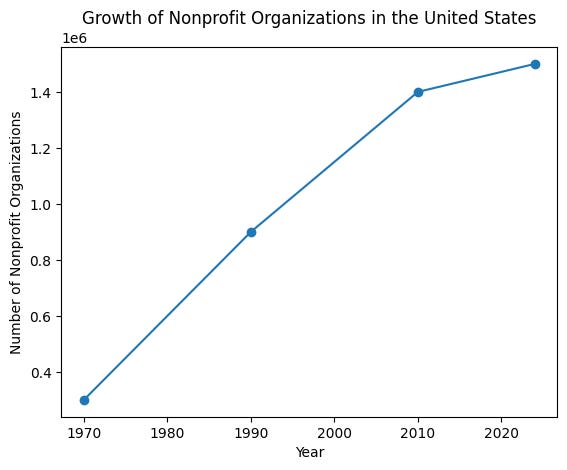
The nonprofit sector in the United States has expanded dramatically during the past half-century.
In 1960, fewer than 300,000 nonprofit organizations were registered nationwide. According to the National Center for Charitable Statistics, the United States now contains more than 1.5 million nonprofit organizations.
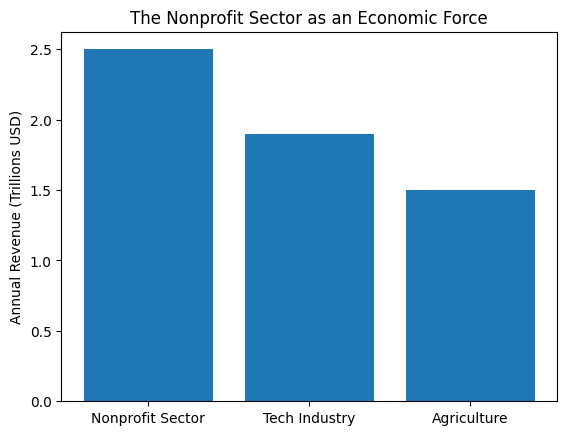
The scale of the sector is easy to underestimate. According to the National Center for Charitable Statistics and related sector reports, the nonprofit world now generates more than 2.5 trillion dollars in annual revenue, an amount approaching ten percent of the entire U.S. economy. That does not mean all of this money goes into activism. Most nonprofits are hospitals, universities, religious institutions, and service organizations. But it does mean the nonprofit sector is no small side operation. It is one of the largest institutional ecosystems in the country.
Many focus on charitable services such as hospitals, religious charities, and educational programs. Others focus primarily on policy advocacy, political organizing, and social activism.
The growth of these institutions created an environment in which political activism could become permanent rather than temporary.
Earlier protest movements often relied on local organizations such as churches, civic associations, or community groups. Modern activism increasingly relies on national nonprofit networks with professional staff and long-term funding.
Once institutions are created, they rarely disappear. They develop their own internal incentives to sustain their operations.
Foundations and the Flow of Money
Large philanthropic foundations play a major role in financing advocacy networks.
Foundations distribute billions of dollars every year to nonprofit organizations working on issues ranging from environmental policy to immigration reform.
Some of the most visible funding networks have been associated with donors such as George Soros through organizations like the Open Society Foundations. Public records show that Open Society Foundations has distributed more than thirty billion dollars in grants since its creation.
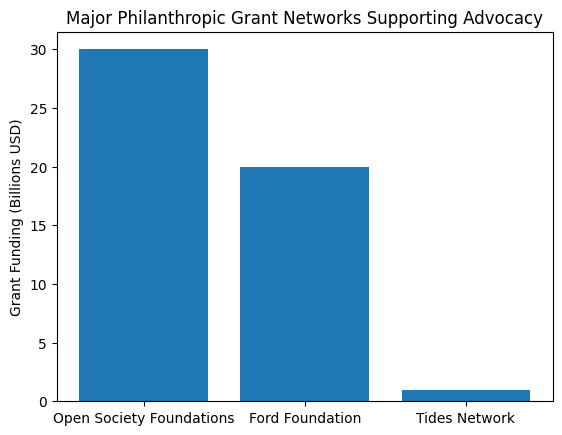
Many of the organizations receiving those grants operate within advocacy campaigns, legal activism, and policy organizing.
This funding rarely pays directly for the protests themselves. Instead, it finances the institutions capable of organizing protests when political pressure becomes useful.
Grant funding often supports staff salaries, communications operations, research departments, legal services, and activist training programs.
Those resources create institutions capable of rapidly mobilizing activists.
Money does not guarantee a protest will occur.
But without financial infrastructure, large protests are difficult to sustain.
Fiscal Sponsorship and Rapid Expansion
Another important mechanism within the nonprofit world is fiscal sponsorship.
Fiscal sponsorship allows a new activist project to operate under the legal umbrella of an existing nonprofit organization. The sponsoring nonprofit manages donations, payroll, and regulatory compliance while the project focuses on its advocacy work.
Several large nonprofit networks specialize in this type of infrastructure. Organizations such as the Tides Center have long served as administrative hubs for activist projects, allowing new campaigns to operate within an existing nonprofit structure. More recently, networks connected to consulting firms such as Arabella Advisors have managed billions of dollars in philanthropic funds distributed through advocacy organizations and policy campaigns.
Instead of building a new nonprofit from the ground up, organizers can begin operating almost immediately under an established institutional framework.
To the public, such projects often appear to be independent grassroots movements. In practice, they may depend heavily on larger nonprofit institutions operating behind the scenes.
The result resembles an institutional platform. Activists do not necessarily need to build an organization from scratch. They can plug into an existing interface that provides funding channels, legal infrastructure, communications support, and national networks of organizers.
The Professional Logistics of Protest
Large demonstrations require extensive planning.
Permits must be obtained from city governments. Transportation must be coordinated for participants traveling from other areas. Legal teams must prepare for possible arrests. Messaging must be coordinated across social media platforms and traditional media outlets.
Professional organizers frequently handle these responsibilities.
Many advocacy organizations employ staff whose primary job is to manage demonstrations, coordinate campaigns, and maintain communication networks among activists.
Their work resembles project management inside corporations or political campaigns. The difference lies in the political goals pursued by the institutions they serve.
Without logistical planning and financial support, demonstrations on a national scale would be extremely difficult to organize.
Incentives and the Appearance of Crisis
Financial infrastructure changes how protest movements operate.
Organizations supported by grants and donations often depend on continued public attention. Public attention frequently emerges during moments of crisis.
This creates incentives.
Movements that emphasize urgent political threats are more likely to attract media coverage, mobilize supporters, and secure additional funding.
Organizations that declare victory and disband rarely survive long.
Institutions that sustain activism tend to highlight problems that require continued mobilization.
This pattern does not mean that the underlying issues are imaginary. Societies face real problems and genuine grievances.
But the institutional incentives inside advocacy networks often encourage the continuation of activism rather than its resolution.
The Political Alignment of Advocacy Networks
Many advocacy organizations operating within the nonprofit sector align closely with policy priorities associated with the Democrat Party.
Issues frequently promoted through nonprofit activism include climate policy, immigration reform, racial equity initiatives, and various international policy campaigns.
The same issues often appear later in national political messaging and election campaigns.
This overlap does not mean every nonprofit organization acts as a direct political instrument. The nonprofit world is extremely diverse, with organizations across the ideological spectrum.
But the alignment between major advocacy networks and the policy priorities of the Democrat Party is difficult to miss.
Activism, nonprofit advocacy, and electoral politics increasingly operate within overlapping networks.
To the average citizen, the connections between these institutions are often difficult to see.
From Funding to Careers
Financing protest movements requires institutions.
Institutions require people.
Across the nonprofit sector, thousands of individuals work as professional organizers, advocacy directors, communications specialists, and campaign managers.
For many activists, organizing protests is not simply a temporary activity.
It becomes a profession.
That development leads directly to the next stage of the protest machine.
Part III examines how activism has evolved into a career path within nonprofit advocacy organizations, political campaigns, and institutional networks closely connected to the Democrat Party.
Support Independent Investigations
Investigations like The Protest Machine series take time. Researching nonprofit networks, financial filings, academic programs, and organizing structures is not something that can be done quickly or casually.
This publication has no corporate sponsors, no institutional funding, and no newsroom behind it. Every article is researched and written independently.
The work continues because readers decide it matters.
Become a Paid Subscriber
Paid subscribers make investigations like this possible. Your support allows long-form research projects such as The Protest Machine to continue.
Become a paid subscriber:
https://mrchr.is/help
Join The Resistance Core
Some readers choose to go further by joining The Resistance Core, the group helping build a long-term independent platform for investigative writing and civic analysis.
Their support provides the stability that allows this work to continue without corporate sponsors, institutional funding, or political pressure.
Join The Resistance Core:
https://mrchr.is/resist
Make a One-Time Gift
If a subscription is not the right fit, you can still support the work with a one-time contribution.
One-time gifts help cover research time, data sources, and the hours required to produce investigations like this one.
Support with a one-time gift:
https://mrchr.is/give
If You Cannot Give
You can still help by sharing the article. Independent writing grows when readers pass it along.
Can you imagine, as precious as life is, going through it knowing your “cause” was just a grift?
Your whole life was useless, spent on something that no one had any intention of fixing.
Young people really need to wake up. lol
"Organizations that declare victory and disband rarely survive long."
Many years ago a good friend of mine explained to me that advocacy groups like The Sierra Club, NRA, and a host of others have no desire to achieve their stated goals because if they did, they would cease to have a reason to exit. That, of course, would leave them unemployed. I was initially skeptical, but the years have proven he was totally correct, and my reaction to any new advocacy group is total cynicism, as has been to most existing ones. The amount of money the officers of various groups award themselves is always amusing to see. Their self-importance, often greater even than the goals they seek, is truly remarkable.
BTW, not that it needs saying, Chris, but another excellent examination.