

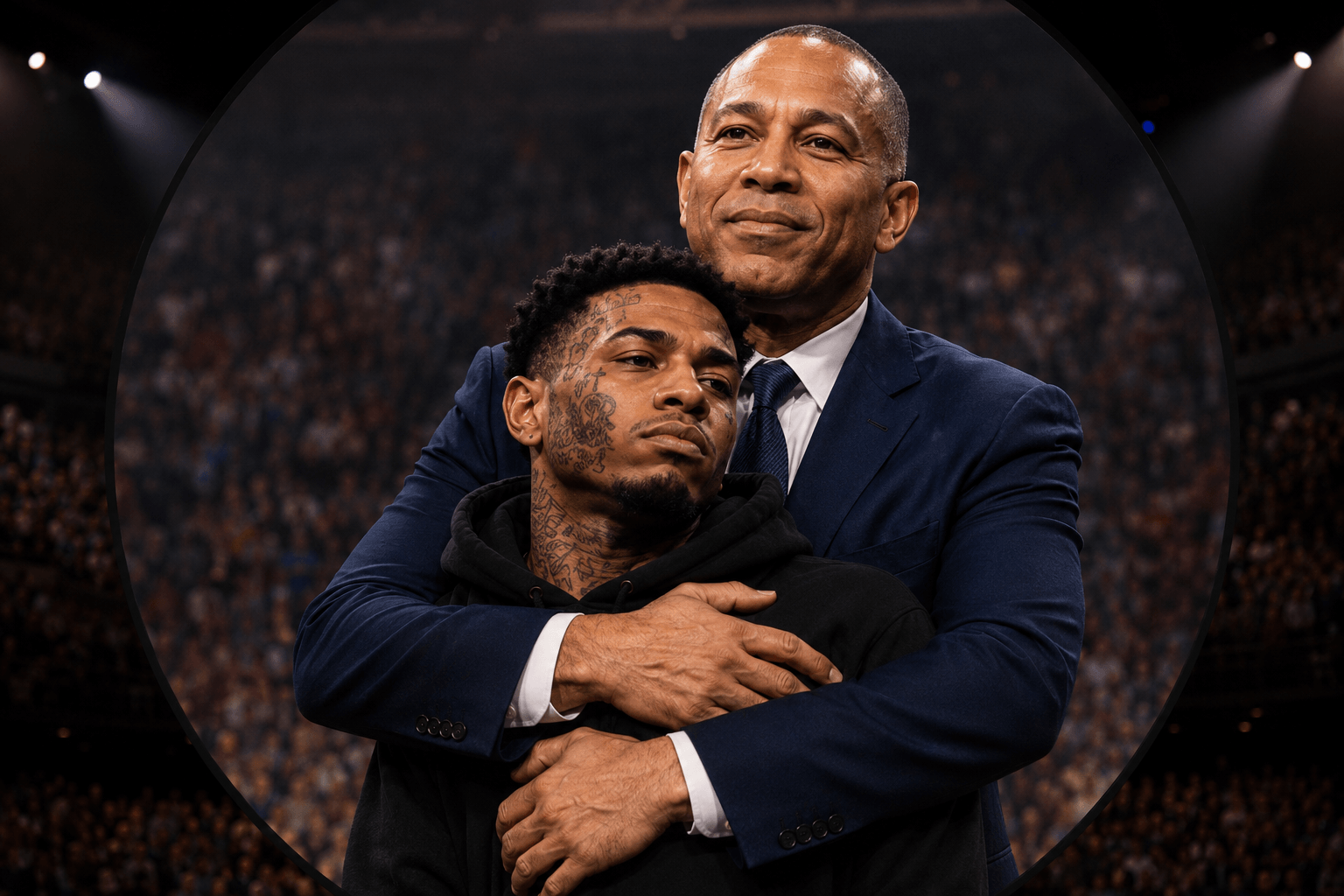
The criminal acts. The citizen pays. That is the modern Democrat response to disorder.
A legitimate society has to distinguish between the person who caused the problem and the person forced to live with it.
That should not require a degree in sociology. If a man murders someone with a gun, the problem begins with the murderer. If a repeat offender attacks another stranger, the first question is why he was still free. If a student assaults a teacher, the problem is not the teacher’s inability to “build relationships.” If people walk into a store and steal without fear, the problem is theft.
Democrat politics has made simple things sound complicated, not because the facts are hard to understand, but because many people are paid, elected, promoted, or praised for pretending not to understand them.
The ordinary response starts with responsibility. Who did this? Why was he able to do it? What consequence should follow? How do we protect the person who obeyed the rules from the person who broke them?
The Democrat response usually starts somewhere else. It starts with explanation. Then context. Then reclassification. Then accommodation. Then a new burden placed on the people who did nothing wrong.
A shooter commits murder, and the next demand is aimed at lawful gun owners. A repeat offender attacks someone, and the public gets another lecture about trauma. A student terrorizes a classroom, and teachers are told to try restorative circles. A thief empties a shelf, and the store is blamed when it closes. An illegal immigrant commits a preventable crime, and the family of the victim is told not to notice immigration status. Addicts and unstable people take over sidewalks, and taxpayers are instructed to step around needles, tents, trash, and human waste in the name of compassion.
This is not one bad policy. It is a habit of mind.
The left sees disorder and asks how society failed the person creating it. Normal people look at the same disorder and ask why they are being forced to live under it.
There is a place for mercy. There is a place for context. There is a place for second chances. But mercy without judgment becomes surrender. Context without standards becomes excuse-making. Second chances without limits become a public safety program for criminals and a punishment program for everyone else.
The old standard was plain enough: protect the innocent from the guilty.
The new standard is different: protect the guilty from consequences and make the innocent adjust.
That is the moral inversion at the heart of the modern Democrat response.
Gun Crime: The Shooter Disappears and the Gun Owner Becomes the Target
When someone murders another human being with a gun, the first moral question should be obvious.
Who pulled the trigger?
Not which object was used. Not which law-abiding citizen should lose another right. Not which farmer, veteran, homeowner, single mother, hunter, or concealed-carry permit holder should be treated like a suspect because a criminal ignored laws that already existed.
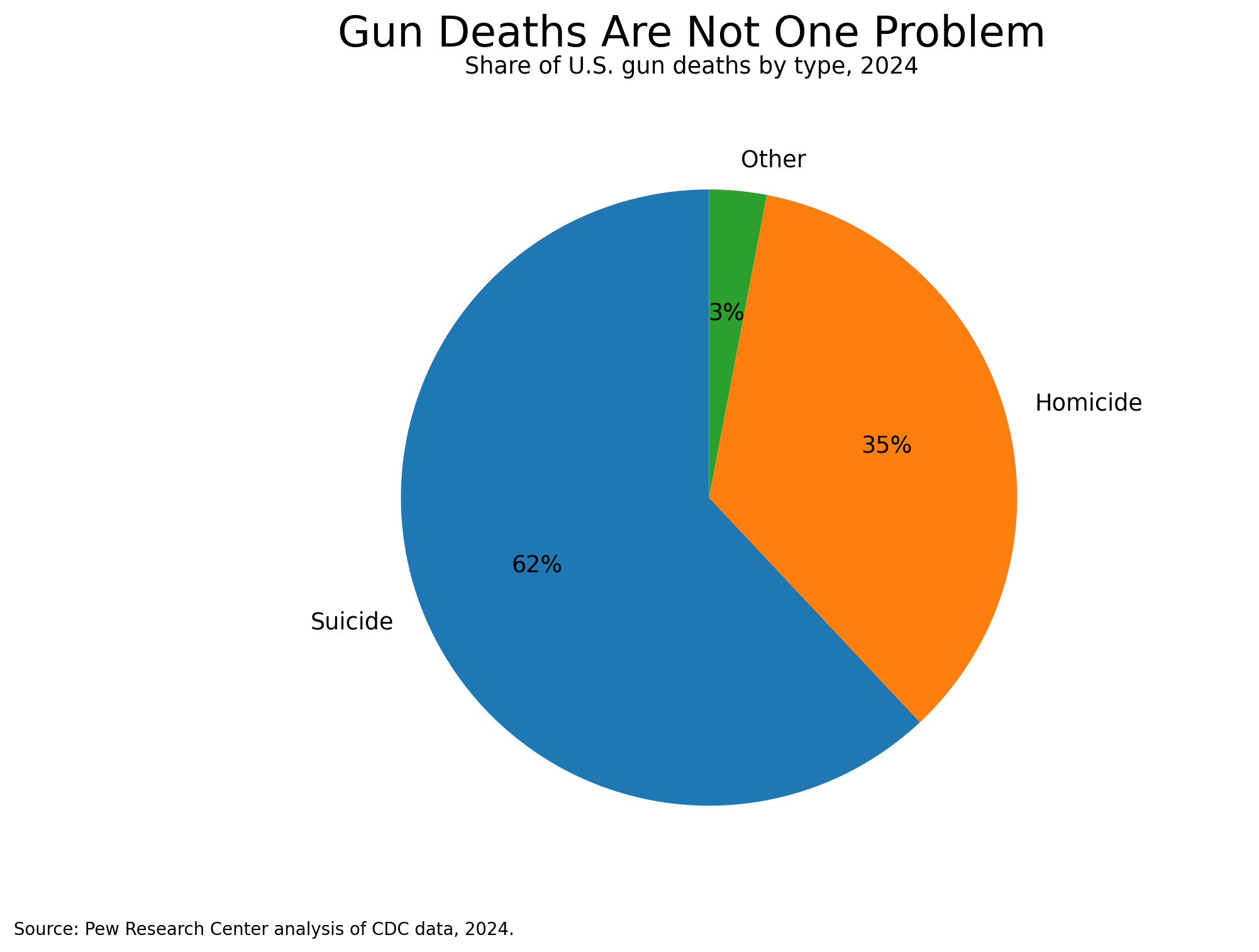
America has a real gun crime problem. Nobody would deny that. Pew reported in April 2026 that gun homicides fell from their 2021 record but still totaled more than 15,000 in 2024. The Bureau of Justice Statistics has also reported that firearms were involved in about 80 percent of homicides in recent years. Those are not small numbers. They represent families destroyed, neighborhoods terrorized, and cities where ordinary people live with dangers that cable-news activists rarely experience firsthand.
But recognizing gun crime does not require pretending that gun owners are the problem.
A serious response would focus on the shooter, the stolen gun, the illegal gun, the gang member, the repeat felon, the straw buyer, and the prosecutor who keeps cutting deals. It would ask why gun charges get dropped. It would ask why violent offenders cycle through the system. It would ask why cities with strict gun laws still have so much gun violence. It would ask why the same young men are often known to police, schools, social workers, and courts long before the final crime.
The Democrat response tends to glide past the person who did the shooting. The man who ignored the laws already on the books becomes the excuse for passing more laws aimed at people who already obey the law.
That is the strange trick in gun control politics. The citizen most likely to comply is not the person causing the problem. The man filling out the forms, passing the background check, locking up his firearm, and following carry rules is not the man carjacking a family or shooting into a crowd. Yet he becomes the convenient target because he is reachable by regulation.
The criminal is harder to talk about. He may live in a city Democrats have run for decades. He may have prior arrests that raise uncomfortable questions about prosecutors, judges, parole boards, and bail policies. He may belong to a demographic group the political class does not want to discuss honestly. He may reveal the failure of the policies sold as compassion. He might not even be a he.
So the law-abiding citizen becomes the substitute defendant.
Chicago, Baltimore, Philadelphia, St. Louis, Washington, D.C., Oakland, and other Democrat-run cities have had years of violence that did not happen because hunters in rural counties lacked another lecture about background checks. A gang member with a stolen handgun is not waiting for Congress to clarify the rules. A felon carrying illegally is not reading municipal ordinances before he decides whether to shoot.
Yet every high-profile shooting somehow becomes an argument for burdening the person who was not there.
That is not justice. It is political substitution. The offender becomes a symbol, and the innocent becomes the policy target.
A country that cannot punish murderers will not be saved by harassing citizens who did not murder anyone.
Repeat Offenders: The Public Learns the Record After the Attack
Many crimes shock people when they happen. Fewer are surprising once the details come out.
After a stranger is attacked, a woman is shoved, a clerk is beaten, or an innocent person is killed, the public often learns the same detail after the fact.
The attacker had a record.
Not every time, but often enough that the question becomes unavoidable: why was he free?
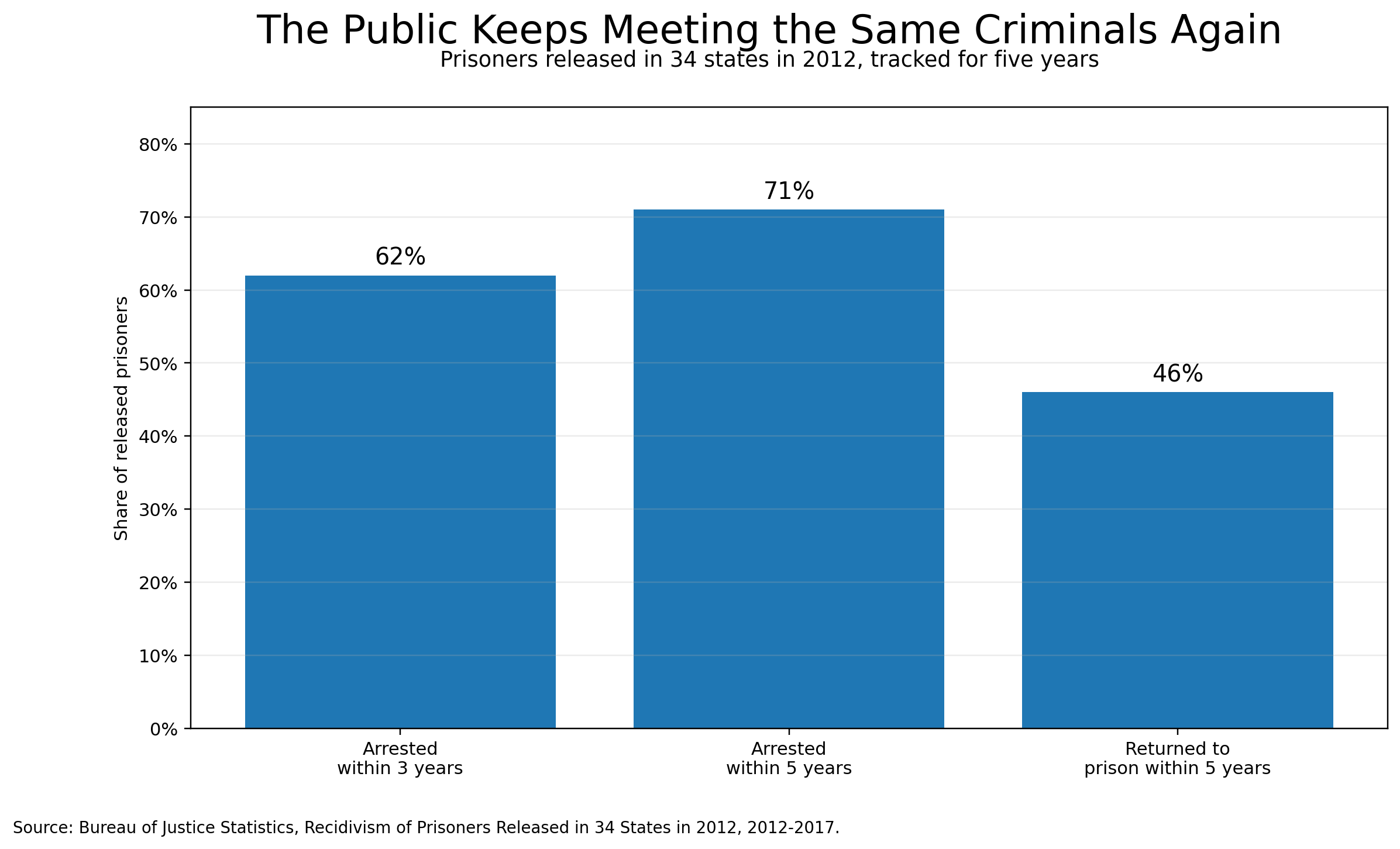
The Bureau of Justice Statistics followed prisoners released in 34 states in 2012 and found that about 62 percent were arrested within three years and 71 percent within five years. Nearly half returned to prison within five years for a new sentence or a parole or probation violation. That does not mean every released prisoner is hopeless. It does mean the public has every reason to distrust policies built on soft words and wishful thinking.
A justice system has to distinguish between the person who made one terrible mistake and the person who has chosen crime as a way of life. A first-time offender may deserve mercy. A repeat violent offender deserves containment.
The purpose of prison is not only rehabilitation. It is also incapacitation. That word sounds cold until you think about the victim who never becomes a victim because the violent man was not free to attack her. A man in prison cannot punch your grandmother on the subway. He cannot rob the corner store. He cannot stab a stranger walking home. He cannot push someone onto train tracks.
For the person who gets home safely, incapacitation is not theory. It is civilization doing one of its basic jobs.
The left often treats incarceration itself as the scandal. Criminals become “justice-involved individuals.” Consequences become “mass incarceration.” Prosecutors avoid charges that might create long sentences. Bail is treated as oppression. Repeat offenders are explained through poverty, trauma, addiction, racism, or social failure.
Some of those factors can be real. None of them makes the next victim less injured.
The Daniel Penny case became a national argument for this reason. Jordan Neely was mentally ill, homeless, and had a long history of arrests. Passengers on a New York subway were trapped in a car with a man behaving in a threatening way. Penny, a former Marine, restrained him. Neely died. Prosecutors charged Penny. A Manhattan jury acquitted him in December 2024.
You do not have to think Penny handled everything perfectly to see the larger failure. The public was not angry only because one man died. The public was angry because ordinary people had been forced for years to share enclosed spaces with unstable and threatening people while officials treated public fear as prejudice. Then, when one passenger finally acted, the system that failed to protect the public suddenly found the energy to prosecute him.
That is the pattern.
The state does not stop the disorder. It prosecutes the person who reacts to the disorder.
Bail reform shows the same problem. There is a fair argument that harmless poor people should not sit in jail only because they cannot afford a small bail amount. Most people understand that. But the public’s fear was never the grandmother who missed a court date for a minor charge. The public’s fear is the violent repeat offender who gets released again and creates another victim.
A serious system can handle both thoughts at once. Do not jail harmless people simply because they are poor. Do detain dangerous people because they are dangerous.
Modern Democrat policy often refuses that distinction because the distinction ruins the slogan.
It is easier to say “end cash bail” than to explain why a violent defendant with a long record was free. It is easier to say “root causes” than to admit that some offenders have already received more chances than their future victims ever got.
People can forgive mistakes. They do not forgive being lied to. When an offender with a long record hurts someone again, the public does not need another sermon about society.
It needs an answer.
Why was he free?
Schools: Adults Fix the Numbers While Children Lose the Classroom
A classroom cannot function without order.
Children cannot learn in chaos. Teachers cannot teach while managing threats. Good students cannot focus when one disruptive student controls the room. Parents cannot be expected to send their children into buildings where adults are afraid to enforce basic rules.
If a student assaults a teacher, threatens classmates, brings weapons, starts fights, or makes learning impossible, the first duty of the school is to protect everyone else. That does not require hatred. It requires adulthood.
A child’s background may explain some behavior. It cannot excuse violence.
This is especially important for poor children. Wealthy families have exits. They can move, pay tuition, hire tutors, or pressure administrators. Poor families are stuck. When discipline collapses, the children who suffer most are usually the children Democrats claim to champion.
The modern left has turned school discipline into a statistics problem. Instead of asking whether children are safe and learning, administrators are pressured to ask whether suspension numbers produce the right racial and political pattern.
The Government Accountability Office reported in 2024 that Black girls receive more and harsher discipline than other girls, even for similar infractions. That is a serious finding and deserves attention. It may reveal bias in some places. It may be an attitude problem or back talk. It may reveal inconsistent discipline. It may reveal adult failure. But it still does not tell a teacher what to do when a student has just hit her, threatened the class, or turned another school day into chaos.
The great trick of modern education policy is to treat unequal outcomes as automatic proof of unequal treatment. Sometimes unequal treatment is part of the story. Sometimes behavior, home life, school culture, neighborhood disorder, peer pressure, and administrative cowardice are part of the story too.
But if school leaders are judged mainly by whether discipline numbers look equal on paper, the incentive is obvious.
Do not fix the behavior. Fix the reporting.
Call violence “conflict.” Call defiance “trauma.” Call chaos “unmet need.” Keep the student in class. Reduce the suspension count. Praise the improved data.
Teachers are left with the consequences. So are students who came to learn.
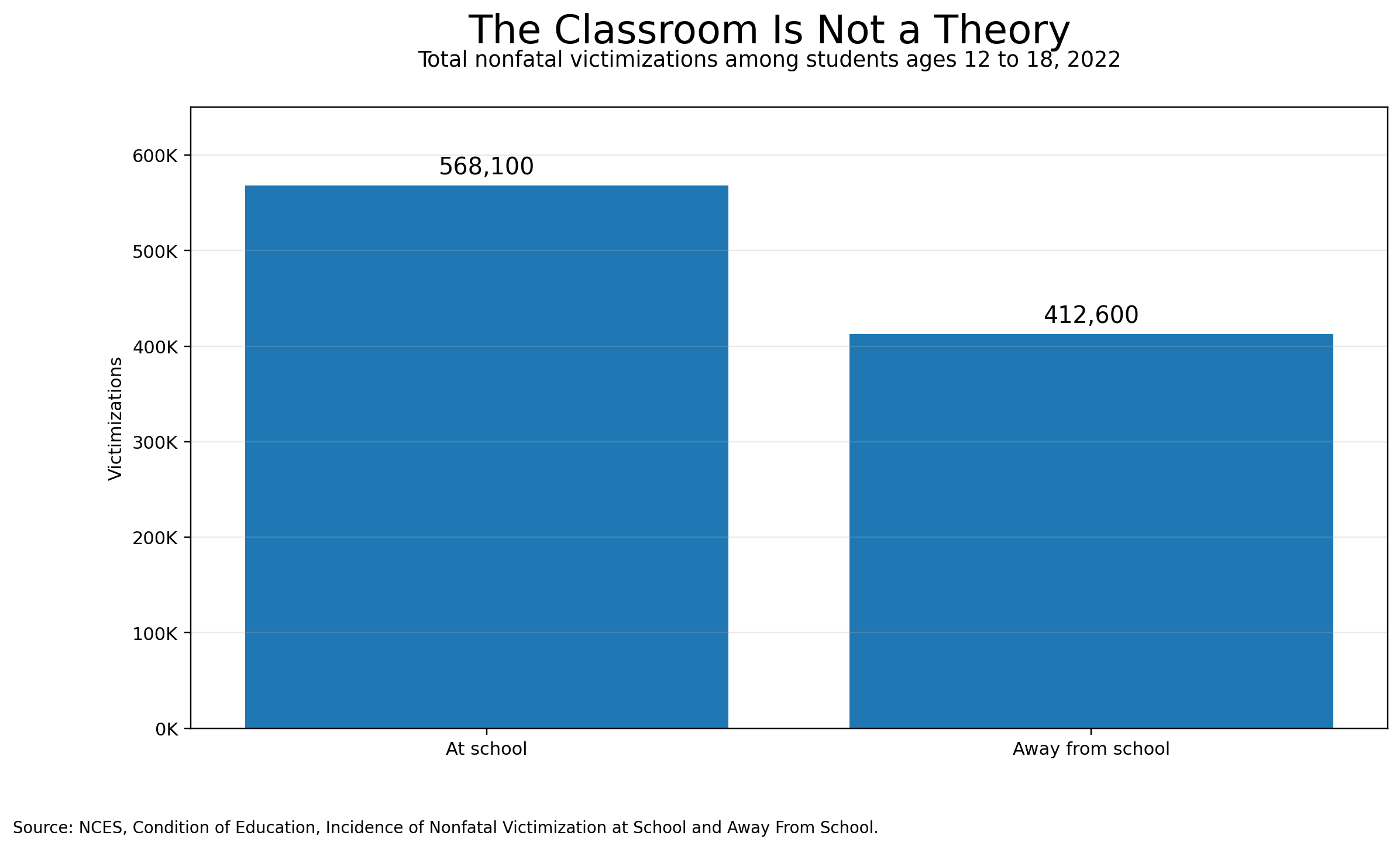
Federal school safety reporting showed that students ages 12 to 18 experienced hundreds of thousands of victimizations at school in 2022. That includes theft and violent victimization. These are not just numbers in a federal report. They are days of lost instruction. They are teachers wondering if administration will back them up. They are children learning that rules are for the compliant, not the disruptive.
The problem is not that every suspension is wise. Some are not. The problem is that the adult response to violence now begins with institutional optics instead of innocent children.
Look at what happened across many school districts over the last decade. Suspensions were reduced. Restorative discipline became fashionable. Administrators learned the language of equity. Consultants got paid. Reports looked better. But many teachers quietly said the same thing: the official numbers improved because schools stopped recording reality honestly.
The violent student was accommodated. The good student was ignored. The teacher was told to be patient.
A school that cannot say no to a child is not compassionate. It is negligent. The child causing the chaos often pays too, because nobody cared enough to correct him while correction still might have worked.
Retail Theft: The Store Closes and Politicians Blame the Store
Theft is not complicated: a person walks into a store and takes what does not belong to him.
A sensible society stops him, prosecutes repeat offenders, protects workers, and makes theft costly enough that other people think twice. A society that stops defending property eventually stops having stores worth robbing.
The left prefers to turn this into a story about corporations, as if Walgreens, Target, CVS, Walmart, and grocery chains are the only ones affected. That framing is useful because corporations are easy to hate. It also hides the real victims.
The cashier making modest wages is affected. The elderly customer who needs a nearby pharmacy is affected. The mother buying formula is affected. The neighborhood is affected when the store reduces hours, locks up basic items, hires security, raises prices, or leaves altogether.
Then the same politicians who tolerated disorder accuse businesses of abandoning the community.
California offers a useful example because the voters eventually noticed. The Public Policy Institute of California reported that shoplifting rose in 2024 and remained far above 2019 levels. San Francisco became a national symbol of locked shelves, store closures, open-air drug use, and civic denial. Walgreens had already closed several San Francisco stores in 2021 after citing theft concerns, though later reporting showed the data was mixed and other business costs also played a role. That nuance is worth admitting because reality is usually messier than slogans.
But the larger point did not vanish because one corporate explanation was incomplete. Retailers were not locking up toothpaste and deodorant for fun. Employees were not watching theft videos go viral because society had become too orderly. Customers were not waiting for a worker to unlock basic items because law enforcement had become too strict.
The Democrat answer was to find someone to blame other than the thief. Poverty. Inequality. Corporate greed. Over-policing. The “criminalization of survival.” Capitalism. Then came policy choices that made theft cheaper: higher felony thresholds, reduced prosecution, lower consequences, and endless hesitation about enforcing the law.
After that, the cost moved to people who never stole anything.
The store clerk gets the danger. The customer gets the higher price. The grandmother gets the longer trip. The honest shopper gets treated like a suspect because everything is locked behind glass. The neighborhood gets the empty storefront.
This is how disorder spreads. It does not always arrive as a riot. Sometimes it arrives as a plastic case over shampoo.
The left’s compassion is selective. It is loudest for the person creating the problem and quietest for the person forced to live with the result.
Retail theft is not just an economic issue. It is a test of whether public order exists for normal people or whether normal people are expected to subsidize disorder.
A society that treats theft as a social expression should not be surprised when stores start behaving as if society has chosen thieves over customers.
Illegal Immigration and Crime: The Status Is Suddenly “Irrelevant”
Not every illegal immigrant commits crimes beyond the immigration violation. That should be said because it is true.
But when an illegal immigrant does commit a serious crime, another truth must also be said: the crime was preventable in the most basic sense. The person should not have been in the country.
That fact makes the political class uncomfortable, so it tries to move around it. Immigration status is called irrelevant. Mentioning it is called hateful. Native-born Americans commit crimes too, we are told, as if that answers the question. One case should not be used to smear a whole group, we are told, which is true and also not the issue.
The issue is whether a government has the right to expose its own citizens to preventable harm because it refused to enforce its own laws.
Laken Riley made that argument impossible to ignore. She was a 22-year-old nursing student killed while jogging near the University of Georgia in February 2024. Jose Ibarra, a Venezuelan man who had entered the country illegally, was convicted of her murder in November 2024 and sentenced to life without parole. That case did not prove that every illegal immigrant is violent. It proved something narrower and more politically damaging: some crimes happen only because the government failed at the border and then failed again after entry.
A serious country secures its border, deports criminal aliens, ends sanctuary policies, and stops releasing people into the interior when it cannot verify who they are, where they are going, or whether they will appear later. If a noncitizen commits crimes after prior contact with law enforcement, the public deserves to know why he was still here.
The Democrat response has been to treat enforcement itself as cruelty. Provide benefits. Offer legal aid. Issue IDs. Block cooperation with federal immigration authorities. House migrants in hotels. Spend taxpayer money on people who entered unlawfully while citizens are told to wait, pay, and remain quiet.
Then, when something terrible happens, the same political class tells the public not to politicize the tragedy.
That demand is political.
If a policy helped create the risk, the policy is part of the story. If sanctuary rules prevented cooperation with immigration authorities, that is part of the story. If a person was released after prior arrests, that is part of the story. If a family lost a daughter, son, mother, or father because government valued ideology over enforcement, that is not a distraction from the issue.
That is the issue.
Democrats often speak as if compassion for foreigners requires indifference to citizens. But the first duty of a government is to its own people. That does not mean cruelty to outsiders. It means citizenship has to mean something.
A nation is not a hotel lobby. It is a political community with borders, laws, obligations, and citizens whose safety should come first.
Homelessness, Addiction, and Public Disorder: Abandonment With Better Marketing
There is nothing compassionate about letting a human being rot on a sidewalk.
There is nothing enlightened about stepping over needles on the way to work. There is nothing humane about allowing mentally ill people to scream at strangers, sleep in filth, smoke fentanyl in public, or die slowly under a tarp while politicians congratulate themselves for not being judgmental.
America’s homelessness problem has become impossible to ignore. HUD reported that more than 770,000 people were experiencing homelessness on a single night in January 2024, an 18 percent increase from the year before and the highest number since the current count began. Drug deaths remain a national disaster even after recent improvement. CDC provisional data showed overdose deaths fell almost 27 percent in 2024, which is good news, but the country still lost about 80,000 people that year.
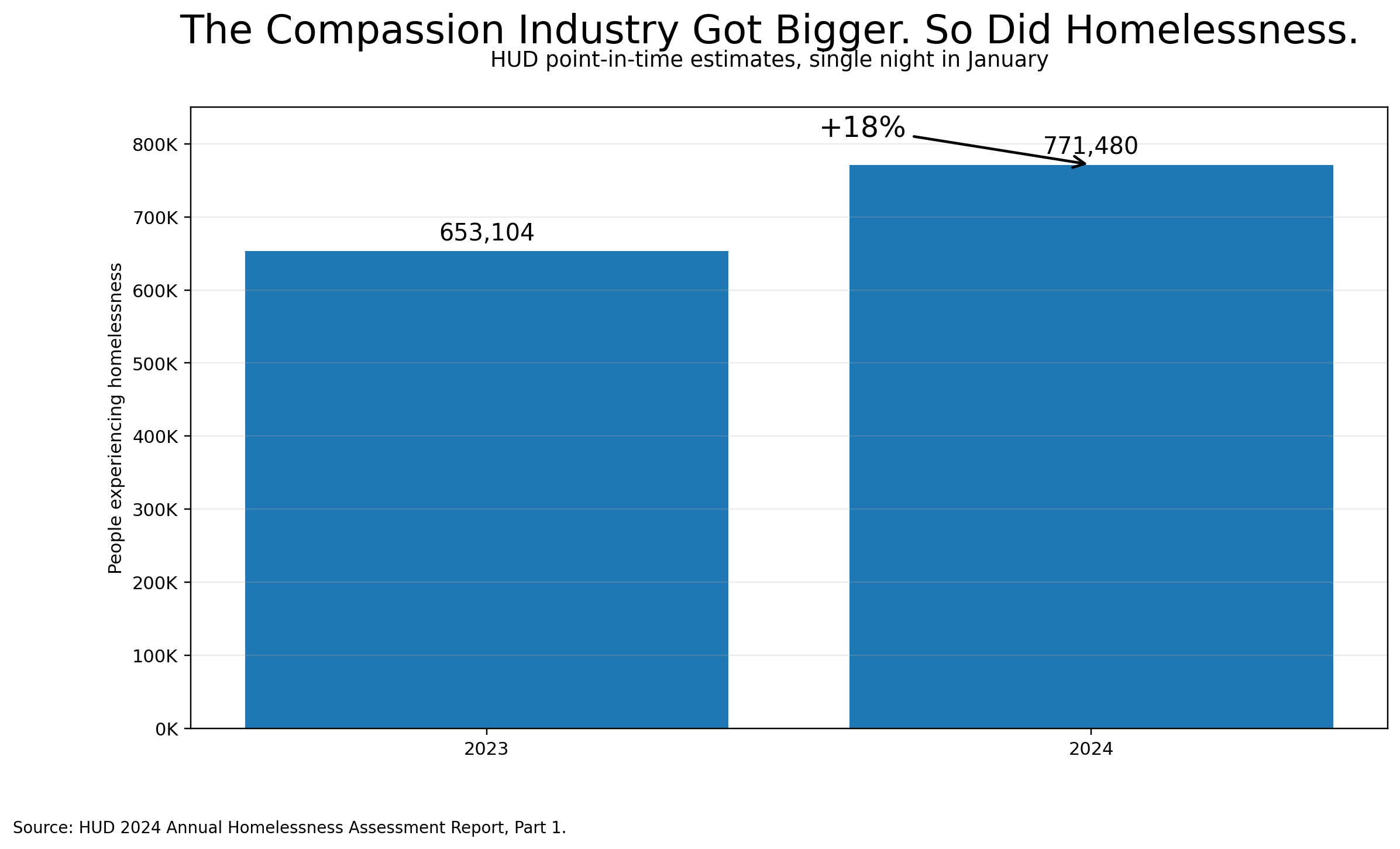
A decent society can recognize those numbers without surrendering its streets.
The sane response combines order and help. Clear encampments. Enforce laws. Stop open-air drug markets. Require treatment when addiction or mental illness makes someone a danger to himself or others. Restore the idea that public spaces belong to the public, including children, workers, families, commuters, and small business owners.
The left has often answered with subsidy and vocabulary.
Tents. Needles. Pipes. Hotel rooms. Cash cards. Decriminalization. Softer language. Endless outreach. Endless spending. Endless explanations for why nothing can be enforced until every underlying social condition has been solved.
But the city still decays. The addict still suffers. The taxpayer still pays. The mother still avoids the park. The store owner still cleans the doorway. The commuter still gets threatened on the platform. The child still learns that adults have surrendered.
San Francisco became the poster child for this failure, but it is hardly alone. Portland, Seattle, Los Angeles, New York, Denver, Philadelphia, and other cities have all wrestled with some version of the same problem: public compassion turned into public disorder. The human being under the tarp is not saved by a city that lets him remain under the tarp. The family trying to use the sidewalk is not cruel for wanting the sidewalk back.
The left likes to pretend there are only two choices: cruelty or permissiveness. That is false.
A decent society can feed people without letting them colonize sidewalks. It can offer treatment without allowing public drug use. It can show mercy without letting unstable people terrorize strangers. It can recognize mental illness without pretending mental illness gives someone a right to destroy public order.
Daniel Penny’s case fits here too. New Yorkers had been told for years to tolerate subway disorder as part of urban life. Then one confrontation ended in death, and the one person the system had no trouble confronting was the passenger who intervened.
That is neglect dressed up as mercy. It is abandonment with better marketing.
Women’s Sports: The Girl Is Told to Move Over
Some issues are presented as complicated because the truth is politically inconvenient.
Women’s sports are not hard to understand. Female categories exist because male puberty creates physical advantages in strength, speed, power, lung capacity, and size. That is not hatred. That is the reason women’s sports exist.
If sex does not matter in athletics, women’s sports have no reason to exist. If sex does matter, then women have a right to their own category.
The left spent years pretending this was bigotry. Lia Thomas, a transgender swimmer from the University of Pennsylvania, became the first openly transgender athlete to win an NCAA Division I title in 2022 after winning the women’s 500-yard freestyle. Riley Gaines, who tied Thomas for fifth in another event, became one of the most visible critics of allowing biological males into women’s competition.
The issue was never only one swimmer or one race.
The lesson being taught to girls was simple: move over, be kind, do not complain, do not notice, and do not say what everyone can see.
The Democrat response was to redefine womanhood, punish girls who objected, and treat physical reality as hate speech. The male athlete was accommodated. The female athlete was told to adjust.
By February 2025, the NCAA changed its policy to limit women’s competition to athletes assigned female at birth, following President Trump’s executive order. But that reversal came only after years of girls and women being told that fairness required their silence.
This is the same pattern in another uniform. The person asking for an exception becomes the center of moral concern. The people who built the category, relied on the category, and were supposed to be protected by the category are told to yield.
Even equality now comes with a waiting room for women.
Riots: The Business Owner Gets Plywood
If people burn buildings, loot stores, attack police, or destroy property, they should be arrested.
That sentence should not be controversial.
A political grievance does not become nobler because someone throws a brick in its name. A sneaker store does not become a civil-rights battleground because someone smashed the window. A small business owner who loses everything is not a footnote to someone else’s revolution.
The Democrat response to riots has often been a study in selective eyesight. In 2020, Americans watched fires, looting, vandalism, assaults, and destroyed businesses while being told the protests were “mostly peaceful.” That phrase became infamous because it asked people to distrust their own eyes.
Of course many protests were peaceful. That was not the question. The question was why so many politicians and media figures seemed more worried about condemning the police than condemning the people burning neighborhoods.
The rioter got context. The police got blame. The business owner got plywood.
This is not a small thing. Property is not just property. It is savings, work, risk, payroll, inventory, insurance, and years of a person’s life. A burned store may be a statistic to an activist. To the owner, it may be the end of a dream. To the neighborhood, it may be the loss of jobs, services, and a place people depended on.
The left likes symbolic victims. It is less interested in unfashionable victims. The immigrant store owner cleaning glass off the floor at midnight does not fit neatly into the narrative. Neither does the Black business owner whose shop was destroyed in the name of racial justice. Neither does the elderly resident whose pharmacy never reopened.
Common sense says arrest rioters and protect property.
The modern Democrat instinct says understand the rage, blame the police, and treat destruction as a regrettable but politically useful expression of pain.
Once again, the person who broke the rule receives the explanation. The person who obeyed the rule receives the bill.
Failing Schools: The System Gets Protected and the Child Gets Passed Along
If a school cannot teach children to read, the school has failed.
There are details, of course. Poverty matters. Family structure matters. Attendance matters. Discipline matters. Language barriers matter. But the basic standard remains: a school exists to educate children. If children spend years in classrooms and still cannot read well, adults failed.
The response should be practical. Use phonics. Restore discipline. Stop promoting children who have not learned the material. Let parents choose another school if the assigned school is failing. Measure results honestly. Reward schools that teach and stop protecting schools that do not.
The Democrat response is to protect the system first.
Lower standards. Rename failure. Attack school choice. Blame racism. Blame funding. Blame tests. Blame parents, unless the parents want vouchers, in which case blame “privatization.” The teachers union gets protection. The bureaucracy gets money. The child gets passed along.
The COVID school closures exposed this clearly. Public schools in many Democrat-run places stayed closed far longer than necessary, even after evidence mounted that children were suffering academically, socially, and emotionally. The same people who said every policy was “for the children” tolerated learning loss on a massive scale while private schools, religious schools, and many schools in red states reopened faster.
Then came the same old answer: more money.
Money matters, but money is not a substitute for accountability. Some of the worst districts spend large amounts per student and still produce terrible results. If a child cannot read, the child does not need another press conference about equity. He needs someone to teach him how to read.
Poor children pay the highest price because their parents have the fewest exits. Wealthy parents do not sit around waiting for a failing system to reform itself. They move. They pay. They call someone. They find a way out.
The Democrat Party claims to stand for the poor while trapping poor children in schools its own leaders would never tolerate for their own families.
That is not compassion. That is protection of a government monopoly.
Mental Illness and Public Safety: Freedom to Decay Is Not Freedom
Mental illness is real. Addiction is real. Trauma is real. None of that changes the public’s right to safety.
Some people are too sick, too addicted, too unstable, or too dangerous to be left alone in public spaces without supervision. Nobody enjoys saying that. But adulthood often requires saying things that polite people avoid.
A serious society provides treatment, supervision, and confinement when necessary. It does not wait until a sick person becomes a corpse or turns someone else into one.
The left often treats intervention as oppression. Forced treatment is called cruelty. Institutions are remembered only for their abuses, not for the vacuum created when they disappeared. Public disorder is reframed as autonomy. A man screaming at strangers on a subway platform is treated as a symbol of social failure instead of a danger standing three feet from someone’s child.
The result is not freedom. It is neglect.
The mentally ill person is abandoned in public. The addict is allowed to keep using in public. The commuter is told to be tolerant. The police are called only after something terrible happens. Then everyone pretends the tragedy came from nowhere.
Jordan Neely is one example. Iryna Zarutska is another. Zarutska, a 23-year-old Ukrainian refugee, was fatally stabbed in an unprovoked attack on a Charlotte light rail train in August 2025. The accused attacker, Decarlos Brown Jr., reportedly had a long criminal history and serious mental health problems. A young woman fled war only to be killed on public transit in America by a man the system already had reason to know.
What exactly is compassionate about that?
Compassion for the unstable person cannot mean indifference to everyone around him. A society that refuses to confine dangerous people has not abolished cruelty. It has merely outsourced the cruelty to strangers on trains, sidewalks, buses, and subway platforms.
The old institutions had problems. Some were terrible. Reform was needed. But the answer to bad institutions was not no institutions. The answer to abusive treatment was not leaving psychotic people to decay under bridges.
Freedom to collapse in public is not freedom. It is abandonment with a civil-liberties vocabulary.
The Pattern
These issues look separate only if you stare at them one at a time.
Gun crime. Repeat offenders. School discipline. Retail theft. Illegal immigration. Homelessness. Women’s sports. Riots. Failing schools. Mental illness.
Different subjects, same instinct.
The person creating the problem becomes the center of moral concern. The person living with the damage becomes an obstacle to compassion.
The shooter becomes an argument against the gun owner. The thief becomes an argument against capitalism. The repeat offender becomes an argument against bail. The violent student becomes an argument against discipline. The illegal immigrant becomes an argument against borders. The addict becomes an argument against enforcement. The rioter becomes an argument against police. The failing school becomes an argument for more funding. The male athlete in women’s sports becomes an argument against biology. The unstable person terrorizing the public becomes an argument against involuntary treatment.
This is why so many ordinary Americans feel like the country has gone insane. They are not reacting to one policy. They are reacting to a ruling class that seems unable to say no to people creating disorder and unable to stop saying no to people trying to live decently.
A civilization is built on incentives. Reward responsibility and you get more of it. Excuse disorder and you get more of that too. This is not mysterious. It is human nature.
When crime is excused, crime spreads. When theft is tolerated, stores close. When classrooms lose discipline, learning disappears. When borders are not enforced, citizenship is cheapened. When public drug use is normalized, public spaces decay. When women are told to surrender their own sports, equality becomes a costume worn by cowardice.
There is nothing sophisticated about refusing to make moral distinctions. It is not compassion to blur the line between the guilty and the innocent. It is not justice to transfer the cost of bad behavior from the person who chose it to the person who did not.
The old rule was better.
Punish the criminal. Protect the citizen. Restore order. Tell the truth.
That is the common sense response. The country would be healthier if more people had the courage to say it plainly.
Help Keep This Work Independent
The easiest thing in America is to pretend not to notice.
Pretend the criminal is not the problem. Pretend the victim is not being ignored. Pretend the teacher, shop owner, commuter, parent, taxpayer, and law-abiding citizen are not the ones being handed the bill for someone else’s behavior.
That is how bad ideas survive. People see the damage, but learn to speak around it.
Become a Paid Subscriber
Your support keeps this work free for people who need to read it, helps these essays reach readers outside the approved channels, and gives plain truths the distribution they need before the respectable voices bury them.
Subscribe here:
https://mrchr.is/help
Make a One-Time Gift
If you do not want another subscription but still want to help, a one-time gift gives me more room to research, write, source, publish, and keep building this platform without asking permission from the institutions I criticize.
Make a one-time gift here:
https://mrchr.is/give
Join The Resistance Core
The Resistance Core helps fund the longer investigations, data-heavy essays, charts, videos, and source work that do not survive inside polite institutional spaces.
Join here:
https://mrchr.is/resist
If You Cannot Give
Read it. Share it. Restack it. Send it to the person who knows this is true but has never seen it said this plainly.