


“Conservatives say they want an independent media ecosystem, but too many large platforms treat smaller writers the same way legacy media treats them: useful as an audience, invisible as peers.”
Conservative media has spent years telling Americans to stop trusting the gatekeepers.
Stop waiting for The New York Times to tell you what matters. Stop waiting for CNN to notice what is true. Stop waiting for Big Tech, universities, publishing houses, corporate advertisers, and the Democrat Party’s media allies to decide which voices deserve to be heard.
Build alternatives, they say.
Support independent media.
Lift up voices the establishment ignores.
It sounds good. I believed it.
That is why I started sharing other people’s work on a regular basis. Retweets. Restacks. Cross-posts. Links. Recommendations. Larger accounts. Smaller accounts. If I thought something deserved attention, I tried to help it find readers.
Not because anyone owed me anything in return.
Nobody owes me a platform, a retweet, a guest essay slot, a podcast invite, a recommendation, or a career. That needs to be said clearly, because it is the easiest way for people to avoid the actual point.
This is not about entitlement. It is about a conservative media world that constantly preaches support, courage, capitalism, and independent voices while often behaving like a closed guild.
If the legacy press is corrupt, if corporate media is captured, if Big Tech manipulates what people see, if the Democrat Party has turned much of the press into a communications department, then conservatives should want as many serious independent voices as possible.
That is what we keep hearing, anyway.
We need alternatives. We need our own institutions. We need to support independent media. We need to lift each other up. We need to bypass the gatekeepers.
Fine. Then where is the lifting?
The Silence Is the Point
After writing, publishing, sharing, reaching out, offering to contribute, offering to reciprocate, asking for advice, and trying nearly every reasonable path into the conservative media world, the response from many larger accounts has been hard to miss.
Not disagreement. Not rejection. Not “this is not a fit.” Not “send me something later.” Not “I’m swamped right now.” Not even “please stop bothering me.”
Just silence.
I have reached out through Substack. I have reached out through Twitter. I have sent emails. I have commented. I have even tried the phone. I have asked for opportunities to write essays. I have asked for advice. I have offered to reciprocate. I have not asked anyone to carry me, endorse everything I say, or hand me their audience.
A few times, the contrast was almost funny. I would send a serious, polite note, hear nothing, and then see the same general crowd posting about the urgent need to support independent voices. Maybe they never saw the message. Maybe it got buried. Maybe they were busy. But after the hundredth version of that experience, “maybe” starts to look less like an explanation and more like a courtesy you are extending to a pattern.
Out of roughly a hundred conservative commentators who could have helped in some small way, one got back to me. He was not one of the big names.
That does not tell you every big conservative account is bad. It does not tell you every ignored message is part of a conspiracy. It does not tell you I am always right, always polished, or always someone’s cup of tea. But it does reveal something.
When larger conservative voices say “support independent media,” too often what they seem to mean is: support our independent media. When they say “lift each other up,” too often the practical translation is: lift me up.
That is the part worth discussing.
I Am Not Asking to Be Discovered From Scratch
Because I am not some anonymous reply guy with three followers, a bald eagle profile picture, and two half-finished blog posts from 2021.
As of July 2, 2026, I have published 298 essays in less than 18 months. Most of them are 5,000 words or more. At my current pace, I am producing roughly one million words per year. I have more than 2,300 engaged Substack subscribers, about 40,000 followers on Twitter, and roughly 4,500 Facebook friends.
That is not The New York Times, Fox News, or The Daily Wire. But it is not nothing. It is work. It is an audience. It is proof that I am not asking to be discovered from scratch.
I have also done much of this while life was anything but stable, under personal and financial pressure that would have made quitting the easier choice. That is not a request for pity. It is context. A lot of people talk about grit, independence, and building outside the system. Some of us are actually doing it without a safety net.
I am not saying follower counts equal wisdom. They do not. Some of the dumbest people in America have very large audiences, while some of the smartest are still mostly unknown. Numbers are not everything.
But numbers do matter when the excuse is that smaller writers have not built anything.
I have built something. It may not be large enough to impress the people who measure value only by proximity to power, but it is real. It is not theoretical. It is not someday. It exists.
Which raises the obvious question.
If someone with that much demonstrated output still gets treated like a nuisance by the very people preaching independent media, what chance does the truly unknown writer have?
That is where this becomes bigger than me.
The next serious conservative thinker may not have a cable-news face, a think-tank job, a famous friend, or a viral gimmick. He may be writing from a spare bedroom after work, fighting bills, algorithms, family pressure, and the quiet suspicion that nobody with a platform is ever going to notice. If the people who claim to be searching for independent voices cannot see him until he is already famous, then they are not discovering talent. They are waiting for someone else to validate it first.
A conservative movement that only amplifies the already amplified is not building an alternative. It is building another aristocracy.
Every institution eventually develops insiders. That is not unique to politics, media, business, academia, or entertainment. The question is not whether gatekeepers exist. Some gatekeeping is unavoidable. Standards matter. Taste matters. Editorial judgment matters. Nobody wants a movement where every crank with a keyboard gets promoted as if he were James Madison.
The problem begins when standards become a polite name for protecting friends, donors, brands, access, and status.
That is what conservatives usually understand when they criticize the left. They know The New York Times does not simply “curate quality.” They know universities do not merely “uphold standards.” They know Big Tech does not only “protect users.” Those institutions use soft language to protect hard power.
Yet when conservative media develops its own inner circles, the same people who can spot gatekeeping everywhere else suddenly become very forgiving.
The problem is not that large accounts are busy. Of course they are busy. Their inboxes are probably filled with spam, bad pitches, trolls, bots, activists, and people demanding favors. I do not expect anyone to read everything, respond to everyone, or become a full-time guidance counselor for every aspiring writer with a Substack.
But “busy” has become the universal excuse for a culture that takes upward support for granted and treats downward support as optional.
Large accounts have time to sell books, promote sponsors, ask for donations, launch paid communities, and remind the base that the country is in crisis. Somehow, though, many of them do not have time to answer a serious smaller writer, share a strong essay, recommend a new voice, or say, “Not for me, but keep going.”
Again, nobody owes me that. But if you build your brand around fighting gatekeepers, you should expect outsiders to notice when you start acting like one.
Useful as Supporters, Invisible as Peers
The deeper issue is that many of these people do not seem to want a movement of independent voices. They want a court.
They want subscribers, donors, viewers, restackers, defenders, and foot soldiers. They want people who will boost the post, buy the book, join the community, promote the sponsor, defend them during the next controversy, and help turn their outrage cycle into income.
What they often do not want is another serious independent voice entering the room with his own audience, his own archive, his own arguments, and no need to ask permission.
A serious independent writer is not just another supporter. He is a potential peer.
That makes some people uncomfortable.
Not because he is guaranteed to beat them. Not because he is owed their place. Not because there is only one seat available. That is the funny part. The people who preach capitalism every day should understand better than anyone that attention is not a fixed loaf of bread in a Soviet grocery store.
Capitalism in Public, Feudalism in Practice
There is plenty of pie.
Good writers do not steal readers from other good writers. They create more readers. Good essays do not shrink the market for serious thought. They expand it. Strong arguments create stronger audiences. A healthier independent media world benefits everyone who is actually serious about independent media.
That is supposed to be the whole point of capitalism.
Markets are not supposed to be closed clubs. Talent is not supposed to need permission from incumbents. Competition is not supposed to be treated as a personal insult. If someone can build something useful, he should be allowed to build it. If readers find value in it, they should be allowed to support it.
Conservatives say this all the time when they are talking about the economy. Then some of them get a large platform and behave as if attention must be rationed by status.
They preach capitalism to the country and practice feudalism in their mentions.
There is also an economic incentive here, and it should be said plainly.
Legacy media gatekeeps to protect an ideological narrative. New media often gatekeeps to protect audience market share. A serious new writer is not just another ally. He is another newsletter, another paid subscription, another voice in the reader’s inbox, another place where attention might go. That is standard corporate protectionism. The problem is that many of these people do it while calling themselves a movement.
That may sound harsh, but look at how status changes the interpretation of the same behavior.
Large conservative accounts ask for money constantly. Subscribe. Donate. Buy the book. Join the community. Support the show. Become a member. Help us fight Big Tech. Help us beat the regime. Help us keep independent media alive. Help us tell the truth. Help us build something outside the corporate press.
When they do it, it is entrepreneurship. When a smaller writer does it, it can be treated as begging. When a famous commentator asks for support, it is movement-building. When an independent writer asks readers to become paid subscribers, he is supposed to feel embarrassed. When a large platform monetizes outrage, it is smart business. When a smaller creator says plainly that the work costs money and the bills are real, some people suddenly discover their delicate concern for tone.
That is not capitalism. That is caste.
Some people will look for an easy explanation. Maybe I talked too much about money. Maybe I was too open about hardship. Maybe the eviction issue made people uncomfortable. Maybe the donation requests and paid subscription appeals turned some people off. Maybe some larger accounts saw that and decided I was too messy, too desperate, or too blunt.
Fine. Maybe some of that turned a few people off.
But it does not explain the pattern, because the silence was there from day one. Before the eviction issue. Before the emergency appeals. Before the desperate posts. Before the public admission that I was trying to keep the lights on, keep a roof over my family, and keep writing anyway, the reaction from most larger accounts was basically the same.
Hardship may give people an excuse to ignore you. It does not explain why they were ignoring you before the hardship became public.
If my personal situation made some people uncomfortable, that is their right. But let’s not pretend discomfort is discernment.
The Right Has Its Own Attention Hierarchy
There is another layer to this that many people notice but few want to say out loud. Conservative media has its own attention hierarchy.
The right mocks the left for identity politics, often correctly. The left has built entire institutions around race, gender, sexuality, credentials, victim status, and ideological loyalty. Conservatives see that and understand how dishonest it is.
But the right has its own version. It is not always race, gender, and pronouns. Sometimes it is looks, access, follower count, former insider status, former liberal status, television polish, donor connections, proximity to power, and whether someone fits a marketable role.
In attention-driven media, presentation often travels farther than substance, even among people who claim to despise shallow politics.
That is not an attack on attractive women, polished speakers, former insiders, or people who happen to be good on camera. Some of them are smart, courageous, and doing good work. The point is not that they should be ignored. The point is that conservative media, like every other attention market, often rewards packaging before substance while pretending it is above such things.
The serious writer doing the work may not be useful as a symbol. He may not flatter the right people. He may not look like a cable-news segment. He may not have the approved biography. He may not know the right donors, podcast hosts, conference organizers, or influencers.
So he stays outside.
The right complains, correctly, that the left rewards credentials, connections, and identity. But the right often rewards follower count, access, looks, and proximity to power. Different uniforms. Similar club.
This is how gatekeeping survives. It changes language. It changes clothes. It changes sides. It does not always announce itself as censorship. Sometimes it appears as silence, neglect, social caution, brand protection, or the quiet assumption that anyone outside the circle must not be worth noticing.
The conservative movement did not abolish gatekeeping. In many cases, it built parallel gates and handed the keys to people who now insist they are rebels.
That should bother anyone who claims to care about the future of conservative media.
A Movement Cannot Be a Fan Club
Because this is strategically stupid.
A movement that refuses to circulate talent eventually becomes a fan club for the already famous.
If every road leads back to the same twenty accounts, conservatives are not building independent media. They are building a smaller version of cable news. Maybe the slogans are better. Maybe the enemies are different. Maybe the ads are for gold, supplements, survival food, and VPNs instead of pharmaceuticals. But the structure is not as different as people pretend.
A real network needs circulation. It needs unknown writers becoming known writers. It needs mid-sized creators being taken seriously. It needs large accounts willing to look outside their circle. It needs readers finding new voices before those voices get burned out, blacklisted, or forced to spend all day begging algorithms for scraps.
It needs more than the same names interviewing the same names, recommending the same names, promoting the same names, and then asking the base why more people are not building alternatives.
People are building alternatives. Many of them are just being ignored.
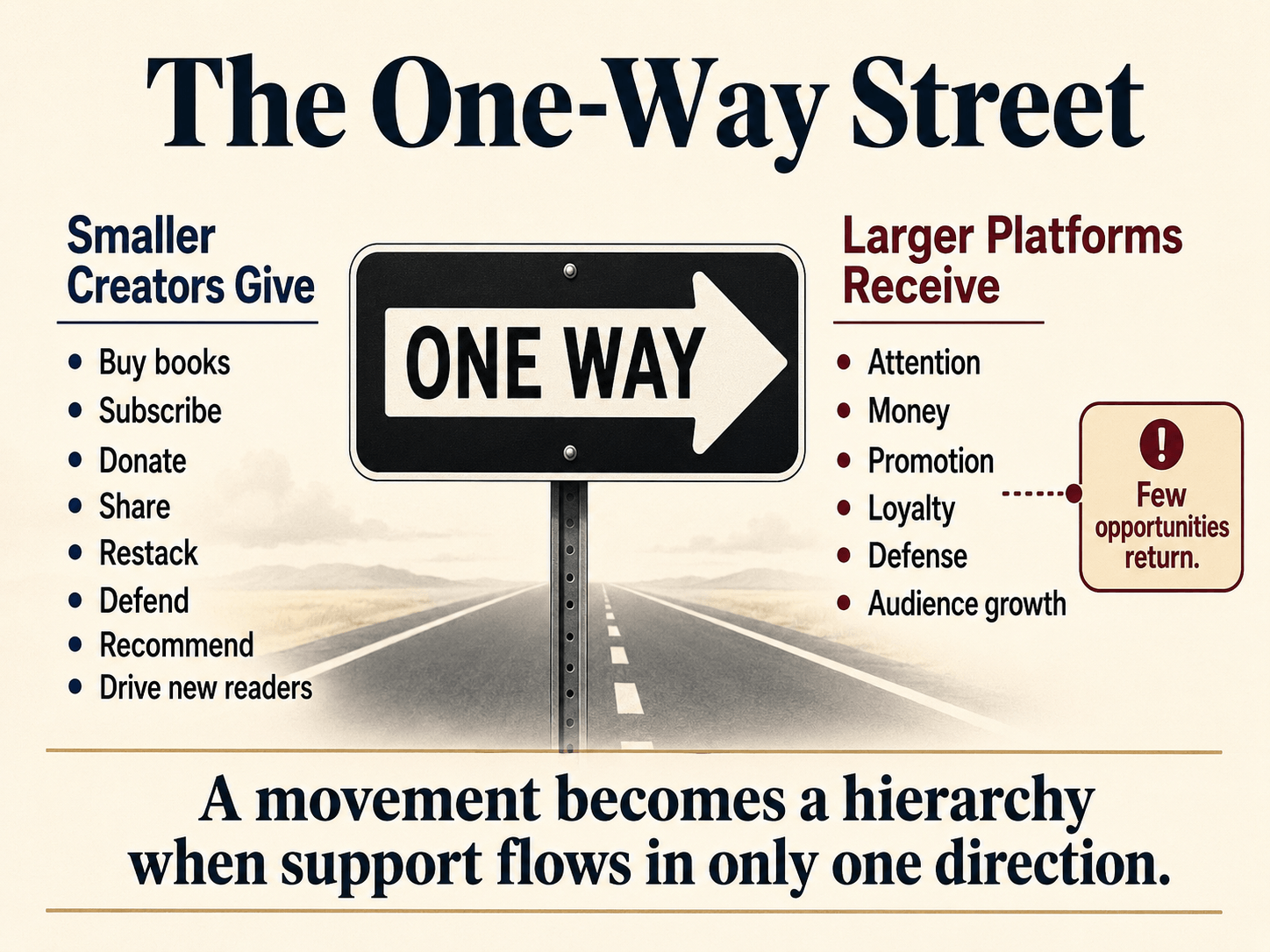
Small and mid-sized creators are the middle class of independent media. They are not the celebrity class at the top, and they are not just spectators in the audience. They are the connective tissue. They buy the books, pay for subscriptions, share the essays, defend the larger accounts, promote podcasts, forward articles to friends, fight in replies, and normalize arguments before bigger names touch them.
A society without a middle class becomes unstable because too much power collects at the top and too much frustration collects below. Media works the same way. If independent media becomes a tiny class of famous accounts speaking to a vast class of passive followers, it is not a healthy movement. It is a top-heavy system waiting to crack.
They are treated like the infantry of independent media: useful in battle, forgotten after the speech.
That is not how a serious movement builds depth. It is how a celebrity economy builds dependency.
The Ladder Has to Come Back Down
A healthier conservative media world would not require every large account to become a charity. Nobody is asking famous writers to spend their days reading every stranger’s 6,000-word essay on immigration, crime, schools, speech codes, foreign policy, election law, or the latest Democrat Party absurdity.
But there is a reasonable middle ground between adopting every stray writer and pretending no one outside the circle exists.
Large accounts could recommend one smaller writer a week. They could host occasional guest essays. They could create open submission windows. They could share strong research with credit. They could answer serious pitches with a short yes or no. They could read beyond the same handful of familiar names.
Most importantly, they could stop acting as if every smaller writer who reaches out is asking for charity.
Some are asking for opportunity. Some are asking for advice. Some are asking for the kind of basic professional courtesy that the right says the left denies to outsiders.
If you can ask the movement for money, you can spend ten minutes a week helping the movement find new voices.
That is not an unreasonable standard.
Smaller writers also need to hear some hard truths.
Not every essay deserves promotion. Not every pitch is good. Not every silence is personal. Not every large account has bad motives. Nobody owes you success. You still have to improve. You still have to build your own audience. You still have to write better, publish more, earn trust, and learn from what does not work.
Obscurity is not automatically injustice. But status is not automatically merit either.
The answer for smaller creators is not to beg harder. It is to build anyway, expose the hypocrisy when necessary, and refuse to become the kind of gatekeeper they once resented.
That is where I am.
I am not going away.
I have written too much, worked too long, and built too much from nothing to disappear because larger accounts do not answer messages. I will keep writing. I will keep publishing. I will keep researching. I will keep sharing good work when I find it. I will keep building my own audience without permission.
At this point, I am not going away unless I keel over and die. That may sound dramatic, but after 298 essays in less than 18 months, it is simply a statement of evidence.
If I fail, I fail working. But I am done pretending the silence is accidental.
Conservative media does not have to share my work. It does not have to answer my messages. It does not have to invite me in.
But it should stop pretending this is all about building a broad, brave, independent media network if the actual model is a one-way street where smaller creators supply attention, money, defense, and amplification while the top recycles the same approved names.
That is not a movement. It is a caste system with better branding.
I still believe there is plenty of pie. I still believe good writers create more readers. I still believe strong arguments create stronger audiences. I still believe independent media can become more than a slogan.
But that will not happen if the people preaching capitalism keep practicing feudalism.
The ladder has to come back down, or they should be honest enough to admit it was never a ladder.
It was a wall.
Help Keep This Work Independent
The easiest thing in media is to pretend not to notice.
Pretend gatekeeping only exists on the left. Pretend independent media means whatever the largest accounts are already building. Pretend “support smaller voices” means subscribe, donate, share, and defend the people who already have the microphone. Pretend the ladder is coming back down someday.
That is how closed systems survive. People see the pattern, but learn to speak around it. They know something is wrong, but they are trained to call it complicated, strategic, busy, brand-conscious, or just how the business works.
This work exists for the people who are done pretending.
Become a Paid Subscriber
Your support keeps this work free for people who need to read it, helps these essays reach readers outside the approved channels, and gives plain truths the distribution they need before the respectable voices bury them.
Subscribe here:
Make a One-Time Gift
If you do not want another subscription but still want to help, a one-time gift gives me more room to research, write, source, publish, and keep building this platform without asking permission from the institutions I criticize.
Make a one-time gift here:
Join The Resistance Core
For readers who want to do more than subscribe, The Resistance Core helps support the longer essays, research, charts, images, promotion, and independent infrastructure behind this work.
Join here:
Venmo
If you prefer to give directly without starting a subscription, Venmo is another one-time option.
Venmo:
https://account.venmo.com/u/mrchrisarnell
If You Cannot Give
If money is tight, share this essay, restack it, forward it, leave a comment, or send it to one person who believes independent media should mean more than supporting the already famous.
That helps more than most people realize.
The more I think about it, the more the middle-class analogy fits. Small and mid-sized creators are the connective tissue. They are not celebrity accounts, but they are also not just spectators. They keep arguments moving, share work, build audiences, and normalize ideas before the big accounts ever touch them. Ignore that layer long enough, and the whole thing becomes top-heavy.
I am certainly not familiar with the world of publishing you have described, but you have done a good job illustrating what I consider a valid point. I am on X, and Substack, and of course the posts I view have trapped me inside an algorithim which feeds me the same cycle of folks which you have described. I have tried to break out of the algorithim by subscribing to certain folks on the left, whom I despise, just to bring in new writers and ideas; however, that has not worked. I am not sophisticated enough to figure out how to break out.
You are correct, there are so many sources out there and all of them want a subscription. I am a paid subscriber to your Substack; however, I cannot afford to subscribe to everyone I would like to. I appreciate your work. I totally understand your issue with the Ken & Barbie profiles getting all the attention; however, nothing new under the sun there.
Keep on researching, fact-checking, and publishing. You will eventually break through. I have one piece of constructive criticism, I love your work; but your essays are very long and require significant dedication to get through them. If you could pack the powerful commentary into a more condensed format, I believe it would help.