

“A constitutional emergency that can wait for the work week to start is not an emergency. It’s politics.”
Every few years, the country rediscovers the War Powers debate. A president orders a strike. Cameras gather. Congress invokes Article I. Commentators announce a constitutional crisis. The phrase “unchecked executive power” makes another appearance.
Then, just as quickly, the urgency fades. The troops remain deployed. The strikes continue, or they stop. And the constitutional alarm recedes until the next president pulls the trigger.
What rarely changes in these moments is the Constitution itself.
Article I still gives Congress the power to declare war. Article II still names the president Commander in Chief of the armed forces. Those provisions have not been amended, rewritten, or updated to reflect modern geopolitics. The words are the same today as they were in the eighteenth century.
Yet the reaction to presidential military action has not remained the same.
Since the end of the Second World War, the United States has formally declared war exactly once. That was in 1942, after Pearl Harbor. Every major military action since then, from Korea to Vietnam to Iraq to Libya to Syria to Iran, has occurred without a formal declaration of war. Presidents of both parties have relied on authorizations passed decades ago, on United Nations resolutions, on NATO commitments, or on their own interpretation of Article II authority.
In 1973, after the long and bitter experience of Vietnam, Congress passed the War Powers Resolution. It required the president to notify Congress within forty-eight hours of introducing armed forces into hostilities and set a sixty-day clock for continued engagement unless Congress granted authorization. Presidents have generally complied with the reporting requirement while often disputing the constitutionality of the sixty-day limit. Courts have almost always declined to intervene, calling such disputes political questions between branches.
The result is not clarity. It is a gray zone. That gray zone has existed for more than half a century.
If one looks at the historical record, it becomes clear that presidents have repeatedly used limited military force without prior declarations of war. That fact is not controversial. What is more controversial is how Congress reacts to those actions.
Some presidents receive criticism. Some receive fragmented opposition. And in recent years, one president has received something closer to near-unified resistance.
Before deciding whether the latest strike represents a constitutional break with history, it is worth asking a simpler question.
Has the standard changed, or has the political environment changed around it?
This Didn’t Start With Trump
If you only started paying attention to war powers when Trump was in office, you would think the whole issue began in 2017. That is how Washington likes it. Washington now speaks as if the Constitution were pristine and unambiguous until the wrong man held the office.
But presidents have been “testing” the boundary between Congress and the Commander in Chief for decades. And Congress has been tolerating it for decades. Sometimes it objects, sometimes it complains, sometimes it votes, and most of the time it does what it always does when responsibility gets uncomfortable. It talks loudly and then funds the operation anyway.

Start with the part people prefer to skip.
Jimmy Carter and Iran
In 1980, Jimmy Carter authorized Operation Eagle Claw, the attempted rescue mission to free American hostages in Tehran. That was a military operation inside Iran. There was no declaration of war. There was no prior authorization from Congress. The mission failed, eight U.S. servicemen were killed, and Carter wore the political blame for it.
What is important here is not the failure. It is the precedent. A president ordered U.S. forces into a hostile sovereign country without a declaration of war. The country argued over competence, not constitutionality. Congress did not erupt into a full-blown campaign to strip Carter of authority. The same people who now speak as if any unilateral action is automatically illegitimate did not treat it that way then.
Ronald Reagan and the Use of Force
Reagan gives you two clean examples.
Grenada in 1983. A fast invasion. No prior declaration of war. Plenty of criticism afterward, but the central complaint was not that the president had committed some unprecedented constitutional crime.
Then Libya in 1986. Reagan ordered airstrikes on Tripoli and Benghazi after terrorist attacks tied to the Gaddafi regime. That was direct military action against a sovereign state. No declaration of war. No up-front congressional authorization.
This is the part that matters for the modern argument. If someone wants to claim the principle is “a president cannot strike a sovereign country without Congress,” then Reagan becomes a problem for that principle. Reagan did it, and the system absorbed it.
Bill Clinton and Kosovo
In 1999, Clinton joined a sustained NATO air campaign in Kosovo. The House vote to authorize that action resulted in a 213 to 213 tie. Authorization failed. The operation continued anyway.
That is not a small historical footnote. That is Congress failing to authorize force and the executive branch carrying on regardless. And it happened under a Democrat.
George W. Bush and the AUMF Shield
Bush is where the pattern changes in a technical way. After 9/11, Congress passed the 2001 AUMF. In 2002 it passed the Iraq AUMF. Those votes gave Bush broad legal cover for years of military action.
So Bush is not the best example for “no authorization” fights, because Congress gave him authorization early and wide. The bigger point is this. When Congress wants to authorize force, it can. When it does not want to own the consequences, it chooses ambiguity.
Barack Obama and Libya
If you want a modern case study that looks a lot like today’s argument, you go straight to Libya in 2011.
Obama participated in a multi-month air campaign. Congress did not pass a clear authorization. The House rejected authorization. The administration argued that the operation did not count as “hostilities” in the sense meant by the War Powers Resolution. That argument was laughed at by critics at the time, including critics who are now conveniently silent when the same kind of legal gymnastics happen under other presidents.
Whatever you think of Libya, it established a blunt reality. A president can conduct a sustained air campaign without Congress signing off in a neat, formal way. And Washington will tolerate it when the political incentives line up.
Obama Again: Syria and ISIS
When ISIS expanded, Obama began air operations in Syria in 2014. He relied on the old 2001 AUMF. Many people argued that was a stretch. Some Democrats objected. The broader party did not organize a near-unified revolt to stop him. That difference matters.
Joe Biden and “Limited Strikes”
Biden also used force without new authorizations, including retaliatory strikes in Syria and strikes connected to the Houthi conflict in Yemen. Progressive Democrats criticized it. Most of the party did not treat it as an existential constitutional emergency.
And that brings us to the obvious question.
If this is truly about first principles, where was the uniform alarm then?
The Reaction Pattern
The constitutional gray zone is not new. What appears new is the scale and uniformity of the reaction when Donald Trump occupies the White House.
Under Trump’s first term, the pattern began to emerge clearly.
In 2017 and 2018, Trump ordered strikes in Syria in response to chemical weapons use. There was debate, of course. There is always debate. But when he authorized the January 2020 strike that killed Iranian General Qasem Soleimani, the reaction sharpened. The House passed a War Powers resolution seeking to limit further military action against Iran. In February 2020, the Senate voted 55 to 45 on a related War Powers measure. The vote split largely along party lines, with almost every Democrat voting to restrain the president’s authority.
That was not merely a disagreement. It was organized, immediate resistance framed in constitutional language.
Now fast forward to his second term.
In June 2025, after Trump authorized major strikes on Iranian nuclear facilities, the Senate voted 53 to 47 on a War Powers resolution to require explicit authorization for continued hostilities. The split again tracked party alignment. Nearly every Democrat voted to curb the president. One Republican crossed over. One Democrat did not. The margins tell the story. This was not a scattered concern. It was near-unified opposition.
When the 2026 expansion of operations followed, the calls intensified. The language grew stronger. Phrases such as “unconstitutional war” and “dictatorial power” were deployed quickly and widely. The constitutional alarm was not measured. It was immediate.
Now compare that reaction to Libya in 2011.
Roughly one-third of House Democrats opposed a related authorization measure during Obama’s Libya campaign. That is not trivial dissent. But it is not ninety percent party unity. It is not an immediate effort to politically isolate the president of their own party.
Compare it again to Biden’s strikes in Syria and Yemen in 2024. Progressive Democrats raised objections. A handful spoke of constitutional limits. There was no overwhelming, coordinated push to halt the president’s authority through urgent War Powers votes.
The contrast is not subtle. It is numerical.
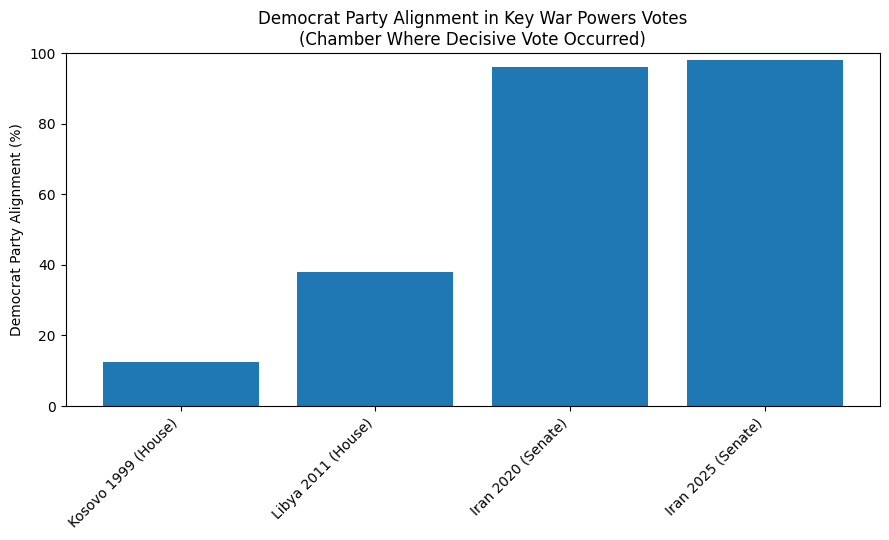
When party alignment rises from roughly 12% in Kosovo to nearly 100% in Trump-era Iran votes, something structural has changed.
Under Trump, opposition to war powers has tended to be fast, aligned, and nearly complete within the Democrat Party. Under other presidents, including those who used force against sovereign states without declarations of war, opposition has been more fragmented.
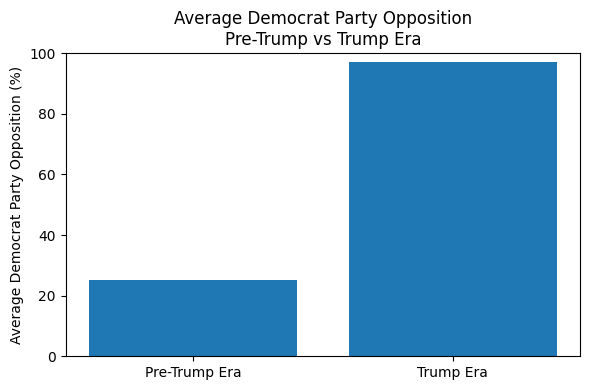
The question writes itself.
Did the legal principle change? Or did the occupant of the office change?
One can oppose Trump’s policies. One can disagree with his judgment. That is not the issue here. The issue is consistency. If unilateral strikes without prior authorization represent a constitutional crisis in 2025, they were also a constitutional crisis in 2011. If they were not a constitutional crisis in 2011, something other than principle is driving the reaction in 2025.
And that something needs to be examined.
The Sovereignty Argument
The most common defense of the heightened reaction to Trump’s Iran strikes is simple.
Iran is a sovereign state.
This is not a terrorist camp in an ungoverned region. It is not a militia hiding in a failed state. It is a recognized government. Striking it carries a higher risk of escalation. Therefore, the argument goes, the constitutional threshold should be higher.
That sounds reasonable on its face. But it collapses under even modest historical scrutiny.
Libya in 2011 was a sovereign state. The United States conducted a seven-month air campaign against the Gaddafi regime. There was no formal declaration of war. Congress did not pass authorization. The administration argued that the operation did not constitute “hostilities” in the meaning of the War Powers Resolution. That legal reasoning was widely criticized at the time. Yet the broader Democrat Party did not mobilize in near total revolt to strip President Obama of authority.
Serbia in 1999 was a sovereign state. The Kosovo air campaign lasted seventy eight days. The House vote to authorize force failed. The operation continued anyway.
Grenada in 1983 was a sovereign state. U.S. forces invaded without prior declaration of war.
Libya in 1986 was a sovereign state when Reagan ordered airstrikes on Tripoli and Benghazi.
Syria is a sovereign state. Presidents Obama, Trump, and Biden have all ordered strikes there without declarations of war.
The sovereignty line, therefore, does not explain the difference in reaction. Sovereignty has not historically triggered near-uniform party resistance.
One might argue that Iran is uniquely dangerous. It presents nuclear implications. The escalation risks are greater.
That may be true as a strategic assessment. But constitutional principles are not supposed to fluctuate with the temperature of geopolitical risk. If the principle is that striking a sovereign state requires prior congressional authorization, then that principle applies equally to Libya, Serbia, Grenada, Syria, and Iran.
If it does not apply equally, then it is not functioning as a principle. It is functioning as a political tool.
This is the uncomfortable part of the discussion.
The same voices who treated Libya as a limited humanitarian intervention now describe Iran as a constitutional breaking point. The same institutional actors who accepted expansive interpretations of Article II authority under presidents of their own party now insist on strict construction when the presidency is held by someone they view as disruptive.
The pattern cannot be explained by sovereignty alone. The data points do not allow it.
And once sovereignty is set aside as the decisive factor, we are left with a harder question.
If not the legal text, and not the sovereign status of the target, what explains the difference in intensity?
The Pattern Beyond Foreign Policy
War powers are not the only place where Trump has triggered an unusually unified response. That is the larger point. The military strike debates are simply where the pattern becomes easiest to measure, because Congress is forced to put something on paper, take a vote, and attach names to positions.
But the reflex has been visible across the board.
When Trump moved on tax reform in his first term, the Democrat Party did not treat it as an ordinary legislative dispute. It became a moral emergency. When Trump moved on immigration enforcement, it was not framed primarily as a policy disagreement about labor markets, border integrity, or administrative capacity. It was framed as a moral crisis that demanded resistance as a posture, not merely debate as a process.
Judicial nominations provide another clean example because the numbers are public and the alignment is obvious. In earlier eras, senators sometimes crossed party lines on judges. It was not constant, but it happened enough to signal that qualifications could outweigh tribal allegiance. Under Trump, the confirmation fights became nearly pure party alignment. Whatever a nominee’s credentials, the default position of the Democrat Party tended to be opposition. That does not mean every Democrat voted no in every case. It means the norm shifted toward automatic resistance.
Even executive actions that would have been applauded under another president were often treated as suspect under Trump, not because the action itself was unprecedented, but because the actor was Trump.
This matters because it reveals something that is easy to miss if one focuses only on foreign policy.
What we are watching is not simply disagreement about specific decisions. Disagreement is normal. It is healthy in a republic. What we are watching is a habit of mind. A posture. An instinct.
Trump is not evaluated on a sliding scale of success or failure. He is evaluated on a binary. If Trump does it, it is presumed illegitimate until proven otherwise.
That is the political context in which war powers debates now occur.
When an Obama administration lawyer stretched the War Powers Resolution and argued that months of bombing did not count as “hostilities,” the argument was met with criticism but also with leeway. When a Biden administration authorized strikes without a new authorization, the criticism came mostly from a small progressive wing. When Trump strikes, the language escalates quickly to “illegal,” “unconstitutional,” and “authoritarian.”
It is not that presidents before Trump never faced criticism. They did. It is that the criticism under Trump tends to align faster, harder, and more completely, even when the underlying constitutional gray zone is identical.
That is why the war powers dispute over Iran cannot be treated as a stand-alone event. It sits inside a larger political pattern. And that pattern is what makes the constitutional language feel selective.
At this point, some readers will want to stop the discussion and say the obvious. Trump provokes this response because Trump is Trump. Because he is rude. Because he is impulsive. Because he says things that offend polite society.
That may explain why he is disliked. It does not fully explain why institutional behavior shifts so dramatically around him.
To understand that, we need to talk about incentives. That is where politics stops being a morality play and starts being a system.
Why Trump Triggers a Different Reaction
There is an easy explanation for the intensity of opposition to Trump. It is the explanation repeated endlessly on cable news. He is divisive. He is blunt. He is undisciplined. He offends people. He violates norms.
All of that may be true. None of it fully explains the institutional behavior.
Politics is not driven primarily by emotion. Incentives drive it. People respond to what affects their leverage, their influence, and their long-term control over outcomes.
Most modern presidents rise through a predictable path. They spend years inside party hierarchies. They cultivate donor networks. They build relationships within bureaucracies and foreign policy institutions. They speak the language of consensus, even when they disagree with parts of it. They may challenge opponents, but they rarely challenge the structure itself.
That structure has guardrails. If a president strays too far, donor pressure applies. Media pressure applies. Party leadership applies. Bureaucratic resistance applies. The system knows how to push back.
Trump did not arrive through that route.
He did not build his political identity through decades of committee hearings and party ladder climbing. He did not depend in the same way on traditional donor pipelines that often shape policy boundaries long before legislation is written. He campaigned not just against the opposing party, but against what he portrayed as an entrenched political class in both parties.
Whether one likes him or not, that is a disruption.
When someone operates inside a system, disagreements are contained. When someone challenges the system’s legitimacy or independence, resistance becomes structural rather than episodic.
This is the key shift.
Under a conventional president, war powers debates tend to remain technical. Lawyers argue over definitions. Members of Congress express concern, but few feel existentially threatened.
Under Trump, the debate feels different because the actor feels different. It is not merely about whether a strike in Iran fits within Article II authority. It is about whether this particular president should be allowed wide discretion at all.
Once the argument shifts from action to actor, intensity rises.
The Democrat Party’s reaction to Trump’s use of force reflects that shift. The language escalates quickly because the concern is not only about Iran. It is about the presidency in the hands of someone viewed as outside the club.
If a president is seen as less dependent on traditional political alliances, less constrained by party leadership, and less predictable in foreign policy posture, then constraining that president becomes a priority in itself.
War powers resolutions become tools not only for asserting congressional authority, but for signaling resistance to the individual holding office.
Again, this is not a claim that Trump is beyond criticism. It is a claim that the magnitude of opposition correlates strongly with who he is and how he arrived, not simply with the constitutional mechanics of the strike itself.
And once that possibility is acknowledged, the consistency test becomes unavoidable.
The Consistency Test
Strip the personalities away for a moment. Forget the tone of speeches. Forget the headlines. Forget whether you like or dislike Donald Trump.
There are only two coherent constitutional positions available.
First position. The president, as Commander in Chief, possesses the authority to conduct limited military strikes without a prior declaration of war, subject to congressional funding power and the War Powers reporting framework.
Second position. The president does not possess that authority and must obtain explicit congressional authorization before engaging in military action against another state.
Those are the options.
If the second position is correct, then the constitutional violation did not begin in 2025. It began long ago. It includes Carter’s incursion into Iran in 1980. It includes Reagan’s invasion of Grenada and the bombing of Libya. It includes Clinton’s sustained air campaign in Kosovo. It includes Obama’s seven-month operation in Libya and his reliance on the 2001 authorization for Syria. It includes Biden’s retaliatory strikes in Syria and Yemen.
If the first position is correct, then Trump’s strikes on Iranian facilities fall within the same gray zone that has existed for decades.
There is no third category reserved for a president whose style offends.
This is where the numbers matter.
In June 2025, the Senate voted on a War Powers measure regarding Iran, split 53 to 47. Nearly every member of the Democrat Party voted to restrict Trump’s authority. That level of alignment is historically unusual compared to earlier episodes involving presidents of their own party.
During the Libya intervention in 2011, dissent within the Democrat Party reached roughly one-third of the House on related authorization votes. That is significant, but it is not near total unity. During Biden’s 2024 Yemen strikes, only a small progressive bloc objected.
When the constitutional alarm activates at ninety percent under one president and thirty percent under another in similar legal terrain, the difference demands explanation.
A constitutional standard cannot be both strict and flexible depending on party control. Either Article II provides room for limited strikes without prior declarations, or it does not. Either the War Powers Resolution meaningfully restricts presidents in practice, or it has been treated as largely symbolic by administrations of both parties.
If Congress truly believes that presidents lack unilateral authority to conduct limited military operations, then the remedy is obvious. Repeal outdated authorizations. Pass new, narrow ones. Enforce funding restrictions consistently across administrations.
But selective outrage is not enforcement. It is signaling.
That is the heart of the double standard. Not that Democrats oppose Trump. Opposition is their role. The issue is that the constitutional language used to oppose him appears elastic when applied to others.
A principle that bends for friends and hardens for opponents is not functioning as a principle. It is functioning as a weapon.
And once that becomes visible, trust erodes.
The Institutional Cost
A republic survives not because its leaders are flawless, but because its rules are applied consistently.
The Constitution was designed to divide power. Congress declares war. The president commands the military. Each branch checks the other. That balance is not automatic. It depends on good faith and institutional memory. It depends on people who are willing to defend a principle even when it constrains their own side.
When constitutional arguments become situational, something subtle but dangerous begins to happen.
Citizens stop believing that the arguments are real.
If war powers are a constitutional emergency only when the opposing party holds the White House, then the public learns to treat constitutional language as partisan theater. If Article I becomes urgent in 2025 but was negotiable in 2011, then the text itself loses authority. It becomes another instrument in a political arsenal.
That erosion does not harm only Trump. It does not harm only the Democrat Party. It weakens Congress.
When Congress invokes its authority selectively, it teaches presidents that resistance is temporary and conditional. Future presidents of either party will learn the lesson. They will conclude that if they can maintain partisan loyalty within their own side, constitutional objections from the other side will fade with the next election cycle.
That is how executive power expands. Not through formal amendments. Through inconsistent enforcement.
It is worth remembering that the War Powers Resolution was passed in 1973 because Congress believed it had surrendered too much authority during Vietnam. Lawmakers wanted to reassert their role. Half a century later, the record suggests that reassertion has been uneven at best.
If Congress believes that presidents should not strike sovereign states without prior authorization, then it must say so clearly and apply that rule to every administration. It must refuse funding. It must enforce consequences. It must do so when its own party controls the White House.
If it does not, then the War Powers debate becomes a recurring ritual rather than a structural safeguard.
None of this requires admiration for Trump. It requires consistency.
One can believe that Trump is reckless and still acknowledge that the legal framework he operates within was built long before he arrived. One can believe that his rhetoric is corrosive and still admit that previous presidents stretched Article II authority without triggering near-uniform party revolt.
The Constitution did not change in 2025.
What changed was alignment. What changed was intensity. What changed was the perception of threat when a president who did not rise through traditional channels exercised authority that others had exercised before him.
That distinction matters.
Because if constitutional standards rise and fall with personalities, then the structure itself becomes secondary to tribal loyalty. And once that happens, every future dispute will be louder, angrier, and less tethered to principle.
A republic cannot endure on conditional rules.
It endures when the same rule applies whether the president is Jimmy Carter, Ronald Reagan, Bill Clinton, Barack Obama, Joe Biden, or Donald Trump.
If that consistency cannot be maintained, then the debate over Iran is not about war powers at all.
It is about whether the rules restrain power, or whether power reshapes the rules.
Help Keep Constitutional Standards From Becoming Partisan Theater
Every few years, Washington rediscovers the Constitution like it is a prop.
A strike happens overseas. Cameras turn on. Members of Congress suddenly remember Article I. Commentators declare an emergency. Then the weekend ends, the noise settles, and the same gray zone keeps operating as it has for decades.
That is the real problem.
Not that people disagree. Disagreement is normal. The problem is that the rules are treated as fixed when your side holds power and flexible when it does not. A republic cannot function on standards that change with the nameplate on the desk.
This piece is not written to defend any politician. It is written to defend consistency, because consistency is the only thing that keeps law from becoming a weapon.
I do not have corporate sponsors. No institutional backers. No foundation grants.
This publication runs on readers who understand that independence has a cost and that reality does not stay visible on its own.
Paid subscriptions make long-form work like this possible.
There are more than 2,450 readers here. Only a fraction are paid.
Substack’s visibility rankings are driven directly by paid subscribers. Support is not symbolic. It determines whether work like this gets amplified or buried.
If you want constitutional arguments to mean something again, help keep this work durable.
Become a Paid Subscriber
Make a One-Time Gift
Join The Resistance Core
The Constitution does not need new words.
It needs adults willing to apply the same ones every time.
Biden and Ukraine... apparently the U.S. is running this war through base in Turkey. Congress has authorized nearly $70B to this war money laundering scheme.