


“Diversity increases variation. Variation produces unequal outcomes. And the more a system tries to force those outcomes into balance, the more distorted it becomes.”
Diversity is often described as a strength.
What is rarely discussed is the cost.
Not in theory, but in practice.
There is a habit in modern discussions to treat diversity as if it were a self-evident good. It is spoken of as strength, as enrichment, as progress. What is rarely asked is a simpler question. What does it actually do?
In 1965, the United States passed the Immigration and Nationality Act of 1965. This law did not just change immigration rules. It changed the composition of the country.
Before 1965, immigration was smaller in scale and heavily European. After 1965, the system shifted toward family reunification and new source countries. The result has been one of the largest demographic changes in American history. Since that time, more than 70 million immigrants have entered the United States. Today, about 14 percent of the population is foreign-born, and close to one third of Americans are either immigrants or the children of immigrants.
That is not a minor adjustment. That is a structural shift.
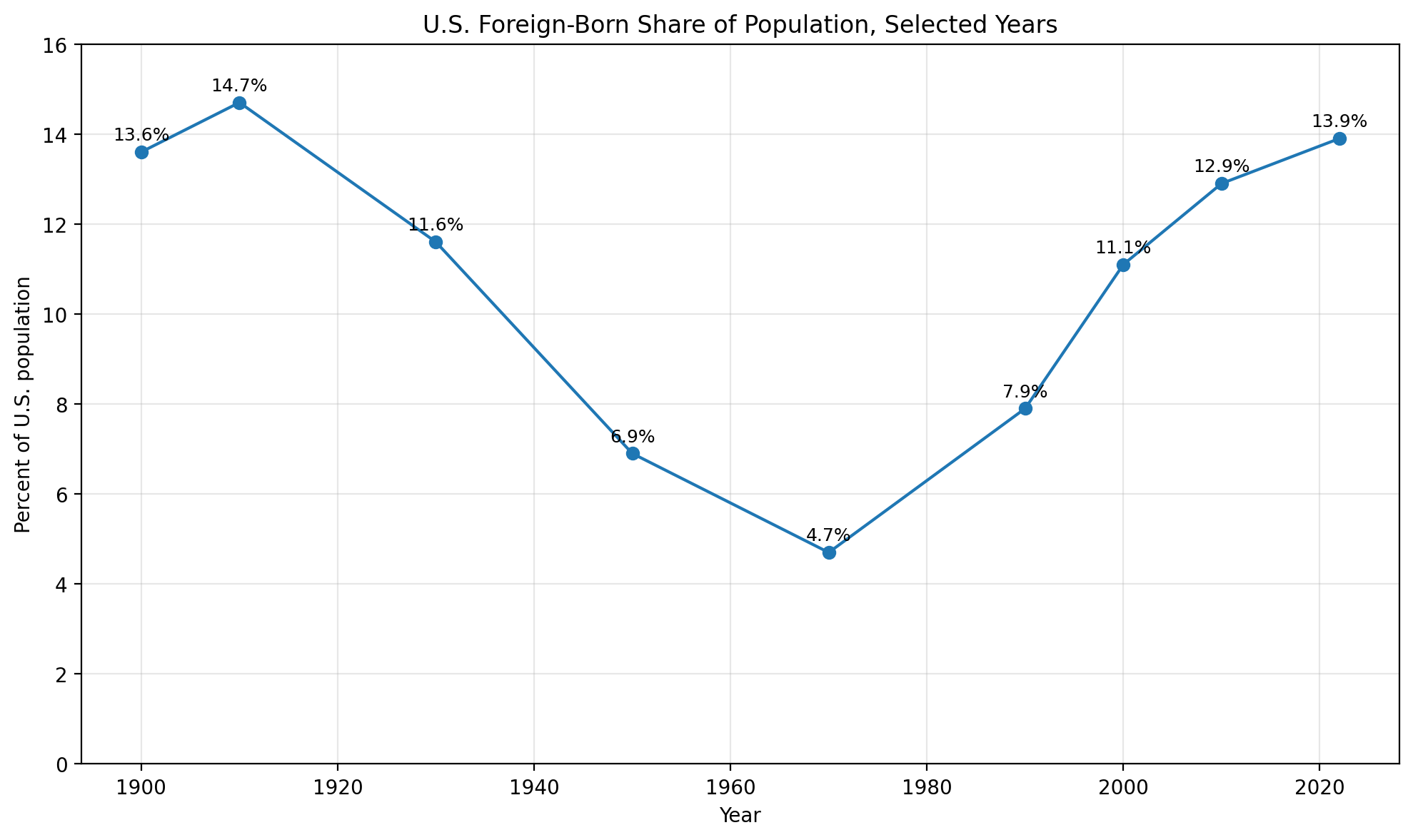
The common defense of this shift is economic. Immigration increases the labor force. It contributes to growth. It supports innovation in certain sectors. All of that is true. The mistake is assuming that what is true in the aggregate is true for everyone.
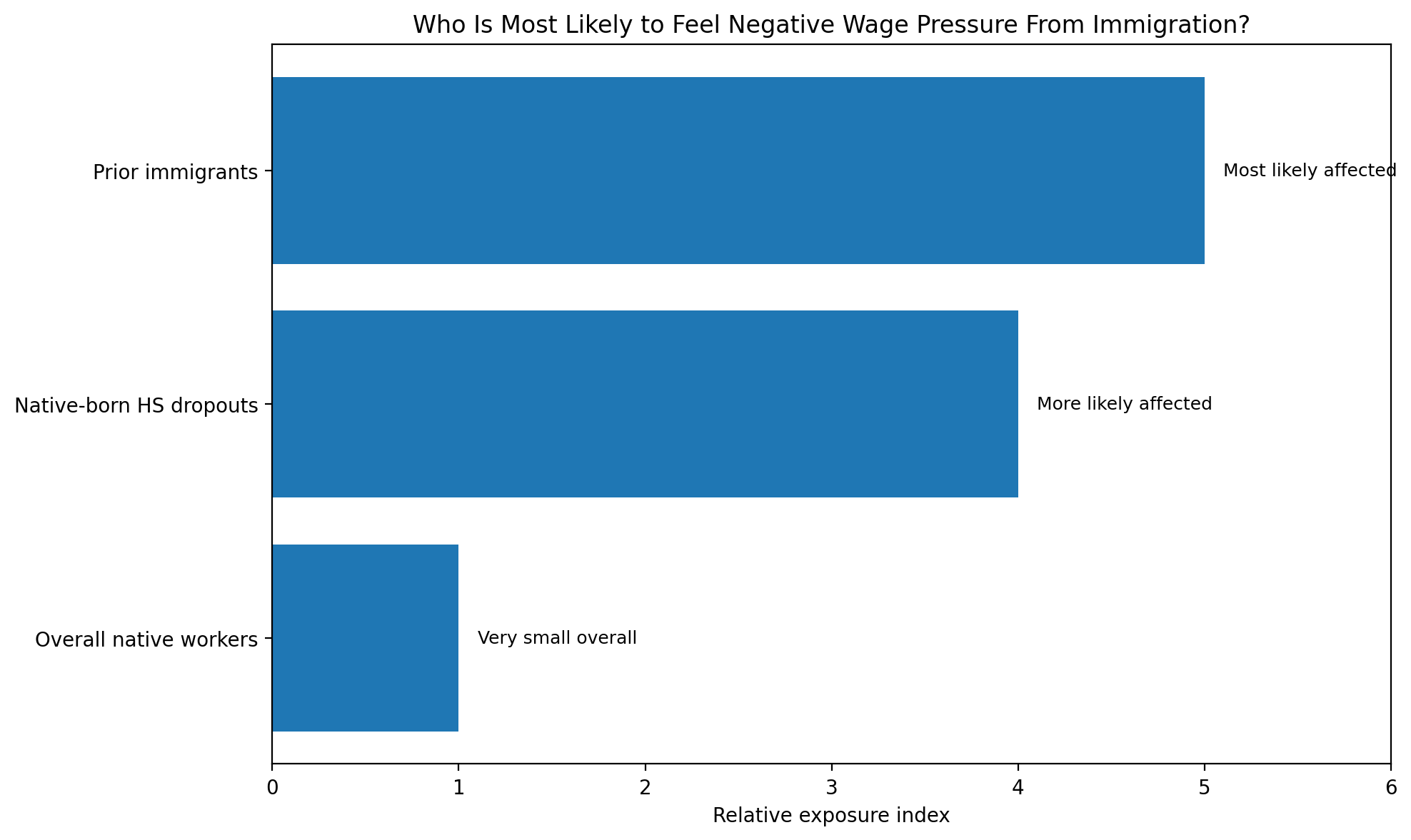
The National Academies of Sciences has found that immigration has little overall effect on average wages. But averages can conceal important differences. The same research shows that the negative effects, where they occur, are concentrated among workers with the least education. Earlier immigrants and native born workers without high school diplomas are the ones most likely to face increased competition.
This is not a mystery.
It never was.
When the supply of labor increases in a particular segment, the price of that labor tends to fall. That is as true in labor markets as it is in any other market. Economists have debated the size of the effect, but very few deny that the effect exists in some form.
What this means in practice is that a policy can raise total output while still putting pressure on specific groups.
The benefits may be spread broadly. The costs rarely are.
Those costs are not limited to wages.
One of the most common justifications for large-scale low-skill immigration has been the claim that Americans will not pay higher prices for basic goods. If wages rise, it is said, food prices will rise with them, and consumers will reject those increases.
This argument was repeated for decades. It sounded reasonable. It was rarely tested.
Then something changed.
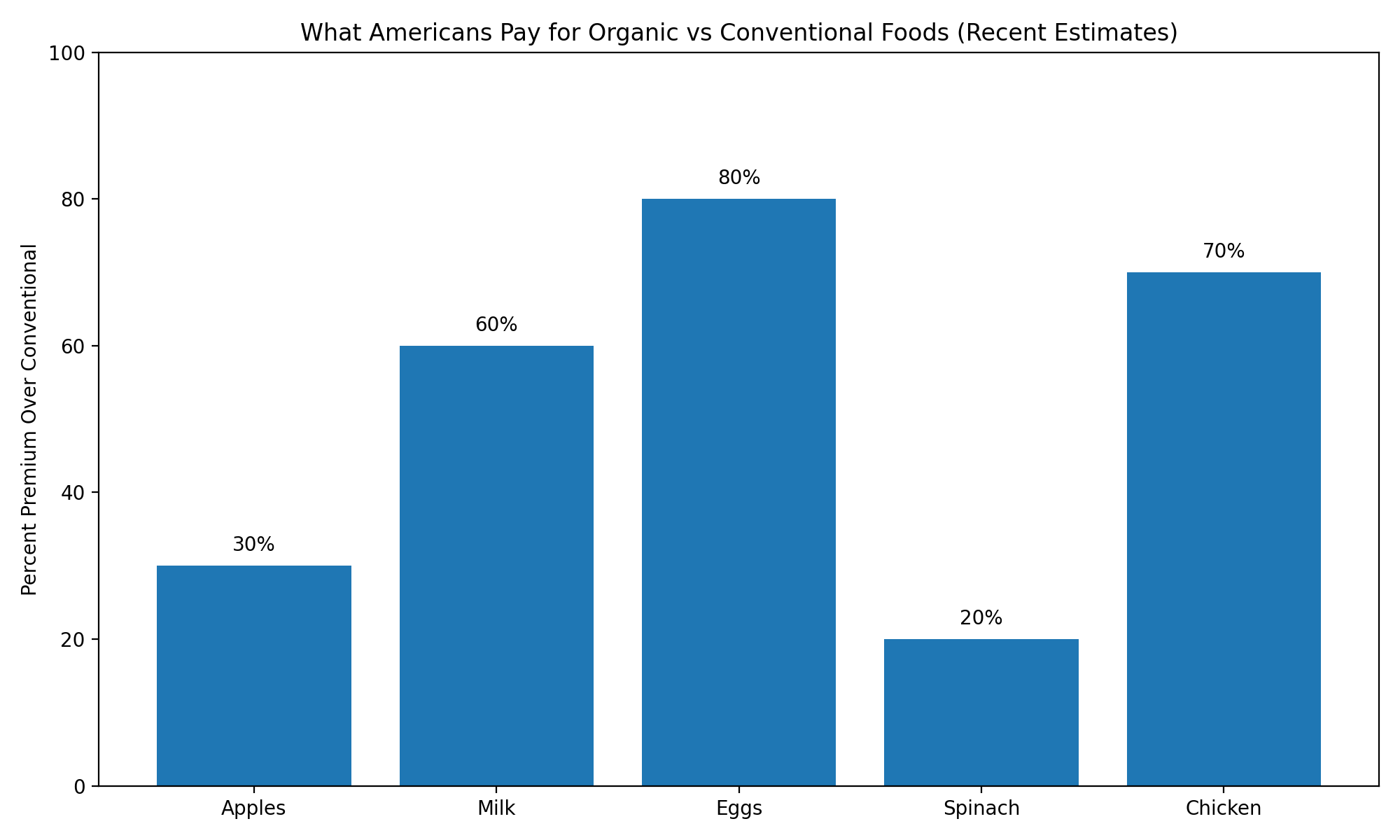
Beginning in the 1990s and accelerating into the 2000s and 2010s, organic foods went from a niche product to a major segment of the market. Today, organic produce often sells for two to three times the price of conventional alternatives. In some cases, the premium is even higher.
The numbers are not trivial. Organic food sales in the United States have grown from a few billion dollars in the early 1990s to more than 60 billion dollars annually by the early 2020s, according to the Organic Trade Association. That growth did not occur because prices were low. It occurred in spite of prices being significantly higher.
Consumers paid the difference.
They paid for perceived health benefits, for environmental concerns, or simply because it became culturally valued. The reason matters less than the fact itself. When people believe something is worth paying for, they will pay for it.
This raises an obvious question.
If consumers are willing to pay two or three times more for organic produce, why is it assumed that they would not pay more for produce grown under higher-wage conditions?
The answer lies less in economics and more in how the issue is presented. Consumers do not refuse higher prices. They refuse higher prices without a story. When higher prices are associated with a positive label, such as organic or natural, they are accepted. When higher prices are associated with higher wages for low-skill labor, they are presented as a burden.
The difference is not what consumers can afford. It is how they are told to think.
This does not mean that prices would not rise if wages increased. They would. But the idea that consumers are unwilling to bear those costs is contradicted by their actual behavior in other contexts.
The “cheap labor” argument, in this sense, has functioned as a justification more than a constraint.
It assumes that the only acceptable price is the lowest possible one, even when consumers routinely demonstrate a willingness to pay more for other reasons.
Once that assumption is questioned, the argument becomes less convincing.
Immigration tends to cluster in particular places. It does not distribute itself evenly across the country. Cities and suburbs absorb most of the change. Schools, housing, and local services are the first to feel the pressure.
A school district that sees a rapid increase in population must adjust quickly. That may include more English language instruction, more administrative resources, and more complex classroom dynamics. These adjustments are not free. They are borne locally, often before state or federal systems respond.
Housing follows the same logic. When demand increases faster than supply, prices rise. Immigration is not the only driver of housing costs, but it adds to demand, especially in already growing areas. The result is higher costs for those already living there.
Beyond economics and infrastructure lies a more subtle issue. Assimilation.
Earlier waves of immigrants faced strong pressure to adopt a common language and set of norms. That process was not always smooth, and it was not always fair. But it contributed to a shared framework.
In more recent decades, that expectation has weakened. Cultural and political movements, often supported by the Democrat Party, have emphasized diversity as an end in itself. The focus has shifted toward preserving differences rather than integrating them.
This shift has consequences.
A society can absorb differences if there is a shared baseline. When that baseline becomes less clear, differences become more significant. Language, expectations, and norms begin to diverge. This does not guarantee conflict, but it increases the potential for friction.
Social trust reflects this pattern. Studies have repeatedly found that trust tends to be lower in more diverse local environments. People are generally more comfortable with those they perceive as similar. That is not a moral statement. It is a human tendency observed across societies.
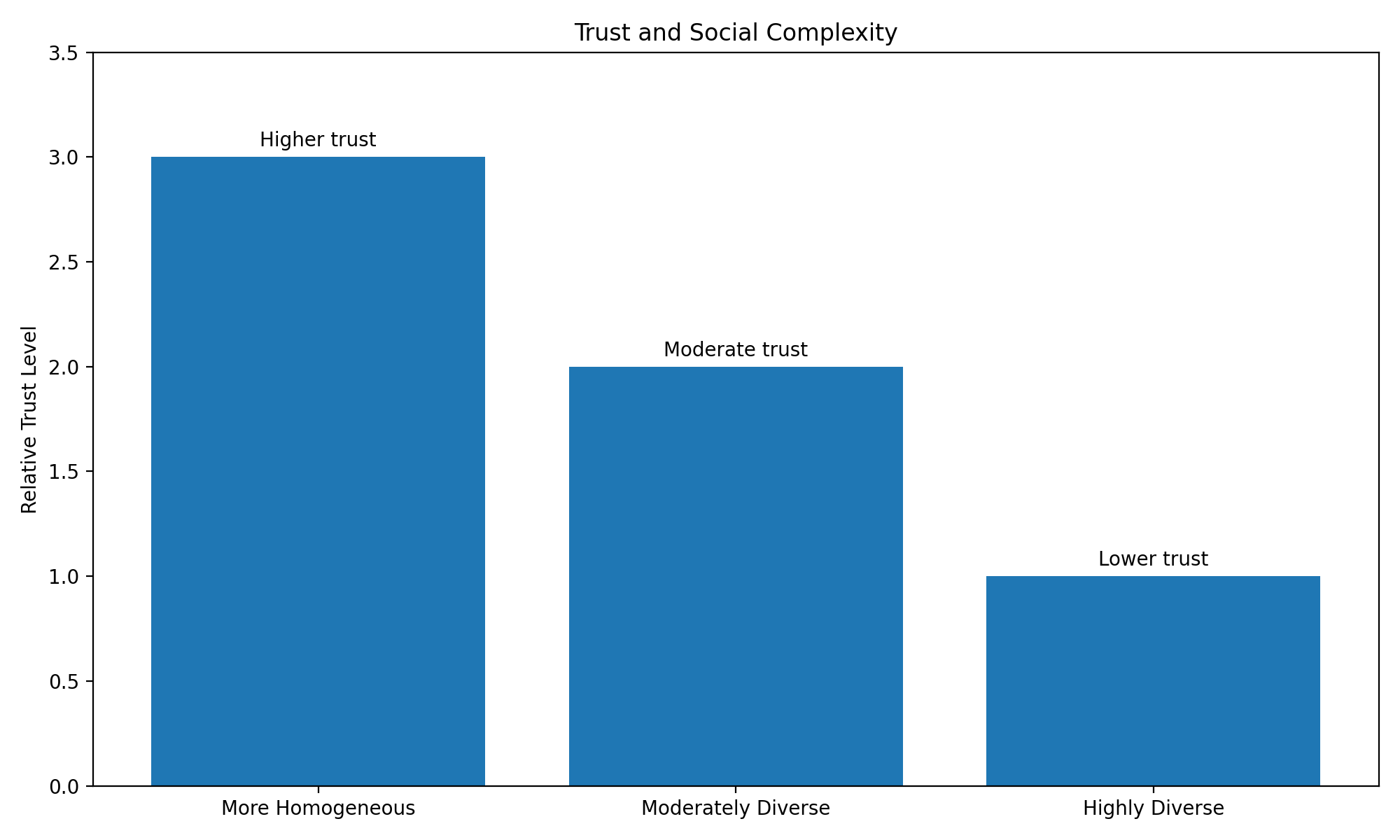
Lower trust does not mean cooperation disappears. It means cooperation requires more effort. More rules, more oversight, and more institutional management become necessary.
Politics becomes more complicated as well.
As the population becomes more diverse, political coalitions increasingly form around group identity. Instead of debates centered on broad policy, politics begins to revolve around demographic interests. The Democrat Party has leaned into this approach, building coalitions based on race, ethnicity, and immigration status.
This strategy can be effective, but it changes the nature of political competition. It encourages people to think of themselves less as individuals and more as members of groups with competing claims.
At this point, the pattern should be clear.
Immigration since 1965 has produced growth, innovation, and expansion. It has also produced labor-market pressure at the lower end, strain on local systems, challenges in assimilation, reduced social cohesion in some areas, and increased political fragmentation.
These outcomes occur together. They are not separate.
Diversity increases variation. Variation produces unequal outcomes. Attempts to manage those outcomes introduce further complexity.
That is the tradeoff.
The effects of immigration do not end at the border.
Changing who enters the country inevitably changes how institutions respond within the country. As variation increases in the population, pressure builds to address the differences that appear in outcomes.
That is where external diversity gives way to internal diversity.
If immigration alters the inputs of a society, policy begins to focus on altering the outputs.
The logic is straightforward. If different groups produce different results, then institutions must step in to adjust those results. What begins as a response to diversity becomes a system for managing it.
This is how the discussion moves from immigration to affirmative action, hiring preferences, and other forms of internal diversity policy.
The two are not separate issues. They are part of the same chain of cause and effect.
When Diversity Becomes a System
If immigration changes who enters the system, internal diversity policies attempt to change how the system produces results.
These policies arose from a real historical context. For much of American history, access to education and opportunity was restricted for certain groups. The goal of later policies was to expand that access.
The problem is not the intention. The problem is the method.
A distinction that should have remained clear became blurred over time. That distinction is between equality of opportunity and equality of outcomes.
Equality of opportunity means individuals are judged by the same standards. Equality of outcomes means the results of those standards are adjusted.
Once that shift occurs, the logic of the system changes.
One of the most debated consequences is what is often called a mismatch. When students are admitted to institutions where their academic preparation differs significantly from that of their peers, the likelihood of struggling increases. This is not speculation. It has been observed repeatedly.
Students in this position are more likely to switch out of demanding fields, such as engineering or science, and in some cases have lower completion rates. This does not mean they lack ability. It means they are placed into environments where the pace and expectations do not match their preparation.
In a different setting, the same student might excel. In a more competitive setting, that same student may fall behind.
Policies that focus on placement without preparation ignore this dynamic.
Another consequence is the effect on perceptions of fairness.
When admissions or hiring decisions include group-based considerations, people begin to question whether standards are consistent. Even when decisions are defensible, the perception of unequal treatment can erode trust.
Institutions rely not only on rules, but on confidence in those rules. When that confidence weakens, so does the institution's credibility.
This is not limited to universities. It extends to hiring, promotion, and contracting. The more criteria that are introduced, the more complex decisions become. Complexity invites discretion. Discretion invites disagreement.
At the same time, these policies often focus on outcomes rather than underlying causes.
Differences in outcomes often begin earlier in life. Family structure, early education, study habits, and environment all play a role. Adjusting standards at the point of college admission or hiring does not change those earlier factors. It shifts where the differences appear.
The result is that the root causes remain, while the visible outcomes are adjusted.
This creates a system that treats symptoms instead of causes.
Adjusting results does not eliminate differences. It relocates them.
There is also an effect on identity.
When institutions emphasize group membership in decision-making, individuals are encouraged to think of themselves in those terms. Instead of competing as individuals, people begin to see themselves as part of a larger category whose outcomes must be managed.
This changes incentives. It encourages organization around identity. It reinforces the idea that differences between groups require an institutional response.
The Democrat Party has built much of its modern political strategy around this framework. By emphasizing disparities and group outcomes, it creates a continuing demand for policy intervention.
This produces a feedback loop.
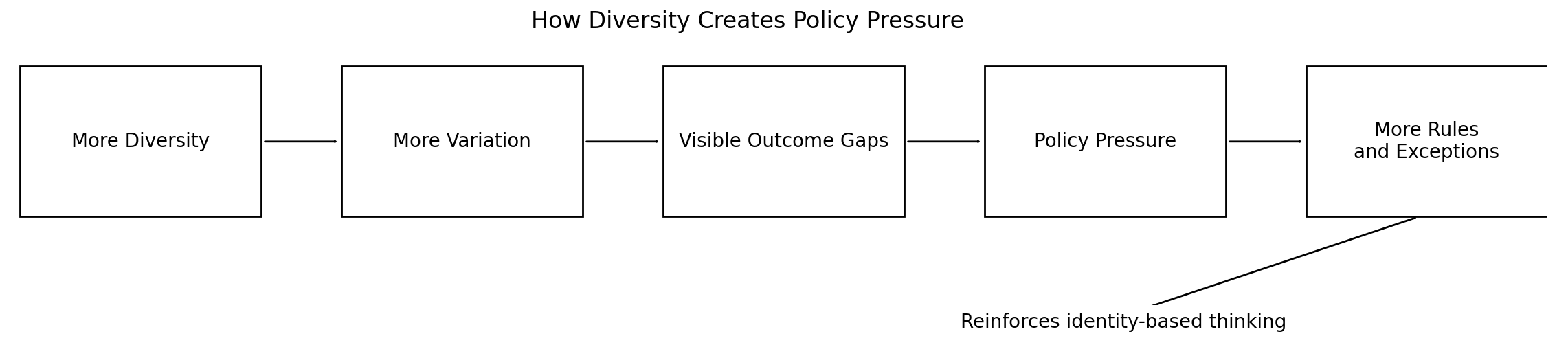
Diversity increases variation. Variation leads to calls for policy adjustment. Policy adjustment increases the focus on group identity. The process repeats.
The system becomes more complex, not less.
And complexity is not a sign of progress if it makes a system harder to understand, harder to trust, and harder to maintain.
At the center of this is a simple question. What is fairness?
If fairness means equal rules applied to individuals, then unequal outcomes are not necessarily a problem. They may reflect differences in preparation, choices, and incentives.
If fairness means equal outcomes across groups, then rules must be adjusted to produce those outcomes. That requires ongoing intervention.
The two definitions are not the same.
Policies that attempt to equalize outcomes without equalizing inputs are likely to create new distortions. They may change who gets admitted or hired, but they do not change the underlying distribution of skills and preparation.
Over time, this can weaken both performance and trust.
The result is not the elimination of inequality, but its transformation into a different form.
What This Has Meant for America
By this point, the pattern is not theoretical. It shows up in ordinary places where people live, work, and send their kids to school.
It shows up in school systems that struggle to maintain order while being told to reinterpret behavior that once had clear consequences. It shows up in labor markets where the people with the least leverage face the most direct competition, while being told that overall growth has made things better. It shows up in housing markets where demand continues to rise faster than supply, and the explanation rarely includes the most obvious factor, which is how many people are competing for the same limited space.
It also shows up in politics, where arguments that once centered on policy now center more often on groups.
None of this appeared overnight.
The United States has always had diversity. What changed after the Immigration and Nationality Act of 1965 was the scale and the speed of change, followed by a shift in how that change was managed.
Earlier waves of immigration were followed by assimilation. That did not mean people abandoned their background. It meant they adopted a common framework of language, law, and expectations. That framework made it possible for differences to exist without overwhelming the system.
In more recent decades, that expectation weakened. Institutions, often influenced by ideas promoted within the Democrat Party, moved away from asking how individuals would integrate into a shared system and toward asking how the system should adjust to different groups.
That is not a minor shift in emphasis. It changes how decisions are made at every level.
When a system begins to adjust itself to produce preferred outcomes, it no longer operates in the same way. The rules become more flexible. The explanations become more complicated. And the results become harder to interpret.
This is where the cost of ignoring tradeoffs begins to show. Tradeoffs do not disappear because they are ignored.
One of the most persistent habits in public discussion is to present policies as if they produce only benefits. Immigration is described in terms of growth, without much attention to who bears the cost of increased competition. Internal diversity policies are described in terms of fairness, without examining how they alter incentives and expectations.
But every policy has costs. The question is not whether those costs exist. The question is where they fall.
In the case of immigration, the costs tend to fall on those least able to absorb them. Workers without advanced skills face more competition. Local schools must adapt quickly to changing populations. Housing markets tighten in areas that absorb large numbers of new residents.
In the case of internal diversity policies, the costs appear in less direct ways. Standards become less clear. Decisions become more difficult to explain. Institutions that once relied on straightforward criteria must now justify outcomes using multiple layers of reasoning.
This does not make those institutions illegitimate. It makes them harder to understand and harder to trust.
Trust depends on consistency.
When people believe that rules are applied evenly, they are more willing to accept outcomes, even when those outcomes are not in their favor. When rules appear to shift depending on circumstances or group considerations, confidence declines.
This decline is rarely dramatic. It happens gradually.
People begin to ask questions that would not have occurred before. What are the standards? Are they the same for everyone? Do outcomes reflect performance or adjustment?
These questions are not the product of hostility. They are the product of uncertainty.
Uncertainty grows as systems become more complex.
A college admissions process that once relied primarily on measurable academic performance now considers a wider range of factors. Each factor may be defensible on its own. Together, they create a process that is harder to explain in simple terms.
The same pattern appears in hiring and promotion. As additional considerations are introduced, decisions rely more on discretion. Discretion increases variability. Variability increases disagreement.
At the same time, many of these policies focus on outcomes rather than the conditions that produce those outcomes.
Differences in education and employment often begin long before college or hiring decisions are made. Early education, family structure, and peer environment all play a role. Adjusting standards at the endpoint does not change those earlier influences. It shifts where the differences become visible.
This is why attempts to equalize outcomes often fail to eliminate disparities. They change the form those disparities take.
Underlying all of this is a simple principle that does not change.
People respond to incentives. A system produces more of what it rewards.
When a system rewards preparation and performance, individuals are more likely to invest in those things. When a system places greater emphasis on group outcomes and representation, behavior begins to shift in that direction.
This does not eliminate effort or achievement. It changes the environment they operate in.
Over time, these changes accumulate.
They influence how individuals approach education, how institutions make decisions, and how political coalitions are formed. The Democrat Party has, in many cases, built its strategy around identifying disparities and proposing interventions to address them. That approach can produce immediate changes in representation, but it also reinforces the idea that group outcomes should be continuously monitored and adjusted.
This creates a cycle.
Increased diversity produces increased variation. Increased variation produces pressure for intervention. Intervention alters incentives and produces new outcomes. Those outcomes generate further pressure.
The system becomes more complex with each step.
Complex systems are not necessarily weak. But they are more difficult to maintain.
A society requires a certain level of shared understanding to function effectively. This includes a common language, broadly accepted norms, and confidence that rules will be applied consistently.
As variation increases, maintaining that shared understanding becomes more difficult. Institutions must take on a greater role in managing differences. More rules are required. More oversight becomes necessary. The cost of coordination rises.
These costs are not always visible, but they are real.
They manifest as slower decision-making, increased conflict over standards, and a gradual decline in trust.
The idea that diversity is always a strength assumes that these costs can be absorbed without consequence. The evidence suggests otherwise.
Diversity increases variation. Variation produces unequal outcomes. Efforts to manage those outcomes introduce new complications.
This is not about individuals. It is about what systems do.
A system built on clear and consistent rules is easier to understand and easier to maintain. A system that continually adjusts those rules in response to variation becomes more difficult to manage over time.
That is the central tension.
It is not resolved by denying it exists. It is addressed by recognizing the tradeoffs and accepting the consequences that come with them.
If This Work Matters, It Needs Backing
Most of what you read online is funded.
This isn’t.
No sponsors. No institution. No safety net.
Just the time it takes to sit down, think through something, and say what most won’t.
If you want more of that, you can support it directly:
Become a paid subscriber:
https://mrchr.is/help
Make a one-time contribution:
https://mrchr.is/give
Join The Resistance Core:
https://mrchr.is/resist
We’re building this one reader at a time.
Not sure which has hurt the country more, the Immigration Act of 1965 or the Great Society programs of the same era.
Both have fundamentally changed America.
I've noticed that both Israel and Singapore have relatively large Muslim populations; fractions that would almost certainly be fatal to any Western liberal democracy.
What else do those two nations have in common? Secular, authoritarian rule of law [as can be judged by their airport security protocols], combined with a high degree of economic freedom; and in Israel's case, generous civil liberties as well. Thus strong incentives exist to encourage responsible actions, as well as to punish antisocial behavior.
Under the heavy hand of secular law & order, multiculturalism is indeed a benefit, as advertised. Without the assurance of the state that no ethnic factions can become predatory, societies will rapidly devolve into tribal warfare.
This also explains why Singapore maintains the death penalty for drug trafficking: If vice crimes are tolerated, ethnic mafias will take root, and the economics of gang culture will proliferate.
It's deeply unfortunate that this obvious fact about human nature needs to be explained to the delusional citizens of Western countries, but here we are. Western progressives can't even get their minds around the fact that most violent crimes are committed by a tiny fringe of the total population, implying that a small number of humans are selected at birth as psychopaths. And although the expression of psychopathy may be determined by environmental factors, there is overwhelming evidence for both the preponderance of psychopaths [outliers even in the prison population], and their stubborn resistance to behavioral modification [A Clockwork Orange].