

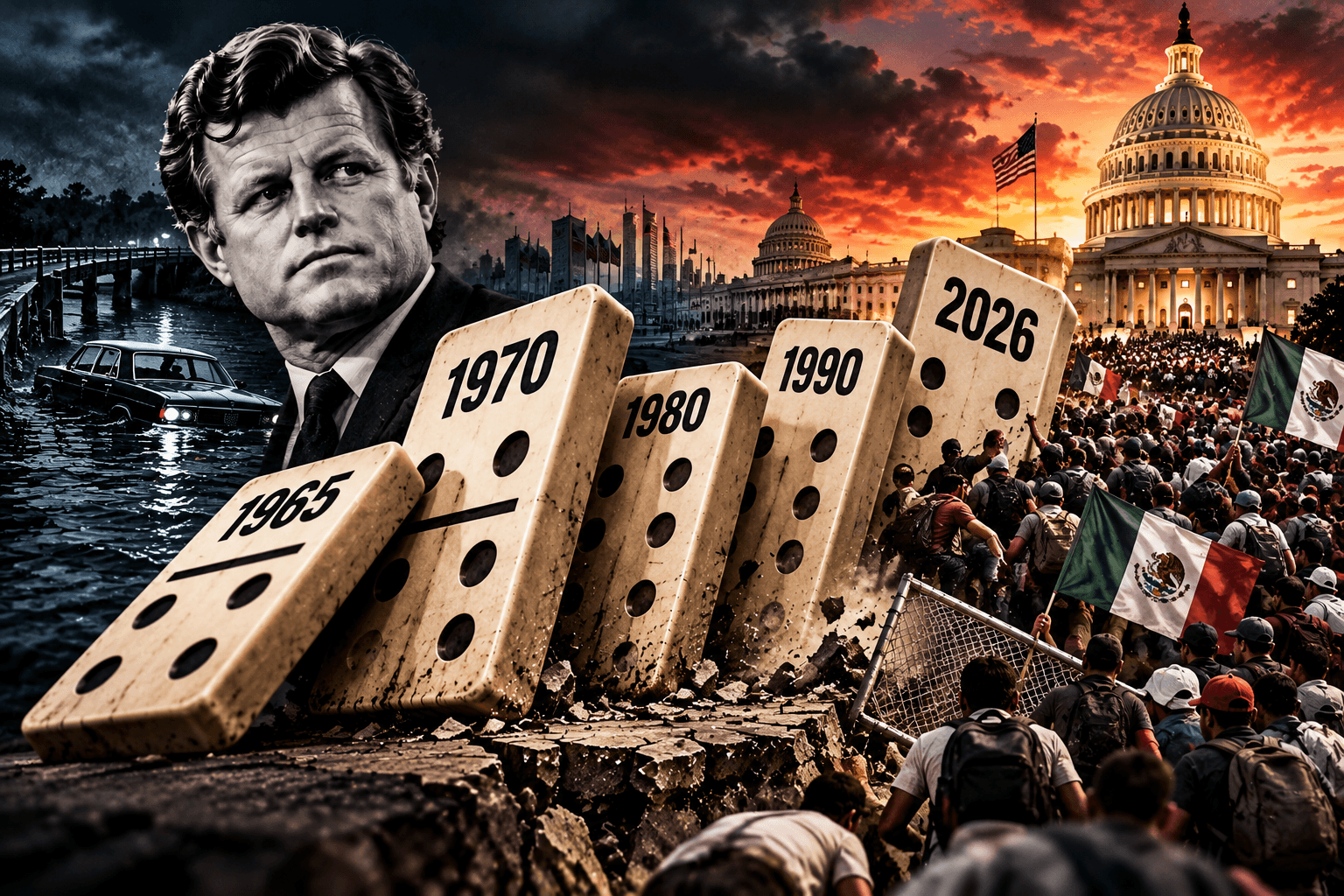
“Ted Kennedy got a second chance after Chappaquiddick. Mary Jo Kopechne never did. Voters sent him back to Washington seven times. There, he helped expand the immigration system he once promised wouldn’t fundamentally change America.”
On the night of July 18, 1969, Senator Ted Kennedy drove his Oldsmobile off a bridge on Chappaquiddick Island, Massachusetts. His passenger, 28-year-old Mary Jo Kopechne, drowned in the submerged car. Kennedy escaped and waited approximately ten hours before reporting the accident to police.
He claimed to have made repeated attempts to rescue her, although nobody witnessed them. He acknowledged drinking earlier that evening but maintained that he had been sober. By the time police learned what had happened, any chance to determine reliably whether alcohol played a role was gone.
Kennedy pleaded guilty to leaving the scene and received a two-month suspended sentence. An inquest found probable cause to believe his negligent driving contributed to Kopechne’s death. He was never prosecuted for manslaughter.
Sixteen months later, Massachusetts voters gave him another six years in the United States Senate, with 62.1 percent of the vote against Republican Josiah Spaulding. He would be reelected six more times.
Kennedy remained in Washington until his death in 2009, nearly forty years after Chappaquiddick. Along the way he helped establish the modern refugee system and sponsored legislation that expanded legal immigration. He had already played an important role in the Immigration and Nationality Act of 1965, a law he assured Americans would produce relatively modest changes.
“Our cities will not be flooded with a million immigrants annually.”
— Senator Ted Kennedy, 1965
The country got considerably more than it was promised. In 1965, approximately 9.6 million foreign-born people lived in the United States. By January 2025, the estimate had reached 53.3 million, before dipping to about 51.9 million by mid-2025. Immigration had become central to disputes over housing, employment, government spending, citizenship, and political representation.
How did a law sold as modest reform help produce changes of this magnitude? And as those changes became obvious, why did Washington keep expanding and modifying the system instead of reconsidering its assumptions? His career is a useful lens, because it shows how an election held on one day can shape laws that govern the country long after the voters, and sometimes the politicians, are gone.
The Promise of 1965
When Ted Kennedy arrived in the Senate in 1962, America was the world’s leading industrial economy. Its factories produced automobiles, aircraft, machinery, and household appliances. American workers enjoyed rising productivity, higher real incomes, and expanding opportunities to own homes and raise families. All of this happened during a period of comparatively limited immigration.
The Immigration Act of 1924 established national-origins quotas that favored Northern and Western Europe while restricting immigration from other regions. The Immigration and Nationality Act of 1952 retained much of that system while establishing preferences for family relationships and employment qualifications. By the 1960s, civil rights politics, Cold War pressures, and lobbying by immigrant communities had created support for replacing the quotas. But America already had an immigration system, and the economy wasn’t waiting for Congress to invent a new one before it could prosper.
In 1930, foreign-born residents were about 11.6 percent of the population. By 1970 the figure had fallen to 4.7 percent, the lowest share in modern American history. During those decades the country helped win the Second World War, built an enormous industrial base, developed new technologies, and grew at an extraordinary pace. Earlier immigrants had contributed to that industrial development, and the postwar economy also benefited from American innovation, wartime investment, abundant natural resources, and the devastation of industrial competitors overseas. Still, a question seldom gets asked. If prosperity depended on ever-increasing immigration, how did the country become so prosperous when immigration was unusually low?
President Lyndon B. Johnson, a Democrat, and his administration wanted to eliminate the national-origins quota system. Civil rights politics played a major role, as did Cold War concerns about America’s image abroad. Established immigrant communities, particularly those of Southern and Eastern European origin, had lobbied for years for more opportunities to bring relatives into the country. The administration first proposed a system emphasizing occupational qualifications and family ties, and congressional negotiations shifted the balance toward family reunification.
Under the law as enacted, family categories received most of the numerically limited preference visas for the Eastern Hemisphere, and immediate relatives of citizens, including spouses, unmarried minor children, and parents of adult citizens, were exempt from numerical ceilings. Think about what that meant over time. An immigrant admitted for one reason could become a permanent resident, later qualify for citizenship, and eventually sponsor eligible relatives, some of whom might become citizens and sponsor others. The process had eligibility requirements and limits, but its cumulative effect could reach far beyond the original admission. Congress built that system deliberately.
“The bill will not flood our cities with immigrants. It will not upset the ethnic mix of our society. It will not relax the standards of admission. It will not cause American workers to lose their jobs.”
— Senator Ted Kennedy, February 10, 1965
Those were unusually confident promises about a law designed to change how immigrants would be selected. Attorney General Nicholas Katzenbach offered similar assurances, telling lawmakers the legislation wasn’t intended to increase immigration numbers significantly. President Johnson signed it on October 3, 1965, at the Statue of Liberty.
Here is what followed. The Pew Research Center estimated that nearly 59 million immigrants arrived between 1965 and 2015. Counting their children and grandchildren, those arrivals accounted for about 55 percent of the country’s population growth over those fifty years, and the foreign-born population reached 45 million by 2015. Immigration from Asia and Latin America expanded dramatically while Europe’s share declined.
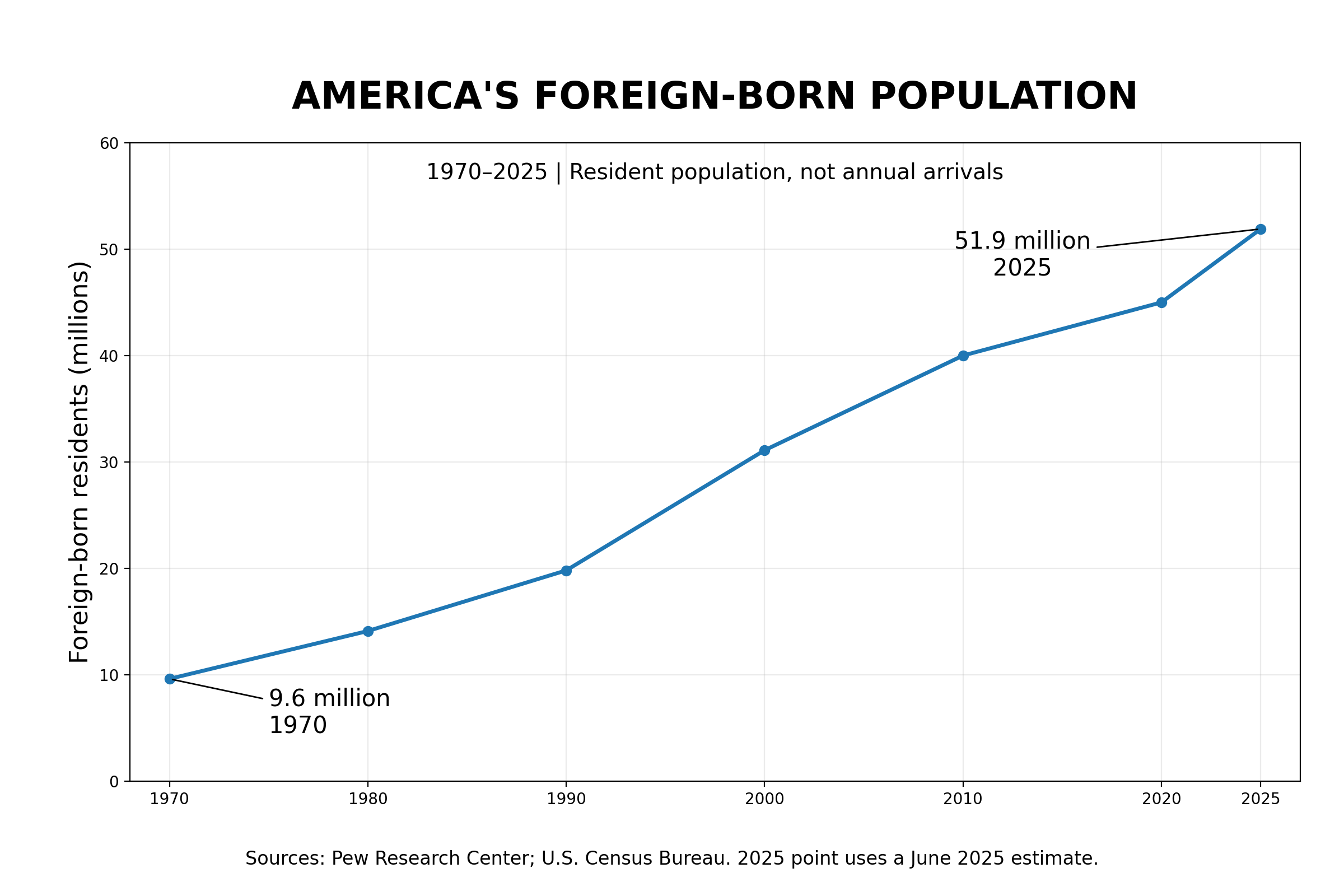
Kennedy and his colleagues fundamentally changed America’s immigration system in 1965. They replaced the national-origins quotas with a system that prioritized family reunification and opened new pathways for immigration from countries that had previously faced severe restrictions. Those changes shaped immigration patterns for generations, and Congress continued expanding the system in the decades that followed. The consequences were considerably larger than Kennedy had promised Americans.
Were they mistaken, or did they reassure Americans about changes they privately expected? The answer depends on what they knew, and the public record can’t settle that. It does establish that the predictions were wrong. Before looking at how Kennedy responded as the country changed, we should examine one of the economic arguments most often used to defend immigration.
What on Earth Did We Do Before Mexicans?
Listening to politicians, you might conclude that before Mexican workers arrived, America’s hotel beds went unmade, restaurants served dinner on dirty plates, and farmers stood helplessly beside rotting crops. Apparently nobody knew how to mop a floor.
We’ve all heard that immigrants do jobs Americans won’t do. Democrat politicians have said it for decades, and some Republicans have repeated it too, including President George W. Bush when he proposed expanding temporary foreign-worker programs in 2004. It’s a strange claim given that Americans have been farming, cooking, cleaning, building, mining, and manufacturing for generations. Millions still do those jobs.
The real question is what employers must offer to attract workers, and what happens when they can’t find enough people at the pay on offer. A hotel manager might insist Americans won’t clean rooms for $13 an hour. Perhaps not, especially in a city where housing is expensive and schedules are unpredictable. Would more applicants appear at $18 or $22? Would better conditions change the answer? Could the hotel use better equipment, fewer labor hours, or higher room rates? Those are costs and tradeoffs, and businesses make such decisions every day. A labor shortage doesn’t always mean a shortage of people willing to work. Sometimes it means a shortage of people willing to work on the terms offered.
And agricultural workers aren’t necessarily working for pocket change. In April 2025, the USDA reported average wages of $19.52 an hour for hired farmworkers, with some regions exceeding $20. Temporary agricultural workers can also receive employer-provided housing and transportation. That’s considerably more than many Americans probably imagine. Which brings us back to the question: what would employers have to offer to attract Americans to do the same work?
Agriculture offers a historical test. Starting in 1942, the federal government ran the Bracero Program, bringing Mexican workers to American farms under temporary arrangements. It eventually supplied hundreds of thousands of seasonal workers a year and ended in 1964, one year before the immigration overhaul. Supporters of ending it hoped domestic farmworkers would see better wages and more work.
Economists Michael Clemens, Ethan Lewis, and Hannah Postel examined what happened. Their 2018 study in the American Economic Review compared states that had depended heavily on Bracero labor with those that had depended on it less, and found no statistically detectable increase in domestic agricultural wages or employment from excluding those workers. Instead, many growers adopted labor-saving technology or changed their crops. The farms didn’t disappear, but domestic workers didn’t get the raises reformers expected either.
The availability of immigrant labor shapes business decisions, and its absence can push employers toward machinery and other methods. Whether a given immigration policy helps American workers depends on the industry, the workers involved, and how employers respond. You also can’t prove that native-born workers are unwilling or unable to do restaurant or hotel work just because employers struggle to hire at a particular wage. The same goes for roadside fruit vendors. Americans have run farm stands and small retail businesses since long before the modern immigration system. An immigrant selling mangoes at an intersection may simply be an entrepreneur.
“The ethnic mix of this country will not be upset.”
— Senator Ted Kennedy, 1965
The argument gets more serious when we look at workers who face real competition, and Black Americans are an important example. In Los Angeles, sociologist Roger Waldinger studied employers in restaurants, hotels, printing, and furniture manufacturing. He found that immigrant recruitment networks shaped who heard about vacancies and who got recommended. Once an employer had a reliable network, hiring from the same circles was convenient, and applicants outside it could struggle to get considered. Black workers were among those facing that barrier.
Economists George Borjas, Jeffrey Grogger, and Gordon Hanson examined immigration and Black male employment from 1960 to 2000. They estimated that a 10 percent immigration-induced increase in the supply of workers in a skill group reduced Black workers’ wages in that group by 2.5 percent and lowered Black male employment rates by 5.9 percentage points. These figures are estimates from the authors’ economic model, not a measurement of the entire historical employment decline. Other researchers have found smaller effects. The National Academies’ broad review found small average effects on native wages overall, with the largest effects falling on earlier immigrants and workers without a high school diploma. Factory closures, discrimination, education, incarceration, and the movement of jobs out of urban neighborhoods also shaped Black employment. But the findings point to something missing from the slogan: some existing workers compete directly with new arrivals.
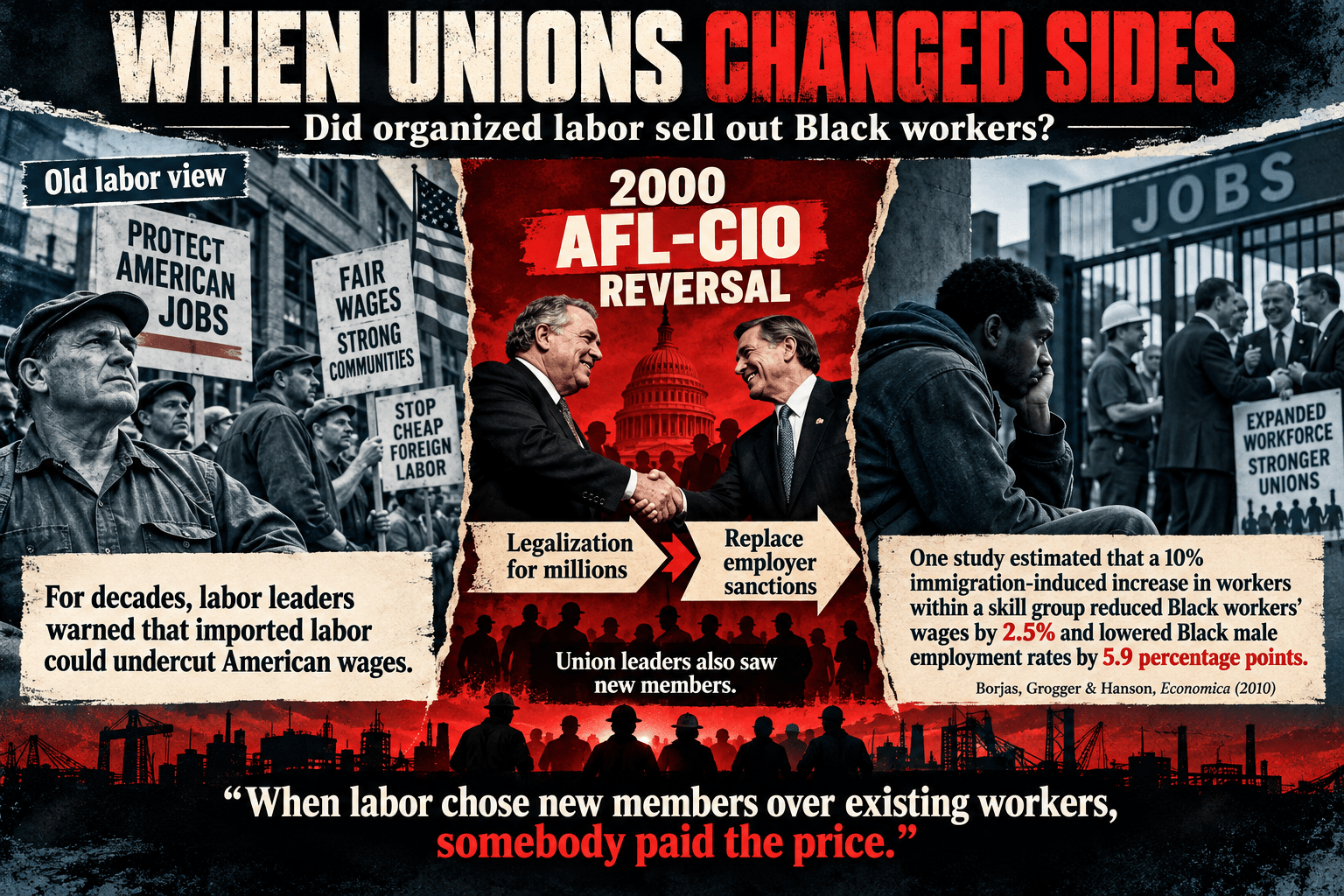
And where were the unions while all this was happening? For decades, organized labor warned that expanding the supply of immigrant workers could undercut American wages. Then, in 2000, the AFL-CIO reversed course, backing legalization for millions of illegal immigrants and calling for the elimination of existing employer sanctions. Union leaders argued that legalization would protect workers from exploitation. But were they protecting the workers they already represented, including Black Americans facing greater competition, or pursuing policies that might replenish their declining membership?
The minimum wage adds another wrinkle. Facing a legal wage floor, employers may become pickier about experience when many people apply for the same jobs, and hiring networks can influence who gets the opportunity. Immigrant and native-born workers are legally entitled to the same minimum wage, though violations and differences in bargaining power can affect actual pay. If immigration helps employers fill positions while raising competition for certain workers, those are two sides of the same transaction. A business can benefit while a particular worker has a harder time finding a job or negotiating pay.
An employer’s desire for more workers is understandable, but it is a business interest, not a complete argument for national policy. Kennedy told Americans workers wouldn’t lose jobs because of the bill, while Congress was making consequential changes to the labor supply. The workers already here deserved more than a few reassuring sentences.
The Senator Who Stayed
The 1970 election didn’t create the 1965 law, which passed four years before Chappaquiddick. It did preserve Kennedy’s chance to influence what came next, and his role was more than voting for legislation others wrote. In 1978 he helped establish the Select Commission on Immigration and Refugee Policy, which studied the existing system and considered changes to admissions, enforcement, legalization, and refugees. In 1979 he introduced a comprehensive refugee bill, describing a systematic resettlement program as something he had pursued for years.
The resulting Refugee Act of 1980, signed by President Carter, created the modern statutory framework for refugee admissions and asylum. America had admitted refugees before, usually through special arrangements for particular crises. Now Congress established a permanent system with a definition based on persecution or a well-founded fear of persecution, including procedures for overseas admissions and for people seeking asylum after arriving. Refugees could eventually obtain permanent residence and citizenship, allowing them to vote, run for Congress, and sponsor eligible relatives.
One of those refugees was Ilhan Omar, who arrived from Somalia in 1995, became an American citizen in 2000, and was elected to Congress in 2018. She came to America seeking refuge, gained citizenship, and eventually secured a seat in Congress, where she has repeatedly attacked the very American policies and institutions that made her journey possible.
Kennedy was also the principal Senate sponsor of the legislation that became the Immigration Act of 1990. He introduced S. 358 on February 7, 1989, and President George H. W. Bush signed the bill in November 1990. It raised the overall level of legal immigration and reorganized employment-based categories, including those for certain professional and temporary workers. He wasn’t the only architect. Presidents signed these laws, Congress supplied the votes, and members of both parties shaped them. But he helped write the original overhaul, stayed in office after Chappaquiddick, and led two more major immigration laws.
Problems kept growing. The Immigration Reform and Control Act of 1986, signed by Reagan, legalized about 2.7 million unauthorized immigrants and barred employers from knowingly hiring unauthorized workers. It was meant to pair legalization with stronger enforcement, but document fraud, continued labor demand, and uneven enforcement complicated the results, and the unauthorized population grew to an estimated 12 million around 2007.
In 1965, Ted Kennedy promised Americans that immigration reform would not relax admission standards. Just 21 years later, Congress passed legislation that would eventually grant legal status to roughly 2.7 million people who had entered or remained in the country illegally.
Apparently, the standards were only standards until enforcing them became inconvenient.
In 1996, President Clinton signed a law creating expedited removal and credible-fear screening for people expressing fear of persecution. The screening was quick, but a positive finding generally meant the person could pursue further proceedings rather than being turned away. About 1,200 credible-fear screenings were completed in 1997. By 2018, annual completions approached 98,000. At the end of fiscal year 2024, immigration courts faced roughly 3.6 million pending cases.
Kennedy died in 2009, before the most recent asylum surge, and the later problems came from decisions by many other lawmakers and presidents. But the refugee and immigration frameworks he helped shape stayed at the center of the system. That raises a question beyond Kennedy. Why did the federal government keep revising immigration law without ever reaching a durable agreement on how much immigration the country should accommodate and how it would affect Americans already here?
Why Didn’t Washington Put on the Brakes?
Several groups have understandable reasons to maintain or expand particular programs, and some wield far more influence in Washington than ordinary workers or taxpayers. Employers want workers. Universities recruit international students. Families want relatives admitted. Humanitarian groups advocate for refugees. Immigration attorneys, contractors, and nonprofit agencies operate inside the administrative system Congress created. A university may collect tuition, a refugee agency may receive grants, and an advocacy organization may gain influence by representing a growing constituency. These interests sometimes conflict, since businesses seeking employment visas don’t necessarily want what refugee or family-reunification groups want.
But those who benefit from established programs usually have stronger reasons to organize than those who bear dispersed costs. A construction worker facing more competition may never know which visa categories or employer practices shaped his local market. A business association knows exactly which bill it wants Congress to change. That difference influences outcomes.
During President Bill Clinton’s Democrat administration, the Immigration and Naturalization Service launched Citizenship USA to accelerate naturalization before the 1996 presidential election. More than one million immigrants became American citizens that fiscal year. A Justice Department Inspector General investigation later uncovered serious failures in background checks and eligibility reviews, along with explicit discussions inside the Clinton White House about the electoral benefits of faster naturalization.
A January 1996 briefing memorandum for Clinton’s Deputy Chief of Staff Harold Ickes stated that faster naturalization meant more potential Democrat voters. Officials working through Vice President Al Gore’s National Performance Review pressured immigration authorities to accelerate processing. One March 1996 email referred to producing a million new citizens before Election Day. Another proposal, forwarded to President Clinton and Vice President Gore, called for influencing 300,000 voters and turning out 96,000 in the presidential election.
The Inspector General documented the political discussions, increased pressure, and compromised processing, although investigators did not establish that the program was originally created to benefit the Democrat Party. By 1996, officials in a Democrat administration were discussing immigration and citizenship in explicitly electoral terms, while the agency responsible for enforcing the rules was struggling to follow them.
Federal refugee programs grew into extensive arrangements involving national resettlement agencies, local affiliates, nonprofits, and public institutions. In fiscal year 2024, specified federal funding for refugee-related programs across the State Department, Health and Human Services, and Homeland Security approached $2.8 billion. Those funds covered different functions and forms of assistance, and they weren’t all payments to contractors or nonprofits. But public money flowing through an established network raises ordinary questions about incentives, oversight, administrative costs, and lobbying. Who gets the grants? What services are provided? How much goes to administration? Which recipients lobby to keep or expand the programs that fund them?
Who decides that employers need more foreign workers? In technology, the H-1B program has become a major route for employing foreign professionals, and in fiscal year 2024 Indian nationals accounted for about 71 percent of approved petitions, including renewals and other filings. That concentration raises questions about outsourcing, wages, recruitment practices, and how firms determine that domestic workers aren’t available. It also shows how immigration policy gets tied up with business models. Once companies organize operations around a labor program, changing the rules becomes politically hard. The country can certainly benefit from talented people who move here. It can also ask whether a specific visa improves opportunities for domestic workers or lets employers avoid other investments, and answer with evidence on wages, recruitment, productivity, and labor-market conditions.
What bothers me about the familiar claim that America needs more workers is how casually it assumes employers’ interests settle the matter. Americans built an extraordinarily productive economy during decades of relatively low immigration. Employers adjusted then, and they can adjust now. Whether the adjustments are desirable depends on the consequences, not on how loudly business groups complain about shortages.
What Happened to California
As immigration expanded, it also transformed particular states, and California shows how federal decisions can have consequences far from Washington.
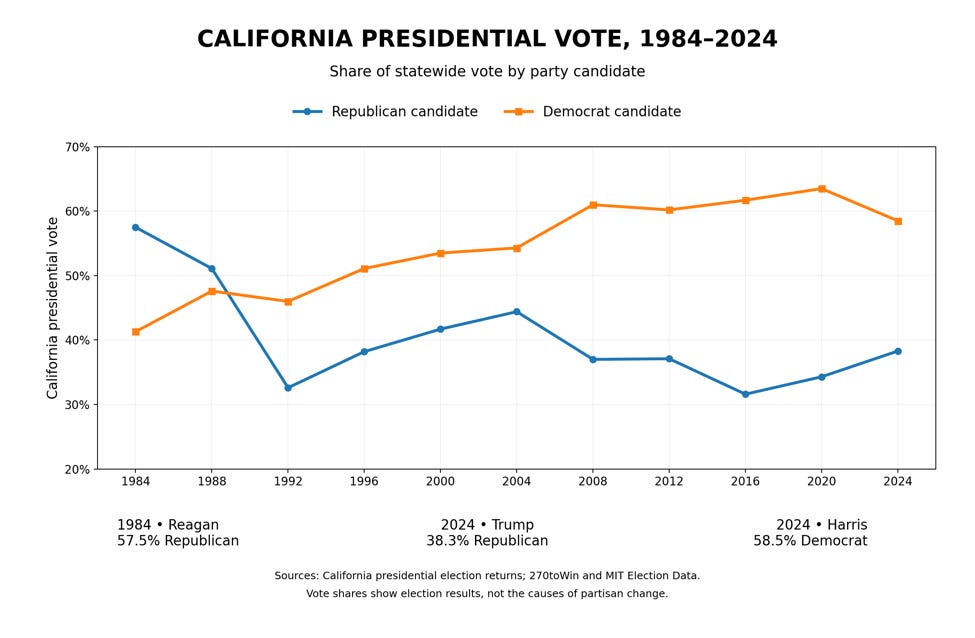
Ronald Reagan won the California governorship in 1966 and 1970, then carried the state in 1980 and 1984. In 1984 he received about 57.5 percent of its presidential vote. Forty years later Donald Trump received about 38.3 percent and Kamala Harris about 58.5 percent. California has gone to the Democrat presidential candidate in every election since 1992, and Democrats have held legislative supermajorities for much of the recent period.
The state’s population changed enormously over those decades. By 2024, California had about 10.9 million foreign-born residents, roughly 28 percent of its population. Immigration contributed substantially to growth in Los Angeles, the Bay Area, and other regions, and naturalization and the American-born children of immigrants gradually changed the electorate.
In 1994, California voters approved Proposition 187 by a decisive 59-to-41-percent margin. Backed by Republican Governor Pete Wilson, the measure sought to restrict public benefits and services for illegal immigrants. But the voters never got what they approved. Federal Judge Mariana Pfaelzer, appointed by Democrat President Jimmy Carter in 1978, blocked most of the measure, ruling that it conflicted with federal immigration law and constitutional requirements. Then, in 1999, Democrat Governor Gray Davis abandoned California’s appeal, effectively burying the initiative. Nearly six out of ten voters had supported it, only to watch a federal judge strike down its central provisions and a Democrat governor abandon the fight to defend them. Pfaelzer died in 2015, but the political and legal consequences of Proposition 187 remain part of California’s immigration debate today.
The political irony is hard to miss. The Democrat Party frequently accuses Republicans of authoritarianism, while its progressive allies march under banners proclaiming “No Kings.” Yet when California voters approved an immigration measure by a substantial majority, the result was blocked by a federal judge and the legal fight was abandoned by a Democrat governor. The court relied on federal supremacy and constitutional law, but the episode raises a question about how much control voters actually have over policies affecting their communities.
Political scientists James Monogan and Austin Doctor estimated that Pete Wilson’s embrace of Proposition 187 produced a lasting 7.1-percentage-point shift toward the Democrat Party among California Hispanic voters and an estimated 4.3-point shift in statewide partisan identification. Those figures reflect the estimated political reaction to the campaign, rather than the electoral effect of immigration itself. California’s realignment also involved changing suburban preferences, social issues, education, internal migration, and the evolving positions of both parties. Immigration contributed significantly to the state’s changing population, while naturalization and voters’ reactions to immigration politics helped reshape its electorate over time.
Representation is affected even when immigrants don’t vote. The census counts residents regardless of citizenship, and those counts decide how the 435 House seats are divided among states. Because each state’s Electoral College votes include its House seats, population changes can shift political power before anyone qualifies to vote. That method is constitutional and predates 1965, and the number of seats affected in any decade requires careful calculation because every state’s population is changing. But the mechanism is simple: immigration changes population, and population influences representation.
The state that elected Reagan four times is politically very different today. The question is how much of that change would have happened under the immigration system that existed before Congress began altering it in 1965.
Sixty Years Later, We're Still Paying
In February 1965, Ted Kennedy told Americans that immigration reform would not flood their cities, upset their ethnic composition, or cost workers their jobs. More than sixty years of evidence now lets us test those assurances.
The effects have been uneven. More households raised demand for housing, especially where construction was already limited by expensive land, restrictive zoning, permitting, and infrastructure. California shows it: immigration was an important contributor to population growth while housing supply in its major metros failed to keep up. The affordability crisis has several causes, but added demand was one of them.
Schools and public services felt it too. In 2021, American public schools enrolled 5.3 million students classified as English learners, representing 10.6 percent of enrollment. In Texas, the figure was more than 20 percent. Teaching children who speak little English requires specialized teachers, additional instruction, assessments, and sometimes translators. All of that costs money. It also creates practical challenges in ordinary classrooms, where teachers must divide their attention between students who understand the language of instruction and those still learning it. When schools lack sufficient support, instruction can slow and other students may receive less individual attention. Meanwhile, growing populations require more classrooms, roads, water systems, emergency services, and healthcare. New workers and businesses generate tax revenue, but the costs of accommodating population growth often fall on local governments first. The National Academies found that first-generation immigration can impose net fiscal costs on state and local governments, particularly through education, even as subsequent generations contribute more in taxes over time. Washington establishes immigration policy, but local taxpayers, teachers, and school districts have to manage much of its immediate impact.
Employment works similarly. Immigration can expand production, supply needed skills, and increase demand, and it can also intensify competition in specific occupations. That’s why the Black employment research and the Bracero experience matter: changes in labor supply affect wages, recruitment, technology, and job opportunities in ways politicians rarely explain in a slogan.
“It’s better here. Until it isn’t. Then where do they go?”
Then there’s the bureaucracy. We built a system that can admit and process large numbers of people without the capacity to resolve every case promptly. By fiscal year 2024, immigration courts held about 3.6 million pending cases, including roughly 1.5 million defensive asylum applications. The backlog came from migration patterns, enforcement choices, limited judicial capacity, and years of shifting policy, and it left costs, legal uncertainty, and disputes over whether immigration law could be enforced consistently.
Kennedy helped shape immigration policy at three decisive moments: the 1965 overhaul, the Refugee Act of 1980, and the Immigration Act of 1990. Each had support from other lawmakers, but Kennedy remained an influential advocate across all three. His career connects the promises of the 1960s with legislation that continued shaping America for generations.
It also shows a problem of democratic accountability. An election happens on a particular day. The legislation that follows can shape the country for decades. A voter can replace a politician after six years, but replacing the laws he helped enact is another matter. By then businesses have reorganized around them, agencies have been built to administer them, and millions of people have made life decisions based on them. Coalitions form to protect the arrangement, and changing course means taking on the interests that have accumulated around it. The people who authorized the law may be retired or dead by the time the consequences are fully visible.
That is what happened after Chappaquiddick. Massachusetts voters knew the circumstances of Mary Jo Kopechne’s death and that Kennedy had waited ten hours to report it, and they sent him back anyway, then six more times. His assurances remain in the congressional record, along with the laws he helped write and decades of population and economic data. The families paying higher housing costs, the workers facing competition in particular occupations, the taxpayers funding public programs, and the citizens of states whose political balance has changed all have reason to ask how it happened, and whether the people responsible understood what they were doing.
Kennedy is gone, and so are many of the voters who returned him after Chappaquiddick. The laws are still here.
Politicians come and go.
Their decisions can haunt us for generations.
I spend a considerable amount of time researching and writing essays like this because Americans deserve to know how we got here, who made the decisions, and what those decisions have cost us.
My work is free to read, but it isn’t free to produce. If you value independent research, historical context, and arguments that challenge what we’re routinely told, please consider supporting this publication.
Become a Paid Subscriber
$8 per month or $80 per year. Your subscription helps fund the research, writing, and investigations that make essays like this possible. Every new paid subscriber makes this publication stronger and more independent.
Join The Resistance Core
For readers who want to make a larger investment in this work, The Resistance Core is my highest level of support. It starts at $1,200 annually, with the amount adjustable when subscribing.
Make a One-Time Contribution
Not interested in another subscription? A one-time contribution is always appreciated. Every dollar helps keep this publication independent and free for everyone to read.
Support directly: mrchr.is/give
Venmo: https://account.venmo.com/u/mrchrisarnell
If You Cannot Contribute
Keep reading. Share this essay. Restack it. Forward it to someone who still believes an election ends when the votes are counted.
If you’re already supporting my work, thank you. Your generosity allows me to keep doing this without putting my research behind a paywall.
The politicians have plenty of people protecting their legacies. I’d rather examine them.
We elect politicians for a few years, but the laws they pass can change America for generations. By the time we fully understand the consequences, the politicians are often retired, dead, or comfortably collecting their pensions. And reversing those decisions can be nearly impossible.
Ted Kennedy died in 2009. We're still living with immigration laws he helped shape more than sixty years ago.
So here's my question: How do we hold politicians accountable for decisions whose consequences may not become obvious until decades after they're gone?
I find it hard to believe that nobody in government at those times knew what the consequences would be of their legislation. Rather, I think those consequences were the intent.