


“A society that treats the work of building families as if it has no value should not be surprised when fewer families are built.”
For most of human history, societies did not organize themselves around theories developed in universities or slogans repeated in political campaigns. They organized themselves around practical arrangements that allowed communities to survive from one generation to the next.
One of the most important of those arrangements was the family.
Across civilizations that differed in language, religion, and culture, the basic structure of family life looked remarkably similar. A man and a woman formed a household. Children were raised within that household. Responsibilities were divided in ways shaped partly by biological realities and partly by economic necessity.
Men generally assumed the role of provider and protector. Women carried the responsibilities of pregnancy, childbirth, and the early years of raising children. These roles were not created by political ideology or government legislation. They evolved gradually because they addressed problems that every society had to solve.
Human children require far more care than the young of most other species. A newborn cannot walk, feed itself, or survive independently. Even after infancy, children require years of supervision before they are capable of functioning as independent adults. Any society that failed to organize itself around this reality would quickly encounter serious difficulties.
For that reason, the family performed functions far beyond private emotional life. It was an economic partnership, an educational institution, and a stabilizing force within communities.
Children learned language, discipline, and basic social expectations within the home long before they entered a classroom. Elderly relatives were often cared for by family members without the need for government programs. Men had strong incentives to work because they were responsible for supporting wives and children. Women invested enormous time and energy into raising the next generation.
None of this required perfect households. Human beings have never lived perfect lives, and families have always contained their share of problems. But the institution itself created a structure that helped societies function with a degree of stability.
When that structure weakens, the responsibilities it once handled do not simply disappear. Instead, they tend to migrate into other institutions.
Schools are expected to manage behavioral problems that families once handled at home. Governments create expensive programs to support single-parent households. Courts and law enforcement encounter forms of disorder that stable families previously prevented.
The costs of social breakdown do not vanish. They simply shift from the household to the public sphere.
For much of the twentieth century, the United States still operated largely within this older framework.
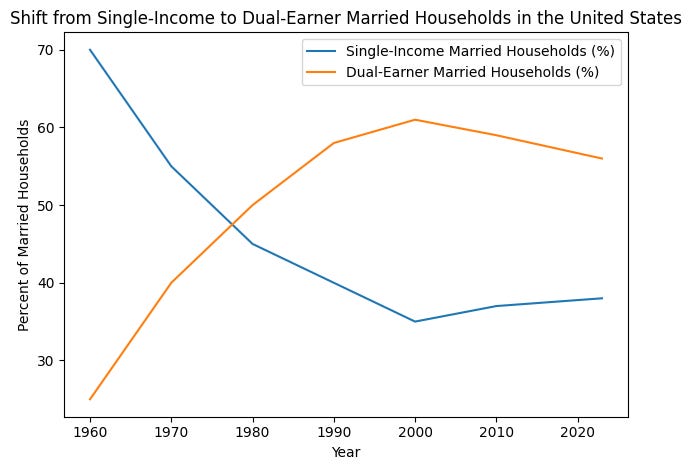
In 1960, roughly 72 percent of American adults were married, according to Census Bureau data. Most children lived with both biological parents. The majority of households relied primarily on a single income earned by the father, while mothers devoted substantial time to raising children and maintaining the household.
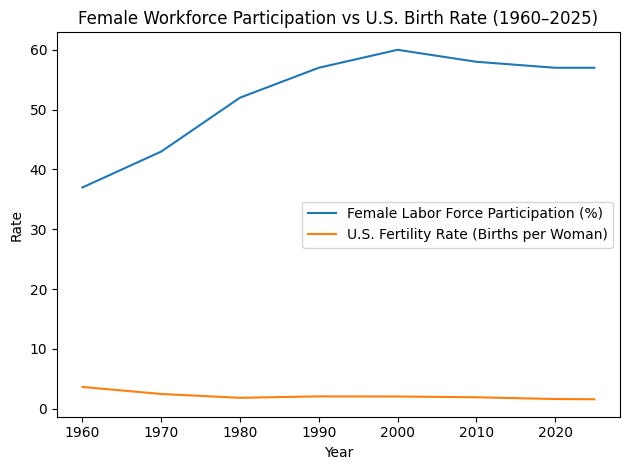
Female labor force participation during that period was far lower than it would become later. In 1950, about 34 percent of American women participated in the labor force. Many of those women were unmarried, widowed, or worked part-time. Married mothers with young children were far less likely to work outside the home than they are today.
Birth rates were also much higher. During the baby boom of the late 1950s, the United States reached a fertility rate of about 3.7 children per woman. That level of fertility produced rapidly growing communities, expanding schools, and neighborhoods filled with children.
Crime rates during the early postwar decades were far lower than the levels that would emerge in later years. In 1960, the national homicide rate stood at about 4.7 per 100,000 people. By the early 1990s, it would climb to more than double that level before eventually declining again.
These statistics do not prove that family structure alone determined every social outcome. Economic conditions, policing strategies, demographics, and many other factors influence crime and social stability.
However, the family provided a framework that helped organize responsibilities between men and women, adults and children, and individuals and communities.
Fathers were expected to support their families. Mothers were expected to raise children. Communities reinforced these expectations through social norms that extended beyond government policy.
Beginning in the 1960s, a growing cultural movement began challenging the legitimacy of this structure.
Its advocates argued that the traditional arrangement between men and women was not simply outdated but oppressive. According to this view, women were being confined to domestic roles that prevented them from reaching their full potential.
This movement would soon become known as modern feminism.
Its supporters presented their ideas as a necessary step toward equality and personal freedom. Yet the movement also represented a dramatic rethinking of the institution that had organized family life for centuries.
What followed was not merely a debate about workplace opportunities or legal rights. It was the beginning of a cultural shift that would gradually reshape how Americans thought about marriage, children, work, and the responsibilities of men and women.
The consequences of that shift would unfold over the next several decades, and many of them were not anticipated by the activists who helped launch the movement.
What the Feminist Movement Promised
Movements that transform societies rarely begin by announcing their long-term consequences. They begin by identifying grievances that many people can recognize. Once those grievances gain public sympathy, the movement expands its arguments and its ambitions.
The feminist movement of the late twentieth century followed this familiar pattern.
During the early 1960s, many women faced genuine limitations in the workplace and in public life. Certain professions had long been dominated by men. Promotions and leadership roles were often difficult for women to obtain, even when they possessed the necessary qualifications. In some fields, employers openly preferred male candidates.
In that era, it is also important to remember how uncommon higher education still was. In 1960, only about 11% of Americans ages 25 to 29 had a bachelor’s degree or higher. By 2024, that figure was about 32%. In other words, when writers and activists spoke about educated women running into closed doors, they were often talking about a relatively small but growing slice of the population, not the average American household. These conditions created frustration among many women who had completed college or professional training but found their opportunities restricted.
Into this environment stepped a new generation of activists and writers who argued that the problem was not simply discrimination in specific workplaces. They argued that the entire structure of traditional family life was responsible for limiting women’s potential.
One of the most influential works in this argument appeared in 1963 when Betty Friedan published a book titled The Feminine Mystique. The book sold millions of copies and helped energize what would later be called the second wave of feminism.
Friedan described the dissatisfaction she believed many suburban housewives experienced during the postwar decades. She referred to it as “the problem that has no name.” According to her argument, women who devoted themselves primarily to raising children and maintaining households were being denied the opportunity to develop their talents in the broader world.
Her message resonated strongly among educated women who had grown up during a period when college enrollment for women was rising rapidly. In 1960, roughly 35 percent of college students in the United States were women. By the early 1970s, that share had risen substantially, and many of those graduates were eager to pursue professional careers.
Feminist leaders argued that society should remove the barriers that prevented women from participating fully in the labor market. This goal appealed to many Americans because it appeared consistent with the broader national commitment to equality of opportunity.
Some legal changes that followed addressed legitimate problems. The Equal Pay Act of 1963 prohibited wage discrimination based on sex. The Civil Rights Act of 1964 included provisions that barred employment discrimination against women. In 1972 Congress passed Title IX legislation aimed at expanding educational opportunities for women.
These measures reflected a growing belief that women should have access to the same educational and professional opportunities available to men.
What was rarely discussed during this period was the concept economists call opportunity cost. Every decision to pursue one path necessarily means giving up another. The feminist movement framed the entry of women into the workforce as an expansion of opportunity without seriously examining what might be lost in the process. The domestic sphere was often portrayed as having little economic value, even though raising children, maintaining households, and building community networks had always required substantial labor.
By treating the household as if it contributed little to society’s productive life, the movement created the impression that the trade-off involved only gains. In reality, the shift involved exchanging one form of social investment for another, and the costs of that exchange would not become visible until decades later.
But the feminist movement did not stop with legal equality.
Increasingly, its leaders began arguing that the traditional household itself was the central obstacle to women’s liberation. If women were expected to devote their lives primarily to raising children, then they would inevitably remain economically dependent on men.
In this view, the family structure that had existed for centuries was not simply a social arrangement. It was a system of power.
Activists and intellectuals began promoting a different vision of adult life. Women were encouraged to pursue careers, develop independent economic identities, and view domestic responsibilities as secondary to personal achievement.
This new vision spread quickly through universities, media institutions, and professional organizations.
Young women entering college during the 1970s and 1980s increasingly heard a consistent message. Success meant building a career. Marriage and motherhood could be postponed once professional goals had been established.
The change in expectations was visible in labor force statistics.
In 1950, about 34 percent of American women participated in the workforce. By 1970, the number had risen to roughly 43 percent. By 1990, female labor force participation reached nearly 57 percent.
Among married women with children, the increase was even more dramatic. In 1960 fewer than one-quarter of married mothers with young children worked outside the home. By the early twenty-first century, the majority did.
Supporters of the feminist movement celebrated these changes as evidence that women were gaining freedom and independence. Millions of women entered professions that had once been dominated by men. Female representation increased in medicine, law, business, and government.
Yet the movement also reshaped how society evaluated different forms of work.
Raising children and maintaining households had long been recognized as essential responsibilities. The feminist critique gradually reframed these activities as limitations rather than contributions.
A woman who focused on raising children was often described as someone who had abandoned her potential. A woman who prioritized career advancement was portrayed as someone who had escaped the restrictions of traditional life.
Over time these cultural signals influenced how younger generations organized their lives.
Women were encouraged to delay marriage while pursuing education and career advancement. Men were increasingly encouraged to view women as economic competitors rather than partners within a shared household structure.
The language surrounding family life began to change as well. Words such as “dependence” and “submission” appeared frequently in feminist critiques of marriage, even though most families had historically functioned through cooperation rather than domination.
This transformation in expectations occurred rapidly. Within a single generation, the cultural understanding of adulthood shifted in ways that earlier Americans would have found difficult to imagine.
The long-term consequences of this shift were rarely discussed during the early years of the movement. The focus remained on expanding opportunity and dismantling traditional roles.
However, when institutions that have structured society for centuries begin to change, the effects rarely remain confined to the group whose circumstances initially motivated the reform.
The transformation of women’s roles would eventually reshape the structure of families, the organization of the economy, and the expectations placed on men as well as women.
Those consequences did not appear immediately. They unfolded gradually over the following decades as cultural ideals began influencing everyday behavior across American society.
The Cultural Turn Against the Household
Legal reforms in the 1960s and early 1970s addressed certain workplace barriers that women had faced. Removing explicit discrimination in hiring and pay reflected a principle most Americans accepted. Equal treatment under the law was not a radical concept in a country that had long celebrated equality of opportunity.
Yet the feminist movement did not remain limited to questions of legal equality. It gradually developed a broader critique of the family itself.
In universities, academic departments devoted to women’s studies began appearing during the late 1960s and early 1970s. These programs did not merely study the historical experiences of women. Many promoted a theoretical framework that described traditional gender roles as structures of power. Within this framework, marriage and domestic life were often interpreted as institutions that preserved male dominance.
This interpretation spread beyond academic journals and classrooms. Media organizations, publishing houses, and television programs increasingly echoed the idea that domestic life represented a form of confinement.
Cultural messaging shifted in subtle but persistent ways. During the 1950s, popular media often portrayed marriage and family life as central elements of adulthood. By the late twentieth century, the tone had changed. Television programs and magazines frequently depicted domestic life as monotonous, while professional success outside the home was portrayed as a more meaningful path.
These cultural signals were absorbed by younger generations long before they entered the workforce.
A girl growing up in the United States during the 1970s or 1980s encountered a steady stream of messages suggesting that traditional roles represented wasted potential. School counselors encouraged girls to pursue professional careers. College admissions programs promoted female enrollment in fields historically dominated by men. Media stories highlighted women who had broken into elite professions.
None of these developments were inherently negative. Expanding opportunities allowed many women to pursue talents that might otherwise have gone unused. The difficulty was that the cultural narrative increasingly treated the household itself as the obstacle.
The work involved in raising children and maintaining a stable home received less recognition as an important social contribution. In many discussions, it was treated primarily as a barrier to professional advancement.
Over time, this narrative influenced how young adults began planning their lives.
Marriage was increasingly postponed. Educational attainment rose as more women pursued advanced degrees. Career development became the primary focus during the years that earlier generations had often devoted to starting families.
The statistical evidence reflects this shift clearly.
In 1960, the median age at first marriage for American women was about 20 years old. By 2024, the median age had risen to roughly 28 years. For men, the median age increased from about 23 in 1960 to around 30 today.
The delay of marriage naturally delayed childbirth as well.
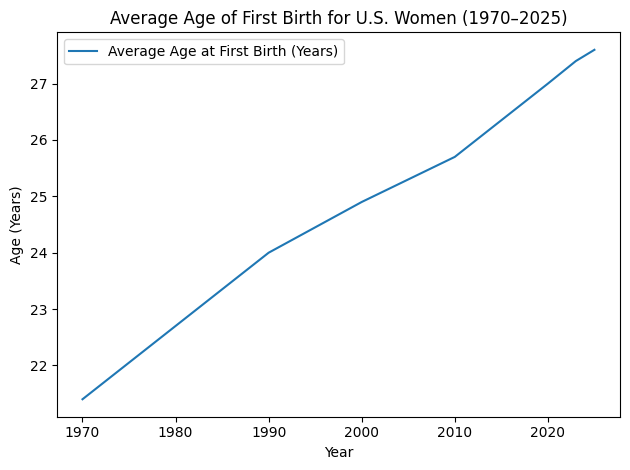
In 1970, the average age of first birth for American women was approximately 21 years old. By the early 2020s, that number had risen to about 27 years old according to data from the Centers for Disease Control and Prevention.
For college-educated women, the average age is often higher.
These changes reflected more than individual lifestyle preferences. They reflected a cultural environment in which family formation had become secondary to career development.
This transformation also altered how people understood adulthood itself.
In earlier generations, adulthood was often marked by marriage, children, and the responsibilities associated with maintaining a household. By the late twentieth century, adulthood was increasingly defined by educational achievement, professional status, and personal independence.
The shift was gradual but powerful.
Universities reinforced it through advising systems that encouraged students to invest heavily in career preparation. Corporations reinforced it by rewarding long working hours and geographic mobility that made early family formation difficult.
Media narratives reinforced it by celebrating professional accomplishment as the highest form of personal fulfillment.
Over time, the cultural status of motherhood itself began to change.
Surveys conducted over several decades show that most women still express a desire to have children. Yet the timing of those children has shifted dramatically. Many women now attempt to balance the biological realities of fertility with professional expectations that reward uninterrupted career progression.
This tension has produced new industries and new technologies. Fertility clinics, egg freezing procedures, and other medical interventions have become increasingly common as women attempt to extend their reproductive timelines.
These developments reflect a deeper cultural change.
A society that once treated family formation as the center of adult life now often treats it as one option among many competing priorities.
When cultural expectations shift in this way, institutions throughout society begin adjusting to the new incentives.
The labor market adjusts. Educational systems adjust. Housing markets adjust. Government policies eventually adjust as well.
The results of these adjustments are rarely visible immediately. They unfold over decades as millions of individual decisions accumulate into large social patterns.
An often overlooked consequence of this cultural shift involved the incentives facing men. For generations, male identity had been closely tied to the role of provider. A young man understood that the path to marriage and social respectability required stable work and the ability to support a household.
When the culture began emphasizing that women did not need men economically, the incentive structure quietly changed. If a man is no longer necessary as a provider, the motivation to become one inevitably weakens for some men. This did not eliminate productive men, but it did loosen the connection between male responsibility and family formation. Over time, that change would have significant social consequences.
The Two-Income Economy
Cultural ideas rarely remain confined to the world of books, universities, and political speeches. Once they influence how millions of individuals make decisions about work and family, those decisions begin reshaping the broader economy.
The expansion of female participation in the labor force during the late twentieth century illustrates this process clearly.
In 1950, roughly 34 percent of American women participated in the labor force. By 1970, the number had risen to about 43 percent. By 1990, it reached nearly 57 percent, according to data compiled by the U.S. Bureau of Labor Statistics. Among married women with children, the increase was particularly pronounced. In 1960, fewer than one-quarter of married mothers with young children worked outside the home. By the early twenty-first century, the majority did.
This change meant that tens of millions of additional workers entered the labor market within a relatively short historical period.
At first glance, the development appeared to promise greater prosperity for households. If two adults in a family earned incomes instead of one, many assumed living standards would rise accordingly.
Yet markets respond to changes in incentives.
When millions of households suddenly possess two incomes rather than one, the purchasing power available in markets increases. Sellers of goods and services adjust their prices accordingly. Over time, the additional income becomes incorporated into the normal price structure of the economy.
Housing provides one of the clearest examples of this process.
In 1950, the median price of a home in the United States was approximately $7,400. Adjusted for inflation, that figure is roughly equivalent to about $90,000 in today’s dollars. A single-income household could realistically purchase a home and support a family in most parts of the country.
By contrast, the median home price in the United States in 2025 exceeded $420,000 according to data from the National Association of Realtors. In many metropolitan areas the number was significantly higher. Cities such as San Francisco, Boston, and Seattle recorded median prices well above $700,000.
Population growth, zoning restrictions, and construction costs all contribute to housing prices. However, another factor is the increased purchasing power created by dual-income households competing in the same housing markets.
When two-income families bid against one another for homes, sellers naturally adjust their expectations upward. Over time, the market price begins reflecting the financial capacity of households that rely on two earners rather than one.
The result is a structural shift.
What once appeared to be additional prosperity gradually becomes a new baseline. Families that attempt to rely on a single-income often find themselves struggling to compete in housing markets that assume two salaries.
This pattern extends beyond housing.
Childcare offers another example of how economic adjustments follow cultural change.
During earlier decades, many families relied on mothers, grandparents, or neighbors to supervise young children. Because a parent was typically present in the home, childcare rarely appeared as a large monetary expense within household budgets.
Once both parents began working full-time outside the home, childcare services became a necessity for millions of families.
The cost of those services can be substantial. Surveys conducted by the U.S. Department of Labor and various childcare organizations indicate that full-time daycare in the United States often costs between $10,000 and $16,000 per year per child. In major cities, costs frequently exceed $20,000 annually.
These expenses consume a significant portion of the second income in many households.
Transportation costs also increased as dual-earner households became common. In earlier decades, a single vehicle often served the entire household because one parent typically worked outside the home while the other remained nearby. With both parents commuting, the need for two vehicles became widespread.
The shift also had a predictable side effect that rarely appears in the rhetoric. Two commuter vehicles per household means more miles driven, more fuel consumed, and more emissions. Whatever one thinks about climate policy, it is difficult to claim that a society built around two daily commutes is environmentally neutral. This is one more example of trade-offs. The same political culture that often speaks most loudly about pollution helped normalize a household structure that expanded automobile dependence.
The Bureau of Labor Statistics reports that transportation represents one of the largest categories of household spending in modern American budgets. Insurance, fuel, maintenance, and vehicle purchases combine to create ongoing costs that earlier generations often avoided.
Time constraints introduced additional economic adjustments.
Households in which both adults work full-time frequently have less time available for cooking meals at home. As a result, spending on restaurant meals, prepared foods, and junk food has increased dramatically over the past several decades.
In 1960, Americans spent a relatively small share of their food budgets on meals outside the home. By the 2020s, nearly half of all food spending occurred in restaurants or on prepared meals, according to data from the U.S. Department of Agriculture.
The rise of processed and convenience foods coincided with these changing time constraints.
These adjustments illustrate an important economic principle. When social structures change, markets reorganize themselves around the new patterns of behavior.
The expansion of dual-income households increased the total number of working hours within many families. Yet the economic benefits of those additional hours were partly absorbed by rising costs associated with housing, childcare, transportation, and convenience services.
This dynamic has led some economists to describe the modern household economy as a treadmill. Families often work more hours than previous generations while still feeling financial pressure.
Surveys conducted by organizations such as the Pew Research Center regularly find that many parents report high levels of stress related to balancing work responsibilities and family life.
The feminist movement initially presented women’s entry into the labor force as a pathway to independence and prosperity. In many cases, it did allow individual women to pursue careers that earlier generations might not have considered possible.
However, the broader economic consequences of the shift created a system in which two incomes gradually became necessary for many households to maintain a standard of living that earlier families achieved with one.
Once an economy reorganizes itself around that assumption, reversing the process becomes extremely difficult. Economic structures built around two incomes eventually make two incomes necessary.
The Collapse of Birth Rates
Economic incentives influence behavior, but they do not operate alone. Culture and biology interact in ways that often produce consequences that reformers did not anticipate.
The transformation of family life in the late twentieth century eventually produced one of the most important demographic changes in modern history. Birth rates across the developed world began falling sharply.
For much of American history, population growth occurred naturally because most adults married and had children. During the postwar baby boom, the United States reached fertility levels that were historically high. In 1957, the total fertility rate reached approximately 3.7 children per woman.
Demographers generally estimate that a developed country needs a fertility rate of about 2.1 children per woman to maintain a stable population over time. This level is known as replacement fertility because it allows one generation to replace itself without relying on immigration.
By the mid 1970s, the American fertility rate had already fallen below that threshold. In 1976, it reached approximately 1.7 children per woman. Although the number fluctuated during the following decades, it rarely returned to replacement level.
According to the Centers for Disease Control and Prevention, the fertility rate in the United States stood at roughly 1.62 children per woman in 2023. Preliminary estimates for 2024 and early 2025 suggest the number remains near that level.
The long-term implications of these numbers are significant.
A fertility rate of 1.6 means that each generation will be smaller than the one before it unless immigration offsets the decline. Over time, the population grows older, the number of workers declines relative to retirees, and economic systems designed for growing populations begin to strain.
These trends are even more pronounced in many other developed countries.
Japan’s fertility rate has remained near 1.3 for many years. Italy and Spain have often fallen near or below that level. Germany’s fertility rate has fluctuated between about 1.3 and 1.6 in recent decades. South Korea has experienced the most dramatic decline. In 2024, its fertility rate fell below 0.8 children per woman, one of the lowest levels ever recorded.
At such levels, a society eventually faces rapid population contraction.
These demographic patterns are not limited to one culture or political system. They appear across much of the developed world wherever education levels rise, careers become central to adult identity, and family formation is delayed.
The timing of childbirth plays a crucial role in this process.
In 1970, the average age at which American women had their first child was approximately 21 years old. By the early 2020s, that number had risen to about 27. Among college-educated women, the average age of first birth is often higher.
The delay of childbirth has biological consequences that no social policy can eliminate.
Female fertility gradually declines after the late twenties and begins falling more rapidly after the mid-thirties. Medical technology has made it possible for some women to conceive later in life through fertility treatments, but those procedures are expensive and not always successful.
As a result, many women who postpone childbirth eventually have fewer children than they originally intended.
Surveys conducted by the Pew Research Center show that many young adults say they would like to have two or more children. Yet the number of children people actually have often falls short of those intentions.
Economic pressures contribute to this gap.
Housing prices have increased substantially in many regions. Childcare costs are high. College tuition continues to rise. Student loan debt affects millions of young adults entering the workforce.
But cultural expectations also play an important role.
For several decades, young women have been encouraged to treat career development as the primary measure of success during their twenties and early thirties. Marriage and children are frequently presented as goals that can be postponed until later.
The difficulty is that biological timelines do not always align with career timelines.
When individuals attempt to balance both simultaneously, many find themselves postponing family formation longer than they originally planned.
These decisions accumulate across millions of households.
The result is a demographic shift that affects entire societies.
An aging population creates economic challenges that governments must address. Pension systems rely on younger workers to support retirees. Healthcare costs rise as populations grow older. Labor shortages emerge in industries that require younger workers.
Several countries have already begun experiencing these pressures.
Japan offers a particularly clear example. Its population peaked around 2008 at approximately 128 million people. Since then, the population has been gradually declining. Rural communities have experienced school closures because there are not enough children to fill classrooms. Businesses struggle to find workers in some regions.
European governments have attempted various policies to encourage higher birth rates, including tax incentives, parental leave programs, and childcare subsidies. While these policies sometimes slow the decline slightly, they rarely restore fertility to replacement levels once cultural expectations have shifted.
The United States has historically maintained somewhat higher birth rates than many European countries, partly because of immigration and slightly younger populations. However, the long-term downward trend in fertility remains clear.
Population decline is not merely a statistical curiosity.
Civilizations depend on each generation raising the next. When a society becomes unable or unwilling to reproduce itself at replacement levels, it eventually faces economic, cultural, and political consequences that extend far beyond demographic charts.
The transformation of family life that began during the late twentieth century therefore did not simply alter individual lifestyles. It began reshaping the demographic future of entire societies.
The Trade-Offs Begin to Appear
The feminist movement promised liberation. What it delivered was a series of trade-offs that many Americans are only beginning to understand. When the family changed, the economy changed with it. When the economy changed, politics adapted.
In Part II, we will examine the consequences that followed. They appear in falling birth rates, the disappearance of clear male roles, the expansion of government programs, and the political incentives that quietly reinforce the entire system.
These developments did not happen by accident, and they are now reshaping the future of the United States.
The consequences of major cultural shifts rarely appear all at once. They unfold slowly, often across generations, until the trade-offs that were once ignored become impossible to deny.
If you want more work that examines those trade-offs honestly, support writing that is willing to ask uncomfortable questions.
Support Work That Examines the Trade-Offs Others Ignore
Most political writing today is reaction.
A headline appears.
A clip circulates.
Social media explodes.
But almost nobody steps back and asks the question that actually matters.
What were the incentives?
Policies, movements, and cultural revolutions are rarely judged by the trade-offs they create. They are judged by the intentions that launched them.
That is not how reality works.
The essay you just read is an example of what this publication tries to do. Slow down the conversation, examine the incentives, and follow the consequences wherever they lead. Sometimes that means revisiting ideas that were once treated as unquestionable progress.
This work does not come from a newsroom, a university department, or a political foundation.
It comes from one writer working independently with the support of readers who believe serious analysis still matters.
There are now more than 2,450 readers here, but only a small portion are paid subscribers.
On Substack, visibility is driven directly by paid support. That determines whether research and long-form writing reach new readers or disappear into the algorithm.
If you want more work that examines the real incentives shaping American society, help keep this publication independent and durable.
Become a Paid Subscriber
Make a One-Time Gift
Join The Resistance Core
We do not need more slogans.
We need more people willing to examine the consequences.
Mr. Arnell,
This is a very accurate essay on the American cultural/ societal / economic changes that have occurred within the past 50+ years; witnessed over my 70+ years of life. Some data point to an “economic tipping point” which has recently arrived, with the desire and necessity for the 2-earner (both husband and wife as full-time workers) household now being challenged.
Beyond feminist inculcation, all post-boomer American generations have widely succumbed to increasing materialism. For example, it’s increasingly common to see three or more new or late-model cars/trucks in the driveways of modest starter homes. Not surprisingly, the rapidly depreciating cars are worth much more than the house itself (!!). Not very smart…. So beyond a mortgage, there are multiple car notes resulting in high credit debt on top of any student loan debt. In short, adequate personal finance / economic literacy is badly lacking in today’s < 50 yr. old-America.
As a paid subscriber, I value and enjoy your essays. As a critique, I’d suggest your “long form” essays may not achieve wide viewership or subscription. Today’s reader has a very short attention span. You should consider shortening your essays, and for the same amount of written content provide more, and shorter, posts.
Looking forward to reading Part II.
Quick note for readers:
This is Part I of a two-part essay.
Part II goes deeper into how the cultural shift was engineered through universities, media, and policy.
If you want to follow the rest of the series as it drops, subscribe here:
https://mrchrisarnell.com/subscribe