


“When the incentives surrounding family life changed, the consequences did not appear all at once. They appeared slowly in disappearing fathers, lost men, and a society struggling to raise the next generation.”
The Displacement of Men
Social institutions rarely change in isolation. When one pillar of society shifts, the surrounding structure eventually moves with it.
The transformation of women’s roles during the late twentieth century, consequently, did not affect women alone. It also reshaped the position of men within families and within the broader economy.
For generations, the expectations placed on men were relatively clear. A man was expected to work, to support a household, and to protect those who depended on him. These expectations did not arise from academic theories about masculinity. They developed because societies required men to assume certain responsibilities in order for families to function.
The household structure reinforced those expectations. A man who wished to marry and raise children understood that he needed stable employment. Fathers were judged, both socially and personally, by their ability to provide for their families.
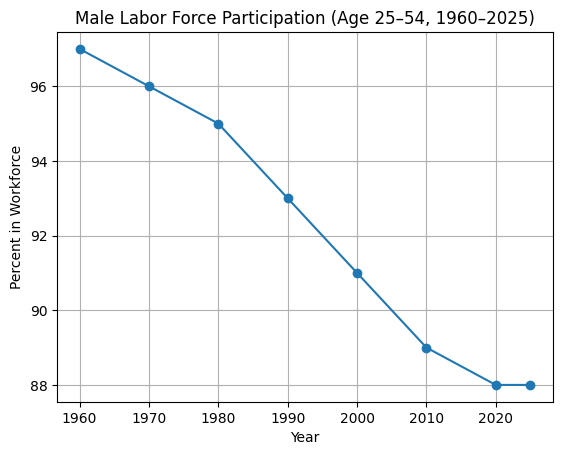
When cultural attitudes toward marriage and family changed, the incentives that had shaped male behavior began to change as well.
One of the first areas where this shift became visible was the labor market.
During the middle decades of the twentieth century, many working-class men could obtain stable employment in manufacturing and skilled trades without a college degree. Industries such as steel production, automobile manufacturing, and heavy equipment provided jobs that paid wages sufficient to support families.
Over time that economic landscape began to change.
Technological advances increased productivity while reducing the number of workers required in many industries. Global trade expanded, allowing companies to relocate manufacturing operations to countries where labor costs were lower.
The share of American workers employed in manufacturing illustrates the magnitude of the change. In 1960, manufacturing accounted for roughly 28 percent of total employment in the United States. By 2024, the figure had fallen to around 8 percent.
These changes did not eliminate opportunities for skilled workers, but they reduced the number of positions available for men without advanced education.
At the same time, educational trends began moving in a direction that further complicated the situation.
Women steadily increased their representation within colleges and universities. By the early twenty-first century, women were earning about 60 percent of all bachelor’s degrees in the United States. The same pattern appeared in master’s degree programs and many professional schools.
Some of this shift reflected the success of efforts to expand educational opportunities for women. However, it also created a widening gap between the educational attainment of young men and young women.
Men who fall behind in education often face greater difficulty securing stable employment. Without stable employment, marriage becomes less likely.
Marriage has historically been closely linked to economic security. Many women prefer to marry men who demonstrate the ability to support a household. When large numbers of men struggle to establish stable careers, family formation declines.
Census Bureau data reflects this change. In 1960, approximately 72 percent of American adults were married. By the early 2020s, that figure had fallen to roughly 50 percent.
The decline is particularly pronounced among younger adults.
Many young men now postpone marriage well into their thirties or avoid it entirely. Some express uncertainty about what role they are expected to play within modern relationships. Others simply focus on individual pursuits rather than family formation.
Cultural messaging has contributed to this uncertainty.
For several decades, public discussions of gender roles have frequently portrayed traditional masculinity as a source of social problems. Terms such as “toxic masculinity” have become common in academic and media conversations.
Critics use these phrases to describe aggressive or irresponsible behavior among men. Yet the language often extends beyond specific actions and begins criticizing the broader idea of male authority or leadership within families.
Young men growing up in this environment receive mixed signals about what society expects from them.
They are still told that they should behave responsibly and respect others. Yet many of the traditional roles through which responsibility was historically expressed have been questioned or discouraged.
The result can be confusion.
Some men withdraw from traditional institutions such as marriage and long-term employment. Others struggle to define their place within a culture that appears uncertain about the value of the roles men once played.
The consequences extend beyond individual relationships.
Children raised without fathers often face additional challenges. Numerous studies conducted over several decades have found correlations between father absence and increased risks of poverty, academic difficulties, and involvement with the criminal justice system.
These patterns do not determine the fate of every child. Many individuals raised in single-parent households succeed in building stable and productive lives.
However, when large numbers of children grow up without consistent male guidance, the social effects become visible at the community level.
Government programs attempt to address some of these challenges through financial assistance and educational initiatives. Yet such programs rarely replace the stability that two committed parents can provide within a household.
The changing expectations surrounding men, thus, represent another consequence of the broader transformation of family life.
When societies alter the roles assigned to one half of the population, the effects inevitably reshape the incentives and behavior of the other half as well.
The next stage of this transformation would become visible not only in household structures but also in everyday public behavior and social expectations.
When Protectors Disappear
Every society develops informal expectations about how people should behave when others are in danger. These expectations rarely appear in legal codes, yet they influence everyday behavior in powerful ways.
For much of history, one of those expectations concerned the responsibility of men to protect women and children. The expectation did not arise from philosophical debates about equality. It developed because physical differences between men and women made certain roles more practical for one sex than the other.
Men possess greater average upper-body strength and larger physical stature. In environments where violence was a real possibility, societies relied on men to confront threats.
This expectation shaped social behavior in ways that many people took for granted.
A man walking with his family understood that protecting them was part of his responsibility. Communities often reinforced the idea that men should intervene when women or children were threatened. The phrase “women and children first,” which became widely known after maritime disasters in the nineteenth and early twentieth centuries, reflected a broader cultural principle that men were expected to assume greater physical risk.
These expectations were not simply ceremonial ideals. They influenced everyday conduct in public places.
When conflicts occurred in earlier decades, bystanders were often more likely to intervene. A man who ignored a situation in which someone was being threatened could face criticism from neighbors or acquaintances who believed he had failed to act responsibly.
During the late twentieth century, cultural attitudes toward masculinity began shifting in ways that affected these expectations.
Discussions in universities and media organizations increasingly portrayed traditional male roles as forms of dominance rather than responsibility. Aggression, even when directed toward defending others, was frequently described as part of a broader pattern of harmful behavior associated with masculinity.
Some critics used phrases such as “toxic masculinity” to describe violent or irresponsible conduct among certain men. Yet the language often blurred distinctions between destructive aggression and protective responsibility.
The traits that allow a police officer to confront a violent suspect or a soldier to defend a community involve controlled forms of aggression. When public discussion treats all expressions of those traits as negative, the protective dimension becomes harder to recognize.
Over time, this cultural ambiguity influenced behavior.
Men increasingly received warnings about the legal and social risks associated with intervening in public disputes. Intervening too forcefully could lead to accusations of assault. Misunderstanding a situation could produce legal consequences.
These concerns encouraged hesitation.
The spread of smartphones introduced another change. Incidents that might once have attracted intervention now frequently attract cameras. Videos posted on social media often show violent confrontations while numerous bystanders watch and record events.
Technology alone does not explain this pattern. Cameras simply reveal how people behave in situations where social expectations about intervention have weakened.
Crime statistics provide additional context for these observations.
The United States experienced a sharp increase in violent crime beginning in the late 1960s. The national homicide rate rose from about 4.7 per 100,000 people in 1960 to more than 10 per 100,000 during the early 1990s before declining in subsequent decades.
Although crime declined during the late 1990s and early 2000s, the trend has not been entirely stable. Several American cities experienced substantial increases in homicide between 2020 and 2022. Some cities saw partial declines afterward, but crime levels in many urban areas remain above the levels recorded before 2020.
Public confidence in safety has also fluctuated.
Surveys conducted by Gallup frequently show that large portions of the American public believe crime is increasing even during years when official statistics suggest more modest changes. This perception may reflect visible incidents that attract media attention or changes in reporting practices that affect how crimes appear in official data.
Some categories of crime are believed to be underreported because victims doubt that reporting will lead to meaningful consequences. Retail theft, for example, has increased in certain metropolitan areas. Businesses in cities such as San Francisco, Chicago, and New York have closed stores, citing repeated theft incidents that employees are discouraged from confronting.
These developments reflect more than changes in policing or prosecution policies.
They also reveal how social norms influence behavior in everyday situations. When communities expect individuals to take responsibility for protecting others, potential offenders may encounter resistance before crimes escalate. When those expectations weaken, institutions such as police departments become the primary line of defense.
Formal institutions can respond only after incidents occur.
Cultural expectations, by contrast, operate continuously. They shape behavior long before a crime takes place.
The weakening of traditional expectations surrounding male responsibility, therefore, affects more than family life. It influences how individuals behave in public spaces and how communities respond to disorder.
These changes did not arise from a single decision or policy. They developed gradually as cultural attitudes toward gender roles shifted during the late twentieth century.
Once those attitudes changed, the institutions that once depended on clear expectations between men and women began adapting to a new and often uncertain social environment.
The next stage of this transformation would involve government policies that responded to these cultural shifts while also reinforcing them in unexpected ways.
A disturbing example occurred in 2021 on a commuter train near Philadelphia. A woman was sexually assaulted on a SEPTA train while other passengers were present in the same railcar. Authorities later said the attack might have been stopped much sooner if someone had simply called 911. The incident unfolded for several minutes before an off-duty transit employee finally alerted police, allowing officers to board the train and arrest the suspect.
When Policy Began Reinforcing the Shift
Cultural changes rarely remain confined to private life. Once large numbers of people alter how they organize their families and careers, political institutions begin adjusting to the new reality.
Government policy during the late twentieth century increasingly reflected the transformation that had already begun within American households.
Several developments illustrate how the relationship between family life and public policy began shifting during this period.
One of the most significant changes involved the expansion of welfare programs aimed at supporting low-income households. Many of these programs were originally created with the intention of assisting widows and families facing temporary economic hardship.
Over time, however, the structure of certain programs created incentives that unintentionally discouraged marriage.
The Aid to Families with Dependent Children program, commonly known as AFDC, expanded significantly during the 1960s. Under the program, financial assistance was provided primarily to households in which children lived with a single parent. In many cases, benefits were reduced or eliminated if a working adult male was present in the household.
This structure meant that a mother who married or lived with a man earning income could lose benefits that she would otherwise receive as a single parent.
Economists who study incentives have often pointed out that policies that reward a particular behavior tend to increase the frequency of that behavior. When government programs provide greater financial support to single-parent households than to married couples with comparable incomes, the policy environment unintentionally favors single parenthood.
Statistical trends during the late twentieth century reflected a substantial increase in children born outside marriage.
In 1960, approximately 5 percent of American births occurred outside marriage. By 1990, the figure had risen to about 28 percent. According to data from the Centers for Disease Control and Prevention, the percentage reached roughly 40 percent by the early 2020s.
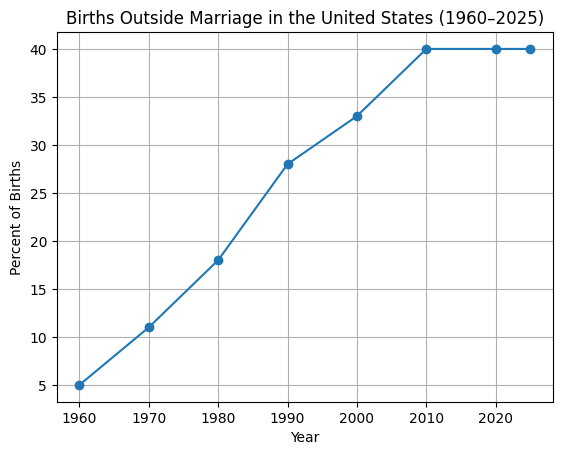
The increase was particularly dramatic within certain communities. Among African American births, the share occurring outside marriage rose from about 22 percent in 1960 to more than 70 percent in recent years.
These numbers reflect many influences, including cultural changes surrounding marriage, economic conditions, and the policies that shaped incentives within low-income households.
During the 1970s and 1980s, social scientists began debating whether welfare policies were contributing to family instability. Some analysts argued that government assistance merely responded to existing social problems. Others argued that the structure of certain programs unintentionally encouraged single-parent households.
Thomas Sowell and several other economists emphasized the role of incentives. When policies change the economic rewards associated with particular choices, behavior often adjusts accordingly.
Public policy also changed in another area that affected family stability. Divorce laws in many states were liberalized during the late twentieth century.
Before the 1970s, many states required evidence of wrongdoing, such as abandonment or abuse, before a divorce could be granted. Beginning with California in 1969, states began adopting no-fault divorce laws that allowed marriages to end without proof of misconduct.
Supporters of these reforms argued that individuals should not be trapped in unhappy marriages. Critics warned that making divorce easier would weaken the long term stability of families.
Divorce rates rose sharply during the 1970s following these legal changes. Although the rate later declined somewhat, the long-term effect was a normalization of divorce that altered how many people viewed the permanence of marriage.
Children increasingly grew up in households that experienced separation or remarriage. Blended families became more common. The expectation that marriage would last a lifetime became less certain.
These legal and policy changes occurred alongside the broader cultural transformation already underway.
Government institutions were not the sole cause of changing family structures. Cultural attitudes, economic shifts, and personal decisions all played roles.
Yet public policy often reinforced the new patterns once they emerged.
Programs designed to alleviate poverty expanded as the number of single-parent households increased. Childcare subsidies were developed to support households in which both parents worked outside the home. Tax policies evolved to reflect the rising number of dual-income families.
By the early twenty-first century, the American economy and social policy framework had largely adapted to a world in which traditional family structures were less common than they had been during the mid-twentieth century.
Political incentives also shaped how these issues were discussed.
Parties that gained electoral support from constituencies dependent on government programs often favored expanding those programs. Critics argued that this dynamic could create long-term political incentives to maintain policies that increased reliance on public assistance.
Supporters of these programs countered that the government had a responsibility to provide support for vulnerable families regardless of how those families were structured.
The debate continues today.
However, the relationship between cultural change and public policy reveals an important pattern. When social institutions weaken, governments frequently expand their role in attempting to manage the resulting challenges.
The next question concerns why certain political groups embraced these changes more enthusiastically than others and how those political incentives influenced the direction of public policy in the decades that followed.
Political Incentives and the Role of the Democrat Party
When large cultural changes occur, political institutions rarely remain neutral observers. Parties, interest groups, and government agencies respond to shifting social conditions in ways that align with their political incentives.
The transformation of family life in the United States during the late twentieth century, therefore, did not unfold outside the political arena. It quickly became entangled with the strategies and priorities of major political parties.
The Democrat Party increasingly aligned itself with many of the goals advanced by feminist activists during the 1960s and 1970s. Party leaders supported legislation that expanded workplace protections for women, promoted gender equality initiatives, and increased government involvement in programs affecting family life.
Some of these policies addressed legitimate concerns about discrimination and opportunity. However, political incentives also played a role in shaping the direction and scope of policy responses.
Political parties tend to support policies that strengthen their electoral coalitions. As the structure of American families began changing, new voting blocs emerged that were more likely to support expanded government programs.
Single-parent households often rely more heavily on public assistance programs such as housing support, food assistance, and childcare subsidies. Individuals whose economic stability depends partly on government support may be more inclined to support candidates who promise to maintain or expand those programs.
This dynamic does not imply that individuals receiving assistance are voting cynically. Most voters simply support policies that they believe will improve their circumstances. However, the cumulative effect of these incentives can reshape political coalitions over time.
During the late twentieth century, the Democrat Party increasingly built its electoral base among constituencies that favored an expanded role for government in addressing social and economic challenges.
Women also became a central focus of political outreach. Campaign messaging often emphasized policies related to workplace equality, reproductive rights, and government-supported childcare programs.
The emergence of what political analysts sometimes call the “gender gap” illustrates this development. Beginning in the 1980s, women became somewhat more likely than men to vote for Democrat candidates in national elections. The gap has fluctuated over time but remains a consistent feature of American electoral politics.
By the 2024 presidential election, exit polling suggested that women supported the Democrat candidate by a noticeable margin, while men were more evenly divided between the major parties.
Political leaders naturally respond to these patterns.
Policies that emphasize government assistance for childcare, healthcare subsidies, student loan relief, and other programs affecting household economics often receive strong support within the Democrat Party.
Critics argue that such policies can inadvertently reinforce the trends that contributed to family instability in the first place. When government programs assume that households will rely on dual incomes or single-parent structures, the policies may further normalize those arrangements.
Supporters of these programs respond that the policies simply reflect the reality of modern society and attempt to address economic pressures faced by working families.
Both interpretations contain elements of truth.
Political institutions rarely create cultural transformations on their own. They typically respond to social changes that have already begun. Once those changes occur, however, political incentives can encourage policies that reinforce the new patterns.
This interaction between culture and politics can create feedback loops.
Cultural shifts influence political decisions. Political decisions reshape incentives that influence cultural behavior. Over time, the interaction between the two becomes difficult to separate.
The relationship between the feminist movement and the Democrat Party illustrates this process.
Many feminist activists found allies within a party that was already advocating expanded government programs and social reforms. Party leaders recognized that supporting these causes could strengthen their political coalition.
The result was a long-term alignment between feminist advocacy organizations and the policy priorities of the Democrat Party.
Whether one views that alignment as progress or as a source of unintended consequences depends largely on how one evaluates the broader changes that followed.
What is clear is that the transformation of family life in the United States did not occur in isolation from politics. Cultural movements influenced political institutions, and political institutions helped shape the incentives facing families across the country.
After several decades of these changes, the United States now faces a series of long-term social and demographic questions that earlier generations rarely had to consider.
The Long-Term Consequences
Large social transformations rarely reveal their full consequences immediately. When institutions that have organized society for generations begin to change, the results often unfold gradually as millions of individual decisions accumulate over time.
The cultural shift surrounding family life in the late twentieth century followed this pattern. At first, the changes appeared limited to expanding career opportunities and altering expectations about marriage and work. Over several decades, however, the effects spread into nearly every aspect of social and economic life.
One of the most visible consequences has been demographic decline.
The fertility rate in the United States has remained below replacement level for many years. Replacement fertility requires approximately 2.1 children per woman to maintain a stable population without relying on immigration. The most recent national data indicate that the American fertility rate has remained near 1.6 children per woman during the early 2020s.
When birth rates remain below replacement level for long periods, populations eventually age and shrink.
An aging population creates economic pressures that affect both public and private institutions. Pension systems rely on younger workers contributing to programs that support retirees. Healthcare systems face increasing costs as older populations require more medical care. Labor markets experience shortages in industries that depend on younger workers.
Several developed countries already face these challenges in severe form.
Japan offers a particularly clear example. The country’s population peaked in 2008 at approximately 128 million people. Since that time, the population has been gradually declining. Many rural communities have experienced school closures due to declining enrollment. Businesses struggle to recruit workers in certain regions because the number of young adults entering the labor force continues to shrink.
European countries have also experienced persistent demographic decline.
Italy, Spain, and Germany have maintained fertility rates below replacement level for decades. Governments in these countries have introduced financial incentives, parental leave programs, and childcare subsidies in attempts to encourage higher birth rates. These policies have slowed the decline slightly in some cases but have rarely restored fertility to replacement levels once cultural expectations surrounding family formation have shifted.
The United States has historically avoided the most extreme demographic declines partly because immigration has supplemented population growth. Nevertheless, the downward trend in birth rates remains a long-term concern for policymakers and economists.
Demographic decline is only one part of the broader picture.
Changes in family structure have also influenced patterns of social stability.
Children raised in households with two committed parents generally experience lower rates of poverty and greater educational success compared with children raised in unstable family environments. Numerous studies conducted by social scientists over several decades have documented these correlations.
These findings do not mean that every child raised by a single parent faces negative outcomes. Many individuals overcome difficult circumstances and achieve successful lives.
However, when large numbers of children grow up without stable family structures, the effects become visible across communities.
Schools encounter greater challenges in managing behavioral problems. Local governments allocate more resources to social services. Law enforcement agencies address crime patterns that often correlate with environments marked by poverty and family instability.
Economic pressures within households have also intensified.
The rise of dual-income families means that many households depend on two full-time earners to maintain financial stability. Housing prices in many regions reflect the purchasing power of households with two incomes rather than one.
At the same time, childcare expenses, transportation costs, and educational expenses have increased significantly over the past several decades.
The Bureau of Labor Statistics reports that housing, healthcare, transportation, and food together represent the majority of household spending in modern American budgets. Families often work more total hours outside the home than earlier generations did, yet many still report financial stress.
Surveys conducted by organizations such as the Pew Research Center frequently show that parents struggle to balance work obligations with family life.
These developments illustrate how economic structures adapt to cultural changes. Once large numbers of households rely on two incomes, markets adjust prices accordingly. Reversing that process becomes extremely difficult.
The social position of men has also been affected by these transformations.
Men without college degrees have experienced declining labor force participation in recent decades. Some of this trend reflects the disappearance of certain manufacturing jobs that once supported working-class families. Some reflect educational gaps between men and women that have emerged within modern school systems.
When men struggle to find stable employment, marriage rates often decline. Marriage has historically been linked to economic stability, and the decline of stable employment opportunities can consequently influence family formation.
The combined effects of these trends produce a society that looks significantly different from the one that existed during the middle of the twentieth century.
Marriage rates are lower. Birth rates are lower. Households rely more heavily on two incomes. Government programs have expanded to address social challenges that stable families once managed privately.
Supporters of these changes emphasize the expansion of personal freedom and individual opportunity. Critics emphasize the unintended consequences that have emerged over time.
Both perspectives recognize that the structure of American family life has changed dramatically within the span of two generations.
The central question for the future is whether modern societies can sustain long-term stability while continuing along this path.
Civilizations depend on their ability to raise the next generation, maintain functioning communities, and create economic systems capable of supporting both young families and aging populations.
When the institutions that once supported those goals weaken, societies eventually face difficult choices about how to rebuild stability.
The debate over feminism and family structure consequently extends far beyond questions of career opportunity or personal identity. It concerns the long-term foundations on which modern societies depend.
Trade-offs and the Future of the Family
Public debates about social change often focus on ideals. Activists speak about equality, freedom, or progress. Critics speak about tradition, stability, or morality. Yet behind these arguments lies a reality that economists often emphasize. Every social arrangement involves trade-offs. When societies change the incentives surrounding family, work, and responsibility, the consequences rarely appear immediately. They emerge slowly as millions of individual decisions accumulate over time.
The feminist movement presented itself primarily as a campaign for liberation. Its central promise was that women would gain greater control over their lives by breaking free from traditional domestic roles. Many women did gain opportunities that earlier generations had not possessed. Professional careers expanded. Educational attainment increased. Women entered fields that had once been dominated almost entirely by men.
These developments represented genuine changes in individual opportunity.
At the same time, the transformation of women’s roles occurred within a larger social system that depended heavily on stable families.
When millions of women shifted their focus from domestic life to careers outside the home, the change affected not only women but also men, children, and the structure of the economy itself.
Dual-income households became the norm in many communities. Housing markets adjusted to the purchasing power of two earners. Childcare became a major industry. Families spent more hours working outside the home while relying increasingly on institutions to provide services that households once handled internally.
The family did not disappear, but its structure and priorities changed.
Demographic trends reflected these changes. Marriage was delayed. Birth rates declined. Populations across much of the developed world began aging rapidly as fertility fell below replacement levels.
These outcomes were not necessarily the goals of the activists who helped launch the feminist movement. They were the result of incentives interacting with human behavior over several decades.
When a society redefines success primarily in terms of career achievement, family formation tends to occur later or less frequently. When government policies adapt to support households structured around single parents or dual incomes, those arrangements become more common.
Each individual decision may appear small. The cumulative effect across millions of households eventually reshapes society.
The consequences of these changes are now visible in economic pressures on families, demographic concerns about aging populations, and continuing debates about the roles of men and women in modern life.
Supporters of the feminist transformation often emphasize that individuals should have the freedom to pursue their own goals without being constrained by traditional expectations. Critics argue that the weakening of family structures has produced social costs that are difficult to reverse.
Both sides recognize that the structure of American society has changed significantly since the middle of the twentieth century.
The central issue now facing modern societies is not whether these changes occurred. The evidence surrounding marriage rates, birth rates, and household structure makes that clear.
The question is whether societies can maintain long-term stability while continuing to move away from the institutional arrangements that historically supported family life.
Civilizations depend on more than economic growth or technological innovation. They depend on social institutions capable of raising the next generation and transmitting values from parents to children.
When those institutions weaken, the consequences unfold slowly but persistently across decades.
The debate about feminism, therefore, extends beyond the interests of men or women alone. It concerns the durability of the social structures on which future generations will depend.
Before I ask for your support, consider what you just read.
The changes described in this essay did not happen overnight. They unfolded over sixty years through cultural pressure, political incentives, and economic adjustments that few people stopped to examine carefully. Today, the consequences appear in falling birth rates, rising household stress, confused expectations between men and women, and a political system that often treats the symptoms while ignoring the causes.
Most major media organizations will not examine these questions honestly. Universities often approach them through ideological frameworks rather than evidence. Political institutions tend to avoid discussions that challenge the coalitions they depend on.
That leaves independent writers and independent readers.
If you believe these issues deserve serious examination rather than slogans, consider becoming a paid subscriber. Your support allows me to keep researching, writing, and publishing work that many larger institutions prefer not to touch.
The future of a society depends partly on whether its citizens are willing to examine uncomfortable truths. If you want more work like this, your subscription helps make it possible.
The consequences of cultural revolutions rarely appear immediately. They unfold gradually as incentives change, institutions adjust, and the effects ripple outward through families, communities, and politics.
Part II examined what happened after the feminist transformation moved beyond slogans and into everyday life. The disappearance of stable male roles, the rise of fatherless households, demographic decline, and the political incentives that quietly reinforce the system did not emerge overnight. They developed over decades.
If you want more work that examines those consequences honestly, support writing that is willing to ask uncomfortable questions.
Support Work That Examines the Incentives Behind Social Change
Most political writing today focuses on reactions.
A headline appears.
A clip circulates.
Social media erupts.
But almost nobody asks the deeper question that actually explains what is happening.
What incentives created the outcome?
Movements are almost always judged by the promises they make. Rarely are they judged by the long-term incentives they introduce into society.
Yet incentives shape behavior far more powerfully than slogans.
The essay you just read attempts to do something increasingly rare in modern commentary. Slow down the conversation, examine the structure of incentives, and trace the consequences that follow over time.
That kind of work is not fashionable. It often challenges narratives that have been treated as unquestionable progress for decades.
It also does not come from a newsroom, a university department, or a political foundation.
This publication is written independently, supported directly by readers who believe serious analysis still matters.
There are now more than 2,450 readers here, but only a small portion are paid subscribers.
On Substack, visibility is driven directly by paid support. That determines whether long-form research and analysis reach new readers or quietly disappear into the algorithm.
If you want more work that examines the real incentives shaping American society, help keep this publication independent and durable.
Become a Paid Subscriber
Make a One-Time Gift
Join The Resistance Core
We do not need more slogans.
We need more people willing to examine the consequences.
Christopher, Great piece, but kind of demoralizing. Your comment, "Census Bureau data reflects this change. In 1960, approximately 72 percent of American adults were married. By the early 2020s, that figure had fallen to roughly 50 percent," is particularly concerning. The left has been dismissing the importance of family, and also encouraging its demise. Since the sixties, negative social trends - as the graphs you provided illustrate - rise, while positives tumble. Three generations of out-ot-wedlock births, along with increasing opportunities for women, are two of the causes. The explosion of woke insanity is the result of these trends. I wish I had the wisdom to turn things around, but the divisions in the country that have been hardening since the sixties, seem beyond reconciliation.