

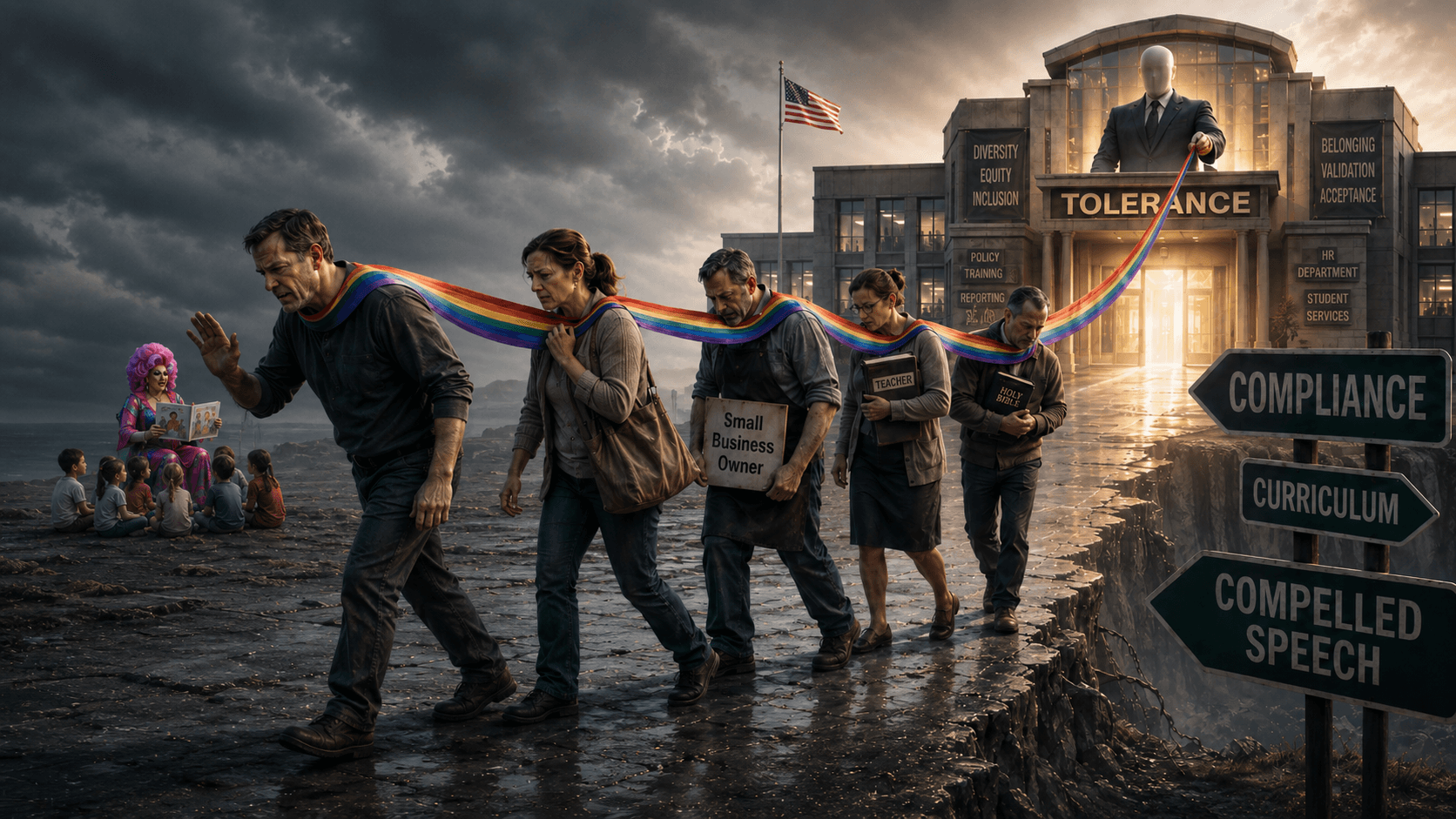
“The issue was never whether gay people could live freely. The issue is whether the rest of society must pretend every claim made in the name of LGBTQ politics is true.”
I grew up right outside San Francisco. That means gay people were never some mysterious abstraction I first discovered through television, talk radio, or a social media feed. I knew gay men and lesbians in the 70s, 80s, and 90s, long before every multinational corporation adopted a rainbow logo and every corporate HR department needed a glossary of approved identities.
They were coworkers, friends, bosses, customers, neighbors, and friends of friends. Some were brilliant. Some were irritating. Some were loyal. Some were selfish. Some were liberal. Some were conservative. Most were ordinary human beings trying to get through life like everyone else.
That is why the modern cultural conversation is so dishonest.
We are constantly ordered to treat ordinary gay people, gay politics, queer theory, transgender ideology, Pride Month marketing, drag activism, school curriculum, corporate DEI, compelled pronouns, and an ever-expanding list of identities as if they are all the same thing.
They are not.
There is a vast difference between two adults living quietly next door and an aggressive political movement demanding that children, schools, doctors, sports leagues, churches, corporations, and language itself be reorganized around sexual and gender identity. A person can treat gay people with basic human decency without surrendering his intellect to the activist machinery that claims to speak for them.
That distinction is the one the public is not supposed to make.
Gay People Are Not Gay Politics
Years ago, after my father was diagnosed with cancer, we moved closer to him. It was a world away from the Bay Area. More conservative. Predominantly white. Heavily Republican. Exactly the kind of place progressive activists routinely describe as a hostile wasteland for a same-sex couple.
One afternoon, I was hanging out with coworkers and a few local business owners who had dropped by our shop. One woman was there with her partner, and during the conversation she mentioned they had also relocated from the Bay Area.
I was surprised. I asked why lesbians would move to a region that seemed so opposite of everything the Bay Area supposedly represented.
She laughed at the premise. They were somewhat liberal, she explained, but also a little conservative. They were not stupid. They owned and operated a veterinary clinic. They cared about taxes, regulation, business costs, government overreach, and whether people would leave them alone to run their business.
Then she said something that stuck with me. Conservatives, outside of the occasional nut, had treated them better. They could live their lives without being hassled. They were not constantly expected to attend a protest, join a movement, chant slogans, or center their entire public existence around their sexuality.
That exchange explains the core of our current cultural divide.
A lot of ordinary gay people wanted tolerance. The activist class demanded conversion.
A normal gay person wants safe streets, low taxes, reliable customers, a thriving business, good neighbors, and a life not interrupted by ideological warfare. A Pride activist wants flags in elementary classrooms, compelled pronouns, drag events for minors, gender theory lessons for children, and corporate loyalty rituals.
Those are not the same person.
Yet the Democrat Party, legacy media, elite universities, corporations, and wealthy activist nonprofits consistently speak as if “gay” automatically translates to left-wing, pro-DEI, pro-trans activism, and anti-conservative politics.
That is false.
There are gay conservatives, gay Republicans, gay libertarians, gay veterans, gay business owners, gay parents, and gay people of faith who are just as exhausted by the cultural circus as everyone else. Some have far more in common with a straight small-business owner in Texas than with a queer studies professor at Berkeley.
The left loves diversity until diversity disagrees.
From Gay Men and Lesbians to Fifty Shades of Gay
The old public categories were relatively straightforward: gay men, lesbians, and bisexuals.
Then came LGBT. Then LGBTQ. Then LGBTQIA+. Now we are flooded with queer, non-binary, pansexual, asexual, demisexual, aromantic, genderfluid, agender, Two-Spirit, intersex, questioning, omnisexual, polysexual, graysexual, and enough hyper-specific subcategories to make a federal tax form look modest.
At some point, a label stopped being a description and became a demand.
Recognize me. Validate me. Teach about me. Fund me. Put me in the curriculum. Give me a flag. Punish anyone who questions me.
This is no longer a man saying he is attracted to men, or a woman saying she is attracted to women. It is a transactional identity economy. A label used to describe an individual. Now it arrives with a glossary, a grievance, a flag, and a compliance officer.
The volume of these labels should make us pause. Stable people do not usually require an endless menu of custom categories to explain their existence to the world. A man who happens to like pink does not need a new sexual identity. A woman who dislikes dresses does not require a gender diagnosis. A teenager feeling awkward in his own skin does not need a permanent, medicalized label before he is old enough to drive.
That used to be called personality.
Now it is treated as revelation.
Tolerance Became Mandatory Celebration
Most decent Americans understand tolerance. Adults should not be harassed, threatened, beaten, or denied basic civic dignity because of their private conduct. You do not have to approve of every choice your neighbor makes to treat him with respect.
That older cultural bargain was simple enough. Live your life. Let others live theirs. Keep adult matters adult. Do not demand that strangers validate your self-concept.
But for the activist class, that bargain was never enough.
Modern Pride politics does not ask to be left alone. It demands to be affirmed, celebrated, subsidized, displayed, institutionalized, and immunized from criticism. It demands that schools, corporations, churches, government agencies, sports leagues, hospitals, children’s libraries, and HR departments serve as missionary arms of a singular cause.
Tolerance says, “Leave me alone.”
Pride politics says, “Join the parade at gunpoint.”
That is where millions of ordinary Americans dug in their heels. Not because they spend their days obsessing over the gay couple down the street. Most people are consumed by bills, jobs, kids, aging parents, health problems, and the ordinary grind of life. They started objecting because the movement refused to stay private. It refused to even stay adult.
The rainbow flag shifted from “we exist” to “your institution will submit.” Pride Month transformed from a parade into a loyalty test. Pronouns moved from common courtesy to compelled speech. Gender ideology mutated from fringe academic theory into binding school-board policy. Anyone who noticed the shift was branded a bigot.
That is not tolerance.
That is moral coercion with a rainbow sticker slapped on it.
From Adult Tolerance to Child Formation
A movement that merely wanted adults to be left alone would not be so focused on children.
That is the plain truth polite society is terrified to say out loud. Drag Story Hour is not an adult privacy issue. Pride displays in elementary-school hallways are not adult privacy issues. Gender identity curriculum for minors is not an adult privacy issue. These are child-facing cultural formation projects.
Drag Story Hour describes itself as drag artists reading books in libraries, schools, bookstores, and other venues, celebrating imagination, self-expression, and the fluidity of gender “at every age.” That is not my hostile interpretation. That is the sales pitch.
Supporters hide this under the banner of “inclusion,” a word doing an immense amount of work. Inclusion sounds harmless. Who wants to be against kindness? But the real question is not whether children should be taught to avoid cruelty. Of course they should. The real question is whether children should be deliberately immersed in adult sexual and gender ideologies before they are old enough to understand what is being normalized.
You do not have to explicitly tell a child to “be gay” for this architecture to work. You simply teach him that queer is brave, straight is boring, Pride is kindness, disagreement is hate, gender is self-declared, and every new identity deserves applause. By the time adolescence arrives, the menu has already been set.
This is not how a movement behaves when it wants tolerance. This is how a movement behaves when it seeks cultural reproduction.
That distinction is crucial because homosexuality does not reproduce itself biologically. The ideology must reproduce itself culturally. This does not mean every individual gay person is trying to recruit children. It means the powerful institutions built around LGBTQ politics have every financial, political, and ideological incentive to normalize, glamorize, and institutionalize these identities as early as possible.
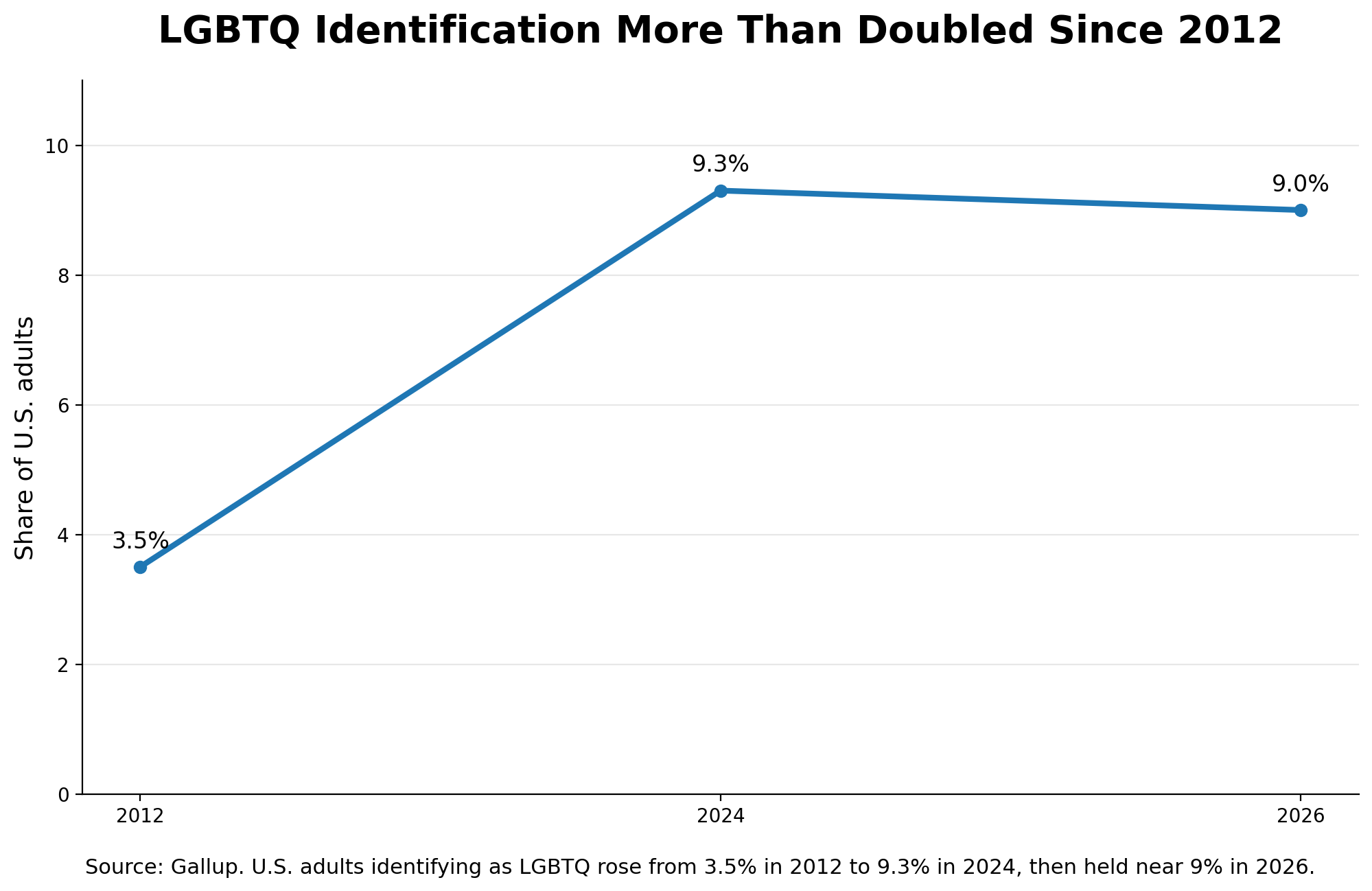
The generational data are hard to wave away. Gallup reported in February 2026 that 9 percent of U.S. adults identify as LGBTQ, more than double the share from a decade earlier. Gallup’s 2025 update found LGBTQ identification at 9.3 percent in 2024, up from 3.5 percent in 2012, with younger generations driving the rise. Biology does not move that fast across a population. Culture can.
Activists will say young people are simply more honest today. Maybe that explains part of the curve. But it cannot be the only permitted explanation. When schools, media, Hollywood, online algorithms, corporate campaigns, and peer groups all teach that queer identity is brave, fashionable, protected, and morally elevated, it is delusional to pretend none of that influences impressionable minds.
Children are not neutral observers of adult culture. They absorb and replicate what adult institutions reward.
The Civilizational Fact Nobody Wants to Face
Underneath the slogans, marketing campaigns, and HR seminars lies a biological reality that no amount of rainbow branding can erase.
Heterosexuality is the reproductive norm of the human species.
This does not mean every straight person is morally obligated to have children. Many cannot. Many choose not to. Some become monks, nuns, career obsessives, or single adults with no interest in parenthood. Society does not require every individual to reproduce.
But society as a whole does require reproduction.
Any sexual or social pattern that cannot reproduce the next generation cannot be elevated as a civilization-wide norm.
This is the foundational point critics try to dodge. They say, “Well, if everyone were celibate, humanity would end too.” Exactly. Celibacy exists as a viable exception only because non-celibates have children. Voluntary childlessness exists as an exception because other people do the heavy lifting of parenthood. Homosexuality exists as an exception because heterosexuality produces the next generation.
The question is not whether exceptions should be tolerated. They always exist. The question is whether society is still allowed to recognize the reproductive norm upon which all exceptions depend.
A sane society can tolerate exceptions without pretending they are foundations. Acknowledging this fact does not make gay people bad. Gay people can be decent, brilliant, hardworking, funny, loyal, generous, and deeply loved. But the claim that homosexuality is biologically equivalent to heterosexuality is false.
Heterosexuality is not just one lifestyle choice among many on a consumer menu. It is the arrangement by which human beings keep showing up on the planet.
The Data Are Not as Cheerful as the Slogans
The official narrative insists that LGBTQ identity is a perfectly normal variation of human nature and that every negative outcome is driven almost entirely by external bigotry.
That narrative may comfort activists, but the empirical data tell a darker and more complicated story.
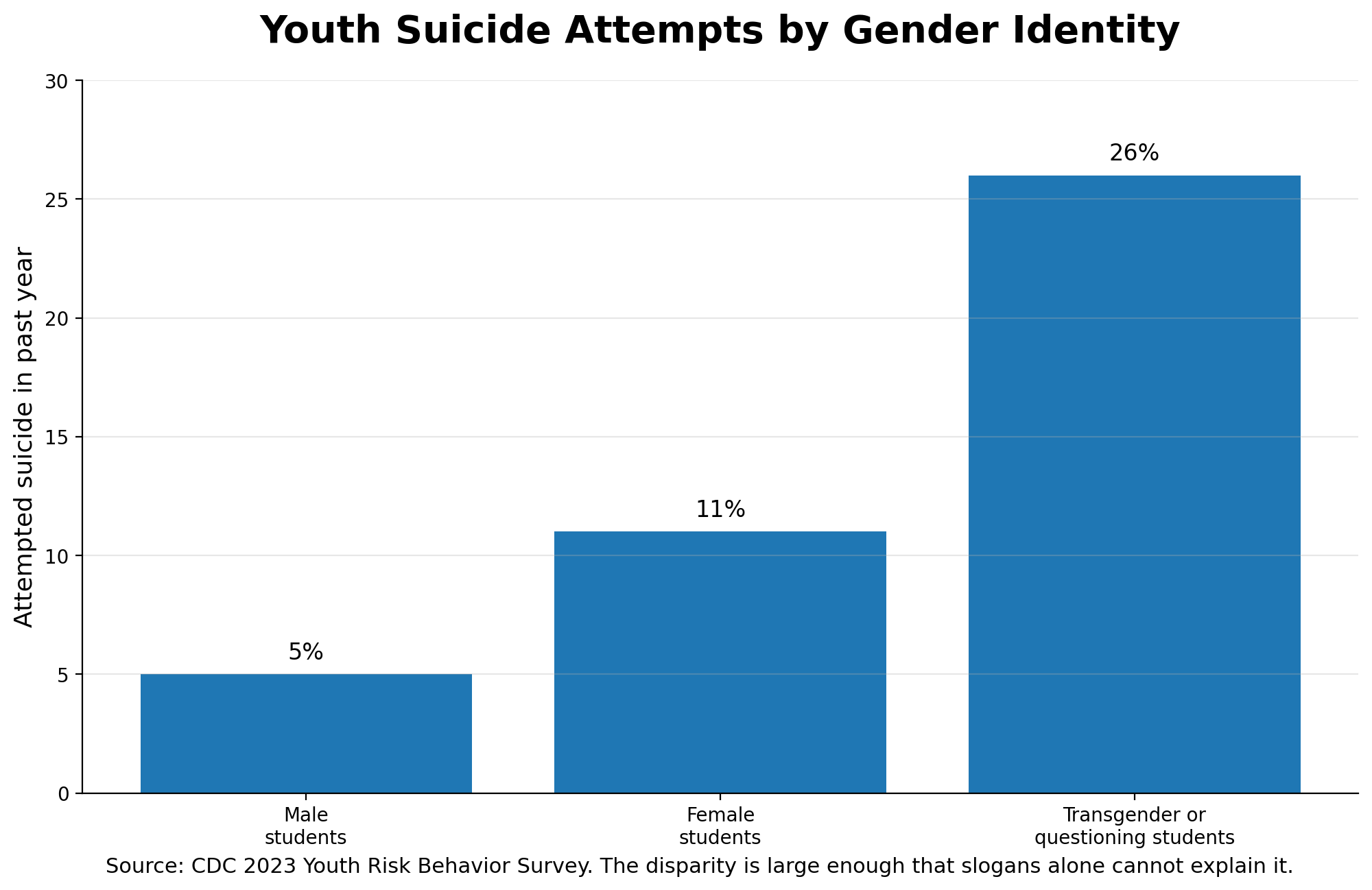
LGBTQ youth show sharply elevated rates of depression, poor mental health, suicidal ideation, and suicide attempts. The CDC’s 2023 youth data reported that approximately 26 percent of transgender and questioning students attempted suicide within a single twelve-month period, compared with approximately 5 percent of cisgender male students and 11 percent of cisgender female students. That is not a small gap. That is a warning siren.
There are also elevated rates of intimate partner violence and sexual violence reported in several lesbian, gay, and bisexual populations. The CDC’s sexual-orientation report from the National Intimate Partner and Sexual Violence Survey found lifetime rape, physical violence, or stalking by an intimate partner reported by 43.8 percent of lesbian women, 61.1 percent of bisexual women, and 35 percent of heterosexual women. Among men, the corresponding figure was 26 percent for gay men, 37.3 percent for bisexual men, and 29 percent for heterosexual men.
Those numbers require careful handling. For example, a significant portion of violence reported by bisexual women involves male perpetrators. Serious people should not misuse the data. But serious people should also not pretend the broader pattern is imaginary.
The “perfectly healthy except for societal bigotry” thesis is inadequate.
Stigma, bullying, family rejection, and discrimination can cause real harm. No honest person should deny that. But serious people must be allowed to ask whether every mental-health disparity can be blamed on outside prejudice.
What about underlying childhood trauma? What about unstable identity formation? What about high-risk sexual networks? What about substance abuse? What about family breakdown? What about online communities that convert teenage awkwardness into a permanent identity crisis? What about peer groups where being straight is framed as boring and adopting a queer label yields immediate social status?
If the data show severe distress, the answer cannot always be to blame everyone else while treating the identity system itself as sacred. That is the question the modern movement forbids people from asking.
They Count Identity Only When It Helps the Narrative
There is a blatant institutional double standard around data collection that almost nobody wants to expose. Institutions obsessively track sexuality when it advances the narrative of victimhood, but often stop counting when the numbers might threaten the brand.
If a gay man is attacked by a group of teenagers, his sexual orientation will instantly be centered. It becomes a hate-crime statistic, a headline, and a weaponized data point used to argue for more funding, more DEI training, and more institutional protection.
But if a gay man molests children in his neighborhood, the public record will usually categorize him as a male offender. It may note his age, employment, relationship to the victim, or location. His sexual identity often disappears from the data.
That is not neutral. That is selective.
The FBI’s hate-crime reporting infrastructure explicitly tracks bias motivations, including sexual orientation and gender identity. When the goal is documenting victimization, identity is treated as vital government data. Public-health agencies and corporate diversity offices also insist that sexual orientation and gender identity data must be collected because what gets measured gets addressed.
Fine. Then measure it consistently.
If sexual orientation is deeply relevant when a gay person is harmed, why is it automatically deemed irrelevant when a gay person harms someone else? If identity metrics are required for grants, funding, and health-disparity analysis, why are they absent when analyzing public safety? If government requires detailed sexual orientation and gender identity data to understand healthcare outcomes, why does it not demand comparable data to analyze offender patterns in child sexual abuse?
The answer is obvious: some data serve the narrative; other data threaten it.
This does not mean every gay person is a danger to children. That is ridiculous. It means selective data collection produces an engineered, selective truth. It allows powerful institutions to document endless victimhood while burying patterns that might embarrass protected political constituencies.
A serious society would collect the same categories with the same honesty, regardless of whether the results flatter the preferred story. Race, sex, age, nationality, immigration status, institutional role, relationship to the victim, and, where relevant and knowable, sexual orientation should be counted when the data help protect children, not just when the data help activists expand budgets.
“Born This Way” Does Not Settle the Question
Some people are undoubtedly oriented toward the same sex from a very early age.
I have known individuals who were not yet out, not sexually active, and far too young to understand their own impulses, but the reality was obvious. A boy seemed distinctly different early on. A girl broke the traditional mold from childhood. Later in life, they naturally turned out to be gay or lesbian. That cohort exists.
The problem with slogans like “Born This Way” is that they flatten complex human reality into a political shield. The phrase was brilliant politics because it framed homosexuality as fixed, innocent, and entirely beyond moral evaluation. But human sexuality is rarely that simple.
Some individuals possess deep, persistent same-sex attraction from early development. Others are bisexual. Others are sexually fluid, experimental, or shaped by early trauma and premature exposure. Some enter same-sex dynamics through loneliness, ideological rebellion, or intense emotional attachment. Today, many teenagers adopt “queer” as a social badge long before there is much physical reality behind it.
The lie is not that some people are born gay. The lie is the dogmatic assertion that every case fits the same neat biological story.
Even if biology explained every case, it still would not settle the ethical question. Human beings are born with many tendencies. A child may be born with an explosive temper, an impulsive streak, or a natural disposition toward selfishness and aggression. Society does not respond by saying, “Well, that is how he was born, so we must celebrate it.” We teach discipline. We demand restraint. We form the child into an adult capable of mastering his impulses.
“Born this way” might explain the origin of a desire. It does not prove that desire should be acted upon, institutionalized into a civil right, taught to children as normal, or celebrated by every major institution.
This distinction is obvious now, when entire friend groups of middle-school girls suddenly declare themselves queer, non-binary, or trans inside the same classroom or online echo chamber. That does not look like random biological variation. It looks like social contagion, peer pressure, identity fashion, and the desperate adolescent need to belong to something exclusive.
Feminine Men and Masculine Women Do Not Need Diagnoses
One of the strangest ironies of modern gender ideology is that it claims to dismantle stereotypes while enforcing them with medical precision.
If a young boy prefers pink, dresses well, enjoys art, or has a gentle, sensitive temperament, the modern apparatus quickly wonders if he is gay, non-binary, or trapped in the wrong body. If a young girl dislikes dresses, excels at sports, cuts her hair short, and prefers rough play, she is suddenly treated as a potential candidate for gender counseling.
That is not progress. That is rigid, regressive stereotyping backed by medical paperwork.
A man can possess feminine traits and remain entirely a man. A woman can be masculine and remain entirely a woman. A boy can be sensitive, artistic, and emotional without needing a new gender identity. A girl can be blunt, competitive, and mechanical without being told by a school counselor that she was born in the wrong physical vessel.
Older common sense was more tolerant than this new progressive orthodoxy. It allowed people to be unusual men and unconventional women. The modern identity machine takes ordinary human variation, converts it into a psychological crisis, and then sometimes points children toward chemical or surgical interventions.
Instead of expanding the boundaries of what it means to be male or female, it narrows the definitions and offers ideological escape hatches.
That is not liberation. It is institutionalized confusion.
Desire Is Not Destiny
Human beings are collections of desires. Some are mild. Some are overwhelming. Some are bizarre. Some are destructive. Some are legal. Some are criminal. Some are harmless between consenting adults. Some, if acted upon, will wreck a marriage, a family, a body, or a conscience.
That is the baseline of the human condition.
A straight man can experience intense attraction to a woman he has no business sleeping with. A married person can experience the temptation to betray vows. Human beings have kinks, fantasies, and sexual curiosities without assuming they must act on all of them.
Desire does not dissolve moral agency.
Yet modern identity politics treats desire as destiny. “I feel this” becomes “I must act on this.” Then “I must act on this” becomes “you must affirm this.” Finally, “you must affirm this” becomes public policy, school curriculum, censorship, and professional ruin for objectors.
Civilization depends on the opposite lesson: the fact that you want something does not make it wise, and the fact that you feel something deeply does not make it true.
Self-control is not oppression. It is adulthood.
Compelled Participation Is Not Tolerance
The activist movement has redefined tolerance in the marketplace.
There is a massive legal and moral difference between serving a customer and being forced to create a message that violates your conscience. If a gay man walks into a bakery to buy cookies, you sell him the cookies. If a lesbian couple brings a pet to a veterinary clinic, you treat the animal. If a gay customer hires a plumber, you fix the sink. Ordinary commerce is not an endorsement of a lifestyle.
But custom art, weddings, photography, website design, and speech-related services raise an entirely different constitutional question. Should the state have the power to force an individual to create, speak, or participate in an event that violates his deeply held beliefs?
This is where the progressive double standard becomes obvious.
Imagine the outrage if the state tried to force a Muslim caterer to prepare pork for an event. Imagine forcing a Jewish baker to design a cake celebrating an anti-Semitic organization. Imagine forcing a feminist graphic designer to create promotional materials for an industry she finds degrading to women, or a Black artist to design a Confederate-themed wedding invitation.
Many of the same activists who would instantly defend those conscience claims become strangely authoritarian when the objector is Christian and the event is a same-sex wedding.
Then tolerance vanishes. Conscience is rebranded as “discrimination.”
This was never really about whether a gay couple could find a cake or a website designer. In most cases, alternatives were available. This is about forcing the dissenter to bow. The goal is not access to the marketplace. The goal is public submission.
These cases became symbolic because they were never only about baked goods or websites. They were about whether the new sexual orthodoxy could force old religious convictions to kneel in the public square.
Pride as Overcompensation
If a cultural position is truly secure, why does it require constant, aggressive public reinforcement?
Pride flags on government buildings. Pride Month stretching across a twelfth of the year. Pride merchandise in every major retailer. Pride lessons in elementary schools. Pride crosswalks. Pride-themed sports nights. Mandatory Pride HR training. Pride children’s books. Pride pronoun rituals.
Some of this is genuine celebration. Some of it is community. But a large portion of it looks like overcompensation.
Confidence does not require a compliance department.
The more genuinely secure an individual is, the less he requires total strangers to validate his self-worth. The loudest parts of modern Pride culture look less like self-acceptance and more like public therapy, political branding, and insecurity weaponized into civic ritual.
There is a world of difference between saying “I am not ashamed” and demanding that every major institution in civilization celebrate your private conduct.
Relationship Patterns Are Not Identical
Another thing the public is not supposed to notice is that same-sex relationships do not always mirror male-female relationships.
Census data have shown that same-sex married couples are less likely than opposite-sex married couples to be close in age. In 2023, the Census Bureau reported that 35 percent of adults in opposite-sex marriages had spouses less than two years apart, compared with 24 percent of adults in same-sex marriages. Census also reported that 5 percent of same-sex spouses had age gaps of 20 years or more, compared with 1 percent of opposite-sex spouses.
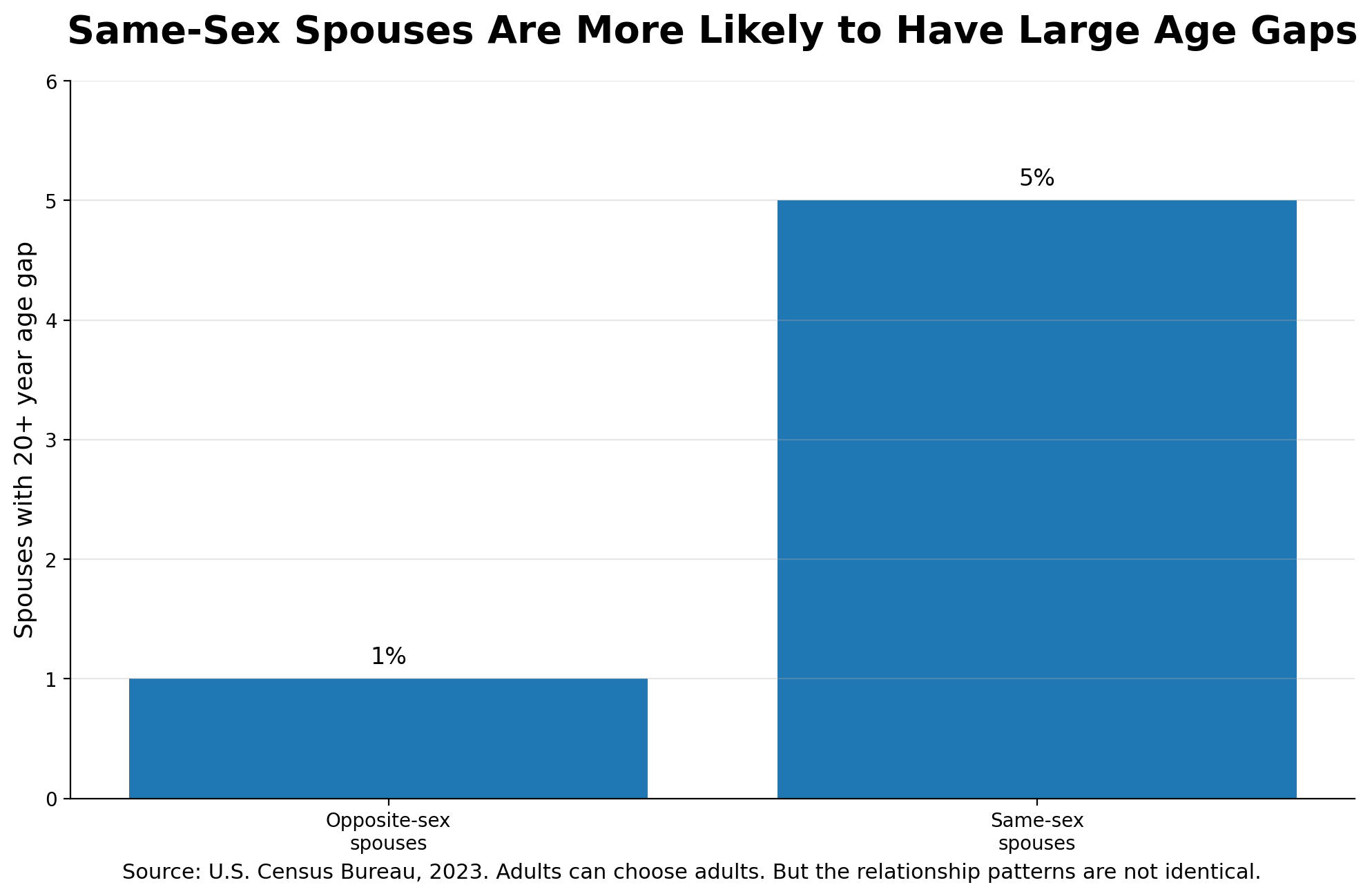
That does not prove anything sinister by itself. Adults can choose adults. A twenty-five-year-old and a fifty-year-old are both adults, even if the age gap raises eyebrows.
But it does undercut the claim that these relationships are simply identical to male-female relationships with different pronouns. They often differ in reproduction, age patterns, family structure, sexual networks, dating markets, and social norms.
Calling two things equal does not make them identical.
Legal equality and biological sameness are not the same concept. Two things can be treated decently under law without being identical in nature, function, or social effect.
The Protected Contradictions
The modern movement survives by shifting definitions whenever its old arguments become inconvenient.
It insists sexuality is private, then demands massive public celebration. It claims gender stereotypes are oppressive, then treats those same stereotypes as evidence that a child may be transgender. It proclaims people are immutable and “born this way,” then celebrates sexual fluidity and identity shifting. It insists children are not involved, then pushes sexual and gender materials into schools, libraries, and youth programs.
It argues that identity is deeply personal, then demands every public institution add custom labels to official forms. It chants “love is love,” then treats intellectual skepticism as hatred. It wraps itself in the language of inclusion and kindness, then coordinates the professional and social destruction of those who refuse the script.
This is no longer merely a civil-rights movement. It is a dogmatic faith system with flags, rituals, taboos, saints, heretics, and corporate sponsors.
The Democrat Party Found a Voting Bloc
The Democrat Party did not engineer every part of this cultural shift, but it learned how to use it.
Identity politics is efficient because it converts personal characteristics into political dependency. Once the population is sorted into aggrieved factions, the party can position itself as the only shield against oppression. Blacks, Hispanics, women, immigrants, gay people, trans people, students, and activists are all compressed into a single narrative: you are permanently unsafe, your neighbors hate you, and only the Democrat Party stands between you and subjugation.
It is a powerful machine.
But gay conservatives break the gears.
A gay Republican exposes the fraud. A lesbian small-business owner who wants lower taxes and fewer regulations dismantles the narrative. A gay veteran who cares more about national security and secure borders than Pride Month corporate sponsorships shatters the framework.
Those individuals are treated with cruelty by the left because they are politically inconvenient. They expose the truth: the progressive establishment does not want genuine diversity. It wants demographic variety inside ideological conformity.
Different faces. Same politics.
The ultimate sin is not being gay, Black, Hispanic, or female. The ultimate sin is refusing to be useful to the machine.
Tolerance Without the Lie
A sane society is not forced to choose between brutal persecution and intellectual surrender.
It can protect gay people from abuse, harassment, and ordinary civic mistreatment without pretending every claim made in the name of LGBTQ politics is true. It can leave adults alone in their private lives without handing children over to activists, therapists, teachers, and online communities eager to turn confusion into identity. It can recognize that a man with gentle traits is still a man, and a masculine girl is still a girl. It can defend free speech and religious conscience without pretending that every refusal to celebrate a same-sex wedding is hatred.
The old bargain was simple: leave adults alone and do not make the rest of society lie. The new bargain is different: affirm the identity, teach the ideology, fund the bureaucracy, punish the dissenter, and call the whole thing kindness.
That is not tolerance.
It is surrender wearing a smile.
The modern LGBTQ apparatus wants the public to believe there are only two paths available: absolute affirmation or unadulterated hatred. That is a manipulative binary lie. There is a third path, and it is the only one a sane country can survive: tolerance without surrender, decency without delusion, kindness without compelled speech, privacy without propaganda, and protection from cruelty without pretending that every claim is true.
Not persecution. Not pretending.
Sanity.
Help Keep This Work Independent
The easiest thing in America is to pretend not to notice.
Pretend tolerance still means tolerance. Pretend “leave us alone” did not become “celebrate us, fund us, teach us, affirm us, and punish anyone who refuses.” Pretend children are not being pulled into adult ideological fights under the banner of kindness, inclusion, and self-expression.
That is how bad ideas survive. People see the shift, but learn to speak around it. They know something is wrong, but they are trained to call it complicated, sensitive, hateful, or dangerous to say out loud.
This work exists for the people who are done pretending.
Become a Paid Subscriber
Your support keeps this work free for people who need to read it, helps these essays reach readers outside the approved channels, and gives plain truths the distribution they need before the respectable voices bury them.
Subscribe here:
https://mrchr.is/help
Make a One-Time Gift
If you do not want another subscription but still want to help, a one-time gift gives me more room to research, write, source, publish, and keep building this platform without asking permission from the institutions I criticize.
Make a one-time gift here:
https://mrchr.is/give
Join The Resistance Core
The Resistance Core helps fund the longer investigations, data-heavy essays, charts, videos, and source work that do not survive inside polite institutional spaces.
Join here:
https://mrchr.is/resist
Venmo
Venmo is also available if you prefer a direct one-time option without starting a subscription or using the gift page.
Venmo here:
https://account.venmo.com/u/mrchrisarnell
If You Cannot Give
Read it. Share it. Restack it. Send it to the person who knows this is true but has never seen it said this plainly.
Another brilliant post, Mr. Arnell! Thank you.
Two thoughts came to mind as I was reading this:
1. “That used to be called personality´- this is the crux of the matter, Mr. Arnell! Once again, you’ve nailed it on the head. It appears that they are attempting to deliberately replace our distinct and diverse (in the true sense of the word!) personalities with their contrived personas. Here’s why they are doing this, in my opinion: a human being with a personality has opinions and is inherently free to act to uphold his or her convictions. A label behaves as dictated by those who labeled him or her.
2. “Pride Month transformed from a parade into a loyalty test” - I grew up in the Soviet Union where we too used to have parades, and loyalty tests is exactly what they were. Attendance was mandatory, and our schoolteachers were required to keep track and report who was there and who skipped. So we showed up, carried the government-issued banners and laughed about it all at the afterparties. The laughter became louder and louder, and the whole system eventually crumbled under its weight. Laughing at their absurdity is the first step back to freedom!
As the loving father of an adult trans daughter, I, all too well, relate to your writing. The whole LGBT movement has moved far beyond its original asking. We all obliged in the beginning. No more. I truly love my daughter. I will not go along with the movement that encircles her now. Write on.