


They didn’t just tolerate dysfunction. They monetized it.
Every society tells itself stories about its heroes. For America, one of those heroes used to be the self‑made man, the figure who built his life on discipline, self‑reliance, and good sense. That image once fit much of Black America like a glove. The generation that survived segregation held tight to work, education, church, and personal honor. They were not rich, but their bearing was serious. If you had told a Black father in 1955 that his grandchildren would one day treat vulgarity as authenticity and chaos as politics, he would have thought you were mocking him.
By “ghetto,” I mean the branding of dysfunction as authenticity. Today, turn on a city‑council feed from Detroit, Chicago, or Baltimore, and what you often see from Black Democrat politicians is unfiltered emotional theater: outbursts, name‑calling, moral certainty unbacked by results, and a deep allergy to accountability. Corruption scandals arrive so regularly that they barely register as news. This isn’t because Black people are uniquely dishonest; it’s because the system of incentives that surrounds them rewards theater instead of competence.
In every field there are laws of behavior. In economics, we know that when you subsidize something, you get more of it. That law doesn’t stop working when you change the subject from money to manners. When a political culture subsidizes grievance and punishes composure, you get angrier politicians and fewer problem‑solvers. The same rule that explains a grocery subsidy explains the behavior of half the city‑hall podiums in modern urban America.
The habit runs so deep that it’s less a strategy than an identity. Many voters, conditioned by decades of cultural messaging, now equate anger with integrity. The politician who says, “axe me a question,” instead of “ask,” may not be uneducated at all. He’s advertising authenticity. He’s running on cultural capital, the suggestion that he’s “one of us,” not one of those polished people who read books or balance budgets. It’s a political version of street credibility.
That transformation did not happen overnight. It was built over sixty years of policy decisions and cultural reinforcements, beginning with the Great Society’s promise that the federal government could engineer prosperity through compassion. It could not. What it engineered instead was a steady trade, freedom for security, dignity for dependency, and leadership for performance art.
The outcome is visible in the makeup of city governments run by the Democrat Party for half a century. They have every program the imagination of Washington can invent, yet they still produce failing schools, hollowed streets, and families without fathers. The dysfunction is not mysterious. It is the natural harvest of incentives gone wrong.
If voters reward indignation, politicians will supply it. The tragedy is that the public gets no roads, no order, and no schools in return, only the satisfaction of seeing their anger echoed by someone in a suit.
You cannot solve problems that you’re paid not to fix. That is the quiet secret of modern urban politics. Progress would end the need for grievance brokers, and grievance is now a multi‑billion‑dollar industry. Every press conference needs a villain; racism, capitalism, Republicans, sometimes the weather, anything that keeps attention off the simple question Thomas Sowell once posed: “Compared to what?” Compared to the promises they made forty years ago, have these leaders delivered better schools, safer streets, stronger families? The answer is so obvious that it must be ignored.
Behind the emotional spectacle lies the deeper cultural shift: what once embarrassed people is now branded as real. When vulgarity earns admiration, corruption soon follows. Because style, not substance, becomes the test of loyalty. The more outrageous the behavior, the harder it is for outsiders to criticize it without being labeled racist. That shield guarantees the very decay it hides.
The sickness is not racial. It is institutional. If the same incentives were offered to any group, white, Asian, or Hispanic, you would see the same results. But the Black community got there first because it was targeted first, not by malice at the beginning, but by the soft tyranny of lowered standards. Black urban politics became the earliest large-scale laboratory for these incentives. The pattern itself is not confined to race. Political monopoly produces the same decay wherever it settles.
They were told, generation after generation, that toughness and accountability were tools of oppression and that government compassion would finish the climb their grandparents began with sweat. It was a seductive lie, and it still pays dividends to those who repeat it.
The influential economist Milton Friedman used to remind his students that there are no solutions, only trade‑offs. The Black community made one when it traded moral authority for political patronage. The bill came due in broken households and broken schools. What makes the picture painful is that it could have turned out differently. There was a time when Black excellence was measured by dignity. The old language of Booker T. Washington, industry, thrift, temperance, wasn’t outdated; it was the operating system of progress. Abandoning it didn’t free anyone; it only chained them to a new sort of master, the bureaucrat whose mission is to manage dysfunction rather than cure it.
That brings us to the real question: How did dysfunction become authenticity, and how did authenticity become a political credential? It happened because the culture around them made “ghetto” a badge of identity and made “sketchy” profitable. Once that cycle began, every incentive reinforced it: schools that refuse to discipline, media that glamorizes defiance, and a party that profits from permanent grievance. Subsidy is a multiplier. It never stops at the first check.
How the Market for Dysfunction Was Built
History seldom moves in leaps; it drifts. You wake up one morning and find a city where outrage is currency and competence no longer pays. That didn’t start in 2016 or 2020. It began sixty years ago, when Washington decided that poverty could be conquered by compassion funded with someone else’s paycheck.
The Great Society of the 1960s looked noble on paper. Its promise was simple: if you pour enough federal money into poor neighborhoods, crime will fall, families will stabilize, and opportunity will bloom. It was the sort of project that flatters the people funding it. But it ignored the most predictable law of all: people adjust their behavior to their environment. When incentives favor dependency, dependency spreads.
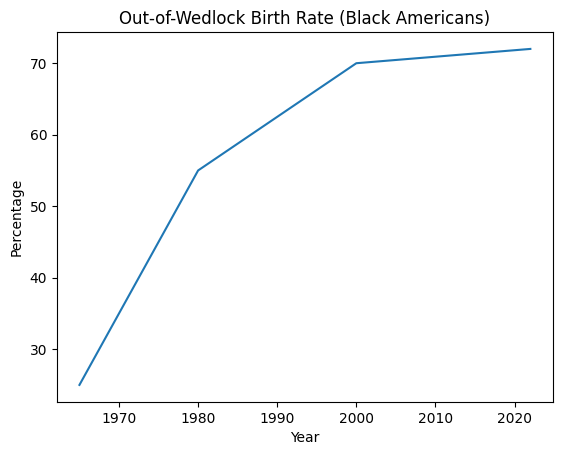
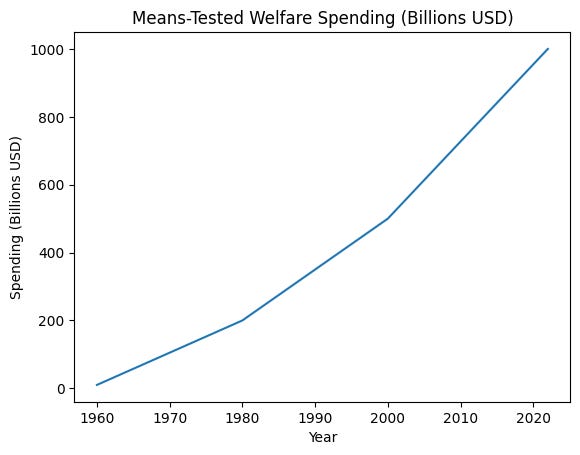
In 1965, about 25 percent of Black children were born out of wedlock. By the year 2000 that figure had risen above 70 percent and today hovers around 72 percent, according to the CDC. The same period saw welfare spending explode from less than $10 billion to over $1 trillion annually across federal and state programs. If the programs were supposed to cure poverty, the outcomes suggest they cured ambition instead.
For politicians, however, those same programs created a pool of reliable voters. If your paycheck, your rent, your grocery card, and your medical bills all depend on a bureaucracy that calls itself compassionate, you’ll be told that voting against it means starvation. Millions obeyed. The Great Society didn’t merely subsidize poverty; it nationalized it under the Democrat Party flag.
Federal grant structures created middlemen whose political survival depended on sustaining dependency. The old white ethnic ward bosses of the early twentieth century were gradually replaced by Black Democrat “community leaders.” They managed federal dollars, organized voter drives, and served as the gatekeepers for access to everything from job‑training programs to public‑housing contracts. Anyone who questioned them was branded as hostile to the poor.
Every federal grant became both a handout and a gag order. Once Washington pays your bills, it owns your vocabulary. Bureaucratic phrases like “underserved community,” “equity initiative,” and “environmental justice zone” replaced the old moral language of responsibility. Teachers who once drilled phonics and discipline were asked instead to celebrate “self-esteem.” Students learned to feel good, not to read well. The result can be measured today: proficiency rates in many urban districts often fall below 20 percent in reading and math after spending over $15,000 per student per year.
Corruption followed as night follows day. When money is distributed by political discretion instead of earned in a market, it becomes an instrument of favoritism. In city after city, we began to see the same pattern: federal aid, rising budgets, shrinking quality of life. The decline of Detroit is the textbook example. In 1960, Detroit was the richest large city in America; by 1990 it was a ward of the state. The population fell from 1.6 million to barely 600,000, yet government payrolls kept expanding. Spending went up as productivity went down, because effort and results were no longer linked. Detroit’s decline involved many forces: industrial contraction, population flight, and global competition, but political monopoly ensured that no internal correction ever came.
The Democrat Party discovered that poverty politics produced not just votes but emotional loyalty. When communities were hurting, the candidate who promised empathy could outperform the one who delivered competence. There was no real competition because local Republican organizations had long since vanished. The result was political monopoly, the classic condition for decay. Without competition, bad service becomes normal. When no one can push you out of office, you can ignore the outcomes that would disgrace you anywhere else.
By the late 1970s, another powerful force joined this equation: culture. The soundtrack of American life began to glorify defiance. Movies and music rewired values faster than any law could have done. When rap emerged in the 1980s, it reflected real hardship at first. But commercial success rewarded the ugliest elements: hostility to authority, sexual aggression, and conspicuous consumption. The industry soon made those traits fashionable. Within a decade, phrases that once embarrassed parents became the everyday language of politics itself. It’s difficult to teach a generation respect for law when its idols brag about breaking it.
By the 1990s the linkage of ghetto aesthetics with political power was complete. Street slang in a city‑hall speech wasn’t a slip; it was a strategy. The politician who spoke “like the people” was trusted more than the one who spoke standard English. That inversion of values, taking what was once a barrier to success and turning it into a credential, was revolutionary and disastrous. From there, performance mattered more than policy. Mayors and representatives learned to play to cameras, not constituents. The scandals that followed were almost a side effect: embezzlement, graft, misuse of funds. The deeper decay was a governing class trained to view responsibility as optional.
The universities reinforced all of this by rewriting history. Instead of teaching cause and effect, they taught narratives of oppression. Every failure had to be traced to some external villain, usually capitalism or racism. Students who internalized that lesson graduated into politics believing that moral indictment substitutes for governance. By the 2000s, identity activism and academic sloganeering had fused completely with Democrat urban machines. The outcome is visible today: officials who treat public office as a stage for social commentary rather than management.
None of this was inevitable. In 1980, while the Great Society framework was collapsing, economist Thomas Sowell addressed the first national gathering of Black conservatives. He separated hope from wishful thinking. Sowell reminded his audience that facts matter more than intentions. “There is growing factual evidence of counterproductive results from noble intentions,” he said. Many of the approaches designed to help poor Blacks, he argued, were already producing dependency, joblessness, and crime. Sowell’s warning wasn’t ideological; it was empirical. But it was ignored because emotion, not evidence, had become the main political currency in Democrat‑run cities.
Around the same time, Star Parker, then a welfare mother herself, was learning experimentally what Sowell had diagnosed intellectually. The system didn’t lift people out of poverty; it tranquilized them into it. After leaving welfare, she founded the Center for Urban Renewal and Education to show that personal accountability, work, and faith could succeed where bureaucracies had failed. Parker’s testimony isn’t theoretical; she lived both sides of the equation. In her words, “Government programs destroyed my family and my community. Responsibility rebuilt them.”
By the 1990s, Washington’s social engineers had quietly accepted that their first experiment had failed, but rather than dismantle it, they expanded it under new names: “community reinvestment,” “inclusion grants,” “empowerment zones.” Each new label created new bureaucracies and new opportunities for local politicians to distribute money. And each required a public spokesman who could keep federal dollars flowing by keeping racial tension alive. That mechanism is still with us in 2026. The vocabulary has changed, “equity audits,” “environmental justice funding,” but the principle is identical. Dependence is marketed as progress.
The marketplace for dysfunction now runs on three engines: policy‑created dependency, cultural glorification of the underclass, and political monopoly. Remove those incentives, and behavior would normalize within a decade. Leave them in place, and you can predict the next scandal as reliably as tomorrow’s sunrise.
Every society gets the leadership it demands. Cities that reward grievance will continue to produce grievance peddlers. The only mystery left is why, after half a century of the same outcome, voters still believe that more money and more outrage will do what self‑discipline once accomplished with no subsidies at all.
Culture as Excuse and Currency
Culture tells people what is admirable and what is shameful. When shame disappears, corruption moves in to fill the emptiness. A civilization can survive policy errors. What it cannot survive is the loss of self‑respect.
In the middle of the twentieth century, Black Americans were known for dignity. They were poor but rarely crude. They built strong churches, tight families, and schools that demanded excellence even when the textbooks were hand‑me‑downs. The Harlem Renaissance, jazz, literature, and the early days of Motown were built on pride in refinement. The heroes were teachers, ministers, soldiers, and business owners who carried themselves as if the future depended on their manners. In many ways, it did.
When that dignity was replaced with a performance of defiance, a whole generation lost its compass. By the 1980s, young people growing up in inner‑city neighborhoods were being told that “keeping it real” was the highest form of integrity. That phrase baptized laziness, vulgarity, and hostility in the name of authenticity. The poison was that it redefined decency as betrayal. Work, patience, and good speech became “acting white.” The rules that once lifted poor people were now scorned as oppression.
Music and media hardened that message. For thousands of young men, rap replaced the father. The first wave of serious rap addressed hardship and injustice. The later waves talked about power, sex, and indulgence. A child could repeat the lyrics of a violent song before he could multiply. By the 1990s, record companies had discovered that outrage sold better than discipline and that rebellion looked good on television. The result was predictable. If the heroes of your culture are criminals, the honest man becomes invisible.
Education was the next casualty. Teachers who tried to impose order were accused of bias. Schools stopped demanding mastery and began demanding feelings. A student who refused to study was not failing, he was “expressing himself.” Failing districts were told that the cure was diversity consultants, not rigorous instruction. Everyone’s self-esteem was protected except the children’s minds. Today, in many large cities, eight out of ten Black students graduate without grade‑level reading or math skills. No industrialized society can survive that level of educational bankruptcy. Yet the same districts celebrate their “graduation equity.” It is a phrase that hides failure behind compassion.
Politics absorbed the same code of conduct. When community meetings look more like shouting matches than planning sessions, it is because officials learned that volume equals credibility. Television clips reward anger. Quiet professionalism, the style of a Tim Scott or a Star Parker, earns no airtime. What the market rewards, it reproduces. A city where the loudest council member steals the headline will soon elect mayors who confuse chaos for courage.
Culture turned pathology into a currency. Anger became the new social capital. A politician could mismanage a budget and still be reelected if he framed his critics as racist. The moral economy inverted itself. In this new exchange, grievance raises your status while responsibility lowers it. The problem is that every society still runs on cause and effect. You cannot repeal math. Cities that glorify emotion will always underperform cities that glorify discipline.
Several thinkers saw this unfolding long before cable news made it fashionable to pretend shock. Thomas Sowell documented decades of data showing that the most successful Black communities were those that resisted cultural decay. If intact families and strict schools produced upward mobility in the 1940s and 1950s, logic suggests they would still do so now. Larry Elder made the same point in his documentary Uncle Tom. He showed how moral courage, entrepreneurship, and religious faith built middle‑class Black America before welfare expansion dismantled it. Star Parker used her own life as a case study. She refused to sell poverty as identity, reminding anyone who would listen that dependence is not compassion, it is slow suffocation. Senator Tim Scott has carried that lesson into national politics. He explains that when you tell children the system will never let them succeed, you have crippled them before the starting gun sounds.
These voices are ignored because they undermine the industry that feeds on despair. The Democrat Party’s worst habit has been to protect failure by moral blackmail. When schools collapse, it blames funding. When crime skyrockets, it blames guns or history. When families disintegrate, it blames slavery two centuries gone. Every failure produces the same demand for more programs run by the same people who failed before. It is political perpetual motion.
Culture turned these excuses into credibility. The politician who wept loudest about injustice was rewarded with a new title or a new grant. The journalist who told the truth about personal responsibility was accused of cruelty. Over time, even ordinary citizens learned the pattern. When confronted with wrongdoing, blame an institution, not yourself. That reflex now defines entire bureaucracies.
There was a time when Americans could say without hesitation that virtue mattered more than background. That belief carried millions of Black families through hard decades and outright hostility. Today, young voters are taught that virtue is a privilege of the powerful. But societies that cancel virtue do not erase hierarchy; they replace self‑made authority with government supervision. The bureaucrat becomes the new patriarch.
The public still senses the wrongness. Polls show that most Americans, including most Black citizens, believe the country is less free to speak honestly than it was a decade ago. They see schools that lower standards, cities that treat criminals as victims, and leaders who profit from chaos. But without cultural confidence, dissent feels dangerous. When every honest criticism risks a public shaming, silence becomes the new conformity.
Culture cannot be legislated, but it can be reclaimed through visible example. People copy what works. If competence, marriage, and thrift become fashionable again, the rest will follow. That was how the earlier post-Reconstruction revival occurred. Freedmen did not wait for a government grant; they pooled money to found hundreds of schools and businesses. Within two generations, they produced scholars and entrepreneurs who disproved the myth of inferiority. They did it without victim studies or diversity training, just old‑fashioned work and moral purpose.
We cannot turn back the clock, but we can withdraw attention from what demeans us. Every dollar spent on entertainment that mocks decency is a vote for self‑destruction. Every choice to elevate calm leadership over theatrics is a vote for recovery. The old formula remains intact: standards first, prosperity later. Deny that logic, and you get slogans instead of success.
That cultural logic is what produced the different temperaments of today’s Black conservatives and their Democrat counterparts. It is not genetics or privilege. It is training. Sowell, Elder, Parker, and Scott were all raised to value cause and effect over feelings. Their lives are proof that rational thinking, not rage, is the real instrument of liberation.
The Political Consequences and a Way Forward
Political systems eventually reflect the moral habits of the people who run them. When those habits decay, no constitution is strong enough to correct them. The corruption and theatrics we see among many Black Democrat politicians are not unique personality flaws. They are the political expression of a culture that rewards grievance over growth and substitutes vocabulary for virtue.
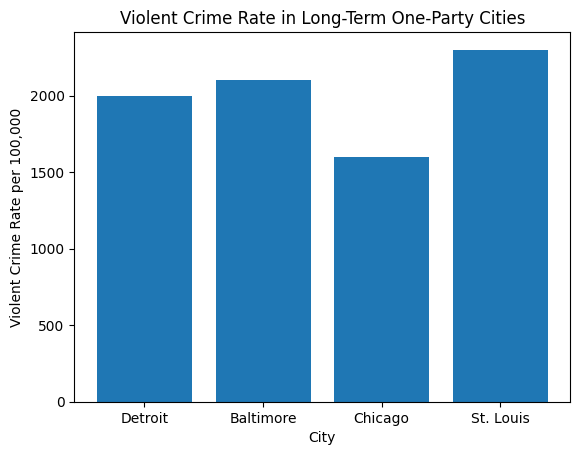
When politics becomes theater, government turns into patronage. Look at the cities long ruled by a single party: Baltimore, Detroit, St. Louis, Chicago, and New Orleans. All share the same pattern. Their populations have fallen sharply, their tax bases have evaporated, and corruption cases read like serial numbers. Yet nearly every election returns the same party and often the same last names. Why? Because each generation of voters inherits the idea that loyalty to the Democrat Party equals racial solidarity.
That false premise has trapped Black Americans in what economist Thomas Sowell called “political monopoly,” a market with one supplier and endless excuses. When there is no competition for the Black vote, accountability vanishes. Every electrical outage, crime wave, or failed school can be blamed on history instead of management. The machine keeps scraping votes from dysfunction while offering no evidence that it can reverse it. Year after year, the nation’s highest murder rates cluster in cities that have been under one-party Democrat rule for decades.
The tragedy is not that people fail to notice but that many have learned to see failure as proof of authenticity. A polished, disciplined leader is accused of “forgetting where he came from.” A loud, unprepared one is praised for “keeping it real.” The political costume has become a badge of identity. It is civic malpractice disguised as culture.
The cost of this loyalty is more than wasted tax dollars. It has diluted the very power Black voters once possessed. As the Democrat Party realized that the Black vote could be taken for granted, it began importing new constituencies under the vague label “people of color.” That phrase sounds inclusive, but it is mathematically subtractive. It groups African Americans with every other demographic grievance, immigrants, gender activists, and a long list of identity movements that share almost none of the same economic interests. The distinct issues of Black Americans, crime, family collapse, and educational breakdown vanish inside a rainbow coalition where no one is wrong, but nothing works.
The results are clear enough. Billions of dollars are now redirected toward immigrant assistance, environmental programs, and “climate equity” projects that rarely hire Black workers or improve their neighborhoods. In Los Angeles, for example, a city that is nearly one‑third Hispanic and less than ten percent Black, new “equity” hiring targets now treat those groups as interchangeable. That policy ensures that the descendants of American slavery, the people meant to be helped first by civil‑rights reforms, are placed near the back of the line. A generation of politicians signed off on this because they were too busy guarding their own status inside the party to notice that their base was being replaced.
Black conservatives warned about this years ago. Larry Elder argued that political independence was the only insurance against extinction by absorption. Once you vote automatically, you become invisible. Senator Tim Scott says the same thing wherever he travels: support must be earned each cycle, not inherited. Star Parker takes it further. Her nonprofit reaches into poor neighborhoods to teach that the first step toward freedom is leaving the government plantation, her phrase, not mine. Whether one agrees with her wording or not, her underlying point is economic truth. Dependency erases dignity, and dignity is the foundation of political power.
Recovering that dignity will require a longer view than one election. No society fixes in a year what took sixty years to erode. The first change has to be mental. People need to stop mistaking style for solidarity. No community thrives when its leaders mimic dysfunction rather than correct it. It needs leaders who can balance a budget, punish corruption, and run a school system that teaches a child to read by age nine. Those tasks require temperament, not theatrics.
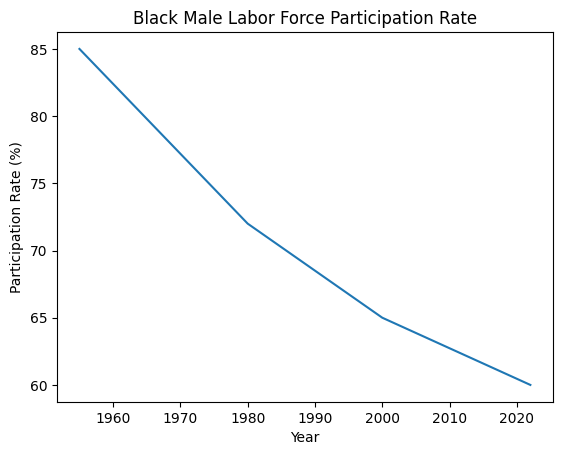
Statistics can tell us how far the goalposts have moved. In the 1950s, Black male labor‑force participation was higher than white male participation. Today it has fallen to barely 60 percent. In the mid-20th century, Black marriage rates were comparable to or higher than those of whites. Today seven out of ten births occur outside marriage. The homicide rate inside predominantly Democrat districts is roughly eight times the national average. None of those numbers were produced by racism alone. They are behavioral indicators of collapsed expectations. The earlier culture of discipline and work protected people from the economic storms of discrimination; abandoning those values left them naked to even mild downturns.
Some critics call this line of reasoning “blaming the victim.” But a person or a city cannot recover by denying agency. Sowell once wrote that the biggest lie of modern politics is that “someone else will be responsible for you.” When people accept that idea, they give away the one thing no system can replace: moral choice. Nothing changes until that ownership returns.
What would change look like in practice? First, families. Marriage matters more than any program. Scholars across the ideological spectrum now agree that children raised by two parents are far less likely to drop out of school, commit crimes, or remain poor. The evidence is not ideological; it is arithmetic. Second, education must once again reward competence, not compliance. Charter schools, homeschooling, and school‑choice vouchers work because they restore the link between effort and outcome. Where families and teachers share that expectation, success appears regardless of race or income.
Third, local businesses must be revived. The foundation of economic independence is ownership. When people create value, they become stakeholders rather than dependents. Star Parker’s organization helps small businesses replace government aid in urban centers. She calls it “entrepreneurial evangelism,” but at bottom it is the same idea that built America: trade skill for reward and responsibility follows.
Finally, the community must learn to expect and demand quiet excellence from its representatives. No community can afford to excuse incompetence as cultural flavor indefinitely. The most progressive act any voter can commit is to fire a politician who fails. If that principle seems harsh, it is because we have been taught to view accountability as cruelty. It is not. Accountability is love in its adult form, the insistence that people can do better because we believe they are capable of better.
None of this will make headlines. Sound judgment rarely does. The incentive systems of media and politics still favor loudness, division, and cheap moral drama. But those are surface winds. Beneath them, more Americans are rediscovering humility, family, and work. They are not attending conferences or tweeting manifestos. They are quietly rebuilding what the experts destroyed. Every time a young father comes home to raise his own child instead of blaming the system, that is political reform in its simplest and purest form.
There is a lesson here that crosses every boundary of race. A nation cannot subsidize strength. It cannot print character. It can only protect the freedom of people who already possess it. The task ahead is moral as much as political: to remember that the qualities that built success are older and stronger than any grievance that can destroy it. The road back for Black America, and for the cities that depend on its success, begins the same way it always has, with individuals deciding that self‑respect is not negotiable.
We have tried slogans, subsidies, and scapegoats. We have tried pretending that noise equals power. The only thing we have not tried in half a century is the simplest ingredient of progress: responsibility. That, not resentment, is what turns citizens into leaders. When the Black community reclaims that moral ground, the ghetto style of politics will fade without a fight, because once people refuse to buy corruption and excuses, the market for it disappears.
Help Fund the Pushback
If you believe culture shapes outcomes, then you understand the stakes.
The incentive systems described above did not build themselves. They are funded, protected, and amplified every day by institutions with billions behind them. Universities. Media conglomerates. Political machines. Foundations. Activist networks.
They do not lack resources.
Independent voices do.
If arguments like this disappear, they will not be replaced with better ones. They will be replaced with silence. And silence is how decay becomes normal.
If you want more data, more history, and more arguments that refuse to bow to fashion, become a paid subscriber:
Become a Paid Subscriber:
https://mrchr.is/help
If you prefer a one-time contribution to support the work:
Make a One-Time Gift:
https://mrchr.is/give
If you want to strengthen this platform at the highest level:
Join The Resistance Core:
https://mrchr.is/resist
The same rule applies to writing as it does to welfare: what you subsidize, you multiply.
If you want more courage and less cowardice in public life, fund it.
Christopher Arnell is a white guy who listens to black voices and takes seriously their insights. For this he deserves our support.
Hard to debate your thesis Chris. Excellent work. I’m a bit skeptical that the democrats feel inclined to change their tactics. There’s always a new victim class to pander to and leave destitute while they skim the programs they promote