


Most people think Substack is simple. You write something worth reading, people find it, and if the work has value, it spreads.
That is not how the platform works.
This post is not a complaint. It is an explanation for readers who want to understand why some writers rise, why others vanish, and why independent voices can be erased without anyone ever pressing the word “censor.” I am laying out the mechanics because many people assume every writer begins on equal footing. They do not.
I learned this the hard way.
The Visible Metric Is Paid Subscriptions. The Hidden One Is Velocity.
Substack’s bestseller lists are not based on likes or clicks. They are based almost entirely on the number of new paid subscribers a writer gets. That is the public piece. The private piece is the speed at which they arrive.
If a newsletter gets two hundred new paid subscribers in three or four days, the system reacts. That writer shoots up the Rising or Bestseller lists. The position acts as a spotlight. People browsing the category see the name. The brand grows.
If a writer gets two hundred paid subscribers over three or four months, the system treats it as a whisper. No spotlight. No visibility. The work may be strong, but the velocity does not register.
This is why the large, institutional liberal voices dominate.
They begin with tens of thousands of imported emails from their television audience, their political campaign, or their former corporate job. Their list is not built from scratch like mine. It is moved from somewhere else. A 10% open rate on an imported list of 50,000 is still 5,000 readers a day. That alone pushes a post into Substack Notes, which in turn generates more visibility and even more readers.
A writer like me begins with zero. To reach 5,000 views, I would need half my subscriber base to open a post in the same 24 hours. That is not how normal audiences behave. Open rates across the entire platform average between 20 and 35%. Mine hover around 50%. That is considered really strong, but it is not enough to compete with a manufactured audience that starts at scale.
The platform does not adjust for this. It does not scale discovery by proportion. It scales by raw volume.
Big Accounts Get Boosted Even When Their Audience Barely Shows Up
Here is the simplest way to understand the imbalance.
If I send a post to 2,000 subscribers and 50% open it, that is 1,000 views. That is a remarkable open rate. But it does nothing in the Substack ecosystem.
If a large account with 50,000 imported subscribers gets a 10% open rate, they still get 5,000 views. At that volume the post is pushed automatically into Notes. Notes produces a second wave of views. Those views create a third wave. The platform assumes size equals importance. Small writers cannot compete with those numbers because they are operating on a different scale.
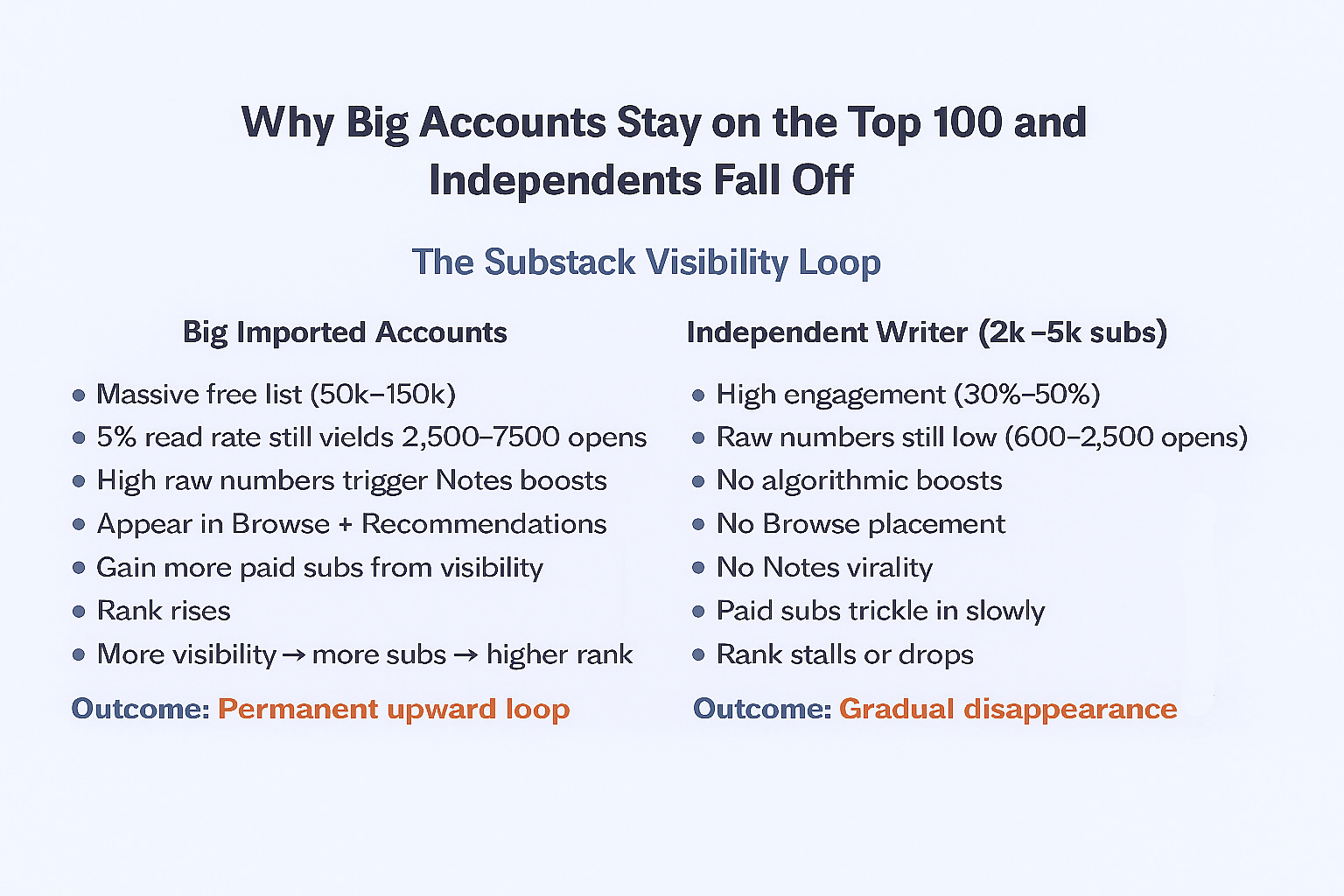
It is not merit-based. It is volume-based.
This is why many of the top names on the political lists are not independent voices at all. They are institutions repackaged as personal newsletters. They have PR teams, assistants, digital strategists, and donor-backed networks behind them. I have none of that. I have the readers who found me because someone they trusted recommended the work.
That difference matters.
Why I Broke Into the Top 100 Before and Why I Am Off the List Now
Earlier this year, a surge of paid subscriptions lifted me into the Top 100 Rising in U.S. Politics. For a moment, I reached #32. I even hit the General Bestseller list at #20. It happened because enough people subscribed quickly enough to trigger the spotlight.
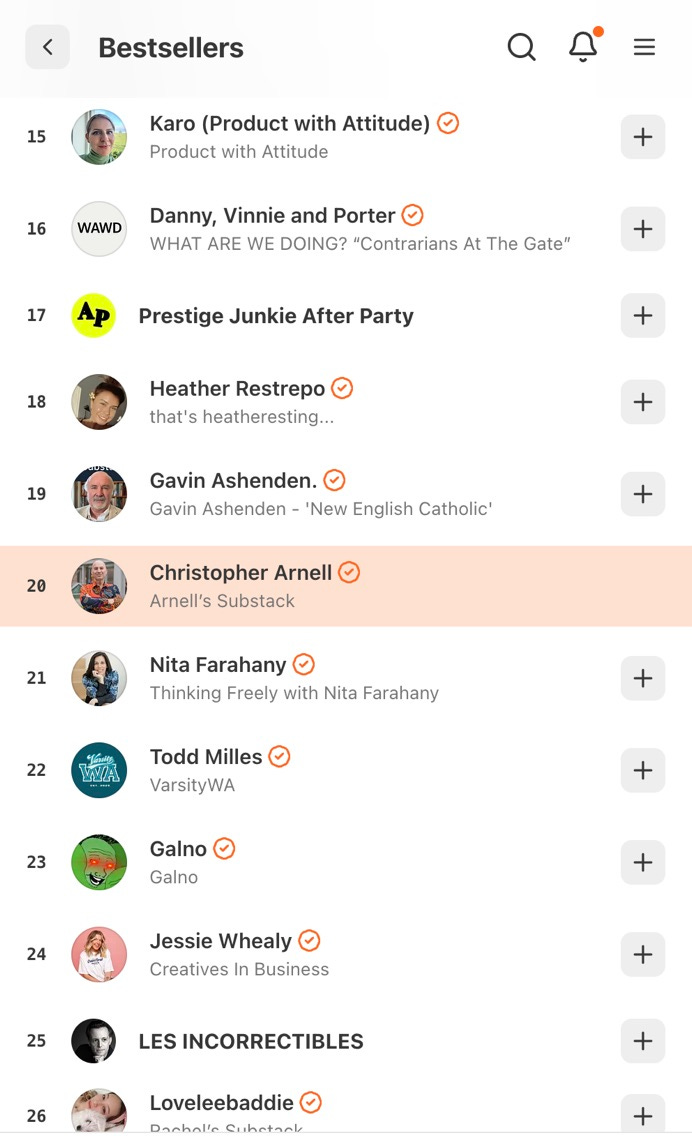
The work did not change afterward. The audience did not disappear. What changed was the velocity.
Large accounts get constant inflows of paid subscribers. It may only be one percent of their massive list, but on a list of fifty thousand, that is still five hundred paying readers in a short window. Enough to keep their names pinned to the top. Enough to crowd out the writers who are actually building something organic.
Velocity turned me visible.
The loss of velocity made me vanish.
Nothing about the ideas changed. Only the math did.
Why This Matters
If I fall off the lists, my work becomes harder to find. It has nothing to do with quality. It has nothing to do with whether people value the writing. It has everything to do with how many people become paid subscribers in a short period of time.
This newsletter is not my hobby. It is my job. It pays the rent and puts food in the house. It also gives me the time to research, analyze, and write work that does not follow the news cycle and is not shaped by donors, institutions, or political machines.
Every chart I have created. Every long-form investigation. Every cultural analysis. All of it exists because readers believed it should.
If you have been thinking about becoming a paid subscriber, this is the moment when it has real impact. Not only for me, but for the work itself. Paid subscribers are the only counterweight to the institutional voices that dominate the lists. They are the only reason an independent writer remains visible at all.
If You Want to Help
Here are the ways that matter most:
Become a Paid Subscriber:
https://mrchr.is/help
Join The Resistance Core (Founding Member):
https://mrchr.is/resist
Give a Gift Subscription:
https://mrchrisarnell.com/gift
One-Time Support:
https://mrchr.is/give
Whether it is eight dollars a month, a founding membership, or a gift subscription to someone who needs these truths in their inbox, it all matters. It keeps this voice alive on a platform that is quietly shifting toward institutional dominance.
Thank you to those who have already stepped up. You are the reason this newsletter has reached as many people as it has. You are the reason the work exists at all.
And to everyone reading this for free, thank you as well. Even considering a paid subscription means you value independent writing enough to protect it. That alone makes a difference.
—Chris
I am a paid subscriber and I wish you the best of luck with this uphill battle. I have forwarded your posts to others and I hope many like-minded folks will do the same. I appreciate your perspective and your work. I hope you can continue to survive against the odds. Your voice is needed in the littered landscape of "corporate/authorized" sponsored narratives.