

The most effective media trick is not the lie you believe. It is the question you never knew to ask.
Most Americans do not know who George Soros is.
That is not because he is irrelevant.
It is because the media, which can turn a county sheriff, a school board parent, or a teenage meme account into a national emergency by lunchtime, has somehow never found the time to explain one of the most influential political billionaires in the world.
The old pledge was about allegiance to a nation under God.
The new pledge is different:
They pledge allegiance to the Soros,
and to the machine that he funds,
one nation without God,
invisible,
with injustice for all.
Ask the average American who George Soros is, and the answer will usually be vague. Some will say he is a billionaire. Some will say he is a donor. Some will say he is the man conservatives talk about. Many will not know even that much. They will not know what Open Society Foundations is. They will not know how much money has moved through it. They will not know what kinds of causes it funds. They will not know how his money has touched criminal justice reform, prosecutor races, immigration advocacy, voting rights groups, journalism projects, legal organizations, activist networks, and the broad “democracy” industry.
Now ask that same person about Donald Trump. Suddenly there is an opinion. Ask about Elon Musk, January 6, Christian nationalism, the Koch brothers, Clarence Thomas, or whatever new villain the media installed in the public imagination last week, and there will be an answer. It may not be informed. It may not be coherent. It may be little more than slogans and fragments. But there will be an answer, because the public knows the names it has been trained to know.
That is the point. The public knows who it has been taught to hate. It does not know who it has been taught to ignore.
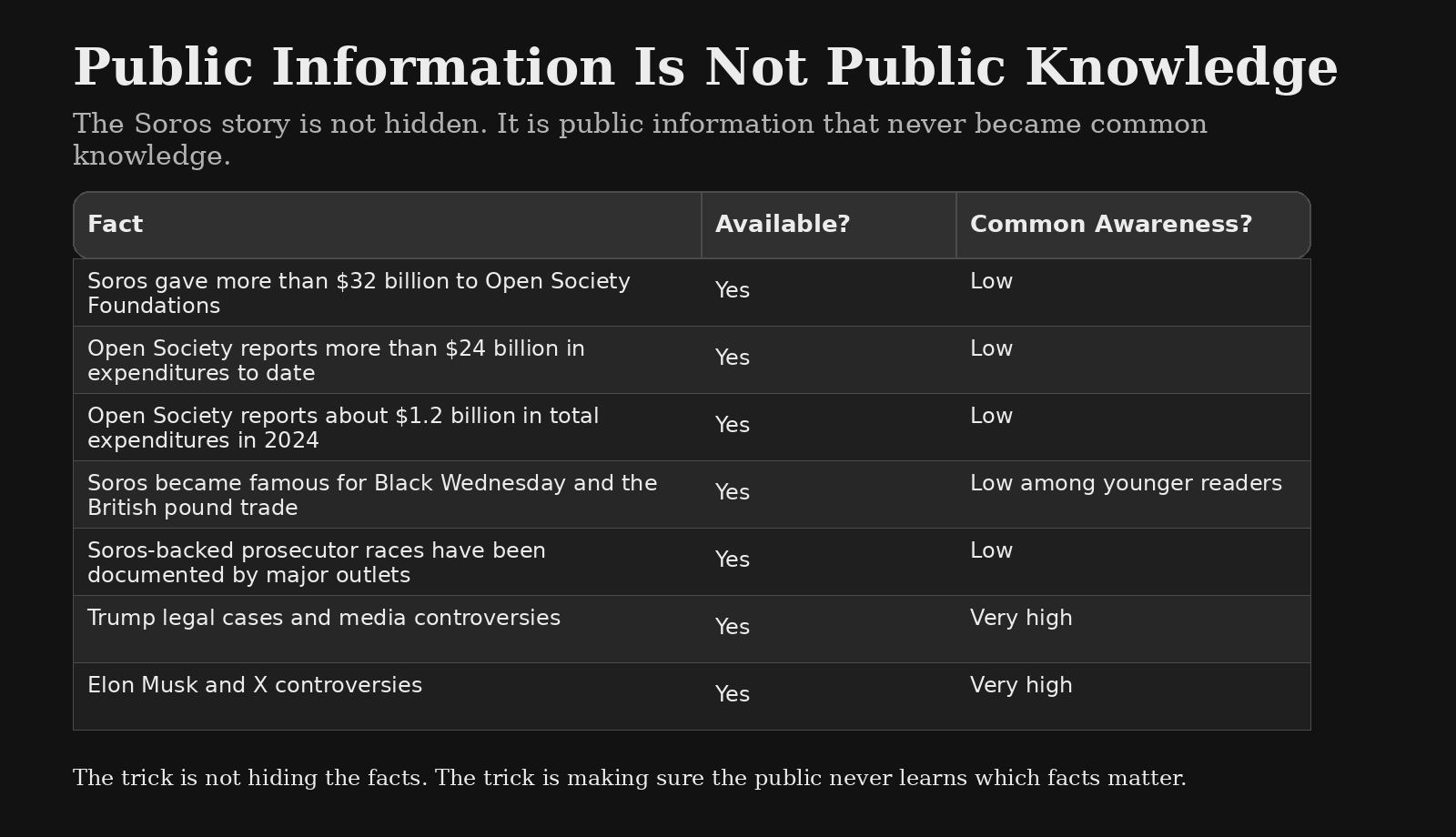
George Soros is not hidden. Much of what he funds is public. Open Society Foundations openly describes Soros as its founder and says he has given more than $32 billion of his personal fortune to the foundations since 1984. The organization describes its work in the language of freedom of expression, transparency, accountable government, justice, equality, and human rights. Its financial page reports more than $24 billion in expenditures to date and $1.2 billion in total expenditures for 2024.
That is not secrecy. It is something more effective than secrecy. It is public information that never becomes public knowledge. The same press that can teach the country the name of a random police officer, school board parent, local sheriff, or anonymous internet account by lunchtime somehow never found the time to make one of the most influential progressive billionaires in the world a household name.
That is not an accident.
The Man Who Broke the Bank of England
Before George Soros became the invisible patron saint of progressive civil society, he was famous for something much less charitable. He was known as the man who broke the Bank of England.
That phrase comes from Britain’s 1992 Black Wednesday crisis. Britain was trying to keep the pound inside the European Exchange Rate Mechanism. Soros and his Quantum Fund bet heavily against the pound, believing the currency was overvalued and that Britain could not keep defending it. Britain eventually withdrew from the ERM, the pound fell, and Soros reportedly made about $1 billion from the trade.
It would be foolish to say Soros alone caused the crisis. Currencies do not collapse because one man has a clever idea before breakfast. There were economic pressures. There were policy failures. There were other speculators. Britain’s position in the ERM had become difficult to maintain. Still, Soros became the symbol of the event for a reason. He made a fortune from a national currency crisis and walked away with one of the most famous titles in modern finance.
That matters because it tells us something important. Soros was not some obscure retired philanthropist who accidentally became a conservative talking point. He was internationally famous before his name became foggy to the average American. His public mythology was built partly on making a fortune while a major country suffered a humiliating financial defeat.
A man famous enough to “break the Bank of England” did not become unknown because he stopped mattering. He became unknown because remembering him became politically inconvenient.
Financial Colonialism, Unless the Country Is Britain
The Bank of England story also reveals something about the left’s selective morality.
Imagine the same story with a different victim. Imagine a billionaire speculator helping destabilize the currency of a poor African country, a Caribbean country, or a Latin American country. Imagine the same kind of financial triumph, except this time the country could be placed inside the left’s favorite vocabulary of oppression, exploitation, colonial history, and global inequality.
Does anyone seriously believe the media would treat that as a charming Wall Street legend?
They would call it financial colonialism. They would call it predatory capitalism. They would call it billionaire exploitation. They would call it Western greed. They would put pensioners, workers, and angry local politicians on camera. There would be documentaries. There would be panel discussions. There would be public radio segments about the human cost of speculation. The man who profited would be turned into a symbol of capitalist cruelty.
But because the victim was Britain, the story became almost clever. A brilliant investor made a bold trade. The Bank of England got embarrassed. Britain lost. The billionaire won. The left shrugged.
This is not about feeling sorry for Britain. Britain is a wealthy country with an imperial history of its own. Nobody needs to pretend the British government was a helpless child in 1992. The point is simpler. The left’s outrage is selective. Economic disruption becomes immoral when the victims are politically useful. When they are not useful, the same behavior can be filed away as genius.
If George Soros had done to a Black or Hispanic country what he famously did to Britain’s currency, he would not be remembered by the media as a philanthropist who later turned to democracy work. He would be remembered as a financial predator who proved that unrestrained capitalism destroys vulnerable nations.
The facts would be similar. The moral vocabulary would be entirely different.
If Soros Were a Republican, You Would Know His Name
Now imagine George Soros were a Republican.
Keep the same biography. A billionaire speculator. A man famous for betting against a national currency. A donor who poured tens of billions into a global foundation network. A political actor whose money touched prosecutors, legal groups, activist organizations, journalism projects, immigration advocacy, criminal justice reform, voting rights campaigns, and international democracy institutions.
If that man funded the right, his name would be everywhere.
CNN would have specials. MS NOW, formerly MSNBC, would run panels. The New York Times would publish interactive diagrams. NPR would have a series explaining how one billionaire shaped American institutions. The Washington Post would treat the whole structure as a threat to democratic self-government. There would be charts, databases, timelines, documentaries, and experts explaining how billionaire money moves through organizations that sound independent but share the same ideology.
They would not call it philanthropy. They would call it a shadow network. They would not call it civil society. They would call it capture. They would not call it democracy work. They would call it an attempt to buy democracy.
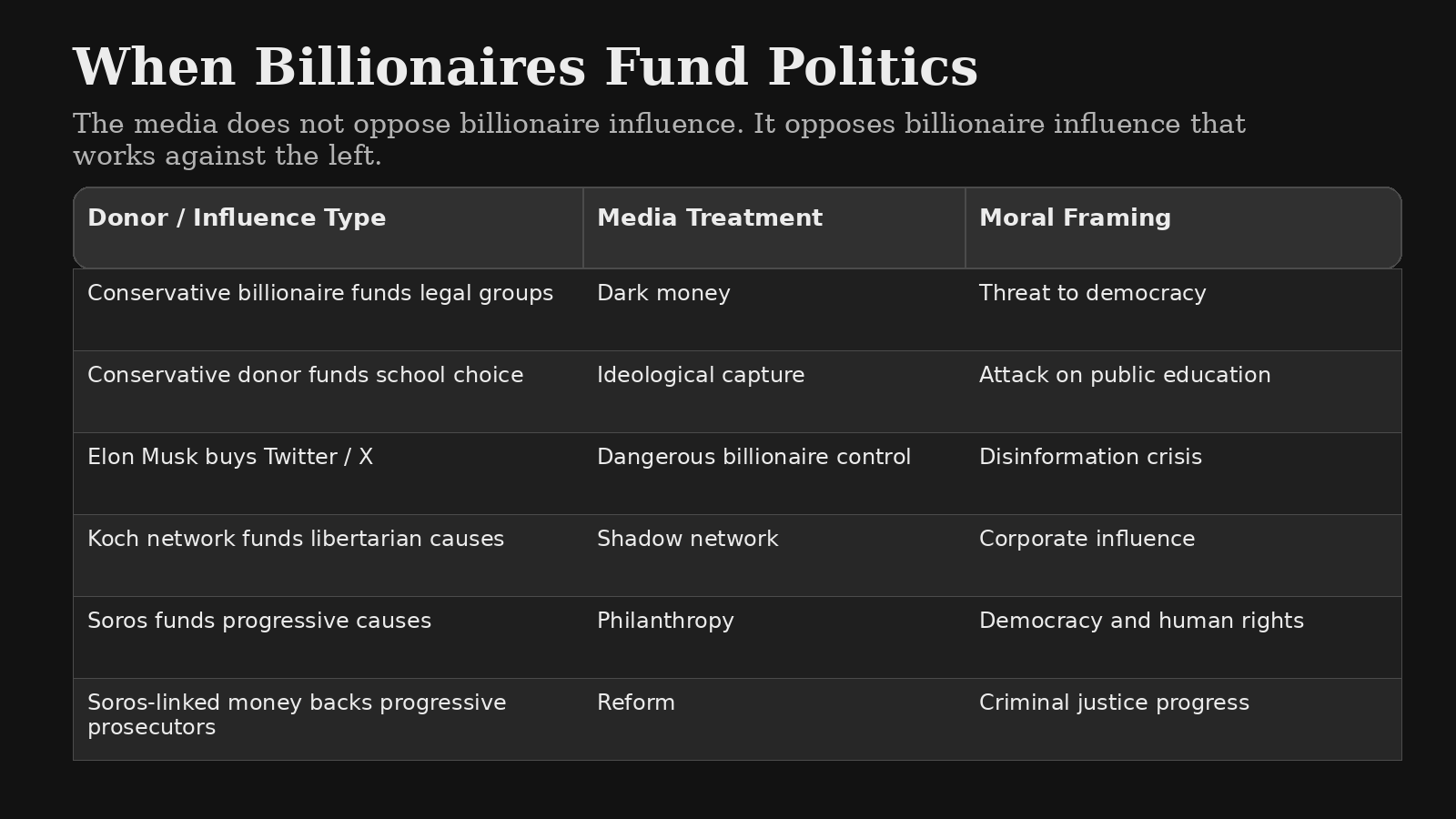
That is the double standard hiding in plain sight. The media does not hate billionaire influence. It hates billionaire influence that works against the left.
When conservative money enters politics, reporters suddenly understand influence. They follow the money. They map the donors. They name the organizations. They use phrases like dark money, capture, extremism, and threat to democracy. But when Soros money moves through progressive institutions, the vocabulary changes. Now it is philanthropy. Now it is human rights. Now it is equity. Now it is reform.
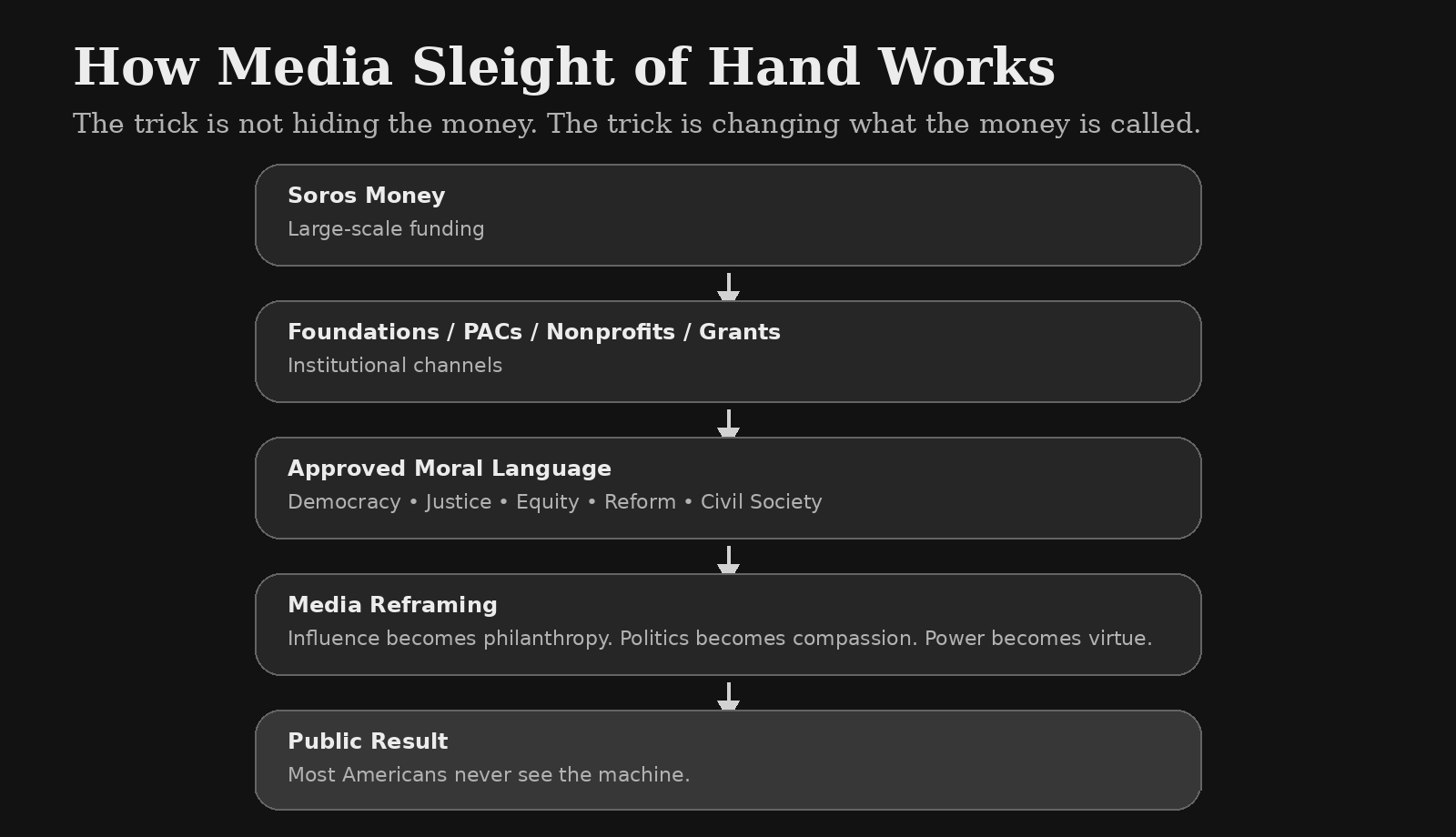
The money did not cease to be political because it was routed through foundations and nonprofits. It merely acquired the vocabulary of virtue.
Omission Is Propaganda Too
Most people think propaganda means telling lies. Sometimes it does. But propaganda also works through omission. It works by giving one story endless repetition and giving another story none. It works by making some names famous and others invisible. It works by teaching people to fear one kind of power while leaving another kind unexplained.
The media does not have to lie about George Soros every day. It only has to make sure most Americans never learn enough to ask serious questions.
This is how omission works. The press can flood the country with a phrase, a villain, or a moral panic until people repeat it without remembering when they first heard it. But somehow Soros remains a foggy name in the background.
Not because the information is unavailable. Because the information is not amplified.
Open Society Foundations says it awards grants and fellowships to organizations and individuals that share its values and that most of its grants are awarded to organizations it approaches directly. That is a normal philanthropic model, but it also means the foundation is not merely responding to the world. It is choosing where to put money, attention, legitimacy, and institutional strength.
Those choices matter. A foundation with billions in lifetime expenditures is not simply “helping.” It is shaping. It is selecting priorities. It is strengthening some institutions and not others. It is making some arguments more likely to be heard and others less likely to survive.
When the right does this, the media calls it influence. When Soros does it, the media often calls it generosity.
That is why omission matters. News does not only shape opinion by what it says. It shapes opinion by what it makes vanish.
Philanthropy Is Politics With Better Lighting
The modern left has learned one of the oldest tricks in public life. Rename power and it becomes respectable.
Call it politics, and people become suspicious. Call it philanthropy, and they relax. Call it influence, and they ask questions. Call it civil society, and they nod as if the issue has been settled. Call it ideological funding, and it sounds troubling. Call it democracy work, and suddenly the same activity sounds noble.
This is why Soros is so useful to the progressive world. His money moves through language that makes politics sound like charity. Equity. Justice. Reform. Human rights. Democracy. Transparency. Inclusion. Accountability. Civil society.
Those words do not merely describe causes. They protect them.
Who wants to oppose justice? Who wants to oppose democracy? Who wants to oppose human rights? The vocabulary creates a moral shield around political activity.
Open Society describes its work as supporting individuals and organizations fighting for freedom of expression, transparency, accountable government, justice, and equality. Its grants page says it supports efforts that can lead to lasting social change. A person may agree with some of those goals. A person may disagree with others. But no serious person should pretend this is neutral activity with no political consequences.
Philanthropy is politics with better lighting.
That does not mean every grant is sinister. It does not mean every organization receiving money is corrupt. It does not mean Soros has no right to spend his money. He does. The question is not legality. The question is why the press applies moral suspicion to one side’s money and moral poetry to the other side’s money.
Money shapes institutions. Institutions shape policy. Policy shapes the country. The media understands that chain perfectly when conservative donors are involved. When Soros is involved, the press suddenly becomes less curious.
The Machine He Funds
The weakest argument is that Soros controls everything. It is also the argument the media wants critics to make, because it is easy to dismiss.
The stronger argument is more limited and more accurate. Soros funds a world.
That world includes criminal justice reform groups, immigration advocacy, voting rights organizations, legal nonprofits, journalism initiatives, global democracy networks, activist infrastructure, and progressive policy institutions. Each grant can be discussed separately. Each organization can be described as independent. Each cause can be wrapped in benevolent language. One group here. One campaign there. One legal project in another city. One prosecutor race. One journalism grant. One activist training pipeline. One “rights” initiative.
A series of isolated grants rarely alarms the public. A visible pattern of grants might. This is why the pattern is seldom presented as a pattern.
The media’s job, when Soros is involved, is not always to deny the facts. Many facts are public. The job is to prevent pattern recognition. Do not show the map. Do not connect the organizations. Do not explain the shared vocabulary. Do not let ordinary people see how philanthropy, activism, media, law, prosecutors, immigration policy, criminal justice reform, and electoral politics can operate as parts of the same ideological ecosystem.
This ecosystem does not require a cartoon puppet master. It requires money, shared assumptions, credentialed managers, friendly media, and a public trained to think criticism of the system is extremism.
George Soros did not need to buy the media. He funded the worldview the media already had.
The Prosecutor Project
The prosecutor issue is where the abstraction becomes real.
Most Americans do not spend much time thinking about district attorney races. That is why those races are attractive to ideological donors. They are local. They are low visibility. They often have low turnout. They can be influenced with far less money than a Senate race or a presidential campaign.
But prosecutors matter. They decide what gets charged and what gets ignored. They shape plea deals, bail policy, sentencing posture, repeat offender treatment, juvenile crime priorities, and the relationship between police and the courts. This is not symbolic power. It is street-level power.
The Washington Post reported in December 2025 that Soros had spent tens of millions backing progressive district attorney candidates through Justice & Public Safety PAC and related efforts. The Post also reported that his chosen candidates had won about 77 percent of the time, while his involvement covered only a small fraction of the roughly 2,400 district attorney races nationwide. In one example, a Soros-funded PAC spent $384,000 in a 2022 district attorney race in Cumberland County, Maine.
That is strategic influence. A billionaire does not have to control every prosecutor in America. He only has to identify races where outside money can matter. A few low-profile elections in major jurisdictions can affect policy for millions of people.
If a conservative billionaire funded prosecutors who promised to crack down on riots, punish repeat offenders, enforce immigration law aggressively, and prosecute left-wing political violence, the media would know what to call it. They would call it authoritarian capture of local justice. They would say billionaires were buying law enforcement. They would warn that voters were being overridden by private money.
But when Soros-linked money helps elect progressive prosecutors who reduce enforcement, oppose cash bail, emphasize rehabilitation, or treat crime as an expression of social injustice, criticism is often treated as hysteria.
Apparently democracy is in danger when voters elect the wrong president, but democracy is just fine when billionaire money helps reshape local prosecutor offices.
The Conspiracy Label Is the Backup Plan
The media’s first defense of Soros is silence. If silence fails, then comes the conspiracy label.
That order matters. First, the subject is made invisible. Then, when someone points at the invisible thing, he is accused of seeing things.
This works because some claims about Soros really are stupid, false, or ugly. There are people who turn every protest, every activist group, every riot, every prosecutor, every nonprofit, and every strange political event into “Soros did it.” Reuters has fact-checked false claims about Soros, including claims that he was a Nazi or that he “owns” Antifa and Black Lives Matter. Those claims are not serious arguments. They are internet superstition.
They should be rejected.
But the existence of bad criticism does not erase legitimate criticism.
This is the media trick. Take the dumbest Facebook meme about Soros and use it to discredit every serious question about his money, foundations, priorities, and influence. If you ask whether Soros money affected prosecutor races, they point to someone claiming he owns Antifa. If you ask about Open Society funding priorities, they point to someone claiming he was a Nazi. If you ask why the media treats left-wing donor networks differently from right-wing donor networks, they point to antisemitic cranks online.
That is not an answer. It is a dodge.
The proper response to false claims is not to stop asking true questions. It is to ask better questions.
The Antisemitism Shield
Antisemitism is real. Some attacks on George Soros are antisemitic. Some use old tropes about Jews secretly controlling banks, governments, revolutions, media, and public events. The Anti-Defamation League has warned that many conspiracy theories about Soros draw on longstanding antisemitic myths about powerful Jews manipulating events from behind the scenes.
There is no need to flirt with that. There is no need to wink at it. There is no need to pretend it does not exist.
But rejecting antisemitism does not require granting George Soros immunity from scrutiny.
Soros is not above criticism because he is Jewish. His foundations are not beyond analysis because antisemites exist. His political influence does not become imaginary because fools and bigots say foolish and bigoted things about him.
This is one of the left’s favorite habits. Criticize DEI and they call you racist. Criticize illegal immigration and they call you xenophobic. Criticize radical gender ideology and they call you hateful. Criticize Soros-funded political influence and they call you antisemitic.
The accusation becomes a fire extinguisher. Its purpose is not to answer the argument. Its purpose is to put out the conversation.
A serious country cannot live this way. Bigotry is real. So is the political habit of using accusations of bigotry to protect power from scrutiny. Both things can be true at the same time.
Why the Media Protects Him
The media does not need to be controlled by Soros in order to protect Soros. That explanation is too crude.
The more interesting truth is that the media protects him because he funds the world the media already believes in.
Look at the overlap. The media class, academic class, nonprofit class, activist class, progressive legal class, and foundation class all speak the same language. Equity. Democracy. Inclusion. Human rights. Public health. Criminal justice reform. Climate justice. Migrant rights. Voting rights. Anti-disinformation. Civil society.
These words are not just policy terms. They are class markers. They tell everyone in the room who is respectable and who is not.
When Soros funds organizations that use this vocabulary, the press does not see a billionaire reshaping politics. It sees a philanthropist supporting the moral universe reporters already inhabit.
That is why the protection feels automatic. No editor needs a secret phone call. No reporter needs an envelope. No producer needs written instructions. The bias is already installed.
A conservative billionaire funding a legal group is a threat. A progressive billionaire funding a legal group is defending rights. A conservative donor funding campus activism is radicalization. A progressive donor funding campus activism is youth engagement. A conservative network fighting election rules is voter suppression. A progressive network fighting election rules is democracy protection.
The machinery is similar. The moral permission slip is different.
This is how institutional hypocrisy usually works. It does not feel like hypocrisy to the people doing it. To them, their side is not political. Their side is decency.
Soros benefits from that delusion.
The Public Knows the Villains It Was Assigned
Most Americans can name the villains they were assigned.
They know Trump is bad because they have heard it ten thousand times. They may not know the policy. They may not know the legal details. They may not know what actually happened in half the stories they repeat. But they know the emotion.
They know Elon Musk is dangerous because free speech became a disinformation crisis once it stopped working only in one direction. They know the Koch brothers were shadowy because the media spent years making libertarian money sound uniquely sinister. They know Clarence Thomas is corrupt because conservative judges must be delegitimized. They know Christian nationalism is scary because ordinary churchgoing Americans are often more frightening to the press than activist billionaires with global foundation networks.
But Soros?
The average American was never given the file.
That ignorance is not random. It is produced. The media cannot make everyone informed, but it can decide what becomes common knowledge. It decides which names are repeated. It decides which billionaires become household villains and which ones remain behind a curtain of polite philanthropic language.
That is real power. Not censorship in the crude sense, but selection, repetition, framing, and omission.
The public can scrutinize only what it can see. If the media never hands people the map, most people will never know there is a map to ask for.
The New Pledge
The pledge at the beginning of this piece is not meant literally. It is meant as a diagnosis.
A country does not have to formally pledge allegiance to a billionaire in order to behave as if certain billionaires are beyond scrutiny. Institutions do not have to admit they are protecting power in order to protect it. Most arrangements in public life are not announced. They are practiced.
That is what makes the Soros story so useful. He is not just a man with money. He is a test case for the media’s honesty.
Does the media actually object to billionaires shaping public life, or does it only object when the billionaire funds the right? Does the left really oppose private money in politics, or only private money that works against its agenda? Do reporters really believe in holding power accountable, or do they quietly exempt power when it speaks the language of justice, equity, reform, and democracy?
A serious press would apply one standard. A serious press would ask the same questions of Soros that it asks of conservative donors. A serious press would not treat one billionaire’s influence as a threat and another billionaire’s influence as moral progress.
But that is not the arrangement we have.
We have a protected donor class, a sympathetic media class, a permanent activist class, and a public trained to hate the approved villains while ignoring the useful ones.
That is why Soros matters as a symbol. He exposes the fraud behind the moral language. He shows that the issue was never billionaire influence itself. The issue was whose side the billionaire was on.
The question answers itself.
What They Would Say If He Funded the Right
Imagine a Republican George Soros funding conservative prosecutors, border enforcement groups, anti-DEI legal organizations, school choice campaigns, election integrity nonprofits, right-wing journalism grants, Christian legal networks, anti-crime PACs, campus conservative groups, and global nationalist movements.
Would the media call him a philanthropist?
No. They would say democracy was being bought. They would say local justice was being captured. They would say billionaires were overriding voters. They would say dark money was poisoning public life. They would say a private fortune was reshaping public policy without democratic consent.
Some of those concerns would be fair.
Private money can distort public life. Billionaires can influence politics. Foundations can become ideological machines. Nonprofits can launder political goals through soft language. Prosecutor races can be changed by outside money. Media projects can be shaped by donors.
None of that becomes false when the donor is on the left.
If billionaire influence is dangerous, then it is dangerous when it funds the Democrat Party’s ecosystem. If money corrupts politics, it corrupts politics even when the checks are written in the language of justice and equality. If democracy can be bought, then it can be bought by people who say “democracy” every third sentence.
The media wants the public to believe the danger is not power itself, but only power used by the wrong side.
That is convenient. It is also dishonest.
The Power of Not Being Seen
Most Americans do not know who George Soros is. That is not because he is powerless. It is not because his funding does not matter. It is not because his influence is imaginary. It is because the people who claim to hold power accountable have decided that some power should remain unnamed.
The media does not need to defend George Soros every day. It does not need to run nightly segments telling viewers not to investigate him. That would be too obvious. It only needs to make sure the public never receives the map.
It only needs to scatter the pieces. It only needs to call left-wing influence philanthropy. It only needs to describe political money as compassion when that money funds progressive causes. It only needs to pretend criticism is conspiracy, scrutiny is bigotry, and progressive power is somehow cleansed of ambition because it arrives in the language of reform.
The question is not whether George Soros has the right to spend his money. He does.
The question is why the media refuses to apply its own rules.
If billionaire influence is dangerous, it is dangerous when it funds the left. If money corrupts democracy, it corrupts democracy even when the checks are written in the language of justice, equity, reform, and human rights. And if the press really believed in speaking truth to power, it would stop pretending power disappears the moment it becomes progressive.
George Soros is not unknown because he is irrelevant.
He is unknown because the media made him that way.
Help Make the Invisible Visible
The people who control the narrative do not need to win every argument.
They only need to make sure certain arguments are never heard.
That is how the machine works. It does not always censor. Sometimes it buries. Sometimes it ignores. Sometimes it smears. Sometimes it waits until someone notices the pattern, then calls that person dangerous for noticing.
This is why independent writing matters.
Not because independent authors are perfect. We are not. Not because every outsider gets everything right. We do not. But because without people outside the approved media class, entire subjects disappear from public view.
George Soros is one example of a larger system.
The press tells you who to hate.
It tells you who to fear.
It tells you who is respectable.
It tells you who is dangerous.
And just as importantly, it tells you who not to notice.
That is what we are fighting.
Become a Paid Subscriber
If this work matters to you, become a paid subscriber.
Paid subscribers are what make it possible to keep digging, keep writing, keep publishing, and keep challenging narratives that corporate media would rather leave untouched.
This platform is not backed by a foundation. It is not protected by billionaire money. It does not have a newsroom, a legal department, or institutional sponsors waiting in the wings.
It has readers.
That is the whole model.
If you want independent writers to keep exposing what the media hides, then independent writers have to be supported by the people who want the truth told.
Become a paid subscriber here:
https://mrchr.is/help
Make a One-Time Gift
A one-time gift also helps keep this work moving.
Every essay takes time. Research takes time. Sourcing takes time. Editing takes time. Creating charts, images, posts, and follow-up pieces takes time.
The media has entire institutions doing this work for the other side. Independent writers have hours, stubbornness, and readers willing to stand behind them.
A one-time gift helps buy time. And time is what makes deeper work possible.
Make a one-time gift here:
https://mrchr.is/give
Join The Resistance Core
The Resistance Core is for readers who understand that this is not casual commentary.
This is narrative warfare.
The media does not simply report reality. It manufactures visibility. It decides which facts become national concerns and which facts get buried under polite silence.
The Resistance Core exists for those who want to help build something stronger than reaction. Something steadier. Something that can keep producing when the pressure gets heavier and the stories get bigger.
If you want to help fund the work at a deeper level, this is where you step in.
Join The Resistance Core here:
https://mrchr.is/resist
What Your Support Builds Right Now
Your support keeps this work independent.
It helps fund long-form essays, research-heavy investigations, charts, graphics, video commentary, and the kind of writing that does not fit inside corporate media’s approved boundaries.
It helps make sure that when the media makes something vanish, someone is still willing to point at the empty space and ask why.
That is not a small thing.
The future belongs to the people who can still see clearly after everyone else has been trained not to look.
If You Cannot Give
If you cannot give right now, share the essay.
Send it to someone who still thinks the media is merely biased instead of structurally dishonest. Post it. Restack it. Quote it. Talk about it. Help put the argument in front of people who were never supposed to see it.
The machine depends on silence.
Break the silence.
A now deceased friend and former partner of Soros (in the late 70’s, early 80’s) told me that Soros had 2 insiders at the Bank of England in his pay. Shortselling currency on theory is very risky, timing makes or breaks the trade. The Pound and all soft currencies were in trouble when Soros put on his billion dollar short. He didn’t just get lucky. The Jewish kid who lived in WW2 Budapest and was never hauled away by Nazis was no stranger to working “inside”. And his European (Channel Islands and Swiss) hedge were probably full of War loot. And certainly had a rogues’ gallery of clients. Anyway, my friend, the the youngest MIT Economics PhD recipient and principal in Nokia, was no fan of the Legendary Soros…and so moved on from his first employment. Just sayin’.
Excellent article exposing, not just George Soros, but the double standards and hypocrisy of the leftist media. Suggest another article on WHY the media and our institutions lean left wing communist.