

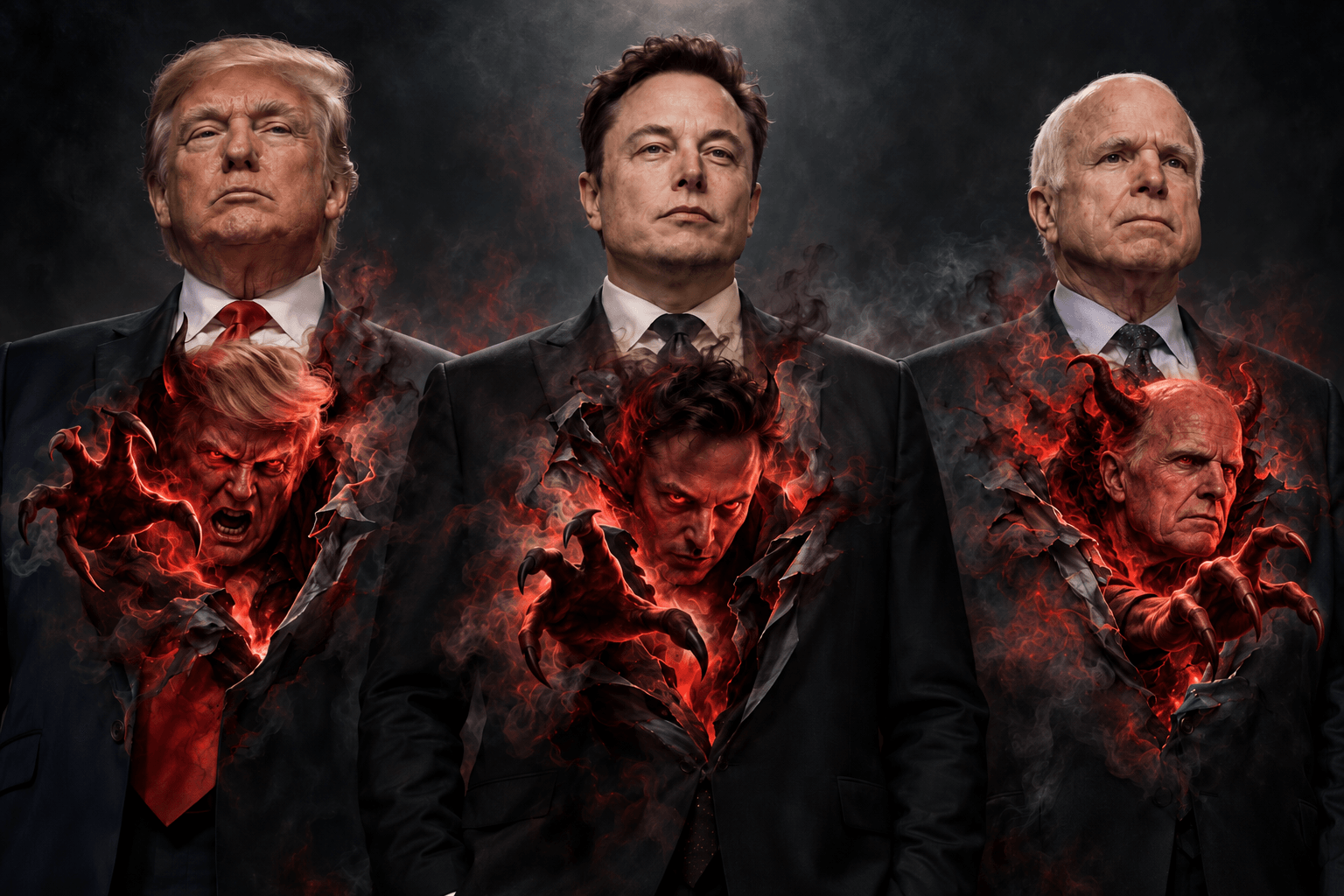
“Funny how a man’s character can change overnight without the man changing nearly as much as the people judging him.”
In October 2012, Barbara Walters looked directly into a television camera and told Donald Trump that she considered him a brilliant businessman, a fascinating personality, and a decent man. She wasn’t promoting his latest television project or interviewing him about another real estate deal. She was criticizing him for demanding that Barack Obama release additional personal records, something she believed was making Trump look foolish.
Walters had known Trump for decades. Even while criticizing his behavior, she wanted viewers to understand that she regarded him as a friend and an accomplished businessman.
Less than three years later, Trump announced his Republican presidential campaign, and the celebrity who had spent decades being welcomed into television studios, political circles, and society events would become one of America’s most controversial political figures.
Elon Musk experienced a reversal of his own. Once celebrated for electric vehicles and technologies associated with environmental progress, he became deeply unpopular among Democrats as his political positions shifted rightward and he took control of Twitter.
John McCain’s experience was almost comical. Political journalists adored him when he challenged fellow Republicans, subjected him to far less flattering coverage during his 2008 presidential campaign, and watched Democrats celebrate him again when he opposed Donald Trump.
The Media Machine
For more than half a century, America’s major news organizations have presented themselves as guardians of truth, impartiality, and democracy. Their history includes some spectacular failures involving Republican presidents and candidates, along with a remarkable ability to correct politically damaging stories after millions of Americans have already heard them.
In February 1968, Walter Cronkite returned from Vietnam and told millions of CBS viewers that the war appeared headed toward a stalemate. The Communist Tet Offensive had suffered enormous military losses, but it had also shattered Washington’s repeated assurances that victory was approaching. Cronkite’s broadcast helped cement the belief that the war could not be won. A television anchorman had become one of the country’s most influential voices on whether America should continue fighting.
The Tet Offensive had failed to achieve its principal military objectives, yet its political consequences provided an unexpected benefit to North Vietnam. American confidence in the war deteriorated despite the enormous losses inflicted on Communist forces. What Hanoi failed to accomplish on the battlefield, it gained politically as public support for the war collapsed. Cronkite’s broadcast became one of the most prominent expressions of that loss of confidence.
Four years later came Watergate and the celebrated partnership of Bob Woodward and Carl Bernstein. The public knew about their mysterious source, Deep Throat, but didn’t learn his identity until 2005. He was Mark Felt, the FBI’s second-ranking official.
Woodward had known Felt since 1970, when he was a Navy officer assigned to the chief of naval operations and occasionally delivered documents to the White House. He already had a personal relationship with a senior FBI official before joining the reporters investigating Watergate.
An FBI executive secretly feeding information to journalists investigating a sitting Republican president deserves more scrutiny than it typically receives in the heroic retellings of Watergate. Nixon’s obstruction of justice was real. So was the role of a powerful government insider whose confidential assistance helped expose it.
In September 2004, CBS’s 60 Minutes broadcast allegations about George W. Bush’s National Guard service, relying on documents the network ultimately couldn’t authenticate. Dan Rather initially defended the reporting before CBS acknowledged its failure and commissioned an independent investigation. The report aired less than two months before a presidential election.
CBS eventually admitted that it should never have used the documents. By then, the allegations had already received national publicity, and the controversy had become part of the election campaign.
During Trump’s presidency, the Russia investigation generated years of accusations, commentary, and speculation about possible coordination between his campaign and Moscow. The Mueller investigation ultimately did not establish that Trump or his campaign criminally conspired with Russia, although it documented Russian election interference and numerous contacts involving campaign associates.
Then there were the anonymous sources. “Officials familiar with the matter.” “People briefed on the investigation.” “Sources who requested anonymity because they weren’t authorized to speak publicly.”
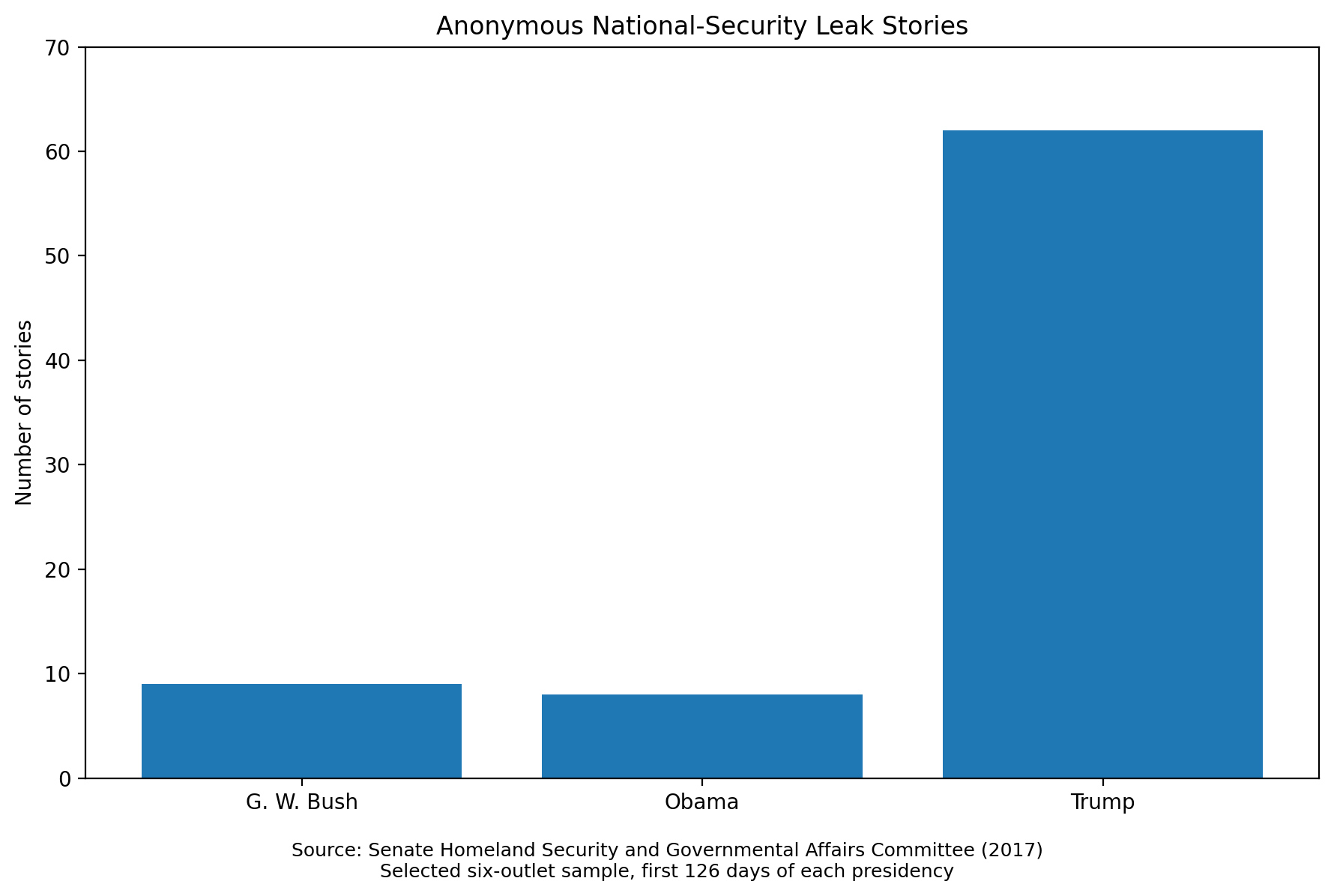
During Trump’s first 126 days in office, Republican staff on the Senate Homeland Security Committee identified 125 news stories based on anonymous leaks involving potentially sensitive national-security information. Using a narrower, consistent sample of six major news outlets, they found 62 such stories under Trump, compared with eight concerning Obama’s administration and nine during George W. Bush’s equivalent opening period.
The Columbia Journalism Review later found that The New York Times alone used the phrase “people familiar with” more than 1,000 times in Trump-Russia stories between October 2016 and the end of his first term.
A thousand uses of a description that tells readers almost nothing about who is talking, what political interests they might have, or whether they’re passing along firsthand knowledge or somebody else’s account.
An anonymous official makes an allegation. A major newspaper publishes it. Television networks repeat it. The accusation becomes national news, while the person feeding the information to reporters remains conveniently invisible.
In December 2017, ABC News correspondent Brian Ross incorrectly reported that Trump had directed Michael Flynn to contact Russian officials during the presidential campaign. The instruction Ross was reporting concerned the presidential transition, after Trump had won. ABC apologized and suspended Ross for four weeks.
A story suggesting campaign coordination with Russia had circulated nationally before the network corrected the timeline.
Then came the 2020 Hunter Biden laptop controversy. During the closing weeks of the election, questions about the material’s authenticity dominated public debate, social-media companies restricted its distribution, and former intelligence officials publicly suggested possible Russian involvement.
In March 2022, The Washington Post reported that forensic experts had authenticated approximately 22,000 emails from a copy of the laptop data. The experts couldn’t verify every file or allegation circulating about the Biden family, but substantial portions of the material were genuine. Information that had been treated with considerable skepticism before the election was receiving forensic confirmation well afterward.
COVID provided another lesson in the dangers of declaring an unsettled question closed.
In February 2020, The Washington Post characterized Senator Tom Cotton’s concerns about a possible Wuhan laboratory origin as a debunked conspiracy theory. In June 2021, the newspaper revised its headline and acknowledged that it had inaccurately characterized his comments because the virus’s origin had not been determined.
In January 2025, the CIA publicly disclosed an assessment favoring a laboratory-related origin, although with low confidence. The FBI had also favored a laboratory origin. Neither assessment settled the scientific debate, but the possibility once dismissed by parts of the press had become a serious subject of intelligence investigation.
The media’s initial coverage of another event, on July 13, 2024, raised a different set of questions.
A gunman opened fire while Donald Trump was speaking at a campaign rally in Butler, Pennsylvania. Trump was wounded, firefighter Corey Comperatore was killed, and two other spectators were seriously injured.
In the first moments, CNN published a headline describing Secret Service agents rushing Trump from the stage after he fell. The Washington Post initially described loud noises of uncertain origin. Those reports appeared during the confusion immediately following the gunfire, before authorities had confirmed the assassination attempt, and the coverage was updated as the facts emerged.
Early reports described a former president falling and hearing loud noises while images emerging from Butler showed him bleeding and surrounded by Secret Service agents. Even allowing for the uncertainty of breaking news, those initial descriptions conveyed remarkably little about the violence unfolding on the stage.
The FBI later confirmed that Trump had been struck by a bullet, whether whole or fragmented, after questions arose about the nature of his injury.
A presidential candidate had narrowly survived an assassination attempt. The contrast between the earliest descriptions and the reality of what happened became another controversy over how major news organizations frame extraordinary events.
Across these episodes, the circumstances and journalistic failures differed. But the stakes were enormous: a war, a presidential resignation, contested elections, federal investigations, a worldwide pandemic, and an attempted political assassination.
Americans were expected to trust the institutions explaining these events, even when those institutions got consequential facts wrong or presented unsettled questions with unwarranted certainty.
A network can apologize. A newspaper can change a headline. An editor can publish a correction. None of those actions guarantees that the millions who encountered the original story will see the revised version.
The accusations make the headlines. The corrections have to catch up.
And the same news organizations that make these judgments about national events also exercise enormous influence over which public figures Americans are encouraged to admire, distrust, or despise.
Donald Trump: Before He Became Public Enemy Number One
Donald Trump didn’t suddenly appear in American life when he descended the Trump Tower escalator in June 2015. He’d been a celebrity for decades, appearing on television, selling books, promoting businesses, and participating in the peculiar American tradition of becoming famous largely for being famous.
He was the outspoken New York billionaire with the enormous ego, extravagant lifestyle, and seemingly bottomless appetite for publicity. His name appeared on buildings, golf courses, television programs, and practically anything else somebody could persuade him to put it on.
In December 1987, Barbara Walters interviewed the 41-year-old businessman for ABC’s 20/20. The conversation included speculation about a possible presidential campaign, and Walters asked whether he’d want the presidency if he could have the job without campaigning.
Four months later, Oprah Winfrey raised the same possibility. During her April 1988 interview, Trump complained about America’s trade relationships, foreign governments benefiting from American markets, and the enormous expense of defending wealthy allies. Oprah asked whether he would ever consider running for president.
Trump said probably not, although he wouldn’t rule it out if he believed the country’s problems had become serious enough.
His complaints about international trade, American military commitments, and wealthy countries taking advantage of the United States would become central themes of his presidential campaigns nearly three decades later. He’d been discussing them publicly since the Reagan administration.
Trump was also a fixture of popular entertainment. In 1994, he appeared on The Fresh Prince of Bel-Air, where the Banks family reacted enthusiastically to his arrival. The scene worked because viewers recognized Trump as a famous billionaire whose appearance was supposed to be exciting.
I remember a Black business acquaintance named Donny who actually went by Donny Trump. I’m serious. I have no idea whether he continued using that name after Trump entered Republican politics, but it illustrates the image Trump had developed among people who admired his wealth and business success.
In January 1999, Trump participated in Jesse Jackson’s Wall Street Project, an initiative intended to increase minority participation in corporate America. Trump provided space at 40 Wall Street for an event associated with the project, and Jackson publicly recognized his involvement.
Trump contributed money to Democrat Party campaigns. Bill and Hillary Clinton attended his 2005 wedding to Melania at Mar-a-Lago, and Bill Clinton later spoke warmly about Trump, recalling how well Trump had treated him and Hillary.
Trump hosted Saturday Night Live in April 2004 and again in November 2015, after announcing his Republican presidential campaign. That second appearance attracted protests over NBC giving him a platform, even as the episode drew a large audience.
In September 2016, Jimmy Fallon invited Trump onto The Tonight Show. During the interview, Fallon asked whether he could mess up Trump’s famous hair. Trump agreed, and Fallon ran his fingers through it while the audience laughed.
Critics accused Fallon of making Trump seem approachable and helping to normalize the Republican nominee. In June 2017, Fallon told Howard Stern that he’d misjudged the audience’s reaction. By the following year, he was still publicly discussing the backlash.
Apparently, messing up Donald Trump’s hair had become a transgression requiring years of explanation.
Stephen Colbert interviewed Trump on The Late Show in September 2015, after Trump had entered the Republican race. Four years later, Anderson Cooper asked whether he’d invite Trump back.
Colbert’s answer was brief: “The quick answer would be no.”
Colbert cited Trump’s conduct as president. By then, the celebrity who had been welcomed onto television for decades had become someone many entertainers wanted nothing to do with.
I’ve joked that if Trump had run for president as a Democrat, they’d probably have carved his face into Mount Rushmore by now. Same ego, same mouth, same gold-plated everything. Just a different letter next to his name.
The remarkable flexibility of “No one is above the law”
On August 8, 2022, FBI agents searched Trump’s Mar-a-Lago residence as part of an investigation involving presidential records and classified documents. Nancy Pelosi emphasized that no person was above the law.
Representative Ilhan Omar expressed similar sentiments following Trump’s March 30, 2023, indictment in New York.
In an official statement, Omar declared: “And no one is above the law.” She urged Americans to support accountability and follow the facts regardless of political affiliation.

Then, on October 12, 2026, federal agents executed a judicially authorized search warrant at Omar’s Washington home as part of a criminal investigation involving allegations concerning immigration records.
Omar described the action as an attempt to target political enemies and weaponize federal law enforcement. Prominent Democrats questioned the search, while her attorneys challenged the investigation and demanded the return of seized property.
Omar denies wrongdoing, and no charges against her had been publicly announced.
In 2023, Omar celebrated Trump’s indictment as evidence that the legal system could hold powerful people accountable. In 2026, confronted with a search of her own home, she accused federal authorities of political intimidation.
The investigations involved different allegations and circumstances. But Omar’s own declaration that Americans should follow the facts regardless of political affiliation makes her response to the search worth examining.
Elon Musk: Saving the Planet Until He Moved Right
For years, Elon Musk represented much of what progressive politicians said America needed: electric vehicles, solar power, advanced battery technology, and reduced dependence on fossil fuels.
Tesla helped transform electric vehicles from expensive curiosities into desirable automobiles. SpaceX developed reusable rockets and changed the economics of commercial spaceflight. Musk became one of the world’s most recognizable entrepreneurs.
He also supported Democrat presidential candidates. Musk has said he voted for Barack Obama and Hillary Clinton.
In 2013, Richard Branson wrote a glowing tribute to Musk for TIME, praising his technological ambitions and pursuit of a cleaner-energy future. In December 2021, TIME named Musk Person of the Year.
California Governor Gavin Newsom was similarly enthusiastic. In October 2021, Newsom described Musk as an extraordinary talent and one of the world’s great innovators and entrepreneurs.
In 2022, Musk announced that he had voted Republican, publicly criticized the Democrat Party, and acquired Twitter. His approach to moderation, reinstatement of suspended accounts, and management of the platform became intensely controversial.
By November 2022, well before his endorsement of Trump, Democratic voters had turned sharply against him.
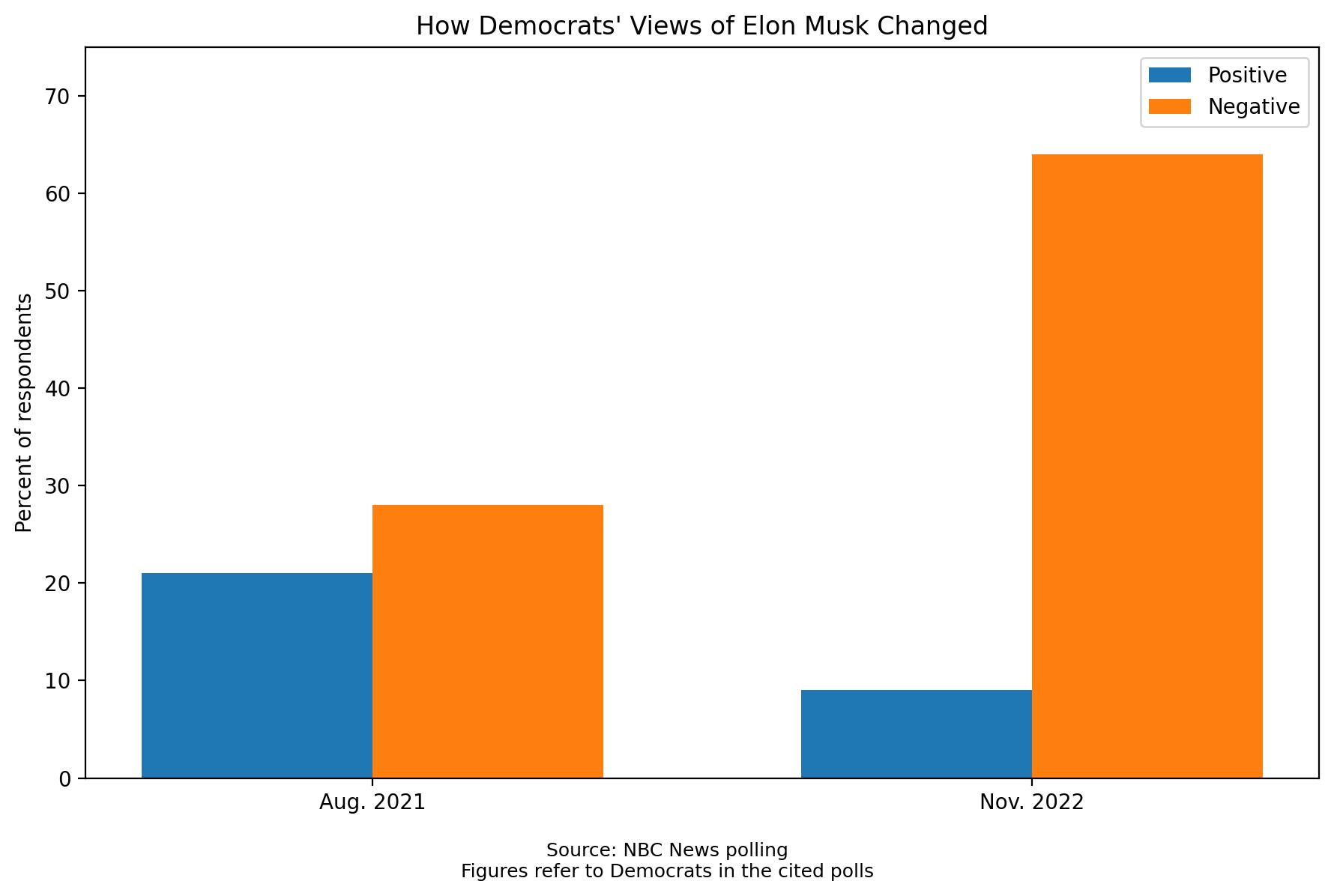
NBC News polling showed that among Democrats, positive feelings toward Musk had fallen to just 9 percent, while negative feelings reached 64 percent. In August 2021, those figures had been 21 percent positive and 28 percent negative.
Musk’s criticism of progressive politics grew louder, as did criticism of Musk. He became increasingly involved in Republican politics and, in July 2024, formally endorsed Trump.
In February 2025, Pew Research Center found that only 12 percent of Democrats and Democrat-leaning independents viewed him favorably, while 85 percent viewed him unfavorably.
And Gavin Newsom, the governor who once called Musk an extraordinary talent?
By March 2026, Newsom was describing him as one of the great disappointments of the era, criticizing Tesla’s business priorities and the growing dominance of Chinese electric-vehicle manufacturers. Newsom continued to acknowledge Musk’s technological abilities but objected to the direction he was taking his businesses.
Tesla was still manufacturing electric vehicles, and SpaceX was still launching rockets. The technological achievements that originally brought Musk so much admiration hadn’t vanished.
But the man once celebrated for advancing cleaner transportation had become one of the most recognizable enemies of the political movement that championed it.
When electric cars become political targets
During 2025, Tesla vehicles, dealerships, storage facilities, and charging stations became targets of (mostly peaceful - lol) criminal attacks across the United States.
On March 21, 2025, the FBI warned about incidents in at least nine states involving arson, gunfire, vandalism, and threatening graffiti. Investigators identified attacks involving firearms and improvised incendiary devices.
At a Tesla facility in Las Vegas, vehicles were damaged by gunfire and fire, and the word Resist was spray-painted on the building. Other incidents involved incendiary devices thrown toward charging equipment, damaged dealerships, and privately owned automobiles.
Federal investigators treated the attacks seriously, and prosecutors pursued criminal charges involving dangerous weapons and incendiary devices.
For years, Americans had been encouraged to embrace electric vehicles as the future of clean transportation. Now criminals were attacking those same vehicles because they despised the political opinions of the man running Tesla.
The owner of a Tesla isn’t necessarily a Trump supporter. A dealership employee isn’t responsible for Musk’s statements. Someone using a charging station may simply be trying to get home.
The FBI noted that perpetrators might regard these attacks as victimless property crimes, which is a peculiar way to think about throwing Molotov cocktails or firing guns around buildings. Fires spread, people get injured, and firefighters risk their lives responding to somebody else’s political tantrum.
Setting fire to an electric vehicle because you hate Elon Musk is a rather strange way to demonstrate your commitment to saving the planet.
John McCain: The Republican the Press Loved, Hated, and Loved Again
I’ve never been much of a John McCain admirer.
McCain spent years cultivating a reputation as the Republican willing to challenge Republicans. He criticized party leaders, collaborated with Democrats, and made himself unusually accessible to national political reporters.
During his 2000 presidential campaign, journalists traveled with him aboard the Straight Talk Express, enjoying informal conversations, personal access, jokes, and lengthy interviews that other candidates frequently restricted.
McCain supplied colorful quotations, compelling personal history, and disagreements with his own party that made excellent stories. Reporters rewarded him with unusually enthusiastic coverage.
On March 5, 2000, the Los Angeles Times published an article titled The McCain-Media Chemistry. It examined the senator’s unusually favorable coverage and the enthusiasm he inspired among national political reporters.
The newspaper recalled a 1996 Esquire profile titled John McCain Walks on Water.
Apparently, the senator had achieved something considerably more impressive than winning a Republican primary. He had convinced journalists that his personal shortcomings were evidence of character.
The Los Angeles Times quoted a Newsweek assessment suggesting that even McCain’s failures added to his character. Political scientist Larry Sabato described the coverage as an extraordinary exercise in political mythmaking.
According to a Center for Media and Public Affairs study, 74 percent of stories about McCain during the week following the 2000 New Hampshire primary were favorable. For George W. Bush, the corresponding figure was 46 percent.
Even some reporters familiar with McCain’s record questioned the enthusiasm. Amy Silverman, who had covered him in Arizona, said local journalists were laughing at the overwhelmingly flattering national portrayal.
Jeff Cohen, founder of the progressive media-watch organization Fairness and Accuracy in Reporting, criticized journalists for turning McCain into a moderate or liberal hero without adequately examining his political record.
Then came 2008.
McCain again pursued the Republican presidential nomination, but this time he won. By then, the reputation he’d cultivated as a political maverick was proving less comfortable.
Pew Research Center examined coverage of McCain’s personal narrative from January 1 through March 9, 2008. It found 57 percent negative and 43 percent positive. Much of the criticism centered on doubts about whether McCain was a dependable conservative.
During the general election against Obama, coverage became even more unfavorable.
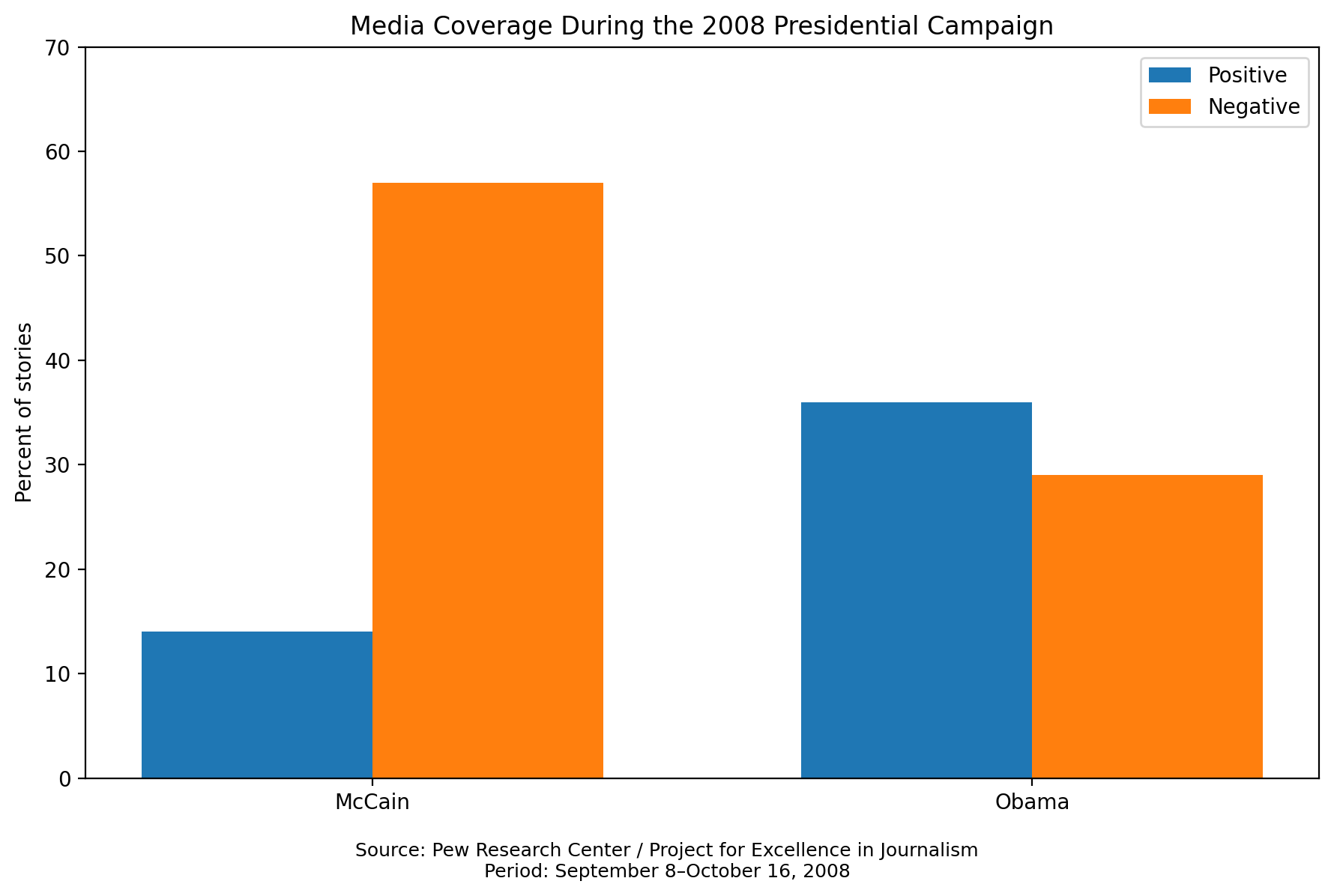
Pew examined reporting from September 8 through October 16, 2008. It found that 57 percent of stories substantially involving McCain were negative, while only 14 percent were positive.
For Obama, 36 percent were positive and 29 percent negative. McCain received approximately four negative stories for every positive one.
The financial crisis dominated that period, and McCain’s campaign decisions contributed to his worsening coverage. But the numbers stood in sharp contrast to the affection national reporters had openly expressed during his challenge to Bush eight years earlier.
I’ve always wondered whether McCain mistook his unusually favorable relationships with journalists for something more durable. He’d spent years being celebrated as an independent Republican willing to challenge his own party, and perhaps he believed that affection would benefit him when he finally won the nomination.
Apparently, being the media’s favorite Republican came with an expiration date.
McCain lost to Obama. Then Donald Trump entered the White House, and McCain once again became a prominent Republican critic of a Republican president.
In July 2017, he cast the decisive Republican vote against a Senate proposal to repeal major provisions of Obamacare. His dramatic thumbs-down gesture became one of the defining images of his final years in office.
Democrats celebrated the vote. When McCain died in August 2018, prominent Democrat leaders offered glowing tributes, and Obama delivered a eulogy at his funeral.
The man Democrats had worked so hard to defeat a decade earlier was once again being celebrated as an American statesman.
McCain never changed parties. His relationship with the press and his reception among Democrats changed repeatedly, depending in part on which politicians he challenged and which political positions he took.
Who Decides What You Believe?
I’ve told my wife and kids for years not to judge people simply by what they say. Examine what they do, look at the results, and decide whether their actions support their claims.
When a politician or commentator praises someone’s independence, look at what happens when that independence produces an unwelcome result. When an entrepreneur is celebrated for changing an industry, see whether his accomplishments are still acknowledged after his political allegiance changes.
And when someone you’ve admired for years suddenly becomes the person you’re expected to despise, compare the new accusations with the historical record.
The media has enormous influence over public reputations because most Americans will never meet the people they’re being encouraged to admire or hate. They depend on interviews, news reports, commentary, and selected clips to form their impressions.
A propagandist doesn’t necessarily need to convince people of an outright lie. Sometimes all he needs to do is provide enough carefully selected truths that they never realize how much of the story they’re missing.
Help Keep Independent Voices Heard
Yesterday’s hero becomes today’s villain, and millions of Americans go along with it without asking what changed. I spend a considerable amount of time digging through old interviews, reporting, public records, and polling because the historical record often tells a very different story from today’s headlines.
I don’t have a newsroom, corporate sponsors, or a political organization funding this work. My readers make it possible.
Become a Paid Subscriber
Support my research and writing with a recurring subscription.
https://mrchr.is/help
Make a One-Time Gift
Contribute whatever you’re comfortable giving, without another subscription.
https://mrchr.is/give
Join The Resistance Core
For readers who want to provide substantial ongoing support and help me expand this work.
https://mrchr.is/resist
Prefer Venmo?
https://account.venmo.com/u/mrchrisarnell
If you can’t contribute financially, please share this essay. Send it to someone who remembers how these men were treated before their political relationships changed.
Thanks for reading and supporting my work.