

“In a republic, treason is not inferred from attitude. It is proven by overt acts.”
The word “traitor” is one of the most serious accusations that can be leveled in American public life. It is not a synonym for “wrong,” “reckless,” or “irresponsible.” It implies betrayal of country, alignment with an enemy, and conduct so grave that it strikes at the survival of the Republic itself. The framers of the Constitution understood how easily such a charge could be abused. In Europe, treason had often been defined broadly enough to destroy political opponents under the cover of legality.
That is why the Constitution defines treason narrowly. Article III states that treason consists only in levying war against the United States or in adhering to their enemies, giving them aid and comfort. It requires an overt act. It requires proof. It requires either confession in open court or testimony from two witnesses to the same act. The bar is intentionally high because free societies do not criminalize dissent simply because it is unpopular or poorly timed.
Currently, there is no public evidence that Ilhan Omar has met that constitutional threshold. There is no indictment alleging espionage. There is no documented investigation showing she leaked classified operational timing. There is no proof that she communicated with Iranian officials regarding military plans. Those facts must be established at the outset because without them, the rest of the discussion becomes untethered from constitutional reality.
The real debate is not about treason in the legal sense. It is about rhetoric, judgment, and how language functions during wartime.
The Timeline: What Actually Happened
On February 24, 2026, Secretary of State Marco Rubio delivered a classified briefing to the Gang of Eight. The Gang of Eight consists of the Speaker of the House, the House Minority Leader, the Senate Majority Leader, the Senate Minority Leader, and the chair and ranking members of the House and Senate Intelligence Committees. This structure exists to provide oversight while limiting exposure of highly sensitive intelligence.

The Democrat members of that group include Hakeem Jeffries, Chuck Schumer, Mark Warner, and Jim Himes. Ilhan Omar is not a member of that group. She does not sit on the Intelligence Committee and does not serve on the Armed Services Committee. Structurally, she is not within the standard advance notification channel for imminent military operations.
On February 26 at 9:55 PM Central Time, Omar posted on X:
“Iraq was attacked by the US during Ramadan and it sickening to know that the US is again going to attack Iran during Ramadan. The US apparently loves to strike Muslim countries during Ramadan and I am convinced it isn’t what these countries have done to violate international law but about who they worship.”
At 12:15 AM Central Time on February 28, Operation Epic Fury commenced. U.S. and Israeli forces launched coordinated strikes on targets inside Iran.
By March 2, reports indicated that six U.S. service members had been killed in Iranian retaliatory actions.
Those are the events. The controversy centers on how to interpret the language in that February 26 post.
Certainty, Not Speculation
It is important to be precise about what Omar wrote. She did not frame her statement as concern or prediction. She did not say she feared escalation. She did not say she believed a strike might occur. She wrote that it was “sickening to know” that the United States was “again going to attack Iran during Ramadan.”
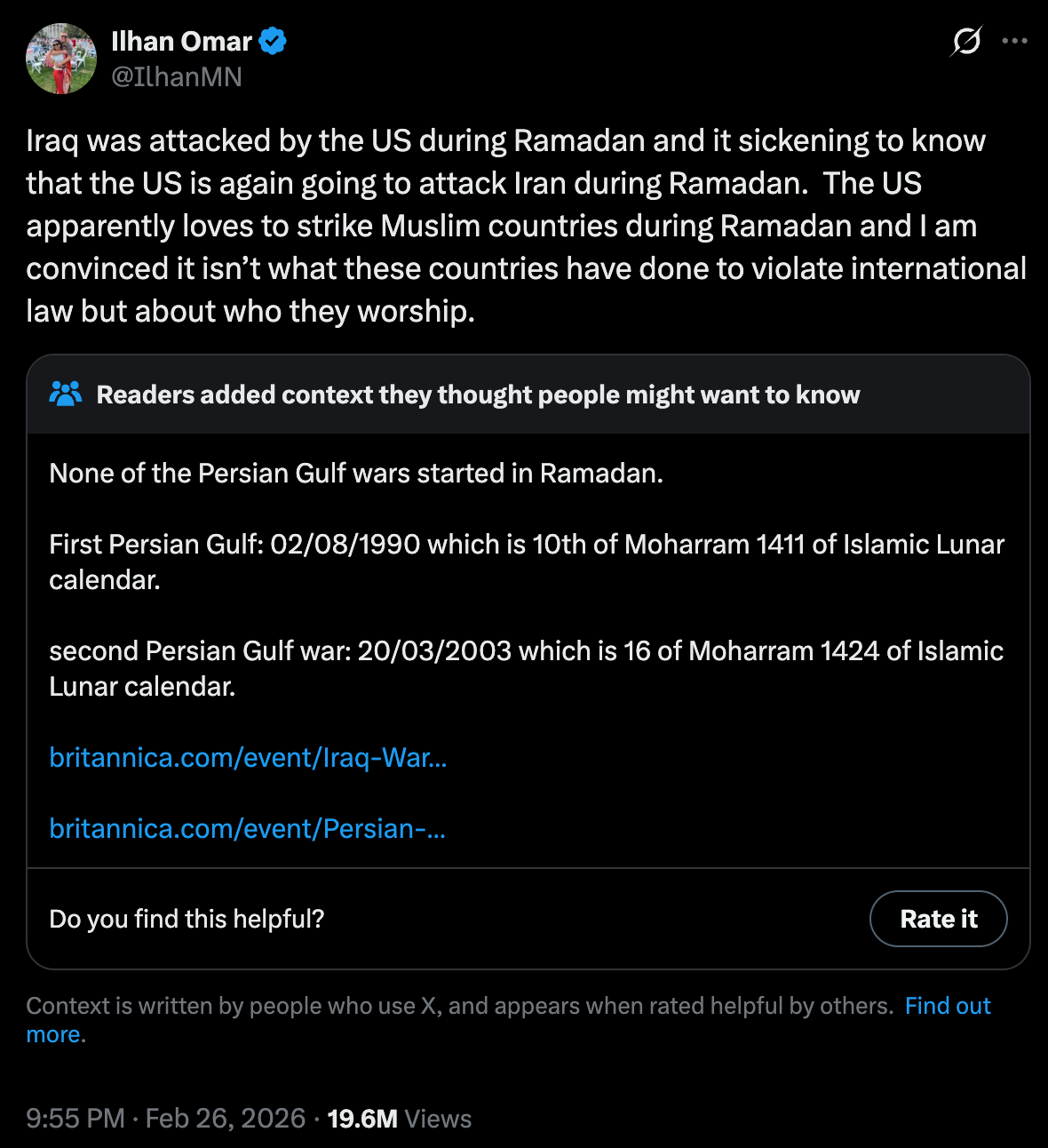
The phrase “to know” communicates certainty. The phrase “going to” communicates inevitability. The wording presents the strike as a
settled fact before it occurred.
That distinction matters rhetorically. There is a meaningful difference between saying “I am concerned this could happen” and saying “I know this is going to happen.”
However, certainty in tone does not automatically establish access to classified information. Escalation between the United States and Iran had been publicly visible. Diplomatic rhetoric had intensified. Strategic warnings had been issued. In such an environment, politicians frequently speak in absolutes to frame events morally before they unfold.
The correct conclusion from her wording is not that she had classified knowledge. The correct conclusion is that she chose to express certainty.
And if she was certain, why?
The Word “Again” and the Claim of Pattern
The word “again” introduces a separate claim. It implies repetition. It suggests a recurring pattern of the United States attacking Muslim countries during Ramadan.
Patterns require evidence.
Ramadan follows a lunar calendar and shifts roughly eleven days earlier each year relative to the solar calendar. Over time, it rotates through every season. Because of that rotation, any long conflict will eventually overlap Ramadan. Overlap alone does not demonstrate intent.
The historical record does not show a consistent pattern of major U.S. wars beginning during Ramadan.
The Gulf War began January 17, 1991. Ramadan that year began March 17.
The Afghanistan campaign began October 7, 2001. Ramadan began November 17.
The Iraq War began March 20, 2003. Ramadan began October 27.

These are the three largest U.S. military campaigns in Muslim-majority countries over the last three decades. None began during Ramadan.
That does not prevent criticism of strikes that occur during Ramadan. It does mean that describing a recurring pattern of deliberate Ramadan launches is not supported by those major historical examples.
If the claim is that the United States “loves” to strike during Ramadan, that claim requires more than a single overlap in a rotating lunar calendar.
Motive Attribution and Religious Framing
Omar’s tweet went further than timing. She wrote that she was convinced the issue was not international law violations but “about who they worship.” That statement attributes motive. It suggests that American military action is driven primarily by hostility toward religion rather than by geopolitical calculations.
Attributing motive is always more serious than criticizing policy outcomes. It moves from “this is unwise” to “this is malicious.”
To substantiate such a claim, one would need evidence that American policymakers select targets based on religious identity rather than strategic objectives. The historical record complicates that narrative. The United States has long maintained security partnerships with Muslim-majority states, including Saudi Arabia, Jordan, the United Arab Emirates, Qatar, and others. It has supported Muslim majority governments and fought alongside Muslim majority forces in various conflicts. It has also engaged in military actions in non-Muslim majority contexts.
American foreign policy has often been criticized for inconsistency, but inconsistency is not the same thing as religious hostility.
If religious animus were the guiding principle, alliance structures would look very different from what they actually are.
Iran’s Regional Record
To fully evaluate the moral framing, one must examine the record of violence associated with Iran’s regime and its proxy network.
Since 2011, the Syrian civil war has resulted in estimates exceeding 500,000 deaths according to multiple monitoring organizations. The majority of those killed were Muslim civilians. Iran, through the Islamic Revolutionary Guard Corps and affiliated militias, provided sustained support to the Assad regime during the conflict’s most violent years.
In Iraq, sectarian violence during the peak years following the 2003 invasion led to tens of thousands of civilian deaths annually at its worst. Iranian-aligned militias played major roles in shaping post invasion power struggles.
In Yemen, the conflict involving the Houthi movement, which has received support from Tehran, contributed to a humanitarian crisis that the United Nations estimates has placed above 350,000 total war-related deaths when including indirect causes such as famine and disease.
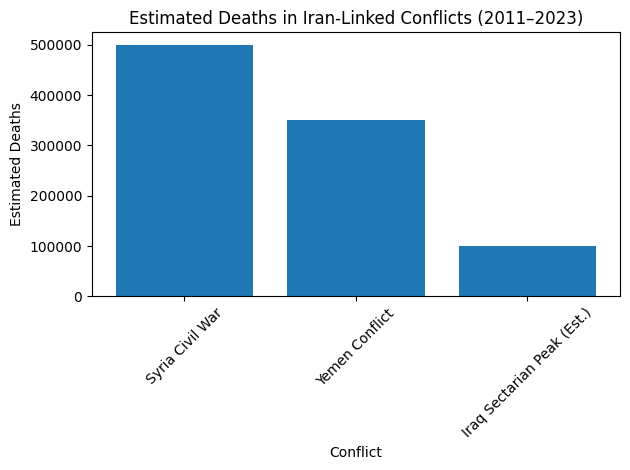
These figures are relevant because they illustrate that the largest Muslim casualty events in the region over the last fifteen years have often involved regional actors and proxy conflicts rather than a simple narrative of American religious hostility.
This context does not absolve American policy from scrutiny. It does complicate the claim that American action uniquely reflects anti-Muslim intent.
Suspicion Versus Proof
The proximity between the February 24 classified briefing and the February 26 tweet understandably raises questions for some observers. In a political climate where trust is low, coincidence often feels like confirmation.
But coincidence is not proof.
Omar was not in the Gang of Eight briefing. There is no public evidence that strike timing was leaked beyond that group. There is no indictment alleging disclosure of classified operational plans. Public escalation had been widely reported. Analysts had been discussing confrontation openly.
A politician can speak with certainty based on public signals and political positioning without possessing secret intelligence.
The constitutional standard for treason requires overt acts and evidence. That standard has not been met.
War Powers and Legal Debate
The debate over the legality of military action is not new. Most U.S. military operations since World War II have been conducted under Authorizations for Use of Military Force or under the President’s Article II authority as Commander in Chief. The War Powers Resolution of 1973 requires notification to Congress within 48 hours of introducing forces into hostilities, but does not require prior approval for limited operations.
Members of Congress are fully within their rights to question the legality or wisdom of a strike. That is not disloyalty. It is oversight.
The issue raised here is not whether Omar can oppose military action. The issue is the framing she used to oppose it.
The Information Environment in Modern Conflict
Political speech does not remain domestic. Statements by American officials are translated and circulated globally within minutes. Adversarial governments and propaganda networks frequently amplify American internal dissent to validate their own narratives.
When a member of Congress frames military action as religious hostility, that framing becomes part of the international information environment. Whether intended or not, it can be used to reinforce claims that American policy is driven by anti Muslim sentiment.
Intent and effect are not always aligned. But elected officials operate in a global information ecosystem, not a private conversation.
The Politics of Moral Certainty
It would be naïve to ignore the partisan environment in which this unfolded. Ilhan Omar has built a national profile largely through opposition to Republican leadership, particularly to President Trump and his foreign policy posture. In a country split down the middle, that posture does not merely signal disagreement. It signals a kind of permanent hostility in which the other side is treated less as a rival to be defeated and more as a threat to be stopped. That framing does not prove disloyalty, but it does create incentives for rhetoric that is accusatory, absolutist, and designed to mobilize her own side rather than persuade anyone outside it.
The internal dynamics of the Democrat Party also matter. Over the last two decades, the party’s activist wing has become more influential in shaping language, priorities, and moral narratives, especially after Iraq and Afghanistan made interventionism deeply unpopular among Democrat voters. The result has been a tendency among some leaders and commentators to treat American power as presumptively suspect and to interpret escalation through a lens of moral wrongdoing rather than strategic calculation. When that worldview becomes standard, even serious policy disputes are often framed as questions of intent and character.
This is where the incentive structure becomes obvious. In the modern attention economy, the reward goes to the person who speaks with certainty before facts are fully established and who assigns motive rather than debating outcomes. Certainty reads as conviction. Motive accusations read as moral clarity. Nuance reads as weakness. In that environment, it is not surprising that a politician would choose language like “to know” and “going to” rather than “it appears” or “it may.” Those softer phrases do not travel as far, do not trend as easily, and do not generate the same emotional response inside a partisan base.
That is also why the Ramadan framing matters. Tying a military strike to religious animus is not merely criticism of policy. It supplies a moral story that is instantly legible and emotionally potent, especially online. It converts a strategic dispute into a religious grievance and presents the United States as acting out of prejudice rather than strategy. Whether that story is accurate is a separate question. The point is that it is rhetorically efficient, and our politics increasingly rewards efficiency over accuracy.
At the same time, one must resist the lazy leap from partisan hostility to criminal implication. It is tempting, in an era saturated with scandals and institutional misconduct, to assume that if political actors are willing to bend norms in one sphere, they must be willing to cross every line in every sphere. That is how a cynical public often reasons. But constitutional standards exist precisely to prevent that style of reasoning from becoming the basis of accusation. Classified briefings carry legal consequences. Leaking operational timing is a felony. Suggesting that party leadership would casually share such information with ideological allies requires proof, not inference.
There is a broader point here that cuts deeper than any single figure. When trust erodes across institutions, coincidence becomes evidence in the public mind, and evidence becomes optional. That is not a recipe for accountability. It is a recipe for permanent suspicion. If citizens want a serious country, they have to demand serious standards, even when they dislike the speaker. Treason is not inferred from attitude or ideology. It is proven through overt acts.
These observations do not turn suspicion into evidence. They explain why rhetoric has become more reckless, why certainty is often performed rather than earned, and why a tweet can be written as if it were knowledge rather than judgment. In a healthier political culture, accuracy would be the incentive. In the culture we have, outrage is.
What This Does and Does Not Prove
Currently, there is no public evidence that Ilhan Omar committed treason. There is no documented proof of a classified leak. There is no indictment alleging coordination with a hostile government.
What remains is a debate about rhetoric, historical framing, and judgment during wartime.
Six American service members are dead. Regional tensions are elevated. The consequences of escalation are real and measurable.
Citizens are entitled to evaluate whether their representatives use language that clarifies reality or distorts it. They are equally obligated to distinguish between suspicion and proof.
The Constitution demands evidence before labeling someone a traitor. That threshold has not been crossed.
But rejecting a charge of treason does not require ignoring the consequences of rhetorical certainty, historical claims of repetition, and assertions of religious motive.
Suspicion is not evidence.
Rhetoric still matters.
Support Work That Separates Facts From Narratives
Most political commentary today is just heat.
Someone says something outrageous.
Cable panels spin it into a morality play.
Social media turns it into a war chant.
And almost nobody slows down long enough to ask the only question that matters.
What do we actually know?
That is what this publication is for.
Not to protect politicians. Not to join a team. Not to chase a headline.
To lay out the record, test the claims, and force reality back into the conversation.
That kind of work is slower, less viral, and more necessary than ever.
I do not have corporate sponsors. No institutional backers. No foundation grants.
This runs on readers who want a serious country and understand that clarity has a cost.
There are more than 2,450 readers here. Only a fraction are paid.
Substack’s visibility rankings are driven directly by paid subscribers. Support is not symbolic. It determines whether long-form investigative work gets amplified or buried.
If you want more writing that actually checks the story against the facts, help keep this durable.
Become a Paid Subscriber
Make a One-Time Gift
Join The Resistance Core
We do not need more outrage.
We need more receipts.
Look at what she is saying. She is not for us, she is for Somalia and should be removed from Congress and our country.
"When a Somalian person becomes an enemy, they become a serious one."
"We will never gain power & move forward as Somalians as long as these people live among us!"
"That's your responsibility and your job to not welcome those people who work to block and undermine Somalians in this country from gaining power or have influence."
#ilhanomar @repilhan #sedition #somalia
https://substack.com/@mrchrisarnell/note/c-222407440
Is she a traitor? Yes and No. She certainly has said traitorous things and may have acted traitorously, but it's awful hard to be a traitor when you were never an American in the first place.
Omar is a naturalized citizen but she's not an American. She's on video proclaiming that she represents the interests of Somalia and not those of the United States. She's not the only one. There's a cohort of foreign born naturalized citizens in our government who are really unassimilated aliens.
We must be the only country on earth to allow people who still owe their allegiance to another country or ethnic group to not just become citizens, but to hold elective office and influence government policies.