

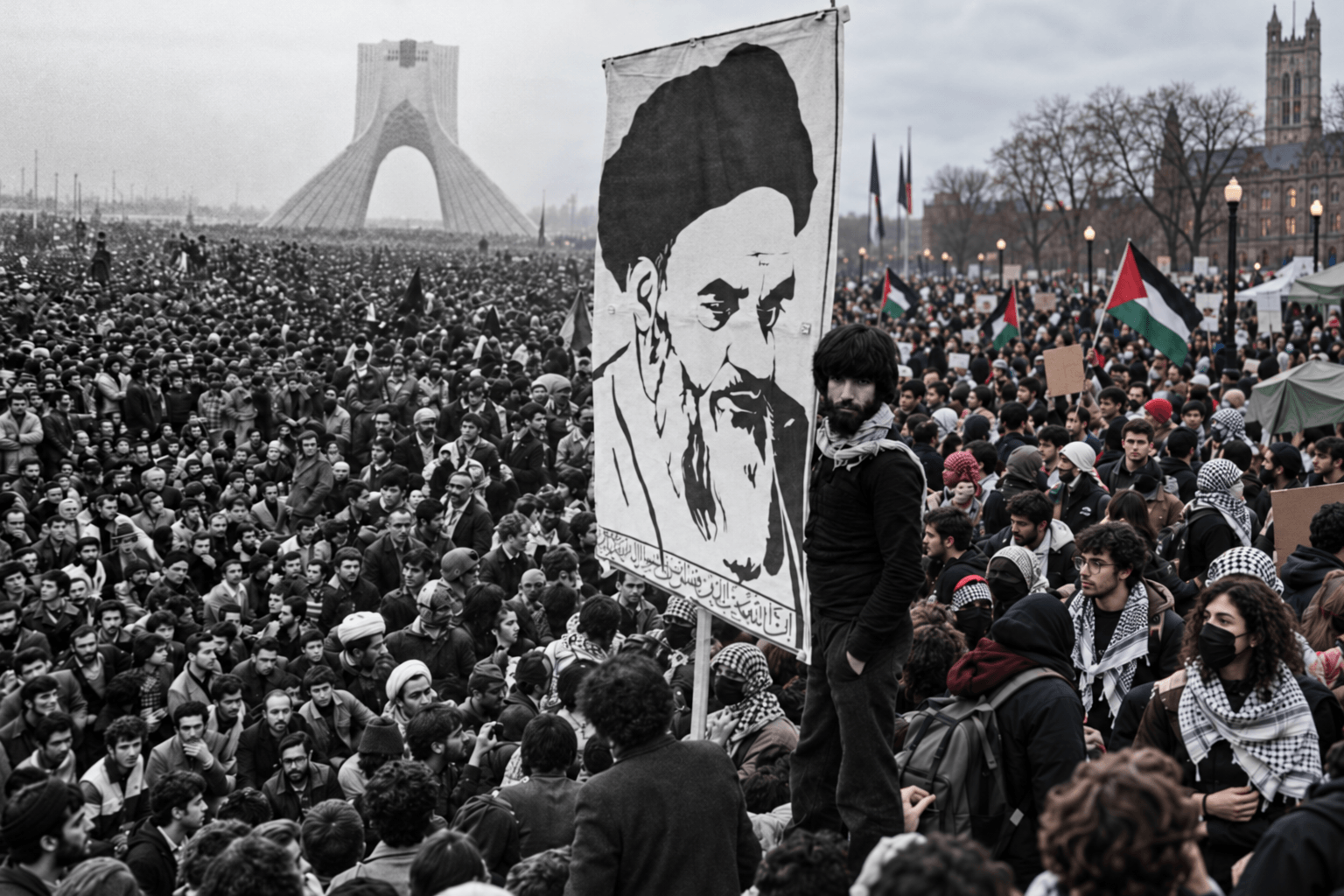
“Iran's leftists helped Islamic extremists seize power. The extremists thanked them with prison cells, torture, and firing squads. Apparently, the American left still hasn't learned the lesson.”
Forty-seven years ago, leftists helped a revolution that delivered Iran into the hands of an Islamic dictatorship. They saw the Shah of Iran, an American ally, as an American-backed oppressor and treated his religious opponents as allies in liberation. The radical clerics who consolidated power went on to imprison and execute many of their former revolutionary allies, including student activists and leftists who had helped them gain power.
Today, many on the left here in America are making the same ideological bargain with that dictatorship and the movements it sponsors. Opposition to America and Israel earns these forces sympathy from people who would never accept their rule over their own lives. Forty-seven years of repression should have destroyed the illusion. Instead, the same hostility toward the West keeps producing excuses for its enemies.
In January 2026, Iranian security forces massacred protesters by the thousands. In March, American activists gathered in New York to honor Ali Khamenei, the supreme leader who had presided over that government. They brought candles and flowers. Before we get to the people arranging the tribute, we need to remember the people who paid for the system he led.
The Freedoms Iranian Women Lost
Look at photographs of Tehran before the revolution and you will recognize quite a bit. Women wearing skirts. University students with their hair uncovered. People going to work, meeting friends, and dressing in ways that would not have attracted a second glance on an American campus. These photographs often surprise people whose entire picture of Iran consists of black chadors, angry demonstrations, and clerics telling everyone else how to live. The women in those older photographs were Iranians, too. They belonged to that country every bit as much as the men who later decided how much of their bodies the public could be trusted to see.
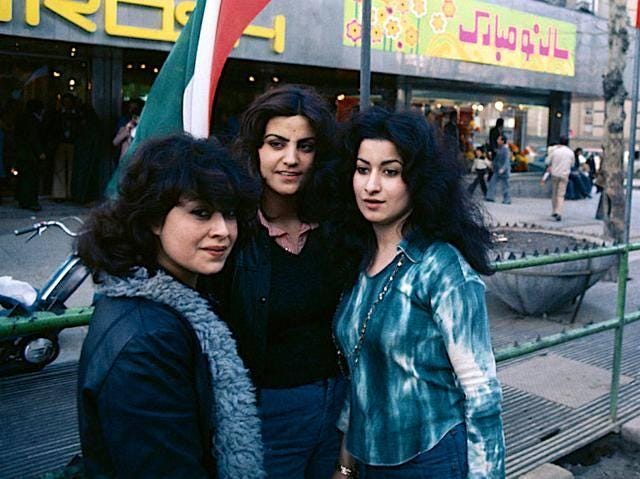
Women gained voting rights in 1963. The Family Protection Laws of 1967 and 1975 expanded their rights in divorce and child custody, restricted polygamy, and raised the standard marriage age for women to eighteen. These reforms changed questions with enormous practical consequences: whether a husband could simply discard his wife, what happened to the children, and how much authority courts could exercise over family disputes. Female university enrollment reached roughly 43,000 by 1976. An education, a profession, and greater independence were becoming attainable for more women. They had something to lose.
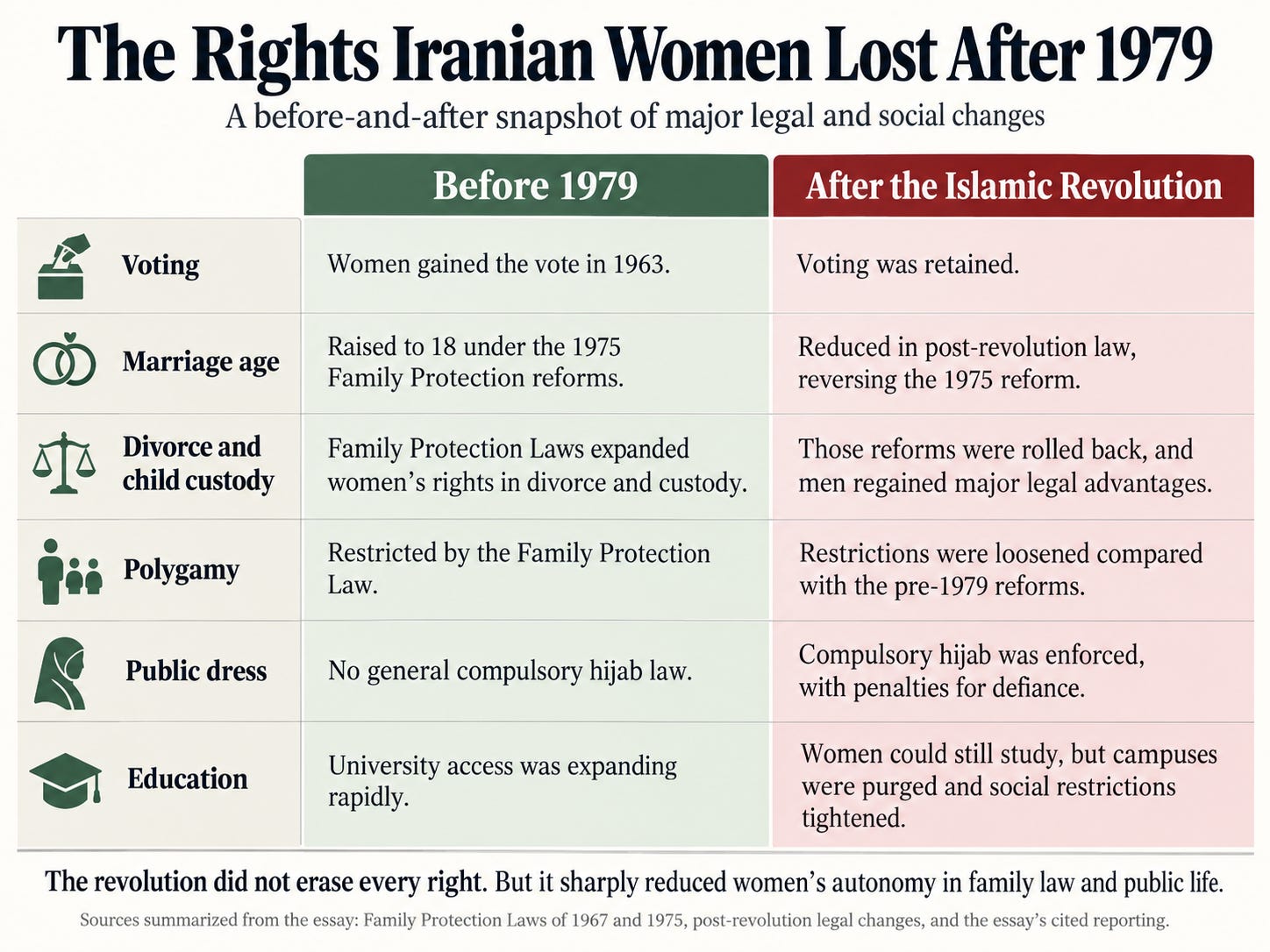
The photographs do not show all of Iran. Secular modernization was most visible among educated urban families, while conservative communities and religious households continued their traditions. Plenty of women covered their hair. Veiled and unveiled women lived in the same country. The dispute was over whether a government could force the second group to dress like the first.
That distinction should be easy for Americans who talk constantly about bodily autonomy. A woman choosing a religious covering exercises a choice. A woman threatened with punishment for refusing one is obeying an order. Calling both situations “culture” conveniently makes the official with the power to punish disappear from the picture. It also erases the women who resisted him. They become props in somebody else’s argument about respecting traditions, even when the tradition being defended is one they are trying to escape.
An education offers no protection from officials determined to control your life. What happens when an educated woman says no? Iran’s clerics had given their answer long before they acquired the power to enforce it.
The Enemy of My Enemy
Ayatollah Ruhollah Khomeini condemned the Family Protection Law in 1967, declaring divorces granted under it invalid. His lectures in 1970 outlined government under Islamic jurists. The proposal gave religious authorities the power to determine whether the country was being governed according to Islamic law. Anyone supporting women’s independence or secular government had an obvious question to ask: what happens when our rights conflict with his interpretation of religion?
You did not need a crystal ball. Reading what the man said would have been a decent start.
His revolutionary partners were focused on removing Mohammad Reza Pahlavi, the Shah. Marxists, students, secular nationalists, and religious militants could agree that he should go without agreeing on what would follow. For an anti-imperialist left that viewed American influence as a central obstacle to liberation, the Shah’s relationship with Washington helped define the struggle. Khomeini opposed an American ally. That made cooperation attractive, even though his answer to the question of who should rule was fundamentally incompatible with theirs.
A coalition can conceal that disagreement for a while. At a demonstration, everyone can shout against the same government. After victory, someone must command the security forces, determine which laws apply, and decide whether the other factions may continue organizing. An agreement about whom to overthrow settles none of those questions. It may only postpone the fight until one partner has acquired the power to crush the others.
Iran’s communist Tudeh Party announced full support for Khomeini in January 1979 and subsequently backed the Islamic Republic on anti-imperialist grounds. By September 1980, it was encouraging members to report the new government’s opponents to the authorities. Opposition to the Shah’s repression had led to cooperation with another government’s repression. The identity of the jailer had changed, and so had the party’s willingness to object. The party could call this service to a larger struggle. The people being reported still had to face the security services.
Western intellectuals contributed their own reassurances. In February 1979, Princeton professor Richard Falk published “Trusting Khomeini” in The New York Times. He suggested Iran might offer a “model of humane governance” and anticipated that Khomeini would provide guidance rather than ordinary governmental rule. There is a considerable difference between studying what a revolutionary leader says and imagining that he will become the leader you would prefer. A Princeton affiliation does not make that distinction less important.
Carter’s administration was meanwhile struggling to respond to the collapse of an American ally, with disagreements over how to handle the crisis. Carter had supported the Shah. His administration’s failed efforts to influence events belong in this history, but its role was different from that of people actively endorsing Khomeini. Washington failed to preserve its position; revolutionary supporters helped legitimize an alternative whose intentions deserved far more scrutiny. Iranians inherited the consequences after the speeches and policy arguments were over.
Khomeini’s victory ultimately produced a system in which elected offices operated beneath clerical authority. The supreme leader commanded the armed forces and possessed sweeping appointment powers. The Guardian Council screened candidates and judged legislation against constitutional and Islamic requirements. Voters could participate, but authorities determined who was allowed to compete. An election offers limited protection when the people exercising power can exclude those who challenge the basis of their rule.
Then the Revolution Came for Its Friends
Women protested attempts to impose compulsory covering in March 1979. The government kept pushing. Hijab became compulsory in government offices in 1980, and by 1983, appearing publicly without the prescribed covering could bring up to seventy-four lashes. The promised liberation had acquired a dress code and a whip. Women who objected were now challenging officials who claimed religious authority to tell them what to wear.
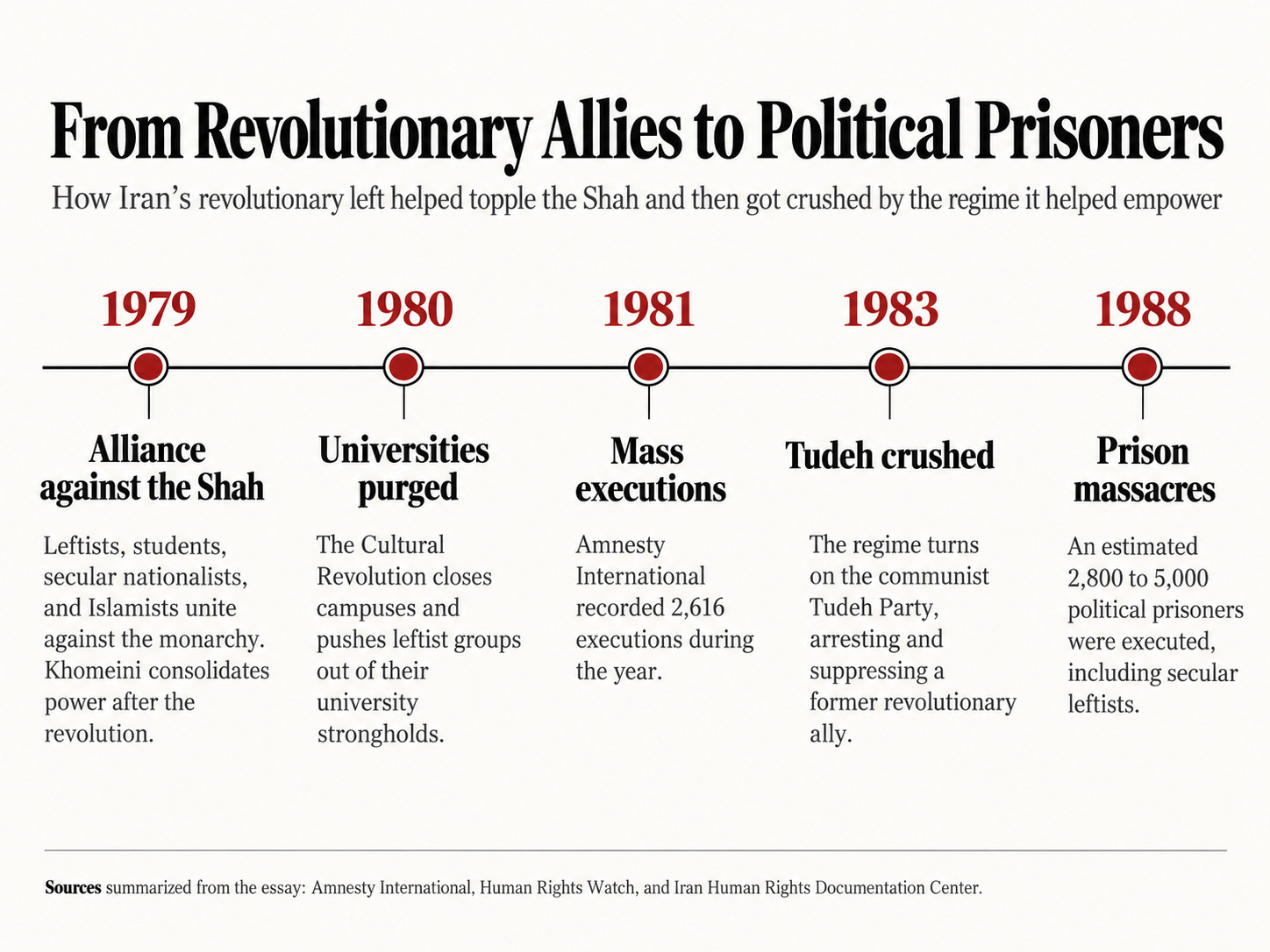
The universities presented another problem for the new rulers. Students had helped weaken the monarchy, and campuses remained places where leftist organizations could recruit and organize. During the Cultural Revolution that began in 1980, authorities closed universities, purged professors and students, and barred thousands of students from returning. The Iran Human Rights Documentation Center identifies the removal of leftist groups from their university bases as a central political objective. Those students’ earlier participation in the revolution did not entitle them to maintain institutions capable of opposing its winners.
The same report tells the story of Mina Yazdani, who entered medical school in Shiraz in 1976. After the closures, she learned that she would not be allowed to complete her studies because she was a Baha’i, a member of a religious community persecuted by the Islamic Republic. She eventually left Iran and continued her education abroad. The state had turned a young woman’s religion into grounds for abandoning the profession she had planned to enter.
Others lost much more. Mehdi Alavi Shushtari, a Marxist student activist, had been imprisoned under the Shah and later opposed the Islamic Republic. According to the Abdorrahman Boroumand Center’s memorial account, he was denied a defense lawyer, defended political activity at universities as a right, and was executed in June 1980. His mother described seeing evidence of injuries during a prison visit and hearing him explain the torture he had endured. His opposition to the monarchy had offered no protection from the government that replaced it.
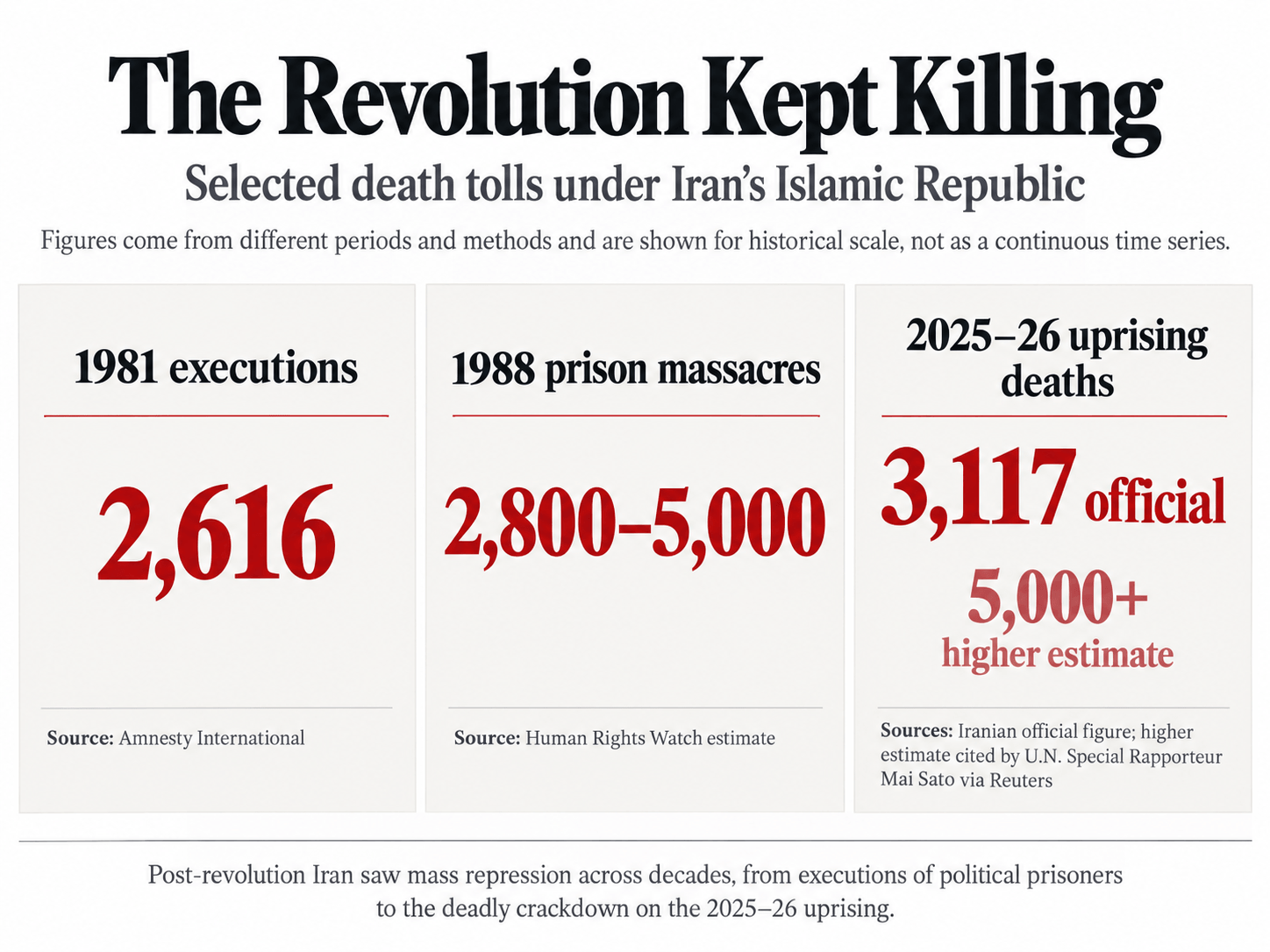
Amnesty International recorded 2,616 executions in 1981, including 2,444 after June 20. Many people executed during the repression of 1981 and 1982 belonged to opposition organizations whose members had initially supported the revolution. In 1983, the authorities turned on Tudeh itself. The party that had cooperated with the Islamic Republic discovered how little its cooperation guaranteed once the rulers no longer found it useful.
During the prison massacres of 1988, authorities killed thousands of political prisoners, including secular leftists. Human Rights Watch cites estimates of approximately 2,800 to 5,000 deaths. Many victims were already serving sentences. They were in state custody, where the authorities controlled their movements and their access to the outside world. The government had them locked up and killed them anyway.
People who expected to negotiate their differences after the revolution discovered that their negotiating partners controlled the prisons. Khomeini’s earlier declarations were now government policy.
The Islamic Republic also extended its influence abroad through money, weapons, and armed organizations, including Hezbollah in Lebanon, Hamas in the Palestinian territories, and the Houthis in Yemen. Iranian support gave these movements resources and helped Tehran exert power beyond its borders. This was not a simple procession of countries becoming copies of Iran. Influence could operate through armed groups powerful enough to obstruct governments, wage war, and impose their will without formally taking over an entire state.
Calling those groups “resistance” tells us whom they fight. It tells us very little about the freedom of the people who must live under them. That is the question their American admirers keep finding ways to avoid.
From Campus Activism to Political Power
The Democratic Socialists of America, or DSA, recruits candidates, organizes campaigns, and sets endorsement conditions. Its criteria instruct candidates to regard themselves as socialist organizers first and legislators second. The organization wants officeholders who will help build its movement, not simply accept volunteers at election time and disappear afterward.
Campaign workers and endorsements are valuable to ambitious politicians. What do candidates accept in return?
On October 7, 2023, DSA’s national statement condemned the killing of all civilians while describing the day’s events as a “direct result of Israel’s apartheid regime.” It also promoted a campaign led by DSA member Zohran Mamdani to cut financial support reaching Israel. Hamas had carried out the massacre. The organization promptly supplied an explanation centered on Israeli culpability and directed readers toward political organizing in New York.
The International Committee was more explicit about Iran in its April 23, 2024 statement. After Israel struck the Iranian consular building in Damascus and Iran retaliated against Israel, the committee portrayed Tehran as a champion of Palestinian liberation. It praised the Iranian attack’s contribution to restoring deterrence and undermining Israel’s perceived invincibility. Here was a favorable assessment of what the dictatorship’s military power had accomplished. The committee had moved beyond warning against a wider war to welcoming a strategic benefit for Iran.
Tudeh also found an anti-imperialist purpose in supporting Iranian clerical power. Forty-five years later, an American socialist committee was praising the dictatorship’s contribution to liberation.
In 2024, DSA conditioned its national endorsement of Alexandria Ocasio-Cortez on demands including opposition to all funding for Israel, expressly including Iron Dome, and support for boycotts, divestment, and sanctions. It withdrew the conditional endorsement when the requirements remained unmet and the New York City chapter requested withdrawal. The local chapter continued to endorse her. Iron Dome intercepts incoming rockets. DSA’s demand therefore extended beyond opposition to bombs dropped in Gaza to opposition to American support for a system protecting people from rockets fired at Israel. Concern for civilian life should survive the discovery that some of those civilians are Israeli.
Darializa Avila Chevalier’s path illustrates the connection with campus organizing. She participated in Columbia’s pro-Palestinian activism and helped organize its 2024 encampment as an alumna. NYC DSA and Mamdani endorsed her congressional campaign in 2026. That June, she defended attending the October 8, 2023, Times Square rally where participants celebrated the previous day’s attack. She explained her attendance through concern about Palestinian lives and the anticipated Israeli response. NYC DSA had promoted that rally before walking back its support. Mamdani had not attended. Attendance does not tell us which chants she endorsed. Her defense of the decision still gives voters a question worth asking: why was that gathering, on that day, an appropriate expression of concern for human dignity? People seeking public office routinely ask us to trust their judgment. Their judgment about whom to stand beside is part of the record.
An October 2024 publication from Columbia University Apartheid Divest, or CUAD, presented Hamas and the Houthis as “principally progressive forces,” treating other characteristics as secondary to their role in national liberation. Beliefs and practices that would provoke outrage in an American political candidate become subordinate considerations when attached to a movement fighting Israel. Palestinians who have experienced Hamas’s idea of political freedom might have something to add.
During Gaza’s March 2019 “We Want to Live” demonstrations over living costs and taxes, Hamas authorities detained more than 1,000 people, according to the Palestinian Independent Commission for Human Rights, cited by Human Rights Watch. Journalists and human rights workers were among those detained. HRW documented the case of Amer Balousha, an activist and freelance journalist who said prosecutors charged him with opposing the revolution. He was held for nine days, seven in solitary confinement. He had also previously been detained after a Facebook post asking Hamas leaders, “Do your children sleep on the floor like ours do?”
An American socialist might recognize that as a complaint about inequality. Hamas treated its author as a problem to be controlled.
The pattern continued during the war. In May 2025, Amnesty International documented threats, interrogations, and beatings of Palestinian protesters by Hamas security forces. Demonstrators wanted an end to Israeli attacks and displacement; some also demanded an end to Hamas rule. One man described being beaten after protesting and accused of collaboration despite having lost family members in an Israeli strike. His suffering did not protect him from the authorities claiming to represent his people. When activists in America call Hamas progressive, what are they telling these Palestinians? That the people beating them serve a cause more important than their freedom to object? Palestinians do not surrender their rights because an American campus organization finds their rulers politically useful. Supporting them requires taking their complaints about Hamas seriously, including the complaints that complicate a favorite slogan.
Rashida Tlaib addressed DSA’s 2025 convention, and the organization prominently featured her remarks on its convention website. Zohran Mamdani is a DSA member. Ocasio-Cortez has faced its endorsement conditions. Ask them which positions they accept and what would cause them to break with the organization. Membership, endorsement, and a convention appearance are different relationships, each worth examining on its own terms. A movement that demands commitments from candidates cannot reasonably complain when voters demand explanations from them.
Opposition to Israeli aid has also moved deeper into the Democrat Party. In July 2026, 103 House Democrats supported an unsuccessful amendment cutting $3.3 billion in proposed security assistance, while 98 opposed it and ten voted present. The funding question can be debated on its merits. Praise for Iranian military action and descriptions of Hamas as progressive deserve scrutiny in their own right, without being hidden inside the much broader debate over American spending.
Tehran has also tried to exploit American activism directly. In July 2024, Director of National Intelligence Avril Haines reported that Iranian actors were posing as activists online, encouraging protests over Gaza, and providing financial support to protesters. She warned that participants might not know a foreign government was involved. Her statement did not identify DSA or a particular politician as a recipient. It did establish that Iran saw an opportunity in the protests and was acting on it. The government being defended abroad was also trying to influence the Americans doing the protesting.
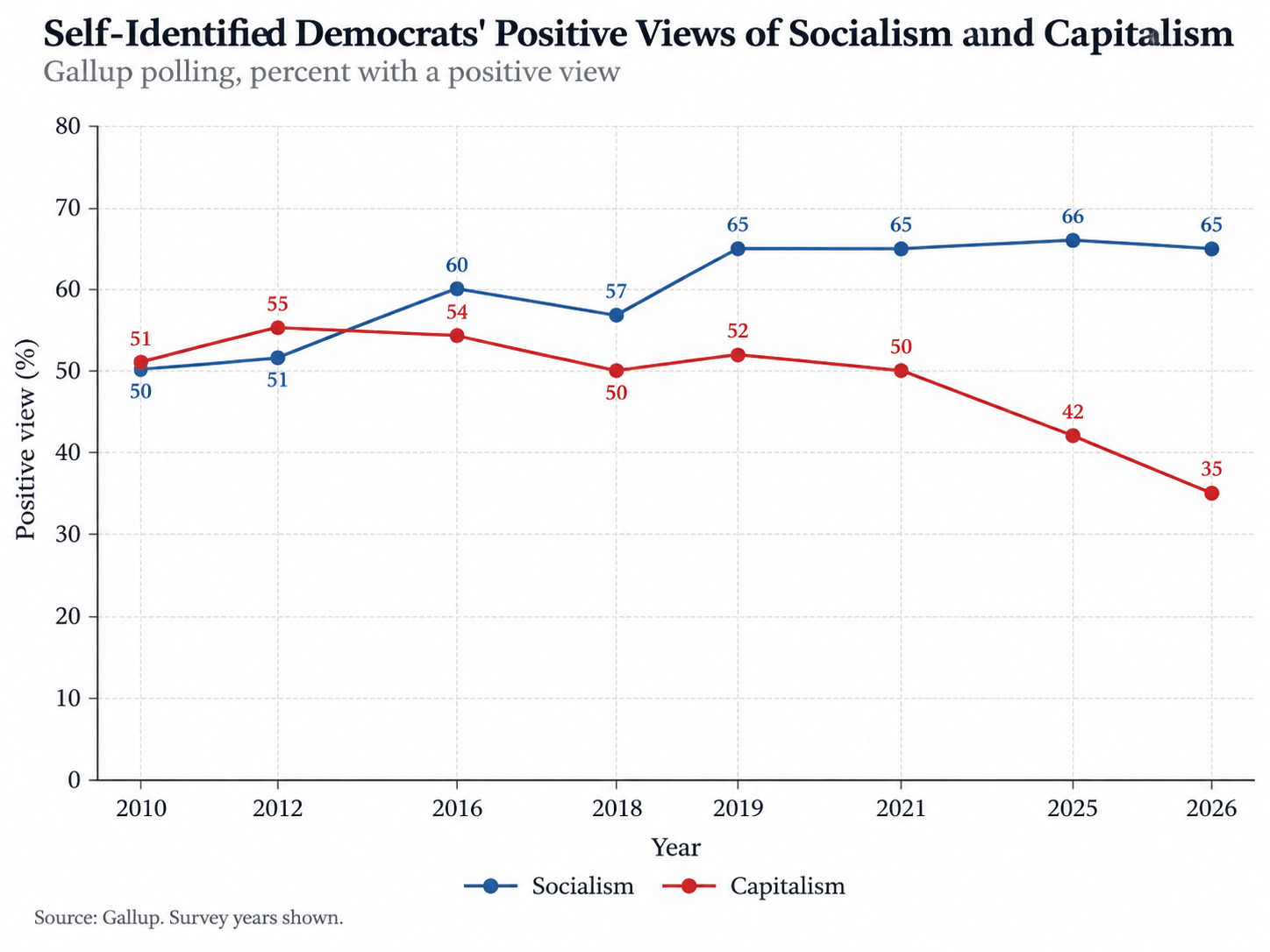
Gallup reported in September 2026 that 65 percent of self-identified Democrats viewed socialism positively, up from 50 percent in 2010. That measures the appeal of an economic and political label, not support for Islamic rule. It shows how receptive the party’s audience has become to the socialist label. Voters attracted by promises about rent, wages, and health care should examine the rest of the package. A promise to lower the rent does not excuse romanticizing a dictatorship.
Freedoms They Demand - Rulers They Excuse
Iran’s latest uprising began on December 28, 2025, after a currency collapse, and spread into demands for an end to Islamic Republic rule. On January 8 and 9, security forces carried out massacres. Amnesty International documented forces firing rifles and shotguns at protesters, frequently targeting heads and torsos. Authorities shut down internet access as the slaughter unfolded. Families searched for relatives while outsiders struggled to determine the scale of the killing.
Iranian authorities acknowledged 3,117 deaths during the uprising. Amnesty reported that UN Special Rapporteur Mai Sato had cited at least 5,000. These figures covered the uprising, not only those two nights, and the full toll remained disputed. Even the government’s own figure described a catastrophe. Amnesty called January the deadliest period of repression in its decades of research on Iran. In footage from an overflowing forensic facility near Tehran, its investigators identified at least 205 distinct body bags. Those were people with families trying to find them, not entries in an argument about American foreign policy.
The government followed the killings with a campaign to silence survivors and relatives. Amnesty documented intimidation surrounding funerals and demands that some families pay money, sign pledges, or falsely describe the deceased as members of the security forces. A family could lose someone and then face pressure to help the authorities lie about the death.
DSA already knew what Iran’s rulers were capable of. In October 2022, its International Committee had condemned arrests, repression, and killings following Mahsa Amini’s death and supported Iranians demanding change.
After the American-Israeli attacks, the national organization described “regime” as a favorite word in the imperialist vocabulary. It framed the confrontation as a continuation of the struggle against Iran since the 1979 revolution and emphasized American responsibility for the conditions provoking Iranian protests. Its statement did not mention the January massacres. It found room to object to the terminology used for the government but no room to describe the government’s recent slaughter of protesters.
Opposing the attacks required no such omission. A person could argue against war and still say plainly that Iran’s rulers had committed mass murder. DSA’s account instead directed the reader back toward American culpability. The people ordering arrests and opening fire became secondary figures in an explanation of conditions supposedly produced elsewhere.
Then came the vigil in New York. In March, organizers reported more than 250 attendees honoring Ali Khamenei, Khomeini’s successor, with candles, flowers, and an altar. They highlighted participation by organizations led by Black, brown, and transgender activists. Endorsers included the Bronx Anti-War Coalition, Workers World Party, and International Action Center.
Khamenei had been supreme leader during the January massacres. Weeks later, American activists were arranging flowers in his honor.
The participants could assemble publicly, denounce their own government, publish an account of their tribute, and go home. Iranians who challenged Khamenei’s authority had been shot in the streets. His American admirers enjoyed the very protection from state power that his opponents were demanding. They were free to choose whom to honor, and this was their choice.
Iran criminalizes consensual same-sex sexual activity, with death available as punishment for certain offenses, and human rights organizations have documented executions under those laws. The government permits some gender transitions while gay and transgender people face severe abuse and discrimination. Its religious authorities decide which intimate relationships are permissible. No argument about American foreign policy gives those authorities a moral right to control someone’s private life. Americans who insist on personal autonomy should be able to recognize its violation without first checking the government’s position on Israel.
Iranian women have made their demands equally clear. Mahsa Amini died after being detained over her hijab in 2022; a United Nations fact-finding mission concluded that state violence caused her death. Women risked their lives protesting the government’s control over them. They did not need Americans to discover that religious compulsion was oppressive. They needed people who claimed to believe in freedom to take their resistance seriously.
An Iranian woman is not less entitled to choose because her government’s enemies include Washington. Her rights can hardly wait until an American activist has finished explaining imperialism.
By October 2026, the punishment of January’s protesters was still underway. Reuters reported on October 8 that authorities were using coerced confessions, prosecutions, and executions to frighten opponents, identifying at least thirty-four executions connected to the uprising. Surviving the gunfire had not meant escaping the government. The state could come back for people months later, when the crowds were gone and the world’s attention had moved on.
Would Your Allies Let You Disagree?
Before extending solidarity, ask whether the people you are defending would permit you to organize against them. Could you publish an attack on their leaders, reject their religious commands, or live openly in a relationship they condemned? If the answer is no, explain why their power deserves your enthusiasm. An account of everything wrong with America is not an answer to what they would do to you.
Politicians seeking the support of organizations that excuse these rulers owe voters an answer, too. They are asking to be trusted with authority. Their judgment about other people’s use of power is part of their qualification for exercising it themselves. Campaign promises about personal freedom mean less when the candidate treats that freedom as negotiable among political friends.
Iran’s revolutionary left learned what its allies intended by living through it. Today’s admirers have forty-seven years of evidence, including the testimony of women, students, and prisoners who survived. They can also hear Palestinians describe being beaten by Hamas for demanding change. In 2026, they could learn about another mass killing in Iran and still find their way to a vigil for the man who presided over its government.
The Iranians who suffered under those rulers did not have the luxury of looking away. Americans arranging the flowers did. Nobody forced them to bring a bouquet.
Freedom Is Not Self-Sustaining. Neither Is Independent Journalism.
Iran’s revolution offers a lesson that Americans would be foolish to ignore. Freedom can be lost with the enthusiastic assistance of people who claim to defend it.
Exposing that kind of hypocrisy takes research, time, and a willingness to challenge political movements that would rather nobody examined their friends too closely.
That’s what I do here. No corporate sponsors. No political party telling me what I can say. No advertisers to keep happy. And no paywall keeping the truth from people who need to hear it.
But keeping this work free doesn’t make producing it free.
If you value independent research, historical context, and commentary that doesn’t bend to political fashion, I hope you’ll consider becoming a paid subscriber.
Become a Paid Subscriber
$8 per month or $80 per year. Your subscription helps fund the research, writing, and investigations that make essays like this possible. Every new paid subscriber makes this publication stronger and more independent.
Join The Resistance Core
For readers who want to make a larger investment in this work, The Resistance Core is my highest level of support. It starts at $1,200 annually, with the amount adjustable when subscribing.
Make a One-Time Contribution
Not interested in another subscription? A one-time contribution is always appreciated. Every dollar helps keep this publication independent and free for everyone to read.
Support directly: mrchr.is/give
Venmo: https://account.venmo.com/u/mrchrisarnell
If You Cannot Contribute
Keep reading. Share this essay. Restack it. Forward it to someone who should understand what happened in Iran and why the same political thinking deserves scrutiny here in America.
The people who helped destroy Iran’s freedoms thought they were fighting oppression. Americans have the benefit of knowing how that story ended.
Let’s make sure the lesson isn’t wasted.