

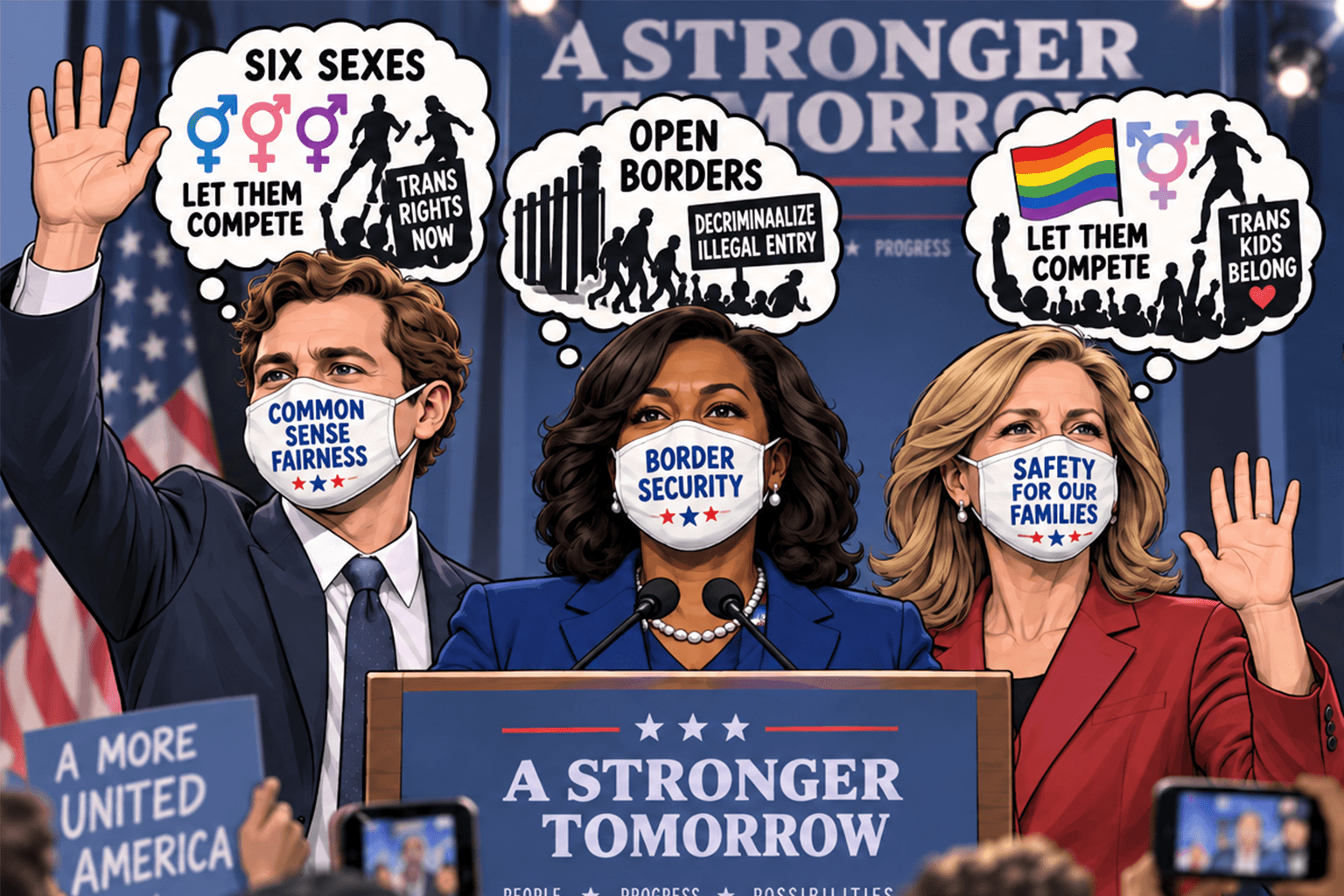
“If liberal policies are really that popular, why do they become so much harder to advertise when everybody gets a vote?”
James Talarico’s pastor may have accidentally provided the perfect introduction to his 2026 Senate campaign.
Reverend Babs Miller is a minister at St. Andrew’s Presbyterian Church in Austin, where Talarico has been a longtime member. In undercover footage published in September, Miller discussed the increasingly moderate positions Talarico has taken while running statewide in Texas. She said she could “guarantee” that once he was elected, he would “change his tune back to where he was.” She also said his campaign had convinced him to back away from transgender issues because the Democrat Party was doing the same, and that his staff was encouraging him to follow along “just for the next 50 weeks.” Miller said she thought it was bad advice, then added, “if it helps him win, okay.”
That is one hell of a sentence to have your own pastor caught saying during an election.
The timing makes it more interesting. Talarico is not merely polishing his biography or changing the subject. Several positions and statements that followed him from the Texas Legislature have changed as his audience expanded from a legislative district to the entire state.
In 2021, Talarico opposed Republican restrictions on transgender student athletes and argued that “some things are more important than perfectly fair competition in sports.” During the same legislative debate, he made his now-famous statement about six sexes. On September 9, 2026, Talarico went on Fox News, said there are two sexes, acknowledged that he had “missed the mark” with earlier comments, and said he would oppose transgender athletes competing in girls’ sports “if it endangers safety or fairness.” The Texas Tribune called the sports position a reversal and noted that the Fox appearance came as Talarico sought support from right-leaning Texas voters.
But notice the escape hatch built into the wording. Talarico did not say males should never compete in girls’ sports. He said he would oppose it if he believed safety or fairness were endangered. That leaves plenty of room later to argue that a particular case does not cross that threshold and that no promise was ever broken.
JAMES TALARICO
THEN, 2021
“There are many more than two biological sexes... there are six.”
NOW, 2026
“There are not six sexes, there are two.”
The conversion arrived on schedule. Statewide voters were now in the room.
Every investigation I publish takes hours of digging through old interviews, legislative votes, campaign ads, archived statements, polling, and video to figure out what politicians said then and what they are saying now.
Your paid subscription helps fund that work. If you value the stories I uncover and want me to keep digging, please consider upgrading today. It makes a real difference, and I’m grateful for your support.
Become a Paid Subscriber
https://mrchr.is/help
The politicians change, the issues change, the states change, and the props certainly change. But the incentive is remarkably durable. A candidate establishes a recognizably liberal record, survives the Democrat primary, and then discovers that independents, suburban parents, working-class voters, gun owners, energy workers, rural voters, and people who voted Republican last time also get ballots.
That is when the wardrobe starts changing. The sheriff appears in the commercial. Somebody finds a rifle. Border security becomes important. Manufacturing becomes sacred. Police sound useful again. “Progressive” starts disappearing while “common sense,” “fairness,” and “bipartisan” suddenly get a workout.
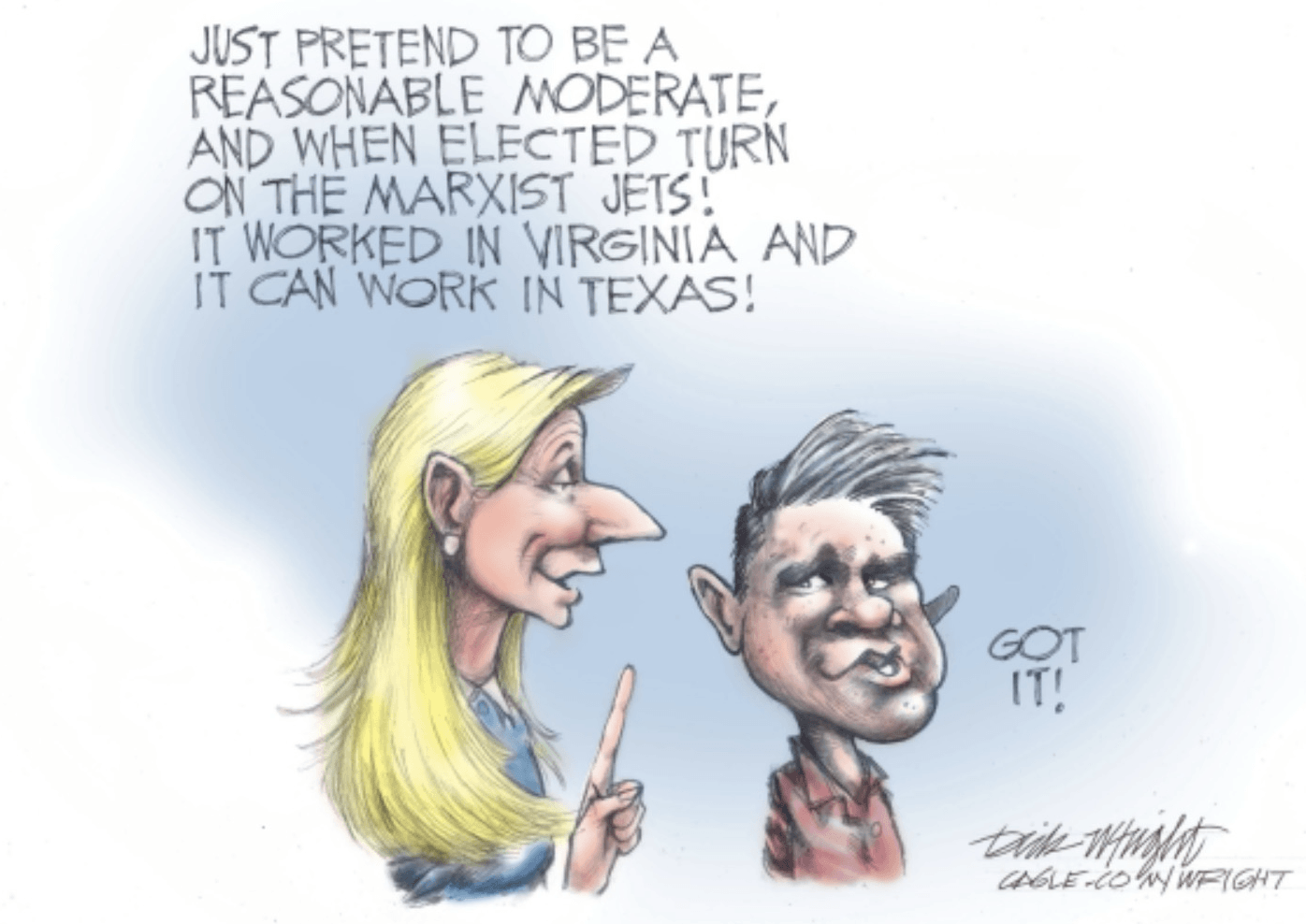
If this happened once, it would be meaningless. When the same maneuver appears across decades, candidates, states, and issues, the timing becomes part of the story.
When the Electorate Changes, So Does the Message
Kamala Harris provided a nearly perfect national example in 2024.
When Harris was running for the Democrat presidential nomination in 2019, she was asked whether she supported banning fracking. Her answer was not remotely ambiguous: “There’s no question I’m in favor of banning fracking.” During that same campaign, she also supported decriminalizing unauthorized border crossings.
Five years later, Harris was no longer competing for progressive primary voters. She was the presidential nominee, and Pennsylvania mattered enormously. Now she opposed banning fracking. On illegal border crossings, she said the laws had to be enforced and “there should be consequences.” CNN described both as shifts from positions she had taken during her earlier presidential run.
KAMALA HARRIS
THEN, 2019
“There’s no question I’m in favor of banning fracking.”
NOW, 2024
“As president, I will not ban fracking.”
Her explanation: “My values have not changed.”
Dana Bash asked Harris what had changed. Harris repeatedly answered that her “values have not changed.” In 2019 she favored banning fracking. In 2024 she did not. Her stated values remained the same while the policy and the electorate changed.
Barack Obama offers an older variation. In 1996, he said he favored legalizing same-sex marriage. During his 2008 presidential campaign, he publicly defined marriage as between a man and a woman. After reaching the White House, he eventually supported same-sex marriage. David Axelrod later wrote that political considerations had influenced Obama’s earlier public position; Obama disputed Axelrod’s account and said his views genuinely evolved.
Barack Obama
THEN, 1996
“I favor legalizing same-sex marriages.”
DURING THE PRESIDENTIAL RACE, 2008
“I believe that marriage is the union between a man and a woman.”
He later publicly supported same-sex marriage as president.
You can argue about the explanation. The chronology does not move: support before the national race, opposition while seeking the presidency, support after reaching the White House.
Apparently evolution has excellent timing.
The broader point is not that every change of position is fake. Politicians change their minds. Voters are supposed to influence them. The more revealing question is why the same kinds of positions keep becoming inconvenient at the same stage of the election cycle.
Strategic Ambiguity
Abigail Spanberger demonstrates something subtler because campaigns do not always need a clean reversal. Sometimes careful ambiguity works just as well.
During her 2025 campaign for governor of Virginia, Republicans attacked Spanberger over transgender students, bathrooms, and girls’ sports. Her response emphasized safety, parents, local communities, and her experience as the mother of three daughters. In one prominent ad, she said she was concerned about children’s safety and argued that schools should trust parents and local communities. The Washington Post reported that she did not mention the transgender issue specifically in that ad, and later described her as vague when pressed on Youngkin’s restrictive transgender policies, saying those questions should be left to local communities.
The voter hears “three daughters.” The voter hears “safety.” The voter hears “parents.” The campaign does not have to finish the sentence.
Abigail Spanberger
THEN, 2025
“Nothing is more important to me than [my daughters’] safety... competitiveness and fairness.”
AFTER THE ELECTION, 2026
“You have a governor that values your community.”
During the campaign, Spanberger emphasized safety, fairness, parents, and local control. After taking office, her administration withdrew the Youngkin-era rulemaking restricting transgender students’ participation in female sports and certain sex-separated facilities.
Spanberger won. In July 2026, her administration withdrew a Youngkin-era rulemaking effort that would have restricted transgender students’ participation in female sports and their use of certain sex-separated facilities. There was no public announcement when the rulemaking was withdrawn. Spanberger later said her administration had consulted the attorney general’s office and determined that the Board of Health lacked legal authority to impose the regulation.
Nobody had to break a clear promise because no categorical promise had been made. That is what makes strategic ambiguity useful. The campaign supplies the comforting words. The voter supplies the conclusion.
The General-Election Costume Closet
Political packaging can be even more obvious when the issue is image rather than policy.
John Kerry had a real military record. He served in Vietnam, was decorated, and later became nationally famous as an antiwar veteran. When he ran for president in 2004 during the Iraq and Afghanistan wars, however, his general-election advertising heavily emphasized the combat service and barely mentioned the antiwar activism that had helped launch his political career. FactCheck.org explicitly noted that Kerry was de-emphasizing that part of his résumé while courting more centrist voters.
Then Kerry walked onto the Democrat National Convention stage, saluted, and announced, “I’m John Kerry, and I’m reporting for duty.”
Nothing about his military service was fabricated. That misses the point. A campaign does not need to invent a man when it can edit him. Forty years of biography go into the cutting room, and voters get the thirty seconds most useful in November.
Joe Manchin entered his 2010 West Virginia Senate race after previously saying he was “totally behind” health-care reform. As the race tightened, CBS reported that he began walking back that support and distancing himself from Washington Democrats. Then came the advertisement in which Manchin picked up a rifle and shot the cap-and-trade bill.
Manchin later spent years showing that much of his moderation was genuine. He repeatedly broke with his own party in office. That gives us a useful control: sometimes the guy holding the rifle really does mean it.
But look at what campaigns repeatedly decide is worth showing voters.
Claire McCaskill’s own campaign told Missouri voters that she was “not one of those crazy Democrats.” Jon Tester, running for reelection in Montana after Trump had carried the state by more than twenty points, opened his campaign by emphasizing legislation Trump had signed and later bought full-page newspaper advertisements thanking Trump for signing Tester-backed measures.
Tim Ryan had spent almost twenty years in Congress as a Democrat and had even run for the Democrat presidential nomination. During his 2022 Ohio Senate campaign, one of the messages he wanted voters to remember was, “I voted with Trump on trade.” PolitiFact found the claim substantially accurate.
The facts were real. The selection was the story.
A politician may have thousands of votes, hundreds of speeches, and twenty years of history. A campaign has thirty seconds. It decides which thirty seconds of that life the voter gets to meet.
That tells us something important about the incentives. Campaigns do not randomly choose sheriffs, rifles, factories, border enforcement, police, manufacturing, and Trump-signed legislation to reassure swing voters. They choose the parts of a candidate’s record they believe will travel best outside the electorate that nominated him.
When the Record Won’t Stay Buried
Then there is Abdul El-Sayed, where the problem is no longer merely selective packaging.
During the defund-the-police debate in 2020, El-Sayed repeatedly supported the concept. Bridge Michigan found interviews and social-media posts in which he endorsed defunding, while explaining the term as shifting money away from policing and incarceration and toward education, health, recreation, housing, and other services.
Years later, while pursuing a U.S. Senate seat in Michigan, El-Sayed told The Detroit News, “I actually never, never called for defunding.” Bridge Michigan went back through the record and reached a wonderfully uncomplicated conclusion:
“He did.”
Abdul El-Sayed
THEN, 2020
“I believe that we do need to defund the police.”
NOW, 2026
“I actually never, never called for defunding.”
Bridge Michigan checked the record: he had.
El-Sayed argues that his earlier remarks require context. That context tells us what he meant by defunding. It cannot make the word disappear.
“I believe that we do need to defund the police” and “I actually never, never called for defunding” are not two nuanced descriptions of the same statement. At some point, words have to survive their own recording.
That is the difference between ordinary campaign editing and something much harder to explain away. Kerry really served. Ryan really voted with Trump on trade. Tester really had legislation signed by Trump. El-Sayed’s problem is that the old sentence and the new sentence are sitting next to each other.
We Have the Tape
Which brings us back to Talarico.
His earlier record exists. His current positions exist. His pastor’s comments now exist. The Texas Tribune independently describes his sports position as a reversal, and Talarico himself acknowledges that he “missed the mark” with some of his previous statements.
And sitting underneath this debate is a number campaigns would be foolish to ignore.
Pew surveyed American adults in February 2025 and found that 66 percent favored laws or policies requiring transgender athletes to compete on teams matching the sex they were assigned at birth. Only 15 percent opposed them, while 19 percent chose neither.
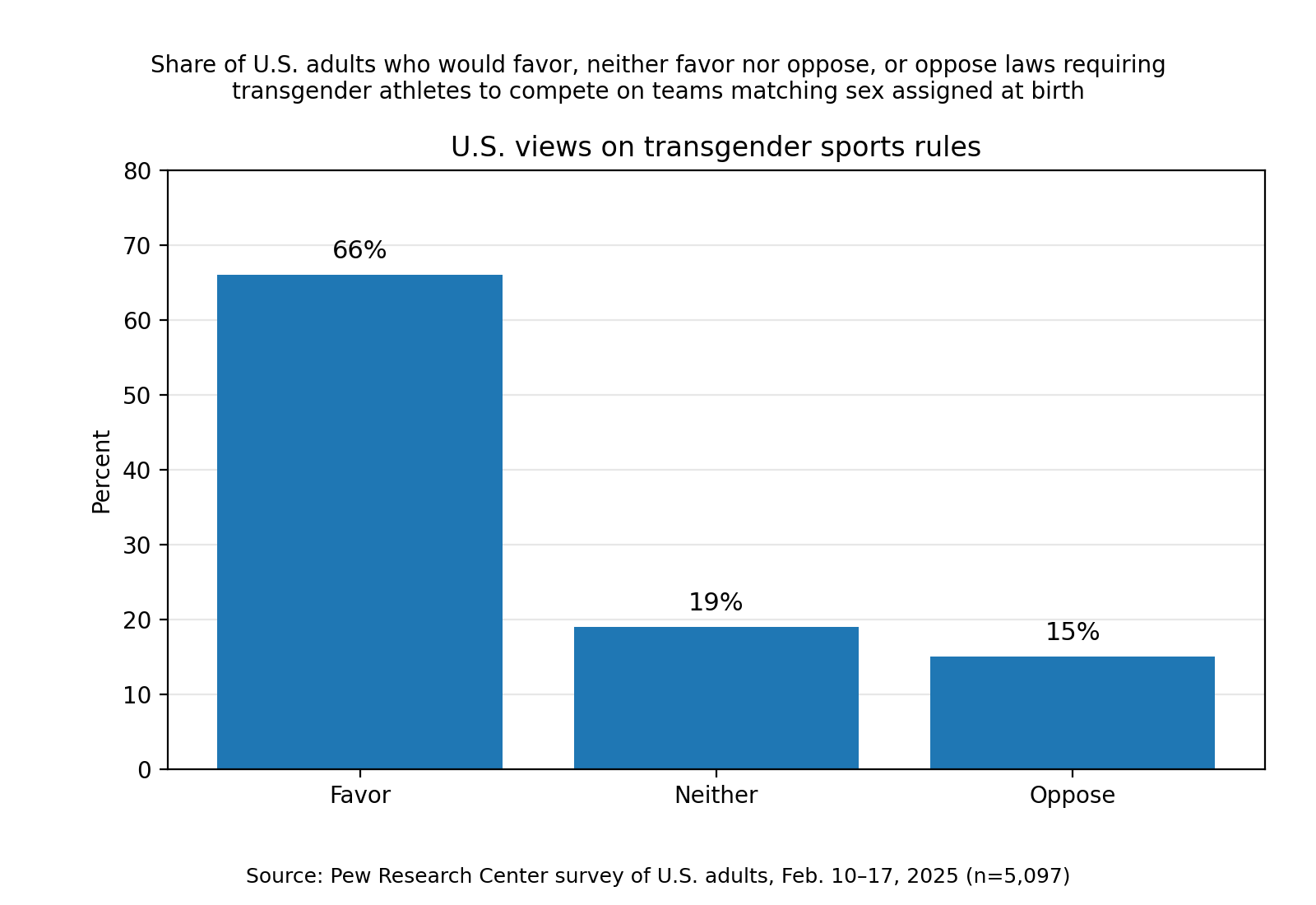
Campaign professionals can read polls. That number tells us something concrete about electoral incentives: a position can be welcomed by part of a party’s activist base and become a liability once the electorate broadens.
That is why Miller’s video matters so much in the Talarico case. According to her account, campaign advisers had encouraged him to back away from transgender positions temporarily, and she predicted that he would “change his tune back” after winning. She even supplied the line that could almost serve as the subtitle to this entire essay: “I think it’s bad advice personally, but if it helps him win, okay.”
What matters now is chronology. What did the politician say before statewide voters were paying attention? What did he vote for before consultants started sanding down the edges? What suddenly became “common sense” when independents showed up? And what survives once the ballots have been counted?
Watch that sequence long enough and the scenery becomes familiar. The sheriff appears, the rifle appears, the factory appears, and Donald Trump’s signature appears. Border enforcement, domestic energy, law enforcement, manufacturing, military toughness, fairness, safety, and bipartisanship suddenly move toward the front of the brochure.
Sometimes the moderation survives the election. Manchin shows that it can. Sometimes the politician is merely highlighting genuine parts of a complicated record. Kerry, Tester, and Ryan illustrate that. Sometimes a campaign avoids telling voters exactly what they would rather not hear. Spanberger illustrates that. And sometimes somebody says one thing when an idea is fashionable and later says he never said it at all. El-Sayed gives us that one almost word for word.
The categories are different. The electoral incentive running through them is not.
The pattern tells you what campaigns believe can survive a primary and what they believe can survive a general election. Liberal politicians do not suddenly feature rifles, border sheriffs, police, manufacturing, domestic energy, and Republican cooperation because those things became aesthetically fashionable in October. Those are the messages their campaigns repeatedly decide are useful when voters outside the progressive base become decisive.
If liberal policies are as popular and persuasive as their advocates insist, there remains an uncomfortable question underneath all of this: why do those policies so often become harder to advertise when everybody gets a vote?
Why the sheriff? Why the rifle? Why the sudden affection for border enforcement, domestic energy, police, manufacturing, military toughness, and Republican cooperation?
If the product is really that good, why does the packaging keep changing before Election Day?
Talarico’s old positions are on the record. His new positions are on the record. His pastor’s prediction is on the record too.
This time, nobody has to rely on memory.
We have the tape.
Don’t Let Them Keep the Change
If you want more investigations like this one, there is a very practical way to help: buy back some of the hours I am currently spending doing other work.
This essay meant digging through years of campaign ads, old interviews, legislative votes, archived statements, news reports, polling, and video clips to compare what politicians said before they needed your vote with what they started saying once they did.
I would rather spend those hours doing this.
Become a Paid Subscriber
If you read regularly and want me to keep digging into political records that candidates would probably prefer you forget, becoming a paid subscriber is the simplest way to help.
Most of the work will remain open. You are not mainly paying to unlock articles. You are helping finance the time it takes to find the old quotes, track down the votes, compare the campaign promises, check the claims, and put the receipts in one place before everybody moves on to the next election.
Become a Paid Subscriber:
https://mrchr.is/help
Make a One-Time Contribution
If you do not want another subscription but still want to throw something in the jar, a one-time contribution helps too.
Sometimes buying back a few hours is the difference between spending the day digging through legislative records and old campaign footage and spending it driving.
Make a One-Time Contribution:
https://mrchr.is/give
Join the Resistance Core
The standard paid subscription builds the floor. Resistance Core helps carry the roof.
Resistance Core is for the small group of readers who believe strongly enough in this work to help fund it at a much higher level. It is $1,200 per year, charged annually, and that kind of support can buy back a meaningful amount of research and writing time over the course of a year.
I already have a handful of people who have stepped up at this level, and several have gone beyond it with additional contributions. I do not take that kind of commitment lightly.
Join the Resistance Core:
https://mrchr.is/resist
Prefer Venmo?
If you prefer a direct one-time option without starting a subscription or using the gift page:
Venmo:
https://account.venmo.com/u/mrchrisarnell
If You Cannot Give
Keep reading.
Share the essay. Restack it. Send it to someone who remembers one version of a politician but never saw the other one. Save the clips. Save the quotes. Save the votes. Compare what they said before the election with what they do afterward.
There are plenty of ways to help this work travel that do not cost anything.