

The modern Democrat Party does not govern with policy; it governs with promises. The policy is merely the inconvenient results that arrive later.
Every stable society rests on an unspoken contract between citizens and those who govern. The public can forgive mistakes, changes of plan, and even failures. What cannot be forgiven is the deliberate lie. When leaders begin to treat persuasion as more important than truth, politics ceases to be government and becomes theater.
Over the past fifteen years, the modern Democrat Party has turned that theater into routine. Its leaders have mastered the politics of reassurance: speak confidently, promise competence, and count on a sympathetic press to translate any failure into good intentions. The pattern has consequences. Americans no longer know whether official statements describe reality or manage it.
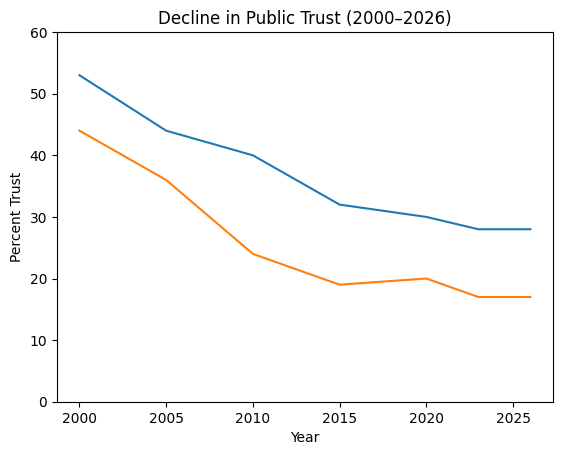
The evidence of that erosion is overwhelming. Gallup shows media trust at roughly 28 percent. Pew finds only 17 percent of Americans trust the federal government to do what is right most of the time. Among young adults aged 30 and under, the number declines further. These are not accidents of mood; they are the direct legacy of being misled by the very people who promised competence and compassion.
Democrat leaders said the Affordable Care Act would preserve existing health insurance. Millions lost coverage. They told Americans that violence abroad was caused by a YouTube video, that Russian collusion was a proven fact, that the border was secure, and that inflation would be transitory. That last one hit home in a way abstract data never could. While officials pointed to charts and declared the economy strong, families were staring at $7 eggs and empty grocery carts. This is the essence of managing reality rather than describing it. By now, the word “transitory” had become a punchline, and the term “Bidenomics” was quietly abandoned by the party itself, a silent admission that the branding failed to override the reality of the grocery receipt. Each claim shared two traits: political usefulness at the time and eventual collapse under evidence.
These are more than broken promises. They form a behavioral map of a party that treats truth as a campaign asset to be leased rather than a civic duty to be honored. The Democrat Party’s leadership class has learned that immediate narrative control matters more than later credibility. The result is a government that performs sincerity for cameras while surrendering honesty in practice.
This first installment traces five major assurances that defined Democrat governance from 2010 through 2026: pronouncements about health care, national security, intelligence investigations, election‑year information, and border policy. In each example, ordinary Americans were told precisely what to believe. In each, the truth eventually demanded revision.
The pattern is not accidental; it is procedural. It teaches the public a grim lesson about how power now operates: official statements are not transparent explanations but deliberate instruments of persuasion. To understand modern politics, one must first recognize that deception within the Democrat Party is not a flaw in leadership; it is its governing method.
1. “If You Like Your Plan, You Can Keep It.”
Barack Obama and the Affordable Care Act
In 2009 and 2010, President Barack Obama and congressional Democrats were pushing what became the Affordable Care Act, often called Obamacare. It was the most sweeping health care reform since Medicare and Medicaid were created in the 1960s.
One of the biggest fears voters had was disruption. Millions of Americans had private insurance plans through employers or the individual market. They wanted to know whether reform would force them to change coverage.
President Obama answered clearly and repeatedly. If you like your plan, you can keep it. If you like your doctor, you can keep your doctor.
Those were not offhand remarks. They were central selling points.
The Affordable Care Act required that health insurance plans meet certain minimum coverage standards. Plans had to include specific “essential health benefits.” They had to comply with new actuarial value requirements. Many lower-cost individual market plans did not meet those standards.
When the law took effect in 2013 and 2014, insurers began sending cancellation notices to policyholders whose plans were noncompliant. Estimates at the time indicated roughly four to five million individual market policies were canceled in the first wave.
These were not random clerical errors. They were the predictable consequence of the redesign of the regulatory structure.
The Obama administration later argued that affected consumers could purchase new plans on the exchanges and that many would receive subsidies. That was true for some. But premiums rose significantly in many markets, especially for middle-class individuals who did not qualify for substantial subsidies.
Between 2013 and 2017, benchmark premiums in the individual market roughly doubled before stabilizing in some regions. Deductibles often increased. Networks narrowed.
The point is not whether the Affordable Care Act achieved some of its stated goals. It expanded coverage. It changed the insurance landscape.
The point is that the categorical promise did not match the policy’s design.
The President of the United States told Americans their existing plans would not be disrupted. Millions were disrupted.
When confronted, the administration shifted language. It spoke of transitions and improvements. PolitiFact, one of the emerging arbiters of “political truth”, named the statement “Lie of the Year” in 2013. However, this was not merely a fact-check; it signaled that the theater had its own critics, yet the show went on. No senior official resigned. The lesson absorbed by future politicians was not humility. It was durability. A bold reassurance could survive a direct contradiction if wrapped in enough moral language.
The lie did not end there. By 2025, with Trump back in office, Congressional Democrats aggressively demanded renewal of the enhanced subsidies they had passed twice under Biden. They forced a government shutdown fight over it, arguing the subsidies were essential to keep coverage affordable. The same Democrats who rammed Obamacare through began saying, “We need to fix healthcare.” Wait, wasn’t fixing healthcare what the ACA was supposed to do? The architects now stood back as if space aliens had created the law, pretending they had nothing to do with its failures while demanding more money to prop it up. That is not governance; it is gaslighting on a national scale.
2. Benghazi and the Early Story
Barack Obama, Hillary Clinton, and the 2012 Election
On September 11, 2012, militants attacked the U.S. diplomatic compound in Benghazi, Libya, killing Ambassador Chris Stevens and three other Americans. At the time, Obama was running for reelection, and Hillary Clinton was Secretary of State.
In the days immediately following the attack, public explanations emphasized a spontaneous protest triggered by an anti-Islam video. Ambassador Susan Rice repeated this on multiple Sunday shows. Internal communications and intelligence assessments, however, indicated officials had early information suggesting the attack was coordinated and carried out by militants.
The distinction mattered. A spontaneous protest suggested unpredictable outrage. A coordinated terrorist attack suggested an intelligence failure or a security misjudgment. The administration later argued that intelligence was evolving. Critics cited internal emails showing officials privately acknowledged the likelihood of a coordinated attack, even as the public narrative emphasized spontaneity.
Multiple congressional investigations followed. The 2012 election proceeded. Obama was reelected. The Benghazi story faded. But the civic residue remained. Citizens watched senior officials offer a confident explanation that later proved incomplete or misleading. The correction did not carry the same weight as the initial reassurance. In Washington, that sequence became familiar. The first explanation shapes public perception. The later revision receives a fraction of the attention. When that pattern repeats, trust declines.
3. Russia Collusion and the Steele Dossier
Donald Trump, Hillary Clinton, and the FBI
The 2016 election shocked the political class. Donald Trump defeated Hillary Clinton despite most polls predicting a Clinton victory. Almost immediately, allegations surfaced that the Trump campaign had conspired with Russia to influence the election.
To understand what happened, separate the two distinct issues. First, Russia attempted to interfere through hacking and online influence operations. That is documented. Second, the question of whether Trump or his campaign coordinated with Russia was treated as an open possibility for years.
The Steele dossier, compiled by former British intelligence officer Christopher Steele and funded through opposition research channels linked to the Clinton campaign and the DNC, contained explosive allegations, many unverified. In October 2016, the FBI used information from the dossier in its FISA application to monitor Carter Page, a former Trump campaign adviser.
The DOJ Inspector General’s 2019 report identified significant errors and omissions in those applications, finding the FBI failed to include exculpatory information and relied on material that had not been fully corroborated. Mueller’s investigation concluded in March 2019 that it did not establish conspiracy or coordination between the Trump campaign and Russia.
That sentence did not erase the previous two years of headlines, commentary, and televised speculation. For many voters, the damage was already done. Gallup surveys between 2016 and 2020 showed sharp partisan divergence in trust in the FBI. Republican confidence dropped significantly; Democrat confidence remained high. The country learned that allegations can dominate public discourse long before they are conclusively established and that investigative processes can become entangled with political narratives. When suspicion becomes atmosphere, trust does not automatically return. It fractures along partisan lines.
4. The Hunter Biden Laptop and the 2020 Election
Joe Biden, Intelligence Officials, and the Gatekeepers
In October 2020, three weeks before the presidential election, at the time, Joe Biden was the Democrat nominee running against President Donald Trump. The New York Post published a report about a laptop allegedly belonging to Hunter Biden. The reporting included emails suggesting Hunter Biden pursued foreign business deals in Ukraine and China and introduced business associates to his father while Joe Biden was Vice President.
The timing was explosive. Within days, fifty-one former intelligence officials signed a letter stating the story bore the “classic earmarks of a Russian information operation.” They did not claim direct evidence it was disinformation; they said it had the hallmarks.
This is where the role of “fact-checkers” became most visible. Organizations that presented themselves as neutral arbiters were not checking facts; they were checking narratives. They provided the moral language that allowed the lie to survive, framing the laptop story as dubious while the election clock ticked down. These organizations have undergone a crisis of authority. “Fact-Check” labels on social media were often viewed by a majority of independents as “narrative-guardrails” rather than objective truth-seeking.
Major social media platforms limited the story’s distribution. Twitter temporarily blocked sharing the link; Facebook reduced its algorithmic spread. Several major news outlets treated the laptop as dubious or unverified. The election proceeded. Joe Biden won.
In 2022 and 2023, major newspapers, including the New York Times and Washington Post, reported that the laptop and many of its emails were authentic. Federal investigations into Hunter Biden’s tax and gun-related matters relied in part on materials from the device. The story was framed as potentially foreign disinformation during the narrow window before voters cast ballots. After the election, the authenticity of key materials was acknowledged. Even if every precaution was taken, the appearance of coordinated suppression erodes confidence. It teaches citizens that some information may be filtered through institutional judgment before they are permitted to evaluate it themselves. Trust weakens when people suspect gatekeepers are not neutral.
5. “The Border Is Secure.”
Joe Biden, Alejandro Mayorkas, and the Record Surge
Immigration and border enforcement have long been contentious, but the period between 2021 and 2024 saw record levels of encounters at the southern border. Throughout those years, senior officials repeatedly described the border as secure or under control.
Customs and Border Protection reported approximately 1.7 million encounters in FY 2021, rising to roughly 2.4 million in FY 2022 and nearly 2.8 million in FY 2023. FY 2024 remained at a historically elevated level of approximately 2.3 million. Cumulative encounters during the Biden administration exceeded nine million.
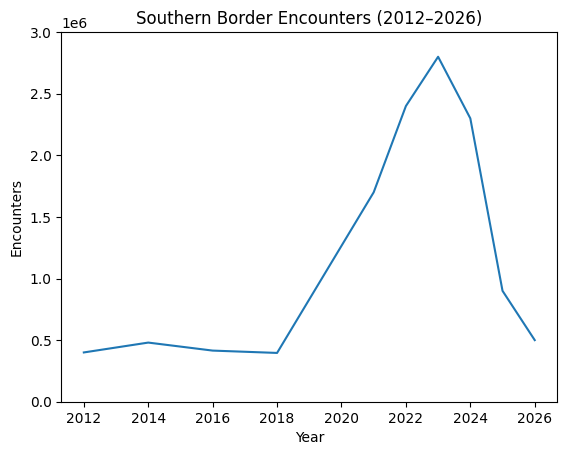
To put those numbers in perspective, annual encounters in the early 2010s typically ranged from 300,000 to 600,000. The period from 2021 to 2024 was unprecedented. Border towns in Texas and Arizona reported overwhelmed shelters and strained local budgets. Governors transported migrants to cities such as Chicago and New York to underscore the pressure. New York City projected billions in long-term expenditures related to housing, healthcare, and education for newly arrived migrants.
Yet public language from the Biden administration emphasized management, processing improvements, and humanitarian standards. Critics focused on volume; officials focused on procedure.
During record surges between 2021 and 2024, the Biden administration repeatedly described the border as secure or under control. After President Trump returned to office in January 2025 and encounters fell sharply, the scale of the previous surge was reframed as a matter of policy preference rather than inevitability. The speed of the decline raised a simple question: if enforcement tools were available all along, why were they not used earlier?
The current reality proves that the previous “it’s as secure as it can be” was a choice, not a necessity. By 2026, the public has realized the government speaks what can only be called Bureaucratic Dialect. “Secure” doesn’t mean nobody is crossing; it means we have enough clipboards to process everyone who does. Exposing that linguistic bait-and-switch makes the lie feel more deliberate. When definitions shift with political convenience, voters notice. When voters notice this pattern enough times, they begin to assume that words are chosen for effect rather than accuracy.
The Pattern So Far
Across these cases, one theme repeats: clear reassurance, contradictory data, reframed language, and limited accountability.
This isn’t just about a polling dip or a 28 percent trust rating. It’s about the father who lost the family doctor who knew his children’s history. It’s about the voter who felt like a conspiracy theorist for believing his own eyes at the border, only to be told four years later that he was right all along. This isn’t just politics; it’s a slow erosion of the shared reality that allows a neighbor to trust a neighbor.
The Democrat Party is not unique in political exaggeration. No party has a monopoly on overstatement. But when overstatement becomes habitual and protected by institutional allies, the damage spreads. Public trust is not destroyed in one dramatic collapse. It erodes in increments. A canceled health plan here. A revised intelligence story there. A narrative that lingers long after evidence shifts. A definition that changes when numbers become inconvenient.
Americans are not simply polarized. They are skeptical.
What Part I shows is how policy reassurance became routine. What follows is more serious. When the same narrative techniques are used not to sell legislation but to shield institutions from accountability, the stakes change.
If Truth Matters, Act Like It
Everyone says they want honesty in public life.
Very few are willing to support it when it costs something.
This publication has no corporate sponsors. No institutional backers. No foundation grants. It runs on readers who believe narrative control should not replace reality.
If you believe the culture of deception needs to be exposed clearly and without euphemism, then back the work that does it.
Paid subscriptions enable long-form investigative writing like this.
There are more than 2,400 readers here. Only a fraction are paid.
Substack’s visibility rankings are driven directly by paid subscribers. Support is not symbolic. It determines whether independent voices rise or disappear.
If even a modest percentage decides that truth is worth eight dollars a month, this publication becomes durable and harder to ignore.
If you want Part II and Part III to go deeper, and if you want this voice to remain independent, now is the moment to act.
Become a Paid Subscriber:
https://mrchr.is/help
If you prefer a one-time contribution to support the work:
Make a One-Time Gift:
https://mrchr.is/give
If you want to strengthen this platform at the highest level:
Join The Resistance Core:
https://mrchr.is/resist
Truth does not sustain itself. It survives when people choose to sustain it.
Hey Chris, you have exposed this despicable group of Dems again and wonder if the party of JFK would even put up with them now since so many are obviously Socialists, Marxists, Communists & radical Progressives who suck up to the One-World Order Globalists big time and seem to hate America, the Constitution and even the basic rule of law governing legal citizenship, imo.
Hey Chris, you have exposed this despicable group of Dems again and wonder if the party of JFK would even put up with them now since so many are obviously Socialists, Marxists, Communists & radical Progressives who suck up to the One-World Order Globalists big time and seem to hate America, the Constitution and even the basic rule of law governing legal citizenship, imo.