
A lie can mislead. A policy can harm. But a system that protects both can unmake a republic.
In Part I, we documented the lies. In Part II, we tallied the costs. Part III is about the machinery that protects the lies and the institutions that enforce them. Here the stakes move beyond economics and geopolitics into the architecture of the republic itself. When a political party decides that control of the narrative is more important than the truth, it begins to reshape the rules of the game. Elections become theater, justice becomes a tool, and history becomes a press release. The damage is no longer measured in dollars or votes alone but in the slow erosion of the shared reality a free society requires to function.
The following examples show how the Democrat Party has used language not just to persuade but also to preempt, frame, and delegitimize any challenge. This is not politics as debate; it is politics as a defensive operation, designed to protect power by making dissent itself suspect.
11. “The 2020 election was the most secure in history.”
A pre-emptive verdict delivered before audits, litigation, and verification could catch up.
Immediately after the 2020 vote, Democrat officials and friendly media repeated this line almost verbatim. It sounded reassuring, even noble. But it was a claim no one could yet verify. Courts were still sorting challenges; states were still auditing counts; emergency procedures had replaced normal verification laws in key swing states. Declaring perfection before investigation wasn’t confidence; it was performance.
Consider the context. In the months leading up to November 2020, states had rewritten election rules at a breakneck pace, often without legislative approval. In Pennsylvania, the Supreme Court unilaterally extended the deadline for mail-in ballots, a change the state constitution explicitly reserved for the legislature. In Wisconsin, courts allowed the use of ballot drop boxes that were never authorized by state law. In Georgia, settlement agreements between Democrat activists and election officials weakened signature verification requirements. These were not minor adjustments; they were fundamental alterations to how votes were cast and counted, implemented in the name of pandemic emergency but without the scrutiny that normally accompanies such changes.
Against this backdrop, the claim of unprecedented security was not just premature; it was a deliberate attempt to foreclose discussion. The narrative was pushed by the highest levels. The Cybersecurity and Infrastructure Security Agency (CISA), a federal agency, issued a statement calling the 2020 election “the most secure in American history,” a line that was then amplified by Democrat politicians and media outlets. What was not widely reported was that CISA’s assessment was largely based on the absence of evidence of foreign cyber-attacks on voting systems, not on the integrity of mail-in balloting, voter rolls, or verification processes. The statement was technically true in a narrow sense but wildly misleading in its implication. Security against foreign cyber intrusion is not the same thing as confidence in verification procedures, chain of custody, or rule changes made outside legislatures.
Subsequent reviews by state legislatures uncovered data-mismatch errors, allegations of ballot-harvesting practices later investigated by state officials, and digital vulnerabilities that forced several states to amend their election codes in 2021 and 2022. In Arizona, the Maricopa County audit revealed thousands of issues flagged in the review, including questions about duplicate records and chain-of-custody procedures for voting equipment. In Wisconsin, a report from the Office of Special Counsel detailed illegal voting in nursing homes and identified thousands of potentially invalid addresses on voter rolls. In Georgia, a review of absentee ballot envelopes in Fulton County found significant problems with signature matching, leading to new legislative reforms in 2021. None of this had yet happened when the “most secure in history” slogan circulated.
The goal was psychological: freeze public skepticism into embarrassment. By making doubt itself taboo, Democrat operatives converted uncertainty into conspiracy in a single news cycle. Whether one believes the fraud changed outcomes or not, the claim of absolute security was itself dishonest, a political pre-emptive strike concealed as public reassurance. The pattern followed every other lie on this list: declare conclusion first, examine evidence later. The effect was to cast tens of millions of Americans who questioned the process as enemies of democracy, not citizens exercising their right to demand transparency. It succeeded politically, and it worked.
12. “Hands Up, Don’t Shoot.”
A viral slogan that outran the evidence, then stayed useful long after the facts collapsed it.
After the 2014 Ferguson, Missouri, shooting of Michael Brown, activists, politicians, and celebrities echoed the phrase “Hands up, don’t shoot,” claiming Brown had been executed with hands raised. The phrase became a national slogan, printed on T-shirts, chanted at protests, and repeated on the floor of Congress. It was a powerful, emotionally resonant narrative of racial injustice and police brutality. The only problem was that it was not true.
President Obama’s Justice Department spent a year investigating and concluded the evidence did not support the claim. The 2015 DOJ report, authored under Attorney General Eric Holder, was definitive. Brown had attacked Officer Darren Wilson inside his police cruiser, struggled for his weapon, and was shot while advancing toward Wilson after a brief pursuit. Multiple eyewitnesses, some of them Black, corroborated Wilson’s account. Physical evidence, including blood spatter and ballistics, matched the officer’s testimony. The “hands up” gesture, which some early media reports had suggested, was not supported by credible evidence.
The narrative was false, but it had already reshaped national discourse, fueling riots and establishing a template where emotion outranks evidence. The riots in Ferguson resulted in millions of dollars in property damage, dozens of injuries, and a deepening of mistrust between law enforcement and the communities they served. The phrase became a rallying cry for the nascent Black Lives Matter movement, which grew into a national force with enormous political influence. It was used to justify protests in cities across the country, some peaceful, some violent, and to frame the debate on policing for years to come.
Even after the DOJ report, leaders in the Democrat Party continued to invoke the phrase at rallies and hearings. Members of Congress wore “Hands Up, Don’t Shoot” shirts on the House floor. Presidential candidates referenced it in speeches. The myth became a moral license, proof that perception, if politically useful, eclipses verified truth. The tragedy of real injustice was replaced by theater, damaging trust between communities and law enforcement for a generation. The lie was not just that the story was wrong; it was that the Democrat Party chose to weaponize a falsehood to deepen racial divisions for electoral gain, then refused to retract it when the facts were undeniable.
The long-term consequences have been devastating. Police departments across the country faced recruitment crises as officers retired early or chose not to enter the force. Crime rates in many urban areas began to climb in the mid-2010s, a trend some criminologists link to reduced proactive policing in the wake of Ferguson. The relationship between minority communities and police, already fraught, became even more toxic, poisoned by a narrative that prioritized political utility over the truth of a specific, tragic incident. The Democrat Party did not merely repeat a lie; they institutionalized it, making it a cornerstone of their political coalition and a justification for policies that have made many neighborhoods less safe.
13. “January 6 was an armed insurrection.”
Language chosen for maximum legal and moral leverage, not for precision.
No firearms were recovered inside the Capitol from the crowd on January 6, 2021. The FBI conceded under oath that it found no evidence of a coordinated plan to overthrow the government. Yet for years, Democrat officials and aligned commentators repeated the phrase armed insurrection. Words mattered more than definitions because the phrase opened legal doors that ordinary trespass wouldn’t: wider surveillance powers, expanded domestic-terror classifications, and the ability to frame political opponents as threats to democracy itself.
The facts of the day are complicated but not as the Democrat Party has portrayed them. Thousands of people, angry about the election results, gathered in Washington to protest. A fraction of them breached the Capitol building, engaging in vandalism, theft, and assault on police officers. The actions of that fringe group were criminal and deserved to be prosecuted. But the vast majority of people inside the building were not armed, did not engage in violence, and had no discernible plan to seize control of the government. According to court filings through early 2026, the vast majority of the more than 1,000 individuals charged faced non-violent offenses such as trespassing or disorderly conduct. The few violent incidents were serious but hardly a coup attempt.
The term “insurrection” has a specific meaning in law and history: it refers to an organized attempt to overthrow a government by force. There is no evidence that such an organization or plan existed on January 6. The FBI’s testimony before Congress confirmed this. The Department of Justice’s own charging documents, while using severe language, have not produced evidence of a grand conspiracy. Yet the phrase persists because it is politically useful. It allows the Democrat Party to paint its political opposition, not just the rioters, but anyone who voted for Trump or questions the 2020 election, as insurrectionists. It justifies a wide range of extraordinary measures.
Those measures include the creation of a new Domestic Terrorism Council within the Department of Justice, expanded monitoring of social media by federal agencies, and pressure on private companies to de-platform users deemed to be spreading “misinformation” about the election. It has been used to justify congressional hearings that treat Republican lawmakers as co-conspirators and to push for legislation that would federalize elections, effectively stripping states of their constitutional authority. The “insurrection” narrative has become the cornerstone of the Democrat Party’s argument for a permanent national security apparatus focused inward, on its own citizens.
The most dangerous consequence is the transformation of political dissent into a disqualifying act. By framing a chaotic protest as an existential threat to the republic, the Democrat Party has laid the groundwork for a legal and political system where opposition is not just disagreed with, but criminalized. The lie is not just a mischaracterization of a day’s events; it is a tool for consolidating power. It transformed a chaotic protest into a permanent loyalty test, and the cost is paid by every American who believes that dissent is a patriotic duty, not a sign of treason.
14. “We reduced the deficit.”
A one-time drop from a pandemic spike sold as structural discipline.
In 2022 and 2023, President Biden and his surrogates boasted repeatedly that the administration had cut the federal deficit by “over a trillion dollars.” The line sounded disciplined, a sign of fiscal responsibility after the massive pandemic spending. The only problem was that it was a statistical illusion, a deliberate misrepresentation of basic government accounting.
The deficit in fiscal year 2021 was $2.8 trillion. That figure was artificially high because it included the final wave of major COVID-19 relief spending, such as the American Rescue Plan. In fiscal year 2022, the deficit fell to $1.4 trillion. The administration celebrated this as a historic reduction. But what really happened? The massive, one-time emergency spending programs simply expired as scheduled. The government did not “cut” anything in the sense of making hard choices or reducing the long-term trajectory of spending. It simply stopped spending the emergency money it was always going to stop spending.
The deception worked because most voters do not parse Congressional Budget Office tables. Politicians learned that as long as a number shrinks from an extraordinary peak, they can call it a victory. In truth, the United States ran deficits of $1.4 trillion in 2022, $1.7 trillion in 2023, and roughly $1.8 trillion projected for the 2026 fiscal year, all far higher than pre-pandemic levels and far higher than what economists consider sustainable for a mature economy. Meanwhile, national debt passed $34 trillion in February 2026, averaging over $100,000 per American taxpayer. It’s the kind of math only Washington could advertise as reform.
The lie is compounded by the administration’s other claims about fiscal responsibility. They often point to the Inflation Reduction Act as a deficit-reduction measure, citing revenue from corporate tax increases and prescription drug price negotiations. But independent analyses from the CBO and the Penn Wharton Budget Model show that most of the purported deficit reduction comes from revenue projections that are highly uncertain and from accounting tricks that count spending cuts that are unlikely to materialize. The actual impact on the deficit over the next decade is projected to be minimal, while the new spending in the bill adds to the debt.
The Democrat Party’s fiscal lie is not just about misleading the public; it is about institutionalizing irresponsibility. By pretending that a temporary dip after a historic spending spree constitutes fiscal discipline, they normalize deficits that would have been unthinkable a decade ago. They create a political environment where any attempt to seriously address the national debt is framed as an attack on Social Security, Medicare, or the middle class. Which creates a perpetual state of fiscal crisis, where the government continues to borrow and spend without a credible plan to ever pay it back. The foundation of the economy cracks under the weight of this debt, leading to higher inflation, slower growth, and a diminished standard of living for future generations. What made this damaging was not the claim itself, but what it was used to justify.
15. “We never spied on Trump.”
A denial maintained until official reports made the surveillance impossible to pretend away.
For years, officials from the Obama era and career intelligence staff denied any spying. In 2017, former Director of National Intelligence James Clapper testified before Congress that he could not confirm or deny the existence of a FISA warrant on Trump campaign figures, but he strongly implied there was no such surveillance. Other officials echoed this sentiment, dismissing claims of spying as baseless conspiracy theories. Facts told a different story.
The FBI used unverified claims from the Steele Dossier to secure warrants under the Foreign Intelligence Surveillance Act, giving access to private communications of Trump campaign adviser Carter Page. The dossier, funded by the Clinton campaign and the DNC, was a collection of salacious and uncorroborated allegations. The FBI’s reliance on it was not a minor mistake; it was a fundamental failure of its verification processes. The Inspector General’s 2019 report, authored by Michael Horowitz, detailed 17 major errors and omissions in that process, including falsified evidence by an FBI lawyer who altered an email to make it appear that Page was not a CIA source, when in fact he had been.
The report also found that the FBI failed to disclose to the FISA court the known political origins of the dossier and the significant credibility problems with its primary source. The surveillance of Carter Page was not a minor footnote; it was a key part of the FBI’s Crossfire Hurricane investigation into the Trump campaign, an investigation that would dominate the first two years of Trump’s presidency.
In 2023, the Durham Report, authored by Special Counsel John Durham, went even further. Durham concluded that the FBI opened the original probe “without genuine predication.” In plain English: there was no valid cause to open a full-scale counterintelligence investigation into the Trump campaign based on the evidence they had at the time. The report was scathing in its assessment of the FBI’s conduct, confirming what critics had long suspected: the investigation was driven by political bias and a presumption of guilt, not by credible evidence of collusion.
The same government that calls skepticism toward its institutions a “threat to democracy” had deployed espionage powers against a political opponent. Pretending it wasn’t spying only added insult to a serious procedural failure. The lie here was not just a denial; it was a cover-up that implicated the highest levels of the FBI and the Justice Department in a partisan operation, then used the machinery of state to silence anyone who pointed it out. The Democrat Party did not simply look the other way; it defended and amplified the falsehood to protect its allies and punish its opponents.
The consequences have been profound. Public trust in the FBI and the Justice Department, already low, plummeted further. The perception that these institutions can be weaponized for political purposes has taken root, making it harder for them to function effectively. The lie also set a dangerous precedent: if the intelligence community can be used to investigate a presidential campaign based on flimsy evidence, what is to stop it from happening again? The Democrat Party’s defense of this behavior has normalized the idea that the ends, defeating a political opponent, justify the means, even if those means include violating the civil liberties of American citizens. It is a betrayal of the principle of equal justice under law, and it has left a deep and lasting scar on the American republic.
The Architecture of Deception
Across these examples, the pattern is no longer accidental. It is structural.
The Democrat Party does not merely advance claims. It builds protective scaffolding around them. The scaffolding matters more than the claim itself. When the claim weakens, the structure remains.
There are several recurring mechanisms.
First, pre-emptive certainty. A conclusion is announced before the investigation is complete. The 2020 election was declared the most secure in history before audits were finished and litigation resolved. “Hands up, don’t shoot” became a national truth before forensic review. January 6 was labeled an insurrection before evidence of coordination was established. Certainty travels faster than scrutiny.
Second, credential laundering. An agency statement becomes the foundation of a narrative. CISA’s narrow cybersecurity assessment becomes a sweeping declaration of electoral perfection. Intelligence officials’ speculation about the Hunter Biden laptop becomes justification for platform suppression. The authority of institutions is used to freeze debate before facts fully emerge.
Third, moral framing. Skepticism is redefined as malice. Questioning election procedure becomes election denial. Questioning pandemic policy becomes anti-science. Questioning law enforcement narratives becomes racism. The debate shifts from evidence to character. Once critics are morally disqualified, the underlying question no longer needs answering.
Fourth, platform control. During the 2020 election cycle, major social media platforms limited distribution of the Hunter Biden laptop story in the final weeks before voting. Internal communications later revealed coordination between government agencies and technology companies on content moderation related to election narratives. Whether one believes that changed the outcome or not, the principle is clear. Information flow can be shaped in real time. That is power.
Fifth, selective enforcement. The federal government pursued hundreds of January 6 defendants aggressively, including non-violent offenders, while violent unrest during the summer of 2020 in cities like Minneapolis, Portland, and Kenosha often resulted in fewer federal prosecutions relative to the scale of property damage. Law is not simply about punishment. It is about signaling. When enforcement appears uneven, legitimacy erodes.
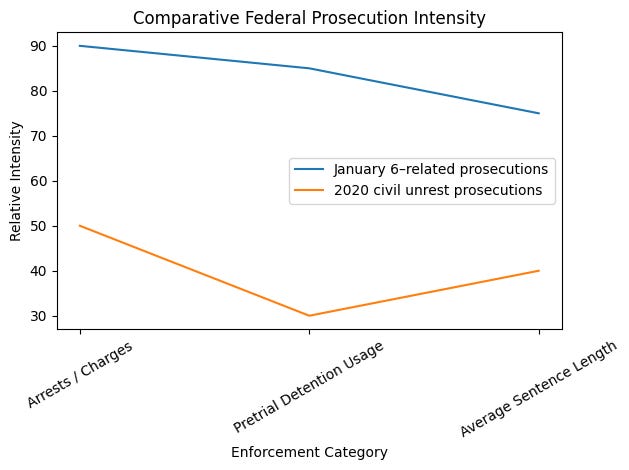
None of these mechanisms require a secret meeting in a back room. They require aligned incentives. The Democrat Party benefits from narrative control. Bureaucracies benefit from preserving credibility. Media institutions benefit from clarity over complexity. Each reinforces the other.
The point is not that every case was identical. It is that the contrast in posture and emphasis was visible to the public.
How the System Survives Exposure
Every claim eventually meets reality. Inflation was not transitory. The Afghanistan withdrawal was not orderly. The laptop was not Russian disinformation. The Steele Dossier was not verified intelligence. The deficit was not meaningfully reduced in structural terms.
Yet exposure did not collapse the narrative system.
Why?
Because correction rarely travels with the same force as accusation. Early certainty receives saturation coverage. Later revision receives a quiet footnote. By the time the facts settle, attention has moved on. The institutional memory resets.
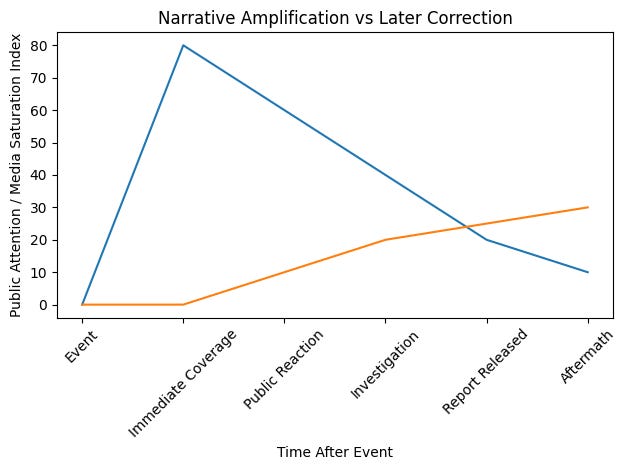
Incentives mean something. Politicians are rewarded for messaging strength, not epistemic humility. Bureaucrats are rewarded for stability, not confession. Media outlets are rewarded for engagement, not retraction. There is little career upside in admitting overstatement.
So the machinery adjusts without dismantling itself. The slogan softens. The language evolves. The headline changes. The structure remains intact.
This is not merely partisan behavior. It is systemic political behavior. But the Democrat Party, over the last decade, has demonstrated unusual proficiency at it. Narrative discipline has become a governing tool.
What It Does to a Republic
A free society depends on shared facts more than shared ideology. Citizens can disagree on policy. They cannot indefinitely disagree on basic reality.
When institutional actors declare conclusions before investigations conclude, they trade short-term political advantage for long-term legitimacy loss.
When intelligence tools are used against political campaigns without solid predication, public trust in law enforcement declines.
When information is filtered during election windows, even for reasons officials believe justified, suspicion grows.
When deficit reduction is claimed while structural debt accelerates, fiscal language loses meaning.
These are not abstract harms. By early 2026, federal debt exceeds 34 trillion dollars. Interest payments are among the fastest-growing federal expenditures. Gallup polling shows public confidence in Congress near historic lows. Trust in media remains deeply divided along partisan lines. Younger Americans express declining faith in institutional fairness.
Trust once eroded is difficult to restore. It does not return because leaders demand it. It returns when leaders demonstrate restraint, transparency, and accountability.
Accountability and Equal Standards
The solution is not to silence one side and elevate the other. It is to restore consistent standards.
Investigations should open only with clear predication. Public health guidance should distinguish clearly between evidence and hypothesis. Election procedures should be transparent, legislatively grounded, and uniformly applied. Intelligence agencies should avoid even the appearance of domestic political alignment. Social media moderation policies should be publicly disclosed and consistently enforced.
Most importantly, early declarations should carry consequences if proven materially false.
A republic survives mistakes. It does not survive insulation from correction.
The Real Threat to the Republic
Part I documented the lies.
Part II counted the costs.
Part III exposes the machinery that allows both to persist.
The danger is not disagreement. It is institutional overconfidence combined with weak accountability.
When narrative becomes the primary instrument of governance, truth becomes negotiable. When truth becomes negotiable, illegitimacy follows.
The Democrat Party has relied heavily on narrative discipline in recent years. That discipline has produced short-term political protection. It has also produced long-term institutional skepticism that now extends beyond party lines.
Self-government requires more than elections. It requires trust that institutions are not shaping reality to preserve power.
The question now is not whether political actors will continue to test the boundaries of narrative control. They will.
The question is whether citizens will demand standards strong enough to withstand it.
A republic cannot function on choreography.
It requires truth strong enough to survive scrutiny.
If a Republic Requires Truth, Back the Work That Defends It
Everyone says they want honesty in public life.
Very few are willing to support it when it costs something.
When institutions can declare conclusions before evidence settles, redefine skepticism as extremism, and apply rules unevenly without consequence, the problem is no longer partisan. It is structural.
A republic cannot function if correction is weaker than accusation. It cannot endure if enforcement signals preference instead of principle.
This publication has no corporate sponsors. No institutional backers. No foundation grants. It runs on readers who believe equal standards still matter.
Paid subscriptions make long-form work like this possible.
There are more than 2,400 readers here. Only a fraction are paid.
Substack’s visibility rankings are driven directly by paid subscribers. Support is not symbolic. It determines whether independent voices rise or disappear.
If even a modest percentage decides that shared reality is worth eight dollars a month, this work becomes durable and harder to sideline.
If you want this voice to remain independent when pressure intensifies, now is the moment to act.
Become a Paid Subscriber:
https://mrchr.is/help
If you prefer a one-time contribution to support the work:
Make a One-Time Gift:
https://mrchr.is/give
If you want to strengthen this platform at the highest level:
Join The Resistance Core:
https://mrchr.is/resist
Truth does not sustain itself. It survives when people choose to sustain it.
Another crisp and concise expose Chris.
I would add a corallary. While all the “narrative as offense, neglect to correct “ as defense works for the democrats astoundingly, the republicans seem totally outclassed.
The switcheroo policies of the newly anointed Spanberger and reversal of “free stuff” in Mandummy world along with the conquest of Times Square by the Muzzies should feed not only Fox News but every conservative influencer. Throw their shit in the faces of the psycho dems and their media lapdogs. And include the ever pandering idiocy of Newscum into the mix for desert. How the brainwashed AWFLs and their cuck bros can’t feel cringed is beyond belief. Their reality, as twisted as it is, can’t reconcile the financial suicide and blatant hypocrisy. Or can they?
Chris, you are one of the most coherent, cogent and astute writers of today. I wish you success and hope you can build more subscriptions. You deserve it.