


George W. Bush called Islam “a religion of peace.” History raises a harder question: How much was spread by persuasion, and how much by force? Peace sells, but who’s buying?
For over four years, my wife and I drove our kids to flag football practice and games four nights a week. The trip became so routine that I could practically do it without thinking. Load the car, find the cleats, make sure nobody forgot a water bottle, sit through traffic, watch practice, then head home and do it again a couple of days later.
About five minutes away sat the Islamic Center of Brushy Creek.
I knew the mosque was there. I had seen the building countless times. What I did not know was how it started, how much it had grown, or what its leaders still intended to build around it.
Then I found the master plan.
That is what they called it. Not a critic. Not a conservative activist. Not some anonymous account posting grainy screenshots online. The Islamic Center of Brushy Creek published a master plan explaining how a small house used as a mosque would become a much larger religious, educational, recreational, medical, and community complex.
The center began in 2007 on a little more than six acres. A 1,950-square-foot house served as the mosque. The land had been purchased for $750,000 through donations and interest-free personal loans from local Muslims. According to the center, roughly 500 Muslim families lived within ten miles, and the surrounding Muslim population had more than doubled in less than ten years.
That small house did not remain a small house. The center expanded through a planned series of phases that added infrastructure, utilities, landscaping, lighting, a detention pond, 230 parking spaces, a children’s play area, and a college-sized basketball court. It then built a two-story mosque capable of holding more than 900 worshippers.
The next phase called for an education and activities center with classrooms, a library, conference rooms, offices, an information technology center, and a medical clinic. Another phase included a multipurpose hall.
Its planning documents discussed social trends, political trends, community growth, security, future needs, and lessons learned from other Islamic center projects. The stated goal was to become a comprehensive center of learning and spirituality for Muslims of all ages.
While my children were learning routes and pulling flags a few minutes away, this center was carrying out a long-term expansion plan.
I had driven past the future four nights a week without understanding what was being built.
That is probably how most people experience cultural change. There is no siren. No government alert appears on the phone announcing that a religious outpost is becoming the center of a self-sustaining community. People go to work, take their children to practice, buy groceries, complain about traffic, and live ordinary lives while another classroom, school, cemetery, charity, sports facility, or political organization is added.
First comes the mosque. Then comes everything needed to preserve and expand the community around it.
That is when the comparison hit me.
McDonald’s.
It sounds ridiculous until you stop thinking about hamburgers and start thinking about systems. What I had been watching five minutes from football practice was the McDonald’s model of Islamification: establish the location, build the supporting institutions, adapt to the local market, and make the whole thing permanent.
The Hamburger Was Never the Whole Business
Most people assume McDonald’s became a worldwide empire because people liked its hamburgers. The hamburgers helped. So did the fries, the drive-through window, the toys, the advertising, and those yellow arches children recognize before they can read the company’s name.
But plenty of restaurants sell hamburgers. Most never become international institutions.
McDonald’s succeeded because it figured out how to reproduce itself. It took one restaurant model and broke it into a system that could be opened almost anywhere. Find the property. Recruit a local operator. Standardize the equipment, food, service, branding, and procedures. Make a few adjustments for local tastes without surrendering the company’s identity, then open another location wherever demand can support one.
The operator running a McDonald’s in Cedar Park does not need to know the operator in New York, Toronto, or Germany. They do not gather for secret meetings about global hamburger domination. They follow the same basic system, which is why the stores remain recognizable even when the menus change.
McDonald’s also understood something most customers never consider. The hamburger is not always the most valuable part of the business, and neither is the franchisee. The location may be worth more than both.
Under its conventional franchise model, McDonald’s often owns the property or controls the long-term lease. The local operator pays rent and royalties while investing in much of what operates inside. Franchisees may fail, retire, or be replaced, but the company keeps its foothold.
That arrangement separates temporary management from permanent control. The person behind the counter may change, but the arches stay.
Islamic institutions can develop in much the same way. Mosques, schools, cemeteries, charities, seminaries, businesses, and community centers remain after the generation that founded them is gone. Children inherit what their parents built. Boards change. Imams leave. Donors die. The institution survives.
Sometimes the land is placed into a waqf, an Islamic religious endowment intended to preserve property permanently for a religious or charitable purpose. In that arrangement, future generations cannot casually sell the land because they no longer share the founders’ priorities.
McDonald’s controls locations to preserve a commercial network. A waqf can preserve a religious one.
Once I understood that, the growth around me looked less like a collection of unrelated buildings and more like a system.
Five Minutes From Football Practice
The Islamic Center of Brushy Creek is not merely a room where people gather for Friday prayer. Its own documents describe spiritual, educational, cultural, recreational, medical, social, and outreach functions. The plan included classrooms, a library, a multipurpose hall, a fitness center, a children’s play area, a basketball court, a day care center, a medical clinic, and community services.
Large churches operate schools, food pantries, hospitals, recreation programs, and charities. Synagogues maintain schools and social organizations. Catholics built entire educational and medical systems. Muslims have the same legal right to build institutions.
The point is not that Muslims should be forbidden from doing what other religious communities have done. The point is that Americans should stop pretending they are looking at nothing more than a prayer room.
The center began with a small house. It expanded into a mosque. The mosque became the anchor for a broader community structure.
A separate project near the same area involved plans for a kindergarten-through-eighth-grade building. The article describing the project referred to the Islamic center as a “church.”
Maybe that was a generic category used by the publication. Maybe it was careless wording. Either way, it made the project sound familiar in a way that concealed what was actually expanding.
A mosque is not a church. An Islamic school is not simply another generic private school. It exists to educate children within Islam and preserve that identity into the next generation.
A few miles north, Renaissance Academy provides an even clearer example.
The Islamic school says it raised $3.3 million to purchase nineteen acres in Leander for a much larger campus. It reports that Austin has experienced a “massive influx” of Muslims, that the current school is at capacity, and that more than 200 students are on its waiting list.
The school does not describe the project as a temporary solution. It says the campus is needed for future generations.
Its stated mission is to graduate students with academic excellence, leadership skills, strong moral principles, and the ability to fully live the values of Islam.
Again, nobody had to uncover a secret document. The school says what it wants to build and why.
The sequence is not exactly hard to follow. Muslim families create demand for Islamic education. The school opens. The school fills. The institution buys nineteen acres and prepares for the next generation.
The population creates the school, and the school helps preserve the population’s religious identity.
Then the process repeats.
From Preschool to Burial
Once I looked beyond one mosque and one school, the regional picture became much clearer.
An Austin-area Muslim directory lists at least fourteen mosques and Islamic centers across North Austin, downtown, Cedar Park, Round Rock, Lake Travis, Pflugerville, Manor, Leander, Georgetown, Kyle, and other nearby communities.
Several provide far more than prayer. They offer classes, humanitarian help, lectures, youth activities, social services, and community events.
The same directory lists multiple Islamic educational institutions. Austin Peace Academy provides education from preschool through twelfth grade. Renaissance Academy offers preschool through college-preparatory high school. Darul Uloom teaches Quran memorization and recitation. Ridwaan Seminary provides organized Islamic study. Mohammadi Institute teaches Arabic, Islamic law, theology, spiritual development, Quranic recitation, leadership, social welfare, and community service.
Then there is the cemetery.
The Islamic Center of Greater Austin says its Muslim cemetery began with a twenty-acre waqf donation outside Austin. Because the land is permanently dedicated, Muslim families receive burial space without paying for the land itself.
The network now serves the community from preschool to burial.
First come the mosques, then forced marriage, then Muhammad Jr. in a taxpayer-funded baby carriage.
That is not one mosque serving a few worshippers. It is regional infrastructure. The mosques gather the community. Schools educate children. Seminaries train teachers and religious leaders. Charities help families. Cemeteries hold the dead. Businesses provide familiar food and services. Advocacy organizations represent political interests. Each piece makes the other pieces more useful.
One location provides a product. A network sustains a way of life.
This is where immigration becomes more than a head count. New arrivals do not enter an empty landscape. They can move into a region where worship, education, food, social connections, burial services, religious instruction, and community organizations already exist.
At that point, the community no longer depends on immigration alone. It has built the machinery to reproduce itself locally.
Islam Did Not Become Political by Accident
Many Americans think of religion as private. People believe what they want, attend services, raise children according to their values, and otherwise live under the same civil law.
Islam did not begin that way.
Islamic organizations themselves explain that Muhammad’s migration from Mecca to Medina in 622 transformed a small religious movement into a unified community that became the foundation of an Islamic state. Within about a century, Islamic rule had expanded from Spain toward the borders of China.
That is not the history of a private faith that somehow became political centuries later. Islam became political during the lifetime of its founder.
Muhammad was a religious teacher, but he was also a ruler, military commander, judge, and lawgiver. The system built around him dealt with worship, marriage, inheritance, finance, punishment, war, government, and the relationship between Muslims and people outside the faith.
The mosque, law, government, and military authority were not separate inventions added long after Muhammad died. They were part of the original model.
That does not mean every Muslim in America wants an Islamic state. Many Muslims came to the United States because they wanted freedom from corrupt governments, religious repression, war, poverty, or instability. They work, serve in the military, own businesses, coach sports, and raise American children.
Millions may barely understand Islamic political history, just as millions of Christians know little about Christian theology or history.
But the character of individual Muslims is not the same question as the institutional character of Islam.
A decent person can belong to a system without supporting every doctrine or historical consequence associated with it. That is true of religions, political parties, governments, corporations, universities, and labor unions.
The argument is not that every Muslim is an Islamist. The argument is that Islam did not arrive in history as religion separated from state power. It combined the two almost immediately.
That distinction becomes important when Western leaders insist that political Islam is some strange corruption completely detached from the religion itself. The historical record does not support such a simple separation.
No Global Headquarters Required
One common response to concerns about Islamification is to demand proof of central control.
Who is issuing the orders? Where is the headquarters? Are Muslims in Texas coordinating with Muslims in Dearborn, Minneapolis, London, Paris, Cairo, or Tehran?
Usually not, and they do not have to.
Two McDonald’s operators can build similar restaurants without ever speaking. They follow a shared model, display familiar symbols, serve similar products, and reinforce the same brand.
Islam is far more diverse than any corporation. Sunnis and Shias disagree. Arabs, Persians, Turks, Africans, South Asians, Southeast Asians, Europeans, and Americans have different cultures and political histories. Some Muslims are secular. Some are reformers. Some are traditionalists. Some are Islamists. Some rarely practice at all.
There is no worldwide Islamic chief executive controlling every mosque.
Still, Muslim communities in different cities repeatedly build similar institutions because those institutions answer the same needs. A mosque provides prayer and community. A school preserves religion among children. A charity assists families. A cemetery provides burial according to Islamic rules. A seminary trains teachers. Businesses provide halal food and familiar services. Political organizations protect group interests.
No secret memo is required. Families attempting to preserve their religious identity naturally build institutions that make preservation easier.
That is not much of a conspiracy. It is simply replication.
Americans tend to look for a secret room, a coded memo, and some villain giving orders. We are less prepared to recognize a decentralized system in which thousands of people independently build the same kinds of institutions because everyone already understands which parts are useful.
Same Brand, Different Menu
McDonald’s does not sell the exact same menu in every country. The company changes products, ingredients, advertising, and portion sizes according to local tastes, religion, culture, and income. Those adjustments are not a rejection of the brand. They are how the brand enters the market.
Islamic organizations also speak differently depending on the audience.
In the United States, Islam is usually presented through religious freedom, civil rights, minority protection, representation, and opposition to discrimination. Those are powerful arguments in a country that correctly protects worship.
In Europe, the language may focus more heavily on refugees, colonial guilt, multiculturalism, welfare rights, exclusion, and hate speech.
On university campuses, Islam often arrives through Palestine, anti-imperialism, resistance, decolonization, and solidarity with oppressed groups.
When addressing social conservatives, the emphasis may shift toward modesty, family structure, discipline, large families, opposition to pornography, and rejection of Western sexual disorder.
Same basic product. Different sales pitch.
This does not mean every Muslim who discusses discrimination is lying. Anti-Muslim hatred exists. People have been threatened or attacked because of names, clothing, accents, or religion. Those acts should be punished.
But successful movements learn which arguments open doors. Political Islam does not need to enter an American university by leading with apostasy penalties, blasphemy law, or the supremacy of Sharia. It can enter through victimhood, identity politics, Palestine, and opposition to colonialism.
Once accepted, the less attractive parts of the system can remain undiscussed.
More Than One Way to Expand
Islam did not spread only by force, but it also did not spread without force.
Islam expanded through preaching, trade, migration, marriage, family formation, political patronage, taxes, economic advantage, legal privilege, and military conquest. The mixture differed across countries and centuries.
In some regions, merchants and missionaries introduced Islam gradually. In others, Muslim armies conquered territory and established rule over non-Muslim populations. Conversion might happen quickly or take generations.
People did not always have to convert at sword point. Legal and economic advantages could make conversion the safer or more profitable choice. Taxes, social status, marriage rules, government access, and political power can pressure people without a soldier standing over them.
Islam used whatever method was available. Where preaching worked, people preached. Where borders were open, people migrated. Where family growth and schools could preserve identity, those institutions carried the faith forward. Where voting created political leverage, organizations entered elections.
Historically, when Muslim rulers possessed military superiority, they used it.
This does not mean Muslims in Texas are preparing for military conquest. It means Islamic expansion has never depended on only one tool.
The method tends to follow whatever opportunity is available.
Citizenship Is Not Assimilation
A McDonald’s can be locally owned. The operator may live nearby, hire local teenagers, sponsor sports teams, and join the Chamber of Commerce.
That local face makes a global system feel domestic.
The same can be true of Islamic institutions. A mosque may be built by American citizens. Its members may pay taxes, serve in the military, own businesses, attend PTA meetings, and vote. Their children may speak with Texas accents and have no personal connection to another country.
None of that proves disloyalty, but it does not automatically prove assimilation either.
Citizenship answers a legal question. Assimilation answers a cultural and political one.
Does American law remain supreme when it conflicts with religious law? Is a Muslim free to leave Islam, become a Christian, or become an atheist without intimidation? Can an American newspaper insult Muhammad as freely as it insults Jesus? Are women and homosexuals entitled to equal civil protection even when religious doctrine says otherwise?
Those questions should apply to every immigrant group, every religion, and every political movement.
A passport tells us which country someone belongs to. It does not tell us which political system that person believes should ultimately govern.
The most important divide is not Muslim versus non-Muslim. It is between people who accept constitutional law as the permanent rule for everyone and people who see constitutional freedom as temporary or conditional.
Muslims who support constitutional supremacy may be among the strongest opponents of Islamism.
Open Here, Closed There
Britain allows Muslims to build mosques, operate schools, preach, seek converts, organize politically, hold public prayers, and use British courts to protect their rights.
Saudi Arabia grants no comparable public freedom to Christianity.
There are no public church networks in Saudi Arabia comparable to the mosques operating across Britain. Private non-Muslim worship may be tolerated in limited circumstances, but the public religious marketplace remains closed.
The answer is not for Britain to imitate Saudi Arabia. British freedom is morally superior and should remain so.
But moral superiority does not require pretending reciprocity is irrelevant.
Islam uses Western religious liberty to establish permanent institutions, gain converts, educate children, and organize politically. Christianity cannot do the same in the birthplace of Islam.
Saudi Arabia is more restrictive than many other Muslim-majority countries. Churches exist in Lebanon, Jordan, Egypt, Indonesia, the United Arab Emirates, and elsewhere, although the level of genuine freedom varies.
Saudi Arabia still illustrates the imbalance. The West usually treats religious liberty as a universal right. Saudi Arabia treats Islamic supremacy as the rule and tolerance of other religions as a private exception.
Somehow, that enormous difference is treated as cultural diversity rather than a warning. Then everyone meets for another interfaith luncheon and a plate of cookies.
Dearborn Is Not the Whole Country
America’s Muslim population remains small nationally. Older estimates placed it at roughly 1.1 percent of the population in 2017, with projections around 2.1 percent by 2050.
Those numbers do not suggest America will become Muslim anytime soon, but national percentages can conceal local power.
A community representing 2 percent of the country may represent a much larger share of one city, school district, legislative seat, or Democrat primary. Political influence does not require a national majority. It requires enough organized voters in the right locations.
Dearborn developed a major Arab and Muslim institutional presence, elected Muslim leadership, recognized Eid for municipal workers, and became important in national elections.
The Census does not ask religion, so exact Muslim percentages are difficult to prove. Nobody needs a religious Census question, however, to see the mosques, businesses, advocacy organizations, political officials, and campaign attention surrounding the city.
Minneapolis developed through a different population. The Twin Cities became home to the largest Somali community in the country, followed by mosques, businesses, nonprofits, elected officials, and political organizations. Minneapolis later removed time restrictions on amplified calls to prayer, allowing them throughout the day under general noise rules.
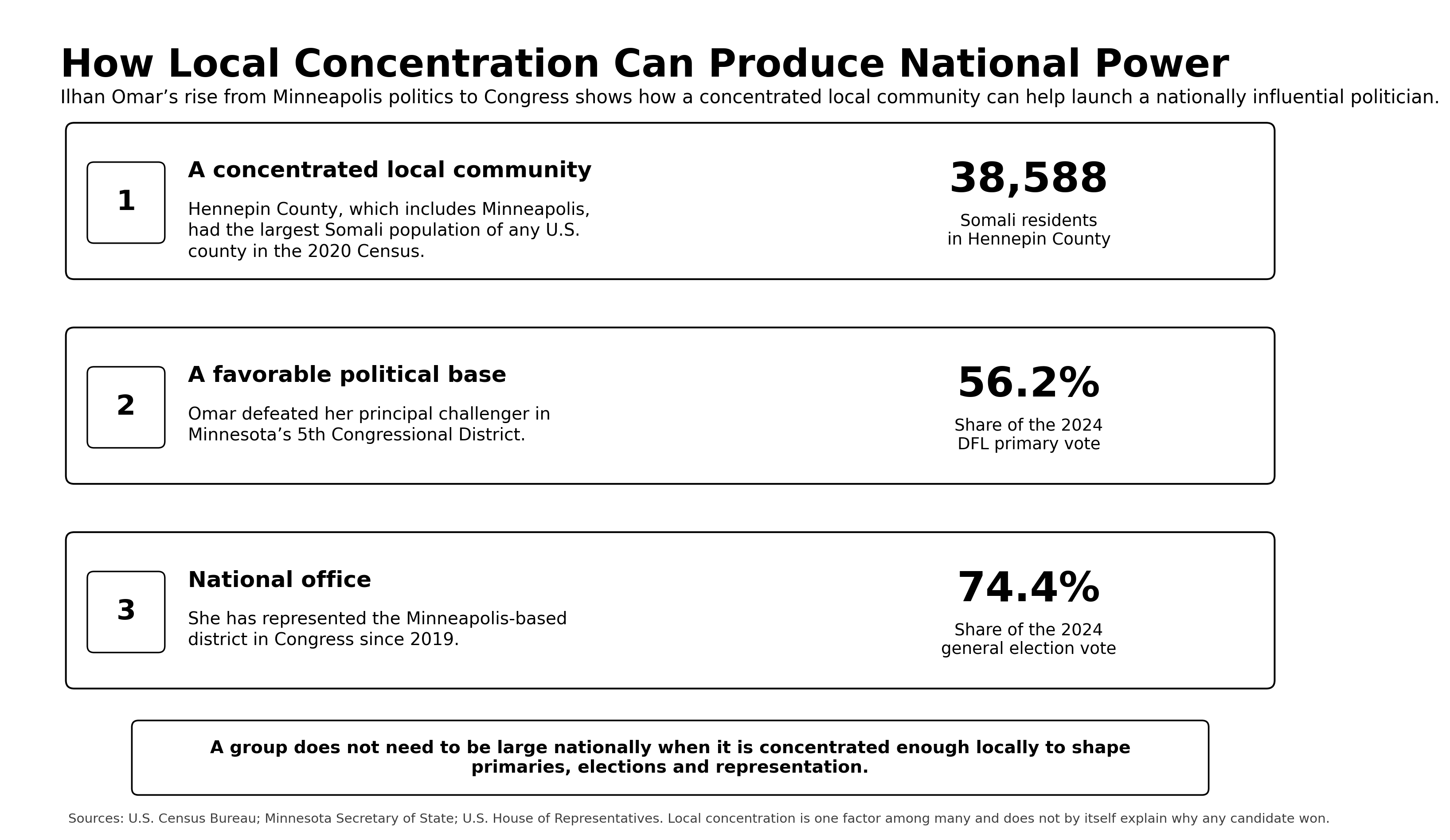
That is not Sharia law. Church bells and other religious sounds may receive similar legal treatment.
It is still an example of public culture changing after demographic concentration becomes political organization.
Immigration creates concentration. Concentration supports institutions. Institutions preserve identity. Preserved identity enables political organization. Political organization changes what elected officials approve.
Dearborn does not automatically produce an Islamic Michigan, but something that happens locally can happen on a larger scale.
Countries do not change all at once. They change through neighborhoods, cities, schools, courts, legislative seats, political parties, and generations.
A country eventually becomes a collection of places that changed earlier.
Dearborn is not the takeover. It is the prototype.
When Prayer Becomes a Public Census
Muslims have the same right to gather and pray as Christians, Jews, Hindus, or anyone else.
A photograph of Muslims praying outdoors does not prove that the people involved support Islamism. A peaceful crowd does not become threatening because it is Muslim.
Large public gatherings still communicate something beyond private belief. Thousands of people filling a street, park, convention center, or public plaza display numbers, confidence, discipline, organization, and the ability to mobilize.
The purpose may be devotional, but the effect is public.
The same principle applies to political rallies, union marches, evangelical gatherings, Catholic processions, and demonstrations. Groups gather publicly partly because public numbers communicate strength.
The mosque establishes the location. The gathering shows the size of the network.
One worshipper demonstrates faith. Ten thousand worshippers filling a civic space also conduct a census in public.
The Religion of Peace Sells
“The religion of peace” may be one of the most effective slogans ever attached to a religion because it often ends the discussion before it begins.
What about jihad? Religion of peace.
What about apostasy law? Extremists.
What about blasphemy laws, criminal penalties for homosexuals, restrictions on religious minorities, or unequal treatment of women? Those are cultural practices, political distortions, poverty, colonialism, or Islamophobia.
Some of those explanations may contain truth. Muslim societies differ, history differs, and not every abuse in a Muslim country comes directly from scripture.
The slogan still serves a political purpose. It substitutes the peaceful behavior of many individual Muslims for an examination of Islamic history, doctrine, law, and political tradition.
Millions of satisfied customers do not tell us everything about a company’s property strategy, franchise rules, labor system, or long-term plans. Peace may be the advertisement, but the franchise agreement still deserves to be read.
Most Muslims in America are peaceful. That is not the hardest question.
The difficult questions concern whether constitutional law will always remain supreme, whether people will retain the freedom to leave or ridicule Islam, and whether Islamist organizations can use the civil rights of ordinary Muslims to shield political goals from scrutiny.
The categories are constantly blurred. Criticize Sharia, and the criticism may be called hatred of Muslims. Investigate foreign financing of a mosque or political organization, and the investigation may be described as an attack on a minority. Question immigration from countries with strong Islamist movements, and the policy debate may be dismissed as religious prejudice.
Sometimes that accusation is justified. Some people use serious concerns as an excuse for crude hostility.
But Muslims and Islam are not the same category. Muslims are people with civil rights. Islam is a body of religious, historical, moral, and political claims.
Equal rights for Muslims do not require intellectual immunity for Islam.
Someone Approved the Permit
No McDonald’s appears in a neighborhood by magic. Someone controls the property. Someone finances construction. Someone approves zoning, connects utilities, supplies the equipment, and gives the restaurant access to customers.
Islamification is not simply something Islamic institutions do to the West. Western institutions repeatedly help.
Immigration systems admit populations. Universities provide ideological protection. NGOs offer advocacy. Corporations supply charitable matching funds and legitimacy. Courts grant accommodations. Media organizations often treat criticism of Islam as a moral defect. Political parties identify new constituencies and begin adjusting their language.
It is not hard to see why the Democrat Party likes the arrangement.
Modern progressive politics divides society into oppressors and victims. Muslims in Western countries can be placed inside a protected minority category, even though Islam governs majorities across dozens of countries.
Islamist organizations gain civil-rights language, campus allies, sympathetic media, nonprofit funding, public officials, and political access. The Left gains another constituency whose grievances can be directed toward Western history, Christianity, capitalism, Israel, and traditional national identity.
The partnership works until someone notices that the two sides do not believe the same things.
The modern Left celebrates abortion, feminism, homosexuality, sexual autonomy, and secular government. Political Islam has often opposed all of them when it has the authority to do so.
Hamtramck offered a small preview. Its Muslim-majority city government restricted which flags could be flown on public property, excluding Pride flags along with most private identity flags.
There is a reasonable argument for keeping government flagpoles free of activist symbols. The revealing part was watching progressives discover that Muslim political representation does not necessarily produce secular liberals who simply eat different food.
The partnership works while both sides share enemies. It becomes less comfortable when one side gains enough authority to act according to its own beliefs.
The Left thinks it is recruiting another voting bloc. Political Islam may see the Left as a temporary franchise partner.
Europe Is Not a Prediction
Europe does not prove what America must become.
It does show what decades of Muslim immigration, low native fertility, geographic concentration, weak assimilation, institutional growth, and political accommodation can produce.
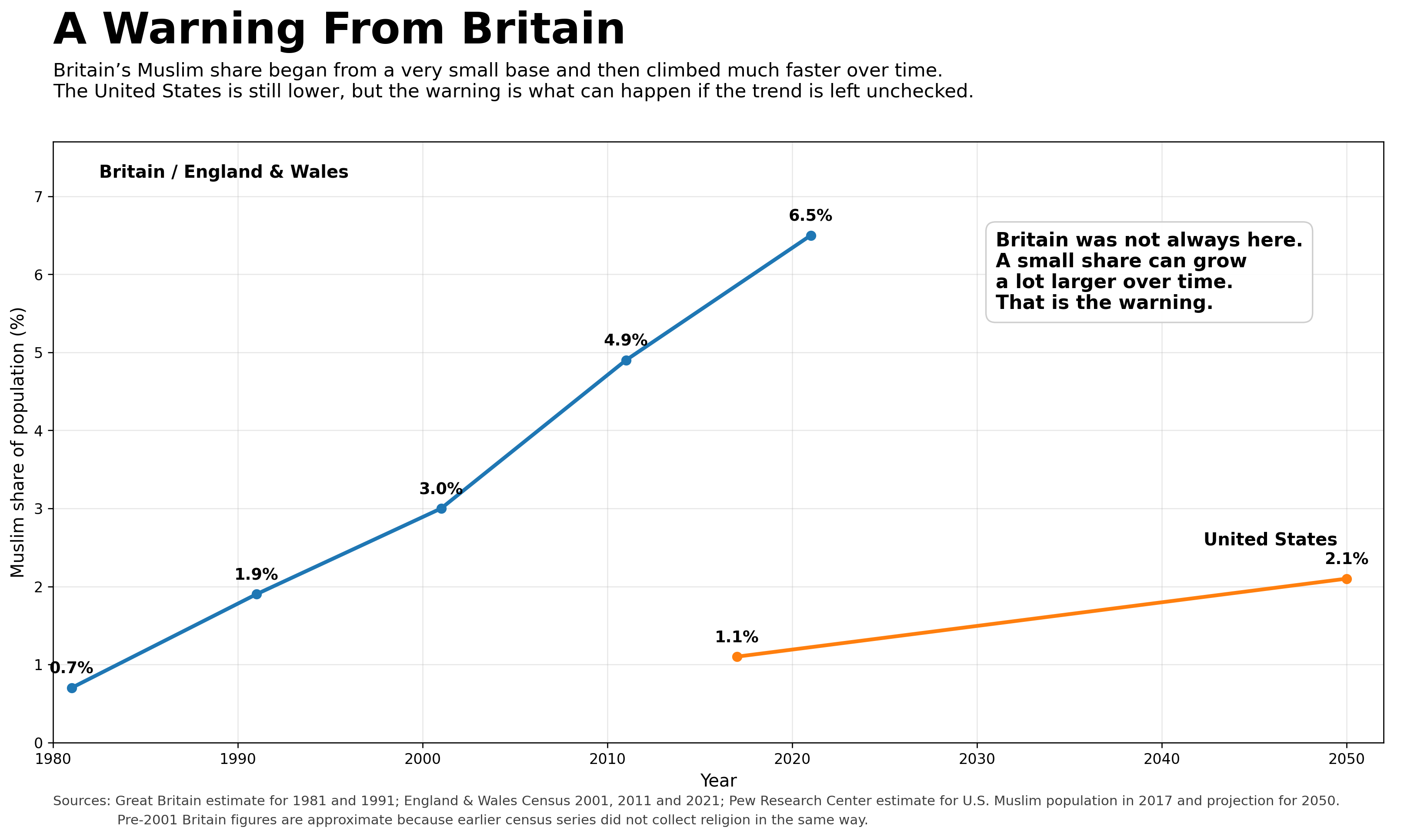
Millions of European Muslims speak the national language, hold jobs, raise families, and live peacefully. Other communities have experienced separatism, extremism, crime, hostility toward Jews, pressure against women, intimidation of former Muslims, and increasing demands for accommodation.
Demographic projections have shown Muslim shares rising even under scenarios where migration stops, largely because Muslim populations are younger and native European populations are aging or declining.
That does not prove Europe will become Muslim. It proves closing the door later does not erase the people, births, institutions, schools, neighborhoods, and political influence already established.
America has advantages Europe often lacked. We have stronger speech protections, a deeper history of assimilation, greater geographic dispersion, and a smaller Muslim population share.
We are also importing many of Europe’s weaknesses: elite guilt, multicultural bureaucracy, open-ended immigration, fear of offending organized minorities, and reluctance to demand assimilation.
“Not Europe yet” is not a reason to continue Europe’s policies. It is the reason to stop.
Billions Served. Millions Slain.
McDonald’s once advertised the number of billions it had served.
Islam has a darker historical ledger.
Billions served. Millions slain.
That is not an audited death count. No historian can calculate every person killed in the name of Islam over fourteen centuries. Empires fight over land, power, money, ethnicity, dynasty, security, and religion, often at the same time.
Ancient casualty figures are unreliable. Modern conflicts rarely have only one cause. There is no need to invent an inflated number because the documented history is already bad enough.
Muslim empires expanded through major wars of conquest. Islamic law often placed Muslims and conquered people in different legal categories. And governments and militant groups acting openly in Islam’s name have killed just about everyone on the list, including plenty of Muslims.
Modern Islamist terrorism alone has killed hundreds of thousands, most of them Muslims. That does not include many battlefield deaths, sectarian wars, state repression, indirect deaths caused by war, or older campaigns for which reliable records do not exist.
Christian kingdoms, communist governments, secular empires, tribes, and modern nation-states have also killed millions. Islam does not have a monopoly on violence.
It should not be given a monopoly on historical innocence.
The slogan advertises peace. History records the acquisition costs.
No Alarm Will Announce the Final Line
There is no scientific formula proving America is safe at 6.9 percent Muslim and doomed at 7 percent. Anyone claiming that level of precision is making it up.
Fertility may fall. Intermarriage may increase. Religious belief may weaken. Immigration laws may change. Muslims may assimilate while keeping their faith.
But proving that 7 percent is not a magic number does not answer the real concern.
Political and cultural change would probably happen unevenly. One neighborhood becomes heavily Muslim. Then a municipality. Then a school district, legislative seat, or regional coalition.
Candidates begin depending on concentrated voters. Institutions become harder to challenge. Accommodations become precedents. Criticism becomes professionally expensive.
By the time the national percentage frightens everyone, local concentrations may have exercised political power for decades.
There will not be a federal alert announcing that the country crossed the final reversible line. Once almost everyone agrees it happened, it probably happened years earlier.
That is why the issue must be addressed while normal constitutional policies remain enough.
America does not need to persecute Muslims, prohibit mosques, or deny citizens equal protection. It needs enough confidence to distinguish religious liberty from political surrender.
One civil law must apply to everyone. Apostasy must remain legal. Blasphemy must remain legal. Women and homosexuals must retain equal civil protection. Political authority must remain with the Constitution and the American people, not with a religious text, imam, priest, pastor, or rabbi.
Foreign funding of mosques, schools, charities, and political organizations should be transparent. Immigration policy should consider assimilation, national cohesion, geographic concentration, and constitutional compatibility instead of pretending labor demand and humanitarian emotion are the only questions.
Muslims who support those rules are not enemies. They may be essential allies against Islamism.
Political movements that reject those rules should not receive immunity because they operate through religious institutions.
The Master Plan Was Five Minutes Away
I started with McDonald’s because it offered a simple way to explain a complicated process.
The more I researched, the more I realized the model was already operating around me.
The Islamic Center of Brushy Creek began with a small house used as a mosque. It expanded into a larger worship center, parking, recreation, education plans, community services, and future facilities.
A few miles away, Renaissance Academy raised millions for nineteen acres because its Islamic school was full and more than 200 children were waiting.
Across the Austin area, a larger network of mosques, schools, seminaries, charities, funeral services, and permanently endowed cemetery land serves the community through every stage of life.
That does not prove every Muslim is plotting anything. It proves plotting is unnecessary.
Families create demand. Institutions meet that demand. Those institutions preserve the community that produces the next round of demand.
McDonald’s did not conquer the world because everyone wanted the same hamburger. It developed a system that could adapt without losing its identity, expand through local operators, secure permanent locations, and become part of the scenery before most people stopped to think about how much the landscape had changed.
Islamification does not require an army outside Washington, every Muslim joining a secret plan, or a caliph issuing instructions from a hidden room.
Open entry, permanent institutions, concentrated communities, family growth, political accommodation, Western financing, elite cowardice, and time can accomplish plenty without any of those things.
Dearborn and Minneapolis are not the whole country, but they show the model operating locally. Europe is not prophecy. It is the mature market.
The master plan was not buried in a classified file. It was sitting online five minutes from where my children practiced football.
The religion of peace sells.
Billions served. Millions slain.
The question is not only who is buying. It is how many locations will be operating before America finally reads the franchise agreement.
Help Keep This Work Independent
The easiest thing in America is to pretend not to notice.
Pretend the mosque is only a mosque. Pretend the school, cemetery, charity, political organization, and permanently secured land are all separate and unrelated. Pretend immigration changes nothing as long as every individual step can be explained away by itself.
This work exists for readers who are done pretending.
Become a Paid Subscriber
A paid subscription helps support the research, writing, source-checking, and time required to produce essays like this while keeping them available to everyone.
Subscribe here: https://mrchr.is/help
Make a One-Time Gift
A one-time contribution helps fund the next investigation without adding another recurring expense.
Make a gift: https://mrchr.is/give
Join The Resistance Core
The standard paid subscription builds the floor. The Resistance Core helps carry the roof.
This is the sustaining level for readers who want to help keep the larger body of work alive, independent, and difficult to silence.
Join The Resistance Core: https://mrchr.is/resist
Venmo
Venmo is also available for anyone who prefers a direct one-time contribution without using the gift page or beginning a subscription.
Venmo: https://account.venmo.com/u/mrchrisarnell
If You Cannot Give
Share this essay. Restack it. Send it to someone who has driven past the same kind of changes without realizing what was being built.
Independent ideas survive only when readers refuse to let them disappear.
The planned Islamic takeover of the world isn't a secret. It is as clearly written in the Koran as Hitler's intent to remove all of the Jews from Europe was written in Mein Kampf. For the United States the problem is that these people are committing no crimes. What they are doing is completely lawful. On the surface they are good citizens, no different than other religious communities, like Mormons or Jehovah's Witnesses. In many ways they are very much the same as those groups. They are clannish. They build lovely homes and places of worship. As Chris mentions, they pay taxes, serve in the military and are active citizens participating in our democratic republic. The major difference is that their goals are not ours. Their participation is focused on taking over this country and making it a place dominated by Sharia, nor liberal democracy which is anathema to their religious beliefs.
These are intelligent, hardworking people who simply do not want to be integrated into our system. They instead have to goal of getting the rest of us to integrate into theirs or at least be subservient to theirs. Their determination to win is exemplified by the origins of the religion, and how effective it has spread to become the largest religion on earth.
For the Muslim the individual is unimportant. What counts is the Ummah, the whole. It, very simply, is why for all of our military power we are unable to bring Iran to heel or Israel cannot totally destroy Hamas and Hezbollah. They are more than willing to sacrifice as many as is necessary to win, and simple survival can be victory in their minds. They will outlast us. They will out populate us on our own territory.
The problem for us is that they are breaking no laws. They are, in fact, using our laws to defeat us. They are buying our universities and our politicians. In the universities they are teaching our children to hate western culture, to see it as corrupt and "Judaic", and, of course, to hate Jews, something that is never too hard to do.
I am fortunate, in a way, at 81 I am probably not going to live to see their takeover even if I live well into my 90s which my doctor thinks I will do. But for you younger people, you had better start thinking about how to stop this from happening, or you better buy a prayer rug and start building a forehead callous.
Demographics rule and Muslims breed like cockroaches while living off the welfare state. The welfare state the democrats have instituted for minority votes for decades. We are under a slow siege and we need to turn it back now. Before they gain any more political power. They will suck us dry then kill us.