

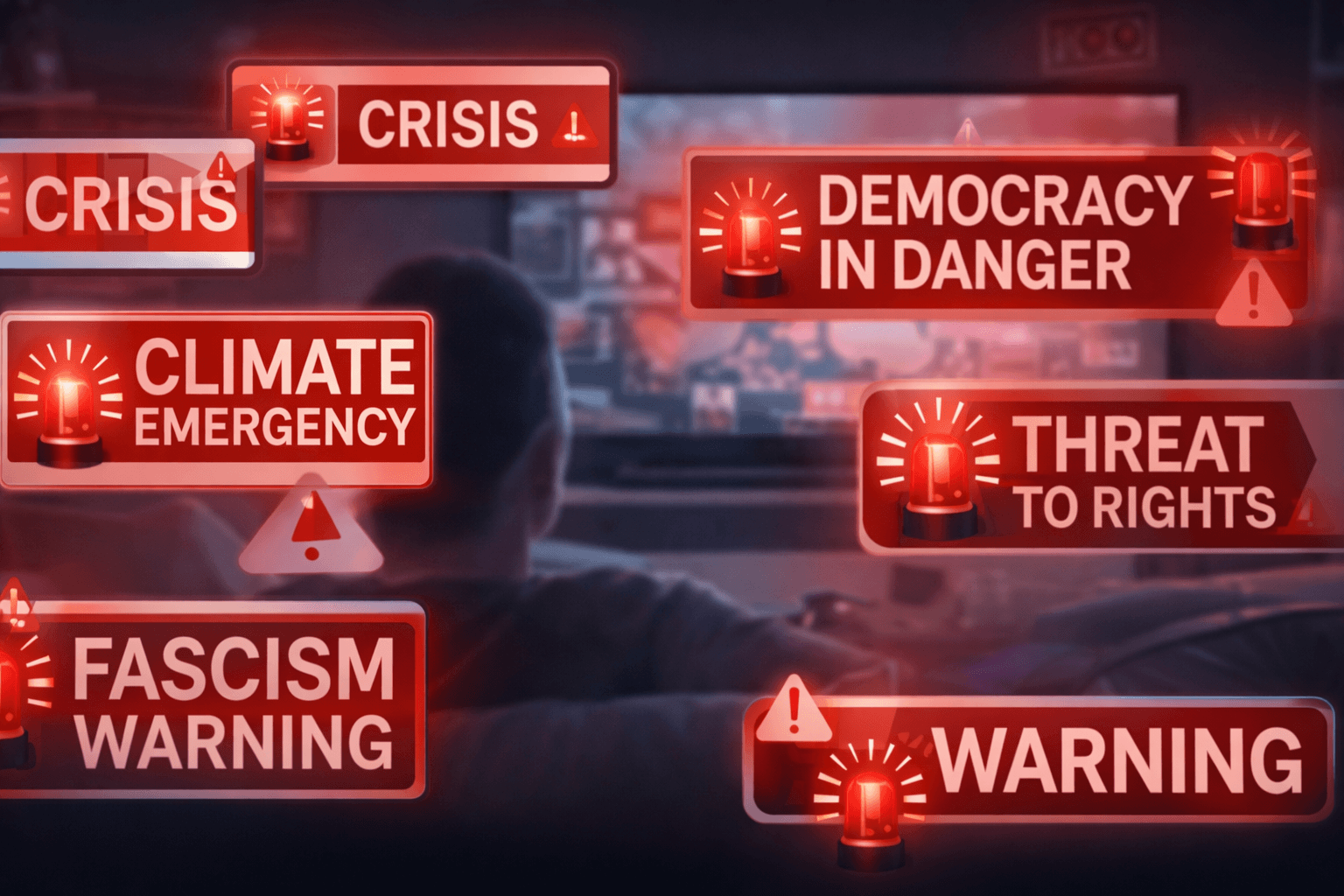
“A society trained to believe catastrophe is always around the corner eventually stops asking whether the catastrophe is real.”
For most of American history, political disagreements involved tradeoffs. Citizens argued about taxes versus spending, economic growth versus regulation, or liberty versus security. Those debates could become heated, but they still assumed something basic: reasonable people might weigh the costs and benefits differently.
That assumption has been fading for some time.
In modern political rhetoric, particularly within the Democrat Party, many issues are framed not as policy questions but as moral emergencies. Elections are described as existential threats to democracy. Environmental debates are portrayed as struggles to save the planet. Immigration disputes become humanitarian catastrophes or national survival crises, depending on the speaker.
Once an issue is cast in those terms, disagreement stops looking like disagreement. It begins to look like cruelty, ignorance, or bad faith.
This rhetorical shift has become one of the most powerful tools in modern politics. When every issue becomes a moral emergency, hesitation itself begins to look morally suspect.
When Politics Stops Being About Tradeoffs
Political decisions in a large and complicated country inevitably involve tradeoffs. Expanding one priority often requires sacrificing another. Governments cannot spend unlimited money without raising taxes or increasing debt. Environmental regulations may protect ecosystems while also affecting energy costs and employment.
Earlier generations of politicians acknowledged these limits openly. The debate centered on which tradeoffs were acceptable and which were not.
Emergency rhetoric removes that framework.
If a policy dispute is framed as a moral catastrophe, then tradeoffs disappear from the discussion. Anyone raising practical concerns can be portrayed as indifferent to suffering or blind to danger. The conversation shifts from weighing consequences to assigning blame.
This approach has grown steadily during the past decade. Political leaders now routinely warn that democratic institutions are collapsing, that the planet faces imminent destruction, or that fundamental rights will vanish if the wrong party wins an election.
When every issue is treated as existential, ordinary political reasoning begins to disappear.
Why Moral Emergencies Work
Moral language has always played a role in politics, but it carries unusual power because it discourages caution. A voter who believes a genuine emergency exists will rarely pause to examine competing evidence carefully.
Delay begins to appear dangerous. Skepticism itself begins to look heartless.
Political movements throughout history have used this dynamic. During the French Revolution, opponents were not merely wrong but labeled enemies of the people. In the twentieth century, many revolutionary movements framed policy debates as moral struggles between oppression and liberation.
Modern American politics does not resemble those revolutions in scale, but the rhetorical pattern is familiar. What has changed is the frequency with which ordinary policy disagreements are described as existential crises.
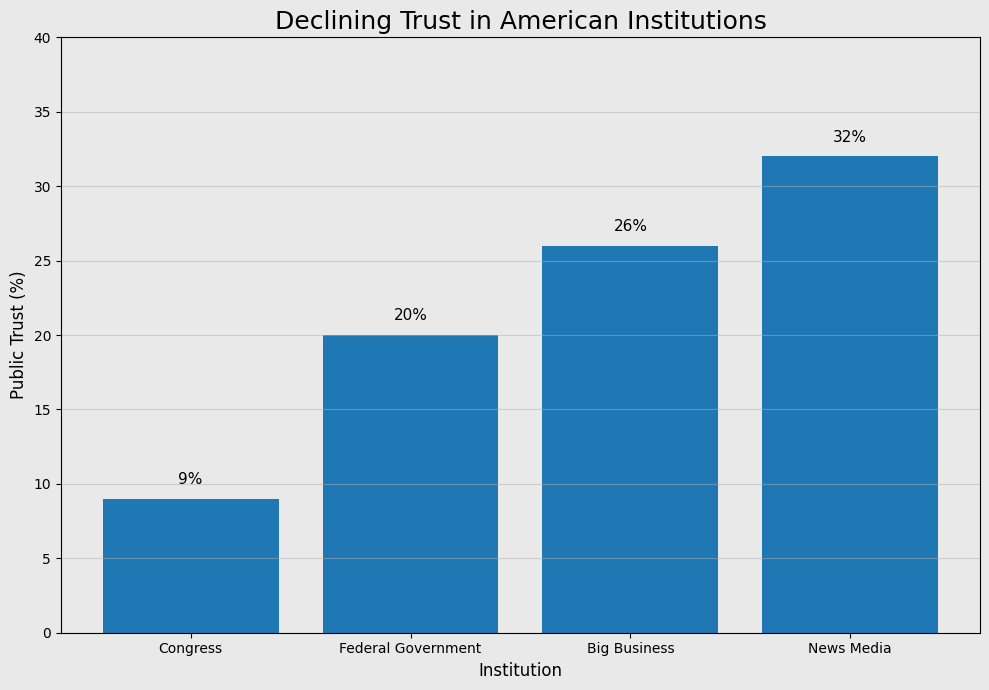
The consequences are measurable. A 2023 Pew Research survey found that roughly seven in ten Americans believe political divisions are greater than at any time in their lives. Gallup polling shows public trust in major institutions such as Congress, the media, and the federal government falling below thirty percent.
A society repeatedly told that catastrophe is imminent eventually begins to believe it.
The Emergency Cycle
When observers step back from individual controversies, a pattern becomes visible. Many modern political disputes follow a recurring sequence.
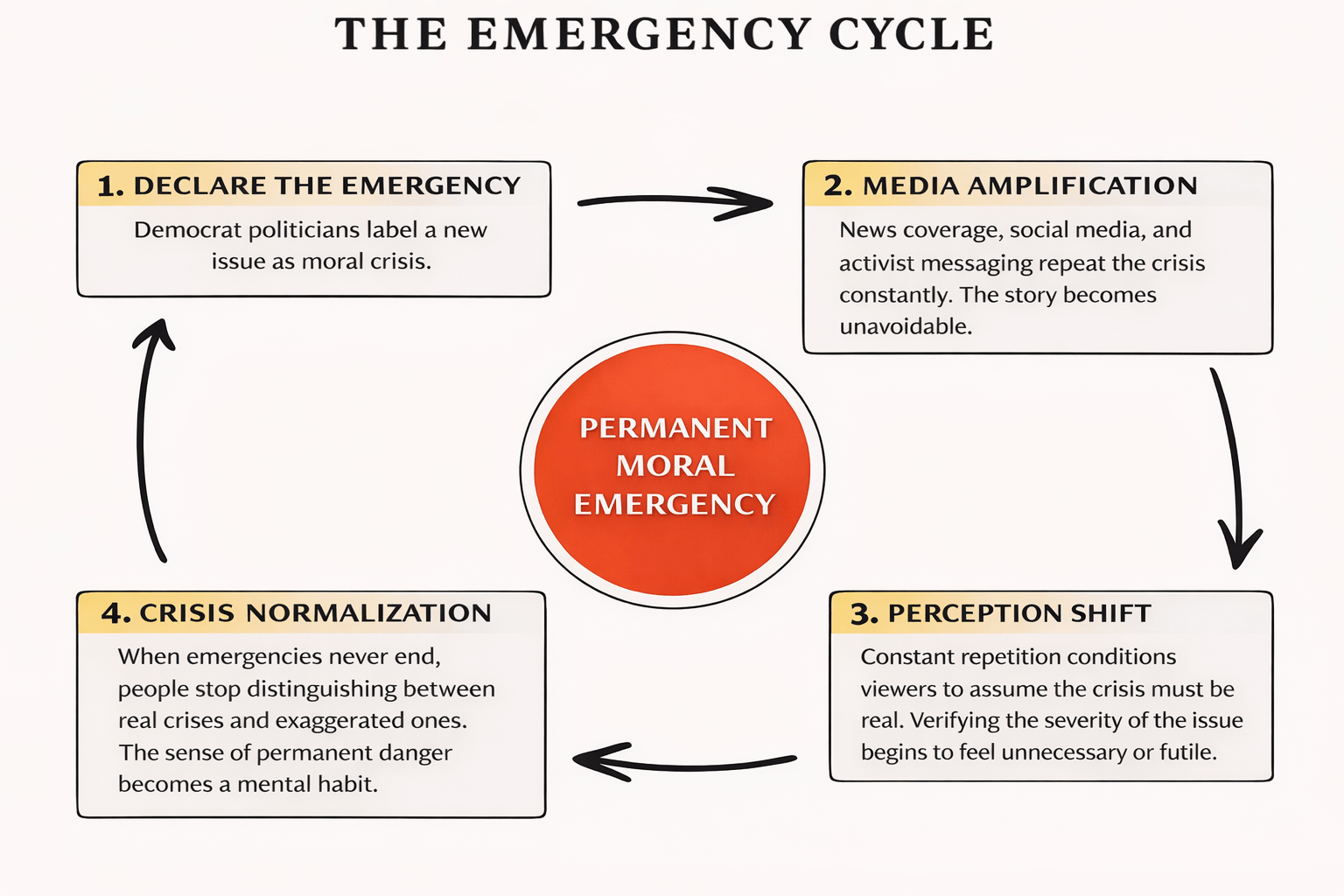
First, a political issue is declared an emergency. Activists and politicians describe the stakes in the strongest possible terms, replacing the language of debate with the language of crisis.
Second comes amplification. News coverage, advocacy groups, and social media networks repeat the warning constantly. The issue becomes nearly impossible for the public to ignore.
Third, perception begins to shift. When viewers hear the same message repeatedly, they begin assuming the crisis must be real. Few people have the time or resources to investigate each claim independently.
Finally, normalization sets in. When emergencies never end, the sense of crisis becomes habitual. Citizens gradually lose the ability to distinguish between severe problems and exaggerated ones.
The cycle then begins again.
What the Viewer at Home Actually Sees
Most Americans are not political analysts. They spend their days working, raising children, commuting through traffic, and dealing with ordinary responsibilities. Political information arrives in fragments through news broadcasts, headlines, and short social media clips.
Under those conditions repetition becomes powerful.
If the evening news repeatedly warns that democracy is collapsing, that civil rights are under attack, or that the planet faces irreversible destruction, viewers eventually assume the danger must be real. Verifying the claims begins to feel unnecessary or even impossible.
Psychologists call this the availability effect. Information that appears frequently feels more significant than information that appears rarely, even when the underlying facts remain uncertain.
Over time the emotional consequences accumulate. Citizens become anxious about the direction of the country and suspicious of neighbors who disagree with the prevailing narrative.
Thomas Sowell has often written that ideas influence society not only through laws but through the way ordinary people interpret the world around them. The politics of constant crisis illustrates that principle clearly.
The Outrage Machine Needs Fuel
Modern activism operates through a large network of nonprofit organizations, advocacy groups, professional organizers, and media personalities.
These institutions depend heavily on attention because public outrage generates donations, media coverage, and social influence. Large demonstrations produce dramatic images that reinforce the perception of crisis. The more intense the reaction appears, the more visibility the cause receives.
Do you ever notice that there’s always something?
This structure creates an incentive to maintain urgency.
When an issue fades from the headlines, the organizations built around that issue often lose momentum. Funding declines, activists disperse, and public attention shifts elsewhere. A constant stream of emergencies keeps the machinery running.
The average viewer watching television rarely sees this infrastructure. He sees crowds carrying signs and assumes the intensity of the protest reflects the severity of the underlying problem.
When Morality Becomes Situational
The flexibility of emergency rhetoric becomes clear when political incentives change.
Consider environmental politics. Electric vehicles were promoted for years as a necessary response to climate change, and Tesla became one of the most recognizable symbols of technological progress in that effort.
Yet after Elon Musk began cooperating with the Trump administration in 2026, Tesla dealerships and charging stations became targets of protests and vandalism in several cities. Environmental symbolism suddenly mattered less than the political alignment of the company’s leadership.
The Senate filibuster offers another example. During the Biden presidency, many Democrat leaders argued that the filibuster should be abolished because it blocked legislation involving voting rights and social policy. The rule was described as an outdated obstacle to democratic governance.
After Republicans regained control of Washington in 2026, some of those same figures began emphasizing the importance of minority protections in the Senate.
The institution itself had not changed. The political incentives had.
Another contradiction appeared during the 2024 election cycle. Democrat leaders repeatedly warned that democracy itself was under threat while the party simultaneously limited competitive presidential primaries in several states to protect the incumbent administration. Representative Dean Phillips openly criticized the decision, arguing that restricting competition undermined the party’s stated commitment to democratic participation.
These examples do not prove the issues themselves are unimportant. They do suggest that moral urgency often expands or contracts depending on political advantage.
What Constant Crisis Does to People
A population that lives under constant warnings of catastrophe does not remain unaffected.
Fear encourages quick judgments and discourages careful thinking. Citizens begin reacting emotionally before evaluating evidence. Political opponents are no longer simply wrong. They become dangerous.
Over time this environment produces exhaustion. People lose the habit of asking basic questions because every issue arrives wrapped in the language of emergency.
Thomas Sowell once observed that the most dangerous ideas are often those that feel morally satisfying while ignoring the long term consequences of the policies they inspire.
Permanent crisis rhetoric creates exactly that environment.
What This Is Really About
Some political issues genuinely involve moral questions. A free society must debate matters of justice, liberty, and human dignity.
But a political movement that can summon moral emergencies whenever convenient gains an enormous political advantage.
It no longer needs to persuade voters patiently. It only needs to keep them emotionally activated. As long as citizens believe disaster is always approaching, they will support whoever claims to stand between them and the threat.
A population trained to see every issue as a moral crisis eventually stops asking whether the crisis is real.
At that point political power no longer depends on solving problems.
It depends on declaring the next emergency.
I Need You
The modern media environment rewards outrage, panic, and constant political emergency. Thoughtful analysis rarely travels as far as the latest moral alarm.
If you believe calm reasoning, historical context, and honest debate still matter, you can help keep this work going.
Become a Paid Subscriber
Paid subscriptions make it possible to research and write essays that challenge popular narratives and examine political claims with evidence rather than emotion.
Your support helps fund the time, research, and independence required to produce this work.
Become a paid subscriber:
https://mrchr.is/help
Join The Resistance Core
Some readers choose to go further by joining The Resistance Core, the group helping build a long-term independent platform for investigative writing and civic analysis.
Their support helps ensure that this work continues without corporate sponsors, institutional funding, or political pressure.
Join the Resistance Core:
https://mrchr.is/resist
Make a One-Time Gift
If a subscription is not the right fit, you can also support the work with a one-time contribution.
One-time gifts help cover research time, data sources, and the hours required to produce essays like this one.
Every contribution helps keep independent analysis alive.
Support with a one-time gift:
https://mrchr.is/give
What Your Support Builds Right Now
Your support allows this publication to continue producing research-driven essays, original charts, and investigative work that many mainstream outlets will not publish.
Independent writing survives only when readers decide it is worth protecting.
If You Cannot Give
You can still help.
Share the article with a friend, post it on social media, or discuss it with someone who sees the issue differently.
Ideas spread when ordinary people decide they are worth sharing.
Another excellent article, Mr. Arnell! I began to suspect back in 2020 that this is what the "covid crisis" was all about - manufacturing an emergency in order to gain more power and push a certain agenda.
It is worth noting that after a successful "test run" with covid, they tried to create several other "medical emergencies" (monkeypox and avian flu are two notable examples). Thank God people are waking up and not buying that crap anymore! I think that the globalists have realized by now that another "pandemic" won't fly.
So what's next - "climate emergency"? Certain political figures (like the current Canadian prime-minister Mark Carney) have a lot of fingers in that honeypot!
Thry don't have that much time in their timetable, and Trump has cost them 4+ years. They have only so much time to implement their agenda, and judgment looks nearer and nearer. Thus their frenzy.