

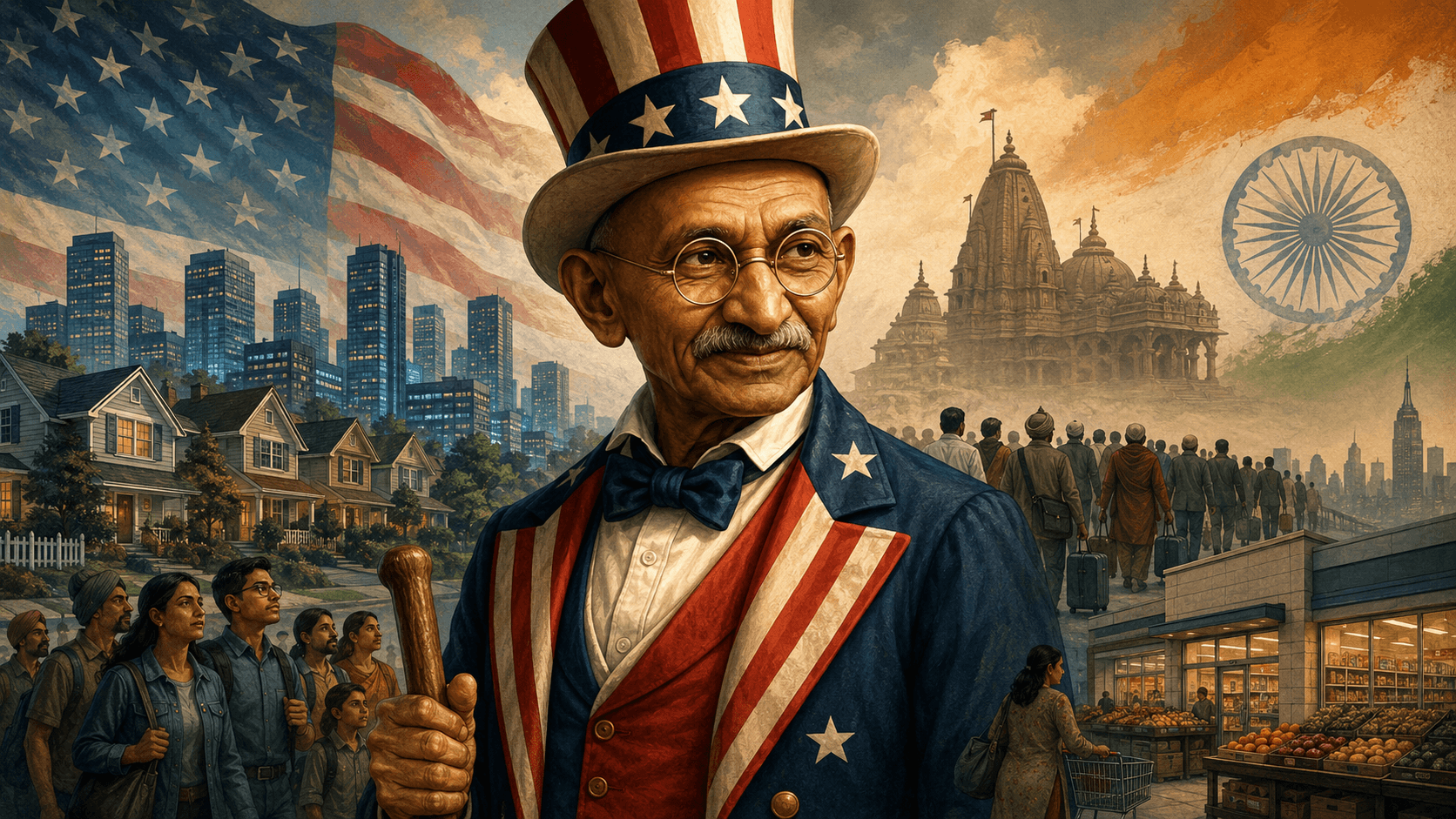
“America thinks it is admitting individuals.
In reality, it is importing networks.”
Before we get to the essay, let’s look at the numbers.
There are about 5.2 million Indian-origin people in the United States. About 3.2 million were born in India. India is now the second-largest foreign-born immigrant group in America, behind only Mexico. India is also the largest source of international students in the United States, with 363,019 Indian students in American higher education in 2024/25. In fiscal year 2024, Indian nationals received 71 percent of approved H-1B petitions, about 283,400 approvals out of 399,400. The median income for Indian-headed households was $151,200 in 2023, far above the U.S. median.
That is not a tiny immigrant community quietly blending into the background. That is a nation-sized population with money, credentials, students, workers, family networks, religious institutions, real estate channels, tutoring centers, business capital, and political potential. It is also a population that often integrates professionally while remaining socially and culturally separate in ways Americans are not supposed to notice.
And most Americans have no idea how large it has become.
When many of us were kids, “Indians” meant the people from elementary school history lessons. American Indians. Native Americans. Reservations. Thanksgiving. Broken treaties. The Trail of Tears. Teepees. Sitting Bull. Geronimo. Maybe a coloring sheet in November, then a guilt lecture a few years later.
Those were the Indians your teacher told you about.
These are not those Indians.
The Indians this essay is about are not in the history unit. They are in the H-1B program, the university system, the real estate market, the tutoring center, the temple, the mosque, the grocery store, the motel, the medical office, the startup, the apartment complex, the school-board meeting, and the neighborhood WhatsApp group.
This is an essay about immigrants from India. More precisely, it is about what happens when immigration stops being individual and becomes institutional.
America was sold Indian immigration as a high-skill success story. Part of that story is true. Many Indian immigrants bring education, discipline, business skill, professional training, and high incomes. They are overrepresented in technology, medicine, engineering, finance, hospitality, trucking, real estate, and small business. That is exactly why the transformation is harder to notice.
Americans are used to thinking of cultural change as something that comes through poverty, refugees, crime, illegal entry, radical mosques, foreign flags, and demands for public accommodation. But a country can be changed by competence too. It can be changed by engineers, doctors, graduate students, motel owners, franchise operators, mortgage brokers, tutoring centers, temples, grocery stores, and high-income suburban buyers.
America thinks it is admitting individuals, when in reality it is importing networks.
Conservatives Watched the Mosque and Missed the Machine
For the last twenty years, conservatives have been trained to look for cultural transformation in a particular form: the mosque, the headscarf, the refugee program, the Arabic sign, the Halal market, the Middle Eastern visa pipeline, and the phrase “Allahu Akbar.”
Some of those concerns were legitimate. A country has every right to ask whether mass Islamic immigration can assimilate into a Western constitutional republic. Europe has already provided enough warnings for anyone willing to notice.
But Islam is not the only form of cultural transformation.
While conservatives watched the Islamic story, a different kind of settlement machine grew in plain sight. It came through universities, H-1B, OPT, tech companies, green-card backlogs, real estate agents, tutoring centers, temples, grocery stores, restaurants, WhatsApp groups, cricket leagues, and school districts.
It did not look like an invasion because it arrived with résumés.
That is the part Americans have trouble processing. They expect cultural displacement to look poor, loud, foreign, demanding, and visibly alien. They are less prepared for cultural change that arrives politely, earns six figures, buys in the best school district, hires a real estate agent who speaks the same language, and opens a tutoring center for the next wave.
This does not make Indian immigrants evil. It makes the usual immigration debate inadequate.
The Warning Label and the Blind Spot
This comparison has to be made carefully.
“Muslim” is a religion. “Indian” is a national-origin category. Some Indians are Muslim. Many American Muslims are not from the Middle East. They may be Pakistani, Bangladeshi, Somali, Afghan, Iranian, Arab, African, Indian, or American-born converts. So this is not a perfect apples-to-apples comparison.
But politically and culturally, the comparison is useful because conservatives have been conditioned to recognize one kind of demographic change while ignoring another.
Muslim immigration is visible because it challenges America in ways people already understand: religion, law, gender norms, speech, national loyalty, terrorism, and public accommodation.
Indian immigration is less visible because it enters through categories Americans are trained to admire: education, income, work ethic, STEM degrees, business ownership, and “model minority” success. But cultural transformation does not stop being transformation because the people changing the country are polite, productive, credentialed, and good at math.
That sentence will bother some people because they have been taught that immigration criticism must be tied to failure. If immigrants are poor, they are a burden. If they commit crimes, they are a danger. If they do not speak English, they are not assimilating. If they reject American values openly, they are a cultural threat.
Those are the easy cases. The harder question is what happens when an immigrant group is successful, wealthy, educated, organized, and still socially separate.
That is where Indian immigration becomes a more interesting case study. It is not the failure case. It is the success case. And that success may be precisely why Americans fail to ask what is being built.
The Numbers Are Bigger Than People Think
The American mind still pictures immigration as the southern border. That misses India almost entirely.
Indian immigration enters mostly through cleaner, more respectable doors: F-1 student visas, OPT, STEM OPT, H-1B, H-4 spouses and children, employment-based green cards, family sponsorship, adjustment of status, business ownership, international student pipelines, and corporate sponsorship. But that is not the whole picture. There are also asylum claims, overstays, unauthorized presence, and other less tidy categories that rarely get discussed because they do not fit the model-minority story.
Each category sounds technical. That is part of the trick. Split the pipeline into enough pieces and the public never sees the whole machine.
A student is not counted the same way as a worker. A worker is not counted the same way as a green-card recipient. A green-card recipient is not counted the same way as a naturalized citizen. A dependent spouse is not treated like the principal visa holder. A child born here is not counted as an immigrant at all. A person waiting years for a green card may still be called temporary, even if he has bought a house, had children, and built a life in America.
This is how scale hides in bureaucracy.
The opening numbers tell you the size. But they still do not fully explain what is happening on the ground. Students become workers. Workers become permanent residents. Permanent residents sponsor relatives. Relatives become citizens. Citizens become voters. Voters become blocs.
That is how a visa category becomes a civilization question.
The Combined Pipeline
There is no single official number called “Indians who settled in America this year.” That is convenient for the people who prefer not to discuss the scale.
The government counts green cards in one bucket, students in another, H-1B petitions in another, dependents somewhere else, asylum claims somewhere else, and unauthorized presence in yet another category. Add them carelessly and you double-count people. Ignore them separately and you miss the broader pattern.
A reasonable way to think about it is this: roughly 65,000 to 80,000 India-born people become lawful permanent residents in a recent year. Around 80,000 to 90,000 new Indian students may enter the U.S. education channel in a year, depending on the estimate and year. India-born H-1B initial employment approvals are also in the tens of thousands. Total Indian H-1B approvals, including renewals and continuing employment, were about 283,400 in fiscal year 2024.
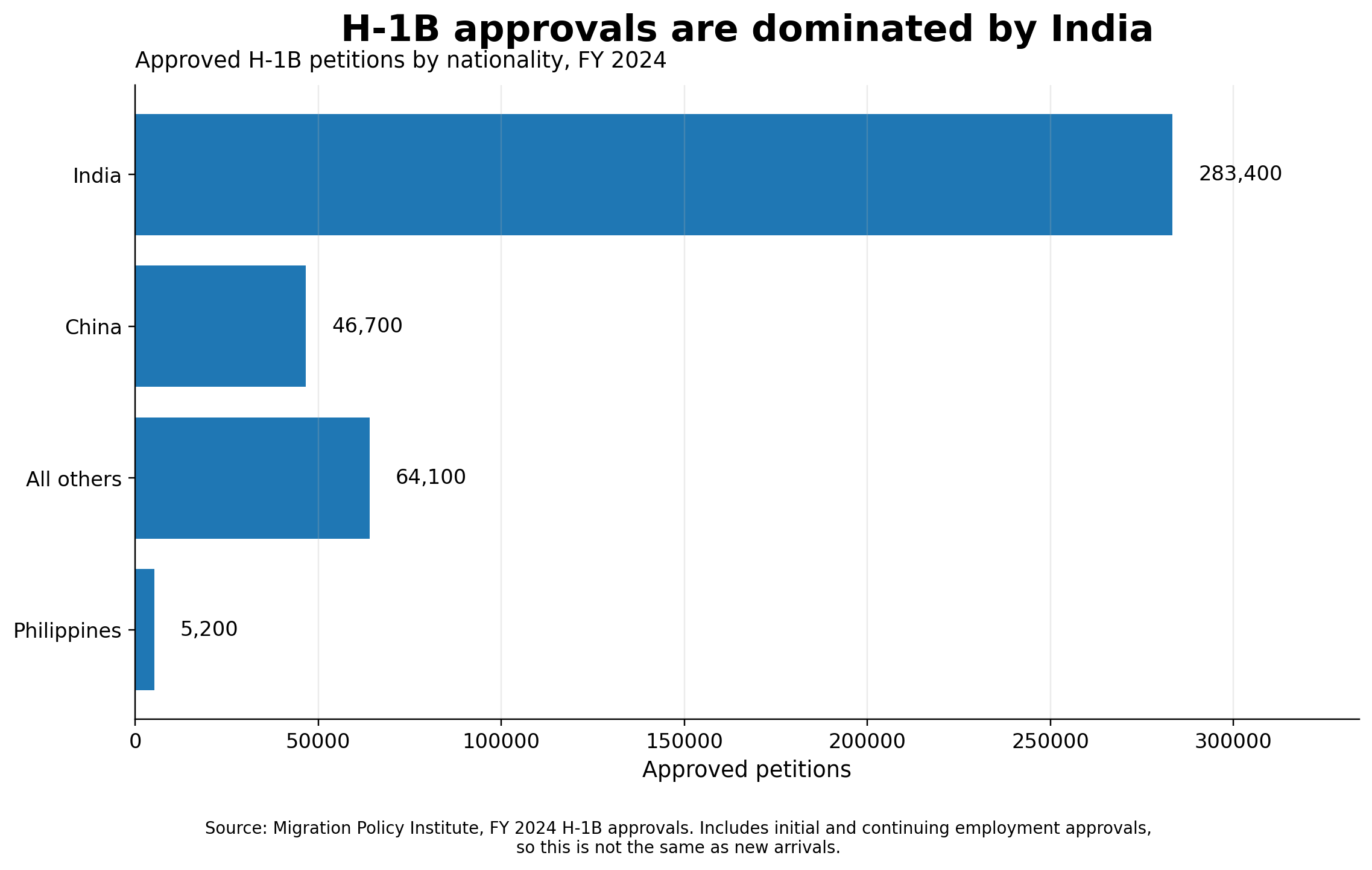
Those are not all unique new settlers, and some overlap, but they show the machinery. The green-card number tells you who became permanent on paper. The student and H-1B numbers tell you who entered the waiting room. The population-growth number tells you who actually stayed.
That is why the best working estimate is not “How many got green cards?” It is broader: how many enter, remain, adjust, sponsor, settle, and build?
When you look at it that way, Indian settlement pressure is probably somewhere around 100,000 to 150,000 net people per year. Not all as permanent residents on day one. Not all through the same door. But through a combined flow of students, workers, dependents, green cards, family migration, asylum, overstays, and unauthorized presence.
That is not a small side story. That is a settlement machine.
How Many Students Go Back?
This is one of the most important questions because it reveals whether the student visa is mainly education or immigration.
Nobody publishes a clean India-only number that says how many Indian students graduate from U.S. schools and then return to India. The system is not built to make that obvious. It tracks enrollment, visas, OPT, H-1B petitions, green cards, and status changes, but not the simple question ordinary Americans would ask: how many came here for school and then went home?
What we do know points in the other direction.
India had 363,019 students in U.S. higher education in 2024/25, making it the largest source of international students. A large share of Indian students are in graduate programs or OPT, which is the post-degree work bridge. For many families, an American degree is not merely education. It is the first step in a stay strategy.
The path is not complicated: F-1 student visa, U.S. university, OPT, STEM OPT, H-1B attempt, employer sponsorship, green-card backlog, long-term residence, and eventually citizenship or family sponsorship.
This does not mean every Indian student is gaming the system. Many are serious students. Many are talented. Many work hard. But the system itself has become a migration pathway.
The university is not always the destination. Sometimes it is the front door.
The Warning America Misread
Chinese immigration was the canary in the coal mine.
It showed America, very early, that immigration does not simply bring workers. It brings networks. It brings language, food, labor systems, family chains, business ties, religious institutions, political demands, and neighborhoods that can become culturally distinct from the country around them.
America’s reaction to Chinese immigration was often ugly, punitive, and unjust. The Chinese Exclusion Act of 1882 was a disgraceful law, and the treatment of Chinese immigrants is one of the more shameful chapters in American immigration history.
But the ugliness of the reaction does not mean the original social observation was imaginary.
Something real was happening. Chinese communities were forming. Chinatowns were growing. Labor markets were changing. Cultural separation was visible. A foreign population was not merely working in America. It was settling in America, clustering in America, and building institutions in America.
That was the warning.
The country saw the pattern, handled it badly, then spent the next century pretending the only lesson was American bigotry. But there was another lesson buried underneath: mass immigration is never just labor. It is settlement. And settlement becomes infrastructure.
Indian immigration is the newer version of that old warning, but it arrives under better public relations. It does not come mainly as railroad labor or laundry work. It comes through universities, H-1B visas, engineering jobs, medical careers, green-card backlogs, suburban home purchases, tutoring centers, temples, grocery stores, cricket leagues, and WhatsApp networks.
Chinese immigration warned America what networks could become. Indian immigration shows what happens when those networks arrive with credentials, corporate sponsorship, and elite approval. One arrived first through labor. The other arrived later through credentials. Both changed America. The Indian version is easier for elites to celebrate because it comes wrapped in education and income.
The “Clean and Articulate” Immigration Class
Joe Biden once praised Barack Obama as “articulate and bright and clean.” It was treated as a gaffe because it revealed the old liberal gaze: the acceptable minority is polished, credentialed, non-threatening, and useful.
That same instinct shapes how elites talk about Indian immigration.
The concern disappears because the immigrant arrives wrapped in success language: doctor, engineer, coder, graduate student, entrepreneur, franchise owner, high-income household, good schools, strong family values, no welfare, no problem.
But that is not analysis. That is flattery.
The ruling class is not saying Indian immigration does not change the country. It is saying it changes the country in a way the ruling class approves of. That is a very different argument.
If a poor immigrant changes a school, a neighborhood, or a labor market, people notice. If a high-income immigrant changes a school, a neighborhood, or a labor market, people call it diversity, growth, or economic development. The change still happened.
The accent in the classroom changed. The grocery store changed. The restaurant row changed. The religious map changed. The tutoring market changed. The real estate referral network changed. The political outreach changed. The assumptions about “good schools” changed. The language spoken at the park, in the apartment complex, and in the neighborhood Facebook group changed.
The ruling class only objects to transformation when it comes from the wrong kind of immigrant.
Professional Integration Is Not Assimilation
This is where the discussion gets more serious.
Indian immigrants often integrate professionally faster than they assimilate socially. That distinction is everything.
A person can work at Apple, Google, Dell, Tesla, a hospital, a university, a bank, or a software company with people from every background and still live a private life mostly inside an Indian network. His coworkers may be American. His boss may be American. His customers may be American. But his marriage expectations, family circle, religious life, business referrals, real estate advice, tutoring choices, food culture, social events, and political network may remain overwhelmingly Indian.
That is not isolation in the old sense. It is selective integration. America gets the labor while the ethnic network keeps much of the loyalty.
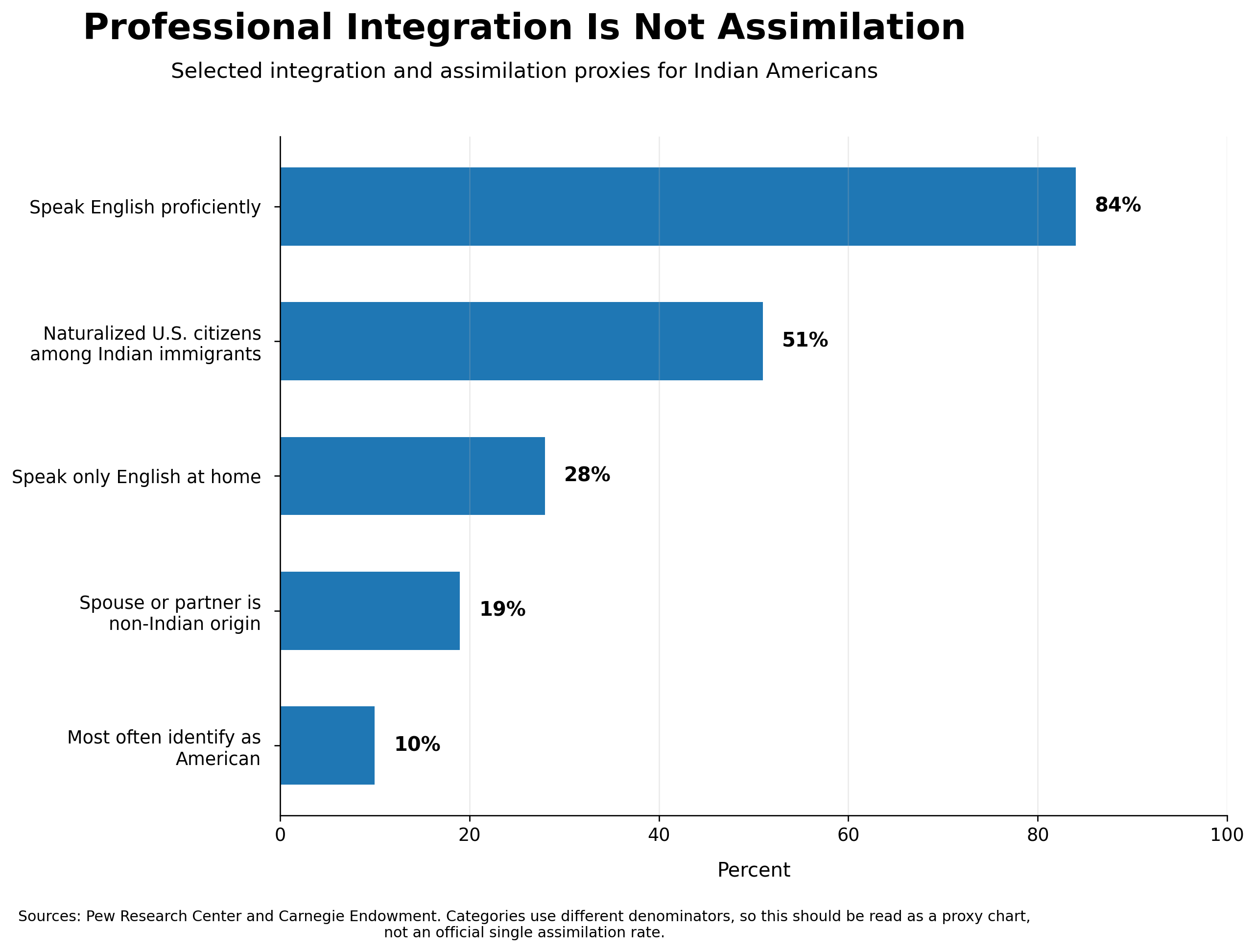
This is the part polite society does not like to discuss. We measure assimilation by the easy things: English, income, education, employment, homeownership, and citizenship. Those things count. They are not nothing.
But they are not everything.
A person can speak English at work and speak another language at home. He can earn an American salary and marry through an ethnic, religious, or caste-conscious network. He can live in an American suburb and still rely on Indian real estate agents, Indian lenders, Indian accountants, Indian doctors, Indian tutors, Indian restaurants, Indian grocery stores, Indian temples, and Indian political contacts.
That is not the melting pot. That is a parallel society with a nice résumé.
The Personal-Life Test
Assimilation is usually measured by English, employment, citizenship, income, and education. Marriage may be the more honest test. Friendship may be another.
Who do people marry? Who do they trust with money? Who do they use as real estate agents, lenders, doctors, accountants, attorneys, tutors, and business partners? Who do they invite to family events? Where do they worship? What language is spoken at home? What expectations are placed on the children? What identity is passed down?
A group can master English, earn high salaries, buy suburban homes, and still remain socially separate if its children are expected to marry inside the group, socialize inside the group, worship inside the group, and build businesses inside the group. That is not full assimilation. That is economic participation with cultural separation.
And it is not unique to Indians. Many immigrant groups do some version of this. Chinese immigrants do it. Somalis do it. Koreans do it. Mexicans do it. Pakistanis do it. Arabs do it. Nigerians do it. Vietnamese immigrants do it.
But Indian immigration is a useful case because it exposes a weakness in the usual American test. We assume that high income means assimilation. It may only mean the group has enough money to build separation more comfortably.
The poor ethnic enclave looks like survival. The wealthy ethnic enclave looks like a school district.
From the Bay Area to Central Texas
I am 58 years old. I grew up in the Bay Area and now live in the Cedar Park and Leander area of Texas, where Indian immigration is not theoretical. It is visible in the neighborhoods, schools, restaurants, grocery stores, real estate market, and professional networks.
If you know the Bay Area, you know this pattern did not begin yesterday. The South Bay, Fremont, Cupertino, Sunnyvale, Milpitas, and parts of San Jose have long had the feel of immigrant success layered over ethnic clustering. Then you come to Central Texas and start seeing the same logic in a newer form. Leander and Cedar Park are not the Bay Area, but the pattern travels well: good schools, tech jobs, newer subdivisions, grocery stores, restaurants, temples within driving distance, and a real estate market that quietly learns where each community wants to be.
I have been around Indians most of my life, and only recently met, for the first time, a white woman married to an Indian man.
That does not prove it never happens. Of course it happens. It happens more than any one person’s experience can capture. Anecdotes are not data, but lived experience is not useless either.
When you grow up around a group, work around a group, live around a group, and then move across the country only to see the same pattern in another high-growth suburb, you start noticing what official language tries to blur. Indians often associate comfortably with other groups in professional life. But personal life can remain heavily Indian.
Professional contact is not personal absorption.
Your coworker may be Indian. Your doctor may be Indian. Your landlord may be Indian. Your software engineer may be Indian. Your real estate investor may be Indian. Your motel owner may be Indian. Your child’s classmate may be Indian. But who is invited inside the private circle? That is where assimilation is tested.
Skill Does Not Erase Cultural Impact
The mistake is assuming that cultural change only comes from dysfunction.
Yes, a nation can be changed by poverty. It can be changed by crime. It can be changed by illegal entry. It can be changed by people who reject its laws openly. But it can also be changed by wealth, high test scores, professional networks, and suburban clustering. It can be changed by people who buy homes in the best school districts, build their own tutoring systems, vote as a bloc, open ethnic businesses, and preserve their customs more effectively than native-born Americans preserve theirs.
The issue is not whether Indian immigrants bring skills. Many do. The issue is whether Americans are allowed to ask what those skills are building.
A software engineer who moves to America, works hard, pays taxes, buys a house, and raises children is not automatically a problem. But if millions of people arrive through similar channels and then build dense infrastructure around language, marriage, religion, school competition, business referrals, and politics, that is not merely labor supply. That is settlement power.
There is a difference between joining a country and using a country as a platform. America has become very good at celebrating the first while refusing to discuss the second.
This Is Not Ellis Island
The old immigration story is sentimental.
A man arrives with a suitcase. He works hard. He learns English. He becomes American. His children assimilate. The family joins the national culture.
That story still happens in pieces.
But modern mass immigration often works differently.
The immigrant does not arrive alone. He arrives into a pre-built ethnic economy. He may already know which neighborhood to target, which real estate agent speaks his language, which lender understands his visa status, which employer hires people like him, which temple or cultural association to join, which grocery store sells familiar food, which tutoring center prepares children for elite schools, which WhatsApp group has job leads, which immigration lawyer handles the paperwork, and which school district has “our people.”
That is not assimilation first. That is network entry first.
The immigrant does not step into America as a lone newcomer. He steps into Indian America, Chinese America, Somali America, Pakistani America, Mexican America, or some other ethnic America already built inside America.
Again, this is normal human behavior. People trust familiarity. People prefer language comfort. People ask relatives where to live. People look for food they know and religious institutions they understand. The question is not whether this is natural. The question is whether a nation can import networks at scale and still pretend it is only admitting individuals.
The Settlement Infrastructure
Mass immigration is not simply the movement of bodies across borders. It is the movement of relationships, habits, institutions, and expectations.
Those connections include family, employment, religion, business, real estate, education, legal services, politics, finance, and language. Once enough people arrive, the informal help system hardens into something more permanent. Then that structure attracts the next wave.
At that point, America is no longer merely admitting immigrants. It is hosting a parallel settlement system.
This is what readers already see, even if they do not have language for it. Indian immigration creates demand for real estate agents, mortgage brokers, accountants, tax preparers, immigration attorneys, restaurants, grocery stores, clothing stores, temples, mosques, cultural centers, cricket leagues, tutoring centers, SAT and ACT prep businesses, college-admissions consultants, private schools, daycare networks, medical practices, dental offices, insurance agencies, business associations, ethnic media, and WhatsApp referral networks.
A restaurant is not just a restaurant. A grocery store is not just a grocery store. A temple is not just a temple. A tutoring center is not just a tutoring center. Together, they form a soft landing system for the next immigrant.
That is why it looks planned even when nobody planned it. The network does the planning.
If one Indian family moves into a suburb, nothing much changes. If fifty move in, people notice. If five hundred move in, businesses follow. If five thousand move in, institutions appear. If the numbers keep growing, politicians show up. That is the life cycle. First come the people. Then the businesses. Then the institutions. Then the politics. By the time the public notices, the machine is already running.
Where Does the Money Come From?
Ordinary Americans see these businesses opening and wonder what they are not supposed to wonder.
India is still relatively poor by American standards. So where does the money come from?
The answer is not one source. It comes from high-income immigrant households, tech salaries, medical and engineering careers, family pooling, extended-family lending, imported family wealth, business partnerships, prior business equity, commercial lending, franchise financing, real estate equity, and sometimes ordinary government-backed or local small-business programs available to eligible applicants.
But the larger point is this: India may be poor on average, but Indian immigrants are not an average sample of India.
Many are selected from educated, ambitious, professional, entrepreneurial, or family-backed classes. Poor countries can still produce large affluent migration classes when the country has more than a billion people.
This is another mistake Americans make. They hear “poor country” and picture the average person. Immigration does not always select the average person. It often selects the mobile person, the educated person, the connected person, the risk-taking person, the family-backed person, or the person whose relatives have already built a bridge.
That is especially true with Indian migration to the United States.
A family may borrow heavily to send a son to an American university. A worker may arrive through a corporate sponsor. A relative may help with housing. A friend may know an employer. A community contact may know a lender. A prior business may finance a second business. One motel may become two. One gas station may become four. One restaurant may become a strip-center presence.
That is not magic. It is network capital.
The Student Visa Is Not Just Education
The university pipeline deserves more attention than it gets.
Universities present international students as diversity, cultural exchange, and global learning. The business model is simpler.
International students pay.
For many Indian families, a U.S. degree is not merely education. It is an immigration strategy.
The pathway can look like this: F-1 visa, U.S. university, OPT, STEM OPT, H-1B attempt, employer sponsorship, green-card backlog, marriage, family sponsorship, or long-term adjustment.
This does not mean every Indian student is gaming the system. Many are serious students. Many are talented. Many work hard. But the system itself has become a migration pathway.
The university is not always the destination. Sometimes it is the front door.
This is why student numbers matter. A student is not a permanent immigrant on paper. But if the student’s plan is to study, work, switch status, find sponsorship, remain in the country, and eventually settle, then the student visa is part of the immigration machine whether the government calls it that or not.
America sells education. The buyer may be purchasing entry.
H-1B: Talent Pipeline or Labor Leverage?
H-1B is sold as a high-skill talent program.
Sometimes it is.
But it also gives employers a workforce whose legal future is tied to employment. An American worker can quit. An H-1B worker has to think about visa status, employer sponsorship, spouse status, children, green-card priority dates, and years of waiting.
That does not make the worker bad. It makes the system useful to employers.
At scale, H-1B is not only about talent. It is also about leverage. And because Indian nationals dominate the system, the Indian migration pipeline is deeply tied to corporate America’s hunger for controllable skilled labor.
This is not hard to understand. A worker whose right to remain in the country depends on continued sponsorship is not in the same bargaining position as a citizen worker. He may be talented. He may be productive. He may be underpaid or well paid depending on the case. But his employer has something more powerful than a paycheck. It has immigration leverage.
That is why corporations love the rhetoric of talent shortages. It sounds generous. It sounds futuristic. It sounds pro-growth. It also gives them a labor system that American workers cannot easily compete against because the foreign worker is not just negotiating a job. He is negotiating a future.
The Green-Card Backlog Turns Temporary Into Permanent
The green-card backlog is often presented as proof that Indian immigrants are victims of a broken system.
There is truth in that, but it also creates a semi-permanent population.
People live here for years. They work here. They buy homes. They have children. They build businesses. They join communities. They may not have green cards yet, but socially, economically, and culturally, they are already settled.
A person waiting ten or twenty years for permanence is not temporary in any meaningful sense. The government may call him temporary. The neighborhood knows better.
This is one of the absurdities of modern immigration language. The paperwork says temporary while the life says permanent. The family is here. The children are here. The mortgage is here. The employer is here. The school district is here. The temple is here. The grocery store is here. The network is here. At some point, “temporary” becomes a legal fiction.
Chain Migration With a Résumé
Chain migration is usually discussed as if it belongs only to low-skilled immigration.
That is false.
Chain migration can wear a suit.
A student comes. Then a worker. Then a spouse. Then children. Then parents. Then relatives, classmates, business partners, and friends follow through separate channels.
It looks more respectable because it comes with degrees, salaries, and LinkedIn profiles. But the network effect is the same. One immigrant lowers the risk for the next. Then the next lowers the risk for the one after him. That is how a pipeline becomes a community.
This is why the phrase “high skill” can mislead people. Skill describes what a person may do in the labor market. It does not describe the social system he builds, the relatives who follow, the institutions that form, or the political demands that come later.
High skill does not mean low impact. Sometimes it means the opposite.
Real Estate and the New Ethnic Map
This is where the hypocrisy becomes obvious to anyone in real estate.
Fair housing law says agents cannot steer buyers by race, religion, or national origin. White agents are trained to fear even the appearance of demographic advice. If a white buyer asks, “Where are the mostly white areas?” the correct answer is: I cannot make recommendations based on race.
That is the law, and agents should follow it.
But ethnic network migration often works outside that formal script.
A Chinese buyer asks a Chinese agent, in Chinese, where Chinese families live. An Indian buyer asks an Indian agent where Indian families live, where the temples are, where the grocery stores are, where the tutoring centers are, where the best schools are, and where their people are buying. A Muslim buyer asks where the mosque and Halal markets are. A Somali family asks where the Somali community is. A Vietnamese family asks where the Vietnamese community is.
The words change. The sorting remains.
America calls one version segregation and the other version community.
This does not mean every ethnic agent is violating the law. Much of this happens informally through friends, relatives, language groups, religious institutions, social media, and community referrals. But the outcome can look very similar: ethnic clustering, ethnic referral networks, and ethnic settlement patterns.
The white agent is trained to fear demographics.
The ethnic network often treats demographics as the whole point.
NAR and the Hypocrisy of Moral Authority
The National Association of Realtors and the real estate industry now preach fair housing.
They are not wrong to condemn steering and discrimination.
But the institution has a history.
The old real estate industry helped create and defend racial sorting. NAR’s own historical materials preserve the 1924 Code of Ethics, and the old language warned Realtors against introducing certain races or nationalities into neighborhoods when their presence was deemed harmful to property values. That was not a private whisper. That was professionalized prejudice.
Now the same industry lectures agents about fair housing while refusing to speak honestly about the new ethnic map forming in American suburbs. The old sorting was direct: keep those people out. The new sorting is softer: find your community, live near your people, use an agent who speaks your language, buy near the temple, buy near the mosque, buy near the grocery store, buy near the tutoring center, ask the WhatsApp group.
One version is condemned. The other is celebrated. Both redraw the map.
That does not mean the old system and the new system are morally identical in every respect. They are not. One was a system of exclusion backed by law, custom, intimidation, lending, covenants, and professional codes. The newer pattern is often voluntary clustering through ethnic networks.
But it still changes the country.
And the people most eager to lecture others about fair housing are often the least willing to discuss what is happening right in front of them.
This Is Not Just Indian
Indians are the case study because the pattern is visible and the elite approval is obvious.
But they are not the only group doing this.
Chinese immigrants do it. Somalis do it. Vietnamese immigrants do it. Pakistanis do it. Mexicans do it. Arabs do it. Nigerians do it. Koreans do it.
Every group with enough scale builds support systems. That is normal human behavior. People trust people who speak their language, understand their customs, share their religion, know their food, and can explain America in familiar terms.
The problem is not that ethnic networks exist. The problem is that Americans are not allowed to discuss what happens when ethnic networks become permanent institutions.
A nation can absorb individuals more easily than it can absorb organized, self-replicating communities that do not intend to disappear into the broader culture. That is the question Americans are not supposed to ask. How much immigration can a nation absorb before assimilation stops being the expected outcome and ethnic infrastructure becomes the expected outcome?
Will Indians Become the Dominant Minority?
Nationally, not anytime soon, but that is not the argument.
Indian Americans are not about to overtake Hispanics or Black Americans as a national population. Hispanics and Black Americans are much larger groups, and they are not standing still demographically.
But national totals can hide local reality.
Indians do not have to become America’s largest minority to become the dominant immigrant infrastructure in certain suburbs, school districts, professional corridors, tech hubs, and real estate markets. That is what people miss when they only look at national percentages.
A group can be small nationally and powerful locally.
If a suburb has Indian real estate agents, Indian lenders, Indian grocery stores, Indian restaurants, temples, tutoring centers, cricket leagues, WhatsApp groups, school pressure networks, and a growing political presence, the national number becomes almost irrelevant to the family living there.
The lived reality is local.
That is why Cedar Park, Leander, Plano, Frisco, Edison, Fremont, Cupertino, parts of New Jersey, parts of the Bay Area, and other high-growth suburbs matter more than the national average. Nationally, the Indian share may look modest. Locally, the infrastructure can feel dominant very quickly.
The point is not national majority. It is local power.
The Politics Always Arrive Later
At first, the network is practical. Where do I live? Where do I work? Who helps with taxes? Who understands the visa system? Where do my children go to school? Where do I worship? Where do I buy food?
Then it becomes cultural. How do we preserve language? How do we teach our children? How do we celebrate festivals? How do we protect the community?
Then it becomes political. Who represents us? Who attends our events? Who supports our visa priorities? Who protects our business interests? Who funds our cultural center? Who opposes immigration restrictions? Who appoints people from our community?
That is how a settlement network becomes a voting bloc. Not overnight. Inevitably.
This is another reason the issue is bigger than labor. Immigration is never only labor. It becomes housing, schools, culture, language, religion, representation, and law. The worker becomes a resident. The resident becomes a citizen. The citizen becomes a voter. The voter becomes a constituency.
Politicians understand this even when the public does not.
The Democrat Party certainly understands it. Corporate America understands it. Universities understand it. Immigration lawyers understand it. Real estate professionals understand it. Ethnic political organizations understand it. The only people expected not to understand it are ordinary Americans.
The Remittance and Home-Country Angle
Money does not only come into America. Money also leaves America.
India is one of the largest remittance recipients in the world. That means overseas Indians are not merely immigrants. They are also an economic asset to India.
This complicates the entire story.
America imports students and labor. American universities get tuition. American companies get workers. Indian families get opportunity. India gets remittances. Immigration lawyers get clients. Real estate agents get buyers. Ethnic businesses get customers. Politicians get voters.
The machine continues because almost everyone inside it has a reason to keep it running. That does not require a conspiracy. Incentives are enough.
Universities do not need to secretly coordinate with tech companies, real estate agents, immigration lawyers, and ethnic organizations. Each part follows its own interest. The university wants tuition. The employer wants labor. The family wants opportunity. The lawyer wants clients. The agent wants buyers. The community wants growth. The politician wants votes. The home country welcomes money flowing back.
The machine runs because motion benefits the people operating it.
The American Blind Spot
America still discusses immigration in greeting-card language: hardworking families, better life, diversity, opportunity, nation of immigrants. Those things can be true, but they are not enough.
A country that imports millions of people does not merely change its workforce. It changes neighborhoods, schools, housing markets, small business, language, religion, culture, politics, and power.
The public is allowed to celebrate all of that. It is rarely allowed to question it.
This is why Indian immigration is such an important case. If the group were poorer, the issue would be easier to discuss. If the group were more visibly hostile, the issue would be easier to discuss. If the group were more associated with crime, the issue would be easier to discuss. If the group were entering mainly through the southern border, the issue would be easier to discuss.
But Indian immigration comes through the front door wearing credentials. That is why the topic is uncomfortable.
Americans have been trained to ask whether immigrants are “good people.” Many are. That is not the only question. The better question is what happens to a nation when millions of good people arrive with their own relationships, customs, institutions, loyalties, and political interests.
A country can be transformed by people who behave well.
That may be the hardest lesson of all.
The Indians We Were Not Taught to Notice
America was sold a high-skill talent pipeline. It got something broader.
It got universities functioning as immigration doors, temporary workers becoming semi-permanent residents, green-card backlogs turning “temporary” into fiction, family migration with credentials, ethnic real estate channels, tutoring centers, religious institutions, grocery stores, restaurants, business associations, remittances, political organizing, and eventually voting blocs.
Indian immigration is not simply a success story. It is not simply a threat story either. It is a systems story.
The Indians your elementary school teacher told you about were presented as part of America’s past. These Indians are part of America’s future because they reveal what modern immigration has become.
It is not just people crossing borders. It is networks crossing borders. Once those networks arrive, they build institutions. Once institutions arrive, they build power. And once power arrives, it does not ask permission to stay.
Help Me Keep Saying What Polite Society Pretends Not to Notice
This essay is free because I want people to read it, share it, argue with it, and think harder about what America is becoming.
If it made you stop and say, “I had no idea it was this big,” consider supporting the research, writing, and uncomfortable work behind it.
Become a Paid Subscriber: https://mrchr.is/help
One-time gift: https://mrchr.is/give
Venmo: https://account.venmo.com/u/mrchrisarnell
Join The Resistance Core: https://mrchr.is/resist
Don't forget the examples of Indian immigrants and first generation Indians who get themselves elected into our government (and appointed to the judiciary) but who hold ideals antithetical to our Constitutional Republic.
Leftist Democrats like Kamala Harris, Ro Khanna, Pramila Jayapal, Ami Bera, Shri Thanedar, and Raja Krishnamoorthi are examples of ethnic Indians who are steeped in socialism, have wormed their way into our government, and are working to "fundamentally transform" the United States into a Communist hell hole.
All very true