

“If the results of 60 years were strong, this shift wouldn’t be happening at all.”
For most of modern American history, the political behavior of Black voters has been one of the most predictable patterns in the country. Election after election, the numbers showed little variation. In many cycles, between 85 and 90 percent of Black voters supported the Democrat Party. That level of consistency is rare in any democracy.
Something has begun to change.
The shift has not been dramatic enough to dominate headlines, but it has been steady enough to matter. In 2016, Donald Trump received roughly 8 percent of the Black vote. In 2020, that rose to around 12 percent. By 2024, estimates placed his support between 15 and 20 percent, with higher movement among younger Black men.
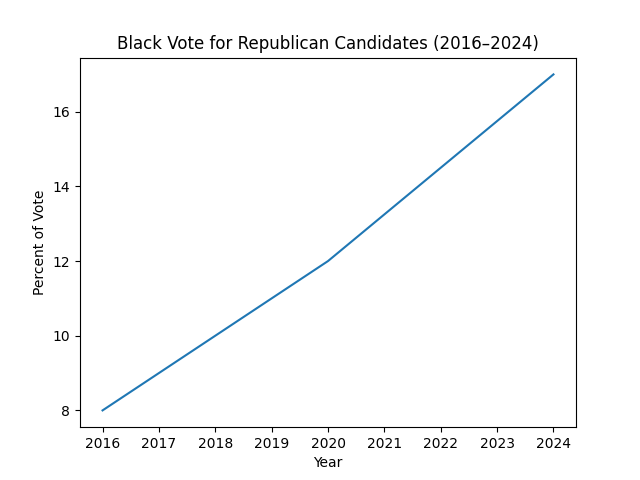
These are not large numbers in absolute terms. But political realignments rarely begin as landslides. They begin with small changes that reflect larger dissatisfaction.
The relevant question is not how large the shift is today. The relevant question is why it is happening at all. Voting patterns that remain stable for decades do not change without reason. People reconsider long-held habits when outcomes no longer match expectations.
Sixty Years of Loyalty
Following the civil rights era, Black voters moved decisively toward the Democrat Party. This was not a gradual drift. It was a clear realignment. By the 1970s, support for Democrat candidates in national elections routinely exceeded 80 percent and often approached 90 percent.
That level of support reshaped political environments, especially in major cities. In many urban areas with large Black populations, political competition diminished. Local governments, school systems, prosecutors, and city councils became overwhelmingly aligned with the Democrat Party. In some places, the general election became noncompetitive. The primary became the only contest that mattered.
When outcomes are predictable, incentives change.
If a voting bloc supports the same party regardless of results, the need to compete for that vote declines. When competition declines, accountability weakens. Promises can be repeated without being tested. Failures can be explained without consequences.
This pattern is not unique to one party or one group. You could look at White rural voters as an example of Republicans underdelivering. It is a feature of political systems generally. But the degree of consistency in this case makes it worth examining.
For more than half a century, Black Americans have been the most reliable voting bloc for the Democrat Party. If political loyalty produces results, those results should be visible in measurable improvements in everyday life.
What That Loyalty Was Supposed to Deliver
The expectations were straightforward.
Greater economic opportunity. Safer communities. Better schools. Stronger families. Expanded access to jobs, housing, and education. A narrowing of long-standing disparities.
These expectations were not abstract. In many areas, progress was already occurring before the political consolidation fully took hold.
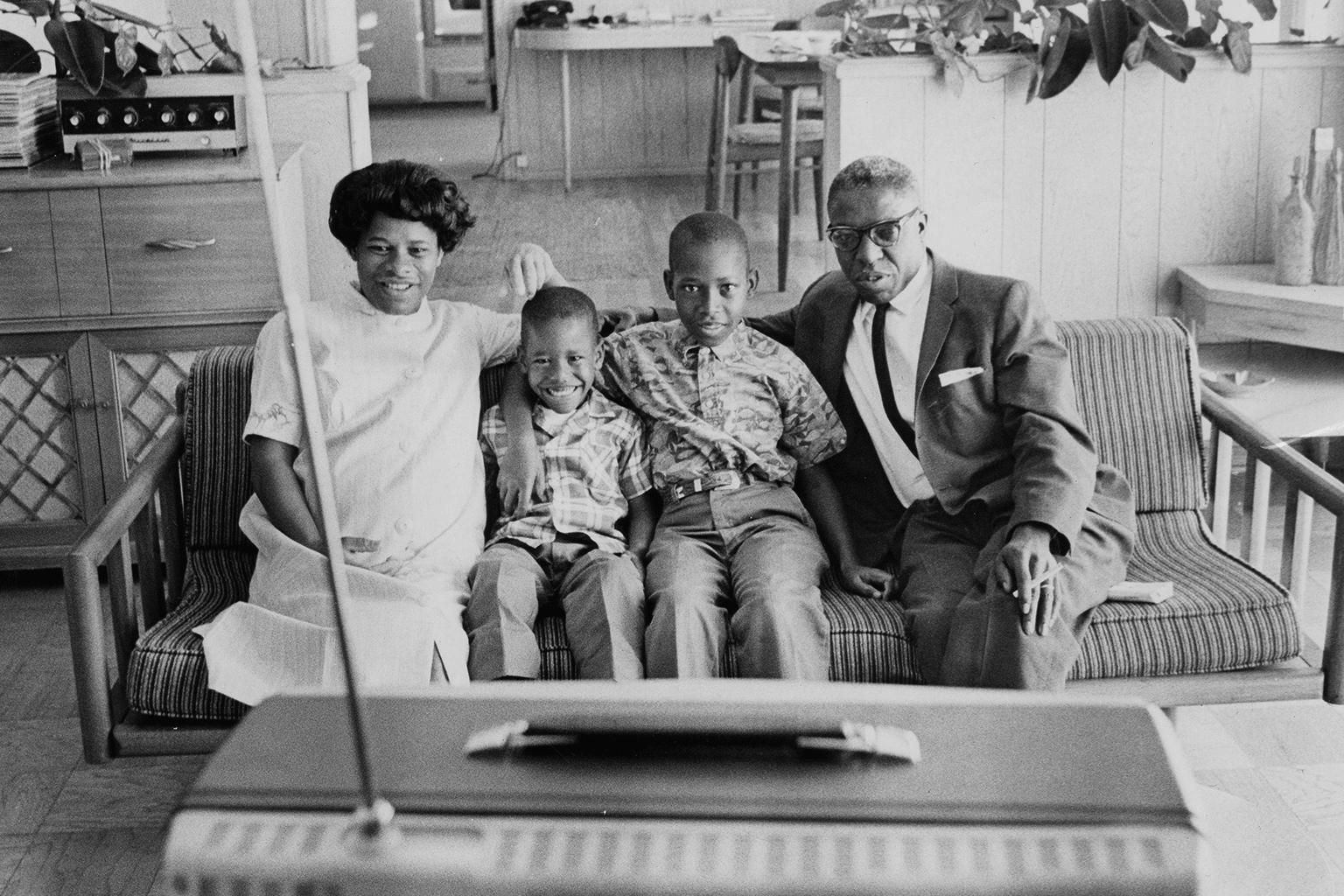
Three years before the Civil Rights Act of 1964, Wade Rice bought a home in Northridge and moved in with his wife, Fannie, and their four children. A Black family purchasing a home in a largely white suburban neighborhood at that time was not merely a social first. It was evidence of a trajectory. Despite real barriers, Black Americans were already making gains through family stability, work, and homeownership. The story did not begin with political dependency. There was already a path.
The question is not whether barriers existed. They did.
The question is what happened to that trajectory.
In the decades leading up to the late 1960s, Black Americans made measurable gains. Labor force participation among Black men was high. Marriage rates were significantly higher than they are today. The majority of Black children were raised in two-parent households. Educational attainment was improving despite substantial external barriers, ironically, led by Democrats.
This was not a period without serious problems. Discrimination existed, and opportunities were limited in many respects. But the direction of change in several key areas was positive.
The expectation after the political shift was that these gains would accelerate. In many areas, they did not. Expanded federal programs, increased representation, and concentrated political support were expected to produce broader and more consistent improvements. That was the premise.
Support in exchange for results.
What Actually Happened
Outcomes are easier to measure than intentions.
Start with family structure. In the early 1960s, the share of Black births to unmarried mothers was under 25 percent. Today, that figure exceeds 70 percent. This is not a marginal change. It represents a fundamental shift in family formation.
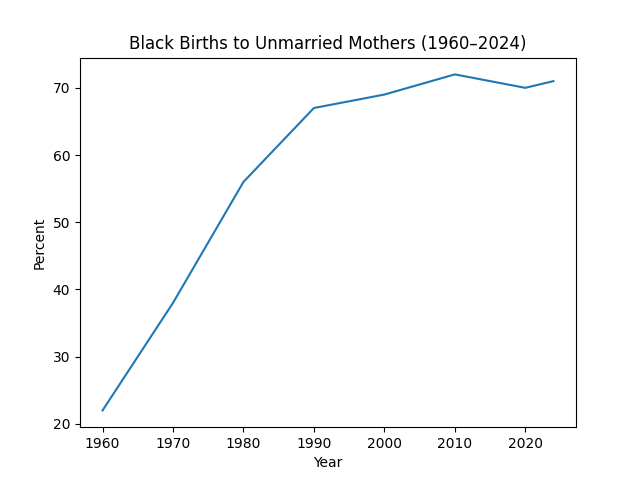
Research across decades has linked family stability to outcomes in education, income, and exposure to crime. When family structure weakens, the effects tend to accumulate rather than remain isolated.
“We know the statistics — that children who grow up without a father are five times more likely to live in poverty and commit crime; nine times more likely to drop out of schools and 20 times more likely to end up in prison."
— Barack Obama, Father’s Day speech on June 15, 2008
Crime presents a similar pattern. Violent crime rates in the United States rose sharply beginning in the late 1960s and continued through the early 1990s. Although crime declined after that peak, it has remained concentrated in specific neighborhoods, many of them predominantly Black. Victimization rates in those areas are also disproportionately borne by Black residents. These patterns have been documented repeatedly in Department of Justice data.
Education outcomes show uneven progress. Public spending has increased significantly, particularly in large urban districts. However, academic performance in many of those districts has remained stagnant. Reading and math proficiency levels continue to lag. Discipline issues and classroom disruption have made consistent instruction more difficult.
Economic trends are mixed. There has been growth in segments of the Black middle class, which is important to acknowledge. At the same time, many urban areas continue to experience long-term stagnation. Labor force participation among Black men has declined relative to earlier decades. Dependency on government assistance has increased in certain communities.
These outcomes are interconnected. Family structure influences education. Education influences employment. Employment influences crime. Crime influences investment and stability.
These are not isolated developments. They are patterns that appear consistently across multiple decades of data.
Not every measure has worsened. Some have improved. Others have not.
Why have so many of the indicators most closely tied to long-term stability moved in a negative direction during the same period in which political loyalty remained largely unchanged?
That question is difficult to avoid.
It also helps explain why even modest shifts in voting behavior today carry significance beyond their immediate size.
The Incentive Problem
Political outcomes are not random. They follow incentives.
When policies change, what is rewarded and what is penalized, behavior changes. Not because people suddenly become better or worse, but because systems shape choices at scale.
Consider family formation.
Beginning in the late 1960s and expanding through the 1970s, a series of federal and state programs increased direct support to low-income households. The intent was to reduce poverty. In many cases, the effect was to reduce the economic necessity of marriage without increasing its incentives. Benefits were often structured in ways that made the presence of a second adult earner a financial disadvantage rather than an advantage.
This did not affect every household the same way. But over time, it altered the cost-benefit calculation around family structure. When a system makes one arrangement easier to sustain than another, more people move toward the easier arrangement.
The data reflects that shift. The rise in single-parent households did not occur gradually over a century. It accelerated within a few decades following these policy changes. Correlation does not prove causation. It does raise questions.
Education presents a similar pattern.
Public school systems in many large cities operate under layers of administration that are insulated from competition. Funding has increased substantially over time. In inflation-adjusted terms, per-pupil spending has more than doubled since the 1970s in many districts. Yet outcomes have not improved at the same rate. In some cases, they have stagnated.
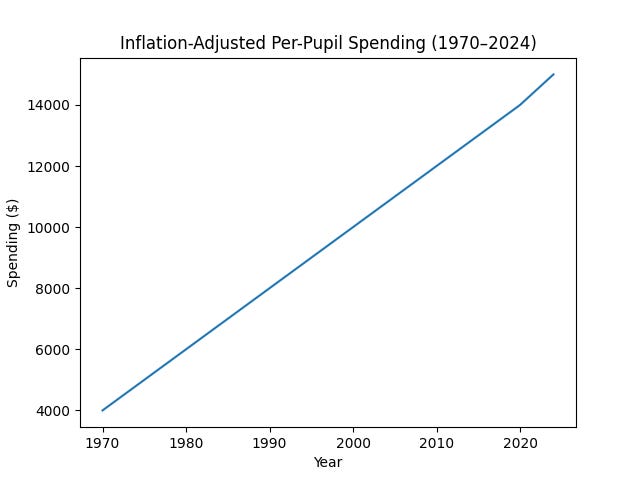
When institutions are not required to produce results in order to maintain funding or authority, performance becomes secondary. This is not unique to education. It is how bureaucracies function when accountability is limited.
Policing follows the same logic.
Shifts in enforcement policy, especially in certain urban areas, have reduced the likelihood of consequences for specific categories of behavior. When enforcement becomes inconsistent, behavior adjusts accordingly. This does not require a change in values. It requires only a change in expectations about consequences.
Across each of these areas, the pattern is consistent. Systems produce what they reward. When incentives change, outcomes follow.
Policies do not have to intend a result to produce it. They only have to change incentives.
Culture Did Not Lead. It Followed.
Cultural expression often reflects underlying conditions rather than creating them.
In discussions about music, media, and behavior, it is common to treat culture as the starting point. The evidence suggests it is more often the result.
When family structure weakens, when economic opportunities become unstable, and when enforcement becomes uneven, cultural signals adjust to those conditions. Over time, those signals can become amplified through media and entertainment, especially when they attract attention and generate profit.
The rise of certain themes in mainstream music is one example. Content that emphasizes status, aggression, and hyper-materialism has proven commercially successful. That success leads to repetition. Repetition leads to normalization. Normalization leads to imitation.
“Rap music helped export the ghetto mindset beyond the neighborhoods where it originated, allowing even Black youth raised in stable suburban environments to adopt the posture and values of gang life without having lived its consequences.”
This process does not remain confined to the original environment. It spreads across geographic and demographic lines. What began as expression becomes identity.
But culture does not operate independently of incentives. It responds to them and then reinforces them.
When the most visible and rewarded behaviors align with instability rather than stability, the broader environment reflects that alignment. This is not a moral judgment. It is a description of how feedback loops operate.
It also helps explain part of the current shift. Cultural messages built around self-assertion, money, and distrust of authority do not sit comfortably with a political tradition centered on bureaucracy and dependence. That tension has made some younger Black voters more open to alternatives they would once have dismissed.
The Silent Response: Society Adjusts Without Explanation
When patterns persist, institutions respond. They do not always explain those responses clearly.
Across the country, public and private organizations have introduced new layers of control in spaces that were once open. These changes are often framed in neutral terms such as safety, crowd management, or customer experience. The language is general. The timing is not.
Cities like Miami Beach have implemented strict spring break measures, including curfews, increased police presence, and restricted access to certain areas. These policies followed repeated incidents of violence and disorder over multiple years.
Large events have adopted stricter entry requirements. The Houston Livestock Show and Rodeo introduced updated dress codes and behavioral expectations tied to maintaining a controlled environment.
Retailers have adjusted operations in response to theft patterns. In many urban stores, everyday items are now secured behind locked cases. This is not a symbolic change. It reflects measurable increases in loss.
Theme parks, malls, and entertainment venues have implemented chaperone policies and identification requirements. These policies did not emerge in isolation. They followed specific incidents that made previous approaches unsustainable.
The common feature across these responses is not how they are described, but when they occur.
Institutions rarely identify the full context behind policy changes in direct terms. They describe the outcome rather than the cause. This approach avoids controversy, but it does not eliminate the underlying pattern.
Instead of addressing root causes, systems adapt to visible effects. Access becomes more restricted. Oversight becomes more intensive. Informal norms are replaced with formal rules.
The result is a gradual shift from open environments to controlled ones.
This shift affects everyone who enters those spaces. It does not distinguish between those who contribute to the problem and those who do not.
That is often how systems respond when underlying issues remain unresolved.
Why the Shift Is Happening Now
Political behavior rarely changes because of speeches. It changes because of experience.
For decades, the message directed at Black voters was consistent. Support the Democrat Party, and progress will follow. In some areas, progress did occur. In others, conditions remained unchanged or deteriorated. Over time, the gap between what was promised and what was lived became harder to ignore.
This is where the current shift begins.
It is not driven by ideology in the abstract. It is driven by exposure to outcomes.
“Black people loved Trump before the media told them they couldn’t.”
I was reminded of that years ago in a way that seemed minor at the time but makes more sense now. In 2009, when I was living in Denver and getting started in online marketing and SEO, I met a Black man at a Chamber of Commerce event who went by the name “Donnie Trump.” I never forgot it. Long before Trump entered politics, he had status. He represented wealth, boldness, and a kind of larger-than-life success that many Black Americans admired openly. What changed later was not simply Trump himself. What changed was the social cost of saying so out loud.
People compare what they were told would happen with what actually happened in their neighborhoods, their schools, and their economic prospects. When those two do not align, loyalty weakens.
The numbers reflect that shift, even if modestly. Support for Donald Trump among Black voters increased between 2016 and 2024, with the most noticeable movement among younger Black men. Polling in 2025 and early 2026 continued to show higher levels of openness to Republican candidates than in previous decades.
These changes are not uniform. They are not dominant. But they are real.
They also follow a pattern seen in other contexts. When a group begins to examine long-standing assumptions, the initial movement is small. Early adopters tend to be those most dissatisfied with current conditions. If those conditions persist, the shift can expand.
This is not a sudden realignment. It is an early stage.
The important point is not who is gaining votes. The important point is that votes are no longer being given automatically.
The Risk of Blind Realignment
A change in direction does not guarantee a better outcome.
If the lesson of the past sixty years is that political loyalty without accountability produces weak results, then replacing one form of automatic support with another does not solve the problem. It repeats it.
Every political party responds to incentives. If support becomes predictable, expectations decline. If expectations decline, performance follows.
What is guaranteed is rarely improved.
The issue is not which party holds power. The issue is whether that power is contingent on results.
History offers enough examples to make this clear. Groups that align unconditionally with a political structure tend to receive diminishing returns over time. This is not because of malice. It is because of incentives. When something is guaranteed, it is no longer subject to competition.
The recent shift among some Black voters suggests a recognition of this pattern. Whether that recognition leads to sustained change depends on what replaces the previous model.
If the shift becomes another form of loyalty without evaluation, the outcome will not be different.
Who Pays the Price
Policy debates often take place at a distance from their consequences.
The effects are not experienced in abstract terms. They are experienced in daily life. Safety, education, and economic stability are not political concepts to the people living with them. They are conditions.
In areas where crime remains concentrated, residents of those communities bear the cost. In school systems where performance is weak, it is students and families who absorb the consequences. In local economies that fail to generate opportunities, individuals face limited options.
These outcomes are not distributed evenly. They fall most heavily on those with the least ability to avoid them.
It is important to distinguish between broad narratives and specific realities. Discussions about policy often focus on intentions or historical context. Those matter. But they do not change present conditions.
The individuals most affected by the patterns described earlier are not political figures. They are the people living in the environments shaped by those patterns.
Any serious discussion of political alignment has to account for that.
The Question That Remains
After sixty years of consistent support of Democrat candidates, the results are mixed at best and deeply uneven in critical areas.
Some progress has occurred. That should be acknowledged. But progress in one area does not offset decline in another, especially when the areas in decline are closely tied to long-term stability.
The shift that is beginning to take place among some Black voters does not answer the larger question. It raises it.
If political loyalty is intended to produce measurable improvements, then those improvements should be visible in the conditions people live with every day.
If they are not, then the alignment itself deserves scrutiny.
The issue is not whether one party is better than another in the abstract. The issue is whether any political support is being evaluated based on results rather than assumed as a matter of habit.
That question and those results cannot be dodged forever.
And that will determine whether the current shift remains small or becomes something larger.
What Was Gained
Any honest assessment has to account for both progress and decline.
Over the past sixty years, there have been real gains. Legal barriers that once restricted opportunity have been dismantled. Access to higher education has expanded. A Black middle class has grown in size and visibility. Representation in business, government, and media has increased in ways that would have been difficult to imagine in earlier generations.
Those changes matter. They are not symbolic. They reflect measurable shifts in access and achievement.
But gains in one area do not erase losses in another.
Family structure has weakened in ways that affect long-term stability. Crime remains concentrated in specific areas, with consequences borne by the people who live there. Educational outcomes in many urban systems have not kept pace with increased investment. Economic progress has been uneven, with some advancing while others remain in place.
These realities exist at the same time.
Progress did occur. It is whether the overall trajectory reflects the outcomes that were promised.
Political support was not given in exchange for partial results. It was given with the expectation of broad improvement across the conditions that shape daily life.
Measured against that standard, the record is mixed.
The Real Lesson
Political systems respond to incentives. That principle has been consistent throughout this discussion, and it applies here as well.
Support that is given without conditions tends to produce fewer results than support that must be earned. This is not a reflection of intent. It is a reflection of how incentives operate.
The shift that is beginning to take place among some Black voters suggests that this dynamic is being recognized. Whether that recognition leads to sustained change depends on what follows.
Replacing one form of automatic loyalty with another does not alter the underlying structure. It preserves it.
What is significant is not which party receives support. What counts is whether that support is contingent on performance.
If political alignment becomes a habit rather than a decision, outcomes become disconnected from expectations. When outcomes and expectations diverge, dissatisfaction grows, even if it is not immediately expressed.
The lesson is not tied to a specific candidate or election cycle. It is broader than that.
Political loyalty has a cost when it is not tied to results. That cost is not always visible at first. Over time, it becomes difficult to ignore.
The current shift, however small, suggests that more people are beginning to recognize that pattern.
Whether that recognition leads to different outcomes will depend on whether expectations change along with it.
A vote that is guaranteed has no value. And what has no value produces no results.
Keep Hope Alive
This piece did not come from a headline. It came from time, research, and a willingness to say things most people avoid.
No corporate backing. No institutional support. No safety net behind it.
Just work.
Become a Paid Subscriber
If this kind of analysis matters to you.
If you want writing that isn’t filtered, softened, or managed.
Then support it directly.
Make a One-Time Contribution
If a subscription isn’t the right fit, you can still help keep this going.
Every contribution buys time.
Time to research.
Time to write.
Time to keep pushing.
Join The Resistance Core
This is the top level of support.
It’s for people who understand what this project is—and where it’s going.
What Your Support Actually Does
It funds:
deep-dive research like this
long-form writing that takes time to get right
independence from sponsors, advertisers, and political pressure
No middleman. No filter. No approval process. No Liberals :-)
If You Can’t Support Financially
You can still help more than you think.
Share this article
Send it to one person
Post it somewhere it doesn’t belong
That’s how this grows.
This Only Works If It’s Backed
There’s no algorithm pushing this.
No institution is funding it.
If this is going to continue, it has to be supported directly.
The saddest part is that the majority of blacks have accepted shitty schools, cities, life of crime and poverty. The generational brainwashing of inner-city blacks is incredible. Anyone who steps out of line like prominent black Conservatives are falsely accused of being the enemy. Like Scott Adams said, There is no fixing this, just get away from them.
Brilliant. A decentralized government is the only means of oversight. The founders wanted limited government for this reason, building in a system of checks and balances. It worked for about 150 years, responsive to the People. It is imperative now, that we take responsibility for problems in our families, neighborhoods, and greater community. We save ourselves because we have the power to act.