

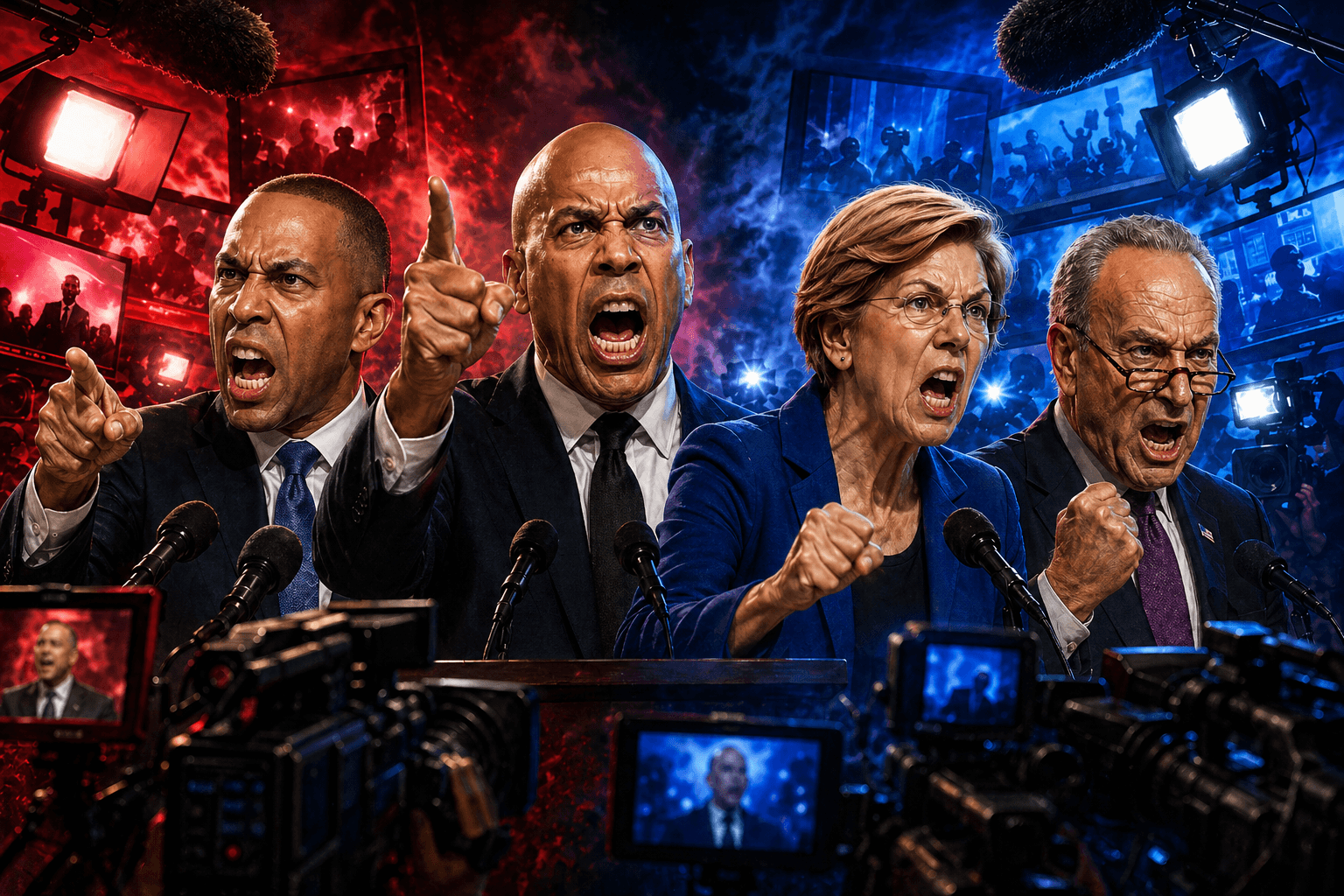
“When a political party turns every disagreement into a death sentence, it is no longer trying to persuade citizens. It is training them to kill.”
This is not new in human history. People have always used language to shape perception. What is different now is the speed, reach, and repetition. A phrase spoken by a politician in Washington can become a cable news segment, a headline, a fundraising email, a social media clip, and a slogan before many people have had time to ask whether the original claim was true, exaggerated, or missing half the story.
No conspiracy is required. Incentives usually do the work. A politician who says, “This policy has tradeoffs,” is unlikely to dominate the news cycle. A politician who says, “People will die,” has given producers, headline writers, activists, donors, and social media accounts something far more useful. A calm explanation of Medicaid formulas, rural hospital reimbursement, budget reconciliation rules, or the long-term tradeoffs of federal spending will lose most viewers before the first commercial break. A segment suggesting that Republicans are making people die will not.
That is the market reality behind the language. Fear sells because it simplifies. It turns complicated questions about cost, access, debt, federalism, incentives, and unintended consequences into a moral test. You are no longer debating whether a policy works better than another policy. You are deciding whether people live or die, which is much easier to sell and much more dangerous to normalize.
For years, Americans have been told that ordinary political disagreements are not ordinary at all. They are emergencies. Elections are not contests between parties with different priorities. They are the last stand for democracy. Policy disagreements are not arguments about means and ends. They are assaults on human dignity. Spending cuts are not reductions in government programs. They are death sentences.
Exhibit A: The Lines That Define Modern Politics
The pattern is not hidden.
We are not dealing with private conversations, leaked memos, or coded language that needs an interpreter. The language is public. It is spoken on the Senate floor, repeated in press conferences, aired on cable news, posted in official statements, and turned into headlines by people who know which phrases will travel.
That matters because the argument here is not that Democrat politicians secretly believe something they are afraid to say. The problem is almost the opposite. They often say the most revealing parts out loud, because modern politics rewards the most dramatic version of an argument. A mild warning disappears. A moral emergency spreads.
Start with the most direct form of this rhetoric: death. In July 2025, Chuck Schumer spoke on the Senate floor about Trump’s “Big, Ugly Bill” and warned that “people are going to die” because of it. His office tied that claim to a Penn study estimating 51,000 preventable deaths per year from Republican healthcare cuts, translating it into “one preventable death every ten and a half minutes.” The same official release described rural hospital closures and Medicaid cuts as evidence that the bill was already “shutting down hospitals” and “cutting off healthcare.”
That is not a small claim. It is not even a normal political claim. Schumer was not merely saying the bill was fiscally irresponsible or administratively foolish. He was saying the bill would kill people. Once an argument reaches that point, the ordinary vocabulary of disagreement no longer applies. A person who disagrees with Schumer is not merely wrong about healthcare financing, rural hospital reimbursement, Medicaid eligibility, or federal spending. He is now placed on the wrong side of life and death.
This does not mean healthcare policy has no life-or-death consequences. Of course it can. A serious person should admit that. The question is not whether policy can affect human life. The question is what happens when death becomes the center of an ordinary legislative fight. There is a difference between explaining risk and using mortality as a weapon of persuasion.
Schumer’s language follows a ladder that often appears in these debates. First, a program will be cut. Then hospitals may close. Then people may lose coverage. Then people may get sick. Finally, people will die. By the time the argument reaches that final rung, the policy itself has almost disappeared. What remains is a moral accusation.
Elizabeth Warren has used the same form of argument for years. When House Republicans passed their 2017 healthcare bill, Warren said, “Trumpcare will devastate Americans’ healthcare. Families will go bankrupt. People will die.” She added that disease, sickness, and old age touch every family, and described healthcare as a basic human right. In a separate 2018 floor speech opposing a proposed 20-week abortion ban, she told senators that government officials should listen to women “whose lives are on the line.”
Warren’s wording is not identical to Schumer’s, but the direction is the same. A healthcare bill leads to bankruptcy and death. An abortion debate becomes a matter of life or death, unfortunately, not for the unborn baby. That does not prove she is wrong about every issue. It does show that she is insincere. Many people sincerely believe dramatic things. But sincerity is not the same thing as restraint, and a society cannot live forever on arguments that turn every dispute into a question of who gets hurt, who goes broke, and who dies.
Hakeem Jeffries usually works from a slightly different angle. His rhetoric often centers on immediate danger rather than direct mortality. In March 2024, appearing on MSNBC with Chris Hayes, Jeffries said Donald Trump was “a clear and present danger to our democracy, to our way of life, to everyday Americans.” That phrase is not casual. “Clear and present danger” belongs to the language of urgency, not ordinary disagreement. It suggests something immediate, severe, and intolerable.
By 2026, Jeffries was applying the same phrase to other subjects. He called the affordability crisis “a clear and present danger” to the economic well-being of working-class, middle-class, and everyday Americans. In another statement, he said the Trump administration’s repeal of the greenhouse gas endangerment finding posed “a clear and present danger to the American people.”
Once a phrase works, it is repeated. Trump is a clear and present danger. The economy is a clear and present danger. Climate regulation becomes a clear and present danger. The phrase can be moved from one issue to another because its purpose is not mainly to clarify. Its purpose is to intensify. The listener is trained to hear politics not as a series of questions to be weighed, but as a sequence of threats requiring immediate resistance.
Cory Booker does something different. He turns the issue into a moral test. In 2020, speaking on food policy, Booker said it was “not a dramatization” to say that the way Americans produce and consume food is “quite literally a matter of life and death.” The issue was not merely nutrition, agriculture, markets, regulation, or consumer choice. It became life and death.
Booker’s 2025 marathon Senate speech used similar moral framing. He described the moment as a “moral moment,” with news coverage quoting him as saying the issue was not left or right, but right or wrong. Supporters in Congress framed Republican cuts to programs like Medicare, Medicaid, Social Security, and SNAP as affecting programs that can be “the difference of life and death for millions of Americans.”
Once a political debate is presented as a moral test, compromise begins to look less like prudence and more like cowardice. If the issue is right versus wrong, then negotiation becomes weakness. If the issue is life and death, then delay becomes cruelty. That is how ordinary legislative fights are moved out of the realm of means and consequences and into the language of sin.
Barack Obama’s rhetoric has usually been smoother and more elevated than the language of Schumer or Warren, but it often works higher up the ladder. In 2010, during remarks in Los Angeles, Obama, ironically, warned that money flowing into elections through “phony front groups” was “not just a threat to Democrats” but “a threat to our democracy.” In his 2017 farewell address, Obama warned about “threats to our democracy” and argued that democracy is weakened whenever Americans write off others because of differences in race, region, or politics.
Obama’s language is key because it prepares the ground. Before you reach “people will die,” before you reach “lives are on the line,” there is often a broader claim that the system itself is under assault. Democracy is fragile. Institutions are being tested. The country is at risk. That can sound noble, and sometimes it may even be attached to real concerns. But it also teaches people to hear ordinary political conflict as something more than disagreement.
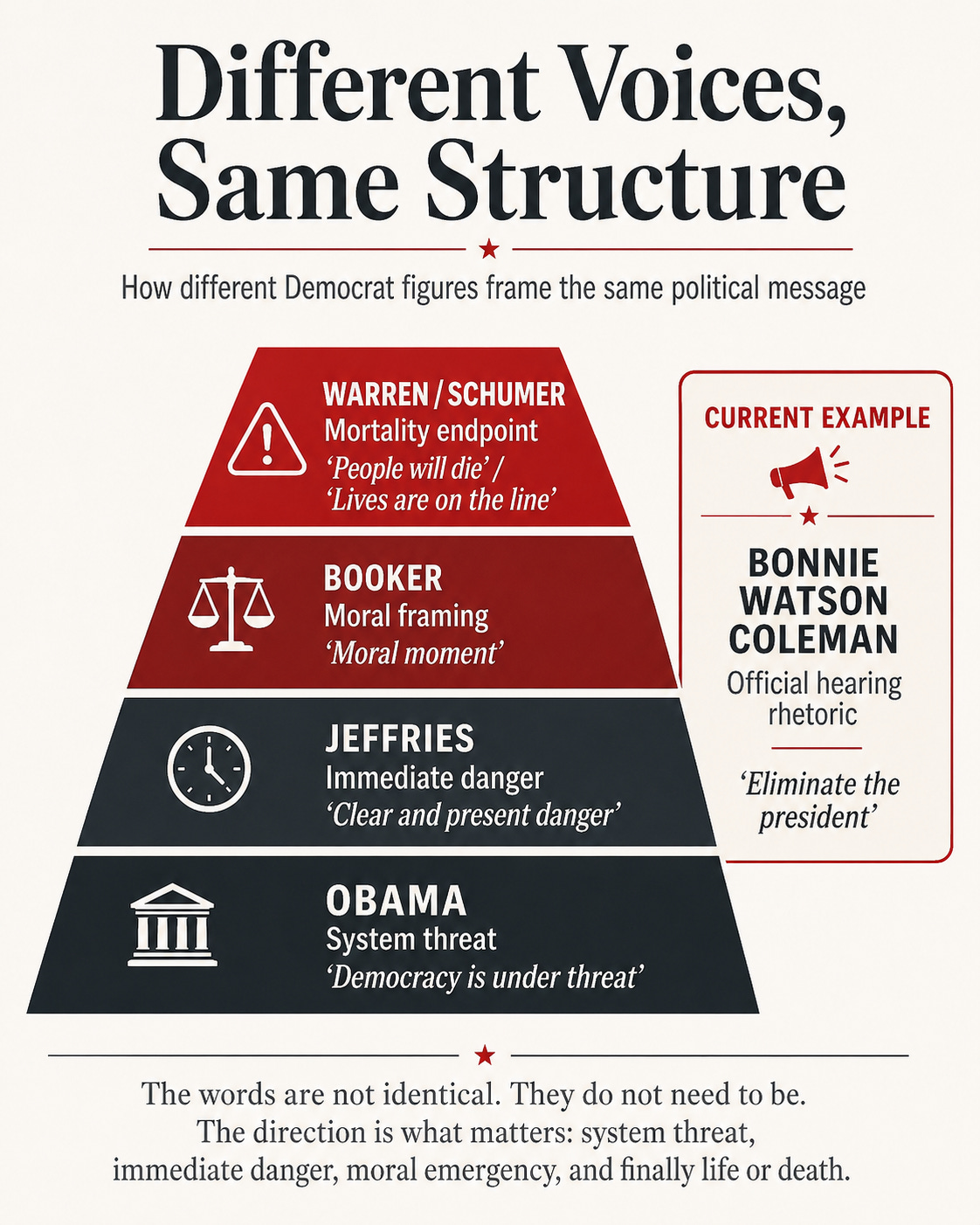
Put these voices together and the structure becomes clear enough. Obama supplies the system-level warning. Jeffries brings danger into the present tense. Booker turns the matter into a moral test. Warren and Schumer carry the argument to its hardest edge, where policy becomes bankruptcy, sickness, and death.
The quotes are not identical. They do not need to be. The direction is what matters.
A budget bill becomes a death sentence. A court nomination becomes a threat to lives. A regulation becomes a danger to the American people. An election becomes democracy’s last stand. The Democrat Party and its media allies have learned that the most powerful way to frame an issue is often not to explain it, but to escalate it.
Rep. Bonnie Watson Coleman, April 15, 2026: “If we wanted to eliminate abuse and fraud, we’d eliminate the president of the United States…” In a normal political culture, no sitting member of Congress talks this way about a sitting president.
And this language has not cooled down. It has become casual enough to appear in official government hearings.
On April 15, 2026, during a House Oversight Committee hearing, Rep. Bonnie Watson Coleman of New Jersey said, “If we wanted to eliminate abuse and fraud, we’d eliminate the president of the United States from the office right now, and the rest of the sycophants in his administration.” The likely defense is obvious: she meant remove him politically, legally, or administratively. Fine. But that is exactly the problem. In a sane political culture, elected officials do not speak loosely about “eliminating” a sitting president, especially after two assassination attempts in 2024 and a shooting incident at the White House Correspondents’ Dinner in April 2026. Words do not land in a vacuum. They land in an atmosphere.
First, tell people the system is in danger. Then tell them the danger is immediate. Then tell them the issue is moral. Then tell them people may die. And when that kind of language becomes normal, even words like “eliminate” can be spoken in official settings and treated as just another sharp political line.
By the time the argument reaches that stage, the policy question has almost vanished. What remains is panic with a respectable vocabulary.
The Pattern: This Isn’t Random
Once the quotes are placed side by side, the pattern becomes harder to miss.
The point is not that every Democrat politician uses the same words in the same order, although sometimes the media does. That would be too obvious, and it is not how political language usually works. The point is that the language keeps moving in the same direction, no matter the issue. It moves from disagreement to danger, from danger to moral urgency, and from moral urgency to survival.
That is how ordinary politics gets transformed into something else.
A healthcare bill is no longer a debate over Medicaid rules, hospital reimbursements, eligibility requirements, federal spending, or insurance markets. It becomes a question of who lives and who dies. A climate regulation is no longer a debate over costs, benefits, energy prices, emissions targets, or regulatory authority. It becomes a clear and present danger to the American people. An election is no longer a contest between parties with different priorities. It becomes democracy’s last stand.
Once that transformation occurs, the old rules of disagreement no longer apply. You can disagree with a tax rate, a spending formula, an environmental rule, or a court decision. But if the other side is killing people, destroying democracy, empowering fascism, or placing lives on the line, disagreement begins to look like complicity. The rhetoric does not merely argue that one side is wrong. It suggests that one side is morally disqualified.
The wording means something because it changes the moral status of disagreement.
Politics has always involved exaggeration. Nobody who has followed American history should pretend otherwise. Campaigns have always warned voters that disaster would follow if the other side won. Newspapers in the early republic were vicious. Nineteenth-century political rhetoric could be brutal. Even in supposedly more dignified eras, politicians routinely accused opponents of corruption, betrayal, stupidity, or cowardice.
But the modern language of the Democrat Party has taken on a particular form. It is less about saying Republicans are wrong and more about saying Republicans are dangerous. That difference is not small. Wrong can be debated. Dangerous must be stopped.
When Barack Obama speaks of threats to democracy, he gives the argument its largest frame. The system is at risk. When Hakeem Jeffries says Donald Trump is a clear and present danger to democracy, that risk becomes immediate. When Cory Booker says a political moment is moral, the issue becomes a test of character. When Elizabeth Warren says people will die, the debate reaches its emotional endpoint. When Chuck Schumer labels legislation the “We’re All Going To Die Act,” the legislative fight is turned into a morality play with bodies in the background.
That may sound dramatic, but that is what the rhetoric is doing. Each layer prepares the listener for the next one. If democracy is under threat, then normal political patience becomes irresponsible. If the danger is clear and present, then delay becomes reckless. If the issue is moral, compromise becomes suspect. If people will die, opposition becomes unforgivable.
That is how the ladder is climbed. Not by one sentence, not by one speech, and not by one politician, but through repetition across issues and years.
The language does not feel extreme to people who hear it constantly. Repetition domesticates rhetoric. What sounded shocking the first time becomes ordinary the tenth time. By the hundredth time, it begins to sound like common sense.
This is one reason political language tends to escalate. The old phrases lose force. If every election is the most important election of our lifetime, the next one must be described as something even more dangerous. If every Republican policy is cruel, then the next one must be deadly. If every conservative judge threatens rights, the next judge must threaten democracy itself. There is no natural stopping point when the incentives all point upward.
A restrained statement gets ignored. A severe warning gets coverage. A catastrophic prediction gets shared. A claim that “people will die” gets remembered. The person making the claim can always defend it later as concern, compassion, or urgency. By then, the emotional effect has already happened.
That is why this is not mainly a question of whether any one statement can be justified in isolation. Almost any dramatic statement can be defended if treated alone. Healthcare can affect life and death. Climate policy can have human consequences. Political corruption can damage institutions. Elections matter. All of that is true.
The problem begins when every issue is pulled into the same emergency frame.
A serious society needs categories. Not every bad policy is tyranny. Not every spending cut is murder. Not every legal dispute is fascism. Not every election is the end of democracy. When those categories collapse, people lose the ability to distinguish between disagreement, incompetence, corruption, and actual danger.
That loss of distinction is dangerous in itself.
A fire alarm is useful because it is rare. If it goes off every day, people eventually ignore it, panic at the wrong time, or stop knowing which alarm is real. Political language works the same way. The more often leaders use emergency language, the less capable the public becomes of judging real emergencies.
And there is another problem. Some people believe the alarm.
Most people will still keep their heads. They will vote, argue, post online, complain, and go to work the next morning. But the argument of this piece is not about most people. It is about the small number who do not process political language that way.
If a person hears for years that Trump is a fascist, Republicans are destroying democracy, conservative judges are stripping rights, budget cuts are killing people, and the country is sliding toward dictatorship, that person is not simply being asked to vote. He is being taught to see politics as a struggle against evil.
That does not mean a politician intends violence. It does not mean a media host wants someone harmed. It does not mean every heated phrase is a command. Responsibility belongs first to the person who acts. But language helps people decide what kind of world they think they are living in.
If the world they hear described every day is one where democracy is dying, fascism is rising, lives are on the line, and people will die unless Republicans are stopped, then a small number of unstable people may begin to draw conclusions that were never stated directly. No one has to intend that result for the atmosphere to matter.
That is why the Bonnie Watson Coleman example matters. She may have meant “eliminate” politically, legally, or administratively. But once a political culture has already normalized talk of existential threats, dictatorship, death, and fascism, words like “eliminate” do not land in a neutral environment. They land in a charged one.
A serious adult understands that context changes meaning.
That is what the modern Democrat style of rhetoric often refuses to acknowledge. It claims the emotional benefits of extreme language while denying responsibility for the atmosphere that language helps create. It wants the urgency, the outrage, the donations, the turnout, the headlines, and the moral superiority. But when anyone asks whether this constant emergency language might have consequences, suddenly we are told that words are just words.
They are not just words when they are used to raise money, mobilize voters, define one side as a threat to the country, and convince millions of people that ordinary politics is no longer ordinary.
The pattern is not complicated. First, define the system as endangered. Then define the opponent as the danger. Then define the issue as moral. Then define the consequence as death. After that, the conclusion does not need to be spelled out for everyone. Most people will hear the rhetoric and move on. A small number may hear something else.
That is not random. It is the risk built into the language.
The Escalation Ladder
The pattern becomes easier to see when you strip away the names, parties, and television panels and look only at the movement of the argument.
It usually begins with something concrete. A budget change. A healthcare rule. A court nomination. A regulation. Something that, in an older and more serious political culture, would be debated on its own terms. What does the rule do? Who pays? Who benefits? What are the tradeoffs? What are the unintended consequences?
That is not where the argument usually stays.
The first step is institutional harm. Hospitals will close. Agencies will be gutted. Courts will be captured. Democracy will be weakened. The issue is no longer just a policy choice. It is an attack on a system people depend on.
The second step is personal harm. People will lose coverage. Seniors will suffer. Women will be endangered. Minorities will be targeted. Workers will be crushed. Now the argument has moved from institutions to individual lives.
The third step is moral accusation. This is not merely mistaken policy. It is cruelty. It is corruption. It is authoritarianism. It is fascism. At this stage, the motives of the other side are no longer treated as debatable. They are assumed to be wicked.
The final step is death: people will die, lives are on the line, this is life and death. The rungs may not always appear in the same order, and every speaker does not climb all of them in one speech, but the direction is consistent. Policy becomes harm. Harm becomes cruelty. Cruelty becomes emergency. Emergency becomes a demand for resistance.
This is why the phrase “people will die” is more than just words. It is not powerful merely because it is dramatic. It is powerful because it arrives at the end of an argument that has already narrowed the listener’s options. By the time death is introduced, the public has often already been told that the system is fragile, the danger is immediate, the victims are vulnerable, and the opponent is morally suspect.
At that point, the original policy question is almost beside the point. A person who hears only the final phrase may think it is simply a warning, but warnings exist on a spectrum. There is a difference between saying a policy may have serious consequences and saying your opponents are knowingly pushing death, oppression, or dictatorship. One invites debate. The other invites moral condemnation.
That is what makes the rhetoric effective and dangerous at the same time. It borrows the seriousness of real consequences while avoiding the discipline that serious consequences should require. If the claim is that people will die, then the evidence should be examined with more care, not less. The assumptions should be tested. The numbers should be challenged. The tradeoffs should be made clear.
Instead, the phrase is often used to end the argument.
Once the public accepts that structure, it becomes available for almost any issue. Healthcare can be life and death. Climate can be life and death. Policing can be life and death. Immigration can be life and death. Elections can be life and death. After a while, the phrase stops being a conclusion drawn from evidence and becomes the default emotional setting.
No country thinks clearly for long when every dispute is described that way. A serious country must be able to say that some policies are bad without calling them murderous. It must be able to say that some leaders are wrong without calling them fascists. It must be able to say that some decisions have risks without treating every risk as proof of evil.
When those distinctions disappear, public judgment deteriorates. People stop asking whether a claim is true and start asking whether it fits the emergency they already believe they are living through.
That is how the ladder works. It takes an issue that might have been debated and turns it into a test of whether you are willing to stop evil before people die.
Why Panic Works
Panic works because it asks less of people than serious thought does.
A normal political argument requires patience. It asks people to compare costs, benefits, risks, incentives, and likely outcomes. It also requires some understanding of how government actually works, which is one reason serious policy debate has always had a limited audience. Most people are busy. They have jobs, bills, kids, aging parents, car repairs, rent, mortgages, and all the ordinary problems of life. They do not spend their evenings studying Medicaid reimbursement formulas, federal regulatory authority, or the details of budget reconciliation.
That is not an insult. It is reality, and political language has adapted to it.
The average person does not have time to become an expert on every issue, so politics is often received through shortcuts: a trusted politician, a favored news outlet, a headline, a phrase, a clip, or a moral impression. Panic has power because it turns all those shortcuts in the same direction. If someone says a bill changes Medicaid eligibility rules, most people do not know what that means without more explanation. If someone says the same bill will close hospitals and cause people to die, the emotional conclusion has already been supplied.
This is why fear has always been one of the most effective tools in politics. Fear narrows attention. It reduces complexity. It tells people what has meaning and what can be ignored. A frightened person is usually not asking for a white paper. He is asking who caused the danger and how it can be stopped.
None of this means fear is always illegitimate. If a hurricane is coming, people should be warned. If a disease is spreading, people should be informed. If a bridge is unsafe, the public needs to know. The problem is not warning people about danger. The problem is using the language of danger so often, and so casually, that the public loses the ability to separate real emergencies from political theater.
A fire alarm is useful because it is rare. It becomes destructive when it is pulled every day because someone wants attention. The first few times, people run. After a while, they either ignore it or live in constant agitation. Neither response is healthy, and politics now has too many fire alarms.
Every election is not the last election. Every Republican bill is not a death sentence. Every conservative judge is not the end of freedom. Every regulation change is not an assault on humanity. But if those claims are repeated often enough, they create a public that is either exhausted, radicalized, or unable to distinguish the serious from the routine.
This is where the Democrat Party has found a very effective method. It does not need to prove that every disagreement is a matter of life and death. It only needs to make enough people feel that way long enough to mobilize them.
Feeling is faster than thinking, which is why the phrase “people will die” is so useful. It bypasses a dozen questions that should be asked first. How many people? Based on what study? What assumptions are being made? Compared with what alternative? Are there offsetting effects? What happens if the policy is not passed? What are the costs of keeping the current system? Are the claimed deaths projected, inferred, modeled, or observed?
Those are adult questions, but they are slow questions, and panic has little patience for them.
A panic frame also gives the speaker moral protection. If a Democrat politician says a Republican policy will kill people, and someone challenges the claim, the objection can be treated as indifference to suffering. The critic is no longer asking for better evidence. He is portrayed as not caring whether people live or die. This is a useful trick because it turns skepticism into cruelty and transforms disagreement into character evidence.
That is how moral language narrows debate. It does not answer opposing arguments. It makes opposing arguments socially and emotionally harder to make. If you oppose the Democrat position after being told that lives are at stake, then the problem is not that you have a different view of policy. The problem is that you lack compassion, decency, or humanity.
The same thing happens with the phrase “threat to democracy.” Sometimes it may describe something real, but it is now used so often that it functions less like a diagnosis and more like a weapon. Once someone is labeled a threat to democracy, the burden shifts. You are no longer asked to consider his policies in the ordinary way. You are asked to stop him.
That distinction has merit because you debate policies, but you stop threats.
The word “fascist” works the same way, only more crudely. If a person is merely wrong, he might be persuaded, defeated, mocked, ignored, or voted out. If he is a fascist, then ordinary politics begins to look inadequate. Nobody teaches young people that fascism is something you compromise with. They are taught that fascism is something moral people resist.
That is why throwing that word around casually is not harmless. It brings with it a whole moral history. It invokes dictatorships, camps, war, genocide, and the idea that hesitation in the face of evil is itself a failure. A person using the term may mean only, “I strongly dislike this politician.” But words carry baggage whether the speaker remembers packing it or not.
Panic spreads easily through media because panic makes better television than complexity. A calm segment about the details of a spending bill is difficult. A panel about whether democracy is dying is easy. The guests know their roles. The host knows the emotional arc. The clips are ready for social media before the segment is over. Outrage is efficient because it gives every participant in the system something useful to do. The politician warns. The anchor nods gravely. The activist demands action. The donor gives money. The viewer feels informed, morally aligned, and afraid enough to keep watching.
None of this requires anyone to sit in a room and plan it. Systems built on incentives do not need constant supervision. The politician gets attention. The network gets engagement. The activist group gets urgency. The party gets turnout. The audience gets the emotional satisfaction of believing it sees the danger more clearly than the fools and villains on the other side.
A normal argument has trouble competing with that. The calmest person in the room may have the better facts, the better logic, and the more realistic understanding of tradeoffs. But if his opponent is describing the issue as a matter of death, democracy, fascism, and moral survival, facts alone may not be enough. By the time he begins explaining the details, the audience has already been told what kind of story they are in. They are not in a budget debate. They are in a rescue mission.
That is the power of panic. It supplies the plot before the evidence has been examined. It tells people who the villains are, who the victims are, and what decent people are supposed to feel. Once that happens, reasoning becomes much harder.
A political movement that relies on panic long enough will eventually produce people who stop recognizing it as panic. They will call it awareness. They will call it compassion. They will call it defending democracy. They will call it being on the right side of history.
Changing the label does not change the mechanism. Panic is still panic, even when spoken in the language of virtue.
The Small Subset Problem
Most people will not act on political rhetoric.
That has to be said plainly, because without that qualification the argument becomes too crude. Millions of people hear dramatic language every day and do nothing more than complain, vote, argue with relatives, post online, or turn off the television. Most people have enough ordinary life in front of them to keep politics in its place. They may be angry, but they are still going to work in the morning.
The danger is often misunderstood because people think in terms of crowds. They imagine mass movements, organized campaigns, and large numbers of people acting together. But political violence does not require millions. It does not require hundreds of thousands. In a country of roughly 330 million people, a tiny fraction is enough.
That is the arithmetic people prefer not to discuss. Even one one-thousandth of one percent is still thousands of people. Most of them will never do anything violent. Many will remain keyboard warriors, protest sign holders, or angry voters. But it only takes a few unstable people, already angry or isolated, to hear years of emergency language as something more than rhetoric.
A sane person hears “our democracy is under threat” and may think, “I should vote.” Another person hears the same phrase and thinks, “I should donate.” Another might think, “I should protest.” Those are ordinary political responses. The danger lies with the small number of people who hear the same language and conclude that ordinary politics is no longer enough.
That is where rhetoric becomes dangerous, not because it commands violence, but because it can help frame the world in a way that makes violence appear morally imaginable. There is a difference between causing an act and helping create the atmosphere in which an act makes sense to the person who commits it. A match does not create gasoline, but striking matches around gasoline is still reckless.
The modern political class often wants the benefits of heat without responsibility for the fire risk. It wants urgency without consequence, outrage without reflection, and mobilization without asking what kind of people are being mobilized. That may work most of the time because most people are stable enough to process heated language as theater. But “most people” is not the same as “everyone.”
History is often changed by small numbers of people. Assassins, radicals, conspirators, terrorists, and unstable loners rarely represent the public. They do not need to. A single shooter can change a presidential campaign. A small cell can alter national policy. A lone assassin can change history in a matter of seconds. Large movements may shape opinion over time, but small numbers can create sudden shocks.
America should understand this better than most countries. Abraham Lincoln was not killed by an army. James Garfield was not killed by an army. William McKinley was not killed by an army. John F. Kennedy was not killed by an army. Ronald Reagan was nearly killed by one man. Donald Trump was nearly killed at a campaign rally in 2024. Political violence does not require mass participation to have national consequences.
That is why the constant use of emergency language is so irresponsible. The average person may hear it and move on. The unstable person may not. The person already angry at the world may hear “fascist” differently. The isolated young man may hear “threat to democracy” differently. The ideological obsessive may hear “people will die” differently. The person looking for meaning, purpose, or recognition may hear “resistance” as something more than a bumper sticker.
Intent is often beside the point. Many reckless things are done without bad intent. A person can drive too fast through a neighborhood without intending to hit a child. That does not make the speed harmless. It simply means the harm was not the purpose.
Political language works the same way. A politician may intend to energize voters, raise money, or dominate the news cycle. A cable host may intend to keep viewers through the next segment. An activist may intend to generate pressure. But the message does not remain under the control of the person who sends it. Once it enters the public, it is interpreted by people the speaker does not know, cannot screen, and cannot restrain.
That is especially true in the age of clips. People do not always hear the full speech. They hear fifteen seconds. They see a caption. They watch a cut-down version with ominous music or a headline layered over the video. The careful caveat, if there was one, disappears. What travels is the emotional payload: democracy is dying, fascism is here, people will die, eliminate the president.
The defender will say that each phrase has context. Sometimes that is true. But context is a luxury that rarely survives social media. The phrase travels farther than the explanation.
That is the small subset problem. When a message is broadcast to millions, it does not need to radicalize many people to matter. It only needs to be misheard, overbelieved, or acted upon by a few. The rest of the audience can be perfectly normal and the danger still exists.
This is why the usual defense is not enough. Whenever someone criticizes overheated rhetoric, the reply is often, “Most people understand what was meant.” That is probably true. It is also irrelevant. Most people are not the concern.
The concern is the tiny number who do not understand it that way, or who understand it too intensely in the wrong direction. A phrase meant as political exaggeration can be heard as moral permission. A warning meant to drive turnout can be heard as proof that drastic action is justified. A metaphor can become a mission in the mind of someone already looking for one.
That is why responsible people once tried to lower the temperature after violence or attempted violence. They understood that a society can survive conflict, but it has a harder time surviving constant moral emergency. The louder the rhetoric gets, the more difficult it becomes for unstable people to distinguish between political participation and personal intervention.
This is not a call for silence. It is a call for proportion.
If a policy is harmful, say so. If an official is corrupt, prove it. If a program has dangerous consequences, explain them. If lives are genuinely at risk, present the evidence with the seriousness such a claim deserves. But do not turn every disagreement into fascism, every budget fight into mass death, and every election into the last chance to save the country, then act surprised when a few people begin to believe the script too literally.
The small subset does not need permission from the majority. It only needs an atmosphere that makes its own conclusions feel righteous. That is why language matters, even when most people do nothing with it.
Author’s Note
This piece is already long, and the subject deserves more than a rushed ending.
In the next essay, I’ll finish the argument by looking at the people and institutions that keep this language alive: the media that amplifies it, the politicians who benefit from it, the activists who turn it into pressure, and the political class that pretends to be shocked when panic becomes permission.
It is not enough to notice the language. We have to ask who benefits from it, who spreads it, and who pays the price when the wrong person hears it the wrong way.
That is where this argument goes next.
Don’t Read This and Do Nothing
I preach this stuff day in and day out because I believe it matters.
Not someday. Not in theory. Now.
Too many people see what is happening, complain about it, share a few posts, shake their heads, and then go right back to doing nothing. Then years later, those same people talk about what they would have done if they had been alive during some other crisis in history.
That is cheap courage.
If you are alive now, this is your moment.
The weakness has to go. The excuses have to go. The “someone else will handle it” mindset has to go.
You and I are in the fight of our lives. Not because politics is entertainment, but because the people manufacturing panic, poisoning language, and turning half the country into designated villains are not going to stop on their own.
This work is part of the fight.
I need you, and you need voices willing to say what others are too afraid, too compromised, or too comfortable to say.
If you believe this work matters, help keep it going.
Become a Paid Subscriber
Paid subscribers make it possible for me to keep publishing without putting the work behind a paywall. I want these essays to reach as many people as possible, including the people who may not already agree.
Subscribe here:
Make a One-Time Gift
If a subscription is not the right fit, a one-time gift helps keep the lights on, the research moving, and the work alive.
Give here:
Join The Resistance Core
If you want to stand behind this work at the highest level, join The Resistance Core.
That is for readers who understand this is not just content. It is a fight for language, truth, memory, and the future of the country.
Join here:
If You Cannot Give
Share the essay. Send it to someone. Restack it. Post it. Leave a comment.
Do something.
Do not be one of those people who sees the problem clearly and then spends the rest of his life explaining why he stayed on the sidelines.
Let’s win this battle together.
"Outrage is efficient because it gives every participant in the system something useful to do."
When an opponent is demonized frequently enough, and from multiple ideologically aligned sources, the response among some ceases to be outrage and morphs into contempt. That is, the opponent is perceived as having no redeeming value whatsoever and must be "eliminated".
I was struck by reports that the alleged shooter at the Correspondents' Dinner, Cole Tomas Allen, was "radicalized" not by some ideological group of fanatics, but rather by left-leaning mainstream media into believing the Trump Adminitration needed to be eliminated.
It's almost as if malign actors are provoking us into an actual kinetic Civil War.
I wonder who benefits from it...