

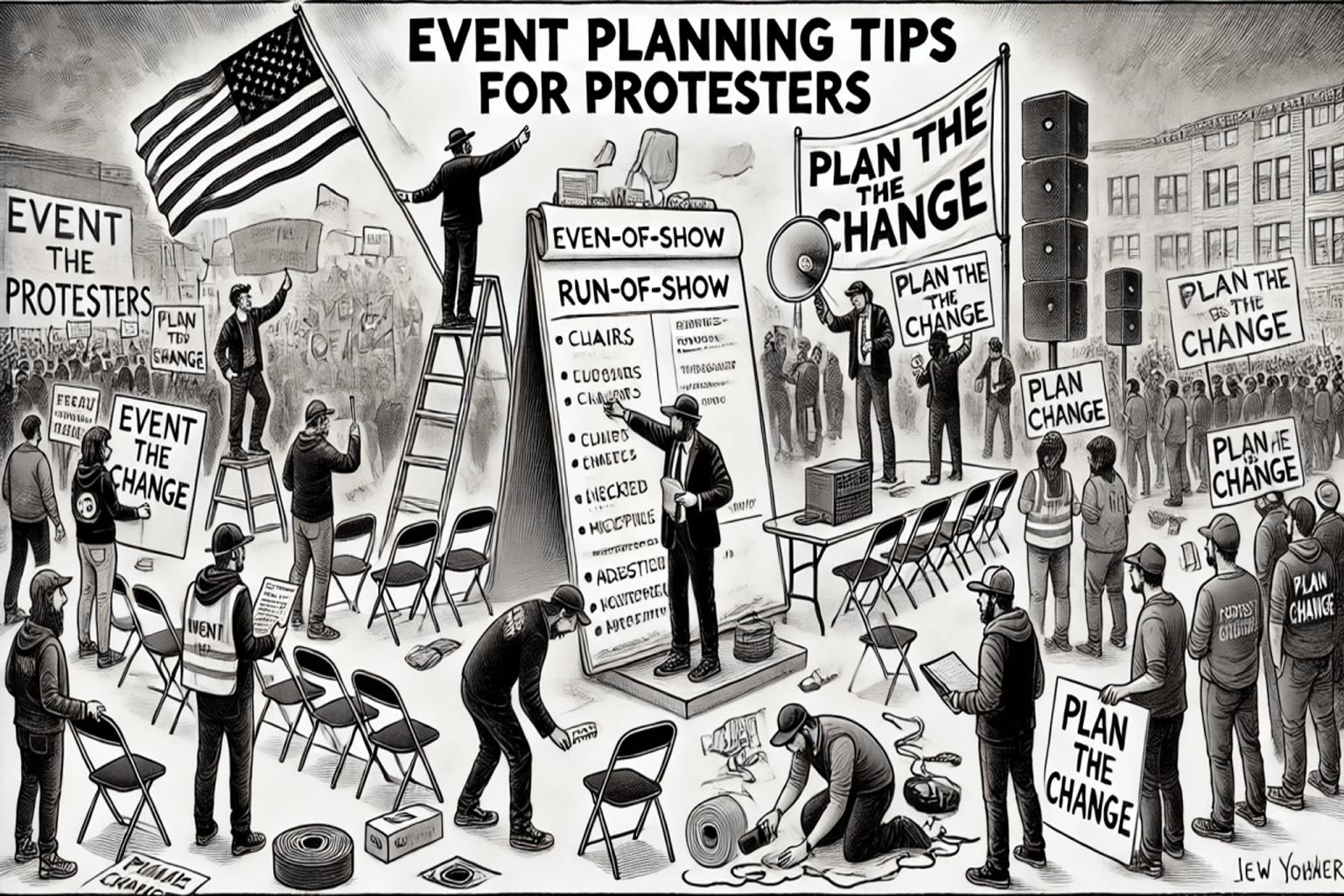
“Modern protests often appear spontaneous. But like most large operations, they usually have planners, funding, logistics, and staff working behind the scenes.”
When most people see a protest on television, they assume they are watching a sudden eruption of public anger. Something happens, people react, and crowds gather in the streets. Sometimes that really is how events unfold.
But many modern protests do not begin in the streets at all. They begin in offices, where organizers plan demonstrations, advocacy groups mobilize activists, and communications teams prepare the messaging that will turn a protest into a national story.
In other words, what appears spontaneous may actually be the final stage of a process that started long before anyone carried a sign into the street.
This essay is the third part of an investigation into what I have called the protest machine. The first part examined how universities increasingly function as training grounds for activists. The second followed the money and showed how foundations and nonprofit organizations finance many modern protest movements.
The next step is understanding the workforce that operates the system.
The series unfolds in four parts.
Part I: Protest U
Part II: Cla$h App
Part III: Protest Inc.
Part IV: Insta Agitator
The first two parts explained where activists are trained and how movements are funded. Part III examines something many Americans rarely consider: the growing class of people whose careers revolve around organizing those movements.
From Grassroots Protest to Professional Activism
For most of American history, protests were organized by people who had other lives. Churches, civic groups, student organizations, and neighborhood leaders often took the lead when an issue stirred public concern. A march or rally might be organized over several weeks, and once the event ended, most participants returned to their ordinary work.
That pattern still exists today, but another layer has developed alongside it.
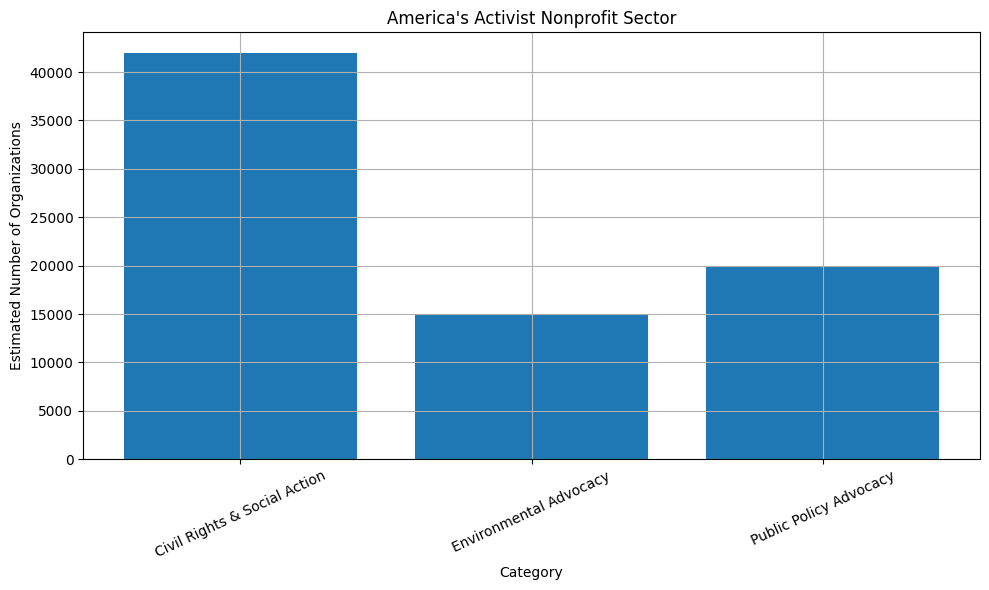
The United States now has more than 1.8 million nonprofit organizations, according to the National Center for Charitable Statistics. Many operate in fields such as environmental campaigns, labor organizing, immigration activism, and civil rights advocacy. A significant number maintain full-time staffs whose job is to recruit participants, coordinate demonstrations, communicate with the press, and maintain pressure on political institutions.
Activism, in other words, has increasingly become institutionalized.
A Career Path Few People Notice
One reason this surprises people is that most Americans never see the career ladder behind modern activism.
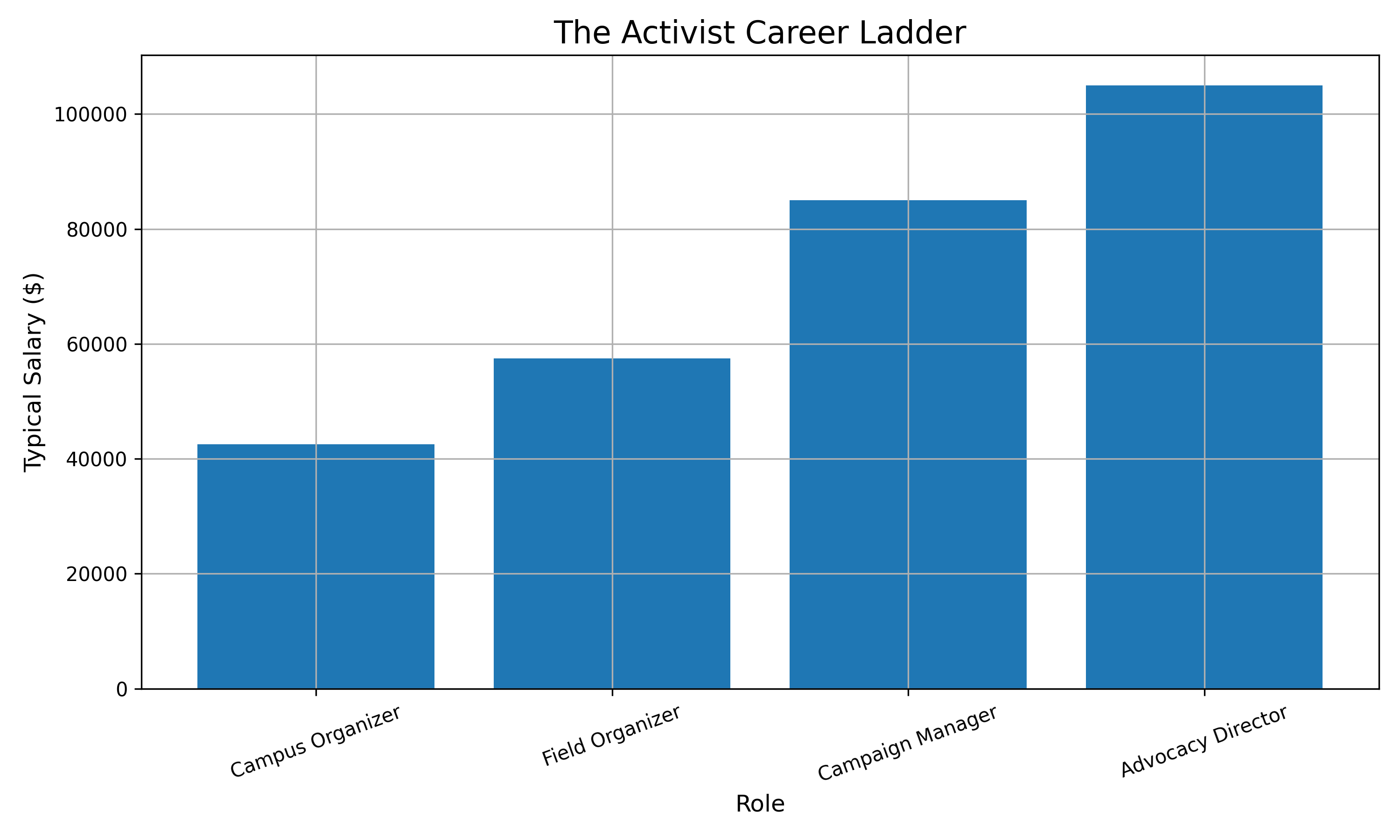
A typical path often begins on college campuses, where students learn organizing techniques and political messaging. From there, some move into internships with advocacy organizations. The next step may be a paid position as a community organizer or field organizer, followed by more senior roles such as campaign manager, advocacy director, or communications strategist.
For those within the system, this progression looks much like that of any other profession.
An activist may spend years moving from one campaign to another, organizing climate demonstrations one year, immigration protests the next, and labor activism after that. Each campaign builds experience and expands connections within the nonprofit advocacy world.
For those working within that world, activism is not simply a cause. It is a career.
The Paychecks Behind the Protests
The financial scale of this system helps explain why it operates the way it does.
Salaries for organizers in the nonprofit advocacy sector typically range from about $45,000 to $70,000 per year. Campaign managers and advocacy directors often earn significantly more, with salaries reaching $70,000 to $120,000, depending on experience and organizational size. But there is also a less visible layer of paid labor beneath these full-time positions. During major campaigns, organizations often bring in temporary workers, paid hourly, daily, or on short-term contracts, to canvass neighborhoods, recruit participants, coordinate events, distribute materials, and help turn a protest into a larger public spectacle. Some job postings for direct-action organizing roles even stress the need to function under pressure and, in certain cases, to be comfortable with the possibility of arrest during protest activity. The result is a system built not only on salaried professionals but also on a flexible pool of campaign-based labor that can be expanded whenever a movement needs bodies, logistics, or noise.
Large nonprofit organizations also bring in temporary organizers during major campaigns. These short-term roles often involve recruiting participants, coordinating rallies, arranging transportation, and managing the logistics required for large demonstrations.
Public tax filings reveal how large some of these operations have become. The Center for Popular Democracy, a national activist nonprofit involved in organizing demonstrations on issues ranging from housing policy to immigration reform, reported roughly $39 million in revenue in a recent IRS Form 990 filing. Millions of that budget were allocated to organizing campaigns, field operations, and mobilization efforts.
These disclosures are public records. Anyone curious about the scale of modern activism can examine advocacy organizations and see that many now operate with budgets comparable to those of small corporations.
By the time a protest appears on the evening news, the event has often been prepared by organizers who spent weeks or months arranging the details.
When Activism Becomes an Industry
Once activism becomes a profession, the incentives within the system begin to change.
Nonprofit organizations rely on funding from foundations and donors. Funding requires visibility and public engagement. Protests generate both.
A large demonstration can generate television coverage, social media attention, and headlines that signal activity to donors and foundations. From the perspective of an advocacy organization, a well-organized protest demonstrates that the group is active, influential, and capable of mobilizing supporters.
When activism becomes a profession, protests stop being occasional events and start becoming a product.
This does not mean every protest is manufactured. Many demonstrations still arise when communities respond to events that affect their lives. But when those events occur, professional activist networks are often ready to amplify them.
Experienced organizers can provide speakers, messaging, transportation, and media outreach that transform a local protest into a much larger national campaign.
In that sense, the professional activist class often acts less like the spark and more like the accelerator.
A Real Example of the System at Work
A clear example of this system appeared during the nationwide demonstrations that followed the death of George Floyd in 2020.
Many protests began as genuine local reactions to the incident. But within days, national activist organizations were providing logistical support that allowed demonstrations to spread rapidly across the country.
Groups such as the Black Lives Matter (BLM), Color of Change, and a network of local advocacy organizations helped coordinate messaging, promote protest locations on social media, recruit speakers, and mobilize participants across multiple cities.
Large demonstrations appeared in cities that had no direct connection to the original event in Minneapolis. Many of these protests occurred at roughly the same time across the country.
None of this required any secret coordination. The organizations already existed. They already had staff, funding, communication networks, and trained activists.
Once the event occurred, the infrastructure was ready.
The Workforce Behind the Demonstrations
By the time a protest appears in the streets, several layers may already be in place.
There are trained activists who learned organizing techniques in universities and advocacy programs. There are funding pipelines that support organizations coordinating campaigns. And there are professional organizers whose job is to mobilize demonstrations and maintain pressure on political institutions.
What the public often sees is the final stage of a much larger operation.
The protest in the street may look spontaneous. The infrastructure behind it often took years to build.
Once that infrastructure exists, something else becomes possible.
Protests can be organized quickly and sometimes appear in multiple cities nearly simultaneously.
That is the subject of the final part of this investigation.
Part IV: Insta Agitator
How trained activists, institutional funding, and professional organizers allow demonstrations to appear almost overnight.
Support Independent Investigations
Investigations like The Protest Machine series take time. Tracing how modern protests are trained, funded, staffed, and deployed is not something that can be done quickly or casually. It requires reading financial filings, reviewing nonprofit records, following organizing networks, and connecting details that are often scattered across many different sources.
This publication has no corporate sponsors, no institutional funding, and no newsroom behind it. Every article is researched and written independently.
The organizations examined in this series have staffs, budgets, and infrastructure.
This work continues because readers decide it matters.
Become a Paid Subscriber
Paid subscribers make investigations like this possible. Your support allows long-form research projects such as The Protest Machine to continue.
Become a paid subscriber:
https://mrchr.is/help
Join The Resistance Core
Some readers choose to go further by joining The Resistance Core, the group helping build a long-term independent platform for investigative writing and civic analysis.
Their support provides the stability that allows this work to continue without corporate sponsors, institutional funding, or political pressure.
Join The Resistance Core:
https://mrchr.is/resist
Make a One-Time Gift
If a subscription is not the right fit, you can still support the work with a one-time contribution.
One-time gifts help cover research time, document review, and the hours required to produce investigations like this one.
Support with a one-time gift:
https://mrchr.is/give
If You Cannot Give
You can still help by sharing the article. Independent writing grows when readers pass it along.
It appears to me this "protest & community organizer career path" became even more popular after Obama revealed how profitable it can be. He rode this path all the way to the White House for two terms. Obviously, he is a gifted speaker and has other talents as well; however, in my humble opinion, he has been the absolute worst president in our nations history. I fear we may not recover from the divisions he deliberately implemented.
Thanks Chris. Your 4 part series on the Protest Machine was outstanding as your work invariably is. Breaking the essay into 4 parts made it easily readable without sacrificing your thoughtful analysis. Short video was also a nice supplement.