

Part One of a two-part essay.
“I remember now. I remember how it started. I can’t remember yesterday. I just remember doing what they told me.”
The Democratic Socialists of America wants to abolish the United States Senate, replace the presidency and Supreme Court with institutions subordinate to Congress, and establish public ownership of America’s largest corporations.
They’ve even been considerate enough to publish the plans.
The organization’s 2026 political program, Workers Deserve More, describes a future without capitalism, debt, or the financial anxiety that dominates so many American households. Housing, healthcare, education, energy, food, and transportation would be organized as public goods rather than businesses operating for private profit.
It sounds wonderful. Who wouldn’t enjoy a life without bills or the worry of wondering whether next month’s paycheck will cover the mortgage? Politicians have been promising some variation of paradise for centuries, and the remarkable thing is how little the price of admission seems to change.
You give them more power over your life, and they promise to make your life better.
Under its proposal, Congress would choose and exercise authority over the institutions responsible for executing and interpreting federal law. The organization also advocates abolishing the Electoral College, introducing proportional representation, and replacing the existing two-party system with a multiparty democracy.
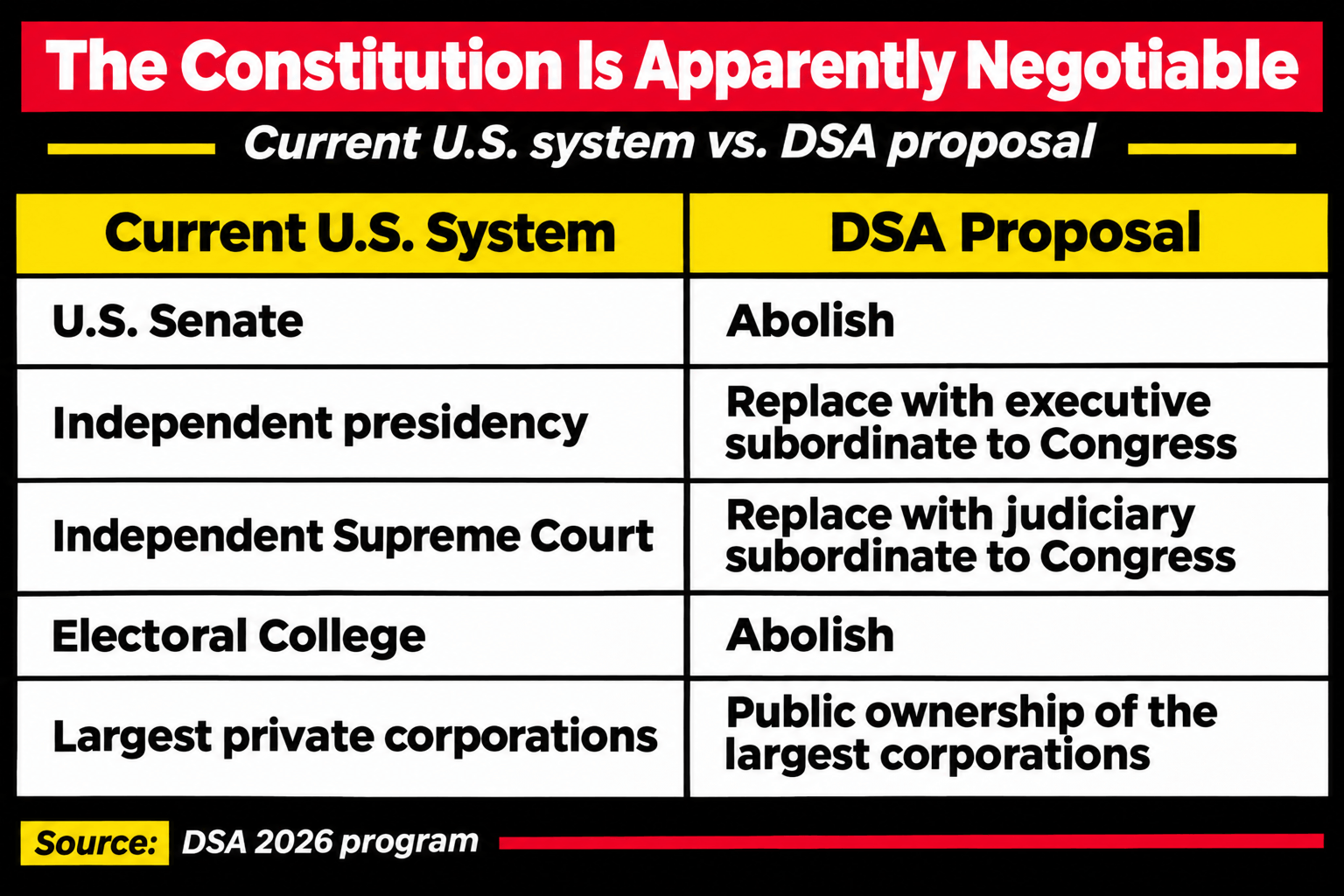
Consider the consequences of transferring judicial authority to an institution subordinate to Congress. A legislative majority passes a law that you believe violates your constitutional rights. You challenge the law, but the institution responsible for deciding whether Congress exceeded its authority operates under the legislature’s control.
The existing Constitution makes it difficult for any political faction to control every part of the federal government. Presidents cannot simply rewrite legislation, Congress cannot exercise unlimited executive authority, and courts can invalidate laws that violate constitutional protections.
Those limitations frustrate politicians because they were designed to frustrate politicians. The founders had enough experience with the dangers of concentrated authority to understand that winning an election didn’t transform an ambitious politician into a reliable guardian of everybody else’s liberty.
The Economics of Free Everything
The DSA advocates a 32-hour workweek with full pay and benefits. There’s an appealing idea, especially for anyone who has spent Friday afternoon watching the clock and wondering why the weekend is taking so long to arrive.
A worker earning $1,000 for forty hours receives $25 per hour. Require the employer to pay the same $1,000 for thirty-two hours, and the hourly wage cost becomes $31.25. That’s a 25% increase in hourly compensation before accounting for changes in benefits or other expenses.
Some businesses may improve productivity enough to accommodate the change. Others will need to raise prices, reduce staffing, automate positions, or absorb lower profits.
A restaurant serving dinner doesn’t become less dependent on cooks and servers because Congress has decided people deserve shorter workweeks. Someone still has to prepare the food, serve the customers, clean the kitchen, and pay the suppliers.
The DSA advocates universal rent control and expanded publicly owned housing. Rent restrictions can protect existing tenants from sharp increases, but they also change the financial incentives facing landlords and developers.
Researchers Rebecca Diamond, Timothy McQuade, and Franklin Qian examined an expansion of rent control in San Francisco. Their research found that covered tenants were nearly 20% more likely to remain at their addresses. Affected landlords reduced rental housing supply by 15%, and the researchers’ working-paper estimate attributed a 5.1% increase in citywide rents to the reduction in supply.
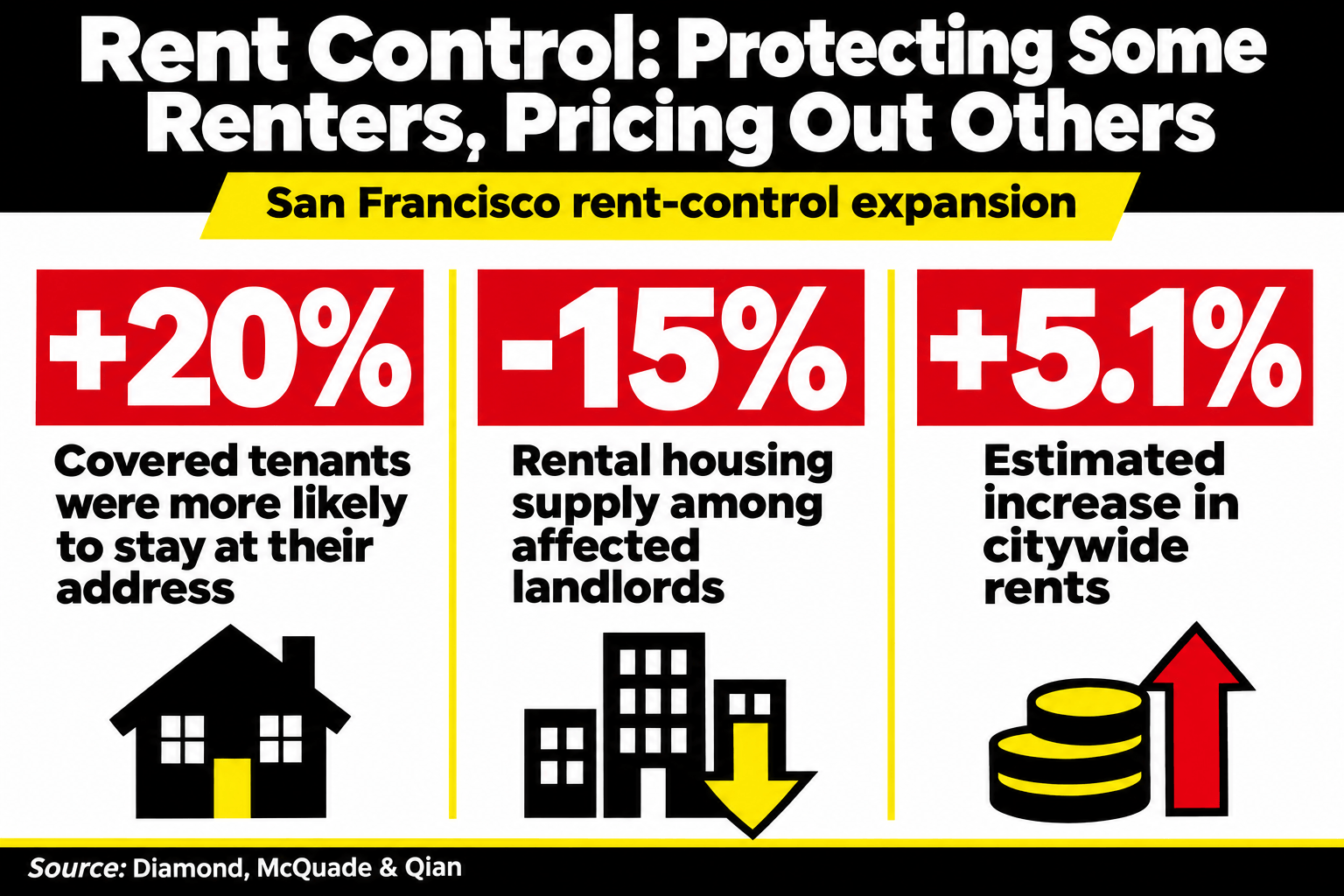
The same policy that protected one tenant helped make housing more expensive for someone else.
That’s an unpleasant result for politicians promising affordable housing, but it isn’t particularly mysterious. Restrict the financial return from providing rental homes, and some property owners will find other uses for their investments or decide that building additional apartments no longer makes economic sense.
Public housing could replace some lost private investment, but then government must acquire land, purchase materials, hire workers, finance construction, and maintain the buildings. Those obligations compete with every other demand on public money.
The government can decide who pays for something. It cannot make the expense vanish by announcing that people deserve it.
Under the DSA’s proposed economic system, important decisions about investment, management, employment, and the allocation of capital would increasingly move from private owners toward publicly controlled institutions.
Public ownership changes who makes those decisions and who bears responsibility when they go wrong. It doesn’t eliminate the underlying economic problems.
And concentrating more economic activity under political authority creates additional opportunities for favoritism. When officials control substantial employment, public investment, and major industries, they also possess greater power to reward political allies and disadvantage competitors.
Americans already have extensive experience with government contracts, subsidies, regulatory favoritism, and politically connected businesses. Assuming those problems disappear when politicians acquire more control over the economy would require an extraordinary amount of faith.
The Government They Want to Replace
The DSA’s program also advocates steps toward abolishing the existing police and prison system, abolishing ICE, extending voting rights to permanent U.S. residents, and fundamentally restructuring federal elections.
If police and prisons are eventually abolished, who apprehends violent offenders, protects victims, and confines dangerous criminals? If ICE disappears, which institutions enforce immigration law? If voting rights are extended to permanent residents, how would the relationship between citizenship and political authority change?
And the organization isn’t waiting for Americans to approve its entire program in one national referendum. It has developed an electoral strategy that allows it to acquire influence inside the existing political system.
That strategy runs straight through the Democrat Party.
The Party Within the Party
On October 3, 2023, eight Republican members of Congress joined 208 Democrats to remove Kevin McCarthy as Speaker of the House. McCarthy had the support of 210 Republicans who voted against his removal, but the final tally was 216 to 210.
You don’t need to control Congress to make life miserable for the people who do. Sometimes you only need enough votes to make sure the people running it can’t accomplish anything without you.
A narrow congressional majority gives organized factions opportunities that their numbers might otherwise suggest are impossible. If party leadership needs ten votes to pass a spending bill, the ten legislators holding those votes can demand concessions or force leadership to seek support elsewhere.
The DSA has developed an electoral strategy suited to those circumstances. Its candidates frequently compete through Democrat Party primaries while the organization works toward the stated objective of building an independent mass socialist party.
In September 2026, the DSA’s National Electoral Commission described its goal of developing a political organization capable of ending capitalism. Its endorsement criteria also make clear that winning office is only part of what it expects its candidates to accomplish.
Applicants for national endorsement must support the organization’s political program, participate in its activities, recruit members, help develop local chapters, and identify publicly with socialism. The August 2026 requirements also state that candidates should view themselves as socialist organizers first, and legislators second.
That’s quite a priority for someone asking to become a member of Congress.
A representative is elected by the people of a district, including citizens who may disagree with socialism and practically everything else the DSA advocates. The representative also swears an oath to support and defend the Constitution.
Even AOC Wasn’t Enough
In 2024, Alexandria Ocasio-Cortez was one of the most recognizable democratic socialists in America. She had defeated a powerful incumbent to enter Congress in 2018, become a national political celebrity, and helped make socialism a familiar part of the country’s political conversation.
Apparently, national DSA leadership still had some questions about her commitment.
On June 23, 2024, its National Political Committee voted to give Ocasio-Cortez a conditional endorsement. The conditions included publicly opposing all American funding to Israel, including Iron Dome, supporting the Boycott, Divestment and Sanctions movement, opposing legislation the organization considered harmful to anti-Zionist advocacy, and regularly participating in its congressional socialist network.
The decision produced an internal disagreement. NYC DSA, which had requested national support, objected to the unexpected conditions and their timing after the primary. Its leadership asked the national organization to withdraw the endorsement.
On July 10, national DSA withdrew its conditional support, citing both the local chapter’s request and the absence of evidence that Ocasio-Cortez had satisfied its requirements. Her New York City chapter continued endorsing her.
November 3, 2026
Six candidates endorsed by the DSA or its local chapters won elections to the House of Representatives: Darializa Avila Chevalier and Claire Valdez in New York, Melat Kiros in Colorado, Angela Gonzales-Torres in California, Donavan McKinney in Michigan, and Chris Rabb in Pennsylvania.
Melat Kiros defeated Diana DeGette, a fifteen-term incumbent in Colorado’s First Congressional District. Darializa Avila Chevalier defeated Adriano Espaillat, chairman of the Congressional Hispanic Caucus, in a New York primary.
Those victories were achieved inside the Democrat Party, not by defeating Republicans.
In districts where one party dominates the general election, a primary can determine which ideological faction ultimately controls that party’s congressional seat. Turnout is typically lower, and well-organized groups can have an advantage over less engaged voters.
Winning those primaries provides the DSA with something more valuable than favorable newspaper coverage. It provides elected officials who can participate in congressional debates, build relationships with other legislators, and pursue parts of the organization’s political program.
The Problem for the Rest of the Party
The Democrat Party contains moderates, progressives, labor-oriented politicians, and socialists whose objectives don’t always align. A party leadership seeking a broad electoral coalition must negotiate among those interests, particularly when congressional majorities are narrow.
A Democrat leader may seek legislation acceptable to several competing groups. DSA-backed representatives may insist on stronger measures or reject compromises they believe undermine the movement’s objectives.
An organization seeking additional public housing or higher taxes is attempting to change what the government does. An organization proposing to abolish the Senate and replace the presidency and Supreme Court is seeking to change what the government is.
Congressional primaries cannot authorize those constitutional changes. But repeated electoral victories can alter the composition of the legislature, influence which proposals receive attention, and expand the movement’s political reach.
And those victories bring the organization into relationships with other activists and political movements whose objectives may be quite different from its own.
Strange Bedfellows: Socialists, Islamists, and the Politics of Convenience
By 1983, Iran’s Islamic government was arresting the communists who had helped bring its revolution to power. The Tudeh Party had supported Ayatollah Ruhollah Khomeini, praised his leadership, and aligned itself with the new Islamic Republic. Four years after the Shah’s overthrow, its leaders were being rounded up, approximately 1,000 active members had been arrested, and the organization was outlawed.
Some people spend their lives imagining how wonderful everything will be after the revolution. Iran’s communists got an opportunity to find out.
Their mistake wasn’t opposing an authoritarian monarch. It was believing that the religious movement replacing him would share political authority with people whose ideas about government were fundamentally incompatible with its own.
The Iranian Revolution brought together religious extremists, secular liberals, nationalists, Marxists, communists, and students who wanted Shah Mohammad Reza Pahlavi removed. They disagreed about nearly everything except the man they wanted out of power.
When the monarchy collapsed in February 1979, Khomeini and his supporters began establishing an Islamic Republic in which ultimate political authority rested with a supreme religious leader. Political opposition was suppressed, newspapers were closed, and restrictions on women’s rights became government policy.
The Tudeh Party continued supporting the government even as other leftist organizations faced repression. Its leaders apparently believed their cooperation would preserve their influence.
By 1983, the regime had turned against them, too. Party leaders were accused of espionage for the Soviet Union, arrests followed, and some officials were executed.
The communists had helped strengthen the political establishment that would eventually destroy their own organization. Their supposed partners had been willing to accept their assistance. Sharing power was another matter entirely.
In 2011, secular reformers, leftists, religious conservatives, and supporters of the Muslim Brotherhood participated in the protests demanding the removal of President Hosni Mubarak. After thirty years in power, Mubarak resigned, and Egypt began what many hoped would become a democratic transition.
The Muslim Brotherhood was among the country’s best-organized political movements. Its candidate, Mohamed Morsi, won the presidency in June 2012 with approximately 51% of the vote.
Five months later, Morsi issued a constitutional declaration placing his presidential decisions temporarily beyond judicial review and protecting the assembly drafting a new constitution from dissolution by the courts.
His supporters said the measures were necessary to protect the revolution. His opponents saw something considerably less inspiring: a president who had won an election and promptly decided the courts should have less authority to challenge him.
Mass protests followed. In July 2013, Egypt’s military removed Morsi, and the country returned to authoritarian government under different leadership. The subsequent crackdown on the Muslim Brotherhood was severe.
An American Alliance
On October 20, 2023, more than 3,000 demonstrators gathered in Manhattan to demand a ceasefire in Gaza and an end to additional American military assistance to Israel, according to the organizers.
The coalition included the New York City Democratic Socialists of America, the Muslim American Society of New York, the Islamic Circle of North America, the Muslim Democratic Club of New York, Jewish Voice for Peace, and several other organizations. Among the speakers was New York State Assemblymember Zohran Mamdani, a democratic socialist who would subsequently become mayor of New York City.
Such cooperation can be politically useful. Organizations introduce supporters to one another, recruit volunteers, share resources, and establish relationships that can extend into future campaigns. A demonstration about foreign policy can become an opportunity to build a political network.
The DSA advocates secular government, abortion rights, LGBTQ rights, and the replacement of capitalism with democratic socialism. Political Islamist movements seeking to place civil government under religious authority may reject some or all of those positions.
The organizations participating in that Manhattan demonstration had united around an issue, not a common blueprint for religious government. Their cooperation illustrates how political networks can bring together people who might disagree sharply about other fundamental questions.
When the Mask Slipped
The reaction to Hamas’s October 7, 2023, attacks on Israel exposed serious divisions within parts of the American left.
Hamas-led attackers murdered approximately 1,200 people and took 251 hostages. Civilians were killed in their homes, at a music festival, and in communities near the Gaza border.
Two days later, the San Francisco chapter of the DSA published a statement condemning Israeli policies and explaining that violent oppression produces resistance. Referring directly to the weekend’s events, the chapter declared that they were no different.
The statement did not condemn Hamas’s murder of civilians.
The Salt Lake City chapter took a similarly troubling approach. In a statement published on October 10, it defended Palestinian resistance and declared that fighting what it considered injustice was not terrorism or antisemitism.
There is a difference between defending the rights of Palestinians and treating attacks on civilians as an acceptable expression of political resistance. The first is a legitimate political position. The second asks people to overlook murder because they sympathize with the perpetrators’ stated objectives.
The Anti-Defamation League cited those chapter statements among examples of rhetoric it considered supportive of the Hamas attacks. An organization that claims to oppose oppression and discrimination should be capable of recognizing the deliberate murder of civilians without needing to consult the political affiliations of the victims.
On November 28, 1941, Adolf Hitler met with Hajj Amin al-Husayni, the former Grand Mufti of Jerusalem, in Berlin. Al-Husayni was an Arab nationalist and prominent Muslim religious leader who had become a willing collaborator with Nazi Germany.
The United States Holocaust Memorial Museum documents his antisemitic propaganda, support for the Nazi regime’s persecution and murder of Jews, and efforts to recruit Muslims for German military and auxiliary forces. Al-Husayni sought German backing for Arab independence and opposition to a Jewish homeland in Palestine. Hitler declined to provide the political commitments he requested, although al-Husayni continued collaborating with the Nazi regime.
Their political objectives were different, but their hostility toward Jews helped bring them together. Nazi Germany was violently anti-Marxist despite having the word Socialist in its party name, and Hitler’s genocidal program was already underway before the 1941 meeting. Al-Husayni supported that program; he did not create it.
Ideological Loyalty Comes First
In August 2025, the DSA’s national convention adopted Resolution 22, For a Fighting Anti-Zionist DSA, by a vote of 675 to 524. The measure strengthened the organization’s commitment to anti-Zionism, support for the Boycott, Divestment and Sanctions movement, and organizational expectations concerning members and political candidates.
The vote also revealed substantial internal disagreement. More than five hundred delegates opposed the resolution, and the measure passed with approximately 56% support.
A representative may have to make decisions about military aid, foreign policy, antisemitism legislation, and the rights of citizens to express competing political beliefs. An ideological organization can demand loyalty to its preferred policy. A member of Congress must answer to a much broader electorate while also fulfilling constitutional obligations.
The people seeking office through the Democrat Party may therefore find themselves balancing the demands of the socialist organization that helped elect them against the responsibilities of the positions they now occupy. Once those political arguments turn into legislation, their consequences reach people who never joined the movement.
The Future Needs a Permit
On March 25, 2026, Bernie Sanders introduced legislation to prohibit the construction and expansion of major artificial intelligence data centers across the United States until Congress established an extensive new system of regulations.
Three months later, Alexandria Ocasio-Cortez introduced the House version, H.R. 9442, with support from Rashida Tlaib and eight other original cosponsors. By November, another eleven members of the Democrat Party had signed on, bringing the total to twenty cosponsors.
American companies were investing billions in the computing infrastructure necessary to develop those technologies. China was doing the same.
And Bernie Sanders thought this would be a good time to stop building.
The legislation, called the Artificial Intelligence Data Center Moratorium Act, would prohibit construction or upgrading of covered AI data centers until Congress enacted laws addressing product safety, employment, economic benefits, environmental protection, utility costs, and several additional requirements.
Congress would also have to explicitly terminate the moratorium. There was no automatic expiration date.
Apparently, we can only move forward with the technological revolution once Washington finishes writing the instruction manual.
Washington Wants the Keys
The proposed legislation would require federal review and approval of AI products before their release. It would also require laws designed to prevent AI-related job displacement and ensure that workers shared in the wealth generated by AI companies.
New or upgraded facilities would have to meet additional conditions, including restrictions on environmental harm, protections against increased consumer electricity bills, community approval, union labor requirements, and a prohibition on government subsidies.
Artificial intelligence creates legitimate concerns. Workers can lose jobs to automation. Criminals can use AI to commit fraud. Companies can misuse personal information, and enormous computing facilities require electricity, water, land, and expensive infrastructure.
But Sanders and Ocasio-Cortez aren’t merely proposing penalties for companies that cause identifiable harm. They’re proposing that an important category of private investment remain suspended until Congress agrees on a far-reaching regulatory and economic program.
The same institution that regularly struggles to pass appropriations legislation would determine when companies could resume building essential computing infrastructure.
The legislation requires safeguards against job displacement and a system for sharing AI-generated wealth with the American people. Yet technological change almost always involves some displacement of existing work.
When automobiles replaced horse-drawn transportation, industries built around horses declined while entirely new industries developed. When computers became commonplace, some clerical occupations contracted while software development, digital communications, and countless other activities expanded.
Had Congress demanded those guarantees before computers became commonplace, we might still be processing invoices with carbon paper.
The Electricity Problem Is Real
Data centers use enormous quantities of electricity, and their growing demand is creating problems that utilities and consumers cannot simply ignore. Lawrence Berkeley National Laboratory estimated that American data centers consumed approximately 176 terawatt-hours of electricity in 2023, representing 4.4% of national electricity consumption.
Its June 2026 update projected that data centers could account for approximately 11.8% of American electricity consumption by 2030, with estimates ranging from 9.5% to 15.3% under different scenarios.

That growth requires considerable investment in power generation, transmission lines, substations, and other equipment. Someone has to pay for it.
An investigation by the state’s Joint Legislative Audit and Review Commission found that the data-center industry contributes approximately 74,000 jobs, $5.5 billion in labor income, and $9.1 billion in annual GDP. Much of that benefit comes from construction, which typically involves far more workers than the completed facilities employ.
The commission projected that a typical Dominion Energy residential customer could face an additional $14 to $37 per month in generation and transmission costs by 2040 as data-center demand grows. That’s another $168 to $444 annually for a household that may already be struggling with electricity bills.
A family shouldn’t have to subsidize a multibillion-dollar technology company’s infrastructure simply because that company has enough money and political influence to demand special treatment.
In November 2025, Virginia’s State Corporation Commission approved a new electricity-rate category for large customers, including data centers, scheduled to take effect January 1, 2027. Customers with sufficiently large electricity requirements would face separate rates and contractual obligations intended to protect everyone else from the financial risks of their enormous power demands. The arrangements include minimum payments tied to contracted electricity capacity, even if a customer ultimately uses less power than expected.
That’s important because utilities might otherwise build expensive infrastructure for projects that are canceled, delayed, or never reach their anticipated demand. Without financial protections, ordinary customers could end up paying for facilities they never needed.
The principle is straightforward. If your business requires extraordinary electrical infrastructure, your business should bear the appropriate costs.
Regulators can require companies to pay their costs, enforce contracts, establish environmental protections, and hold businesses responsible for damages without prohibiting an entire category of investment until Congress reorganizes the industry.
China Isn’t Waiting for Bernie Sanders
According to the International Energy Agency, the United States accounted for approximately 45% of global data-center electricity consumption in 2024. China accounted for another 25%. Electricity consumption alone does not establish technological superiority.
Artificial intelligence is becoming increasingly relevant to manufacturing, medicine, logistics, cybersecurity, scientific research, and military technology. Countries capable of developing and deploying these systems can gain important economic and strategic advantages.
A federal construction moratorium cannot compel Chinese companies to suspend their projects. The Sanders-AOC legislation attempts to address international competition partly through restrictions on exporting American computing hardware to countries without comparable safeguards.
A country that slows its own investments while competitors continue developing theirs should at least be prepared to explain why the expected benefits justify the economic and strategic costs.
The Socialists Are Organizing
On July 14, 2026, its publication Democratic Left described organizing efforts involving chapters in Tucson, Corpus Christi, Seattle, New York, and other communities. The discussion included New York State Senator Kristen Gonzalez, a member of NYC DSA who supported legislation regulating data-center development, including a proposed one-year moratorium on large facilities.
In Tucson, organizers had been campaigning for municipal ownership of the electric utility. Their chapter viewed opposition to a major data-center project as an opportunity to advance that objective while supporting local candidates and recruiting political allies.
A resident worried about higher utility costs wants an affordable electric bill. The DSA wants public ownership of major industries and greater political control over economic resources.
The DSA’s own account acknowledged that conservative residents were participating in opposition campaigns. One organizer in Corpus Christi even described self-identified MAGA mothers expressing unexpected sympathy for the socialists involved.
When Washington Decides to Stop Building
Now imagine that legislation resembling the Sanders-AOC proposal becomes law. A technology company has purchased land in Virginia, secured financing, signed construction contracts, and arranged for new electrical infrastructure. Hundreds of workers are preparing to begin construction.
The company suspends its project. Contractors lose scheduled work, equipment orders are postponed, and local officials begin calculating the tax revenue and economic activity that may never arrive.
Imagine federal regulators refusing to allow an existing facility to upgrade its equipment, even though the company argues that the project falls outside the law’s restrictions. A federal judge agrees with the company and issues an order blocking the government’s enforcement decision.
The administration now faces a choice. It can obey the ruling, appeal, or ask Congress to clarify the law. Instead, suppose federal officials announce that the court has interfered with the government’s economic program and instruct regulators to continue enforcing the restriction.
The company returns to court. State officials challenge the administration’s conduct. Congressional opponents demand investigations, and the government insists that judges should not be allowed to obstruct policies enacted by elected representatives.
Some politicians demand restrictions on judicial authority. Others begin advocating the constitutional restructuring already described in the DSA’s published program. Opponents organize around the proposition that government officials must remain bound by the legal limits of their offices, regardless of how popular their policies may be.
The question would no longer be whether America needed another data center. It would be whether America still had a government that obeyed its own laws.
A Personal Request
I’ve always believed my essays should be free for everyone to read. I don’t want someone’s financial circumstances determining whether they have access to the work I publish.
But I need to ask for your help.
Since my car accident on October 7, life has been considerably more difficult than I anticipated. The accident took away my ability to earn money driving, and the physical recovery has made rebuilding my income from home more challenging than I’d hoped.
Meanwhile, the bills haven’t exactly shown much sympathy.
I’ve continued writing, researching, and publishing because I believe in what I’m doing. These essays take an enormous amount of work, and I have no intention of abandoning them. But determination doesn’t pay the rent, buy groceries, or keep the lights on.
I’m still struggling to get back on my feet financially since the accident, and this month is particularly difficult. I could genuinely use your help.
If you enjoy my writing and believe it’s worth supporting, please consider becoming a paid subscriber for $8 a month or $80 a year. You’ll be helping me continue publishing essays that remain free for everyone.
Become a paid supporter:
https://mrchr.is/help
Join the Resistance Core ($1,200/year):
https://mrchr.is/resist
Make a one-time contribution:
https://mrchr.is/give
Venmo contributions are also welcome, especially if you’d prefer to help directly without taking on a recurring subscription.
https://account.venmo.com/u/mrchrisarnell
I know many of you have your own financial pressures, and I don’t take anyone’s support for granted.
If you’re in a position to help me through this stretch, it would make a real difference right now.
To those who have already contributed, subscribed, or reached out since the accident, thank you. Your generosity has helped me keep going through a period I wouldn’t wish on anyone.
I’m not finished writing. Not even close.
I just need a little help getting back on solid ground.
COMING NEXT: Revolution Calling, Part Two: America Says No
The socialists have told us exactly what they want. The question is whether Americans are willing to let them have it.
Part Two looks at what happens when politicians push beyond constitutional limits and Americans refuse to surrender the country they inherited.
They think they've got us. They have seriously miscalculated.
And if the title sounds familiar to a few of you, that's no accident.
I remember now...
Another great one Chris. How the populace can be so ignorant as to believe in or trust these idiots is a testament to our education and immigration systems. God help us! Fuck these ass hats