


America turns 250 this year. Rome also looked stable deep into its decline. The part people miss is that long collapses still have short decision windows. The curve bends quietly for decades, then the recovery window closes. If you are looking for the moment that matters, it is not the year the walls fall. It is the last generation that still knows how to fix the walls.
For us, that window is not 250 years away. It is closer to forty.
The tragedy of a crumbling society is not that it happens in a flash of fire, but that it happens while everyone is looking the other way. If you walked through Rome in the second century, you would have seen a city that appeared to be at the absolute pinnacle of human achievement. The marble was polished, the grain ships were arriving on schedule, and the legal system was the envy of the known world. Yet, beneath that veneer of stability, the very intellectual and cultural foundations that built those aqueducts were already beginning to erode. We are seeing a very similar process play out in the United States as we move through 2026. It is a quiet, statistical decay that most people ignore because it doesn’t fit into a catchy news cycle.
What made Rome’s decline so difficult to perceive was not ignorance, but continuity. Most Romans alive in the second and third centuries experienced a world that still functioned. Taxes were collected. Courts convened. Roads were repaired. Grain arrived. The state did not appear to be failing in any obvious sense. What had changed was not the existence of institutions, but the depth of understanding behind them.
When Knowledge Becomes Procedural
Roman historians later recorded a subtle but telling shift. Technical knowledge increasingly became procedural rather than conceptual. Engineers followed inherited designs without understanding why they worked. Administrators enforced laws they could no longer adapt. Military commanders relied on tradition rather than strategy. The empire continued to operate, but on momentum alone.
This distinction matters because physical infrastructure decays more slowly than intellectual infrastructure. Stone aqueducts can function for centuries even after the people capable of designing them are gone. Legal codes can be enforced long after the philosophical reasoning behind them has been forgotten. The illusion of permanence is strongest precisely when decline has already begun.
Institutional memory is not stored solely in books. It is stored in people. It exists in habits of thought, in apprenticeship, in tacit knowledge that cannot be written down easily. Once that memory is lost, rebuilding it is vastly more difficult than maintaining it would have been.
Rome did not lack warnings. Writers as early as Tacitus and Juvenal complained of declining standards, loss of discipline, and cultural decay. These warnings were dismissed as nostalgia. Every generation believes decline is merely older people romanticizing the past. Rome paid the price for that assumption.
The lesson is not that Rome fell because of decadence or moral failure. It fell because a complex civilization allowed its stock of competence to decline while assuming the system would continue to function indefinitely.
That assumption is always wrong.
The Rome Curve
When we discuss the “Rome Curve,” we refer to the measurable lag between the moment a population loses its collective ability to solve complex problems and the moment its physical infrastructure finally fails. It takes a certain level of cognitive capital to maintain a power grid, a sophisticated legal system, or a modern medical apparatus.
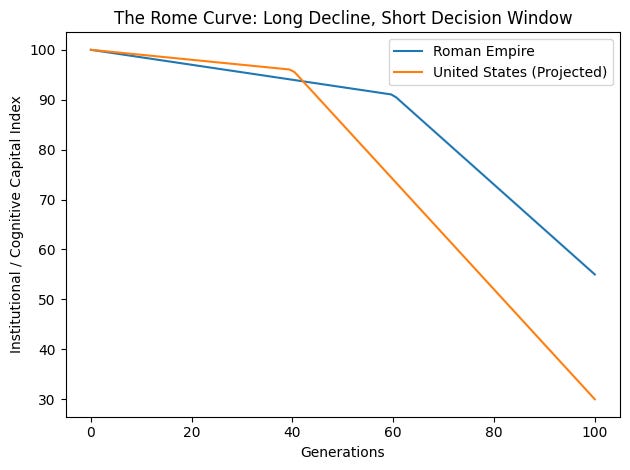
One reason cognitive decline is poorly understood is that modern systems obscure it. Automation compensates for missing competence until it suddenly cannot. Checklists replace judgment. Software replaces intuition. When everything works, these substitutions appear to be progress. When they fail, they reveal how thin the margin has become.
Consider the electrical grid. Modern power systems are vastly more complex than those of fifty years ago. They require engineers who understand load balancing, cascading failures, and physical infrastructure, not just software dashboards. When outages occur today, investigations increasingly cite human error, misconfiguration, or lack of situational awareness. These are not funding problems. They are competence problems.
Aviation provides another example. Modern aircraft are extraordinarily safe, but they are also heavily automated. Pilots now spend far fewer hours manually flying aircraft than previous generations. When automation fails or produces conflicting data, accidents disproportionately involve crews with limited manual-flying experience. The industry has quietly acknowledged this by increasing simulator training focused on raw skills rather than procedures.
Medicine shows the same pattern. Diagnostic accuracy has improved in some areas due to imaging and algorithms, but physicians are increasingly trained to follow protocols rather than reason from first principles. When cases fall outside expected patterns, misdiagnosis rates rise sharply. This is not because doctors are lazy or uncaring. It is because training has shifted from understanding to compliance.
The Long Arithmetic of Decline
These examples illustrate a broader truth. As systems become more complex, the cost of losing competence rises faster than the cost of losing money. You can fund infrastructure indefinitely. You cannot instantly manufacture the minds required to maintain it.
Cognitive capital is not evenly distributed, and it never has been. A relatively small number of people carry a disproportionate share of institutional knowledge. When that group shrinks, societies do not collapse immediately. They adapt. They lower standards. They redefine success. They mistake survival for resilience.
That is how decline hides.
Decline hides behind functioning systems. As long as the lights stay on, people mistake momentum for competence and survival for strength.
If the average level of competence in a society drops by even a small margin, you don’t notice it the next day. You notice it thirty years later, when the people who understood the system's underlying physics retire and are replaced by those who were taught to pass tests rather than to think.
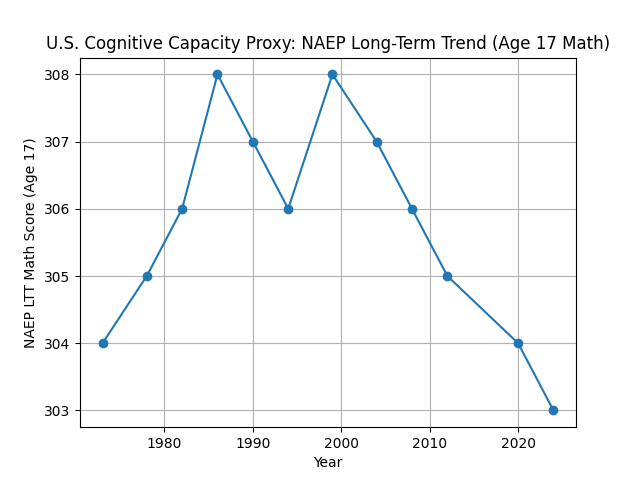
The numbers tell a story that many would prefer not to hear. Between the middle of the twentieth century and the present day, we have observed a steady decline in the nation's cognitive reserves. It is often said that a single IQ point shift across a population can result in a massive difference in Gross Domestic Product. When you lose that edge, you lose the redundancy that allows a civilization to survive a crisis. If you have fewer engineers who can innovate and fewer doctors who can diagnose complex ailments without a computer prompt, you are essentially living on borrowed time. This is not a matter of opinion or “mean-spiritedness,” but a matter of cold, hard arithmetic.
Historical precedents are rarely perfect, but they are often instructive. The Roman elite eventually ceased to see the necessity of reproducing their own culture and skills. They outsourced the defense of their borders and the labor of their fields to people who had no cultural or intellectual investment in the Roman project. At the same time, environmental factors such as lead contamination and soil exhaustion began to take a toll on the physical health of the population. By the time the barbarians arrived at the gates, the people inside the walls had already forgotten how the gates were built in the first place.
The Modern Inflection Point
In the modern context, we can look at the year 1970 as a major turning point. That was roughly when the fertility rates of the most educated segments of the population began to plummet. It was also around the time that the Democrat Party and various academic institutions began to prioritize ideological conformity over raw merit. When you add the impact of the 1965 Immigration Act, which shifted the focus away from high-skill recruitment, and the decline in the nutritional quality of our food, you get a recipe for long-term decline. By 2026, the weighted mean IQ of the country has slipped from 100 to about 98. That might sound like a small change, but in the world of complex systems, it is the difference between a society that can fix its problems and one that simply manages its own decline.
A two-point drop in average IQ does not sound alarming until you realize that modern civilization does not run on a 0–100 scale. It runs on margins. If the functional cognitive floor for maintaining complex systems is approximately 90, then a decline from 100 to 98 represents not a trivial shift but the loss of roughly 20% of the buffer separating competence from fragility. Civilizations do not fail when intelligence disappears. They fail when redundancy does.
The period around 1970 is important not because of a single policy decision, but because it marked a simultaneous shift in incentives across multiple domains. For decades after World War II, American institutions operated under assumptions shaped by scarcity, competition, and performance. Those assumptions began to change.
In education, mastery slowly gave way to credentialing. Diplomas and degrees became symbols of participation rather than evidence of competence. This shift did not happen overnight. It unfolded gradually as standards were softened to accommodate broader social goals. Over time, the signal value of credentials weakened, even as their importance increased.
In the labor market, complexity increased faster than training. Jobs that once relied on apprenticeship and skill accumulation became abstracted into bureaucratic roles. Performance was increasingly measured by compliance rather than output. This rewarded those who navigated systems well, not those who understood them deeply.
Culturally, the meaning of adulthood shifted. Marriage and child-rearing were postponed or abandoned among the most educated, precisely the group most capable of transmitting cognitive and cultural capital. This was not framed as decline. It was framed as liberation. The long-term demographic consequences were barely discussed.
Immigration policy changes layered onto this environment. Family reunification became the dominant mechanism of entry, not skill matching. Over decades, this altered the skill distribution of incoming populations in ways that interacted with declining educational standards rather than compensating for them.
None of these changes were inherently malicious. Each was defensible in isolation. Together, they created a system that consumed cognitive capital faster than it could be replenished.
History rarely punishes intentions. It punishes outcomes.
If we stay on this current path, the projection for the next century is grim. We could see the mean IQ decline to 96 by 2120. At that level, the institutions that we take for granted, reliable air travel, clean water, and a stable currency, become nearly impossible to maintain. We have a window of about forty years to reverse these trends. This would require a serious effort to reform immigration to favor merit, to encourage the most capable among us to have larger families, and to address the environmental factors that are quite literally dulling the minds of our children.
The soil itself is part of this struggle. Recent studies from 2024 and 2025 have shown that the minerals necessary for brain development are declining in the food supply. If the brain does not have the fuel it needs during its formative years, no amount of government spending on schools will make up for that deficit. We are essentially fighting a war on two fronts: a biological one and a cultural one. If we do not win both, the Rome Curve will continue its downward slope regardless of who holds office in Washington.
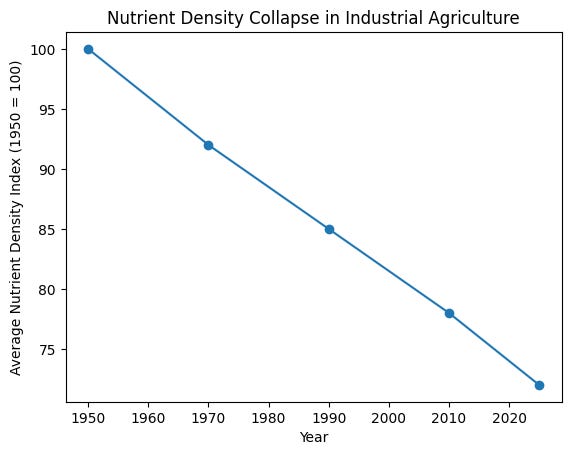
This decline does not announce itself with crisis headlines. It unfolds quietly, across decades, and expresses itself statistically rather than dramatically. But when biological inputs degrade at scale, no institutional reform can fully compensate. The curve continues to bend, regardless of intention.
The average child born today will be in the prime of their life when this window of opportunity begins to close. If they are not equipped with the mental tools and the physical health to manage the world we leave them, they will be the ones who watch the lights go out. It is a heavy burden to place on a generation, but history does not care about our feelings. It only cares about results. We can either do the hard work of rebuilding the nation’s cognitive capital now, or we can leave our descendants to wonder why we let such a magnificent civilization slip through our fingers while we were distracted by the trivialities of the moment.
Education as a Case Study
When examining the decline of American education, it is easy to get bogged down in the latest controversies over what is being taught in the classroom. But the real story is much older and more systematic. It is a story of how the very meaning of achievement has been redefined by the Democrat Party and its allies in the academic world. For more than half a century, we have seen a steady shift away from the idea that schools exist to transmit knowledge and toward the idea that they exist to socialise children into a particular ideological worldview.
The results of this shift are now visible in the data. As of early 2026, the latest National Assessment of Educational Progress results indicate that twelfth-graders’ scores in reading and mathematics have declined to their lowest levels in decades. In math, nearly 45 percent of high school seniors are now performing below a “basic” level of proficiency. This is not just a temporary dip caused by recent school closures; it is part of a “long arc” of decline that experts have been tracking for years. When you have nearly half of your high school graduates unable to perform basic arithmetic, you are not looking at a school system that is “failing”; you are looking at one that is succeeding in its goal of replacing academic standards with ideological goals.
One of the most effective ways the Democrat Party has undermined meritocracy is through the promotion of what they call “equity.” In practice, this has meant the elimination of honours classes, the lowering of grading standards, and the erosion of classroom discipline. If everyone is a “winner,” then no one has to do the hard work of becoming a winner. This is a classic example of what I have often called “make-believe fairness.” It doesn’t actually help the students who are struggling; it just hides their failure from public view until it is too late for them to catch up.
The role of teachers’ unions in this process cannot be overstated. These unions have become a massive arm of political influence, funneling millions of dollars into the campaigns of politicians who will protect them from any form of accountability or competition. They have consistently opposed merit pay, school choice, and meaningful assessments of teacher performance. As I have noted many times, schools do not exist to provide iron-clad jobs for adults; they exist for the education of children. But when the unions and the Democrat Party are in lockstep, the interests of the students are the first thing to be sacrificed.
We are also seeing a massive wave of “grade inflation” that makes a mockery of higher education. At many universities today, including some of our most prestigious institutions, “A” has become the most common grade awarded. More than 60 percent of grades at some top-tier schools are now in the “A” range, compared to only 25 percent just twenty years ago. When grades no longer serve as a signal of competence, they become nothing more than a receipt for tuition paid. This leads to “credential inflation,” where a Master’s degree is now required for jobs that once required only a high school diploma. It is a shell game that keeps young people out of the workforce longer and saddles them with debt, all while their actual cognitive skills are in decline.
The tragedy here is that we know what works. We have seen charter schools in the most impoverished neighborhoods post results that rival the wealthiest suburban districts. These schools succeed because they focus on discipline, rigor, and the transmission of actual knowledge. Yet, the Democrat Party continues to stand in the way of expanding these opportunities because they represent a threat to the status quo. If we want to bend the Rome Curve upward, we have to stop pretending that spending more money on a broken system will fix it. We have to return to the simple truth that education is about merit, not about making everyone feel good while they fail.
Immigration and Cognitive Capital
When we talk about the health of a civilization, we cannot ignore the physical composition of the people who make it up. It is not enough to have a good constitution and a storied history if the people themselves are changing in ways that make them less capable of carrying that history forward. One of the most significant, yet least discussed, factors in this shift was the Immigration and Nationality Act of 1965. For generations prior, the United States had a system that, while far from perfect, at least prioritized the cultural and economic compatibility of those joining the American project. The 1965 Act, championed by the Democrat Party, fundamentally changed the rules of the game.
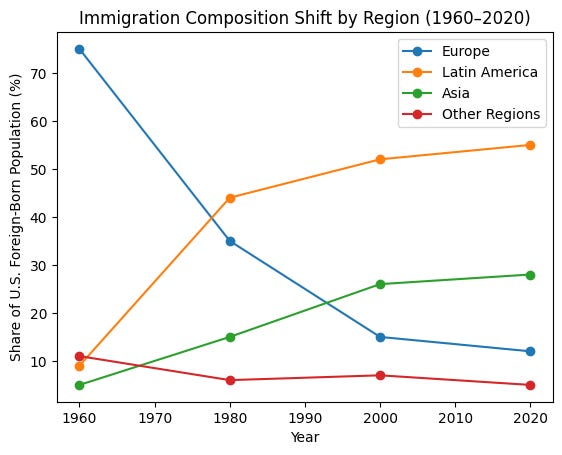
What changed after 1965 was not merely the number of people entering the country, but the cognitive and educational profile of the inflow. For most of American history, immigration disproportionately drew from regions with high literacy rates, industrial experience, and cultural familiarity with Western institutions. After 1965, that selection mechanism was replaced by family-chain migration. Over time, this altered the average skill distribution of new arrivals, not because of malice, but because selection criteria matter. Complex systems do not run on intentions. They run on competence.
The old system was replaced with one that prioritized family reunification above all else. At first glance, that might appear to be a compassionate policy. But in the world of public policy, what sounds compassionate often has consequences that are anything but. By prioritizing family ties over raw skill and educational attainment, we effectively signaled that the nation's cognitive needs were secondary to individuals' desire to bring their extended families across the border. Over time, this shifted the composition of our immigrant population away from those most likely to contribute to the nation’s “cognitive capital” and toward those who often required significant public support merely to reach the baseline of American life.
You cannot maintain a high-performance civilization while systematically importing people who were never selected for high performance.
The data show that the share of immigrants from regions with lower historical averages of educational attainment has increased substantially. In 1960, about 75 percent of our foreign-born population came from Europe, where the industrial and intellectual traditions were most similar to our own. By 2026, that number has dropped to roughly 12 percent. Meanwhile, more than half of our current immigrant population comes from Latin America and a growing portion from other regions where the educational infrastructure is often in shambles. This is not a comment on the “worth” of these individuals as human beings, but rather on the “competence” of a nation in maintaining a high-tech, complex society. If you are importing millions of people who struggle with literacy in their own language, let alone English, you are not building a stronger nation; you are building a more fragile one.
This brings us to a hard truth that is often avoided in polite company. When you have a massive influx of people who are, on average, less cognitively equipped to handle the demands of a modern economy, you create a permanent underclass. This underclass then becomes a political constituency for the Democrat Party, which promises more government aid and lower standards in exchange for votes. It is a self-reinforcing cycle of decline. We see this in our schools, where the presence of large numbers of non-English speakers and students from backgrounds with low academic expectations inevitably leads to a “dumbing down” of the curriculum for everyone. You cannot maintain a high-performance culture when the very people you are bringing in are not selected for their ability to perform.
In 1968, the United States absorbed fewer than ten million immigrants while building the most advanced economy in human history. Today we are absorbing more than forty-five million, while struggling to maintain the systems that the economy depends on.
But the erosion of the American mind is not just a matter of who is coming in; it is also a matter of what is happening to the people already here. We are quite literally losing the “ground” beneath our feet. A 2024 National Geographic study and subsequent research in 2025 have highlighted a terrifying trend: the “nutrient collapse” of our soil. Because of intensive farming practices that prioritize yield over health, the minerals that are essential for brain development, things like iodine, iron, and zinc, are disappearing from our food supply. If a child’s brain does not receive these building blocks in the first few years of life, that child will never reach their full cognitive potential.
The NIH published a study in late 2025 suggesting a direct link between soil fertility and national IQ. In regions where the soil is “exhausted,” we see a corresponding dip in the mental performance of the population. This is a form of environmental warfare that we are conducting against ourselves. When you combine a degraded food supply with an education system that has abandoned merit and an immigration policy that ignores competence, you get the “Rome Curve.” You get a society that is slowly, quietly losing its mind.
We have about forty years, roughly two generations, to change course. This is not a task for the faint of heart. It would require us to admit that we have been wrong for a long time. We would need to return to an immigration system that ruthlessly selects for intelligence and skill. We would need to dismantle the educational bureaucracies that have turned our schools into ideological warehouses. And we would need to treat the health of our soil as a matter of national security. If we don’t, the story of America will end the same way the story of Rome did: not with a bang, but with the quiet sound of a people who forgot how to maintain the world their fathers built.
Three Levers Still Within Reach
If we are to take the “Rome Curve” seriously, we must stop treating it as a prophecy and start treating it as a math problem. Math problems have solutions, but they often require us to give up on our favorite illusions. To bend this curve back upward, we need to pull three specific levers that have been rusted shut by decades of mismanagement and political posturing from the Democrat Party.
The First Lever: Rebuilding Fertility of the Competent
It is a basic fact of life that you cannot have a society of engineers if the people with the aptitude for engineering are not having children. For decades, our tax codes and our cultural messages have effectively penalized the very people we need to lead the next generation. We have made it more expensive and more socially difficult for high-functioning, stable families to have three or four children, while simultaneously subsidizing households that are often unstable.
As of early 2026, many Western nations have attempted “pro-natalist” policies, but most of them fail because they treat children like a consumer good that can be bought with a one-time “baby bonus.” A five-thousand-dollar check doesn’t change a person’s mind about the twenty-year commitment of parenthood. What actually works is structural reform. We need tax exemptions that scale with the number of children and, more importantly, a cultural shift that stops treating motherhood as a “career setback.” If we don’t encourage the most capable among us to reproduce their values and their skills, we are essentially voting for our own obsolescence.
The Second Lever: Reforming Immigration for Merit
The second lever is the most politically charged, but also the most straightforward. We must stop using our borders as a pressure valve for the world’s problems and start using them as a filter for the world’s talent. Countries like Canada and Australia have long used “points-based” systems that prioritize age, English proficiency, and high-demand skills. Even as late as January 2026, discussions in Congress have floated similar “genuine link” frameworks to ensure that newcomers are an asset, not a liability, to the national balance sheet.
When the Democrat Party argues that any talk of “merit” in immigration is somehow exclusionary, they are ignoring the fact that a complex society cannot survive without a high concentration of high-skill individuals. If we are going to import people, they should be the surgeons, the physicists, and the master technicians of the future. This isn’t about where someone is from; it’s about what they bring to the table. A nation that imports its poverty will eventually find that it has exported its prosperity.
The Third Lever: Restoring Nutrition and the Environment
The final lever is perhaps the most fundamental because it involves the nation's biological infrastructure. As I mentioned earlier, the “nutrient collapse” in our soil is a direct threat to the intelligence of our children. Recent data from February 2026 indicates that regenerative farming practices, like soil remineralization and cover cropping, can increase the mineral content of produce by as much as 25 percent.
This is not just “green” posturing; it is an economic necessity. Studies from late 2025 show that farmers who move away from synthetic, chemical-intensive fertilizers can increase their profit margins by 20 to 30 percent while producing food that supports brain function. If we want a population that can think clearly, we have to stop feeding them industrial filler grown in dead dirt. We should treat the restoration of our topsoil with the same urgency we once accorded the Space Race.
The Decision Horizon
We are currently at the midpoint between the peak of our civilization and its potential collapse. The Roman precedent suggests that we have approximately 40 years remaining in our “window of return.” By 2065, if we haven’t fundamentally changed how we educate our children, who we let into our country, and what we put into our bodies, the “knowledge debt” will simply be too high to pay back.
History is replete with ruins built by people who believed they were too important to fail. They weren’t, and neither are we. But unlike the Romans, we have the data. We can see the curve. The question is whether we have the courage to put down the lyre, stop the political bickering, and start the hard work of re-engineering the foundations of the nation. If we rebuild the mind of the nation, its competence, its curiosity, and its courage, we can do more than just survive. We can create a renaissance that makes the last century look like a mere rehearsal.
Help Keep This Work Alive
If you made it this far, you already understand something many people would rather not confront.
Civilizations do not collapse because no one sees the warning signs.
They collapse because those who see them assume that someone else will act.
What you just read is an attempt to name the curve while it can still be bent. That kind of writing does not trend. It does not get sponsored. It does not receive grants. And it does not get institutional protection.
It survives only if readers who recognize its value decide it is worth supporting.
Become a Paid Subscriber
A paid subscription is the simplest way to support this work and keep it going.
Paid subscribers make it possible for me to continue writing long-form, evidence-based essays like this one without watering them down, chasing outrage, or flattening uncomfortable conclusions to please platforms.
If this essay clarified something for you, sharpened a half-formed intuition, or gave you a framework to understand what you are watching unfold, a paid subscription is how you help ensure there is more of this work.
Make a One-Time Contribution
If a subscription does not make sense for you right now, one-time contributions help more than you might think.
They cover immediate costs.
They buy time.
And they signal that this work has value beyond quiet agreement.
Join The Resistance Core
For readers who want to do more than keep the lights on, The Resistance Core is the top-tier option.
Members directly underwrite the most ambitious work: investigative projects, long-form research, and essays that take weeks rather than hours to produce. This is where ideas that cannot survive in the mainstream are given the room they require.
What Your Support Builds Right Now
Your support is not abstract.
It pays for:
Time to research and write pieces like this properly
The ability to stay focused on writing rather than scrambling for short-term income
The freedom to publish without appeasing sponsors, donors, or platforms
In short, it buys independence.
If You Cannot Give
If money is tight, sharing this essay helps more than you may realize.
Send it to someone who still believes decline happens all at once. Post it where it will reach readers who are sensing something is wrong but lack the language to describe it. Quietly expanding the audience matters more than public applause.
You nailed it again Chris. Unsaid is the permeation of low trust immigration over the last decade. Sowing Islamist cockroaches intent on dehumanizing the high trust,high iq, white Christian’s and Jews with sharia similar to the debasement in Europe and the UK. Within 2 generations there will be no allies in Western Europe, the five eyes surveillance partners will be untrustworthy and the global elites will rise again to enslave the leftovers if they are not exposed and imprisoned. Even Canada has reached terminal velocity towards Islamification and Chinese infiltration. We are alone on island USA and we better keep the democrats out of office or we will accelerate into the Roman curve much faster.
Sobering. But, I don't think we have enough people with the understanding or the will to effect the changes that need to be made.
“Hard times create strong men, strong men create good times, good times create weak men, and weak men create hard times.”
Successful societies eventually become the victim of their own success. We're no different.