

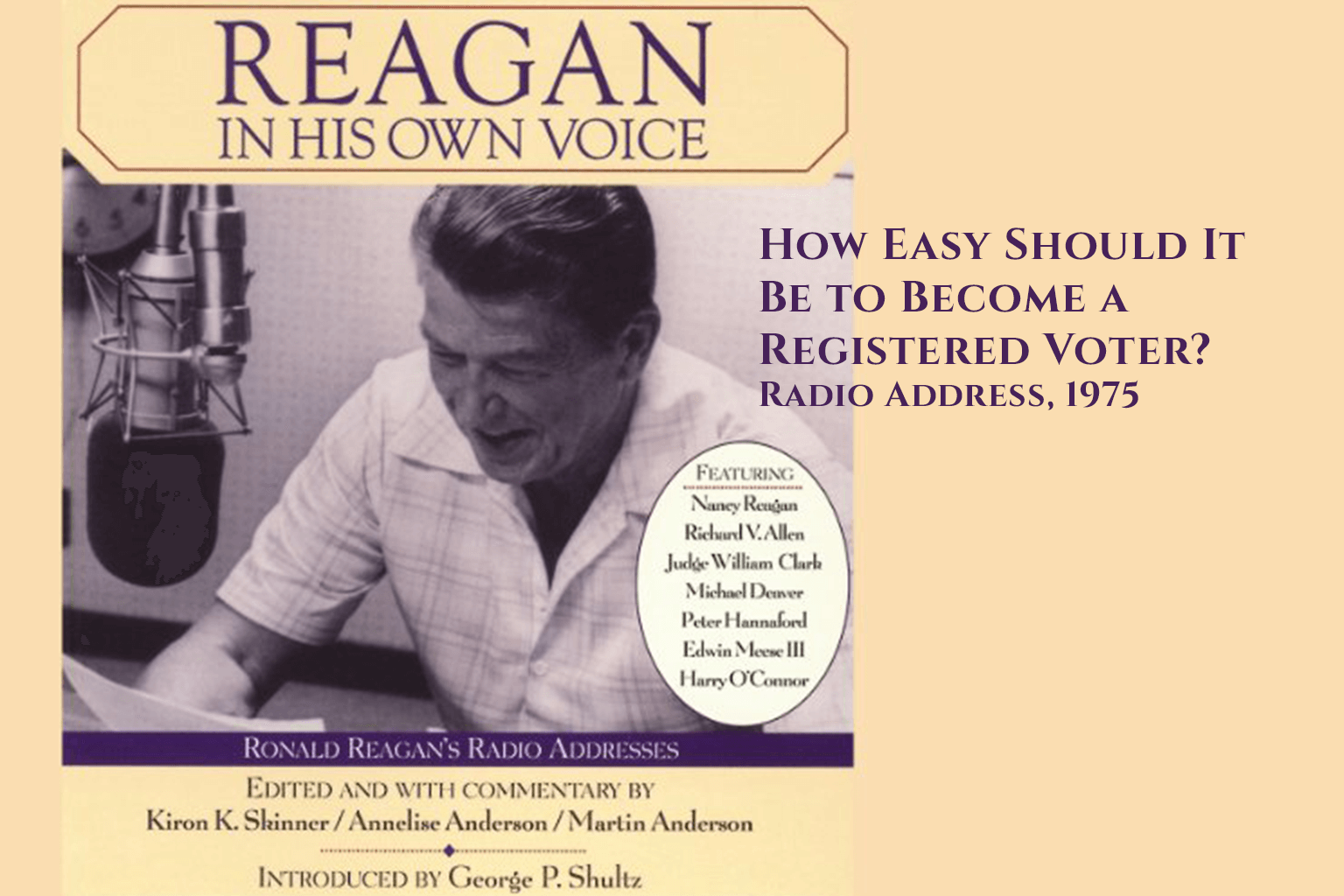
Listen to the original radio address below.
This is Ronald Reagan’s 1975 broadcast, recorded for his weekly Viewpoint radio commentaries while he was a private citizen. The commentary that follows looks at what Reagan was warning about when he asked, “How easy should it be to become a registered voter?” and why that question still hangs over American elections today.
In 1975, Ronald Reagan recorded one of his weekly radio commentaries. It was part of a program that aired on hundreds of stations across the
country, reaching millions of listeners who tuned in not for spectacle, but for explanation.
That week, he talked about voter registration.
He was not the President. He was not on a ballot. He was speaking as a former governor who had spent years watching how rules quietly change while most people are paying attention to something else.
The question he raised was simple.
How easy should it be to become a registered voter?
He did not argue that people should not vote. He asked why standards kept being lowered while everyone insisted standards did not matter.
Ease Does Not Create Engagement
Reagan pointed out something that was already visible in the 1970s. When people care about the stakes, they register and vote. When turnout collapses, it is usually because voters feel disconnected, cynical, or convinced the outcome is already decided. It is rarely because a form was too hard to fill out.
The 1974 midterm election saw turnout fall to roughly 38 percent. Surveys at the time showed that most nonvoters did not blame the difficulty of registering. They blamed disinterest and distrust.
Reagan drew a conclusion that has since been treated as heresy.
Making something easier does not make it more meaningful. It makes it easier to manipulate.
Berkeley Was Not an Accident
Reagan used Berkeley as his example because it was honest and small enough to dismiss.
California courts and legislators had loosened residency requirements. Physical presence stopped being the test. Declared intent replaced it. A person only had to say they intended to live somewhere.
The results were absurd and completely legal.
In one Berkeley election, more votes were cast than there were adult residents. Dozens of voters were registered at a single address. One of those addresses had burned down months earlier. People from other California cities and even other states voted by stating that they intended to live in Berkeley.
Reagan said it plainly. Technically legal. Morally close to ballot box stuffing.
This separates legality from legitimacy. A system can follow the letter of the law and still produce outcomes that no reasonable person trusts.
Scale Changed, Logic Did Not
Reagan could already see the pattern. Lower standards. No cross checking. Courts ratifying administrative shortcuts. Questioning the process is treated as hostility to democracy.
What he could not see was scale.
He could not see national elections decided by a few tens of thousands of votes. He could not see DMV based automatic registration. He could not see fifty states running incompatible databases with no real time verification. He could not see private money financing public election offices. He could not see digital platforms deciding which information voters were allowed to see before Election Day.
The machinery changed. The logic stayed the same.
2020 Was the Stress Test
The 2020 election was not controversial because of one allegation. It was controversial because of math.
Joe Biden won the presidency with 306 electoral votes to Donald Trump’s 232. The popular vote margin exceeded seven million. Those numbers looked decisive until you examined where power actually shifted.
The election turned on roughly 44,000 votes across Georgia, Arizona, and Wisconsin. That is about 0.03 percent of all ballots cast nationwide. If those three states had flipped, the election would have gone to the House of Representatives, where Trump would have been reelected.
That narrowness is arithmetic.
Different Rules Produce Different Outcomes
Between 2016 and 2020, the rules changed.
Mail voting nearly doubled, rising from about 24 percent of ballots to roughly 46 percent. Rejection rates for mail ballots fell from about 1 percent to roughly 0.3 percent. That drop sounds trivial until it is converted into ballots.
Roughly one million mail ballots that would have been rejected under pre-2020 standards were counted instead. Biden received a disproportionate share of those ballots. That number alone exceeded his national winning margin many times over.
Drop boxes appeared in states where legislatures had never authorized them. In Wisconsin, more than 500 unattended drop boxes were deployed. In 2022, the Wisconsin Supreme Court ruled those boxes had no basis in state law.
Private money entered election administration on an unprecedented scale. Through organizations such as the Center for Tech and Civic Life, more than $400 million flowed into local election offices. The funds were concentrated in large urban counties that already leaned toward the Democrat Party. Those counties saw turnout increases two to three times higher than comparable counties that received no such funding.
At the same time, major technology platforms suppressed the Hunter Biden laptop story weeks before the election. Later polling showed that between six and nine percent of Biden voters in swing states would have reconsidered their vote had they known the story was authentic.
None of this required ballot stuffing. It required different rules and different information.
Georgia Shows the Problem Clearly
Georgia is the cleanest example.
Biden won the state by 11,779 votes. Mail ballots increased more than fivefold from 2016. The rejection rate collapsed from 6.4 percent to 0.34 percent. If Georgia had applied its 2016 standards, roughly 45,000 ballots would not have been counted. That is nearly four times the margin that decided the state.
Fulton County later admitted that approximately 315,000 early in-person votes were verified without the required poll worker signatures on tabulator tapes. Those signatures are the audit trail. They are how a state proves that what was counted matches what was recorded.
As of early 2026, the Georgia State Election Board voted unanimously to refer the matter to the Attorney General. Potential fines exceed $670,000. A judge ordered Fulton County to turn over digital ballot images after the county resisted disclosure for more than a year and claimed compliance would cost $400,000.
Five years later, the records still require court orders.
That alone tells you the system failed its most basic test.
Registration Is the Front Door
Everything downstream depends on who gets in.
In recent years, states themselves have admitted that automatic registration systems enrolled voters without confirmed citizenship.
Oregon acknowledged that nearly 1,900 individuals were added to the rolls without proof of citizenship. Arizona discovered that roughly 218,000 voters with legacy driver’s licenses were registered as full ballot voters without citizenship documents on file. Iowa identified 277 noncitizens registered to vote, of whom 35 cast and had ballots counted. Ohio audits identified confirmed noncitizens on the rolls and referred cases for prosecution. Michigan identified noncitizens who voted and referred most of those cases to the Attorney General.
These were not internet rumors. They were official admissions by the states themselves.
Most of those individuals likely did not intend to break the law. That makes the system worse, not better. A system that enrolls ineligible voters without intent is structurally unsound.
Why “Fraud Is Rare” Avoids the Issue
The Democrat Party often responds by saying voter fraud is rare. Narrowly defined, that can be true.
Reagan was not worried about impersonation at the polling place. He was worried about systems that cannot prove their own integrity.
In Georgia, five percent of 315,000 votes equals 15,750 ballots. That exceeds the margin of victory. No one has to prove that five percent were improper to understand the problem. When verification fails at scale, confidence collapses.
In aviation, finance, or medicine, nobody accepts “we think it probably worked” as a safety standard. Elections should not be different.
When Ordinary People Stop Trusting the Process
During the aftermath of 2020, a postal contractor in Wisconsin, Ethan Pease, said he was not a Trump supporter or a Biden supporter, but that something profoundly wrong had occurred and the public had a right to know.
That sentence mattered more than any lawsuit or press conference.
When people close to the machinery no longer trust it, the system has already lost something essential.
Legality Is Not Legitimacy
Courts often protect outcomes rather than processes. Administrative errors are frozen in place because undoing them is deemed destabilizing. Certification replaces confidence.
Reagan rejected that trade.
A republic survives because its systems can be examined, tested, and trusted repeatedly. When officials resist transparency, when errors are shielded instead of corrected, and when questioning procedure is treated as subversion, legitimacy erodes even if no crime is ever proven.
The Question Still Standing
Reagan asked how easy registration should be. We answered by removing friction without replacing safeguards.
The 2020 election showed what that choice costs. Not certainty of fraud, but permanent doubt. Not one disputed outcome, but a precedent.
Reagan was not ignored. He was understood and then overridden.
The question he asked in 1975 is still unanswered.
One Honest Paragraph Before You Go
I am going to be direct. Work like this does not survive on shares, likes, or quiet agreement. It survives only if enough readers decide it is worth paying for. This series exists because I believe the ideas Ronald Reagan was warning about matter now more than ever, and because too few people are willing to explain them honestly. If you read this and thought, someone needs to keep saying this, that belief has a cost. This is the moment when support stops being symbolic and becomes real.
If you want this work to continue, here are the simplest ways to support it:
Become a Paid Subscriber
https://mrchr.is/help
Make a One-Time Contribution
https://mrchr.is/give
If you can step up at the highest level right now:
Join The Resistance Core
This tier defaults to $1,200, but you can give any amount that’s comfortable for you.
https://mrchr.is/resist