

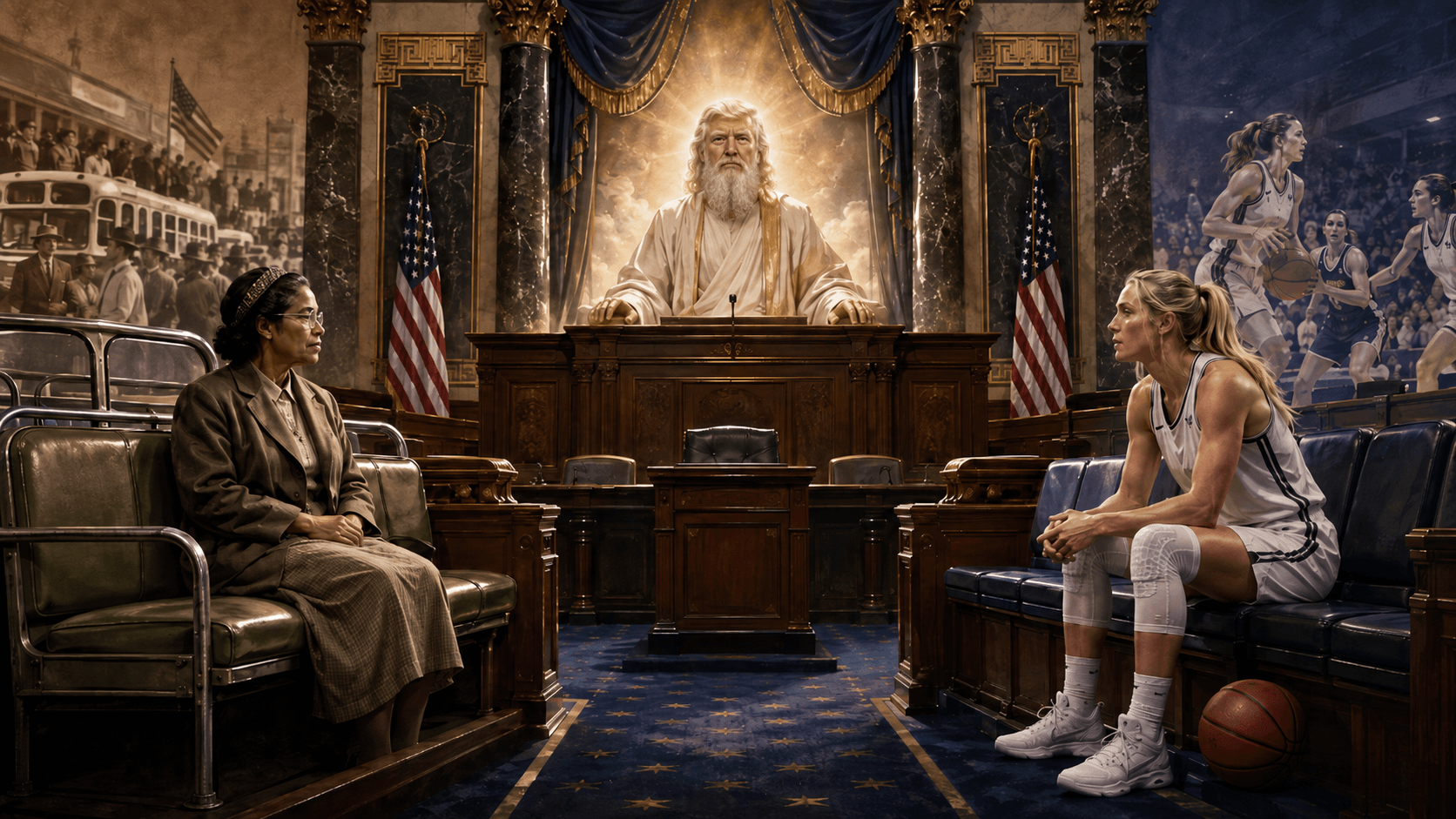
“The moment a political party believes it cannot lose you is the moment it can afford to stop pretending it can protect you.”
There is a peculiar feature of modern liberal politics that becomes easier to see once you stop listening only to what people say they believe and start watching what happens when two of those beliefs collide.
Hollywood spent decades presenting itself as enlightened on women while the “casting couch” became such a familiar part of the business that the phrase entered the English language. Harvey Weinstein was not some conservative interloper who slipped unnoticed into progressive Hollywood. He was one of its most powerful producers, a major Democrat fundraiser and donor who moved comfortably among politicians and celebrities who regularly lectured the rest of America about women’s rights.
Then came #MeToo and “Believe Women,” another principle that sounded wonderfully absolute until an accusation involved the wrong politician, donor, celebrity or political ally. Suddenly context became important. Due process was rediscovered. Nuance returned from vacation.
The pattern shows up elsewhere. Sanctuary-city politicians are considerably more enthusiastic about compassion when the immigrants are somewhere else. COVID restrictions seemed much more absolute when ordinary Americans were being told what they could do than when politicians themselves wanted dinner, travel, a haircut or a party.
Calling all of this hypocrisy is accurate but not very interesting. Hypocrisy is ancient and bipartisan. What is more revealing is the point at which the principle changes. It tends to happen when honoring the principle requires sacrificing something else the institution values more.
Politics has incentives, and politicians are not magically exempt from them. A constituency is extremely valuable while its vote is still being contested. Politicians court it, flatter it, learn its grievances, identify its enemies and promise protection. Once that constituency becomes reliable, the relationship changes. The party no longer has to ask how to win those voters. It mostly has to make sure they show up.
Over time, the most loyal voter can become the easiest one to neglect.
Two women separated by seventy years illustrate that process better than most political-science textbooks. One was Rosa Parks. The other is Sophie Cunningham.
The similarities are less interesting than the differences.
The Real Rosa Parks Story Was Better Than the Rosa Parks Story
Most Americans learned the Rosa Parks story when they were children.
She was a tired seamstress in Montgomery, Alabama. On December 1, 1955, after a long day at work, she boarded a city bus. The bus filled. A white passenger needed a seat. The driver ordered Parks to move. She had finally had enough, so this otherwise ordinary black woman spontaneously decided that she was not moving. She was arrested, America saw the injustice, and one tired lady helped ignite the modern civil-rights movement.
It is a terrific story, but it leaves out nearly everything that makes Rosa Parks politically interesting.
Parks really did refuse to surrender her seat, and doing so in Alabama in 1955 required courage that is easy to underestimate from the comfort of 2026. But she was not some politically uninvolved seamstress who wandered into history by accident.
She had spent years working with the Montgomery NAACP and had served as its secretary. Months before her arrest, she attended a workshop at the Highlander Folk School in Tennessee dealing with integration. The Library of Congress notes that the Montgomery NAACP was already looking for a test case to challenge Alabama’s bus-segregation laws. Parks herself later wrote that she understood refusing to move could result in arrest or rough treatment and was prepared to take that chance.
There is another piece of the story children are rarely taught. Parks was not the first black woman in Montgomery to refuse to surrender a bus seat. Claudette Colvin had done it months earlier. She was fifteen. Mary Louise Smith later refused too.
Neither became Rosa Parks.
Why Parks? Because political movements need more than an injustice. They need someone through whom the public can understand the injustice.
Parks was forty-two, married, respected, disciplined, politically experienced and difficult for segregationists to portray as reckless or disreputable. When she was arrested, experienced activists knew they had a remarkably strong case around which to organize.
There is no solid evidence that Parks was planted on the bus or instructed to refuse her seat that afternoon. The confrontation itself appears to have been her decision. What followed was far more deliberate.
The event was real. The story was curated.
There is nothing particularly sinister about that. Successful political movements have always understood the value of symbols. Human beings respond to people and stories much more readily than they respond to court filings. A movement trying to persuade millions of Americans that segregation was indefensible needed someone Americans could identify with.
Parks was nearly perfect.
The better history, then, is not that one random woman somehow created a movement because her feet hurt. The movement was already there. Organizers were already working. Legal challenges were already being considered. Other women had already refused to move.
Then Rosa Parks did it, and this time the movement had the right woman.
The People Behind the Icon
Once the other names enter the story, the kindergarten version starts falling apart.
E. D. Nixon had spent years organizing around labor and civil rights. Virginia and Clifford Durr were prominent white liberal allies. Clifford had worked in the New Deal. Virginia helped Parks attend Highlander. The Women’s Political Council was already active in Montgomery and moved quickly after Parks’s arrest.
Highlander was not some pleasant adult-education retreat. It was a place where labor and civil-rights activists exchanged ideas, tactics and experience. Parks attended only months before Montgomery became national news.
Knowing this does not make her refusal less courageous. If anything, understanding the possible consequences and refusing anyway makes Parks more interesting. What disappears is the comforting idea that history simply happened because an unknown woman got tired one afternoon.
Parks had experience, allies and an existing political network. Once she was arrested, people who had spent years thinking about segregation recognized what could be done with the case.
She was not necessarily chosen for the confrontation. She was chosen for what came next.
The Democrat Party’s Awkward History
The partisan history gets ugly fast.
Jim Crow in the South did not emerge from some mysterious nonpartisan fog. Southern Democrats dominated much of the region’s political machinery for decades and repeatedly obstructed federal civil-rights efforts. Southern Democrat senators were central to the filibuster against the Civil Rights Act of 1964, which was eventually broken by a bipartisan coalition.
That history does not reduce neatly to “Democrats bad, Republicans good.” By the 1940s, 1950s and 1960s, the Democrat Party was tearing itself apart over civil rights. Northern Democrats increasingly supported federal action while many Southern Democrats resisted it. Republicans had divisions of their own. Party coalitions were changing.
The political transformation was nevertheless extraordinary. A party containing many of the politicians who had maintained segregation gradually became the party most black voters came to trust to protect them from racial discrimination.
That took decades. Roosevelt’s New Deal had already begun moving black voters away from their older Republican allegiance. Truman pushed civil rights and integrated the military. Northern Democrats became more aggressive on the issue while Southern Democrats fought them.
Then politicians learned a lesson they rarely forget once they discover it: moral causes can also produce votes.
In October 1960, Martin Luther King Jr. was jailed following an Atlanta protest. John F. Kennedy called Coretta Scott King. Robert Kennedy contacted officials regarding King’s situation, and King was released. Martin Luther King Sr., who had previously leaned toward Richard Nixon, publicly praised Kennedy.
The Kennedy campaign made sure black voters heard about it.
Of course it did.
Kennedy may well have believed helping King was the right thing to do. He was also running for president in an extremely close election. Those motives can exist in the same person without requiring either sainthood or conspiracy.
The political lesson was clear enough. Black political allegiance was not fixed. It could be courted, shifted and eventually held. A constituency that had once leaned Republican could become reliably Democrat.
Once that happens, the incentives start changing.
From Courtship to Captive Market
Anyone who has ever changed cable companies knows the economics.
Before you sign, there are discounts, promotions and people eager to answer the phone. Everyone wants your business. After the company decides you have nowhere else to go, customer service develops a different personality.
Politics is not terribly different.
A competitive voter has to be persuaded. A reliable voter mostly has to be mobilized. Once a party begins assuming a voter cannot leave, attention naturally moves toward somebody whose loyalty is less certain.
Black Americans eventually became one of the most dependable Democrat constituencies in America. They still are, but the margin is no longer quite what it once was.
Pew’s analysis of validated voters found that Donald Trump received 15 percent of the black vote in 2024, up from 8 percent in 2020 and 6 percent in 2016. Kamala Harris still won black voters overwhelmingly. Nobody looking seriously at those numbers would claim black America suddenly became Republican.
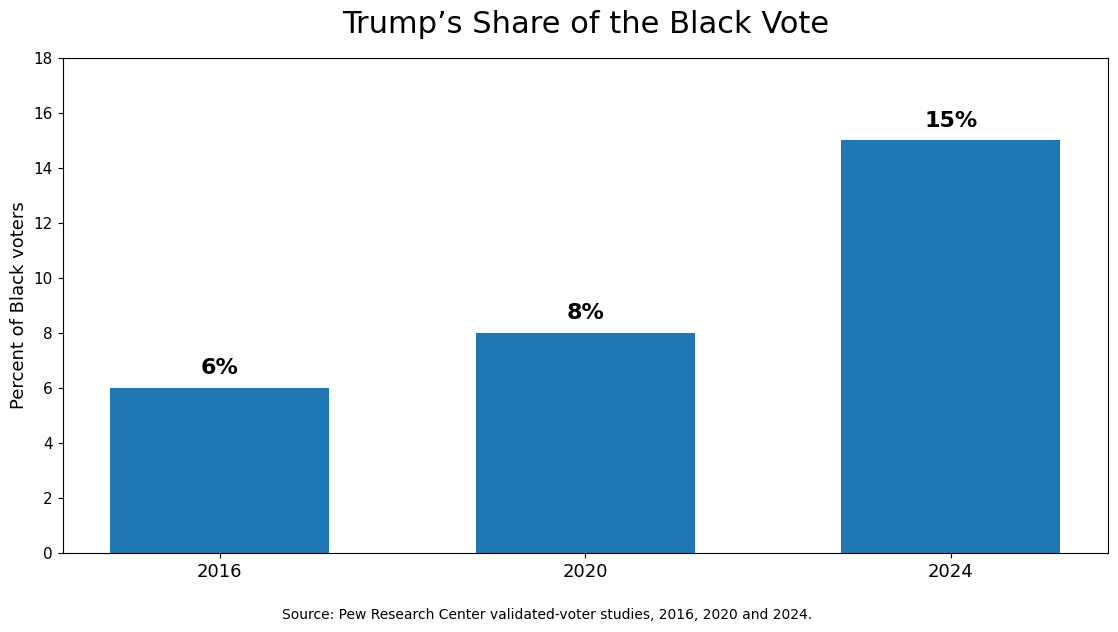
But moving from 6 percent to 15 percent is not nothing. Republicans do not have to win the black vote outright. In close elections, shaving several points off an opponent’s enormous historical advantage can be enough.
Why might some black voters move? There is no single explanation. Inflation, immigration, crime, schools, religion, culture, economic opportunity, candidate personality and generational change all play roles.
Political monopolies create another problem, though. Eventually the customer starts wondering what extraordinary loyalty has purchased.
A party that believes your vote must constantly be earned has a reason to listen. A party convinced you cannot leave has far more freedom to spend its attention somewhere else.
Democrats became very good at turning victims into voters. The trouble starts when some of those voters begin shopping around.
Then Came the War on Women
Women are not remotely a single political bloc. White women vote differently from black women. Married women differ from unmarried women. Religious women differ from secular women. Straight women differ substantially from lesbian and bisexual women.
But women constitute an enormous share of the electorate, and Democrat political messaging has spent decades presenting women as a class requiring Democrat protection.
Republicans threaten your reproductive rights. Republicans threaten women’s healthcare. Republicans want control over women’s bodies. Republicans oppose women’s equality. Republicans are waging a “War on Women.”
Every one of those arguments requires the same premise before it can work.
Women exist.
Not merely as an identity someone can claim, but as a sex with shared biological interests. Otherwise, “women’s healthcare” becomes a rather curious expression.
That is what makes the transgender debate such a remarkable political contradiction.
Democrats built their hold on women by convincing them that Republicans threatened their sex. Now they are asking those same women to pretend sex doesn’t exist.
Women are not some tiny constituency that can be dismissed without consequence. They cast enormous numbers of votes. White women alone represent tens of millions of ballots.
Yet raw numbers do not automatically produce political power.
Large groups are usually politically diffuse. A straight woman may care about abortion, taxes, schools, crime, housing, inflation, immigration and healthcare. Her attention is divided across a dozen concerns.
Small activist groups can operate very differently. When one issue defines a group’s politics, members are more likely to organize around it, donate around it, pressure institutions over it and punish politicians who deviate.
That is how comparatively small groups acquire influence far beyond their population.
The big bloc provides the votes. The small blocs provide the fear.
By fear, I mean political consequences: donor pressure, activist campaigns, media denunciations, primary threats, corporate complaints, social-media outrage and accusations of bigotry.
Large groups provide numbers. Organized minorities can create immediate pain. If politicians believe the large group is staying anyway, the incentive practically announces itself.
Worry about the people who might revolt.
Hollywood Already Showed Us How This Works
Hollywood provides a nearly perfect example because the contradiction was never subtle.
For generations, the entertainment industry advertised itself as enlightened while women working inside it knew exactly what “casting couch” meant. Women were celebrated in theory while powerful men could remain protected in practice.
“Women” could be an enormously useful cultural abstraction: strong women, empowered women, independent women, women smashing glass ceilings.
Protecting one actual woman from somebody powerful was different because now somebody had to pay a price.
Harvey Weinstein did not flourish outside liberal Hollywood. He flourished inside it.
A principle becomes more revealing when honoring it forces a choice between two things an institution claims to value.
Women’s sports have now produced that kind of collision in a different form.
The progressive coalition says it protects women. It also says it protects transgender people. For years those commitments could coexist without much friction because few situations required a direct choice between them.
Sports did.
Somebody has to define the boundary.
Feminism Built the Wall
Title IX became law in 1972, prohibiting sex discrimination in federally funded education. Female participation in organized high-school sports grew from roughly 294,000 in 1971 to more than 2 million by 1978, an increase of more than 600 percent.
Women gained teams, scholarships, championships, records and professional pathways that earlier generations rarely enjoyed.
All of it rests on a biological fact so obvious that nobody originally needed a committee to discover it.
Women’s sports exist because male and female bodies are different.
That does not demean female athletes. It is precisely why separate female competition was worth building.
If biological sex has no meaningful effect on athletic performance, then women’s swimming, track, basketball and separate female records make little sense. We could simply have sports and let the best athletes win.
Nobody seriously proposes that because everyone knows what the result would be.
Women’s sports are not evidence that sex does not matter. They exist because sex matters.
Which makes the Women’s National Basketball Association a particularly strange place to become squeamish about defining a woman.
Nearly Thirty Years, and Still Losing Money
The WNBA began play in 1997.
Its existence makes a biological claim before anybody says a word about politics. Women need their own professional basketball league because female athletes cannot simply merge into NBA rosters and compete physically on equal terms with elite male players.
For almost thirty years, the league has also enjoyed something most businesses never get: extraordinary patience.
The NBA kept backing it while the WNBA lost money. Adam Silver said in 2018 that the league had been losing more than $10 million annually on average. Even during the enormous 2024 boom, reports put expected losses around $40 million to $50 million. In 2026, the league’s finances remain disputed during its labor negotiations, especially over accounting and revenue allocation, but nobody can seriously describe the WNBA as a comfortably profitable standalone business.
Nearly three decades is quite a runway.
The league kept receiving support. Sponsors kept buying in. Networks kept carrying games. Advocates kept insisting that women’s basketball deserved more attention.
Then Caitlin Clark arrived, and America paid attention.
Caitlin Clark Finally Gives Them What They Wanted
The numbers are hard to dismiss.
Early in the 2024 season, WNBA merchandise sales were up 236 percent from the year before, with Clark among the leading jersey sellers. Her first WNBA game averaged 2.1 million viewers on ESPN platforms, at the time the network’s most-watched WNBA game ever.
By the end of the season, the league reported its highest attendance in 22 years. The Indiana Fever drew 340,715 fans at home, setting a league record. Fever games repeatedly filled larger arenas on the road as well.
This was precisely what women’s-basketball advocates had spent years demanding: fans, attention, ratings, merchandise and national relevance.
Clark made people who could not have named three WNBA teams suddenly know when Indiana was playing. She was not stealing attention from women’s basketball. She was dragging attention into it.
Yet parts of the culture surrounding the league seemed oddly irritated by the arrangement.
Clark has taken hard fouls, shoves and plenty of physical punishment. Some of it is basketball. Stars get hit. Rookies get tested. Rivalries get ugly.
At some point, though, the question becomes hard to avoid: why did a league that spent decades begging for attention seem so ambivalent about the woman who finally brought it?
Clark was increasing everybody’s value.
If growing women’s basketball was really the priority, Caitlin Clark should have been treated like manna from Iowa. Instead, an enormous amount of energy went into arguing about whether she was receiving too much attention.
Then Sophie Cunningham stepped in.
Sophie Cunningham Refuses to Read the Room
Cunningham is not Clark. Clark changed the economics surrounding women’s basketball. Cunningham became important for another reason.
She was willing to stand up for teammates, physically and publicly. Then she entered the transgender-athlete debate and said biological males should not compete in women’s sports.
That should have been one of the least remarkable statements ever made by somebody employed in the Women’s National Basketball Association.
Instead, it became a national controversy.
Cunningham has repeatedly said she does not hate transgender people and wants people treated with respect. Her line is much simpler: young girls should not have to compete against biological males.
The public is considerably closer to Cunningham than the institutional controversy might suggest. Gallup found in 2025 that 69 percent of Americans believed athletes should compete on teams matching their birth sex, compared with 24 percent who favored participation based on gender identity.
Her position also applies without regard to race, politics or sexual orientation. Black women and white women get the same rule. Lesbians and straight women get the same rule. Democrats and Republicans get the same rule.
No hierarchy is required.
The irony is difficult to miss. The position routinely described as exclusionary is also the position that treats every female athlete equally.
Intersectional politics becomes considerably messier when separate protected groups want incompatible things. Somebody eventually has to yield.
In this dispute, that somebody increasingly appears to be women.
Love Will Win. Everybody Else Can Go to Hell.
Indiana Fever coach Stephanie White may be the most revealing person in the story because I doubt she thinks she is betraying women at all.
White coaches Caitlin Clark and Sophie Cunningham. She coaches women in a professional league built around the biological distinction between men and women.
Yet when transgender-athlete eligibility became controversial, White leaned toward the language of inclusion rather than Cunningham’s much clearer line.
Then came DiJonai Carrington.
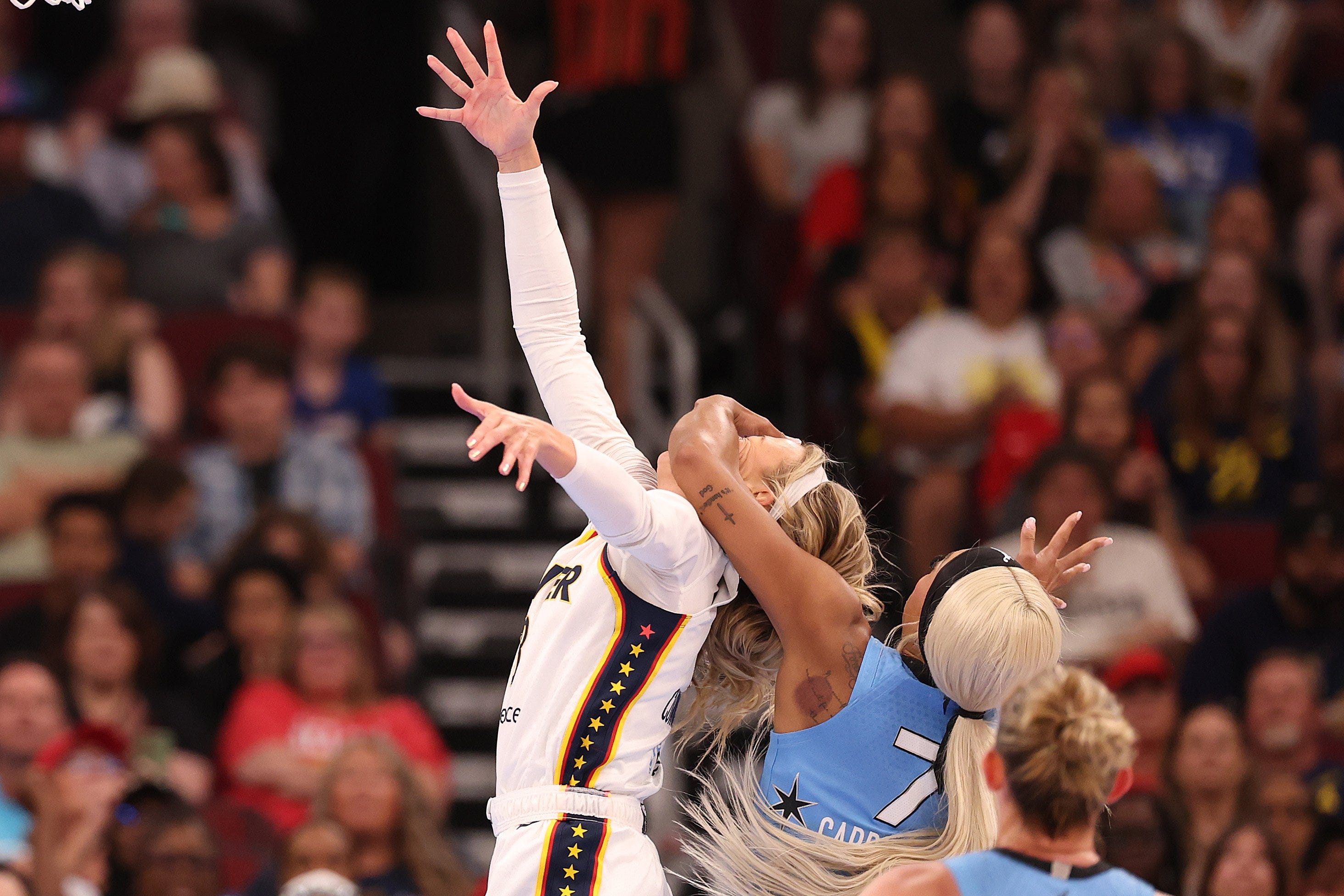
On August 8, Carrington struck Cunningham around the head and jaw during a play. Officials reviewed the foul, upgraded it to a Flagrant 2 and ejected Carrington. Carrington later invoked “white privilege” while criticizing the reaction to the incident.
White had previously coached Carrington and said she did not believe Carrington was trying to hurt Cunningham. Fans were furious.
A few days later, White spoke publicly about unity, love, grace, humility and divisiveness before concluding that everybody else could “go to hell.”
You really cannot improve on that.
Clark and Cunningham both defended their coach afterward. Clark made clear that she disliked hearing White booed, while Cunningham emphasized that the locker room remained together. Neither has publicly accused White of betraying her.
The video is still fascinating.
Clark sits beside White, repeatedly lowering her head and covering part of her face. Another player on White’s other side also appears withdrawn. Nobody can know from posture what Clark was thinking. Maybe she was exhausted. Maybe she was sick of the controversy. Maybe she agreed with White completely.
Readers can watch it themselves.
What interests me more is the way ideological enforcement works inside institutions.
Nobody needs to telephone Stephanie White with instructions. People learn which vocabulary is safe, which opinions require disclaimers and which conclusions carry professional or reputational risk. Eventually the pressure becomes internal.
People start editing themselves before anyone else has to.
That is ideological self-disarmament.
Women do not need to be forced to surrender a boundary if enough women can be persuaded that maintaining the boundary is immoral.
Women Were Protected Until Protecting Women Became Inconvenient
The Hollywood story and the WNBA story now look considerably less separate.
Hollywood did not hate women. It loved women as an abstraction. The trouble came when protecting a particular woman threatened somebody more powerful.
The Democrat Party does not hate women either. It loves campaigning on them.
Women’s bodies matter tremendously when abortion is being discussed. Women’s healthcare matters when Republicans can be accused of threatening it. Women’s equality matters when a conservative can be blamed for violating it.
Then sex-based female interests collide with transgender activism, and the vocabulary changes. Now there must be balance, nuance, inclusion, more discussion and perhaps a task force.
No hatred of women is required to explain any of this. Politicians and institutions merely need to believe that women inside the coalition are less likely to leave than the activists demanding accommodation.
That is why a very large constituency can occasionally lose an argument to a much smaller one.
The people supplying the votes are not necessarily the people producing the immediate political pain.
That arrangement can work for a long time, but eventually somebody asks why she is always the one expected to move.
Which brings us back to Rosa Parks.
Rosa Parks Had a Movement. Sophie Cunningham Became One.
Sophie Cunningham is obviously not Rosa Parks. That is why the title works.
Parks confronted government-enforced racial segregation in Alabama in 1955. Cunningham plays professional basketball in 2026. The historical stakes are completely different.
The comparison is the seat.
Parks was told to surrender hers and refused.
Cunningham is being told, culturally and politically, that women should surrender some of the boundaries around an athletic category generations of women fought to establish. She refuses.
But Parks had something Cunningham apparently did not. A movement was already waiting.
Experienced activists understood immediately what Parks’s arrest could become. They had organizations, lawyers, ministers, political allies and an existing campaign against segregation.
Cunningham seems to have traveled in the opposite direction. She gave her opinion, millions of people heard it, and many suddenly realized how unusual it had become for a woman in professional sports to say something that would have sounded utterly ordinary not long ago.
Rosa Parks was chosen by a movement.
Sophie Cunningham became one.
The political reversal is almost perfect. Parks represented a constituency Democrats increasingly needed to win. Cunningham represents a constituency progressives often act as though they already have.
The first kind of voter gets courted.
The second gets told why she needs to compromise.
From Victims to Voters to Republicans
Political loyalty feels wonderful when you are the politician receiving it.
Voters should be more suspicious.
If politicians know you will leave when ignored, they have a reason to listen. If they believe you will support them regardless, you have surrendered your most useful form of leverage: your ability to walk away.
Black Americans gave the Democrat Party extraordinary levels of loyalty for generations. Democrats still dominate the black vote, but 2024 demonstrated that the relationship is not immovable. Trump did not need to win black voters. Moving from 8 percent to 15 percent was enough to show that Democrats could lose some of them.
Women are a different political animal because their voting behavior is far more divided.
But Democrats have spent decades building their brand around being the indispensable protector of women, and brands create expectations.
If you tell women for half a century that being female gives them political interests requiring protection, some are eventually going to notice when the definition of female becomes negotiable.
They may wonder why women’s bodies are politically sacred when discussing abortion but suddenly difficult to define when discussing sports. They may wonder why Title IX is celebrated as one of the great achievements of women’s equality while defending the female category underneath it can be condemned as exclusionary.
They may also wonder why politicians who spent decades warning them about men threatening women’s rights become uncomfortable when a woman asks them to keep male bodies out of women’s athletic categories.
None of this requires millions of women to change parties overnight. Elections move at the margins. A few percentage points among tens of millions of women can matter far more than near-unanimous support from a tiny constituency.
That is why Sophie Cunningham matters beyond basketball.
Her argument is not merely about transgender athletes. It is about whether women are permitted to defend an interest specific to women when that interest conflicts with another politically favored group.
She has answered yes.
If enough women eventually reach the same conclusion politically, the Democrat Party may rediscover an old lesson: votes believed to be permanent have a strange habit of becoming valuable again the moment they start disappearing.
Rosa Parks refused to give up her seat on a bus. Sophie Cunningham refuses to give up women’s seat on a bench.
One had a political movement ready to explain why her refusal was righteous. The other discovered that many of the people who spent decades telling women to stand up for themselves became strangely uncomfortable when a woman actually did it.
The moment a political party believes it cannot lose you is the moment it can afford to stop protecting you.
The big bloc provides the votes. The small blocs provide the fear.
But only until the big bloc remembers it can leave.
Don’t Give Up Your Seat
If you have been reading this work for a while, you already know I am going to keep writing whether this publication is large or small, profitable or not.
The real question is what we can turn it into.
Right now, most of this work reaches people who already understand much of what I am writing about. That is important, but it is not enough. If we actually want to change anything, eventually we have to get beyond preaching to people who already agree with us.
That means growing the audience. Producing more content. Getting back into video. Supporting my upcoming book, An Inconvenient Black Truth. Building this into something capable of reaching people who do not already see the world the way I do, and the way most of you do.
That will not be easy.
It will also take more than one guy writing essays between everything else he has to do.
Become a Paid Subscriber: $80 per Year
Paid subscribers provide the foundation.
Eighty dollars a year may not sound enormous by itself, but multiplied across enough readers it creates the stable base that allows this publication to grow instead of constantly fighting just to stay where it is.
Join the Resistance Core: $1,200 per Year
Resistance Core is not really a subscription upgrade. It is the small group of readers who have decided they want to help build this into something much bigger.
There are only five members right now. Most of them have already contributed the full $1,200 annual membership and then stepped up again with additional donations during the year.
I do not take that lightly.
That kind of support gives me a chance to grow this beyond essays alone. More content. Video. An Inconvenient Black Truth. A larger audience. Eventually, an operation capable of reaching people outside the circle of readers who already agree with us.
That last part is the hard part.
Writing for people who already see what we see is important. Changing anything requires reaching the people who do not.
Resistance Core is for readers who want to help me get there.
It is $1,200 per year, charged annually.
Make a One-Time Contribution
Maybe another subscription is not what you want. A one-time contribution still helps move this forward without creating another recurring expense.
Prefer Venmo?
For readers who would rather send something directly, Venmo is the simplest option.
https://account.venmo.com/u/mrchrisarnell
And if money is not in the cards, share the essay. Restack it. Forward it to somebody who will disagree with it. Put it in front of someone outside our usual circle.
That may eventually be the most important part.
We already know what we think.
The next level is reaching the people who don’t.
If your politics require you to pretend biology stops being real the moment it becomes inconvenient, maybe the problem is not Sophie Cunningham. Maybe the problem is your politics.
Oh, Chris - what an excellent piece. For two reasons: 1. I love me some Caitlin Clark (born and raised in Iowa and watched her play in high school and college). And, I have fallen for Sophie for fighting back over Caitlin’s abhorrent treatment on the basketball court. And, 2. Your comparison between Rosa Parks and Sophie could not be better investigated and explained. Your exposing the hypocrisy of groups standing behind principles only as long as it benefits them is duplicity at its highest. I look forward to your book. Write on.