


Most people believe Substack is a meritocracy. You write well, you build an audience, and the platform helps your work spread. That is the story Substack tells. But the truth looks nothing like the advertising.
And readers deserve to see the mechanics behind what they are actually looking at.
Substack was built on a promise. A place where independent writers could grow without institutional interference. A place where the playing field would be level. A place where powerful institutions could not drown out real voices.
But that is not the reality happening on this platform.
What Substack Said Notes Was Supposed To Be
When Substack launched Notes, they painted it as a grassroots discovery engine.
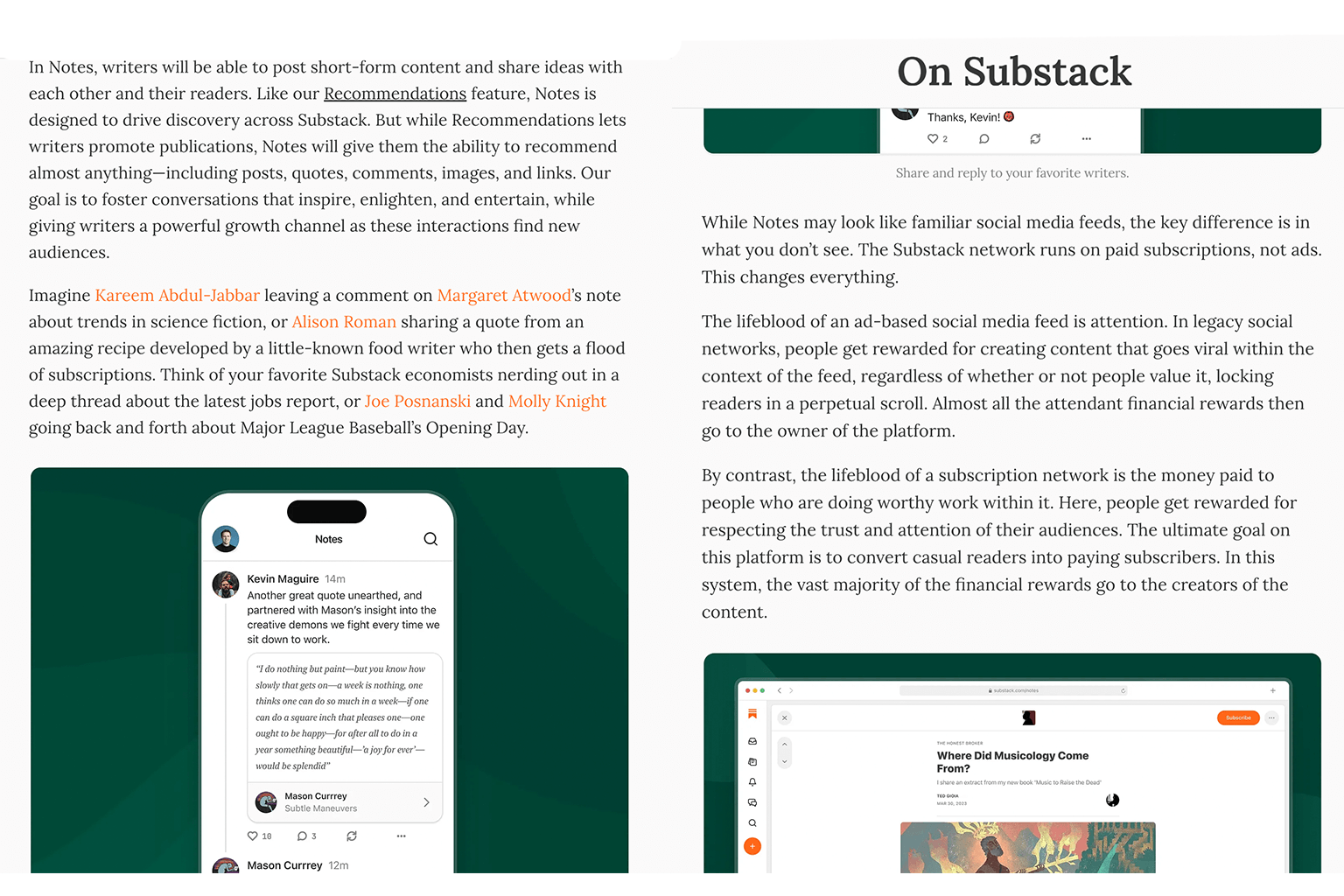
Substack promised Notes would:
Help writers find new readers
Highlight genuine engagement
Reward conversation over clout
Prioritize paid subscribers rather than algorithms
That was the theory.
What has happened instead is something very different.
The Manufactured “Audience” Trick
You may have noticed accounts on Substack that look gigantic almost overnight. Some appear with one or two posts and tens of thousands of subscribers. Some post once and get thousands of likes as if they have a building full of enthusiastic readers hanging on every word.
Start with Zohran Mamdani.
His Substack has more than 45,000 subscribers. That number alone would put him in the top tier of the platform. But he has no posts. No Notes. No visible activity at all.
Yet he already looks like one of Substack’s biggest creators.
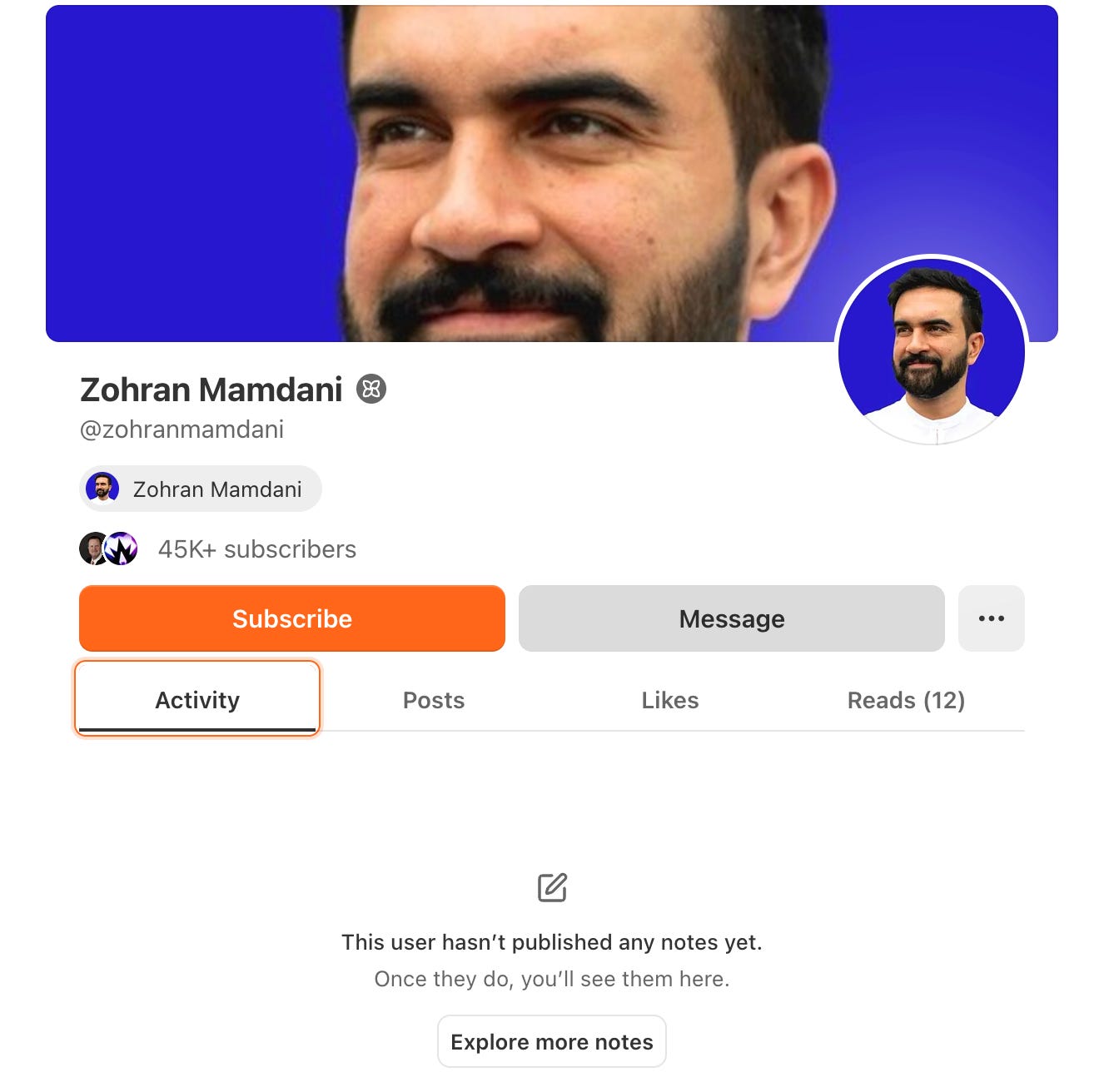
This is not what organic growth looks like. This is what happens when a politician imports a massive campaign list into Substack and instantly appears “popular” without ever building a real community here. The size creates prestige. The prestige triggers algorithmic boosts. And overnight, a political figure with zero Substack presence is treated as if he built a thriving readership on the platform.
Another example is Senator Elizabeth Warren.
Her Substack has roughly 97,000 subscribers. She has posted once since July. Yet engagement arrives instantly and in enormous numbers.
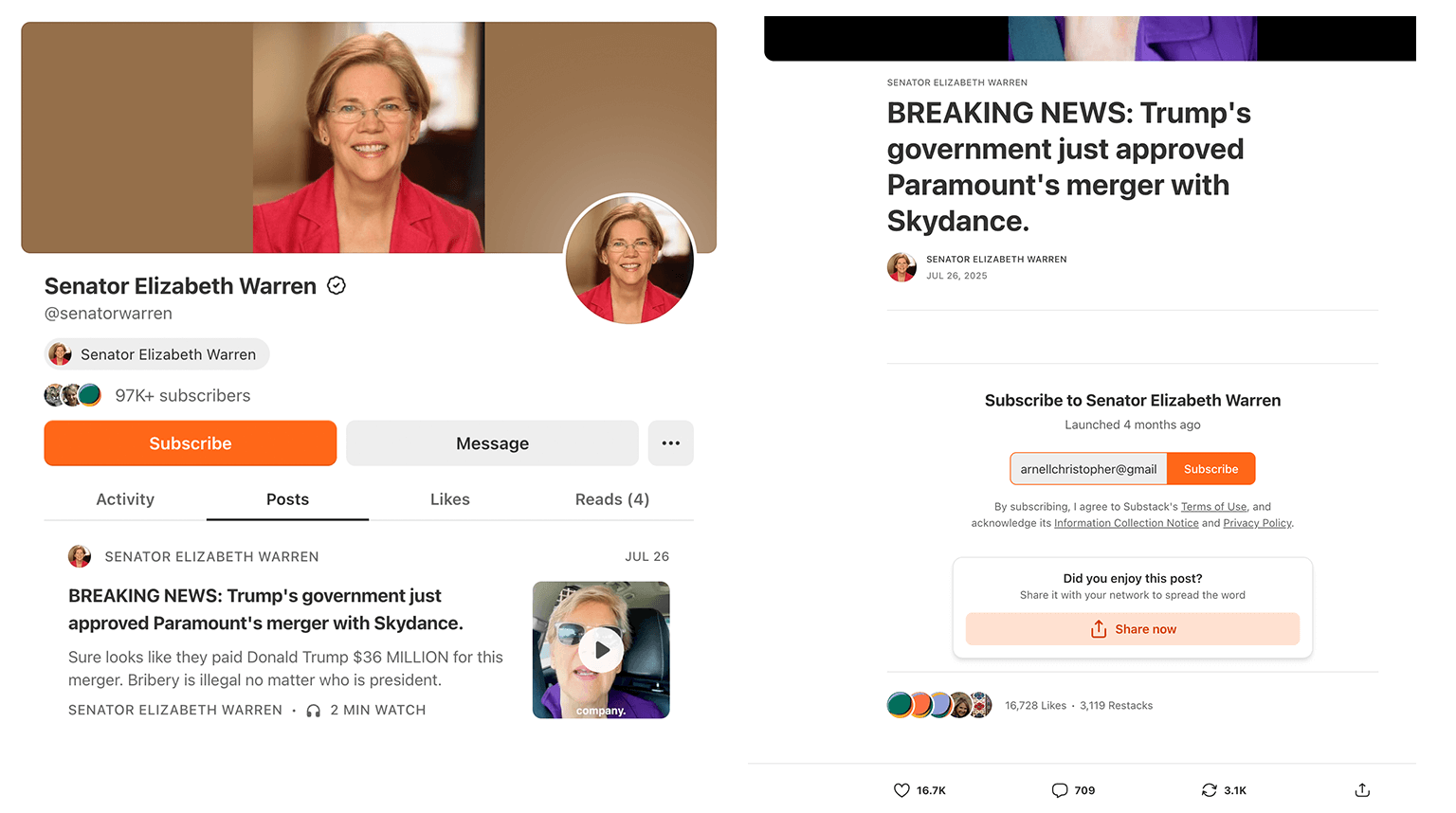
This looks like a grassroots political movement on Substack.
It is not.
Politicians and large organizations can import massive external email lists directly into Substack. These lists come from campaigns, fundraising operations, PACs, donor networks, activist databases, and years of political marketing. None of these people signed up to read Substack. None of them discovered the account organically. They did not choose to join this platform at all.
But the moment those lists are imported, Substack counts them as “subscribers.”
And then Substack treats those accounts as if they emerged from the same ecosystem as everyone else.
Which brings us to Representative Jasmine Crockett.
Four posts since May. More than two hundred fifty thousand subscribers. Dominating Notes. Flooding timelines. Appearing everywhere as if a quarter million people are reading her daily.
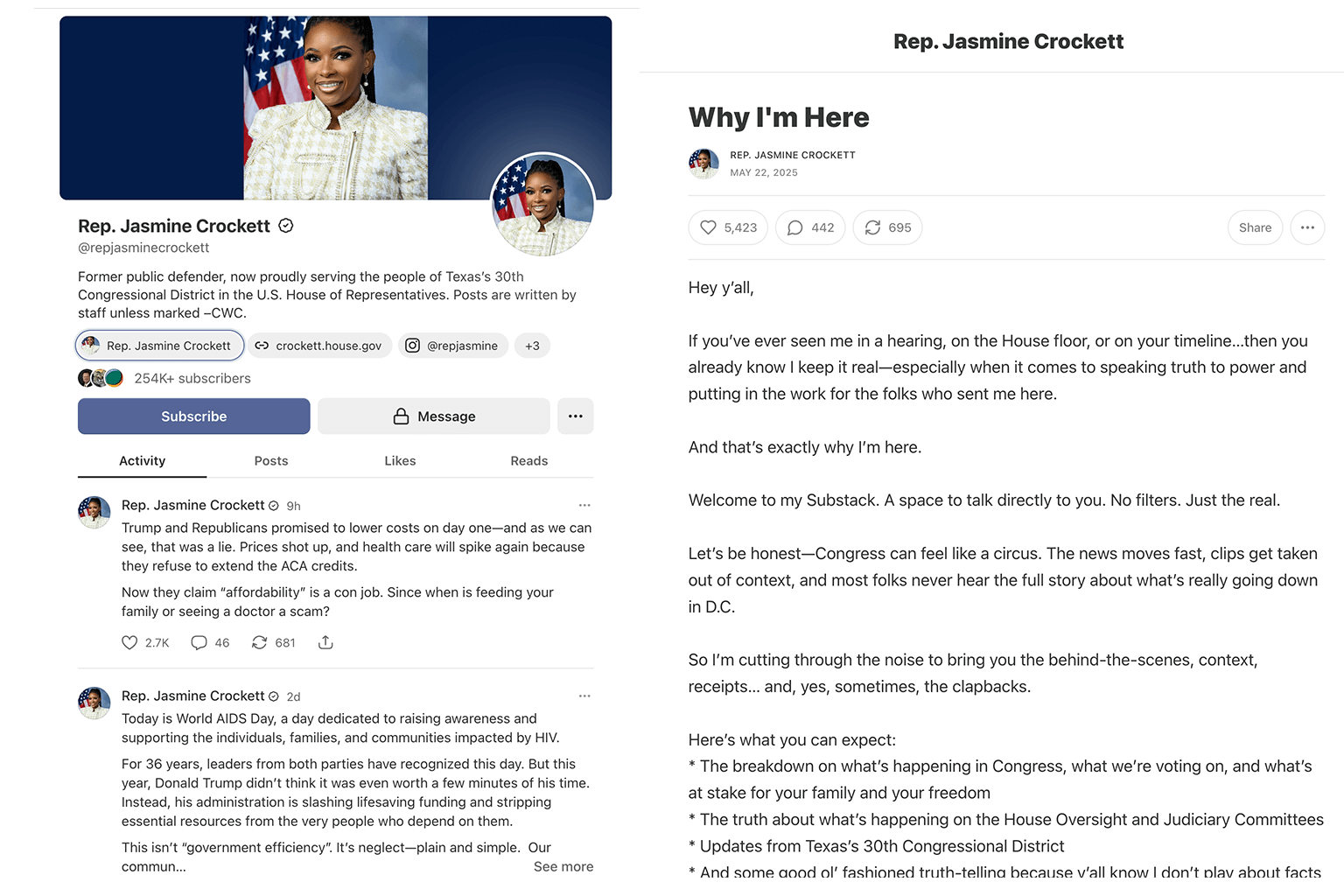
Again, this is not organic growth. This is a congressional email database moved onto a new platform, instantly converted into “influence.”
The illusion becomes reality because Substack treats raw list size as proof of popularity.
How the Cheating Works in Practice
Here is the part no one talks about.
When a politician imports 100,000 emails:
Even a small open rate produces thousands of views
Those views look like momentum
Notes interprets it as popularity
The algorithm pushes the account higher
The account appears constantly in discovery
New users see the account everywhere
And the cycle strengthens
Meanwhile, a real writer with 2,000 subscribers could have half their entire base open an email and still fall short of the thresholds for Notes exposure.
So a politician with one post gets treated like a top publication.
A genuine writer with one thousand loyal readers gets buried.
One arrives with a database.
The other arrives with an essay.
One is treated as a powerhouse.
The other fights uphill for every inch.
This is the Substack illusion.
Why This Matters
Substack originally positioned itself as a platform that would liberate writers from institutional power. But now the very institutions writers were trying to escape have simply moved in through the back door.
The moment a senator or congresswoman imports a campaign list, the playing field collapses. Suddenly Substack is not a competition of ideas. It is a competition of databases.
Readers are shown “popular” accounts that never built anything here.
Writers who built something real are treated as if they never mattered.
You can see the result by looking at the Notes feed on any given day. It is dominated by large political accounts with enormous external lists. These accounts are elevated automatically, regardless of the quality or frequency of their writing.
The people with the largest external lists are the people who appear most popular.
Substack tells you this is momentum.
But it is not momentum.
It is manual importation dressed up as proof of influence.
The Cost to Real Writers
Independent writers do not have PACs.
We do not have congressional email lists.
We do not have national fundraising networks to import.
Everything here is built one reader at a time.
Real conversations.
Real connections.
Real community.
If those voices vanish, the platform becomes a mirror of the institutional publishing world that independent writers came here to escape.
That is the danger.
That is why independent voices are struggling to stay visible.
And that is why I am writing this now.
If You Want Substack to Remain a Home for Independent Thought
Paid subscribers are not just financial support. They are the only signal Substack recognizes that actually comes from human choice — not a party database.
Paid support tells the platform:
“This voice matters. Keep it visible.”
If you want to help keep this work alive — and help independent writers compete against political machines importing six-digit lists — you can subscribe here:
Become a Paid Subscriber
If you already support this work, thank you. You are the reason this writing survives inside a system that rewards artificially inflated accounts and institutional power.
If you cannot subscribe financially, you can still help by sharing this post or sending it to someone who has never heard these arguments made plainly.
Independent truth-telling survives only when real people choose to hear it.
Thank you for reading. Thank you for standing with this work. And thank you for caring about the difference between genuine influence and manufactured illusion.
Chris
My heart aches while reading this post because it reinforces the dark cynicism I'm fighting these days. When I read classic works of the past and compare them to the garbage published today, a little part of me dies every day. I had high hopes for SubStack in the beginning, but I see the trends you are describing in this post. The entire publishing industry has been completely captured by the WOKE, DEI, CRT, and socialists factions controlling our universities, government (deep state) institutions, Hollywood, the media, and much of corporate America. It starts in elementary school and continues through the overpriced universities (public & private). What you are describing is the unfortunate results of our failure to teach kids to think. They grew up to become shallow adults that can't think for themselves. We are swimming in a sea of ideologues and activists that can't carry on a civilized conversation. It has been happening for over 50 years and now the harvest is in full bloom. No wonder GenZ resents Boomers, we supervised this catastrophe. Now it's out of control.
“Substack originally positioned itself as a platform that would liberate writers from institutional power. But now the very institutions writers were trying to escape have simply moved in through the back door.”
Truer words have not been spoken. I was an early reader and had such high hopes. Now, Substack has become the “Mini-Me” of X. Sad.