


A movement that does not own its infrastructure does not own its voice.
Substack experienced a brief outage today. That is not unusual. Large digital systems occasionally fail. Servers misfire. Code breaks. Traffic overwhelms something that normally works. But what matters is not the outage. What matters is the silence.
For approximately an hour, thousands of writers were unable to publish. Millions of readers were unable to access posts. Political commentary that normally flows without interruption simply stopped. No law was passed. No court issued an injunction. No agency filed a complaint. Infrastructure went dark. That is the modern condition of speech.
Speech Is Not Just Protected by Law
Americans are trained to think about speech as a constitutional issue. The First Amendment protects citizens from government censorship. That protection is real and necessary. But most limitations on modern speech are not statutory. They are structural.

They involve hosting providers, payment processors, app stores, search engines, cloud servers, email distribution systems, and algorithmic ranking. When those systems malfunction or change policy, speech contracts immediately. The past five years have provided several examples. In January 2021, Twitter suspended a sitting president. Facebook and Instagram followed. YouTube removed and demonetized political channels. Amazon Web Services terminated hosting for Parler, effectively shutting the platform down for weeks. Payment processors tightened scrutiny on politically controversial organizations. Parler did not lose a debate. It lost servers. That difference is not philosophical. It is mechanical.
Why This Matters More for Conservatives
From 2020 through 2022, surveys consistently showed that Republicans believed they were treated unfairly on social platforms. Pew Research reported in 2021 that 73 percent of Americans believed social media sites likely censored political viewpoints. Among Republicans and Republican-leaning independents, the number exceeded 85 percent. Whether every individual claim was justified is not the point. The perception of vulnerability drove behavior.
Writers migrated. They left legacy media. They left platforms they viewed as hostile. They searched for alternatives that promised more open debate. Substack became one of those destinations. By 2023, Substack reported over 20 million active subscriptions and more than 2 million paid subscriptions. By 2025, many political writers were earning substantial income there. A noticeable portion leaned right of center. The migration was rational. But migration is not construction.
When a movement clusters heavily on a single platform, it assumes concentration risk. In finance, concentration risk refers to excessive exposure to one institution. If that institution fails, the damage is amplified. Today’s outage was brief. The structural exposure it revealed was not.
Institutions Shape Outcomes
The Democrat Party has historically invested in institutional influence. Universities, media organizations, nonprofit advocacy networks, and segments of corporate America have leaned left for decades. OpenSecrets data through the 2024 election cycle shows that employees at major technology firms donated overwhelmingly to Democrat candidates. In some firms, contributions exceeded 80 percent to the Democrat Party.
That does not prove coordinated suppression. It demonstrates ideological alignment within institutions that govern digital speech. Institutions establish norms. Norms influence moderation. Moderation shapes visibility. Visibility shapes political influence.
Substack has publicly defended controversial writers and positioned itself as supportive of free expression. That is to its credit. But goodwill is not immunity. Regulatory pressure, payment disruptions, app store disputes, or internal policy shifts can quickly alter a platform’s posture. When a political movement relies heavily on a single infrastructure channel, it is exposed to those variables.
What About Truth Social and Rumble
Some will argue that conservatives are building. Platforms such as Truth Social and Rumble are frequently described as conservative-owned alternatives. There is some truth in that. Truth Social was launched by Trump Media & Technology Group as an alternative to Twitter. Rumble has positioned itself as a free speech video platform and has invested in hosting infrastructure to reduce reliance on legacy providers. As of 2025, Rumble reported tens of millions of monthly active users.
These platforms represent effort. But they do not eliminate structural risk. Both still rely on core internet infrastructure. Domain registrars, cloud systems, app store distribution, payment processors, and telecommunications networks remain centralized industries. Regulatory frameworks still apply. Banking relationships still matter. Server capacity still depends on physical data centers subject to jurisdiction. Ownership does not equal insulation. If conservatives migrate from Twitter to Truth Social without diversifying further, they are still clustering. The sign on the door changes. The architecture remains centralized. Parallel platforms are a step toward resilience. They are not full sovereignty.
The Narrative Window
Modern political narratives form rapidly. A major event occurs. Within 24 to 48 hours, a dominant storyline solidifies. Journalists publish. Commentators respond. Social algorithms amplify. Search engines rank. The first framing often persists. Economists describe this phenomenon as path dependence. Early inputs influence long-term outcomes.
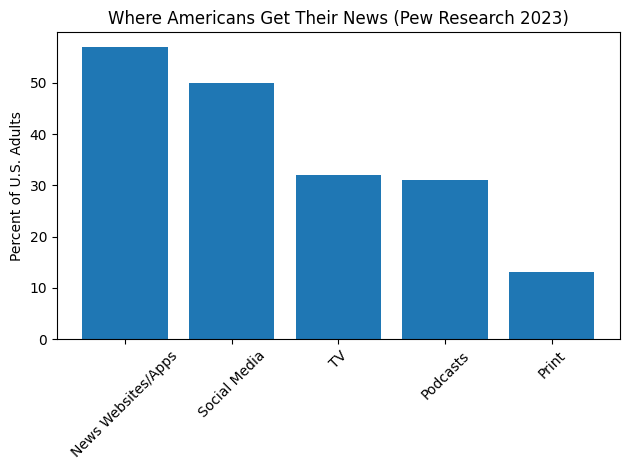
According to Pew Research in 2023, roughly half of Americans reported getting news at least sometimes from social media. Younger Americans relied on it even more heavily. If a political movement loses access to its primary publishing channel during that early narrative window, even temporarily, the asymmetry is meaningful. Silence, even short silence, affects perception. That is not a theory. It is a function of attention.
The Irony of Centralization
Conservatives regularly warn about centralized federal authority. They advocate decentralization and local control. Yet in digital media, they repeatedly centralize their own distribution. They migrate from platform to platform rather than building distributed systems. True resilience requires redundancy. It requires maintaining independent domains. Exporting and backing up email lists. Diversifying where content is hosted. Reducing reliance on single payment processors. Treating platforms as channels, not homes.
This is not dramatic. It is practical. Liberty without infrastructure is aspiration. Liberty with infrastructure is capacity.
The Lesson of One Hour
Substack’s outage lasted less than an hour. It was resolved. Traffic resumed. Writers continued. But small tremors reveal structural truths. Speech in 2026 is shaped less by statute than by systems.
There is a hollow, sickening feeling in the chest of a writer when the “Publish” button leads to a void. It is the sudden realization that your voice exists only by the grace of a machine you do not own and a code you cannot read. For sixty minutes, a movement was effectively erased, not by a tyrant’s boot, but by a flickering light in a server room.
The serious question is not whether Substack will recover. It is whether we will continue to build our houses on rented land, or if we will finally find the courage to own the ground beneath our feet.
Join me.
Build With Me
If this work matters to you, understand what it requires.
Independent writing is not sustained by slogans about free speech. It is sustained by infrastructure.
When you become a paid subscriber, you are not just supporting an essay. You are helping build a durable ground beneath it.
You are helping reduce reliance on advertising networks and outside sponsors.
You are helping ensure that if one switch flips somewhere else, this voice does not disappear with it.
That is the difference between renting space and owning it.
If you believe conservatism must stop migrating and start building, then help build.
If you can do more, Join the Resistance Core
Share this work directly with someone who values independent thought.
Liberty without infrastructure is aspiration.
Let’s build the infrastructure.