

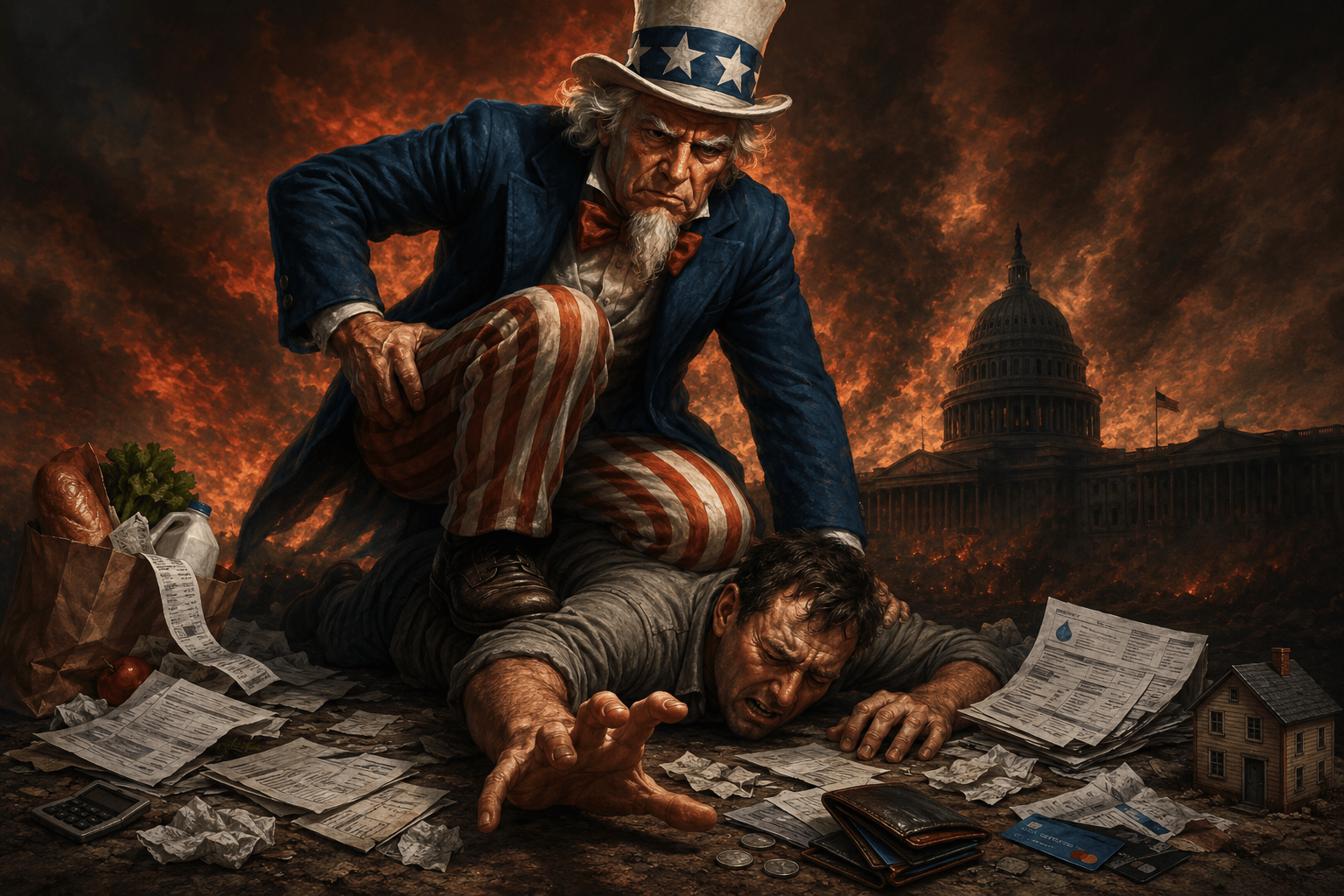
“Tax increases do not fix corruption. They finance it.”
The American taxpayer is out of air.
He is told the country needs more money. Schools need more money. Cities need more money. Agencies need more money. Migrants need more money. Foreign governments need more money. Contractors need more money. Nonprofits need more money. Bureaucrats need more money. Every failure of government somehow becomes evidence that government was underfunded.
Meanwhile, the cost of ordinary life keeps climbing. Groceries are higher. Insurance is higher. Rent is higher. Mortgage rates are higher. Car payments are higher. Credit card interest is brutal. Property taxes rise even when the house does not change. Utility bills arrive like punishment. Fees appear where taxes used to hide.
Then Washington clears its throat and says the problem is that government still does not have enough money.
That is the oldest con in politics. When a private citizen runs out of money, he is told to budget. When government runs out of money, the citizen is told to pay more.
This is not taxation in the old sense. It is taxation through asphyxiation.
Taxphyxiation
tax·phyx·i·a·tion
noun
The slow financial suffocation of the taxpayer caused by a government that spends beyond what taxation can support, then covers the gap through debt, inflation, interest, fees, future tax increases, and moral lectures about “fair share.”
Example: The taxpayer did not stop paying. Government kept spending faster. The result was Taxphyxiation.
A government spends beyond what taxation can support. It borrows what taxation cannot cover. It pays interest on what politicians already consumed. It weakens the future by disguising today’s shortfall as tomorrow’s obligation. Then it calls the citizen selfish for asking where the money went.
America does not have a “not enough taxation” problem. It has a spending problem. It has a waste problem. It has a fraud problem. It has a corruption problem. Above all, it has a political class that has learned to turn every failure of government into a demand for more government.
The Great Lie: America Is Undertaxed
The great lie of modern Washington is that America is broke because Americans are undertaxed.
This lie usually arrives dressed as compassion. We are told the rich need to pay their fair share. We are told the country cannot afford basic services. We are told every deficit is proof that taxpayers have failed to contribute enough. The assumption is always the same. Government is virtuous, spending is compassion, and the taxpayer is the suspect.
But the numbers tell a different story.
In fiscal year 2025, the federal government collected $5.23 trillion in revenue, spent $7.01 trillion, and ran a $1.78 trillion deficit, according to Treasury Fiscal Data. That is not a starving institution. That is a government taking in more than five trillion dollars and still spending far beyond what it collects.
Put that in household terms. For every $100 Washington collected, it spent about $134.
If a family did that year after year, we would not call it compassion. We would call it a crisis. If a business did it, the accountant would call a meeting. If a local charity did it, donors would ask questions. But when Washington does it, politicians call it investment.
That is the distinction this essay has to make. The issue is not whether taxes have risen. They have. The issue is whether government spending has risen faster than the tax system can support. The answer is yes, and it has happened over many decades, under both parties, through wars, recessions, emergencies, entitlements, bailouts, stimulus bills, agency growth, interest costs, and the permanent machinery of modern government.
This is why the argument should not be reduced to one president, one party, one pandemic, or one budget year. Fiscal years overlap administrations. Spending in any given year is shaped by laws, formulas, entitlements, debt service, agency habits, and commitments made years earlier. The point is not that one man created Taxphyxiation. The point is that modern Washington runs on it.
Washington does not have a revenue shortage. It has a restraint shortage.
Who Actually Pays the Federal Income Tax?
Before anyone says “tax the rich,” it helps to ask a basic question.
Who already pays the federal income tax?
This is where the slogan runs into arithmetic. The federal income tax is already highly progressive. That does not mean the tax code is perfect. It is not. It does not mean wealthy people never use loopholes. Some do. It does not mean payroll taxes, sales taxes, property taxes, and state taxes do not hit working people. They do.
But when politicians talk about “fair share,” they are usually talking about the federal income tax. So let us look at that tax specifically.
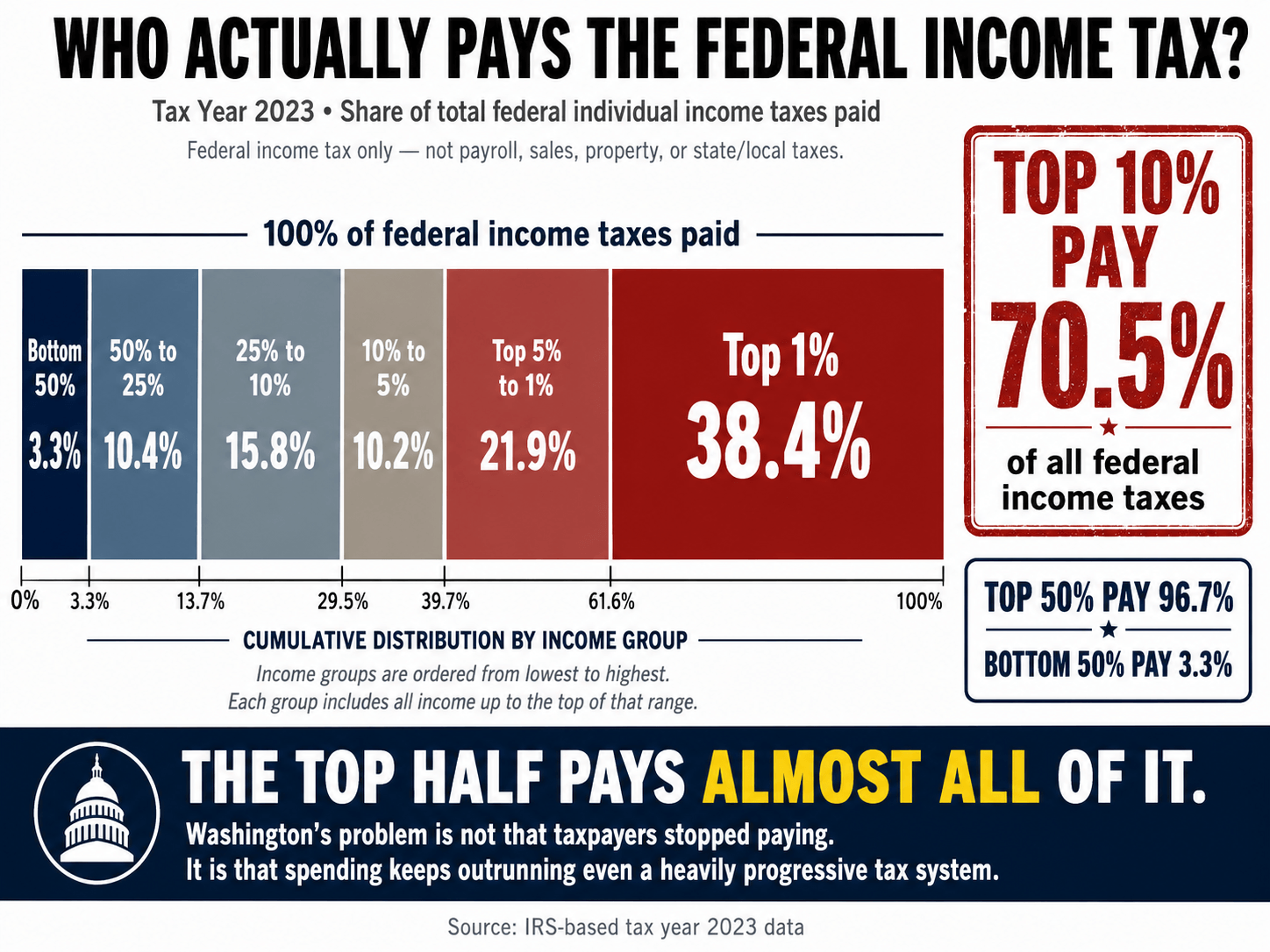
For tax year 2023, IRS-based data summarized by Tax Foundation show that the top 1 percent of taxpayers paid 38.4 percent of all federal income taxes. The top 10 percent paid 70.5 percent. The top 25 percent paid 86.3 percent. The top half of taxpayers paid 96.7 percent, while the bottom half paid 3.3 percent.
That is not a flat system. That is not a system where “the rich pay nothing.” It is a system where the federal income tax burden is already concentrated heavily at the top.
This does not end the tax debate. It clarifies it.
The real question is not whether some billionaire somewhere can afford to pay more. Of course he can. The real question is whether giving Washington more money fixes the problem when Washington already takes trillions and spends beyond them anyway.
A government that cannot control spending will always define “fair share” upward. Eventually, it will define “rich” downward. It begins with billionaires. Then millionaires. Then small business owners. Then dual-income households. Then families that saved, bought a home, and thought they had climbed into stability. The spending appetite does not stop because the rhetoric was aimed higher up the ladder.
This is the problem with the fair share argument. It assumes the taxpayer is the reason the government is broke. But the federal income tax is already heavily loaded onto upper earners, and Washington still cannot live within it.
You cannot fix a spending addiction by accusing the taxpayer of sobriety.
The Taxpayer Kept Paying
The taxpayer did not vanish.
The economy grew. Wages grew. Corporate profits grew. Investment income grew. More people worked. More transactions occurred. More money flowed through the economy, and Washington took its cut.
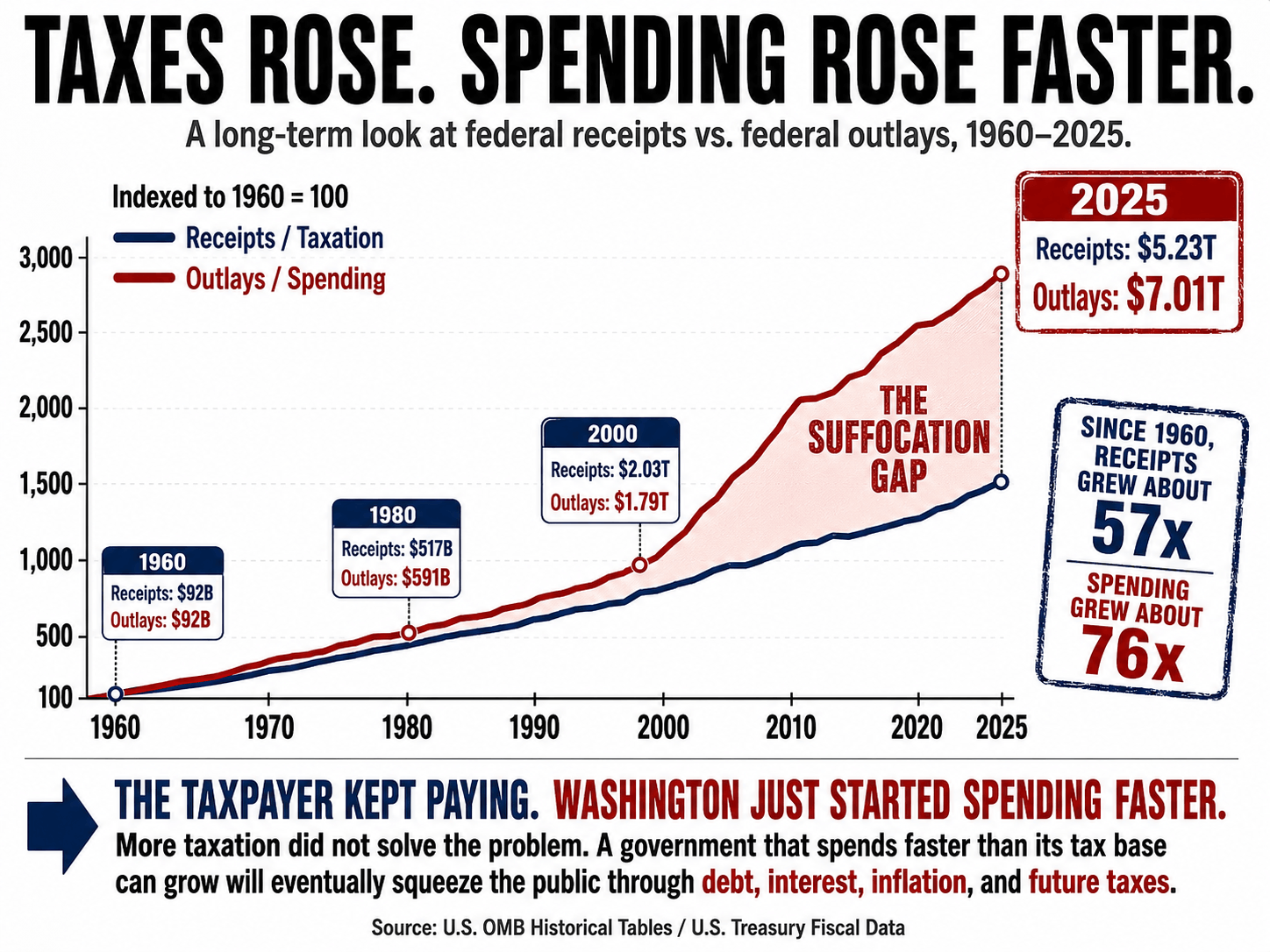
In 1960, federal receipts and outlays were both about $92 billion. By 1980, receipts were about $517 billion, while outlays were about $591 billion. By 2000, receipts had climbed to about $2.03 trillion, while outlays were about $1.79 trillion, producing a surplus. By 2025, receipts reached $5.23 trillion, while outlays reached $7.01 trillion. OMB’s Historical Tables include Table 1.1, which tracks receipts, outlays, and surpluses or deficits from 1789 through 2025.
That is the chart that matters because it avoids the partisan dodge and shows the long-term trend.
Not 2020 to 2025. Not COVID to today. Not Biden to Trump or Trump to Biden. The stronger story is the long-term behavior of a government that learned to spend faster than taxpayers can fund it.
Since 1960, federal receipts rose from about $92 billion to $5.23 trillion. Federal spending rose from about $92 billion to $7.01 trillion. The tax base grew enormously. Spending grew even more.
A normal person understands this. If your income doubles, but your spending triples, your problem is not that your income failed. Your problem is that your appetite outran your income. Washington has spent decades pretending not to understand this because pretending not to understand it is profitable.
It allows politicians to say, “We need more revenue,” instead of admitting, “We made promises we cannot pay for.” It allows bureaucrats to say, “Our agency needs more funding,” instead of asking why the last funding increase did not solve the problem. It allows the political class to blame the citizen for the government’s lack of restraint.
This is why the main chart should not merely show raw dollars. It should show the two lines moving over time, with receipts rising and outlays rising faster. The shaded space between them should be labeled what it is: The Suffocation Gap.
The Suffocation Gap
The deficit is not a cloud in the sky. It is not a technical inconvenience for accountants. It is not free money produced by clever people in Washington.
The deficit is the distance between what politicians promise and what taxpayers can actually carry.
When government spends more than it collects, the difference does not disappear. It becomes debt. Debt becomes interest. Interest becomes a permanent claim on future taxpayers. If Washington tries to soften the burden through easy money, ordinary people can feel the pressure through prices. If interest rates rise, they feel it through mortgages, car loans, credit cards, and business financing. If future taxes rise, they feel it in paychecks, investment, ownership, and opportunity.
Debt is taxation with a delay. Interest is taxation without services. Inflation is taxation without a vote.
That is why deficits matter. They are not just numbers on a Treasury report. They are tomorrow’s taxes being spent today by people who want credit now and consequences later.
CBO’s 2026 to 2036 outlook projected that the federal deficit would be $1.9 trillion in fiscal year 2026 and grow to $3.1 trillion by 2036. As a share of the economy, CBO projected deficits rising from 5.8 percent of GDP in 2026 to 6.7 percent in 2036, above the 50-year average of 3.8 percent. CBO also said rising net interest costs drive much of that increase.
That is not a temporary cough. It is a chronic condition.
The suffocation gap also exposes the moral fraud behind endless spending. Politicians get to be generous with money they do not have. They get applause for the program, the grant, the benefit, the subsidy, the bailout, the emergency relief, the foreign aid package, the climate initiative, the migrant program, the education scheme, the housing plan, and the urban rescue fund.
The person paying the bill rarely gets the applause. He gets the invoice.
When Washington spends more than taxation can support, it is not avoiding taxes. It is postponing them, disguising them, and spreading them across time until the citizen no longer knows where the pressure is coming from.
He only knows life keeps getting more expensive.
The Leaking Bucket Wants a Bigger Hose
There is another part of this story, and it may be the most insulting one.
Washington does not merely spend too much. It also loses, wastes, misdirects, and improperly pays enormous amounts of money. Then it asks for more.
A leaking bucket does not need a bigger hose. It needs the hole fixed.
In fiscal year 2025, federal agencies estimated about $186 billion in improper payments across 64 programs, according to GAO. That was about $24 billion more than the previous fiscal year. GAO also reported that cumulative improper payment estimates since fiscal year 2003 total about $3 trillion, while warning that the actual amount may be significantly higher.
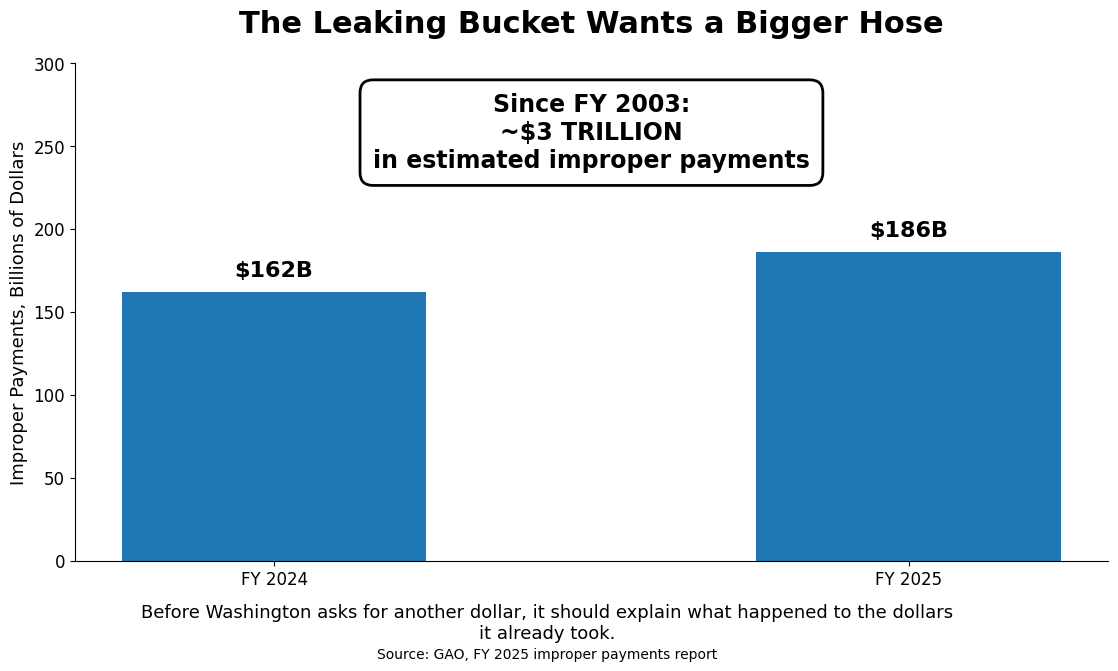
That is not a rounding error. That is a civilization-sized leak.
Improper payments are not always fraud. Some are overpayments. Some are payments made in the wrong amount. Some are payments made without sufficient documentation. Some result from agency error. Some result from recipient fraud. But from the citizen’s perspective, the distinction is less comforting than Washington imagines.
The public does not care whether the money was stolen, mishandled, misclassified, sent to the wrong person, paid without documentation, or lost inside a program designed so badly that no one can track it. The public cares that government takes money by force, fails to protect it with competence, and then returns with a moral lecture about paying more.
The taxpayer is not underpaying. The government is under-accounting.
This is where the “tax more” argument becomes obscene. Before Washington asks Americans for another dollar, it should explain what happened to the dollars it already took. Before politicians demand higher taxes, they should explain why improper payments can pile up by the trillions over two decades while the agencies responsible keep operating as if the only missing ingredient is more funding.
Tax increases do not fix corruption. They finance it.
Fraud Is Not a Rounding Error Anymore
Fraud is often discussed as if it were a few bad actors gaming a mostly healthy system. Sometimes that is true. But when government becomes large enough, complicated enough, and politically protected enough, fraud stops looking like an exception and starts looking like the predictable cost of the system.
The larger the program, the more people it touches. The more people it touches, the more rules it needs. The more rules it needs, the more administrators it hires. The more administrators it hires, the more contractors, vendors, nonprofits, consultants, compliance teams, eligibility systems, and political intermediaries appear. Somewhere inside that maze, accountability dies of exhaustion.
By the time the public learns that billions were improperly paid, the money is gone, the headlines are old, the agency blames the system, Congress holds a hearing, and the same people demand more funding to prevent the next failure.
The pandemic made the problem impossible to ignore. GAO estimated that unemployment insurance fraud during the COVID-era programs was likely between $100 billion and $135 billion from April 2020 through May 2023. GAO also noted that the full extent of UI fraud during the pandemic will likely never be known with certainty.
The SBA Office of Inspector General estimated that SBA disbursed over $200 billion in potentially fraudulent COVID-19 EIDL, EIDL Targeted Advance, Supplemental Targeted Advance, and PPP funds. SBA OIG said that represented at least 17 percent of COVID-19 EIDL and PPP funds disbursed.
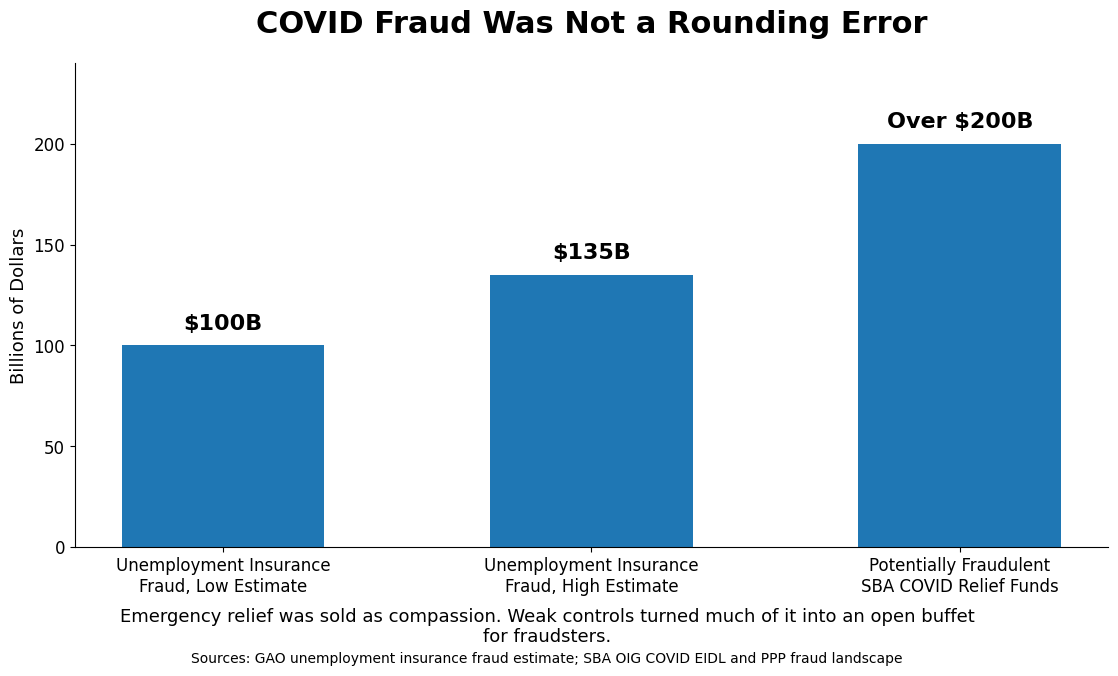
Those programs were sold as emergency relief. Much of the money did go to people and businesses under real pressure. But weak controls also turned federal aid into an open buffet for fraudsters.
The problem did not begin with COVID. The pandemic simply showed what happens when Washington points a fire hose of money at the country and worries about verification later.
The broader pattern is familiar. Medicaid improper payments. Unemployment fraud. Small business relief abuse. Homelessness spending with little visible improvement. Education spending while outcomes decline. Grants to organizations better at activism than results. City programs that expand while public order collapses. Contractors paid to manage problems they never seem to solve.
The machine survives the failure. The taxpayer absorbs it.
Fraud flourishes when compassion is announced loudly and accountability is enforced quietly, slowly, or not at all. It flourishes when agencies are rewarded for moving money, not for protecting it. It flourishes when politicians treat oversight as cruelty and skepticism as extremism.
That is not merely incompetence. It is an incentive structure.
Democrats Built the Bigger Machine
Both parties have fingerprints on the debt. Republicans are not innocent. They campaign on limited government, then discover exceptions when defense contracts, farm subsidies, corporate favors, highway projects, stimulus checks, or election-year promises are involved. Many Republicans talk like Calvin Coolidge and spend like they are afraid of bad headlines.
But honesty requires distinction.
Republicans waste money. Democrats institutionalize the waste.
The Democrat Party has built the larger permanent spending ecosystem. Its political power is tied to bureaucracies, public-sector unions, activist nonprofits, federal grants, urban machines, welfare administration, education systems, environmental programs, immigration services, legal-aid networks, homelessness organizations, DEI offices, and layers of agencies that grow more influential as government grows more expensive.
For Democrats, spending is not merely policy. It is payroll, patronage, ideology, and voter maintenance.
This is why spending cuts are treated as moral violence. Every dollar in government has a constituency. Every program has employees. Every grant has recipients. Every agency has allies. Every nonprofit has a story. Every union has organizers. Every city has officials who blame shortfalls on insufficient funding rather than failure. The system does not merely spend money. It creates people whose livelihoods, status, and influence depend on the next appropriation.
That does not mean every person inside that system is corrupt. Many are not. Some are sincere. Some are overworked. Some are trying to do decent things inside broken institutions. But systems do not need every participant to be corrupt in order to produce corrupt results. They only need incentives that reward expansion and punish restraint.
The Democrat Party has mastered that arrangement. It turns government into an ecosystem, then calls opposition to that ecosystem an attack on the poor, the elderly, the sick, the migrant, the teacher, the environment, or democracy itself.
This is why the taxpayer loses the debate before it begins. He is not arguing against a line item. He is arguing against a moral theater production.
If he objects to the spending, he hates the poor. If he objects to the fraud, he lacks compassion. If he objects to the debt, he is extreme. If he objects to the tax increase, he is greedy. If he asks why the last trillion did not work, he is told the next trillion will.
That is not fiscal policy. It is moral theater with an appropriation bill.
The “Tax the Rich” Escape Hatch
The easiest argument in politics is “tax the rich.”
It is easy because most people do not think they are rich. They imagine someone else paying the bill. They imagine billionaires, private jets, hedge funds, yachts, and tax shelters. They do not imagine the definition moving down to include them, their employer, their landlord, their retirement account, their small business, or the prices they pay every week.
The problem is not that no wealthy person can pay more. The problem is that “tax the rich” is sold as a solution to a spending machine that has no intention of becoming smaller.
Even if Washington raises taxes on high earners, what happens next? Does spending fall? Does the debt shrink? Do improper payments disappear? Do agencies become leaner? Do cities become safer? Do schools improve? Do homeless programs suddenly produce accountability? Do contractors return unused funds? Do politicians say, “Thank you, that is enough”?
Of course not.
The new money becomes the baseline. The baseline becomes the floor. The floor becomes the next crisis. The next crisis becomes the next tax increase.
That is how government grows. Yesterday’s emergency becomes today’s entitlement. Today’s entitlement becomes tomorrow’s moral obligation. Tomorrow’s moral obligation becomes next year’s deficit.
A government that cannot control spending will eventually define “rich” downward.
There is another trick. Many taxes do not stay where politicians pretend to place them. Corporate taxes can show up in prices, wages, returns, and investment decisions. Property taxes show up in rents and homeownership costs. Regulatory costs show up in fewer businesses, higher prices, and slower growth. Debt shows up in future taxes. Inflation shows up in the grocery aisle. Interest rates show up in mortgages, car loans, and credit cards.
The taxpayer may not see his name on every bill. But he pays all the same.
Interest: The Bill for Yesterday’s Lies
Interest on the national debt is the least sentimental part of the federal budget.
It does not teach a child. It does not secure a border. It does not pave a road. It does not arrest a criminal. It does not treat a patient. It does not house a veteran. It does not put food on a table. It does not inspect a bridge. It does not defend a city.
It is simply the cost of yesterday’s political promises.
CBO projected in 2026 that net interest outlays would more than double from $1.0 trillion in 2026 to $2.1 trillion in 2036. As a share of the economy, net interest was projected to grow from 3.3 percent of GDP in 2026 to 4.6 percent in 2036.
That is the trap. The more Washington borrows, the more it pays to service the borrowing. The more it pays to service the borrowing, the less room it has for actual services. Then politicians say the government needs more revenue, as if the public should be grateful for the chance to finance the interest on yesterday’s irresponsibility.
Interest on the debt is the sound of yesterday’s political promises eating tomorrow’s paycheck.
This is where the moral fraud becomes clear. The politician who voted for the spending may be retired. The bureaucrat who administered the program may be promoted. The activist who demanded the money may have moved to a new cause. The contractor may have already cashed the check. The worker remains.
So does his child.
Debt allows one generation of politicians to buy applause and send the invoice to people who were not in the room. It is taxation without representation for the unborn, and taxation without honesty for the living.
Taxphyxiation Is Bigger Than the IRS
Taxphyxiation is not just the federal income tax.
That is what makes it hard for people to describe. They feel squeezed from all directions, but each squeeze has a different name. One is called a tax. Another is called a fee. Another is called inflation. Another is called a premium. Another is called tuition. Another is called compliance. Another is called interest. Another is called a surcharge. Another is called a deficit.
The ordinary citizen experiences all of them as pressure.
Income tax, payroll tax, property tax, sales tax, gas tax, corporate tax passed through the economy, utility fees, licensing fees, tolls, permits, compliance costs, inflation, higher interest rates, higher insurance costs, higher rents, higher home prices, higher deficits, and future tax obligations all narrow the space in which ordinary people try to live.
Not every one of those is a tax in the formal sense. But formal definitions do not pay the electric bill.
The genius of modern taxation is that much of it no longer arrives with the word “tax” printed on the bill.
Government does not need to take everything at once. It only needs to make breathing more expensive.
That is why people know something is wrong even before they see the chart. A worker gets a raise and feels poorer. A family buys a home and gets punished by property taxes. A small business owner meets a wall of regulation. A household uses credit cards to survive inflation and then gets hammered by interest. Everyone watches government programs fail upward, then hears that the solution is more funding.
The result is not merely financial stress. It is civic suffocation.
People lose faith when they realize competence is not required, accountability is rare, and failure is often rewarded with a larger budget. They become cynical when they see politicians protect the institutions that failed while lecturing the citizens who paid.
That cynicism is not extremism. It is pattern recognition.
The Middle Class Pays for Everyone’s Lies
The middle class is the great target of modern government, even when politicians pretend otherwise.
The rich can hire accountants. They can borrow against assets. They can move money. They can structure income. They can influence policy. They can absorb costs that would crush a normal family. The poor are often used as political props, and many receive benefits that offset some direct taxes.
The middle class gets squeezed from both directions.
It is too “rich” to be left alone and not rich enough to escape. It pays income taxes, payroll taxes, property taxes, sales taxes, insurance premiums, tuition bills, utility hikes, mortgage interest, car loan interest, grocery inflation, medical bills, and fees that politicians never call taxes because honesty would make the scheme harder to sell.
The middle class is not where politicians begin when they sell a tax increase. It is where they end when the money runs out.
That is why “tax the rich” should worry normal people. Not because every rich person is sympathetic. Some are not. Not because every tax increase is identical. They are not. But because a government that cannot live within trillions will not be satisfied by one more raid on one more income group.
The machine does not retire after one tax increase. It treats that increase as the new floor.
And when it comes back, it does not knock only on the doors of billionaires. It knocks through prices, interest rates, debt, reduced opportunity, higher rents, weaker savings, smaller businesses, and children who inherit obligations they never approved.
A country that punishes work, savings, ownership, and family formation should not be surprised when people do less of those things. A country that rewards dependency should not be surprised when dependency grows. A country that funds failure should not be surprised when failure organizes into a lobby.
Compassion With Someone Else’s Oxygen
The left sells spending as compassion. That is one reason the argument works.
No one wants to be against compassion. No one wants to be against the poor, the sick, the elderly, the disabled, the struggling student, the homeless family, the migrant child, or the worker who fell behind. These are sympathetic cases, and politics is very good at finding sympathetic cases.
But sympathy is not accounting. Good intentions do not repeal arithmetic.
Spending money you do not have is not compassion. Borrowing against children is not compassion. Taxing workers to fund corrupt systems is not compassion. Keeping failed agencies alive because they employ the right people is not compassion. Giving more money to programs that cannot account for what they already spent is not compassion.
It is vanity with a public budget.
Compassion with someone else’s money is easy. Compassion with money borrowed from children is not compassion. It is theft wearing a halo.
This is the moral inversion at the center of Taxphyxiation. The taxpayer is treated as morally suspect for wanting to keep more of what he earned, while the political class is treated as noble for spending what it did not earn, borrowing what it cannot repay, and wasting what it took by force.
The question is not whether government can find sympathetic causes. It always can. The question is whether sympathy justifies suffocation.
At some point, compassion for the recipient becomes cruelty toward the payer. At some point, the public servant becomes the public’s master. At some point, the taxpayer stops funding civilization and starts funding the machinery that is squeezing civilization out of him.
The Taxpayer Cannot Breathe
The bureaucracy can breathe. The contractors can breathe. The unions can breathe. The NGOs can breathe. The activist class can breathe. The consultant class can breathe. The grant writers can breathe. The urban machines can breathe. The politicians can breathe. The agencies can breathe. The debt market can breathe.
The American taxpayer cannot.
He is told the government needs more. He is told the system is compassionate. He is told the spending is necessary. He is told the fraud is complicated. He is told the debt is manageable. He is told the rich will pay. He is told the next program will work. He is told the next audit will help. He is told the next reform will be different. He is told to be patient while his paycheck, savings, purchasing power, and future are slowly compressed.
But the numbers tell a simpler story.
Taxpayers kept paying. Federal revenue rose into the trillions. The federal income tax burden is already heavily concentrated at the top. Washington still spent beyond it. Improper payments reached hundreds of billions in a single year and trillions over time. Pandemic fraud exposed how easily emergency compassion becomes institutional negligence. Interest costs are projected to grow. Deficits are projected to persist. The machine that created the problem insists the solution is to feed the machine.
A nation that spends beyond taxation must eventually tax beyond consent.
That taxation may come as higher rates. It may come as inflation. It may come as interest. It may come as fees. It may come as debt passed to children. It may come as a smaller future, a weaker dollar, fewer opportunities, and a middle class that works harder to stand still.
A government that spends beyond taxation does not abolish the bill. It only changes the name on the envelope. Sometimes the envelope says debt. Sometimes it says inflation. Sometimes it says interest. Sometimes it says higher taxes tomorrow.
But it is always addressed to the same person.
The American taxpayer.
Help Keep This Work Breathing
The government can take your money by force.
I cannot.
That is the difference.
Washington can spend trillions it does not have, lose billions it cannot explain, bury the country in interest, and then come back to the American taxpayer with a straight face and say, “We need more.”
This publication does not work that way.
There are no corporate sponsors here. No institutional backing. No foundation grants. No taxpayer-funded nonprofit pipeline. No political machine quietly keeping the lights on.
There is only the work, the reader, and the question of whether truth like this gets enough oxygen to keep spreading.
Become a Paid Subscriber
If this essay helped put words to what you already feel, please consider becoming a paid subscriber.
Paid support is what keeps these essays free for everyone, including people who need to read them but may not be in a position to pay. It buys the time required to research, write, build charts, check sources, publish, promote, and keep going without turning this work into another paywalled product for insiders.
If enough people only read, the work stays fragile.
If enough readers pay, the work becomes harder to ignore.
The machine has money.
This work has readers.
That difference matters.
Become a paid subscriber here:
https://mrchr.is/help
Make a One-Time Gift
Maybe you do not want another subscription. I understand that. Everyone is being squeezed.
But if this essay was worth something to you, a one-time gift helps keep the work moving without adding another monthly bill.
Even a small contribution helps buy time, stability, and oxygen.
Make a one-time gift here:
https://mrchr.is/give
Join The Resistance Core
For readers who want to do more than help for a month, The Resistance Core is the higher level of support behind this work.
This is for people who understand that writing like this does not survive on applause alone. It survives when a small group decides the work is worth protecting, funding, and expanding.
The government gets funded whether it earns your trust or not.
This work has to earn it every time.
Join The Resistance Core here:
https://mrchr.is/resist
What Your Support Builds Right Now
Your support helps build a counterweight to the machine.
It funds long-form essays, data work, charts, source review, video clips, social posts, and distribution. It helps push these arguments beyond the people who already agree and into the hands of ordinary Americans who know something is wrong but have not yet been given the language to explain it.
The goal is not just to complain about the machine.
The goal is to expose it clearly enough that ordinary people can see it.
If You Cannot Give
Share the piece.
Send it to one person who still thinks America’s problem is “not enough taxation.” Post it. Quote it. Leave a comment. Help it travel.
The machine wins when people feel the pressure but cannot name it.
Now they can.
Taxphyxiation.
And the only one who can’t breathe is the American taxpayer.
"Every failure of government somehow becomes evidence that government was underfunded...The Leaking Bucket Wants a Bigger Hose" - ha-ha, you do have a way with words Mr. Arnell!
The REAL question though is: what can we do (other than open revolt!) to break the vicious cycle you describe?
To my mind, two changes are needed:
1) Severe, permanent and LEGISLATED limitations to the power of governments (e.g. governments cannot be involved in any business of any kind, be it selling cannabis or insurance, transporting oil and gas or providing any services the private sector provides; govts cannot increase taxes or introduce new taxes without a referendum; maybe wipe out all "regulations" to begin with - a law is a law, a "regulation" is a govt creation designed to circumvent law!), and
2) Politicos must answer with their PERSONAL WEALTH for any deficit they incur. This too has to be law. Once we bankrupt a couple of them - very publicly! - the rest will take notice.
Where I run into a problem is, how do we bring these much-needed changes about (once again, short of open revolt)?? Obviously, our current govts would not legislate themselves out of all this power and money!
Would love to know your thoughts on this.
(P.S. I apologize for the capitals - this platform does not allow for bolding!)
The real answer is we should have hung EVERY politician 50 years ago and drafted new politicians for one term only. They drafted us kids for their war and we still had to pay for it when we came home.
Look what that got us, endless wars and endless debt and endless corruption. Now our government is too big to function, too corrupt to be fixed.
I wonder if politicians can be replaced by AI?