

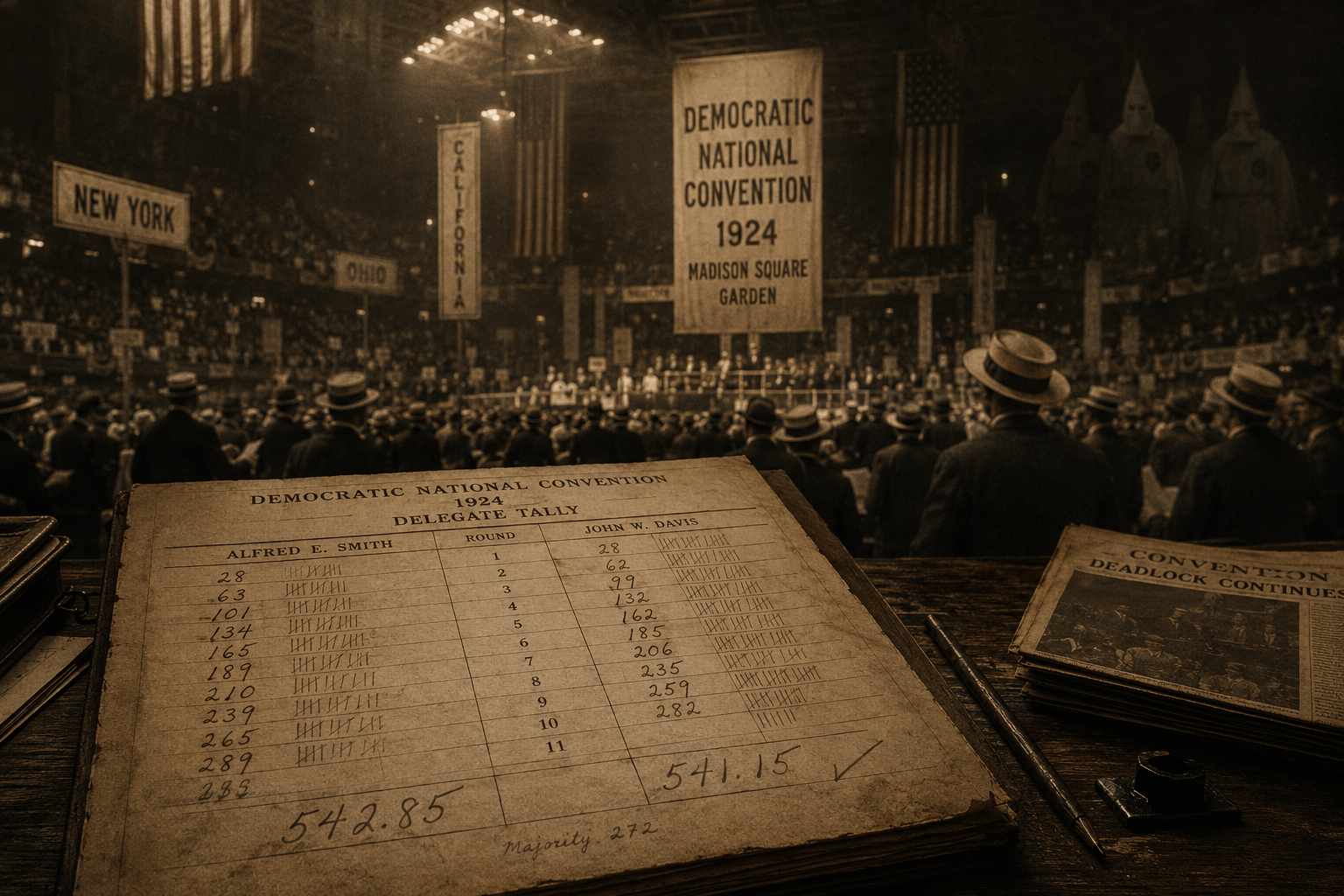
The image is symbolic, but the point is historical: the anti-Klan plank failed by roughly one delegate vote. The scandal was not in the hallway. It was in the math.
The most damaging thing about the 1924 Democrat National Convention is not that the Ku Klux Klan existed outside the hall. It is that Democrats had to negotiate with its power inside the hall.
That is the part modern Democrats would rather skip. They love talking about racism, provided the story begins late enough, is edited carefully enough, and ends with them standing on the right side of their own sermon.
But history is not a campaign ad.
The 1924 Democrat National Convention was held at Madison Square Garden in New York City. It became known as the “Klanbake.” That sounds like something invented by a meme page, but it was not. The nickname stuck because the Ku Klux Klan was one of the major forces tearing the Democrat Party apart that year.
This was not some county fair in Alabama. This was the national convention of the Democrat Party in New York City.
The same party that now treats every voter ID law, every border policy, every crime bill, and every criticism of racial politics as evidence of white supremacy could not agree in 1924 on whether to condemn the Ku Klux Klan by name.
Not slavery. Not Jim Crow. Not segregation. The Klan. By name. Even that was too much.
This is not a footnote. It is a window.
The Party That Now Sells Racial Innocence
The modern Democrat Party speaks about racism like a reformed arsonist giving fire safety lectures while hoping no one asks who burned down the neighborhood.
Today, Democrats talk as if they inherited the civil rights movement by divine right. They speak as if history appointed them permanent guardians of racial justice. If you disagree with them on welfare, schools, crime, immigration, abortion, policing, or voting rules, the accusation is usually waiting before the argument begins.
Racist. White supremacist. Dog whistle. Threat to democracy.
The words change depending on the year, but the purpose does not. These are not arguments. They are social weapons. They are meant to end discussion before facts can intrude.
The problem is that the Democrat Party’s own record does not fit its sermon. This was the party of slavery, secession, resistance to Reconstruction, Black Codes, Jim Crow, segregation, resistance to anti-lynching laws, and Southern filibusters against civil rights.
That is a lot of history to make disappear. So they explain it away, usually with some version of “the parties switched.”
That little phrase does an astonishing amount of work. It functions like political baptism. Everything before 1964 is washed clean. Everything ugly becomes someone else’s sin. Everything complicated is compressed into one convenient bedtime story for people who do not plan to check the dates.
The 1924 Klanbake makes that story harder to sell because 1924 did not happen in the Reconstruction South. It happened in New York City, inside the national machinery of the party that now claims to own racial morality.
Madison Square Garden, 1924
The 1924 Democrat National Convention was a political disaster wearing a formal suit.
The party met in Madison Square Garden. The location mattered. New York represented the urban, Catholic, immigrant-heavy wing of the party. Much of the South and West represented a different Democrat world: rural, Protestant, prohibitionist, segregationist, and far more tolerant of the Klan.
The two leading candidates symbolized that split.
Al Smith, the governor of New York, was Catholic, urban, anti-Prohibition, and hated by many Klan sympathizers. William Gibbs McAdoo, Woodrow Wilson’s former Treasury secretary, represented much of the dry, Protestant, Southern and Western wing of the party.
McAdoo did not have to campaign in a hood to become the preferred candidate of many Klan-aligned Democrats. He simply failed to reject the Klan clearly enough to satisfy the anti-Klan wing of the party. That told people what they needed to know.
The fight was not only about two men. It was about what kind of coalition the Democrat Party would be. Would it be the urban machine party of Catholics, immigrants, labor, and big-city politics? Or would it remain a party where the Klan and its allies had enough weight to make everyone else tiptoe?
The answer showed itself in the platform fight.
The Simple Test Democrats Failed
At the 1924 convention, Democrats fought over whether the party platform should condemn the Ku Klux Klan by name.
That was the test.
Not whether the party would destroy Jim Crow. Not whether it would protect Black voters in the South. Not whether it would pass an anti-lynching law. Not whether it would dismantle segregation. Not whether it would apologize for slavery, secession, or the Democrat role in suppressing Black Republican political power after the Civil War.
The test was much smaller.
Would the Democrat Party condemn the Klan by name? It failed, and narrowly. Some accounts record the anti-Klan plank losing by roughly one vote, 542.85 to 541.15. Whether one focuses on the exact fractional delegate math or the larger political meaning, the result is the same. The Democrat Party could not bring itself to clearly name and condemn the Ku Klux Klan at its own national convention.
That fact cannot be polished. Democrats were not asked to end racism. They were asked to name the Klan. Even that was too costly.
Too many people inside the Democrat coalition were either sympathetic to the Klan, afraid of the Klan, dependent on Klan voters, or unwilling to offend those who were. Political power is not always shown by who signs the check. Sometimes it is shown by who everyone is afraid to offend.
The “Mostly Peaceful” Defense of the Klanbake
The cleanup operation begins with technicalities.
For decades, Democrats and their defenders have tried to explain away the 1924 Klanbake the way modern media explain away riots. Technically, the building was not on fire. Technically, every person there was not a Klansman. Technically, the Klan did not officially sponsor the convention. Technically, the viral photograph you saw online may not have been taken at the actual convention.
Very well. This is the “mostly peaceful” defense of the Klanbake.
It is the historical version of a reporter standing in front of a burning building and telling the audience not to trust its own eyes. The trick is to narrow the question until the larger truth disappears.
Was the Klan’s logo printed on the convention program? Was every delegate wearing a hood? Was the famous photo really from the convention? Was the Klan the official sponsor?
Accuracy matters. If a photo is fake, say it is fake. If a claim goes too far, correct it. A bad meme is still a bad meme. But correcting a meme does not erase the historical reality behind it.
The real question is not whether the Klan bought the decorations. The real question is whether the Klan had enough power inside the Democrat coalition to make condemning it by name politically dangerous. The answer is yes, which is the part they want to avoid.
The Klan did not need to sponsor the convention. Its power was already inside it.
During the convention fight, about 20,000 Klan supporters gathered at a nearby rally in New Jersey. They mocked Al Smith, attacked Catholic and Jewish influence, and ended with a cross-burning. That was the political weather around the Democrat Party in 1924.
The defenders want to argue over whether the Klan was in the lobby. The problem is that the Klan was in the math.
Democrat Street Muscle
People get nervous when the Klan is described as an enforcement arm of Democrat power. They should be nervous, because the phrase is harsh. But harsh is not the same as false.
If someone objects to calling the Klan the military wing of the Democrat Party, fine. Use softer language. Call it armed street muscle. Call it terrorist enforcement. Call it political violence in bedsheets. Whatever phrase one chooses, the function is hard to miss.
In the Reconstruction South, the Klan did not merely hate Black people in the abstract. It targeted Black citizens, Republican voters, Republican organizers, white Republicans, teachers, ministers, local officials, and anyone else who threatened the old racial order.
Its violence had a political purpose.
It was used to terrorize Black voters, destroy Republican political power, weaken Reconstruction governments, and restore white Democrat rule across much of the South. That does not mean every Democrat personally wore a hood. It means the violence served the political interests of the Democrat ruling class in places where Black citizenship and Republican voting power threatened that class.
This is where modern people often lose the plot. They think racism was only personal hatred. Sometimes it was. But in politics, racial terror also had a practical function. It controlled labor. It controlled voting. It controlled courts. It controlled public behavior. It controlled who could organize and who had to stay silent.
The Klan was not just a social club of bigots. It was an instrument of political control.
By 1924, the second Klan was not merely a Southern ghost from Reconstruction. It had become a mass national movement with influence in many states outside the South. It targeted Black Americans, Catholics, Jews, immigrants, and anyone else outside its vision of Protestant America.
That is what makes the 1924 convention so revealing. Democrats were not arguing over some dead memory from the Civil War. They were arguing over a live political force with real influence. And they blinked.
The Klanbake Was Not an Accident
The 1924 Klanbake did not fall out of the sky. It came from a long pattern.
The Democrat Party had been tied to slavery, secession, resistance to Reconstruction, Black Codes, Jim Crow, segregation, opposition to anti-lynching laws, and resistance to federal civil rights enforcement.
The names changed. The mechanisms changed. The moral language changed. But the old habit of racial control did not vanish merely because the party later learned to speak in softer tones.
That is why 1924 matters. It was not the Democrat Party betraying its history. It was the Democrat Party revealing it.
For modern Democrats, the preferred starting point is always later. Start with the New Deal. Start with John F. Kennedy. Start with Lyndon Johnson signing the Civil Rights Act. Start with whatever moment makes the party look noble and avoids the longer record.
But choosing a starting point is not the same thing as telling history.
If a man robs banks for forty years and then donates to a neighborhood watch program, he does not get to write his biography beginning with the donation.
The Democrat Party wants the same privilege. It wants credit for the civil rights era without too much attention paid to what had to be overcome inside its own coalition.
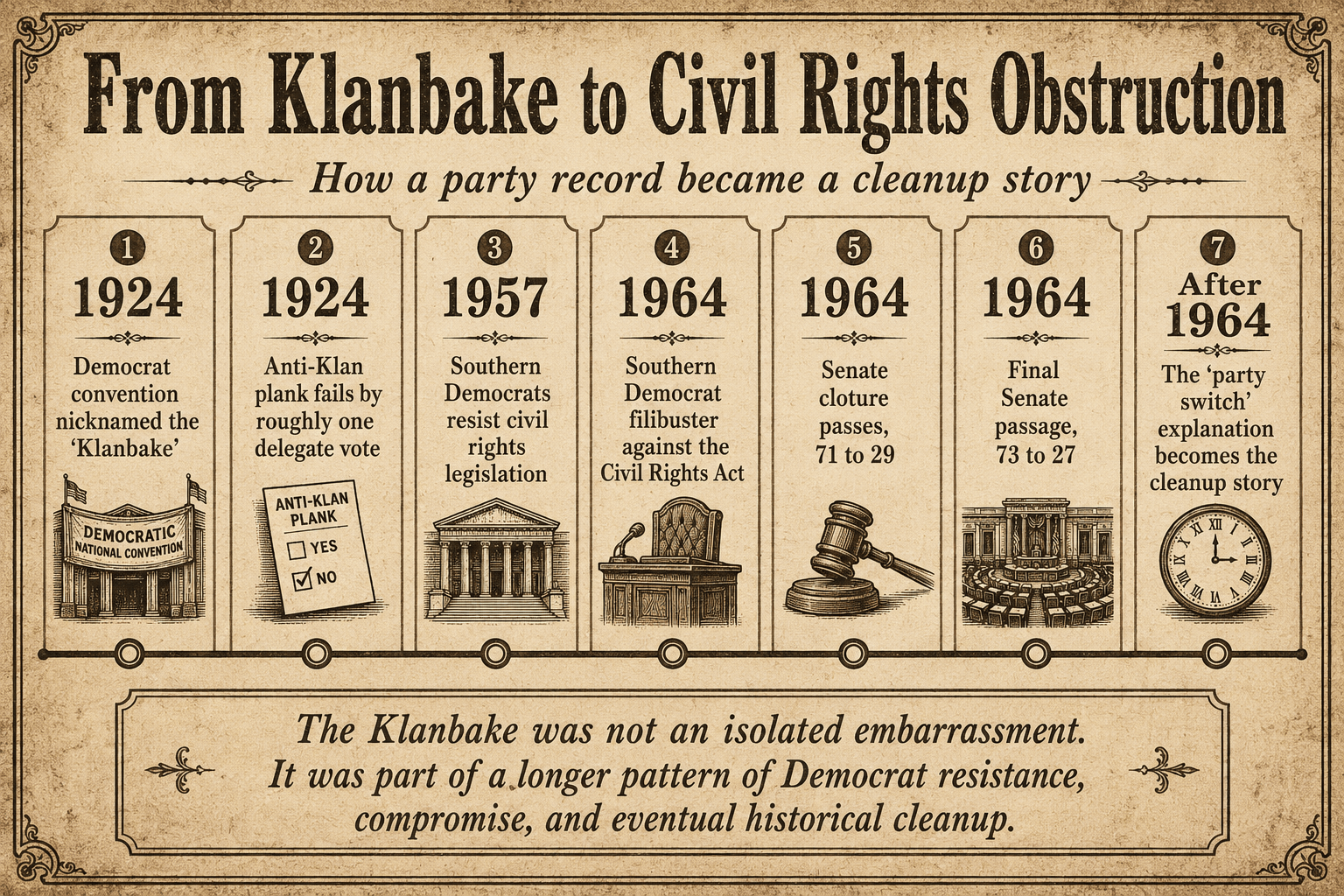
From Klan Favorite to Civil Rights Obstruction
The road from the Klanbake to the 1964 Civil Rights Act was not a story of Democrats gliding gracefully from darkness into enlightenment. It was a story of a party being dragged away from tools it could no longer publicly defend.
From 1924 to 1964, the Democrat Party had to balance Northern urban Democrats with Southern segregationist Democrats. It wanted immigrants, Catholics, labor unions, big-city machines, and eventually more Black voters. But it also depended on Southern power, and Southern Democrat power was built on segregation.
That contradiction defined the party for decades.
By the civil rights era, the main institutional opposition to civil rights was not some mysterious force floating outside the parties. Much of it came from Southern Democrats.
In 1964, when the Civil Rights Act reached the Senate, Georgia Democrat Richard Russell led the Southern bloc against it. The filibuster lasted for weeks. The cloture vote to end debate passed 71 to 29. Final Senate passage came on June 19, 1964, by a vote of 73 to 27.
The party breakdown is worth knowing. In the Senate final vote, Democrats voted 46 to 21 for the bill, while Republicans voted 27 to 6 for it. That means about 69 percent of Senate Democrats supported it, compared with about 82 percent of Senate Republicans. In the House, the pattern was similar. A larger percentage of Republicans than Democrats supported the bill.
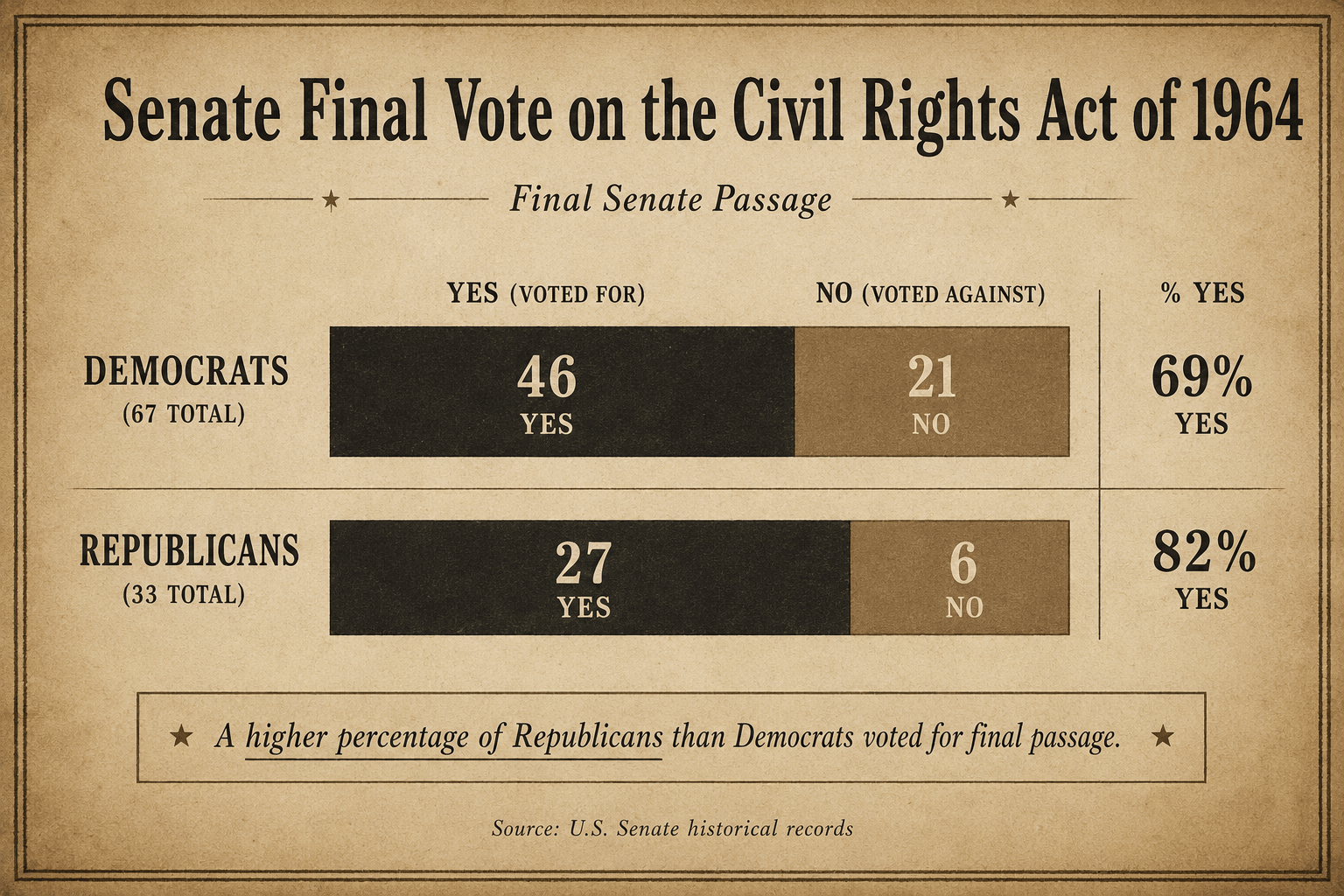
That does not mean Republicans were perfect. Politics is not Sunday school. But it does mean the cartoon version is false.
The civil rights story was not “bad Republicans versus good Democrats.” The truth was messier, and far more damaging to the Democrat Party’s modern self-image. Southern Democrats were the great obstacle. Northern Democrats and Republicans helped break the obstruction.
Without the party-switch story, Democrats have too much to explain.
The Sixty-Year Cleanup Operation
For sixty years, the Democrat defense has been less an explanation than a cleanup operation.
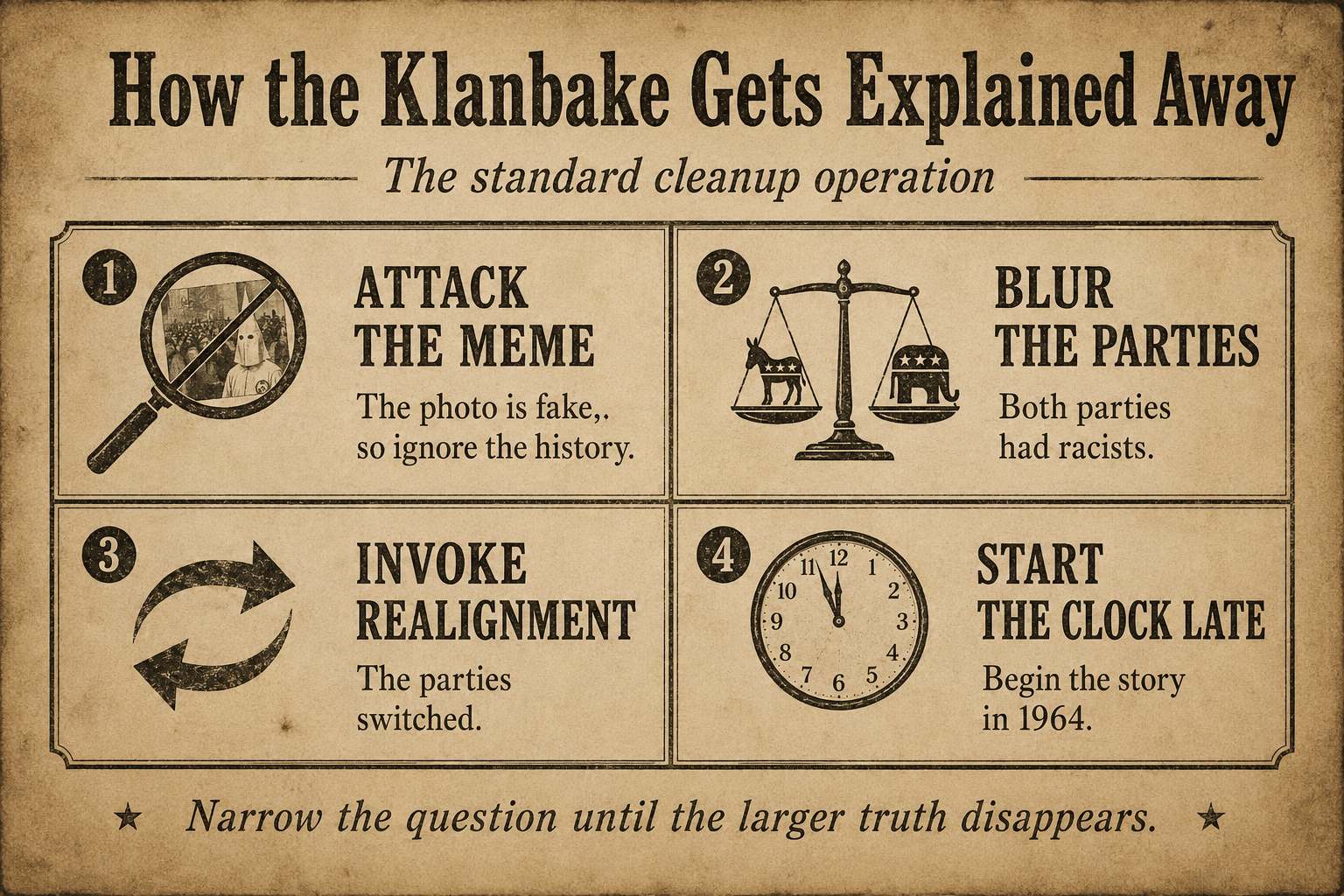
First, they attack the meme. If someone posts a fake or miscaptioned Klan photograph, that becomes the whole discussion. The photo is wrong, therefore the scandal is supposedly gone. But the scandal was never dependent on one photograph. The scandal was that the Democrat National Convention was split over whether to condemn the Klan by name, and the anti-Klan plank failed.
Then they blur the parties. They say both parties had racists. Sometimes that is true in the broad sense. The 1920s Klan had influence beyond one party and beyond one region. But that does not answer the question. The question is why the Democrat Party, at its own national convention, had Klan-aligned delegates and could not pass a plank condemning the Klan by name.
Then they invoke realignment. Realignment is a real historical subject. Voters did shift over time. Regions changed. The South did become more Republican. The Democrat Party moved left on many cultural issues. The Republican Party changed too. No serious person needs to deny that American politics changed across the twentieth century.
But “things changed” is not the same as “the parties switched.”
The switch story is not used to explain complexity. It is used to bury responsibility. The standard version says Democrats used to be the racists, then Democrats supported civil rights, then all the racists became Republicans, and now Republicans are the heirs of Jim Crow.
That is a children’s version of history.
It also has a name problem.
If all those old segregationist Democrats supposedly became Republicans, people should be able to name them. The name they usually have is Strom Thurmond. He was a segregationist Democrat, ran as a Dixiecrat in 1948, opposed federal civil rights laws, and joined the Republican Party in September 1964. That happened. It should not be hidden. But one man is not a party switch. The U.S. Senate’s biography of Thurmond records both his opposition to federal civil rights laws and his 1964 switch to the Republican Party.
Most of the Southern Democrat senators who fought civil rights did not become Republicans. They remained Democrats. Some served for years afterward. Some served until the end of their careers wearing the same party label they had worn while fighting civil rights.
Robert Byrd is the example Democrats would rather leave in the attic. Byrd had once been a Ku Klux Klan organizer. He later became a Democrat senator from West Virginia and filibustered the 1964 Civil Rights Act for 14 hours and 13 minutes. He did not become a Republican. He remained a Democrat, rose to become Senate Majority Leader, and eventually became one of the most powerful Democrats in Washington. The Senate records Byrd’s 14-hour-and-13-minute speech against the bill as the final individual speech before cloture.
The South did not become Republican overnight in 1964. The shift was gradual. It involved religion, taxes, crime, abortion, national defense, the Cold War, suburban growth, federal power, school policy, cultural liberalism, economic change, and the Democrat Party’s movement leftward over time.
People do not change political parties for one reason across fifty states and multiple generations. Coalitions change. Issues change. Institutions change. The voters who once cared most about one issue begin caring about another. New voters enter. Old voters die. Regions modernize. Industries move. Churches change. Cities decline. Suburbs grow.
That is history.
The switch myth is propaganda because it takes all that complexity and reduces it to one moral transfer: Democrats became good, Republicans became bad.
Convenient. Too convenient.
It allows Democrats to inherit the moral credit of civil rights while handing off the historical guilt of slavery, Jim Crow, the Klan, and segregation to people who were often not even in power when those systems were built.
That is not analysis. That is laundering.
The party-switch myth is not history. It is witness protection for the Democrat Party.
The Real Switch Was Tactics
The parties did not switch in the cartoonish way Democrats teach it. The tactics switched.
When open suppression became impossible, Democrats moved toward political containment. When segregation became indefensible, they moved toward dependency. When intimidation at the ballot box became illegal, they moved toward emotional blackmail at the ballot box.
The old method said Black Americans must be kept from Republican power. The new method says Black Americans must be kept from Republican ideas.
That is why every election becomes an emergency. Republicans are going to bring back Jim Crow. Republicans are going to take away your rights. Republicans are going to erase you. Republicans are going to put you back in chains. The language changes, but the function is familiar.
Keep the voter afraid. Keep the voter dependent. Keep the voter inside the political fence.
The Democrat Party did not stop managing Black Americans. It simply learned that dependence was more useful than exclusion.
That may sound harsh, but look at the results. Many of America’s largest Democrat-run cities have had generations of Democrat leadership, failing schools, high crime, weak public order, and neighborhoods where children are born into systems that tell them Republicans are the danger while Democrat machines keep producing the same misery decade after decade.
If a policy fails for sixty years and the people who ran it still demand loyalty, that is not compassion. It is ownership with better branding.
From Hoods to Hashtags
This does not mean modern Democrats are all Klansmen. That would be too easy to dismiss and too lazy to defend.
The sharper point is that modern Democrats did not inherit the costume. They inherited the habit.
The hood is gone. The method survived.
A hood is not the only uniform racial politics can wear. Sometimes it wears a professor’s jacket. Sometimes it wears a cable news smile. Sometimes it wears the language of compassion while producing the results of control.
The old racial politics treated Black Republicans as threats to the racial order. The new racial politics treats Black conservatives as traitors to the racial narrative. The old system punished Black independence physically. The new system punishes it socially, professionally, and culturally.
Clarence Thomas is not disagreed with. He is smeared. Thomas Sowell is not answered. He is ignored. Black conservatives are not debated as individuals. They are treated as defects in the political machinery.
If Democrats believed Black Americans were independent citizens, they would not panic every time some of them think independently. They panic because independence threatens the arrangement.
The old plantation demanded labor. The new machine demands votes. Both hate escape.
Why Democrats Need You to Forget 1924
The reason the 1924 Klanbake matters is that it breaks the moral spell.
It reminds people that Democrats did not begin as the party of racial justice. They became the party that needed racial justice language after older tools of racial control became too embarrassing to defend.
They need people to forget 1924 because it shows the Democrat Party negotiating with Klan power. They need people to forget 1964 because it shows Southern Democrats fighting civil rights. They need people to forget the slow Southern realignment because it shows the “switch” was not a magic moral transfer. They need people to forget modern Democrat cities because those cities show what racial management looks like after segregation.
Most of all, they need people to confuse rhetoric with results.
A party can say “equity” while trapping children in failing schools. It can say “justice” while letting criminals destroy neighborhoods. It can say “representation” while treating Black dissenters like heretics. It can say “civil rights” while building systems that produce dependency, disorder, and permanent grievance.
Words are cheap. Results are the audit, and the audit is ugly.
The Klanbake Was a Warning Label
The 1924 Democrat Klanbake was not an internet meme. It was not just a bad photograph. It was not an isolated embarrassment from a world that has no bearing on today.
It was a warning label.
It showed a party so entangled with racial and religious bigotry that condemning the Ku Klux Klan by name became politically dangerous.
Not every Democrat was in the Klan. Not every delegate wore a hood. Not every person in the hall supported racial terror. Those qualifications are true, and they are also evasions when used to hide the larger reality.
The party failed the simple test. It could not condemn the Klan by name.
The next time Democrats lecture America about racism, remember 1924. Remember the Klanbake. Remember that this was not the party confronting the Klan from the outside. This was the party negotiating with Klan power from the inside.
And when they tell you the parties switched, understand what they are really asking you to do. They are asking you to forget who needed the switch story in the first place.
Help Keep the Record from Being Buried
The 1924 Democrat Klanbake is not just a story about one convention. It is a story about what happens when powerful institutions control the memory of a country.
They do not always have to erase history. Sometimes they only have to rename it, soften it, explain it away, or start the clock late enough that the important parts disappear.
That is why this work matters.
I write these essays because most people were never taught the full story. They were given slogans. They were given party-approved morality tales. They were told what to remember, what to forget, and who to blame.
But a country that forgets who lied to it becomes easier to lie to again.
Become a Paid Subscriber
If this essay helped you see the issue more clearly, please consider becoming a paid subscriber.
Paid subscribers make this work possible. They allow me to keep researching, writing, documenting, and publishing these long-form pieces without putting everything behind a paywall.
I want this work to reach people who have never heard these arguments before. That means keeping it free to read. But free to read does not mean free to produce.
Your paid subscription helps keep the lights on, keeps the research going, and keeps these essays in circulation.
Become a paid subscriber here:
Make a One-Time Gift
If a paid subscription is not the right fit, a one-time gift also helps.
Every contribution supports the time, research, editing, and distribution behind this work. These essays do not come from a media organization, university department, foundation, or political machine.
They come from one person doing the work they hoped you would never see.
You can make a one-time gift here:
Join The Resistance Core
The people who bury history have institutions.
The people who uncover it need infrastructure too.
The Resistance Core is for readers who want to do more than read along. It is for those who understand that the real fight is not only over elections, policies, or headlines. It is over memory, language, and truth itself.
If you believe this work needs to grow, reach more people, and keep challenging the stories we were told, you can join The Resistance Core here:
What Your Support Builds Right Now
Your support helps me keep producing essays like this one: researched, sourced, readable, and written for normal people who were never supposed to ask these questions.
It helps cover the time required to dig through old records, compare claims, check the numbers, write clearly, and push the work beyond the small circle of people who already agree.
The goal is not just to preach to the choir.
The goal is to reach the people who still think the choir is crazy because no one ever showed them the receipts.
If You Cannot Give
If you cannot give right now, I understand.
You can still help by sharing this essay, leaving a comment, restacking it, or sending it directly to someone who still believes the “party switch” story explains everything.
A buried history does not stay buried because it is strong.
It stays buried because too many people stop digging.
The people who sold you the cleaned-up version of history are counting on silence.
Do not give it to them.
Excellent essay!
Excellent "inside baseball" analysis, this is why I subscribe. If it weren't for the abominable deterioration of our public school systems over the past 40 years, more people would be aware of this history and its implications on social order today. Thank you for sharing this, I wish you had a much wider audience. Furthermore, I wish we had an honest media that would tell the truth occasionally.