

“Some politicians ask for your vote. Others help themselves to it. Meet the people who got caught.”
Michael “Ozzie” Myers had a practical solution to the problem of persuading voters. Pay the person counting them.
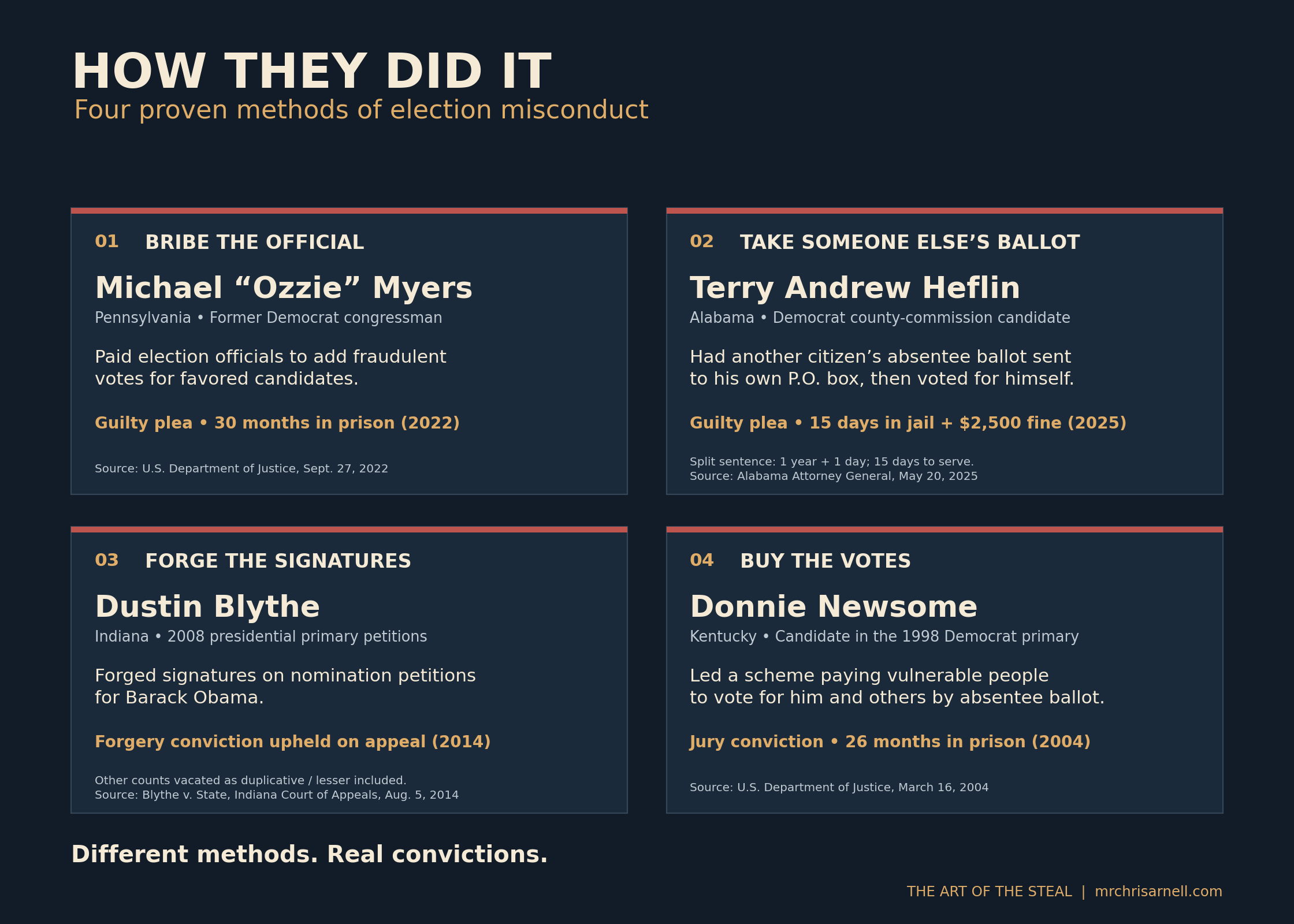
The former Democrat congressman bribed Philadelphia election officials to add votes for favored candidates. Payments to one official, Domenick DeMuro, ranged from $300 to $5,000 per election. DeMuro operated the machines, added fraudulent votes, and certified results that included his own inventions. Myers pleaded guilty in 2022 and received a 30-month prison sentence.
At DeMuro’s polling division, prosecutors identified 27 fraudulent votes in the 2014 primary, 40 in 2015, and 46 in 2016. Those were roughly 22 percent, 15 percent, and 17 percent of the reported votes at that location. A voter could follow every instruction, stand in line, make an informed choice, and still have that choice diluted by an official with his hand out.
Apparently, some campaigns needed consulting services. The consultant needed cash. And democracy needed a few extra voters who never showed up.
The Democrat Party asks Americans to trust it as a defender of voting rights. Its record includes politicians and operatives who stole those rights from individual voters. The people whose ballots they diluted or appropriated were entitled to more than a speech about democracy.
An election system is supposed to protect voters from dishonest people, including dishonest people who work inside it. The public should not have to prove that a presidential election was stolen before a stolen local election becomes worth discussing.
They Even Cheat Their Own
In Alabama, Terry Andrew Heflin found a voter who was particularly supportive of his county-commission candidacy: himself, using somebody else’s ballot.
Heflin, a Democrat candidate, pleaded guilty in May 2025 to absentee-ballot fraud. He had requested another citizen’s ballot, directed it to his own post-office box, and completed it without the voter’s knowledge or permission. His sentence included 15 days in jail and a $2,500 fine.
Heflin was asking to represent a citizen whose vote he had already helped himself to. Waiting for permission was too much trouble.
In Texas, Shannon Brown won a 2018 Gregg County commissioner primary by five votes. In 2022, Brown and his wife, Marlena Jackson, each pleaded guilty to misdemeanor election fraud connected to illegal vote harvesting in that primary. They received probation and $2,000 fines. The five-vote margin does not establish how many votes the scheme changed, but it illustrates how little room there can be between winning public office and losing it.
Atlantic City councilman MD Hossain Morshed used false residency registrations in connection with the 2019 primary. A nonresident’s mail ballot was counted, and Morshed instructed the person to lie if investigators asked questions. He pleaded guilty in 2024. Local reporting in May 2026 said he was serving an 18-month sentence and had appealed.
Earlier, Kentucky county judge-executive Donnie Newsome was convicted in a vote-buying conspiracy involving a 1998 Democrat primary. Prosecutors described payments to impoverished, disabled, illiterate, or otherwise vulnerable people to vote absentee. Newsome received 26 months in prison; associate Willard Smith received two years.
Several of these operations victimized fellow Democrats. Think about that the next time party loyalty is offered as a substitute for scrutiny. A crooked politician who needs your vote may have less respect for you than for the Republican he openly despises. At least the Republican knows they are opponents.
Other People’s Names
An operative can exploit a voter’s identity before a ballot is cast. Petition signatures qualify candidates; registration forms determine where ballots are sent.
In Indiana, former St. Joseph County Democrat chairman Butch Morgan and associates were convicted over forged signatures on petitions for the 2008 presidential primary. An appellate opinion describes workers being directed to copy names and signatures from an earlier petition onto petitions for Barack Obama, Hillary Clinton, or John Edwards. Local operatives manufactured the evidence of public support required to qualify candidates.
Los Angeles provides another version of the business. Brenda Lee Brown Armstrong collected signatures for ballot initiatives and was paid for qualifying signatures. Registered voters were therefore valuable to her. According to her federal plea agreement, she offered people on Skid Row small cash payments to sign petitions and began paying people to register as well.
Some homeless registrants did not have an address to provide. Armstrong supplied her own former address on several occasions. Prosecutors pointed out the consequence: because California sends mail ballots to registered voters, ballots in those people’s names could potentially arrive at an address where they neither lived nor collected mail.
Armstrong pleaded guilty in June 2026 to paying another person to register to vote. In August, she received 18 months’ probation and 120 hours of community service. Her conviction was for paid registration; prosecutors did not establish subsequent fraudulent voting or a Democrat campaign’s involvement. The vulnerability was concrete: the person buying registrations could supply the address to which other people’s ballots would be sent.
Earlier Skid Row prosecutions also produced convictions involving cash or cigarettes exchanged for fraudulent petition signatures and registration forms. The poor were useful because somebody else could make money from their names. A system that pays for volume gives the collector a reason to produce names. Verification is what stands between that incentive and a stack of fraudulent forms.
Dirty Tricks Before Election Day
Four Democrat campaign workers received jail sentences in 2006 for slashing tires outside a Bush-Cheney campaign office on Election Day 2004. Apparently, persuading voters was harder than disabling the other campaign’s vehicles.
Other tactics work through confusion. On October 28, 2026, The New York Times reported that Mary Peltola’s campaign and allied operatives participated in efforts to recruit spoilers into Alaska’s Senate race, including another man named Dan Sullivan, the name of the Republican incumbent. The reporting drew on interviews and text messages. Peltola’s campaign and the national Senate campaign committee denied involvement; former campaign manager Elisa Rios sought to retract her earlier statements before publication.
Recruiting a candidate because voters might mistake him for somebody else treats the electorate as a collection of marks. The reported strategy depended on confusion: voters intending to support the incumbent could select the wrong Sullivan.
A name can be legally printed on a ballot and still be placed there to deceive. Voters do not need a prosecutor’s permission to reject that behavior.
Broke at Home. A Major Donor on Paper.
Bernie Sanders built a fundraising identity around the ordinary person’s small contribution. ActBlue helps turn those contributions into substantial power for the Democrat Party. But a small-dollar fundraising story depends on something more basic than the size of the payment: the named donor must actually be the donor.
In August 2026, The Center Square reported on Wisconsin interviews conducted by private investigators led by Kyle Corrigan of Brightline Investigations. Two interviewees reportedly denied ever making a political donation. Others disputed the amounts attributed to them. One person, confronted with 7,878 contributions totaling $93,168, responded, “look where I’m living.”
The donor denials are the strongest part of that report. The totals require checking because Federal Election Commission filings can describe the same contribution as it passes through an intermediary to a recipient, including memo entries. My earlier essay, “The $27 Illusion,” raised questions about repeated contributions associated with Sanders. A count of database entries cannot settle how many separate payments someone made.
Congressional investigators have also examined ActBlue’s internal controls. Republican committee leaders allege that it weakened fraud-prevention standards and gave Congress misleading assurances about screening foreign contributions. Their April 2026 statement cited reporting on concerns raised by ActBlue’s former outside counsel.
ActBlue disputes the accusations. In September 2026, it cited a commissioned review and said 99.99 percent of roughly $990 million in political contributions processed in 2023 came from donors who supplied a U.S. address or passport number. Supplying an address answers where someone claims to be. It does not establish that the person whose name appears authorized the payment.
There is a proven example of concealing political money behind other people’s names. Prakazrel “Pras” Michel was convicted in 2023 in a case that included funneling foreign money through straw donors to support Obama in the 2012 presidential election. A straw donor supplies the name while somebody else supplies the money. The public sees an American contribution; the real financier stays out of sight.
The ActBlue interviews establish donor disputes, not Michel’s kind of scheme. Resolving them requires matching the reported contributions to the payments and identifying who funded and authorized them. A platform’s reputation cannot answer a question about somebody else’s bank account.
Your Ballot, Their Hands
A mail ballot passes through other people’s hands before it reaches the count. Rules limiting who may collect it and records documenting official custody make those people accountable.
In Bridgeport, Connecticut, absentee-ballot handling helped bring down an election result. Video of ballot deposits became central to the challenge to the 2023 mayoral primary between Joe Ganim and John Gomes. A judge ordered the primary repeated. By August 2026, former local Democrat vice chair Wanda Geter-Pataky and council member Alfredo Castillo had rejected plea offers in criminal cases involving absentee-ballot allegations and were headed toward trial. The criminal allegations remained unresolved at the essay’s cutoff.
In Fulton County, Georgia, a separate investigation documented failures to preserve the custody records for drop-box ballots from 2020. The initial report concerned approximately 18,900 ballots whose transfer forms had not been supplied to a news organization. Investigators found that an employee had failed to copy all the records onto the supplied drive. After additional records were reviewed, the reported deficiency stood at 58 forms covering 892 ballots. A county official said more forms had subsequently been located.
The December 2021 State Election Board hearing also addressed missing courier oaths and surveillance footage. The board unanimously referred the case to the attorney general. These were documented compliance failures, not a finding that 18,900 fraudulent ballots had been counted.
Fulton County was responsible for preserving the records needed to check its own work. Missing paperwork leaves the public trying to reconstruct a process the government was supposed to document as it happened. A safeguard that exists in a manual but disappears in practice offers very little protection.
Explain the Opposition to Safeguards
In September 2024, Gavin Newsom signed Senate Bill 1174, authored by Democrat Dave Min. It prohibited local governments from requiring people to present identification when voting or submitting ballots unless state or federal law required it.
California already checks identity at registration using identifying numbers, such as a driver’s license number or the last four digits of a Social Security number. A registered voter at the polls generally supplies a name and address and signs the roster. Mail-ballot envelope signatures are compared with signatures in the voter’s record; a mismatch gives the voter an opportunity to resolve it. Additional identification rules apply to certain first-time voters whose identity was not verified at registration.
The disagreement concerns whether those checks are enough and whether an additional check at the polls would prevent impersonation without keeping eligible voters from voting. Checking a registration establishes who belongs on the rolls. Checking the person who arrives to vote helps establish whether that person is the registered voter. A name in a database cannot look across a table and identify the person standing there.
Newsom and Min went beyond declining to require that additional check. They prohibited local governments from adding it. Attorney General Rob Bonta and Secretary of State Shirley Weber had also sued Huntington Beach in April 2024 over its voter-ID measure. Their stated position was that uniform state rules protect voting rights and that local identification requirements could burden eligible voters.
That is a coordinated policy position, with legislation and litigation behind it. Its supporters should defend the actual protection their preferred system provides. Eligible voters who lack identification need free documents and practical ways to obtain them. The cost of providing those belongs alongside the cost of leaving a preventable opening in the process.
Photo identification alone would not have stopped Myers. His operation depended on bribing an official to add votes. Preventing that requires reconciling the count with the voters who actually participated and checking the people who certify it. Heflin’s theft required checks on who obtained an absentee ballot. Armstrong’s operation exposed the need to verify registration addresses.
Newsom and Min need not have committed fraud to be accountable for the safeguards they prohibit. Their policy should stand on the protection it provides eligible voters and their ballots, not the virtue its supporters claim for themselves.
The 2020 Rulebook
Election rules determine which ballots qualify, how they reach officials, and what evidence remains after the count. Campaigns have an obvious interest in those rules. The pandemic increased the pressure to change them while leaving less time to test how the changes would work.
Pennsylvania’s expansion of mail voting began with Act 77 in October 2019, before the pandemic. It allowed qualified voters to request mail ballots without the previous absentee excuse requirement. The later fights over implementation concerned a system already authorized by legislation, not a mail-voting system invented from scratch during COVID.
Wisconsin illustrates the uncertainty created when administrators and courts supply competing interpretations. In 2022, the state Supreme Court held that the challenged drop-box guidance was inconsistent with state law. In July 2024, it reversed that position and permitted secure drop boxes. A voter trying to return a ballot should not need to follow the changing membership and reasoning of a supreme court to know which method is lawful.
Private funding deserves a separate accounting. The Center for Tech and Civic Life reports distributing nearly $350 million to almost 2,500 election departments in 47 states in 2020. Grants ranged from a $5,000 minimum to more than $19 million for New York City. More than half went to departments serving fewer than 25,000 registered voters. CTCL says every verified eligible applicant was approved and that partisan considerations played no role in its decisions.
Those figures establish the scale and reach of private funding, not that the grants purchased a candidate’s victory. My objection is to making the administration of public elections dependent on voluntary private support. A donor can withdraw funding or change priorities; an election office must still serve its voters. Government should budget for that responsibility instead of passing the hat.
These changes do not establish that Trump would otherwise have won. They show why the rules and funding deserve examination before an election: once ballots arrive, a dispute over procedure becomes a fight over which candidate benefits from enforcing it.
“Trust the Machines” Is Not an Audit
Myers’s scheme depended on a dishonest official. Electronic systems add another concern: what someone with access can make the equipment do, and whether an independent record will reveal it.
Researchers J. Alex Halderman and Drew Springall identified serious vulnerabilities in Dominion’s ImageCast X. In June 2022, the federal Cybersecurity and Infrastructure Security Agency issued an advisory; the Election Assistance Commission acknowledged nine vulnerabilities. Exploiting them required physical access, access to election-management infrastructure, or modification of files later loaded onto devices. CISA reported no evidence at that time that the vulnerabilities had been exploited in an election.
The Georgia court record documents demonstrations of elevated access and vote-flipping malware. One concern was that malicious software could alter a machine-readable QR code without changing the text a voter reviewed. A voter could therefore inspect the printed choices while the machine read something else. That vulnerability puts a specific obligation on election officials: prevent unauthorized access and verify results against evidence an attacker cannot silently rewrite.
Adjudication creates a different responsibility. When a scanner cannot interpret a mark, authorized workers may resolve the voter’s intent. The original ballot and a record of who made the decision must remain available for review. Giving someone authority to interpret an ambiguous mark cannot mean giving them the last word about whether their interpretation was honest.
Venezuela’s 2024 presidential election demonstrated what independent records can accomplish. The Carter Center found that results sheets covering 81.7 percent of polling stations showed Edmundo González with 67.1 percent of the votes in those records, against Nicolás Maduro’s 30.4 percent. González’s lead exceeded the number of registered voters at all the remaining stations. The government nevertheless declared Maduro the winner without producing the polling-station evidence supporting its announcement.
Those machine-generated records helped expose the false national result. Smartmatic had stopped participating in Venezuelan elections in 2017. The protection came from preserving evidence that could contradict the officials announcing victory. Americans should demand that same ability to check the count, regardless of who supplies the equipment.
Make Them Answer
Ozzie Myers did not need to hack a national network. Heflin did not need millions of accomplices. Morshed did not need to persuade an entire city to register at the wrong address. They needed access to the process and a way around the checks that should have stopped them.
The Democrat Party cannot erase the conduct of its convicted politicians by reciting its commitment to democracy. Heflin received 15 days in jail for taking another person’s ballot. Myers received 30 months for an operation spanning multiple elections. Punishment is part of election security, too. What does the next ambitious operator expect to gain, and what does he expect to lose?
Every extra vote DeMuro invented reduced the influence of the citizens who actually voted. The injury was inflicted whether or not anyone could reconstruct a different winner afterward. Requiring a stolen presidency before taking stolen votes seriously would give local crooks an extraordinarily generous allowance.
The Philadelphia voter whose ballot DeMuro diluted was entitled to an honest count. That right did not depend on whether the perpetrator belonged to the correct party or whether exposing him made anyone uncomfortable.
He was paid to protect their votes. Myers paid him to betray them. Start there before asking the rest of us for more trust.
If You Want Me to Keep Writing,
I Need Your Help. NOW.
If this work gives you facts you can use, arguments worth sharing, or something you weren’t getting elsewhere, please become a paid subscriber today.
I keep my essays free because I want people to read them, use the research, and pass them along. Paying readers make that possible. Your subscription helps support my family and gives me the time to keep researching and writing.
Become a paid subscriber: $8 a month or $80 a year.
https://mrchr.is/help
If you would rather help with an immediate expense, a one-time contribution is welcome and needed.
https://mrchr.is/give
Prefer Venmo?
https://account.venmo.com/u/mrchrisarnell
For readers able to make a larger commitment, join the Resistance Core at $1,200 a year, charged annually. That level of support gives me more room to take on substantial research and reach new readers.
https://mrchr.is/resist
If you already support my work, thank you. You are helping me keep going. If money is tight, share this essay, restack it, or send it to someone who needs to read it.
If you’ve been meaning to subscribe, please make today the day.
Have you voted yet?
We have two more years of work to do!
This election decides who controls Congress and who exercises power in your state and community. Don’t let the people you complain about make those decisions without you. Vote, then remind someone else to go.