

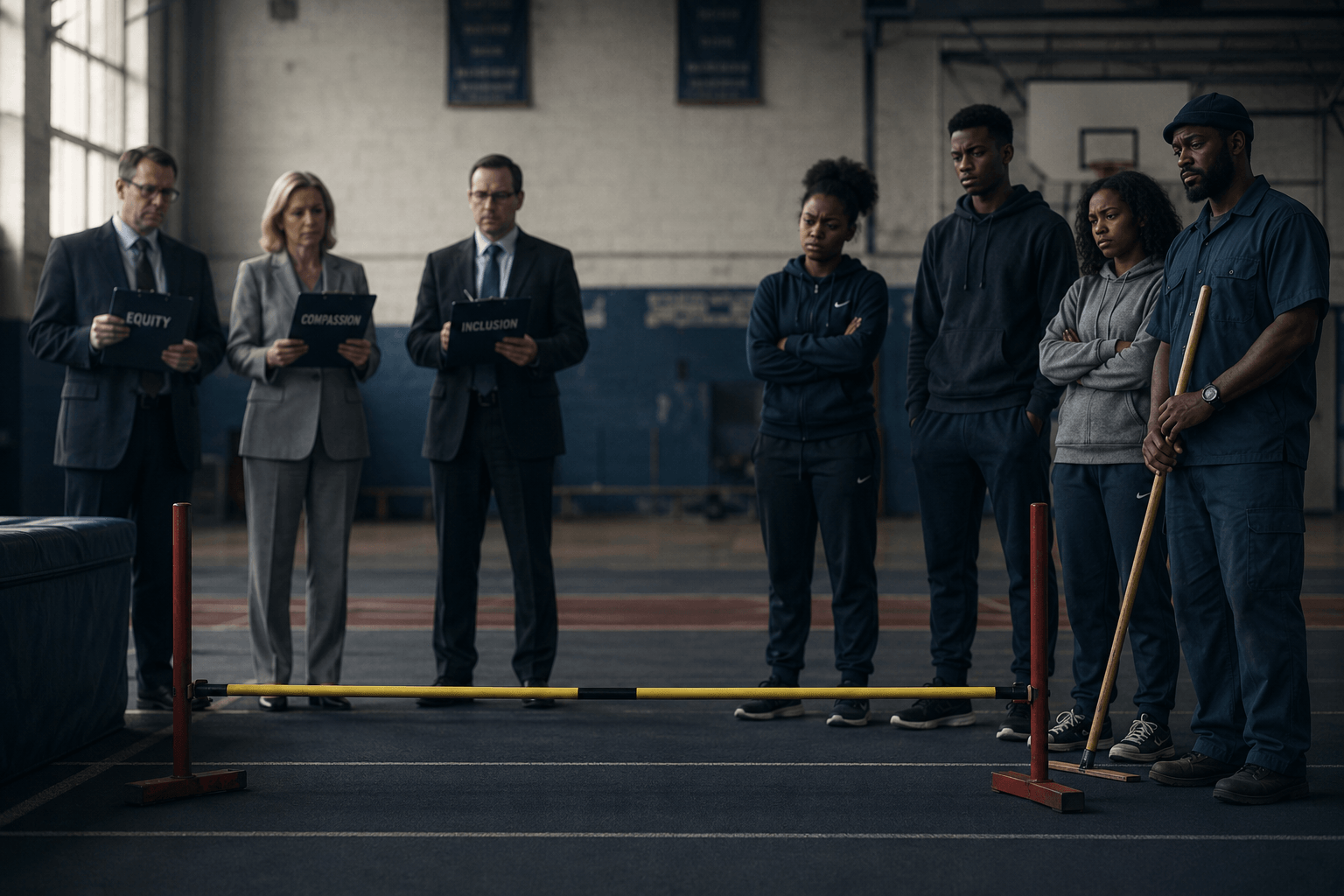
“Low expectations are not kindness. They are contempt with a softer voice.”
There are few forms of bigotry more polite than low expectations. It smiles. It funds programs. It writes mission statements. It speaks in the language of compassion while quietly assuming that some people cannot be expected to show up on time, speak clearly, dress appropriately, treat customers with respect, control their tempers, or do the job they were hired to do.
Then, when ordinary Americans notice the decline, they are told the problem is not the decline. The problem is that they noticed it.
That is the fraud at the center of modern racial politics. The worst behavior gets explained, softened, funded, renamed, and protected. The people who reject that behavior, including millions of decent Black Americans, are treated as if they do not exist. The public is then asked to pretend that lowering expectations is compassion.
It is not compassion. It is contempt with better manners.
The argument here is not that Blackness is the problem. That is the lazy argument, and it is not true. Black America has produced soldiers, teachers, entrepreneurs, police officers, ministers, scholars, mechanics, nurses, parents, and ordinary working people who carry themselves with more dignity than many of the white liberals who presume to speak for them.
The problem is that ghetto culture has been elevated, marketed, excused, politicized, and protected as if it were authentic Blackness. That lie has damaged the country, but it has damaged decent Black Americans first. It has forced them to carry the reputation of people they did not raise, do not resemble, and often quietly resent.
This is the part polite society does not want to discuss. It is also the part ordinary people see every day. They see it in schools where the disruptive student has more power than the teacher. They see it in workplaces where managers are afraid to correct bad employees. They see it at fast-food counters where a wrong order can turn into a public meltdown. They see it in movie theaters where people talk to the screen as if no one else paid to be there. They see it in street takeovers, airport brawls, viral fights, graduation ceremonies turned into vulgar performances, and public spaces where ordinary manners have been treated as optional.
Then they are told not to generalize. Fair enough. Generalizing is often unfair. But what happens when society generalizes in the other direction? What happens when every bad behavior is treated as a product of oppression, every standard is treated as suspicious, and every criticism is treated as racism?
That is not anti-racism. That is surrender.
What Changed Was Not Blackness
When I was younger, most Black Americans I saw wanted the same basic things everybody else wanted. They wanted to get married, buy a home, raise decent children, stay out of trouble, go to work, live in peace, and be respected. They did not confuse respect with fear. They did not confuse celebration with obscenity. They did not confuse hardship with permission to act like a fool in public.
Of course, there were criminals. There were bad neighborhoods. There were dysfunctional families. There were also white criminals, white drunks, white deadbeats, and white trash. No serious person claims that disorder is exclusive to one race. But the moral expectations were different. Poor did not automatically mean trashy. Working class did not automatically mean vulgar. Black did not automatically mean ghetto. Coming from a rough neighborhood did not mean you had to bring the street into every room you entered.
Something changed, and it was not DNA, skin color, or some mystical racial essence. What changed was which version of Black culture got rewarded and protected. The older standard said, “Do not embarrass your people.” The newer standard says, “Who are you to judge?” The older standard said, “Carry yourself with dignity.” The newer standard says dignity is respectability politics. The older standard said, “Get married, raise your children, stay out of trouble, and speak to people with respect.” The newer standard says the family structure is complicated, crime is systemic, manners are cultural, and consequences are oppressive.
This did not happen because Black Americans demanded lower standards. Many did not. It happened because white liberal institutions found it easier to excuse failure than confront it. Schools could not fix the achievement gap, so they attacked the tests. Cities could not stop crime, so they attacked policing. Employers could not make every worker competent, so they redefined professionalism. Universities could not produce equal outcomes, so they lowered admissions standards and called it equity.
Bad behavior did not merely grow. It got bodyguards. Academia gave it vocabulary. Politics gave it money. Entertainment gave it glamour. HR gave it protection. The media gave it euphemisms. The Democrat Party gave it a constituency. Then white liberals stood in front of the whole arrangement and called it justice.
That is how ghetto culture became protected as if it were Black culture. Blackness did not become the problem. Ghetto culture was allowed to masquerade as Blackness, and white liberals helped guard the costume.
Low Expectations Are Not Compassion
The bigotry of low expectations begins with a soft assumption: certain people cannot be expected to meet the same standards as everyone else.
Not openly, of course. No one says it that plainly at the faculty meeting, corporate training session, nonprofit conference, or Democrat campaign event. They use better words. Equity. Trauma. Systemic barriers. Lived experience. Cultural expression. Restorative justice. Harm reduction. Inclusion.
Some of those words can describe real things. Trauma exists. Poverty exists. Bad schools exist. Family breakdown exists. Historical injustice exists. But an explanation is not the same thing as an excuse. A cause is not the same thing as a permission slip.
The white liberal version of compassion often works like this. A student fails a test, so the test must be biased. A disruptive student gets suspended, so the discipline must be racist. A criminal commits violence, so society must have failed him. An employee acts unprofessionally, so the workplace must be culturally insensitive. A crowd turns a public event into chaos, so officials must ask whether the space was welcoming enough.
The same people who claim to respect Black Americans keep inventing reasons not to expect too much from them. Real respect says, “You are capable of more.” Fake compassion says, “We cannot expect more from you.” That difference is everything.
A society that lowers standards for a group is not honoring that group. It is announcing what it really thinks of them. It is saying, in a softer voice, that discipline is too much to ask. Self-control is too much to ask. Punctuality is too much to ask. Literacy is too much to ask. Marriage is too much to ask. Lawfulness is too much to ask. Professionalism is too much to ask.
Then it calls that insult progress.
The Standard Became the Suspect
Standards used to be ordinary. You showed up on time. You dressed for the job. You did not curse at customers. You did not threaten teachers. You did not attack someone because you were insulted. You did not turn a graduation into a nightclub. You did not bring street behavior into a workplace, school, restaurant, airplane, theater, or public office.
These were not white standards. They were adult standards.
Now, too many ordinary standards have been treated as suspicious. Punctuality becomes rigid. Professional speech becomes code-switching. Dress codes become cultural oppression. Testing becomes bias. Discipline becomes criminalization. Punishment becomes systemic racism. Self-control becomes respectability politics. Public manners become whiteness.
There may be abuses in any system. A bad manager can enforce rules unfairly. A bad teacher can discipline unfairly. A bad cop can abuse authority. But the existence of unfairness does not make standards illegitimate. It means authority should be accountable, not abolished.
The modern left did something much more destructive. It taught institutions to fear standards. Teachers stopped correcting. Administrators stopped enforcing. Managers stopped managing. HR departments stopped protecting performance and started protecting institutions from accusations. Prosecutors stopped prosecuting. City leaders stopped demanding order. Customers stopped expecting basic service. Coworkers stopped complaining because they knew the complaint could become the problem.
A society cannot keep standards it is too ashamed to defend.
This is how decline begins. Not with a press conference. Not with a vote. Not with a memo titled “We Are Lowering Standards.” It happens one exception at a time. One disruptive student left in class. One violent incident explained away. One dress code ignored. One graduation ceremony surrendered. One employee protected. One customer told to be more understanding. One city told to tolerate disorder because enforcing order might look bad.
Eventually, the exception becomes the expectation.
When Dysfunction Gets Rebranded as Culture
America lowered standards, excused dysfunction, protected bad behavior, and called it culture.
That word has done a lot of dirty work. Culture can mean food, music, faith, humor, language, family memory, church traditions, neighborhood bonds, military service, work habits, and a shared moral code. Black culture at its best has all of that. It has produced discipline, excellence, grit, patriotism, faith, style, music, entrepreneurship, and moral seriousness.
But not everything people do deserves the protection of culture. Public vulgarity is not culture. Violence over disrespect is not culture. Turning ceremonies into obscene performances is not culture. Disrupting classrooms is not culture. Threatening restaurant workers is not culture. Ruining movie theaters is not culture. Street takeovers are not culture. Glorifying criminality is not culture. Dragging children into chaos is not culture.
Some things are just dysfunction.
The excuse machine wants to blur that line because the blur is useful. Once dysfunction is renamed culture, criticism becomes racism. Once bad manners become cultural expression, correction becomes oppression. Once disorder becomes identity, order becomes hate.
That is a neat trick. It is also a cruel one.
Calling dysfunction culture does not elevate the dysfunction. It degrades the culture.
Decent Black Americans know this better than anyone. They know there is a difference between a family cookout and a mob. They know there is a difference between Black music and commercialized degeneracy. They know there is a difference between cultural pride and public embarrassment. They know there is a difference between being expressive and being low-class.
But white liberals often do not want to hear from those Black Americans. They prefer the ones who confirm the theory. They prefer the activist, the academic, the grievance merchant, the street poet, the rapper, the DEI consultant, the nonprofit director, and the politician who says every problem can be traced to racism, policing, poverty, or whiteness.
The respectable Black person is inconvenient because he proves the excuse was optional.
The Conduct No One Is Allowed to Name
Graduations are supposed to mark achievement, discipline, and the movement from one stage of life to another. Increasingly, we see ceremonies turned into spectacles: screaming, twerking, vulgar dancing, fights, attention-seeking behavior, and families acting like the event is a club with diplomas. When people object, they are told it is celebration. Maybe some of it is. But celebration does not require public embarrassment. A society that cannot distinguish joy from vulgarity has already lost something important.
Then there are the street takeovers. Roads blocked. Cars doing donuts. Crowds filming. Police surrounded. Ordinary citizens trapped. Sometimes there is gunfire. Sometimes people get hurt. Sometimes the whole event is promoted on social media as if public disorder were a hobby. In 2026, cities around the country were still dealing with viral teen takeovers, with reports of malls, beaches, restaurants, and streets overwhelmed by large youth crowds. Chicago officials were debating parental fines after Memorial Day weekend chaos, while police departments around the country were warning families that these gatherings can turn violent quickly.
Notice the language. Teen takeover. Youth gathering. Social media trend. Unrest. Lack of safe spaces. Need for programming.
A better term might be failure of civilization.
Spring break tells the same story. Florida cities tolerated wild young people for decades. Nobody mistook spring break for a church retreat. But there is a difference between partying and creating a public safety emergency. Miami Beach, a city that depends on tourism, did not crack down because it suddenly became allergic to money. Its own planning documents referred to excessively large crowds, high levels of criminal activity, life-threatening violence, shootings, stampedes, firearms, felony arrests, and public safety threats. Cities do not turn away business for fun. They do it when disorder becomes more expensive than profit.
Airports and airplanes have become another stage. Gate confrontations. Flight disruptions. People screaming at staff. Travelers behaving as if rules are personal insults. Spirit Airlines became a joke for a reason, but the joke works because everyone recognizes the pattern. Cheap travel did not create low-class behavior. It merely gave low-class behavior a boarding pass.
Movie theaters used to have an obvious rule. Sit down and watch the movie. Now, in too many places, people talk to the screen, shout over dialogue, pull out phones, argue, laugh at serious scenes, record clips, and behave as if everyone else in the room is an unpaid audience for them. Again, the issue is not race. The issue is public self-restraint. Other people paid to be there too.
Restaurants and fast-food counters reveal the same collapse. A wrong order becomes a screaming match. A missing sauce packet becomes a confrontation. A wait time becomes a threat. Employees are abused. Customers act as if disappointment gives them moral permission to humiliate strangers. Sometimes employees are just as bad, treating customers like interruptions to their phone time.
This is not poverty. Poor people have behaved with dignity for centuries. This is not oppression. Oppressed people are still capable of manners. This is not cultural expression. This is low-class behavior being excused by people who would never tolerate it in their own neighborhoods, offices, schools, or dinner parties.
That is the key. The people who defend it rarely want to live with it.
Schools Built the Pipeline
The workplace did not create the problem. The workplace received the graduate.
Schools spent decades lowering expectations and then acted surprised when the results walked into public life. If students are not expected to read, behave, show up, respect teachers, complete work, accept correction, or sit still long enough to learn, why would anyone expect them to become disciplined adults at eighteen?
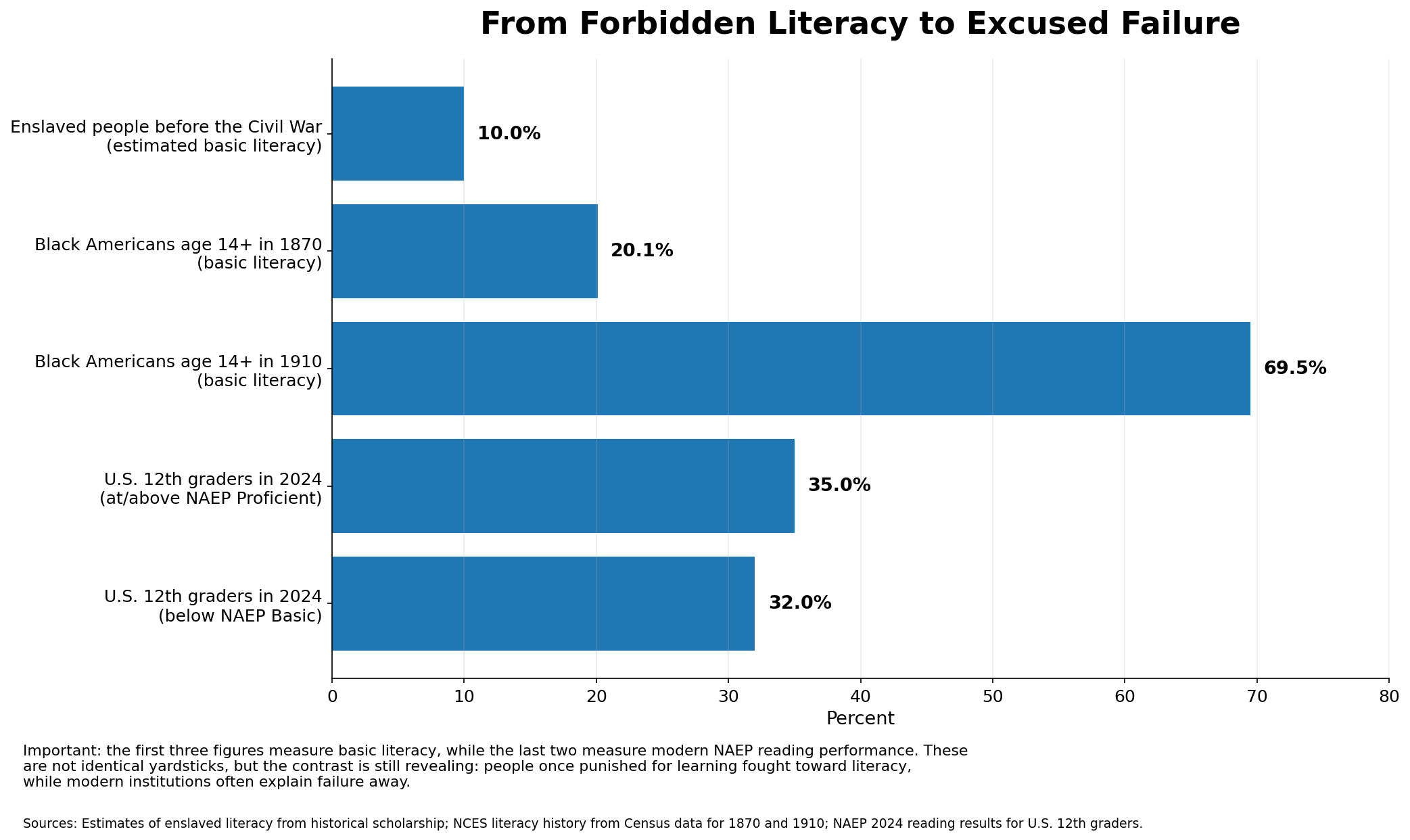
By 1910, roughly seven in ten Black Americans age fourteen and older were literate. Many of them had been born into a world that had either forbidden their education or treated it as a threat. They had no equity consultants, no federal education bureaucracy, no diversity offices, no trauma-informed seminars, and no billion-dollar school systems built in their name. Yet they fought toward literacy because they understood that reading was freedom. In 2024, only 35 percent of American high-school seniors scored proficient in reading on the Nation’s Report Card. The comparison is not exact. Basic literacy in 1910 is not the same as NAEP proficiency in 2024. But the contrast is still damning.
The former slave wanted the book. The modern institution wants the excuse.
The broader 2024 Nation’s Report Card only deepens the problem. Across grade levels, reading performance has weakened, absenteeism remains a serious issue, and the education bureaucracy keeps finding softer ways to describe failure. But the larger point is simple: a system that graduates students without serious reading ability has not helped them. It has lied to them.
Discipline data show another uncomfortable reality. The Department of Education’s civil rights data for 2020-21 showed Black boys were 8 percent of K-12 enrollment but 18 percent of students who received one or more out-of-school suspensions and 18 percent of expulsions. Black girls were 7 percent of enrollment but 9 percent of out-of-school suspensions and 8 percent of expulsions. The Department presents these disparities as civil rights concerns. Fine. They may be, in some cases. But what the bureaucracy often refuses to ask honestly is whether differences in punishment can sometimes reflect differences in behavior.
That question is treated as forbidden.
The result is predictable. Administrators become more concerned with suspension numbers than classroom order. Teachers are told to manage chaos without meaningful backup. Good students are sacrificed to protect the image of equity. Disruptive students learn that adults are negotiable. Parents of decent children, including decent Black children, watch schools become less serious and less safe.
In Oregon, the state suspended its Assessment of Essential Skills graduation requirement through 2027-28, meaning students do not have to demonstrate those specific reading, writing, and math skills through that assessment pathway to receive a regular or modified diploma. The official language is bureaucratic and gentle. The message to families is not gentle at all. The message is that proving basic academic skill has become too politically inconvenient.
That is not compassion. It is academic malpractice.
The child who cannot read is not helped by being promoted. The student who cannot do math is not helped by a diploma with less meaning. The disruptive student is not helped by avoiding consequences. The good student is not helped by being trapped in a room where adults are afraid to enforce order. And the decent Black student pays twice. He pays once when learning is interrupted by students who should have been removed. He pays again when the lowered expectations follow him into the wider world.
The Respectable Black Person Pays Twice
This may be the cruelest part of the whole arrangement. The respectable Black worker is not helped when the lazy worker is excused. The respectable Black student is not helped when the disruptive student is protected. The respectable Black parent is not helped when ghetto parenting is romanticized. The respectable Black customer is not helped when public disorder is defended as culture. He is insulted by all of it, because it says his discipline is unusual, his manners are borrowed, and his dignity is somehow less authentically Black than dysfunction.
That is the trap. The worst behavior gets protected in the name of the whole group, and the best people in the group are forced to carry the reputation of the worst.
White liberals claim to fight stereotypes, but they often protect the conduct that creates them. Then, when ordinary people notice patterns, the same liberals accuse them of stereotyping. It is a dishonest game. It allows the bad actor to avoid judgment, the liberal to enjoy moral superiority, and the decent Black person to absorb the public suspicion created by someone else’s behavior.
A middle-class Black man raised by two parents should not have to walk into a store, office, school, or neighborhood carrying the burden of someone else’s vulgarity. A Black woman who worked hard, raised her children properly, and conducts herself with dignity should not be grouped with women who treat public life like a reality show. A Black student who came to learn should not lose classroom time because adults are afraid to remove the child who came to disrupt.
But that is what happens when behavior is protected by race.
The public eventually stops distinguishing as carefully as it should. That is unfair, but it is not mysterious. If institutions insist on treating ghetto behavior as authentic Blackness, many people will eventually believe them.
The white liberal does not defend Black dignity by defending ghetto behavior. He destroys Black dignity by pretending the two are the same.
The Family Collapse No One Wants to Own
No serious discussion of culture can avoid the family.
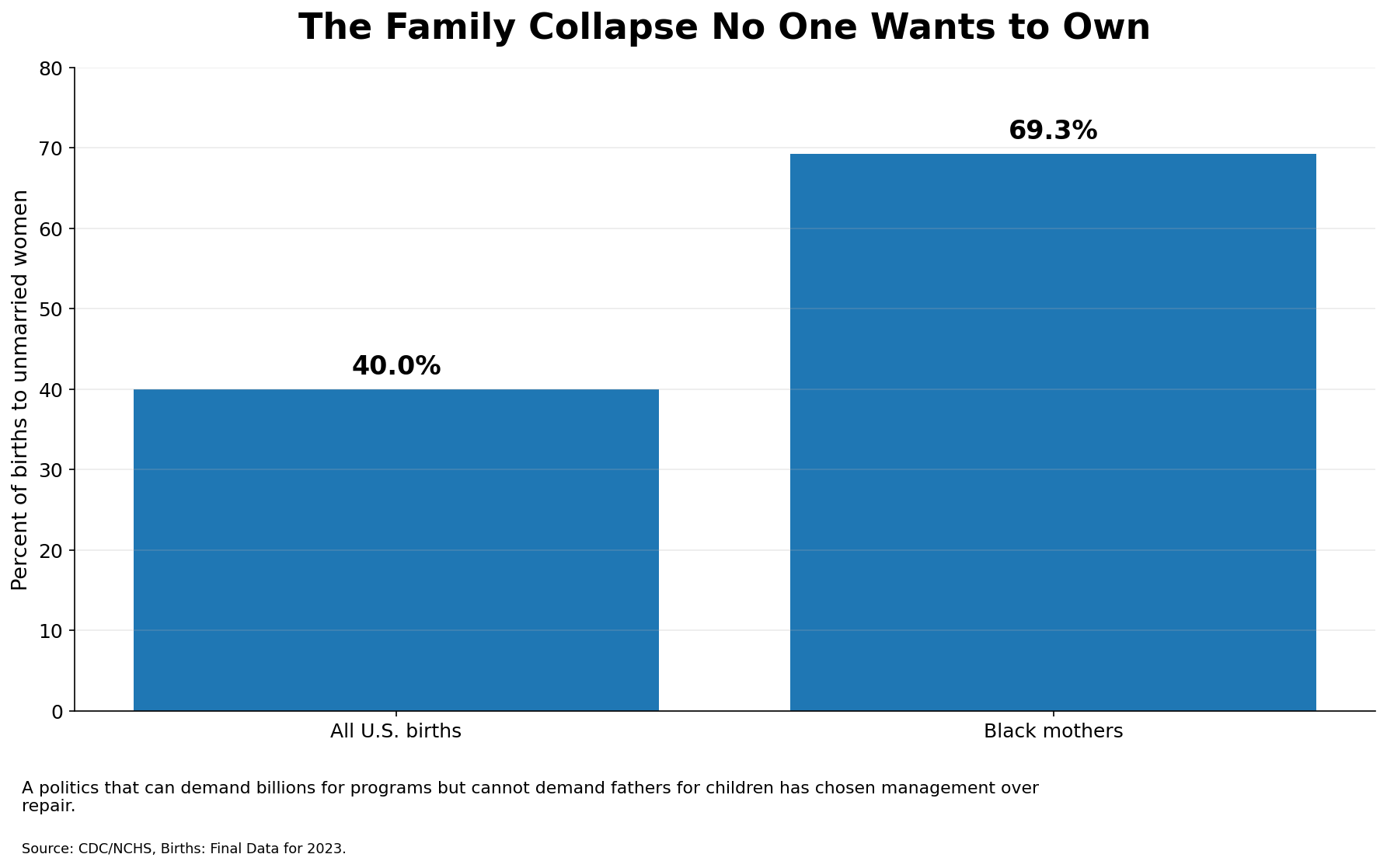
In 2023, CDC data showed that 40 percent of all U.S. births were to unmarried women. Among Black mothers, the share was about 69 percent. That number is not a slogan. It is a social earthquake.
Children need fathers. They need mothers too, obviously, but the modern debate spends far more time explaining away father absence than confronting what it does. A boy without a father is more likely to search for manhood in the street, online, in music, in gangs, in resentment, or in performance. A girl without a father is more likely to learn the hard way what male attention costs. These are not universal outcomes. Many single mothers do heroic work. Many children beat the odds. But public policy cannot be built on exceptions.
The old moral code understood this. Marriage was not just a romantic arrangement. It was social infrastructure. It civilizes men, protects women, stabilizes children, and forces adults to think beyond themselves.
The welfare state weakened that infrastructure. The sexual revolution mocked it. Feminism often treated male authority as oppression. The Democrat Party built political machinery around dependency. Popular culture glamorized baby mama and baby daddy chaos. Then white liberals looked at the wreckage and blamed racism.
Racism did not make a man abandon his child. Racism did not make a woman have children with a man she knew would not stay. Racism did not make the music industry glorify criminality, promiscuity, and contempt for women. Racism did not make schools afraid to discipline boys who clearly needed discipline.
History shapes people. It does not absolve them of responsibility.
A culture that cannot tell men to marry the women they impregnate is not compassionate. It is cowardly. A politics that can demand billions for programs but cannot demand fathers for children is not serious. It has chosen management over repair.
The Workplace Learned to Surrender
Now take the same problem into the workplace.
Postal workers in sweats. Retail employees on phones. Daycare workers acting as if children are a burden. Assisted living aides treating the elderly like interruptions. UPS store clerks who seem annoyed that customers came inside. Government workers who behave as if citizens are trespassing. Fast-food employees and customers turning minor problems into public drama.
Again, this is not all Black workers. It is not even limited to Black workers. Low-class conduct appears in every race. But in modern America, when ghetto behavior is attached to Blackness, institutions become especially afraid to correct it.
That fear changes everything. Managers learn to document less, confront less, demand less, and tolerate more. Coworkers learn that the worst employee can create the most protected situation. Customers learn that complaining may make them the villain. HR learns that avoiding accusations can become more important than preserving standards.
The bad employee used to fear being corrected. Now the manager fears correcting him.
This is not good for business. It is not good for customers. It is not good for coworkers. It is especially not good in jobs involving children, elderly people, patients, packages, food, transportation, or public trust.
Elites often look down on these jobs as menial. Ordinary people know better. A bad corporate diversity hire may ruin a meeting. A bad daycare worker can harm a child. A bad assisted living aide can neglect someone’s mother. A bad delivery or postal worker can disrupt basic life. A bad front-desk employee can turn a simple task into a humiliating experience.
The lower the status of the job, the more likely elites are to ignore the damage caused by lowering standards. But ordinary people do not live in policy papers. They live at the counter, in the waiting room, at daycare pickup, in the school office, on the airplane, at the restaurant table, and beside the nursing home bed.
Diversity can widen the search for excellence. Quotas can replace the search for excellence. A workplace does not improve because the staff photo becomes more colorful. It improves when the people in the photo are competent, disciplined, trainable, respectful, and worthy of trust.
The Excuse Machine
The excuse machine is always ready.
Violence becomes a reaction to disrespect. Low test scores become proof the test is biased. School discipline becomes racial criminalization. Crime becomes poverty. Bad work habits become different cultural norms. Public vulgarity becomes authentic expression. Riots become mostly peaceful protest. Anti-White hostility becomes punching up. Dependency becomes support. Failure becomes the legacy of racism. Correction becomes oppression.
Some explanations contain pieces of truth. That is what makes them useful. Poverty can increase stress. Bad schools can limit opportunity. Family breakdown can damage children. Neighborhood disorder can shape behavior. Racism has existed and still exists in some places.
But the explanation is not the whole story.
If poverty caused crime, all poor people would be criminals. They are not. If racism caused academic failure, no Black students would excel. They do. If trauma caused public vulgarity, every traumatized person would act like trash in public. They do not. If oppression caused fatherlessness, every oppressed group would collapse the same way. They have not.
The excuse machine survives by treating partial truths as total explanations.
It also depends on selective compassion. The criminal gets context and a GoFundMe. The victim gets an excuse. The disruptive student gets a restorative circle. The good student gets lost instruction. The bad employee gets patience. The good coworker gets extra work. The violent teenager gets a sociological explanation. The elderly woman afraid to leave her home gets told to examine her biases.
This is not justice. It is moral inversion.
The cruelest thing you can do to a person is convince him that his failures are always someone else’s fault and his bad habits are always someone else’s prejudice.
The Lie That Standards Are White
Few ideas are more insulting than the suggestion that punctuality is white, literacy is white, professionalism is white, or self-control is white. That is not liberation. That is racial condescension.
It takes the habits required for adulthood and civilization, assigns them to white people, and then tells Black people that expecting the same from them is oppression. It is hard to imagine a more poisonous idea coming from people who insist they are anti-racist.
Black parents did not historically tell their children to be late. Black churches did not preach illiteracy. Black soldiers did not win respect through indiscipline. Black entrepreneurs did not build businesses by abusing customers. Black teachers did not improve children by excusing ignorance. Black families that made it into the middle class did not do so by treating manners, work, marriage, and self-control as white inventions.
The people calling standards white are not defending Black culture. They are insulting it.
This is how deep the lie has gone. When people meet a Black person who is intelligent, respectful, professional, kind, articulate, dependable, and pleasant to be around, the quiet reaction is often, “She doesn’t act Black.” But that is not a compliment. It is evidence of cultural vandalism. She is not acting white. She is acting civilized. She is acting professional. She is acting like an adult. The tragedy is that ghetto culture has been elevated so aggressively as authentic Blackness that ordinary decency now looks like racial departure.
This is why so many decent Black Americans are tired. They are tired of being told that the worst behavior is somehow more authentic than their own. They are tired of watching academics, activists, rappers, politicians, and white liberals turn dysfunction into identity. They are tired of having their standards dismissed as respectability politics by people whose own children will be protected from the consequences.
A serious society does not ask less of people because it claims to care about them. It asks more because it believes they are capable of more.
The Democrat Party’s Investment in Excuses
The Democrat Party has not merely tolerated this decline. It has benefited from it.
Dependency creates voters. Grievance creates voters. Fear creates voters. Disorder creates voters who can be managed through promises of protection, programs, subsidies, representation, and blame. The Democrat machine does not need Black America to become excellent. It needs Black America to remain politically loyal.
That is why Black conservatives are treated with such venom. The independent Black thinker threatens the arrangement. He proves that Black people do not have to think the way white liberals tell them to think. He proves that racial loyalty to the Democrat Party is not intelligence, morality, or destiny. It is a political habit, and sometimes a very damaging one.
The party and its allies protect the disruptive student, not the child trying to learn. They explain the criminal, not the victim. They defend the public spectacle, not the citizen trying to live peacefully. They soften the bad worker, not the coworker carrying the load. They protect the stereotype, then accuse others of stereotyping.
This is how political ownership works. You keep people angry enough to vote, dependent enough to fear change, and flattered enough to mistake condescension for respect.
The result is a terrible bargain. In exchange for loyalty, people get excuses. In exchange for votes, they get lowered expectations. In exchange for outrage, they get leaders who will blame every institution except the ones closest to the failure: home, school, neighborhood, culture, and local government.
That bargain has been disastrous.
Societies Collapse by Permission
This did not happen overnight.
Societies rarely collapse by announcement. They collapse by permission. One classroom surrendered. One fight excused. One test lowered. One graduation turned into a circus. One dress code abandoned. One shoplifting wave explained away. One street takeover described as youth expression. One violent reaction called understandable. One manager silenced. One police officer second-guessed. One fatherless home normalized. One vulgar song called art. One public standard rebranded as oppression.
Then people wonder why everything feels worse.
The answer is that standards are cumulative. So is disorder. You cannot excuse small things forever and expect large things to remain intact. You cannot train children to reject authority and expect adults who respect law. You cannot tell students that tests are oppressive and expect a serious academic culture. You cannot tell workers that professionalism is bias and expect good service. You cannot treat crime as sociology and expect safe streets.
The bill always arrives.
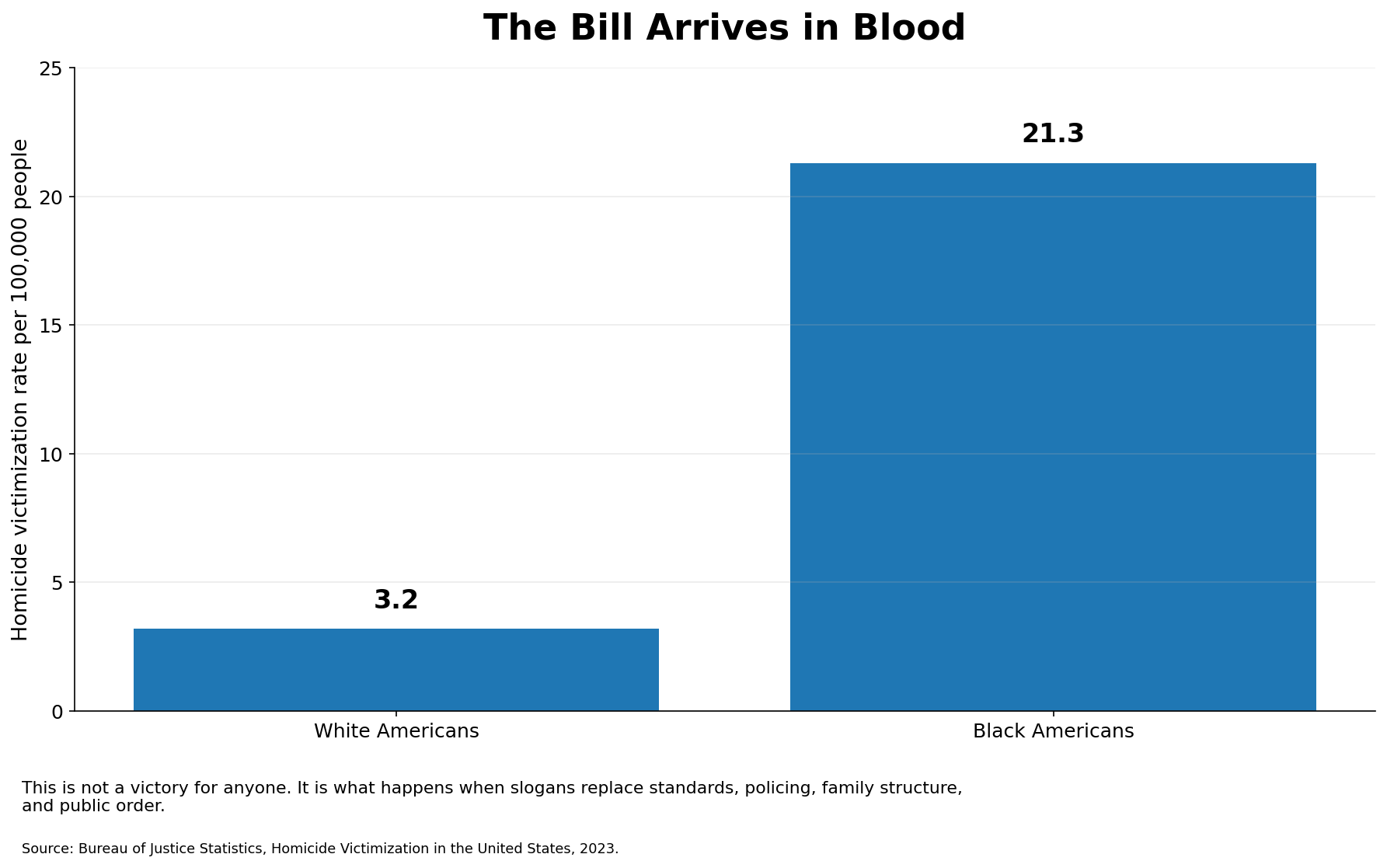
Sometimes it arrives as a reading score. Sometimes as a homicide rate. In 2023, the Bureau of Justice Statistics reported that Black Americans had a homicide victimization rate of 21.3 per 100,000, more than six times the white rate of 3.2. That is not a victory for anyone. It is not something to explain away with slogans. It means Black Americans are being killed at catastrophic rates, often in the very communities where progressive theories have had decades to prove themselves.
Sometimes the bill arrives as a city that no longer wants spring break. Sometimes as a mall that needs curfews. Sometimes as a school where teachers are afraid. Sometimes as an elderly resident who gets careless treatment. Sometimes as a child who cannot read. Sometimes as a decent Black man who has to prove, yet again, that he is not what the culture has been trained to expect.
That last bill may be the most insulting of all.
The Public Is Not Crazy
Ordinary people notice when service gets worse, when schools get less orderly, when public events become unpredictable, when employees act like customers are burdens, when children are not being raised, when vulgarity becomes normal, and when violence is explained more eagerly than it is punished. They notice when the same people who demand compassion for criminals have contempt for victims.
Then they are told that noticing is racism.
This is one of the great gaslighting operations in modern America. The public did not invent the disorder. The public did not create the videos. The public did not make schools less serious, streets less safe, workplaces less professional, ceremonies less dignified, or entertainment more degraded. The public simply noticed what institutions refused to admit.
The lie was not that things changed. The lie was that only bad people noticed.
There is nothing hateful about wanting children to behave in school. There is nothing extremist about wanting employees to do their jobs. There is nothing racist about wanting public spaces to be safe, clean, and orderly. There is nothing oppressive about expecting adults to control themselves. There is nothing cruel about saying that a wrong fast-food order does not justify assault, screaming, threats, or viral humiliation.
These are basic expectations. A country that cannot defend basic expectations cannot defend civilization.
Real Respect Means Expecting More
Real respect is not excuse-making.
It is not lowering the test. It is teaching the child to pass it. It is not ignoring classroom disruption. It is protecting the children who came to learn. It is not calling vulgarity culture. It is teaching dignity. It is not explaining away crime. It is protecting the innocent. It is not telling men they are victims of systems while their children grow up without fathers. It is telling men to become fathers worthy of the name.
Real respect demands more because it believes more is possible.
It expects children to behave in school. It expects adults to control themselves in public. It expects workers to dress and act like the job deserves respect. It expects parents to raise children who can function around other people. It expects students to read, write, calculate, and compete. It expects customers to treat staff with respect and staff to treat customers with respect. It expects men to raise their children. It expects people not to call every correction oppression.
That is not hatred. That is civilization.
The people who call these expectations racist are revealing themselves. They are saying they do not believe certain people can meet them. They may say it gently. They may say it with a degree, a foundation grant, and a yard sign. But the belief underneath is ugly.
The bigotry of low expectations is still bigotry. It just learned to smile.
Compassion Without Standards Is Contempt
America was told that lowering standards would produce justice. Instead, it produced weaker schools, worse workplaces, more public disorder, more racial suspicion, and more resentment among the very people who still believe in standards.
The greatest insult was not expecting too much from Black America. It was expecting too little.
It was allowing ghetto culture to masquerade as Blackness, then punishing decent people for noticing the difference. It was excusing dysfunction and calling it culture. It was protecting bad behavior and calling it equity. It was lowering standards and calling it compassion. It was telling ordinary Americans to surrender their judgment, surrender their language, surrender their eyes, and surrender their common sense.
And after all that surrender, it still was not enough.
The institutions still demand more excuses. The activists still demand more money. The schools still demand less discipline. The politicians still demand more loyalty. The HR departments still demand more silence. The media still demands that people pretend not to see what they see.
No serious country can be built on excuses. No serious people can be raised on lowered standards. No serious culture can survive by defending its worst habits and punishing its best examples.
The bigotry of low expectations has done enough damage.
It is time to expect more.
Help Me Keep Saying What Polite Society Pretends Not to See
This essay will offend the people who profit from lowered standards.
That is fine. The truth was never going to be welcomed by the institutions, consultants, academics, activists, politicians, and nonprofit empires built around excuses.
That is why independent work like this has to exist.
I do not write behind a university shield. I do not have corporate sponsors, foundation grants, or a political machine covering the bills. This work is reader-supported because it has to be. The moment writing like this depends on the approval of the people it criticizes, the writing is already dead.
Become a Paid Subscriber
If this piece said what too many people are afraid to say, become a paid subscriber.
Your support keeps this work free for people who need to read it, helps push these essays farther through Substack, and gives uncomfortable truths the distribution they need.
Subscribe here:
https://mrchr.is/help
Make a One-Time Gift
If you do not want another subscription but still want to help, a one-time gift gives me more room to research, write, source, publish, and keep building this platform without asking permission from the institutions I expose.
Make a one-time gift here:
https://mrchr.is/give
Join The Resistance Core
The Resistance Core helps fund the longer investigations, data-heavy essays, charts, videos, and source work that do not survive inside polite institutional spaces.
Join here:
https://mrchr.is/resist
If You Cannot Give
Read it. Share it. Restack it. Send it to the person who knows this is true but has never seen it said this plainly.
The excuse machine survives because decent people stay quiet.
Do not stay quiet.
The true black community needs to lead the charge.
Another well researched essay, thank you Chris. This is why I subscribe. Everything you said in this essay is true; however, I don't see anything on the horizon that will change the current trend. I keep hoping, but I'm losing optimism by the day. I still believe the truth will set us all free. Unfortunately, I don't see much appetite for truth these days.