


“The thief owns the theft. The institution owns every check written after the warning.”
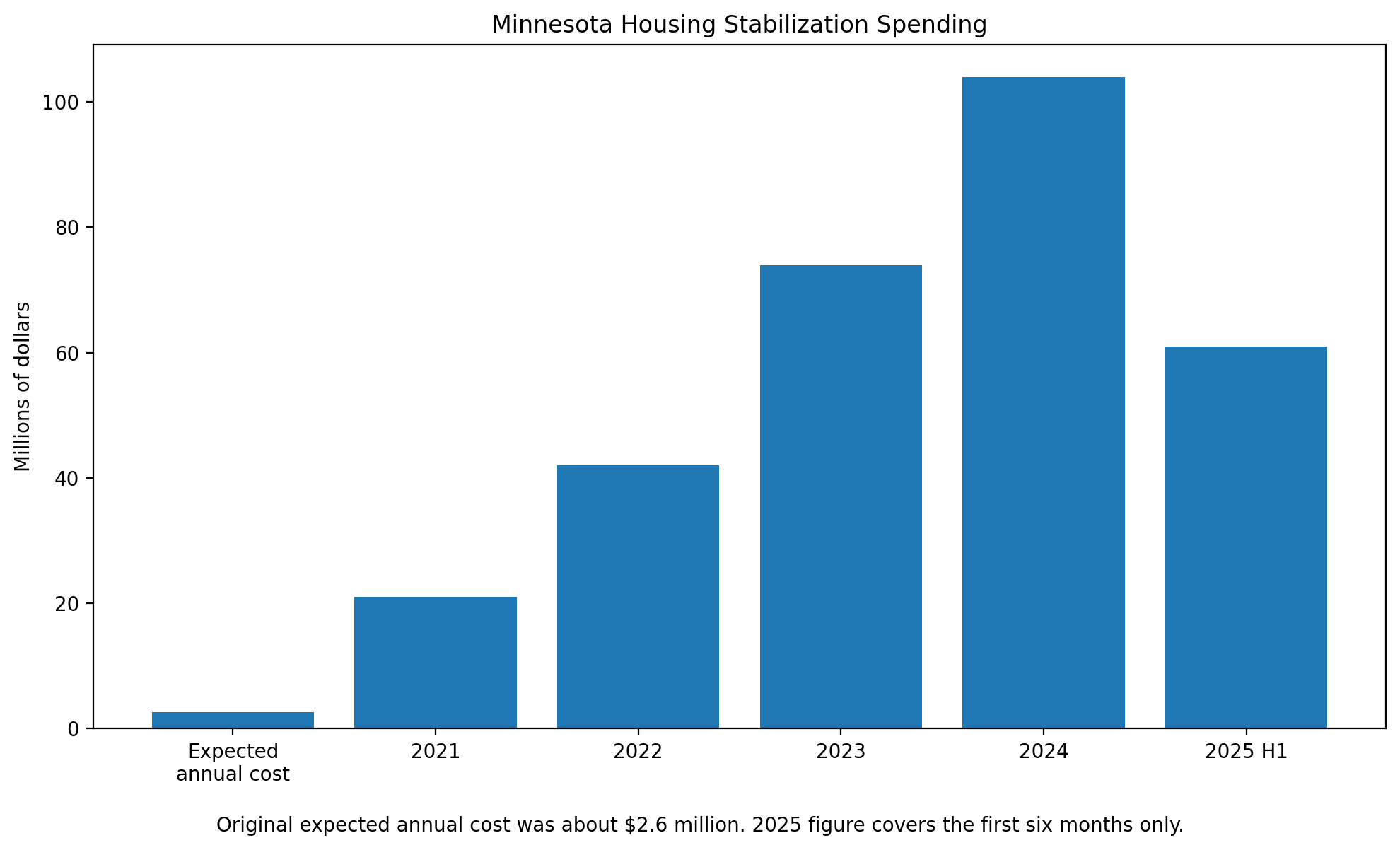
Minnesota built a program to help disabled and vulnerable people find and keep housing. Before the first claim went out, the state thought it would cost about $2.6 million a year. That estimate did not survive contact with a reimbursement form.
The program paid more than $21 million in 2021, then $42 million, then $74 million. By 2024 taxpayers were at $104 million a year, and another $61 million went out in the first half of 2025 before Minnesota shut the thing down in the middle of a federal fraud investigation.
The state was not buying houses. It was paying people who said they had helped somebody else find or keep one. A house can be walked through. An hour of “housing help” is a line on a form. A large agency cannot sit in every autism session, count every meal, watch every child walk through a daycare door, or ride along on every outreach visit. So it builds eligibility rules, billing codes, and a stack of paperwork. The provider reports what happened, a clerk processes the report, and a check goes out. Anybody who wants to find out whether the service was real usually arrives later, sometimes years later.
This works until somebody notices that the form is easier to produce than the service. At that point the paperwork is the product. Daycare claims say the children attended. Meal claims say the food was served. Autism claims say the treatment happened. Hospice claims say the care was delivered. Housing claims say the assistance was provided. Government sees a document standing in for reality and pays as if the reality were there.
Sometimes the document is the only thing that exists.
Crooks will always look for a weak spot. What I want to know is why government keeps building systems with the same weak spots, and why the checks keep going out after people inside the agency have already started raising alarms. Once the warning is sitting on somebody’s desk, this stops being only a story about the thief. It becomes a story about the people who had the authority to stop paying him and did not.
Follow the Check, Not the State Color
The fastest way to miss the story is to stop at the map. Find a California case and yell Democrats. Find a Mississippi case and yell Republicans. Point at a Medicare prosecution in Houston and announce that politics is irrelevant because Texas looks red on a cable-news map.
A state does not write the check. An office does.
Texas can elect Republican governors while Austin and Travis County vote overwhelmingly for the Democrat Party. A Houston Medicare case may involve a federal billing code, a private clinic, and a federal prosecutor. An Austin homelessness contract may involve city money, HUD money, a nonprofit, and a city council. Those are different animals. Calling both of them Republican fraud because the governor is a Republican tells you who won the last statewide election. It does not tell you who approved the invoice.
The same rule runs the other direction. Tim Walz did not personally invent every fake meal in Minnesota, and Gavin Newsom does not initial every California payment. Start with the people who designed the program, approved the provider, authorized the money, received the complaint, and had the power to stop payment. Then keep going through the contractor, nonprofit, board, accountant, lawyer, donor, and appointee.
The interesting name is the one that shows up in two scandals the headlines treated as unrelated. Follow that name until the trail stops.
Minnesota Didn’t Get Fooled Once
Feeding Our Future is the case people know, for good reason. The nonprofit sat inside federal child-nutrition programs meant to feed poor children. During the pandemic the operation exploded. Prosecutors described a scheme of about $250 million built on fabricated attendance, fake invoices, shell companies, and meal counts that had little to do with children actually fed.
Founder Aimee Bock was convicted and, in May 2026, sentenced to 500 months in federal prison. If that were the whole story, it would be an enormous crime and nothing else. It is not the whole story.
Minnesota’s Office of the Legislative Auditor later found that the Department of Education had received at least 30 complaints about Feeding Our Future or its sites between June 2018 and December 2021. Some were never investigated. Others were investigated badly. In one of the stranger acts of oversight on record, the department asked Feeding Our Future to investigate complaints about Feeding Our Future.
The honor system needed an honor system.
The warning lights were already on before federal agents showed up.
The rest of the backyard looks familiar if you watch the payment instead of the press release. Minnesota was the first state to cover Housing Stabilization Services under Medicaid, at that expected cost of about $2.6 million a year. Within a few years the program was over $100 million.
Prosecutors say providers collected beneficiary information, filed inflated or fake claims, and were paid millions for services they had not provided as billed. By 2026 the Justice Department was using the phrase “fraud tourism” for people traveling to Minnesota to get in on it. Outsiders looked at a state benefit and decided the trip was worth the airfare.
The weakness had a reputation.
Autism billing followed the same curve. Spending and the number of providers soared, while federal prosecutors charged schemes involving kickbacks, unnecessary services, and treatment that was never delivered as billed. A 2026 Justice Department healthcare takedown covered more than $90 million in alleged fraud across Minnesota programs.
By then the pattern was hard to miss: meals, autism, housing, childcare. Different programs, same opening. Get somebody eligible, report activity that is difficult to verify, send in the paperwork, get paid. The label changed, but the opportunity did not.
The Number Nobody Puts in the Headline
When a $250 million fraud breaks, the headline number is $250 million.
The more revealing number is Loss After Notice: how much went out after the government already had a credible reason to think something was wrong?
That is the number I want.
Once inspectors have raised concerns, employees have complained, attendance numbers stop making sense, or an audit has flagged the controls, every new payment belongs to a different story. At that point you are no longer measuring only the thief. You are measuring the office that kept paying him.
Feeding Our Future is the clean illustration. The legislative auditor did not merely add up the theft after the raid. It documented weak complaint handling and weak follow-up while the money was still growing. The criminal owns the lie. The institution owns what it does after the warning.
How many of the billions later labeled fraud were paid after somebody inside the system had already sounded the alarm?
Government is pretty good at adding up the wreckage after the fact. It is much less interested in calculating how much money it kept sending after somebody had already yelled, “Hey, maybe stop.”
That number tells us something the fraud total cannot. It tells us how much damage happened after ignorance was no longer an excuse.
Stopping can also be the move that hurts the employee. After Minnesota began restricting Feeding Our Future, the nonprofit sued and alleged discrimination.
Now put yourself inside the bureaucracy. Approve a doubtful claim today and an auditor may ask about it three years from now. Deny it today and the provider calls this afternoon, a lawyer calls tomorrow, a politician wants to know why a constituent is being hassled, somebody says racism, and your name is in the paper.
No secret meeting is required. If approving the payment is safer than stopping it, the checks will keep going out.
It is also a mistake to count only the cases that end with handcuffs. Criminal fraud is the easy category: somebody lies, government pays, prosecutors prove the lie. Taxpayers also lose money through improper payments, legal spending that buys little, contractors who get rich while the deadline moves, consultants who bill for years, and officeholders who operate inside influence rules the legislature itself wrote.
Nobody has to break a law for the public to get a bad deal.
Failure Can Still Send an Invoice
California high-speed rail belongs in a different category. Here the question is not fake billing for a service that never happened. It is how failure itself becomes something you can keep invoicing.
Voters approved nearly $10 billion in bonds in 2008 for a San Francisco to Los Angeles line commonly sold at about $33 billion, with service around 2020 and no ongoing state subsidy for operations.
In the Authority’s 2026 business plan, the optimized estimate for the full Phase 1 line, San Francisco to Los Angeles and Anaheim, was $126.08 billion. A higher re-estimate of the older full scope, without those cost-cutting assumptions, ran around $231 billion.
As of October 2026, after roughly $15.6 billion in program spending, not one mile of operational high-speed track had been laid on the main passenger corridor. Track installation was still scheduled to begin later that year.
The Authority’s own books showed about $15.6 billion spent by August 2026. Roughly $8 billion of that was design-build civil work in the Central Valley: viaducts, embankments, trenches, grade separations. About $1.4 billion was land. Around $1.15 billion went to outside project-management advisors, including firms such as KPMG, Nossaman, AECOM-Fluor, and SYSTRA/TYPSA.
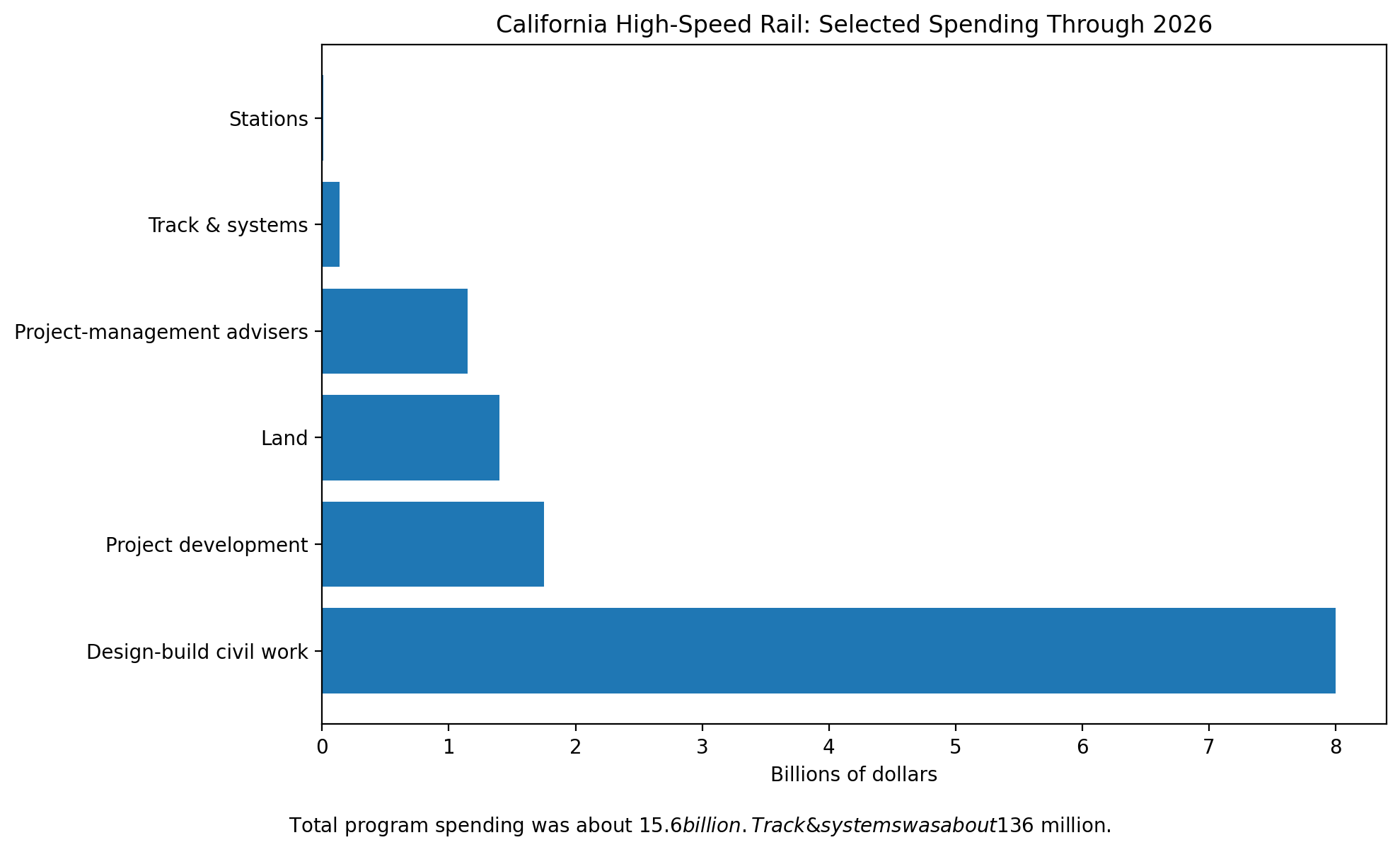
Project development, meaning planning and environmental work, accounted for about $1.75 billion. Track and systems, the part a normal person would call the railroad, was about $136 million. Stations were about $10 million.
Nobody needed to invent 10,000 phantom passengers. Construction firms were paid, engineers were paid, lawyers were paid, project managers were paid, consultants were paid, land was bought, and change orders ran into the billions, including a $537 million amendment in 2026 on top of hundreds of earlier ones.
The California State Auditor had already said this in plain language. A 2018 report concluded that flawed decisions and poor contract management had contributed to billions in overruns and delays. The Authority started Central Valley construction in 2013 without enough land, utility agreements, or deals with other agencies in the way, and it had trouble showing that some large bills were necessary or appropriate.
Audits in 2010 and 2012 had already called the planning and oversight weak. Eight years after the 2018 report, the optimized price was $126 billion and the checks were still going out.
In late September 2026, Governor Newsom vetoed a bill that would have given the rail inspector general more staff and more freedom to hire help, two weeks after that office published another ugly little window into how the project spent money: consultant travel.
The Authority paid more than $2 million in consultant travel over two fiscal years. Of about $1.15 million reviewed, roughly $680,500 lacked required prior approval, and about $540,000 to $590,000 was unallowable under the contracts or travel rules.
The file included premium flights, reimbursement tied to private aircraft, international trips the contracts did not allow, and rides to gyms, a nightclub, an escape room, a tiki bar, and a cigar lounge. Some of it was approved after staff objected, including requests tied to the chief executive.
Compared with the billions already spent, the travel bill is almost comic relief. The larger story is the decade of spending after the state’s own auditors had already documented serious management failures. Call that Spending After Warning.
A project can fail spectacularly at its public purpose and still be a very good business for the people being paid to pursue it.
California gives us another version of the same game: behested payments.
A behested payment is a donation an official asks someone to make for a charitable, legislative, or governmental purpose. There is no general dollar cap. Above a reporting threshold it has to be disclosed. It is not a campaign contribution and it is not a personal gift.
Newsom has used the system more heavily than any California official on record, with more than $340 million in reported solicitations since taking office.
About $4.3 million to $5.1 million of that went to the California Partners Project, founded by his wife, Jennifer Siebel Newsom, who does not draw a salary there. She does take about $150,000 a year from a separate nonprofit she founded, the Representation Project, which has also paid her film company.
A 2021 Sacramento Bee review found more than $800,000 to that nonprofit from firms that lobby the administration, including PG&E, AT&T, and Kaiser.
Several Partners Project donors had business in front of the state. The Federated Indians of Graton Rancheria gave about $1.8 million at Newsom’s request, including half-million checks in 2024 and 2025 and another $500,000 in March 2026, while tribal gaming compacts and a fight over a rival casino were live.
Blue Shield-related entities gave large sums to causes Newsom requested, including about $20 million in 2020 for a housing program, before the administration gave Blue Shield a no-bid role in the COVID vaccine network, capped around $15 million in expenses it could recover. The company said it would work at cost.
Who asked for the money? Who gave it? Where did it go? What business did the donor have before the state? What happened before the payment, and what happened afterward? Did the same names keep showing up?
In June 2026, the Fair Political Practices Commission fined Newsom $31,500 for filing 18 behested-payment reports late. A federal inquiry involving related nonprofits was also reported that year. By early October, no charges had been announced.
The money does not have to arrive in an envelope under a table.
California created a legal channel for public officials to direct large sums toward outside organizations, including one founded by the governor’s wife, while donors may also have business before the state. Put the money in the right box, file the disclosure, and the relationship becomes part of the system.
Republicans Built Their Own Versions
Mississippi blew more than $77 million in TANF money through nonprofit intermediaries, political allies, a famous quarterback, and even a volleyball facility. A Republican state auditor eventually went after the money.
That case gives us something useful to compare against Minnesota instead of pretending corruption carries a party registration card.
Mississippi was one patronage network wrapped around one welfare pot. Minnesota was a sequence: meals, autism, housing help, childcare, complaints already in the file, payments still going out, and people from out of state flying in because the billing had a reputation.
California rail is something else again: billions continuing to move through a project long after auditors had documented major management failures. Same treasury, different machines.
Texas is the fair test. A Republican governor does not make Austin, Travis County, Houston, or Harris County Republican institutions.
If social-service fraud inside Texas clusters in Democrat-run cities, counties, agencies, and nonprofit networks, that strengthens the pattern. If it is spread evenly through rural Republican counties and Democrat metros, the pattern gets weaker.
Federal healthcare fraud shows up anywhere a billing code exists. The more specific question is whether the same social-service cascade keeps appearing where Democrats administer the benefits: hard-to-verify services, weak controls, intermediaries between taxpayer and recipient, political resistance when somebody tries to shut the faucet, and more money going out after the warning.
That is what needs to be counted.
The Democrat Party Built the Kind of Machinery Greed Loves
The Democrat Party did not invent greed. It spent decades expanding exactly the kind of government machinery greed has learned to use: open-ended benefits, hard-to-verify services, reimbursement codes, nonprofit intermediaries, grants, contractors, and layer after layer between the taxpayer and whatever taxpayers supposedly bought.
Faced with a social problem, the habit is another program, another grant, another nonprofit partner, wider eligibility, more administrators, more contractors, and often another office to watch the first office. Some of those programs do real good. Every one of them also creates another eligibility decision, another claim, another payment, and another organization standing between the taxpayer and the person who was supposed to be helped.
More transactions create more opportunities to bill. That is arithmetic.
Then politics enters the room. What happens when the providers and nonprofits drawing the money are also part of the political coalition that created the program?
Minnesota gives us a pretty good look. Feeding Our Future turned discrimination into part of the enforcement fight. Suddenly the bureaucrat trying to stop suspicious payments had something to lose personally, while the bureaucrat approving them could push the problem down the road.
Build enough incentives like that into a system and you do not need corruption in every office. You only need people behaving rationally inside a badly designed machine.
The cases in this essay show what happens once that machine is running. The national comparison still needs to be counted, and Texas gives us a clean place to start. If the same architecture produces the same failures under Republican local control, the argument gets weaker. If the pattern continues clustering inside Democrat-run social-service systems, the argument gets stronger.
Either way, count it.
The people exploiting these systems are often less mysterious than the coverage makes them sound. They read the manual.
What gets reimbursed? What paperwork is required? Which claims almost nobody checks? How many auditors are there? How long does an investigation take? Which appeal buys six months? Which legal theory makes a supervisor nervous? Which nonprofit structure qualifies for money a business could not get directly?
The capable operator does not have to fight the agency. He has to know which form makes the agency mail him the money.
Those skills travel. A person who can manufacture attendance understands reimbursement. A recruiter who can produce nominal clients can do it in the next program. An accountant who knows which file survives review can serve more than one provider.
Headlines put scandals in separate boxes because cases have docket numbers. People do not stay in the boxes.
A shared bookkeeper tells me more than a shared ethnicity ever will.
That is the connection worth following.
The Warning Is the Story
Thieves, contractors, grant writers, and political operators are not going away. Government cannot repeal greed. It can decide how easy it is to turn greed into a business, and it can decide what happens once the warning is already sitting in somebody’s inbox.
Minnesota priced a housing program at $2.6 million a year and watched it climb to $104 million. Feeding Our Future piled up complaints before federal agents ever arrived. California’s rail authority had been warned for years about bad decisions and weak contract management while the price climbed past $126 billion and the trains still did not run. Mississippi pushed welfare money through nonprofits until a Republican auditor demanded more than $77 million back.
Who got the money? Who ran the office that paid it? Who kept showing up around the contracts? When did somebody in authority know something was wrong, and how much went out after that?
That last number is the one I want to see on every government fraud investigation from now on.
Loss After Notice.
How much money went out after the warning?
Somebody approved the provider. Somebody signed the contract. Somebody read the audit. Somebody received the complaint. Somebody watched the spending blow past the estimate and kept paying anyway.
Finding the thief is only half the investigation.
The other half begins when government knew.
Follow the money down to the institution that actually wrote the check.
Help Keep This Work Independent
Everything I publish is free to read. A paid subscription is not about unlocking articles. It is about supporting the work, funding the research, and buying back the time it takes to keep doing it.
This essay took hours of digging through audits, indictments, spending reports, court records, agency documents, political connections, and years of warnings that were too often ignored.
If you value independent work that follows the money instead of the party talking points, please consider becoming a paid subscriber.
Become a Paid Subscriber:
https://mrchr.is/help
Make a One-Time Contribution
Do not want another subscription? You can make a one-time contribution instead.
Give here:
https://mrchr.is/give
Join the Resistance Core
For readers who want to make a bigger commitment to keeping this work independent, the Resistance Core is $1,200 per year, charged annually.
Venmo
https://account.venmo.com/u/mrchrisarnell
If You Cannot Give
Share the essay. Restack it. Send it to somebody who needs to read it. Post a quote. Leave a comment.
Independent work does not survive because everybody agrees with it.
It survives because enough people decide it is worth keeping alive.