

“The lottery is not a tax on luck. It is a tax on the belief that luck is the only thing left.”
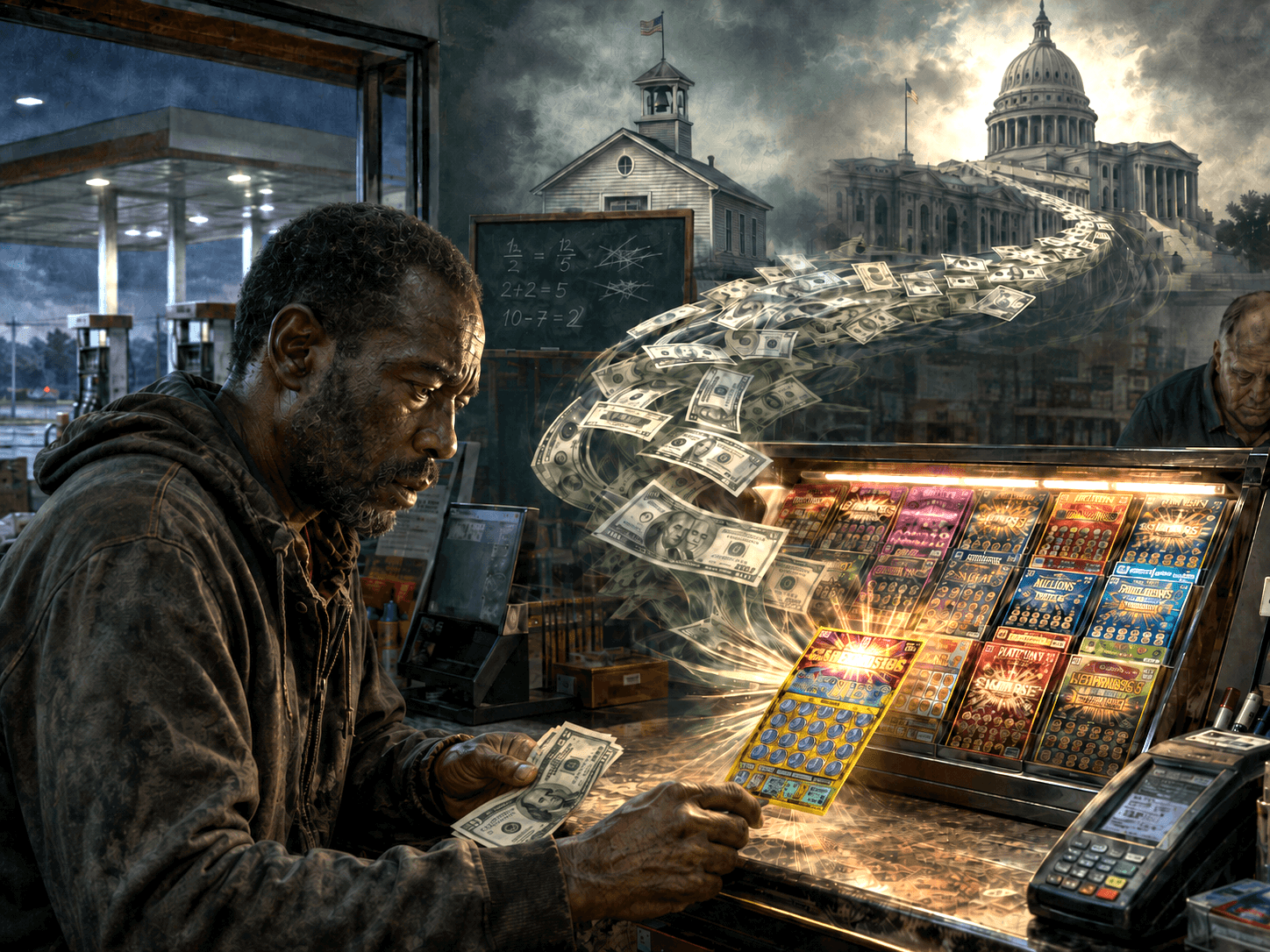
A man walks into a gas station.
Maybe he needs gas. Maybe coffee. Maybe cigarettes, beer, milk, or a bag of chips before heading home from work. He is not rich. He is not sitting on a portfolio. He is not reading state revenue reports or thinking about the compounding power of small investments.
He is tired. He is short on cash. He needs a way out.
Then he sees the scratch-offs.
Bright colors. Big numbers. Tiny odds. A few dollars for the chance to stop worrying about rent, the car note, the electric bill, the next emergency, the next bad week.
No one calls this predatory.
They call it education funding.
That is the genius of the lottery. The same government that claims to protect people from exploitation runs one of the most exploitative gambling businesses in America. It sells hope to people with the least margin for error, keeps a cut when they lose, taxes them if they win, and then tells the public it was all for the children.
The lottery is not harmless entertainment. It is not merely a bad bet. It is a government-run gambling machine that extracts money from the poor, the desperate, and the financially uneducated, then launders the revenue through slogans about schools, veterans, public programs, and good causes.
The scam is not that nobody wins. Somebody wins, and that winner becomes the advertisement.
The scam is that millions lose so the state can advertise the one person who did.
The Billboard Shows the Jackpot
The public sees the billboard, not the annual report.
The billboard says $500 million. The annual report says revenue stream.
In fiscal year 2024, Americans spent about $104.7 billion on state lottery tickets. Lotteries paid out about $70.2 billion in prizes. That left about $34.5 billion in net lottery revenue.
Put more simply, out of every $100 spent on lottery tickets, roughly $67 was paid out as prizes before taxes, and roughly $33 stayed behind as net lottery revenue.
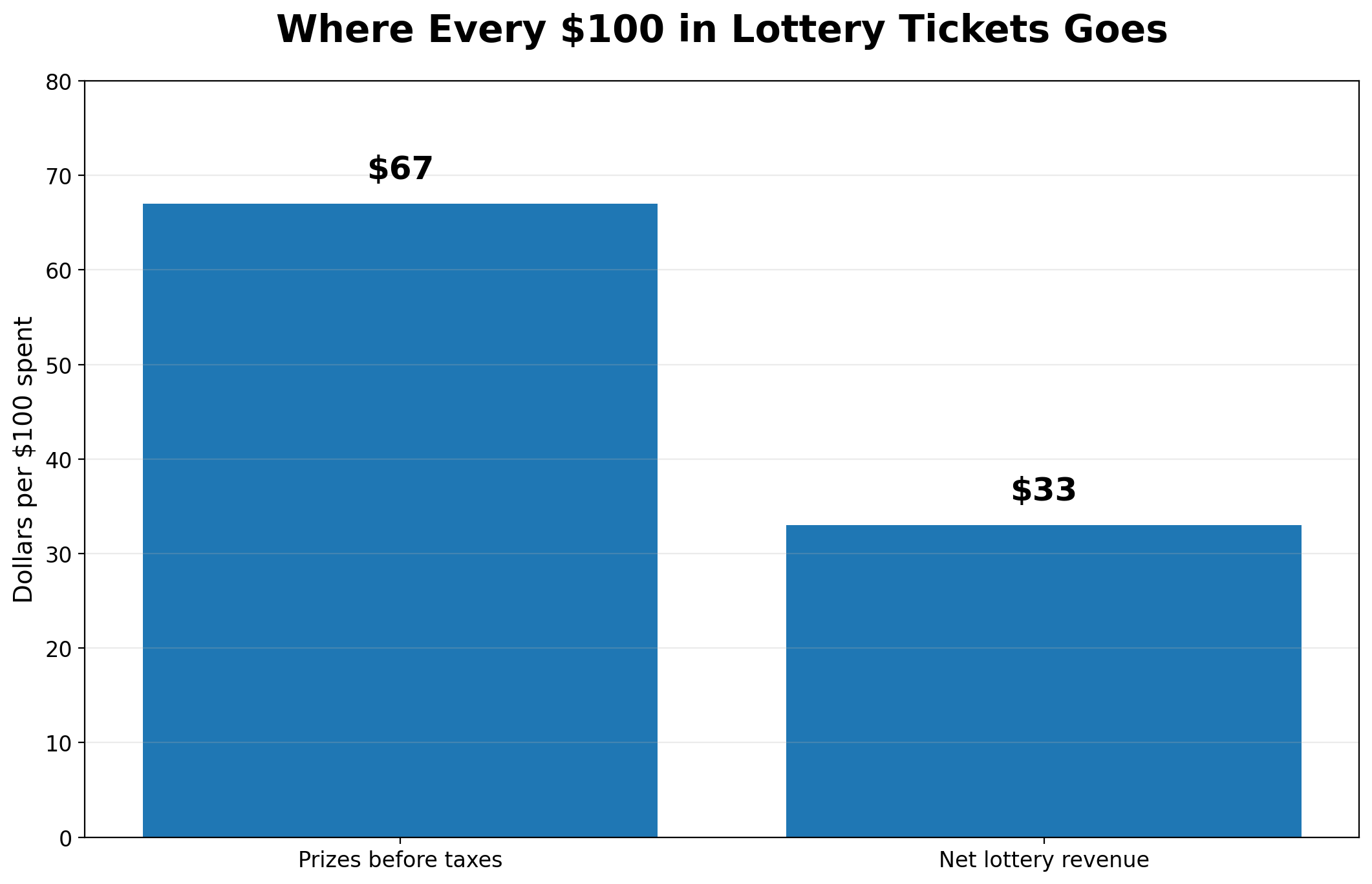
That is before federal taxes, state taxes, local taxes, unclaimed prizes, retailer commissions, vendor contracts, advertising, and the school-funding shell game.
The lottery can say “most of the money goes to winners” only because it is counting the gross prize number. It is not counting what winners actually keep. It is not explaining that the state has already kept its cut before the winner ever sees a dime. It is not reminding people that the advertised jackpot is usually not the cash number. It is not telling poor people that the odds are not merely bad, but absurd.
The billboard shows the jackpot. The annual report shows the business model.
That business model depends on a simple fact. The state does not need people to understand the math. It needs them to feel the hope.
The Government Gets Paid Twice
The first bite comes when the ticket is sold.
The second bite comes if somebody wins.
Lottery winnings are taxable gambling income under federal law. Federal withholding on many large gambling winnings is often 24%, but that is not necessarily the final tax bill. It is withholding. Big winners can owe more because lottery winnings are taxed as ordinary income. A huge jackpot can push the winner into the top federal bracket. Depending on where that winner lives, state and even local taxes can take more.
So when the lottery says it paid $70.2 billion in prizes, that does not mean winners kept $70.2 billion. It means the lottery credited that amount as prizes before the tax code reached back into the pile.
Using the national 2024 numbers, the government kept about $34.5 billion in net lottery revenue. If you apply 24% federal withholding to the $70.2 billion prize pool, that is another roughly $16.8 billion. That gets the government’s take to about $51 billion before state and local prize taxes. If you estimate using the top federal rate, the number rises toward $60 billion before state and local taxes.
The exact number varies because not every prize is taxed at the top rate, not every state taxes winnings the same way, and some winners may offset gambling losses. The caveats matter. So does the central fact. The official lottery revenue figure does not include the tax clawback on the prize money.
The government sells the ticket, skims the ticket, announces the prize, taxes the prize, and then brags that most of the money went to winners.
They tax the dream on the way in and tax the miracle on the way out.
The Hidden Poverty Tax
Ronald Reagan understood inflation as a hidden tax. Government spends, borrows, prints, and inflates, and ordinary people discover the tax later at the grocery store, the gas pump, the rent office, and the used car lot. No politician has to send a bill saying, “We are taking 10% of your purchasing power this year.” The dollar simply buys less.
The lottery is a cousin of that idea, but uglier.
Inflation is how government taxes people without sending a bill. The lottery is how government taxes desperation without calling it a tax. Education funding is how it launders the whole thing into virtue.
The state does not call it a poverty tax. It calls it Powerball, Mega Millions, scratch-offs, a dream, public service, and help for schools. A tax usually has paperwork. A lottery ticket has bright colors. A tax sounds like government taking something from you. A lottery ticket sounds like you choosing a chance at something better.
That is why the “voluntary” defense is so thin. Payday loans are voluntary too. So are rent-to-own contracts, bad credit cards, and sports-betting apps. Calling something voluntary does not make it moral. It only means the state figured out how to make the victim walk to the counter.
The lottery is a tax that arrives as a dream and leaves as a budget line.
The Poor Pay More
The lottery does not fall evenly on rich and poor.
Among lottery-playing households earning under $30,000 a year, Bankrate found that lottery spending consumed about 13% of annual income. Among those earning $30,000 to $49,999, it was about 3%. For people earning $50,000 to $79,999, it was 1%. For those earning $80,000 and over, it was also 1%.
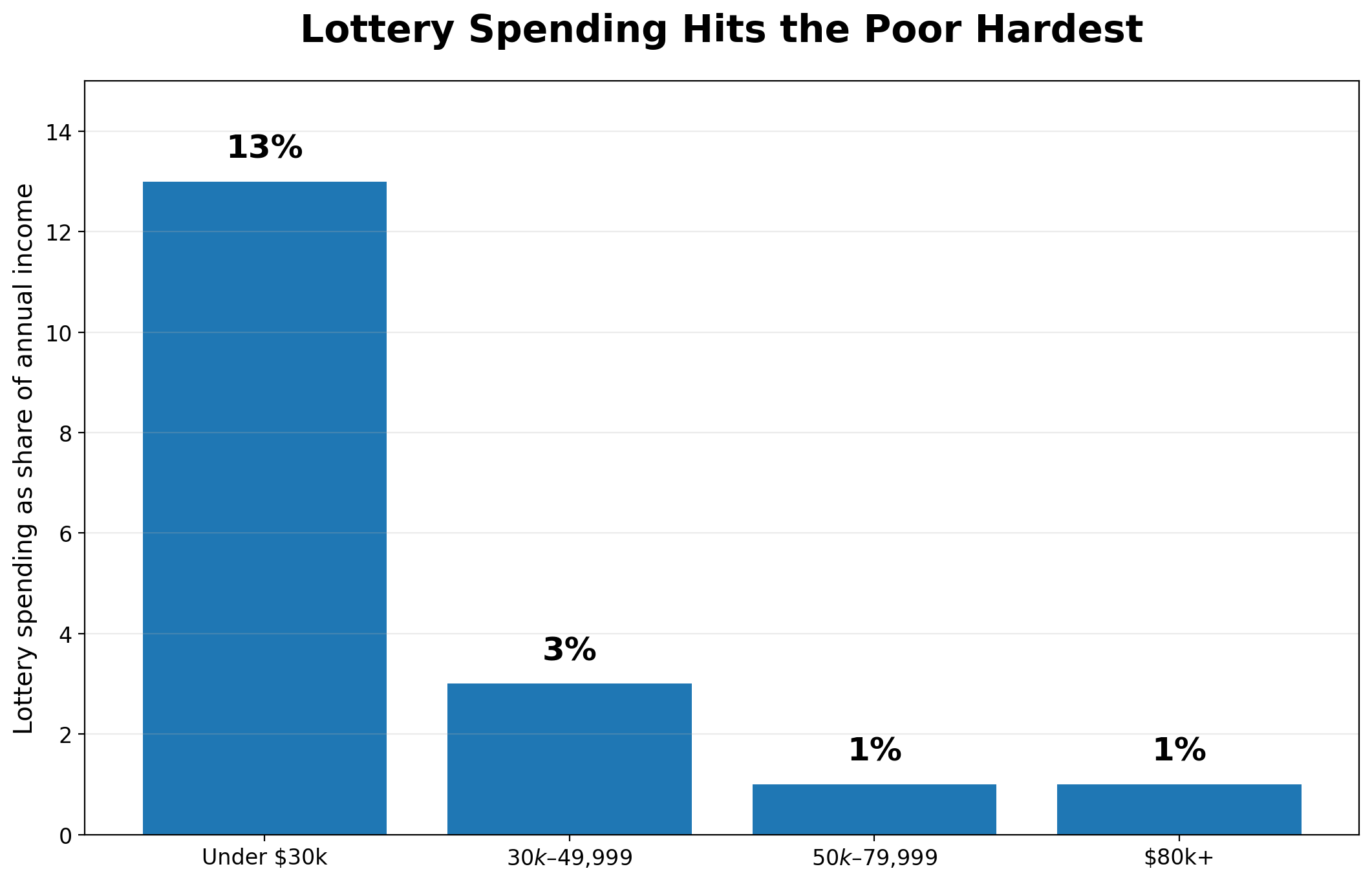
That is not ordinary entertainment. That is a second tax system for people who can least afford it.
A rich man buying a ticket during jackpot fever is spending pocket change. A poor man buying tickets every week is doing something very different. He is not really buying a game. He is buying emotional escape from arithmetic.
A rich man buys a ticket for fun. A poor man buys one because it feels like a plan. The state knows the difference.
Another major study found that people in the lowest fifth by socioeconomic status had the highest lottery participation rate, about 61%, and the highest average number of lottery gambling days. The lottery is not supported mainly by the person who buys one ticket when the jackpot gets huge. It is supported by repeat buyers.
Lottery defenders can say the odds are equal. A millionaire and a janitor can buy the same ticket. Same numbers. Same drawing. Same jackpot. Same dream.
That sounds fair until you remember that equal odds are not the same as equal consequences. If a millionaire loses $20 on tickets, nothing changes. If a poor man loses $20, that may be lunch, gas, medicine, or part of an overdue bill. The odds may be equal, but the downside is not.
The lottery offers equal odds in a world of unequal consequences.
Placement, Not Slogans
The lottery does not need a racist slogan. It has a placement strategy.
It does not need to say, “We target Black people.” It can simply target the conditions that fall disproportionately on Black and Hispanic communities in many cities: poverty, lower savings, weak schools, lower math proficiency, high stress, thin financial buffers, convenience-store density, and fewer visible paths out.
The mechanism is economic. The effect can still be racial.
A Howard Center for Investigative Journalism investigation found that lottery retailers are disproportionately clustered in lower-income communities in nearly every state it analyzed. Those neighborhoods were also disproportionately home to Black, Hispanic, and lower-income residents, and mobile-phone location data showed that customers at lottery retailers tended to come from nearby communities.
The lottery is not merely available. It is placed.
Now add the education angle. NAEP math results continue to show major achievement gaps by race and income. The 2024 math results reported declines among Black, Hispanic, and White twelfth-graders compared with 2019, and state snapshots such as Texas show Black and Hispanic students scoring well below White students in math.
That is the cruel backdrop. The same public system that claims the lottery funds education has failed to produce basic math competence in many of the communities most exposed to lottery advertising. Then the state turns around and sells mathematically impossible hope to people it failed to teach probability.
They do not have to target Black people by name. They target the neighborhoods where Black poverty, weak schools, and bad math instruction already did the work for them.
The state failed to teach math, sold a math trap, taxed the winner, kept the loser, and called it public service.
The Psychology of Desperation
The lottery does not sell wealth. It sells escape.
A middle-class person may buy a ticket as a joke. A person with money in the bank may join an office pool for fun. But for someone broke, exhausted, and out of options, the lottery offers something more powerful than entertainment. It offers a door. A fake door, yes, but still a door.
The poorer you are, the more insulting normal financial advice can sound. Save $10 a week. Build an emergency fund. Invest slowly. Good advice. Now imagine telling that to a man whose rent is late, whose car needs repairs, whose son needs shoes, and whose paycheck is already gone before it arrives.
Slow discipline is real. It works. But when a person sees no ordinary path out, the impossible can start to feel rational.
That is what the lottery sells. It sells escape, control, equality, and the feeling that the universe might finally pick you. It sells the little thrill of choosing numbers. It sells the near-miss. It sells the fantasy that a gas station receipt might do what school, work, government, and family never did.
The lottery is not selling probability. It is selling relief from probability.
Missing by one number feels close, but mathematically it is just another loss. The payout is the same as missing by a mile. Still, the brain reads it as progress. It feels like the next ticket might be different.
A near-miss is losing with better marketing.
Scratch-offs make this even worse. They offer instant feedback. Lose, lose, win $5, lose, win a free ticket, lose again. The small win feels like encouragement. The free ticket feels like the game wants you back. The $5 prize often becomes five more dollars in tickets.
The small prize is not generosity. It is bait with a receipt.
Slot Machines Next to the Milk
Scratch-offs are slot machines made acceptable because they are sold next to milk and cigarettes.
A casino announces itself. It has lights, guards, machines, dealers, carpets, signs, sounds, and shame. You know what you are entering.
The lottery is different. It is tucked inside normal life. You see it when buying gas. You see it while paying for coffee. You see it next to the debit card reader. There is no casino door to walk through, no moment of decision that says, “I am now gambling.” The state has dissolved the casino into daily errands.
The state does not need a casino in every poor neighborhood. It has gas stations.
Retailers commonly earn commissions, and some states offer bonuses for selling major winning tickets. Oregon’s lottery, for example, advertises 8% commissions on traditional lottery games for retailers, while California’s retailer materials list 6% commissions on draw games and scratchers, plus bonuses for selling certain big winning tickets.
So the store is not merely a neutral seller. The store is part of the machine. The state provides the seal. The retailer provides the counter. The vendor provides the system. The poor provide the revenue.
The ticket is only two dollars. The machine behind it is worth billions.
The Number on the Billboard Is Not the Money in Your Hand
Lottery marketing plays a clever game with the word “win.”
Powerball says the odds of winning the grand prize are 1 in 292,201,338. The odds of winning $1 million are about 1 in 11.7 million. The odds of winning $50,000 are about 1 in 913,000.
Mega Millions is similar. Its jackpot odds are 1 in 290,472,336.
Those numbers are so large that most people cannot really feel them. One in 290 million does not sound like information. It sounds like fog. So the lottery leans on another number: the odds of winning any prize.
That number is much friendlier because it includes tiny prizes. A few dollars. A free ticket. A payout that barely gets you back to even, or more often, gets you to buy again.
They advertise the dream with the jackpot number, then defend the game with the small-prize odds. They advertise the odds of winning something, not the odds of winning something that changes your life.
“Somebody has to win” is another favorite trick. It sounds hopeful, but it is not a financial argument. Somebody has to win is not a plan. It is the sentence people use when the math is too ugly to say out loud.
Even the jackpot number is not what many people think it is. Big jackpots are usually advertised as annuity values, which assume payments spread over decades. Many winners choose the lump-sum cash option, which is much smaller than the advertised jackpot. Then federal taxes take a bite. Then state taxes may take a bite. In some places, local taxes take another bite.
The jackpot on the billboard is not the check in the winner’s hand. It is the most flattering version of the number.
No private business would be praised for marketing this way to poor people. Imagine a company advertising a $1 billion benefit, then explaining after purchase that the real cash value is lower, taxes will take more, the odds are one in hundreds of millions, and most “wins” are tiny.
If a private company did that, politicians would hold hearings. When government does it, politicians pose with oversized checks.
The Education Funding Scam
The education pitch is the moral laundering operation.
The state does not say, “Please gamble so we can balance the budget.” It says the money helps schools. It says the money helps children. It says the money supports public programs.
That sounds noble until you look closer.
The problem is not that schools receive no lottery money. Many do. The problem is that lottery money does not automatically mean schools get extra money. In many cases, lottery revenue can substitute for money that would have come from the general fund. The lottery dollar goes in. The regular budget dollar comes out. Politicians then spend the freed-up money somewhere else.
This is not a conspiracy theory. It is a long-running concern in public-finance research. Research on state lotteries has discussed how lottery revenues earmarked for education can substitute for general-fund education spending rather than simply add to it.
Even when lottery earmarks increase education funding in some categories, the benefits can be uneven. Brookings found that lottery earmarks for higher education increased appropriations and merit-based aid, but could also worsen conditions for disadvantaged students by supplanting need-based aid.
That is a quiet scandal. Poor people buy the tickets. Better-prepared students and families may capture some of the benefits. Politicians still get to say it was all about education.
The scam is not that schools receive no lottery money. The scam is that voters are led to believe lottery money is extra school money. In many cases, it is replacement money.
The child on the brochure is not the beneficiary. He is the shield.
The Moral Laundering Machine
This is where the lottery starts to look familiar.
The lottery is USAID with scratch-offs. The money goes in under the banner of compassion, passes through a machine no ordinary citizen understands, enriches the people who operate it, and comes out wrapped in slogans about helping children.
That does not mean lottery accounting is literally the same as foreign-aid corruption. It means the moral architecture is the same.
Take money. Route it through noble language. Put a sympathetic beneficiary on the brochure. Let the bureaucracy, vendors, retailers, consultants, and politicians eat. Then accuse critics of hating the beneficiary.
Question the lottery, and you hate schools. Question foreign aid, and you hate starving children. Question education bureaucracy, and you hate teachers. Question welfare bureaucracy, and you hate the poor. Question public spending, and you hate whatever sympathetic person they put in the commercial.
The beneficiary becomes the human shield for the machine.
That is why the lottery is so hard to attack. You are not arguing against a game. You are arguing against a story. The story says the lottery helps children. The numbers say it extracts billions from adults, many of them poor, and then routes the proceeds through a political system that knows how to protect itself.
The moral shield is not the beneficiary. The moral shield is the excuse that protects the machine.
The Fair Share Fraud
No modern progressive phrase has been repeated more than “fair share.”
The rich must pay their fair share. Corporations must pay their fair share. Billionaires are exploiting the poor. Private companies are greedy. Inequality is immoral. The system is rigged.
Then many of the same governments run lotteries.
The same politicians who accuse everyone else of exploiting the poor operate gambling machines aimed at the poor. They scream about billionaires not paying their fair share while collecting a poverty tax from gas station counters.
A poor lottery player earning under $30,000 can spend 13% of annual income on lottery tickets, according to Bankrate’s survey of people who spend on lottery tickets. Higher earners spend about 1%. That is not progressive. That is not compassionate. That is not asking the rich to pay more. That is taking proportionally more from people with less.
If a bank did this, the Democrat Party would demand hearings. If a payday lender did this, they would call it predatory. If a corporation advertised false hope to poor neighborhoods and took a huge share of income from the desperate, politicians would stand in front of cameras and denounce greed.
But when the state does it, the language changes. Now it is voluntary. Now it is public revenue. Now it is entertainment. Now it is for the children.
The rich have accountants. The poor have scratch-offs. Guess which group the state found easier to tax.
At Least the Billionaire Sold Him Something
This is where the billionaire comparison becomes useful.
Apple reported about $112 billion in net income in fiscal year 2025. That is a massive profit. But Apple made that money selling phones, computers, watches, software, services, and tools people use every day.
A poor person who buys a cell phone may be spending too much. He may be buying a model he does not need. He may be helping make a billionaire richer. Fine. But he receives a working tool. He can call his family, apply for jobs, use maps, manage banking, check school portals, order rides, read email, take pictures, and run half his life through that device.
There is an exchange.
Now compare that to the lottery.
Government can extract roughly $51 billion to $60 billion or more from lottery players after counting ticket revenue and prize taxes. One sells utility. The other sells false hope, taxes the miracle, and calls it education funding.
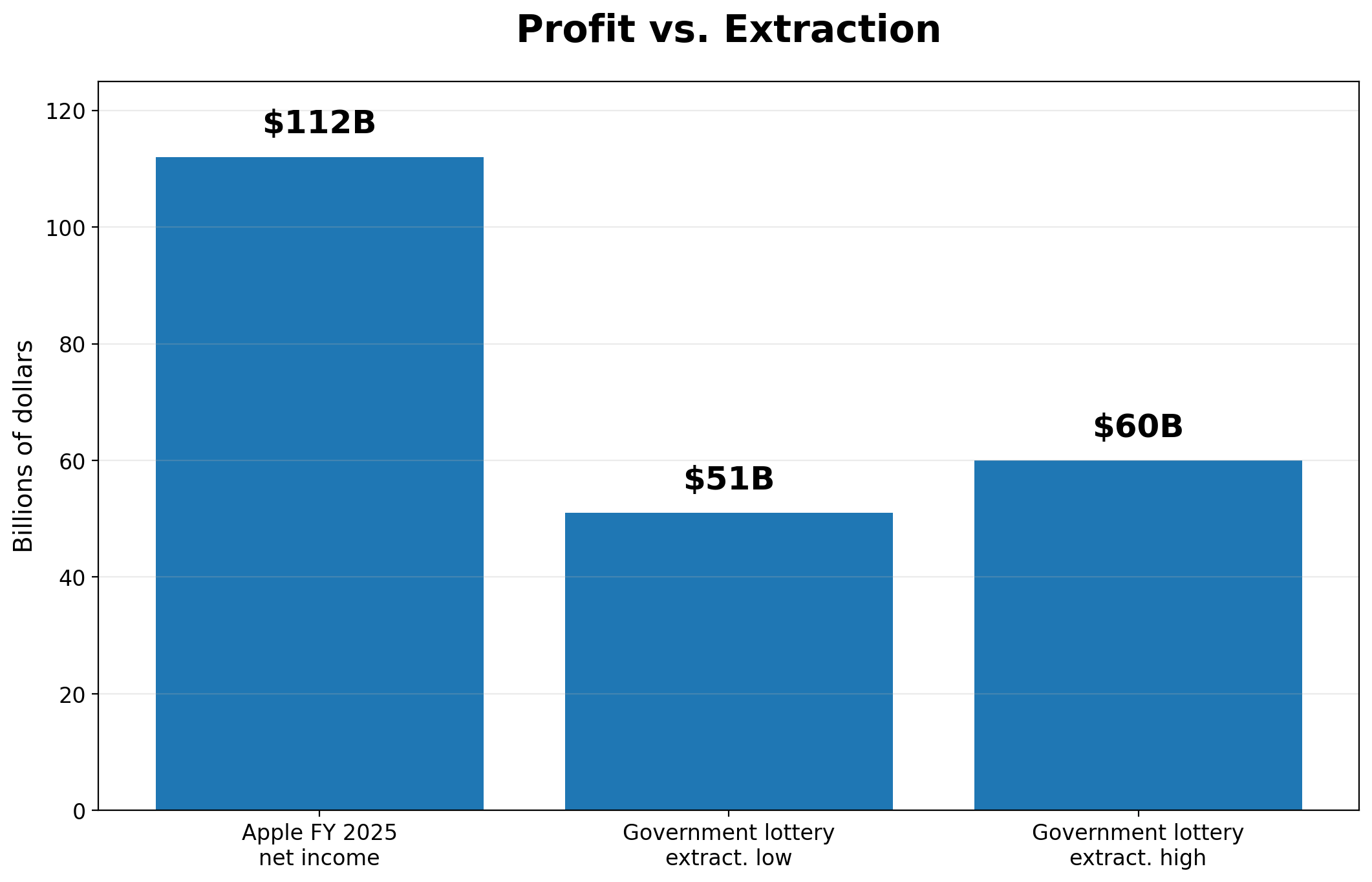
That is the asymmetry the “fair share” crowd never wants to discuss. When a consumer hands money to a billionaire, he may be overpaying, but he often receives a pocket supercomputer that lets him participate in modern life. When he hands money to the state at the lottery counter, he receives a piece of cardboard mathematically engineered to become trash in 90 seconds.
The billionaire profits when the poor man buys a tool. The state profits when the poor man buys a dream that almost always fails.
The billionaire does not need to pretend the iPhone funds third-grade reading.
Private profit can be greedy, but greed is not automatically fraud. The lottery is worse because it sells illusion under the cover of virtue. It profits from loss, advertises the rare exception, then claims public credit for the money it extracted.
One sells utility. The other sells illusion.
Even the Prize Money Finds Its Way Back
Some prize money never reaches winners.
The rules vary by state. In some places, unclaimed prizes go to education. In others, they may go to future prizes, lottery funds, or general state purposes. But the basic point is the same: money counted as prize money does not always become winner money.
Texas gives a clean example. In fiscal year 2024, Texas lottery sales totaled about $8.39 billion, and the Texas Lottery transferred about $80.3 million in unclaimed lottery prize winnings. That is almost $1 out of every $100 in sales.
Unclaimed prizes are the lottery’s quiet refund to itself. The lottery counts the prize when it wants credit for generosity, then recaptures the prize when nobody claims it.
Some winnings can also be intercepted for debts such as child support, back taxes, or other obligations, depending on state law. Some of that may be defensible policy, but it still reveals another layer of the machine. The state sells hope to broke people, and if one of them wins, the state checks whether it can take more before handing over the money.
The lottery does not just tax the dream and tax the miracle. In some cases, it garnishes the miracle before the winner ever touches it.
What the Money Could Have Become
The loss is not just the ticket price. It is what the ticket money could have become.
If a household spends $412 a year on lottery tickets for 40 years, and that money were invested at a 7% annual return, it could grow to roughly $82,000. If someone spends $976 a year, it could grow to roughly $195,000. If someone spends $2,500 a year, it could grow to nearly half a million dollars.
These are estimates, not guarantees. Markets move. Returns vary. Life happens. But the concept is not complicated.
The poor are not just losing ticket money. They are losing the compound growth on the ticket money.
A $5 scratch-off does not feel like much. Neither does a $10 weekly habit. That is how the machine survives. It converts large lifetime losses into tiny emotional purchases.
The customer does not feel the $82,000 future. He feels the $5 ticket.
The state understands that math better than he does.
The Winners Are Not the Business Model
Some people win. That cannot be denied.
The winner is the advertisement. The loser is the business model.
There is a popular claim that 70% of lottery winners go broke. That claim is shaky and should not be the center of the argument. The stronger argument is not that every winner is ruined. Some winners handle the money well. Some are better off forever. Some keep their wealth.
That does not rescue the system.
The lottery does not need most winners to go broke. It needs most losers to keep playing.
A few winners are necessary to keep the dream alive. They appear on television. They hold the check. They smile for the cameras. They become proof that the impossible is possible.
But the machine is not built on winners. It is built on everyone else.
The Biggest Scam in America
Return to the man at the gas station.
He is not stupid. He is not evil. He is not uniquely greedy. He is tired. He is broke. He is hoping.
And the state knows it.
The state knows the odds. It knows the demographics. It knows where the retailers are. It knows who buys scratch-offs. It knows the difference between a casual player and a repeat buyer. It knows the schools are failing too many children in the very communities where the lottery is most visible.
Then it puts the ticket by the register.
The lottery is not one scam. It is several stacked together. The jackpot is advertised in its most flattering form. The prize pool is counted before taxes. The state keeps its cut upfront. Federal taxes take more if someone wins. Some states and cities take more after that. Tiny prizes make the odds sound better than they are. Scratch-offs use casino psychology without the casino building. Retailers are paid to sell. Vendors build the system. Media outlets turn jackpot fever into free advertising. School funding provides the moral cover. General-fund substitution hides the budget game. Unclaimed prizes can return to the state. The poor pay the highest share. The state calls all of it public service.
Once schools depend on lottery revenue, the state needs poor people to keep gambling for the children.
A government that truly cared about the poor would not design a revenue system around their desperation. A government that truly cared about education would not fund it through games that punish bad math. A government that truly cared about inequality would not sell false hope in the neighborhoods where hope is already in short supply.
But that is exactly what the lottery does. It monetizes despair, then sends the money through a moral car wash.
Inflation is how government taxes people without sending a bill. The lottery is how government taxes desperation without calling it a tax. Education funding is how it launders the whole thing into virtue.
The state failed to teach people probability, then sold them mathematically impossible hope to fund the schools that failed them.
Calling this public service does not change what it is. It only tells us how profitable moral language can be when the people using it control the receipts.
That is the biggest scam in America.
Help Keep This Work Independent
The easiest thing in America is to pretend the scam is harmless.
Pretend the scratch-off ticket is just entertainment. Pretend the gas station lottery machine is just another convenience. Pretend the state is helping children when it sells impossible odds to people who can least afford to lose. Pretend a government-run gambling operation becomes virtuous because politicians put schools on the brochure.
That is how bad systems survive. People see the damage, but learn to speak around it. They know something is wrong, but they are trained to call it voluntary, complicated, harmless, or for a good cause.
This work exists for the people who are done pretending.
Become a Paid Subscriber
Your support keeps this work free for people who need to read it, helps these essays reach readers outside the approved channels, and gives plain truths the distribution they need before the respectable voices bury them.
Subscribe here:
Make a One-Time Gift
If you do not want another subscription but still want to help, a one-time gift gives me breathing room to keep writing, researching, publishing, and building this work without asking permission from gatekeepers.
Give here:
Join The Resistance Core
If you want to go deeper than reading and sharing, join The Resistance Core. This is where I share strategy, drafts, behind-the-scenes thinking, and ways to help push this work farther.
Join here:
Venmo
You can also send support directly through Venmo:
https://account.venmo.com/u/mrchrisarnell
If You Cannot Give
If you cannot give right now, share the essay. Restack it. Send it to one person who needs to read it. Post a quote. Leave a comment. Push it into places where the official voices would rather it not go.
That helps too.
Great article! I was never in favor of the lottery or any other form of legalized gambling in Texas. I am worried about a growing faction of Texans advocating for casinos in out state. I hope and I pray we will be able to avoid it. I don't have a moral objection to gambling; however, I have seen nothing good come from it, period! It brings economic disaster to many. It always ushers in crime and a variety of nefarious activities, none of them positive for the communities their in. Your article sheds light on the inherent graft associated with legalized gambling, it's always the same. Will we ever learn?