


“Waste and fraud are no longer treated as problems to fix. They are treated as revenue streams to protect.”
The Phantom Daycare
On Nicollet Avenue South in Minneapolis stands a tidy brick building with a locked glass door and a weathered sign that once read “Quality Learning Center Inc.” Below it, a newer awning advertises Albi Kitchen, a Somali café serving cardamom coffee and sambusas. Walk inside, and you smell cumin and frying oil, not crayons and disinfectant. Yet the Minnesota Department of Human Services still lists the address as an active daycare licensed for ninety‑nine children through December 2025.
The center repeatedly demonstrated patterns consistent with staged compliance: children present without records, staff unable to identify children, enrollment documentation produced after inspection began, attendance and immunization records missing, and DHS’s own finding that the program was not operating within the terms of its license.
On May 9 and 10, 2022, staff were unable to provide the first and last names for most of the children present.
Between 2019 and 2024 that daycare collected about 7.8 million dollars in taxpayer money through the Child Care Assistance Program, including roughly 1 to 1.3 million dollars in the first half of 2024 when there were no children left to watch. The state automatically paid the invoices because the rules require it; the license is active and payment is authorized.
To most people this looks like negligence. It is not. It is the normal function of a political economy built on extraction. The Democrat Party’s version of government does not merely overspend; it converts spending itself into a business. Every grant, contract, and subsidy passes through a network of consultants, advocacy groups, and nonprofit “partners” that recycle a portion of those funds into campaign donations, board positions, and speaking honorariums. The fraud that made headlines was only a crude imitation of the legal grift surrounding it.
A Minnesota daycare with no children is not a glitch in that system; it is a mirror of it.
How the Child‑Care Assistance System Works
CCAP, the Child Care Assistance Program, began as a way to help working parents afford daycare. The state draws money from the federal Child Care and Development Fund, adds state revenue, and pays licensed providers directly. Everything depends on trust: the center keeps attendance logs, the county reimburses, and regulators check the paperwork later, if ever.
Rates vary by county and child’s age. In Hennepin County, a provider bills between $70 and $110 per child per day, or roughly $1,500 to $2,400 per month. One center at full enrollment can collect over two million dollars annually. Very little of it is verified in real time. If a license is suspended, payments stop; if it is merely “conditional,” they continue. The difference is political vocabulary, not accountability.
A “conditional license” is not a clean renewal. It means the state has determined that the provider failed to meet basic licensing requirements and is being allowed to continue operating only under heightened scrutiny and corrective conditions.
Democrat operatives present programs like CCAP as humanitarian triumphs. In reality, they are fiscal engines that power a patronage network. High taxes provide the fuel; redistribution provides the profits. Each new initiative expands the list of organizations needing contracts and the list of voters grateful for them. Fraud is not an unforeseen cost but part of the return on investment: insiders earn consulting fees, favored nonprofits receive grants, and bureaucrats secure stable careers overseeing the churn.
Minnesota serves as a miniature version of the national pattern. Washington’s USAID distributes billions each year to Beltway contractors run by former officials; the Department of Education funds “innovation centers” whose boards overlap with those of teachers’ unions; local governments award equity and sustainability grants to groups that later endorse the very politicians who funded them. The circle closes neatly; money to ally, praise to politician, more money next budget cycle.
Within that system, the incentive is not to produce measurable results but to increase disbursement volume. Success equals size. Bureaucrats who spend more are promoted; those who ask for audits are labeled obstructionists. It is by this logic that a paper daycare can thrive while genuine childcare providers drown under regulation. The rules that should protect taxpayers have been rewritten to protect the flow.
The Rise of Quality Learning Center Inc.
Quality Learning Center Inc. registered with the state in 2017, promising “comprehensive early‑learning experiences” for infants through school‑age children. On paper, it looked ideal: minority‑owned, located in an “underserved neighborhood,” and ready to absorb subsidy dollars. Within two years, inspectors recorded repeated violations: unsupervised children, untrained staff, missing health records, hazardous cleaning supplies left out, and falsified attendance forms. Ninety‑five separate violations accumulated between 2019 and 2023. The Department of Human Services placed the center on a conditional license in 2022, renewed it twice, and continued full payments.
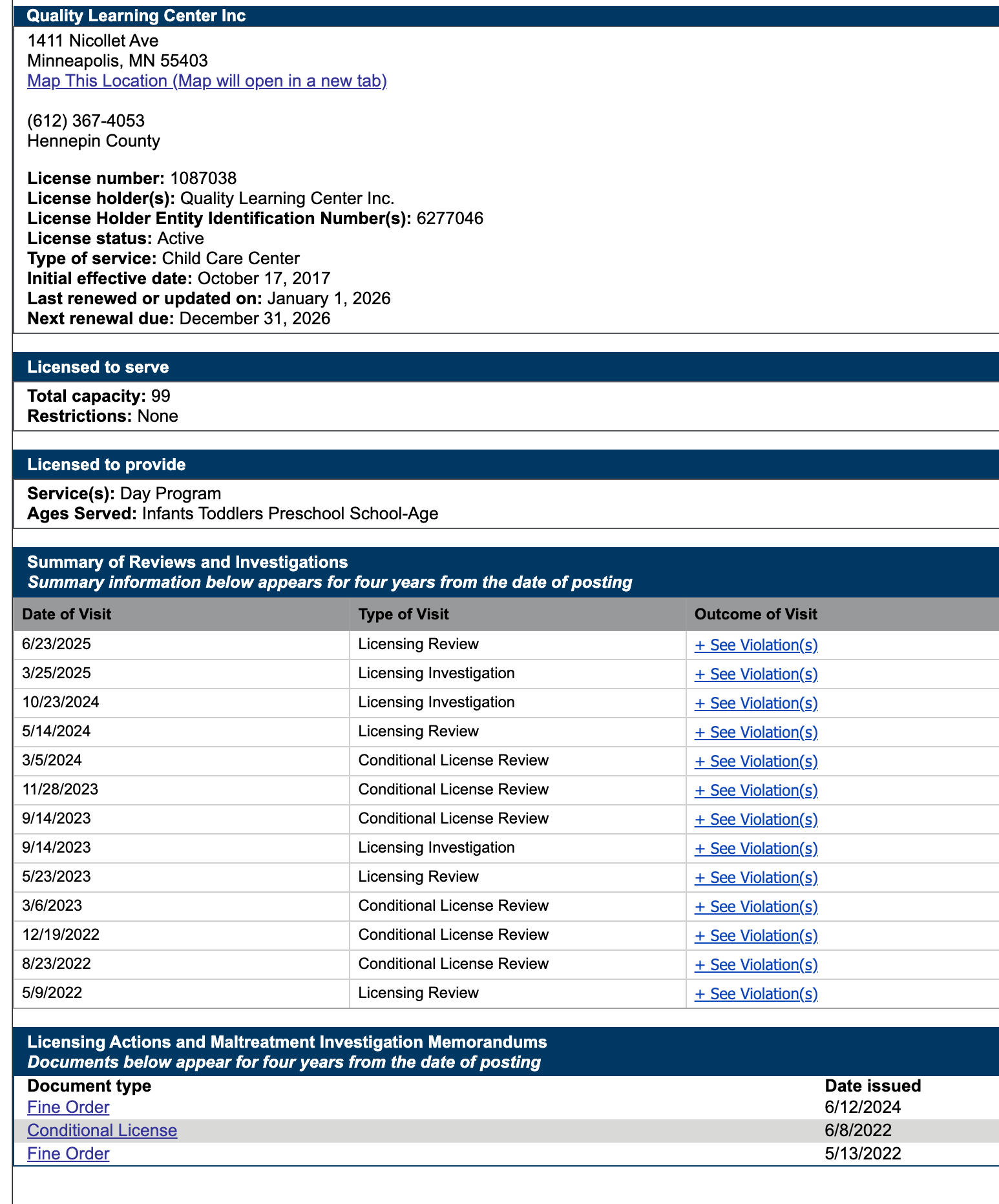
Why the indulgence? The daycare sat at the intersection of two political priorities: expanding welfare spending and demonstrating “equity outcomes.” Closing it would have reduced the department’s headline statistics for “families served” and exposed the porous oversight of immigrant‑run centers that had become politically untouchable. Keeping it open maintained the illusion of success.
The owners understood the incentives. Under a bureaucracy trained to see every failing provider as a victim of “systemic barriers,” the fastest path to cash was to master the language of grievances. Phrases like “community empowerment” and “cultural competence” became shields against scrutiny. DHS investigators, weary of being portrayed as insensitive, reported violations but rarely recommended termination. Everyone involved learned the same lesson: in Minnesota’s welfare regime, political narrative outranks performance metrics.
Legitimate daycares watched this from the sidelines. They hired certified teachers, bought liability insurance, paid payroll taxes, and waited months for reimbursements, while the state wired hundreds of thousands to centers that barely existed. Those with friends in politics called it “Partnership Development.” Others called it what it was, a license to steal.
By 2024, Quality Learning Center had stopped even pretending. The rooms were empty, “the staff gone,” but the money still arrived on schedule. The fraudsters were only doing openly what the ruling class had done for decades under more refined auspices: collecting the spoils of public virtue.
A Timeline of Permission
2017
Quality Learning Center Inc. was issued a child care license at 1411 Nicollet Ave, Minneapolis.
2022
The center is placed on a Conditional License and fined after repeated violations.
This is a warning status, not a clean approval.
2023–2024
Multiple licensing investigations and reviews occur.
Violations include missing records, improper supervision, and failure to operate in accordance with license terms.
March–June 2025
Additional investigations find continued noncompliance, including children present without documentation and programs not operating as licensed.
August 1, 2025
A restaurant — Albi Kitchen — opens at the same licensed address, replacing the daycare’s physical operation.
January 1, 2026
Despite the address now operating as a restaurant, the daycare license is marked “Renewed” and remains Active, preserving eligibility for CCAP payments.
Under Minnesota’s CCAP system, payment eligibility is tied to licensing status, not real-time verification of operations. As long as the license remains active, reimbursement eligibility remains intact unless the state intervenes.
The Payouts — How the Numbers Work
According to DHS rate tables for 2024, a Minneapolis daycare could bill between $70 and $110 per child per day, depending on age and facility rating. A center licensed for ninety‑nine children, claiming only eighty‑percent occupancy at $85 per day, would collect about $8,400 every week, roughly $440,000 per year for one classroom license. Multiplying that across rooms and a full‑year operation pushes revenue toward $2 million.
When investigators retraced the records for Quality Learning Center Inc., they found that during the first six months of 2024, when inspectors could locate no staff or children, the center still received about $1 million in payments, consistent with its previous billing pace. This was not a failure of accounting software but of governance. The regulations written and defended by state managers guaranteed payment to any provider with an “active” or “conditional” license. Revocations require a lengthy administrative hearing; hearings rarely proceed because they trigger public complaints of bias or hostility to minority‑run businesses.
That mechanism turns risk into entitlement. Providers learn that losing taxpayers’ money is safer than losing the narrative. The fraud becomes a predictable by‑product of a system that measures “success” by gross disbursement. It mirrors what happens nationally when the federal government announces another trillion‑dollar relief or infrastructure package: the object is not performance, it is throughput. Agencies are graded by the speed of their expenditure, not by their results.
By 2025, Minnesota’s CCAP budget had climbed from $285 million in 2018 to more than $520 million, an 82‑percent increase. Yet the proportion of children served showed little change, and the number of serious violations climbed sharply. The pattern looks less like social policy than like a revenue‑sharing plan among bureaucrats, consultants, and politically favored operators. Quality Learning Center simply removed the pretense.
The Empty Classroom
By early 2024, anyone visiting the building on Nicollet Avenue could see that no daycare operated there. The play mats were stacked against the wall, the security cameras unplugged, the mailed inspection reports piling in a corner. Nonetheless, the DHS licensing database continued to show “Active.” A reviewer even entered the note “renewal initiated” three weeks after the last staff member quit.
That small detail captures a larger truth. Bureaus are rewarded for closing data gaps, not for confronting physical realities. To mark the center as inactive would have lowered the Department’s metrics for “service capacity.” It was safer to renew automatically, generate a new compliance form, and charge the next audit to taxpayers. The daycare lived on in spreadsheets because that is where bureaucracies live, inside rows and columns, unbothered by evidence.
By mid‑summer, the property was under renovation. Contractors were tearing out drywall to build a commercial kitchen for what would become Albi Kitchen, a restaurant that opened in August 2025. Visitors ate lunch under fluorescent lights while the same address remained on DHS websites as a functioning childcare center. The paperwork reality and the physical world diverged completely, and no one inside government considered reconciling them. Acknowledging failure would require risking budgets.
Quality Learning Center was not an accident; it was a logical product of a system that equates documentation with truth and subsidy with compassion.
The Bureaucratic Excuse Factory
When reporters exposed the scandal, the Department of Human Services issued a calm statement: “A conditional license requires compliance with special terms for the program to continue operating.” In agency-speak, that means “we handled it correctly.” The department treated its inability to prevent fraud as proof that additional “program support” was needed.
This self‑referential reasoning defines much of contemporary governance. Every mistake justifies expansion. When oversight fails, the conclusion is never that the mission should contract but that it should hire more people and create new units; Integrity Offices, Equity Offices, Accountability Task Forces. Each position filled is another ally bound to the system that created the scandal.
That pattern extends to the federal level. USAID’s “capacity building” contractors bill for audits that rarely occur. Education reform consultants launch five‑year studies that recommend more consultants. The Department of Housing commissions diversity evaluations of projects that have already exceeded their budgets. The technique is identical in every Democrat‑run bureaucracy: spend first, moralize later, never refund.
Within DHS, this culture meant inspectors became facilitators. Their mission subtly shifted from protecting children to protecting agencies from embarrassment. Any center accused of fraud was reclassified as “out of compliance” rather than “under investigation.” Internal memos framed enforcement as “technical assistance.” The managers who perfected that language were later promoted to advisory roles or left for nonprofit partners that contract back with the state.
Such arrangements blur the line between legitimacy and illegality until the two are indistinguishable. The daycare that commits fraud merely does openly what many agencies do institutionally: convert public virtue into private job security. The tragedy is that the people who pay for these comforts are the parents whose taxes fund them, and the children who never see a real classroom.
A Tale of Two Daycares
Numbers never lie when incentives are this crooked. To understand how Minnesota’s daycare system became a trough for insiders, compare the records of two centers operating under identical rules.
According to Minnesota Department of Human Services records, Quality Learning Center Inc. (1411 Nicollet Avenue South, Minneapolis) has been licensed since 2017, with a capacity of 99 children, and has an active license extending through 2026. Between 2022 and 2025, the department logged more than 95 violations, ranging from unsupervised children and unqualified staff to failed background checks, missing immunization records, unsafe furniture, and recurring cleanliness and safety hazards. Inspectors found meals out of compliance with federal nutrition standards, electrical outlets without shields, and hazardous objects accessible to toddlers. The center was fined twice and operated for years under a conditional license.
DHS summaries show that only one or two minor issues, such as missing postings, were fixed on site. The rest were marked “Correction Documentation Submitted and Approved,” indicating the provider submitted paperwork rather than proof. Despite that pattern, the license remained active and payments from the Child Care Assistance Program never stopped.
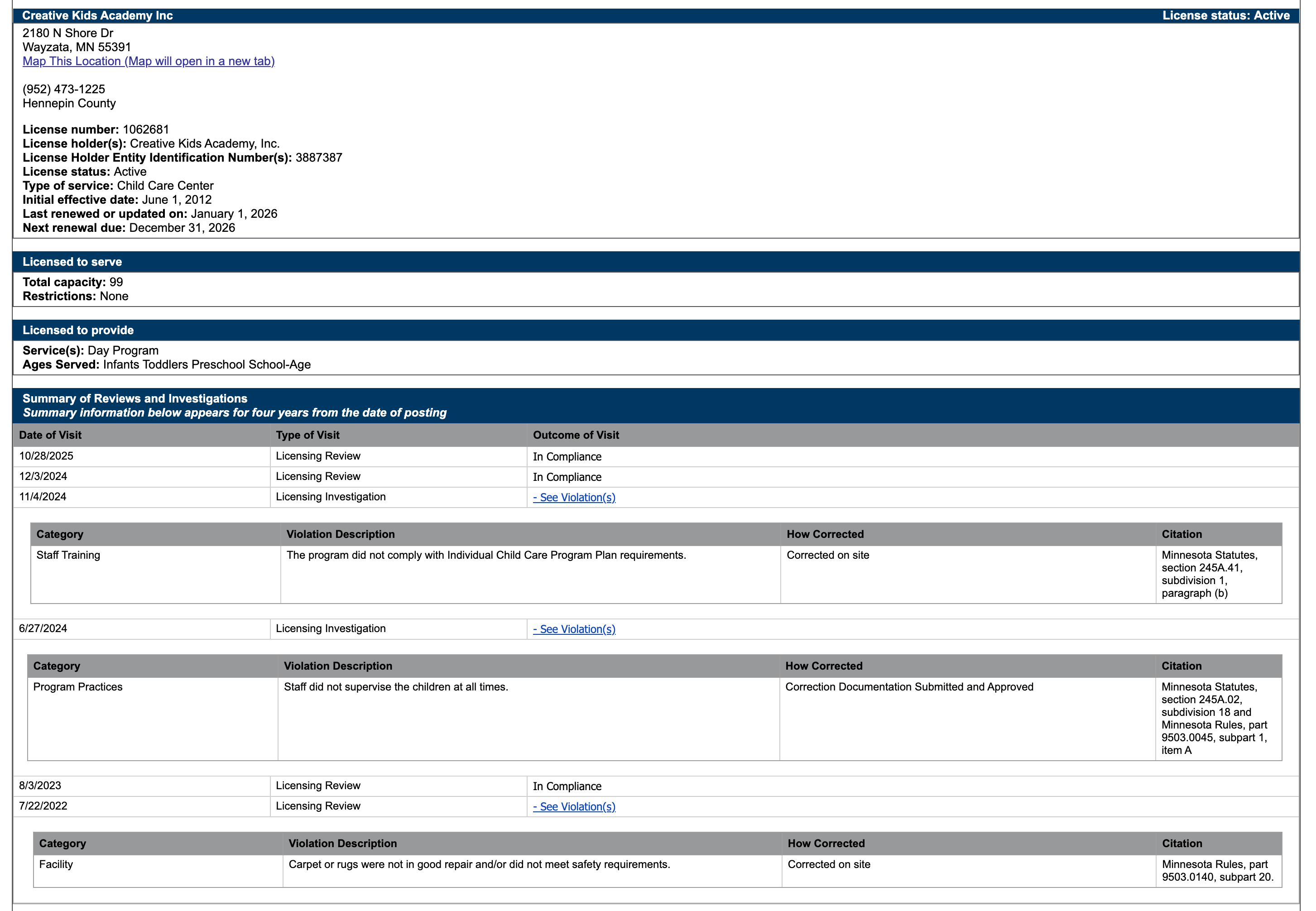
Placed beside Creative Kids Academy in Wayzata, which corrected three minor violations during inspections and now shows a clean record — the difference is stark. The same regulatory agency punished the center that cooperated while protecting the one that ignored its orders. The disparity has nothing to do with resources or competence; it reflects political incentives. The honest provider followed the childcare rules. The dishonest one followed the rules of government.
The case file tells the rest. Quality Learning Center operated under a conditional license renewed twice, collected roughly $7.8 million in reimbursements over six years, half during known non‑operation, and listed relatives of the owner as cash‑paid “employees.” Inspection logs even bear signatures from supervisors no longer employed by DHS, yet quarterly payments continued to clear.
The comparison exposes a simple law of bureaucratic economics: integrity is a liability. The careful operator invests in compliance, training, and payroll to stay solvent; the hustler exploits paperwork and earns more in months than an honest business in years. The state treats them alike because bureaucracy measures compassion by the volume of money it moves, not by the results it achieves.
From the government’s perspective, both daycares “served families.” One actually cared for children. The other existed to produce the numbers that justify the budget. In this system, morality is irrelevant; what counts is motion, the perpetual transfer of other people’s money.
The Political Incentive Structure
Minnesota’s political establishment did not ignore fraud; it monetized it. The purpose of ever‑expanding social programs is not reform but retention, retention of contracts, staff, and voters. High spending guarantees all three. When welfare dollars pass through a web of nonprofits, “consultants,” and progressive advocacy groups, every node in that web becomes a loyal client.
At the county level, administrators negotiate with those same NGOs for “community‑outreach” roles; at the state level, legislators appear at their banquets to praise diversity and showcase partnership. Campaign contributions flow quietly from those nonprofit boards back to the politicians who fund them. In this sense, the state operates as a brokerage house for influence. The daycare sector, small in comparison to healthcare or housing, reflects the same structure in miniature.
The fraud that took down Feeding Our Future in 2022, over three hundred million dollars in fictitious food claims, had many of the same players: paper nonprofits, friends of state employees, and consultants who once held grants themselves. None of it stopped the next program from expanding. The political calculus is too profitable. Media scandal costs less than alienating loyal operators who mobilize voters and funnel campaign cash.
This is why enforcement fails even when the evidence is obvious. Closing a fraudulent center will appear on the nightly news for a week; funding one produces years of quiet gratitude from benefactors. Rational actors in politics choose the latter. Compassion is a marketing term; patronage is the business model.
To believe that overspending arises from misplaced generosity is to misunderstand the machinery. Bureaucratic waste persists because it feeds people who matter to elected officials. They are not trying to solve poverty; they are trying to manage dependency. The poorer the community, the more programs it requires, and the more contracts those programs generate. Fraud is merely the overflow. It is tolerated because it supports the greater objective, keeping public money in motion.
The Numbers in Perspective
Seen statistically, Minnesota’s childcare fraud is not an outlier but a ratio: the quantifiable portion of a larger, largely legal transfer scheme. Between 2018 and 2025, CCAP funding rose from approximately $285 million to more than $520 million, while the total number of program‑certified children rose less than ten percent. Adjusted for inflation, the cost per child nearly doubled.
Over the same period, DHS recorded a tripling of “serious violations” among licensed providers. In 2018, roughly 150 centers fell into that category. By 2025 the number surpassed 450. The department’s published summary did not call this a failure; it referred to it as “expanded engagement with providers experiencing challenges.” The language of rescue replaced the language of enforcement.
State legislators, citing these exact figures, congratulated themselves on “historic investments in families.” They used the spending increase as political proof of compassion. Yet even DHS’s internal audits show that fewer than half of licensed centers have passed a full‑year inspection since 2020. The data tell a familiar story: record spending, declining outcomes, no reform.
At the federal level, the scale is astronomical. The Government Accountability Office estimates that waste, fraud, and abuse across social‑service programs amount to roughly 5% of outlays each year, about $200 billion in 2025 terms, equal to the GDP of a small nation. The real number is likely higher because much of it is “lawful inefficiency,” money steered to political allies under charitable pretenses. Every state that replicates the Minnesota model adds another layer to that total.
For taxpayers, these statistics describe a transfer not of wealth but of responsibility. The productive class pays for an industry that exists to service itself. The honest provider, the working parent, and the child needing genuine care are background noise to a bureaucracy whose primary goal is survival. Quality Learning Center Inc. was therefore not exceptional; it was simply smaller, clumsier, and less discreet than the professionals directing the broader game.
The Reckoning
By the end of 2025, the story that had once sounded like a rumor had become headline news. YouTubers filmed the old daycare on Nicollet Avenue, which is now a restaurant. Political offices rushed to issue their damage control statements. Treasury officials in Washington confirmed an inquiry into whether any of the missing funds had been moved overseas through informal hawala networks. Representative Tom Emmer demanded explanations from Governor Tim Walz. The governor announced an audit, an integrity task force, and a promise of new “training for equitable oversight.” The pattern repeated exactly as it had after every earlier scandal.
Minnesotans had seen this play before. The Feeding Our Future prosecutions, the Medicaid housing fraud, and the autism therapy cases all ended with speeches calling for more resources and better communication. Not a single structural reform followed. The same lawyers who drafted the last reforms were hired to write new ones. The same commissioners remained in office. No one paid back the money.
When journalists visited 1411 Nicollet Avenue, they found the restaurant full of paying customers, yet the state’s website still listed the property as a licensed daycare. The illusion had survived longer than the building’s original purpose. In the logic of bureaucracy, that counted as proof that the “program remained active.” It captured perfectly the moral arithmetic of government: if the spending continues, the mission must be working.
The public outrage faded, as it always does. Working families moved on to the next crisis in groceries, rent, or taxes. The people who designed this arrangement understood that attention spans are short. Programs grow quietly, but reform requires noise. Silence favors the bureaucrat. The scandal passed. The system remained.
What Real Accountability Would Look Like
Accountability is not complex. It simply means requiring proof. In the private world, no one gets paid for a service they cannot document. In government, that principle is described as “innovation” whenever someone rediscovers it. A serious reform of Minnesota’s childcare programs would begin with verification. Parents should confirm each day’s attendance by secure digital check‑in, not paper sheets. Providers should match payroll and background checks against enrollment before billing. Any center with unresolved violations should have payments stopped automatically until the issues are cleared. These are basic controls that cost less to enforce than the losses they would prevent.
Structural change would separate licensing from payment. The agency that promotes daycare growth should not be the same one that distributes money and reports on its own success. Publishing every subsidy payment as open data would do more for honesty than ten new task forces. The public can patrol waste better than bureaucrats ever will if given transparent numbers.
States that tried this approach have proved it works. When Florida and Texas moved to electronic attendance logs and automatic holds for non‑compliance, subsidy fraud fell by almost forty percent within a year. The honest providers gained customers. The dishonest disappeared. The reforms did not require reinventing government; they required admitting what government had become.
Minnesota already owns the necessary technology and legal authority. What it lacks is will. Real accountability threatens too many comfortable careers. Bureaucracies fear closure more than embarrassment. They will accept headlines about inefficiency as long as the money still arrives on schedule. Courage is the scarcest commodity in public service precisely because the system rewards its absence.
The Price of Pretend Compassion
Today, late in 2025, the state’s database still lists Quality Learning Center Inc. as an active provider. The restaurant that replaced it does a brisk trade at lunch and pays rent on time. On paper, the old daycare still “serves families.” That is how governments measure progress, by words, not by results.
For generations, the Democrat governing philosophy has equated compassion with expenditure. If a policy fails, spend more. If oversight fails, add committees. Each increase proves moral superiority. Yet compassion without accountability is not virtue. It is vanity with a price tag. The price is paid by citizens who obey the law and fund the failures they are told to admire.
Quality Learning Center was only one incident, but its ghost license stands for many. It represents the schools with endless funding and stagnant test scores, the housing projects that disintegrate while budgets rise, the social programs whose paperwork multiplies faster than the help they provide. Each functions as a monument to the same illusion, that intentions outweigh incentives.
Thomas Sowell often wrote that when you subsidize something, you get more of it. Minnesota subsidized failure. It financed incompetence, rewarded deceit, and congratulated itself for caring. The result was predictable: more failure, greater deceit, larger budgets. The old daycare on Nicollet Avenue is therefore not an oddity but a symbol. It is the portrait of a society that mistakes the movement of money for the presence of mercy.
If Minnesota ever wishes to be progressive in any real sense, it must progress toward the truth. Compassion that ignores evidence is not compassion at all. It is self‑congratulation funded by people who cannot afford the praise.
That is the price of pretended compassion, an empty classroom that still earns applause on paper.
Why This Work Exists — and Why It Needs Backing
This piece was not written to go viral.
It was written because the public record said something no one wanted to say out loud.
Everything you just read is drawn from government documents, inspection records, photographs, and timelines that exist whether anyone looks at them or not. Most people never do. Institutions count on that.
This is what independent work looks like when grants, nonprofits, political committees, or advertising incentives do not fund it. It looks slow. It looks uncomfortable. It looks like reading hundreds of pages most reporters will never open.
And it only continues if readers decide it should.
If you believe public money should be tracked all the way to its real-world use — not just until it clears a spreadsheet — then supporting this work is how that happens.
Become a Paid Subscriber
Paid subscribers make it possible to spend time where institutions would rather no one look: licensing files, enforcement gaps, and programs that survive on inertia instead of performance.
Your subscription funds:
document review and archiving
long-form investigations that don’t fit news cycles
follow-ups when agencies refuse to answer
Subscribe here: https://mrchrisarnell.com/subscribe
Make a One-Time Contribution
If a monthly subscription isn’t for you, a one-time contribution still matters. It directly offsets the time and cost of producing work like this — and signals that this kind of scrutiny is worth sustaining.
Support once: https://mrchr.is/give
Join The Resistance Core
This tier is for readers who see this work as something that should exist long-term and want to make a stronger statement of support. It defaults to $1,200 per year, but you can adjust it to any amount that makes sense for you.
Think of it less as a donation and more as a once-a-year vote for clarity over noise.
Join here: https://mrchr.is/resist
If You Can’t Give
The simplest form of support is attention with intention. Share the piece. Save it. Reference it when the same institutions insist nothing is wrong.
Sunlight only works if it’s aimed deliberately.
It's a money laundering scheme. How much have these Somali criminals donated to Walz, Ellison, and the Democrat Party?
The MSM, liberal politicians, and self-loathing wokesters have all conspired to hide or minimize the extent of this fraud because calling it out is apparently "racist" and "islamophobic".
If anything, this fiasco illustrates the dangers of mass chain migration. Since Obama, there's been a concerted effort to settle huge numbers of these third world "immigrants" in concentrated areas where they have a significant impact on local and State politics. They have no desire or incentive to assimilate - in fact, they're hostile to our culture.
You don't have to be a conspiracist to think there's a bigger ulterior motive in all this. Obama promised to "fundamentally transform" this Country and that's what's happening. We're seeing cities taken over by unassimilated immigrants. Recently, the muslim mayor of Dearborn MI told a Christian to get out of the city because "he wasn't wanted" there and they even tried to change the insignia of the Dearborn PD to include Arabic. Somalis are such a powerful voting block in Minneapolis that mayor Fry gives speeches in Somali and a white, female politician donned a hijab (like a hostage, flanked by two Somalis) to express her "solidarity". The "Great Replacement" isn't a theory, we're watching it being shoved down our throats in real time. And not only that, don't doubt that the Cloward-Piven strategy isn't being implemented, too.
Liberals always argue that we're a "nation of immigrants". No we're NOT. We're a nation of AMERICANS. This Country didn't become successful because we stayed a collection of disparate immigrant groups who put their group's identity first.
The Fraud in Minnesota is just the tip of the iceberg.
Very timely article which provides details about CCAP funding mechanisms and negligent oversight. Like the 100+ million Americans that have watched the entire Nick Shirley video, I am just totally disgusted with our government, not just in Minnesota, but nationwide. I truly believe this rot has been festering for many years as the old "spoils system" has been (to use an Obama term) "reimagined" in its current form. I don't really see this as an entirely partisan issue. I think both parties have been more than willing to continue the non-stop uncontrolled spending of OPM (other people's money). I believe Mike Benz has done an outstanding job exposing how USAID and the explosive growth of NGO's have paved the way for the current corruption.
What's happened in Minnesota is just the natural outcome of perpetual bureaucratic expansion (growth of government). We have been on this path for over 70 years. Both parties talk about reigning in government growth, neither actually does anything about it. However, seems like the most progressive democrats no longer even talk about controlling spending or reducing bureaucracies. As you stated in this article, I doubt there will be an ounce of accountability or reform after the fanfare subsides concerning the tragedy in Minnesota. In fact, I predict Walz will be a cabinet member in the next administration.
Unfortunately, I do not believe we have enough common-sense Americans left to save this country. I don't see any signs of a majority population willing to say NO to more government spending. Not even the MAGA nation is willing to seriously cut spending and eliminate waste. DOGE fell flat on its face! Our national debt has morphed into warp speed and there is no realistic way to arrest it or reverse it at this point. We have mortgaged our grandkids grandkids futures...for what?
Especially disheartening, I hear the foolish campaign slogans of rising political charlatans like Mamdani promising "there is no problem too small for government to care about." The fact he was elected, and prospect of many more just like him in the future, truly extinguishes any cause for hope I might have had.
I appreciate your consistent reporting on truth. I hope you can continue to research and publish your hard hitting journalism. Unfortunately, the speech (censorship) trends I see in Europe, and the dark clouds looming over the mid-terms, do not bode well for your work either.