

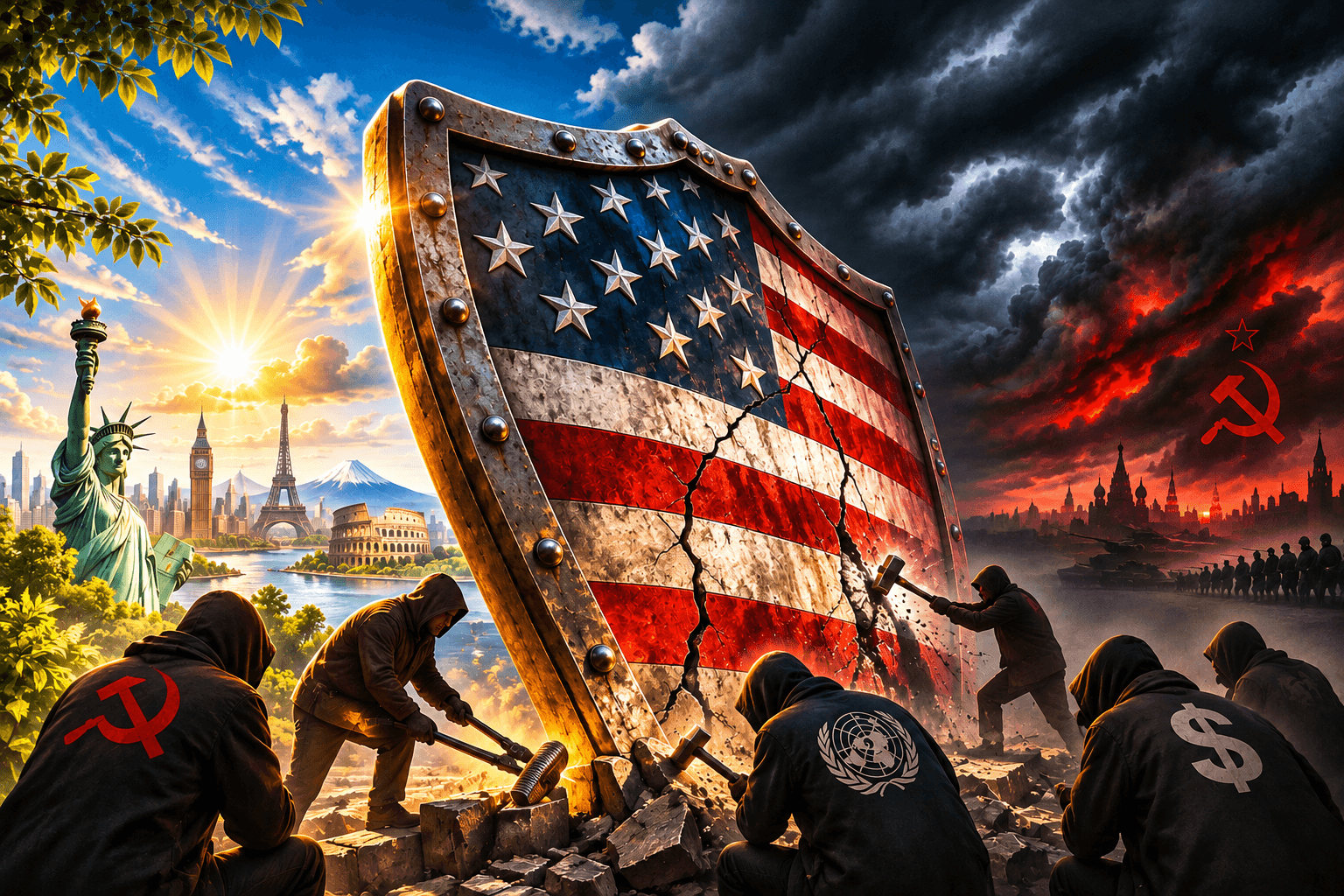
“And in the end, they’re not after me, they’re after you. And I just happen to be standing in their way.” — Donald Trump
I believe the ultimate target is America herself. For fifty years, powerful interests have been systematically dismantling the last barrier between the free world and global tyranny. America is the thin red, white, and blue line standing in their way. If she falls, who stops them?
I’ve been to East Germany when it was still under communist rule.
When I served in the United States Army in Germany, I had the opportunity to visit a city divided between two fundamentally different political systems. On one side was West Berlin, an enclave aligned with democratic West Germany, surrounded by communist East Germany, with private enterprise, political competition, and individual freedoms. On the other was East Berlin, the capital of a dictatorship that had built a wall to prevent its own citizens from escaping.
Imagine that. A government so confident in the superiority of its political and economic system that it had to build a wall to keep people from leaving. Apparently, the workers’ paradise wasn’t quite as popular with the workers as the government claimed.
The Berlin Wall came down in 1989, and two years later the Soviet Union collapsed. Americans celebrated because countries that had spent generations under communist domination finally had an opportunity to determine their own futures. But the Soviet Union’s disappearance didn’t eliminate authoritarian ambitions. It eliminated one particularly powerful government pursuing them.
China remains under the Chinese Communist Party. Russia has invaded Ukraine and continues using force to pursue territorial ambitions. Iran’s revolutionary government has spent decades financing armed organizations and projecting influence across the Middle East. North Korea remains a hereditary dictatorship where meaningful political opposition is virtually nonexistent. These governments disagree about plenty, but their rulers share a considerable appetite for power and a limited willingness to let ordinary people challenge it.
One country presents an obstacle none of them can afford to ignore: the United States of America. Its military strength, productive economy, technological capabilities, alliances, and willingness to oppose hostile governments restrict what authoritarian powers can accomplish beyond their borders. I believe America is the last great line of defense between the world we know and a world in which those powers would face far fewer obstacles to expanding their control.
For at least half a century, our schools, economy, national identity, immigration system, public institutions, and political culture have undergone profound changes. Some were born of sincere disagreements and some of incompetence, but I don’t believe their combined direction is fifty years of bad luck. Political and financial interests have spent decades working to change what schools teach, who exercises political authority, how much of the economy government controls, and what Americans consider normal. I believe some of those interests understand that an independent, constitutionally restrained America obstructs the political order they want, and are willing to weaken the country to achieve it.
The most revealing part isn’t any one controversy. It’s how the changes can strengthen one another: a citizenry less familiar with its constitutional traditions, political organizations working to expand government power, media institutions shaping which arguments are heard, an economy increasingly dependent on public spending and foreign supply chains, and an electorate that has less confidence in the system intended to resolve political disputes peacefully.
In a July 2023 speech, Donald Trump said, “And in the end, they’re not after me, they’re after you. And I just happen to be standing in their way.” He was talking about his political opponents and the American people. I’ve come to see something larger in those words. America’s power stands in the way of ambitions that extend well beyond Washington, and the world has no second America waiting to take her place.
The Country That Changes Everything
When World War II ended, much of Europe lay in ruins. The Soviet Union had emerged with enormous military power and control over much of Eastern Europe. America could have retreated across the Atlantic and left the Europeans to sort out another catastrophe, but instead it helped finance recovery through the Marshall Plan and joined eleven other countries in establishing NATO in 1949. An attack on a NATO member would now carry the risk of confrontation with the United States.
That changed the choices available to Soviet leaders. It didn’t make war impossible, but it raised the price of attacking countries that might otherwise have been overwhelmed individually. Western European democracies gained the security and breathing room to rebuild; Japan, South Korea, and other countries later developed formidable economies alongside American security commitments. The United States became more than another nation participating in world affairs. Its strength helped determine how much room other countries had to govern themselves.
The scale is still extraordinary. The Stockholm International Peace Research Institute estimates that the United States spent $954 billion on its military in 2025, about 33 percent of all military spending worldwide. China spent an estimated $336 billion and Russia $190 billion. America spent more than both combined, supporting aircraft, intelligence networks, advanced weapons, logistics, communications, personnel, and worldwide relationships no other single country can readily reproduce.
Take Taiwan. Its defense planning cannot ignore the possibility of American intervention against China. Japan and South Korea maintain serious military capabilities of their own, but their strategic calculations remain intertwined with American commitments. European governments are spending more on defense, yet NATO still relies heavily on American capabilities. Remove the United States from those calculations and every government involved must reconsider what aggression might cost and what protection might be available.
The international struggle over political freedom hasn’t disappeared with the Cold War. Freedom House reported in March 2026 that global freedom had declined for the twentieth consecutive year: political rights and civil liberties deteriorated in 54 countries during 2025 and improved in only 35. Twenty years earlier, 46 percent of the world’s population lived in countries rated Free. Now the figure is 21 percent, barely one person in five.
Most people alive today don’t live in countries Freedom House classifies as free. In many places, criticizing political leaders or organizing meaningful opposition can bring prison or persecution. Americans can criticize the president, publish controversial opinions, organize political movements, sue the government, and vote officials out of office. Try organizing a serious opposition movement against the Chinese Communist Party and see how accommodating the authorities become.
That freedom, and America’s ability to help other countries preserve theirs, depends upon capabilities that have to be maintained. Military power requires industrial strength, political legitimacy, educated citizens, resources, and national purpose. An adversary doesn’t have to defeat every American aircraft carrier if the country becomes too divided, dependent, or unstable to sustain the fleet and the commitments behind it.
A Fifty-Year Struggle Over the Institutions
People tend to imagine the destruction of a country as a dramatic event involving troops in the streets. But a nation’s character can change through legislation, court decisions, regulation, university curricula, professional standards, and political organizing. None requires an invasion, and most continue long after the people who initiated them have retired or died. Nor does a decades-long transformation require every participant to attend the same secret meeting: organizations can knowingly pursue overlapping goals, finance one another’s work, and hand their victories to the next generation.
Consider an American born in 2005. He has no memory of the country that existed in 1970. He doesn’t remember the Cold War, the earlier immigration system, or what Americans once regarded as the ordinary limits of federal authority. He knows the institutions and assumptions he inherited, and what his grandparents would have considered a radical departure may seem perfectly normal to him. Gradual change enjoys a considerable advantage: eventually, it stops looking like change.
Political organizations understand how this works, and some are remarkably candid about their objectives. The Democratic Socialists of America’s 2021 convention resolutions included demands to abolish Immigration and Customs Enforcement, remove voter identification requirements, expand citizenship pathways, and change the regulation and ownership of energy. Its ecosocialist Green New Deal supported bringing major energy systems under public ownership, expanding public employment, and guaranteeing certain necessities through public provision.
The same convention discussed electoral campaigns, congressional allies, labor organizing, political education, and media. That’s an important distinction from a collection of unrelated slogans. DSA’s members explicitly recognized that changing economic institutions requires political power, that winning political power requires organizing and persuasion, and that the results may outlast any one election. Marxism made control over the means of production a central political question; modern democratic socialists pursue a variety of approaches, but DSA’s calls for public ownership show that the old argument over who should control production hasn’t disappeared. I consider its program hostile to vital American traditions of private enterprise, constitutional restraint, and national independence. Its supporters describe it as a program for equality and economic justice. At least we can examine what they actually propose instead of guessing.
Then consider the money behind long-running political advocacy. George Soros’s Open Society Foundations reported about $1.2 billion in expenditures during 2024, with $242 million associated with its United States work. The foundations report more than $24 billion in cumulative expenditures. That’s enough money to support organizations, research, litigation, public campaigns, and personnel over many election cycles.
We can trace examples without inventing a secret organization pulling every lever. In 2002, the Open Society Institute publicly announced a $75,000 grant to the National Immigration Law Center for policy analysis, litigation, and advocacy involving immigrant civil liberties. A January 2006 announcement identified another $195,000 grant to NILC relating to immigrants affected by Hurricane Katrina. Open Society has also publicly identified the Brennan Center for Justice among the organizations it supported on voting-rights issues; the Brennan Center’s own 2022 annual report lists Open Society Foundations among its supporters.
What do such organizations actually do? In September 2021, the Brennan Center joined litigation challenging provisions of Texas Senate Bill 1, including restrictions on assistance to certain voters. In 2026, NILC and the Brennan Center were both among organizations involved in litigation against federal immigration-enforcement activities that they argued intimidated eligible voters. Those cases concern contested legal questions, not established proof of election fraud or sabotage. They do, however, show the mechanism: lawyers, advocacy organizations, public arguments, litigation, and government policy meeting in the same courtroom.
Those two lawsuits were not necessarily financed by the grants I just described, and a successful lawsuit isn’t evidence of a conspiracy. The documented point is more straightforward and more important: wealthy foundations can help sustain permanent institutions that seek changes through several channels, while the voters often focus almost exclusively on the candidates appearing on their ballots. A president has four years in a term. A foundation or advocacy network may operate for forty.
I believe many of these efforts are moving America away from the constitutional and economic principles responsible for her strength. The published programs establish deliberate political action; evidence that particular individuals intend to leave America defenseless against foreign powers would be a different, more demanding finding. But Americans shouldn’t pretend these policies emerge spontaneously. We can follow the grants, legislation, appointments, lawsuits, and institutional decisions, insist upon financial disclosure, challenge unlawful actions, and remove officials from office through elections. Political influence should never become immune to public accountability simply because it operates through a foundation instead of a campaign.
Education, Ideology, and Who Gets to Explain Reality
If I wanted to transform a country across generations, education would be one of the first institutions I’d try to influence. Decisions about standards, curricula, teacher preparation, and academic priorities affect what future voters understand about history, economics, law, and their own government. A citizen who knows those subjects can challenge political claims. Someone who doesn’t is more dependent on others to interpret them.
The National Assessment of Educational Progress found that only 31 percent of fourth graders met or exceeded its Proficient reading benchmark in 2024. In the 2022 civics assessment, just 22 percent of eighth graders reached that benchmark. Proficient is a demanding assessment standard rather than a synonym for basic literacy, but the results still describe serious weaknesses in education and civic knowledge.
And there are policy decisions we can actually name. In October 2023, Oregon’s State Board of Education extended the suspension of a separate graduation requirement that students demonstrate essential skills in reading, writing, and mathematics, through the 2027-28 school year. Students still take statewide tests and must satisfy other diploma requirements. State officials presented the decision as part of an effort to make graduation requirements more equitable. But it was a deliberate decision to stop requiring a particular demonstration of academic proficiency before awarding a diploma, at a time when educational performance already deserved greater scrutiny. That priority is fair game for criticism.
How can citizens recognize an abuse of governmental authority without understanding the limits of that authority? How do they judge promises of free healthcare, housing, or college without appreciating the cost of providing those things? Students eventually become voters, reporters, attorneys, doctors, teachers, government administrators, and elected officials. Educational weakness doesn’t remain in the classroom; its consequences follow graduates into every institution they operate.
I’ve met enough people with impressive academic credentials and remarkably little common sense to appreciate the difference between completing a course of study and learning to think. A diploma tells me someone satisfied a university’s requirements. It doesn’t establish that person can recognize a contradiction, calculate a trade-off, or defend a conclusion with evidence.
Educational policies don’t appear out of thin air. They have authors, sponsors, and officials who approve them, and those officials can be held responsible for predictable consequences even when they say their intentions were good. Suspending proof of essential skills at graduation is a deliberate choice to remove one measure of student performance, not proof of a secret plan to make children ignorant. But I believe too many institutional leaders have accepted weaker demonstrations of achievement while treating fashionable political priorities as more urgent than the knowledge children need to become independent adults. The resulting deficits eventually follow students into the professions and institutions running the country.
Consider socialism. My generation watched communist governments control production, suppress political opposition, and sometimes literally prevent citizens from leaving. Younger Americans are frequently introduced to socialism through promises of affordable housing, healthcare, college, and economic security. Those are attractive promises, especially when people are struggling. But wanting a benefit tells us little about whether a particular political system can deliver it, how it will be financed, or how much authority the government will acquire in administering it.
In September 2026, Gallup found that 43 percent of Americans viewed socialism favorably, the highest share in that polling series. The figure reached 57 percent among adults aged 18 to 34 and 65 percent among supporters of the Democrat Party. Capitalism still received a higher favorable rating nationally, at 55 percent, and people use the word socialism to describe very different policies. Nevertheless, the degree of acceptance among younger Americans represents a significant change in political attitudes.
Groups such as DSA openly promote political education, recruiting, and media activity in support of their economic program. Schools and universities influence the assumptions people bring to such arguments. Journalists choose which proposals receive attention and how the public encounters them. Poor civic education, organized ideological persuasion, and selective media coverage can therefore reinforce one another without anybody needing to issue a daily instruction sheet.
Researchers Maxwell McCombs and Donald Shaw described the agenda-setting function of mass media in a landmark 1972 study. Newsrooms influence which issues people consider important through decisions about coverage and prominence. Once that influence meets an audience poorly equipped to test claims against history or economics, political assumptions can become the background of ordinary life rather than propositions open to challenge.
A political movement advances an idea, an educational environment affects how readily the idea is accepted, and news coverage influences whether the public regards it as normal, extreme, urgent, or unworthy of attention. The result may be a change in what citizens consider proper government authority. And changes to government authority eventually change what politicians can do with it.
Immigration, Citizenship, and the Meaning of America
America has long welcomed immigrants, but immigration policy must deal with both legal admissions and unlawful entry. Successful immigration has also depended upon something modern political discussion too often treats as an inconvenience: assimilation. The American idea wasn’t merely that people with different backgrounds could occupy the same territory. It was that they could become Americans, sharing a constitutional system and a common civic identity without having to abandon every family tradition they brought with them.
That distinction becomes increasingly important when the pace of immigration changes. Congress rewrote the immigration system in 1965, replacing national-origin quotas with family and employment preferences. In 1986, another federal law legalized approximately 2.7 million people who had been living here without authorization while also imposing sanctions on employers who knowingly hired unauthorized workers. Those were deliberate, consequential political choices, not accidents of geography. Foreign-born residents represented about 4.7 percent of the population in 1970; by 2024, the figure was 14.8 percent, approximately 50 million people, matching the share recorded in 1890. A country can welcome immigrants and still confront real limits in housing, schools, healthcare, transportation, and local budgets.
The Congressional Budget Office estimated that the immigration surge beginning in 2021 could have raised state and local spending by $28.6 billion in 2023 while increasing revenues by $18.8 billion, leaving a potential net cost of $9.8 billion to those governments for that year. That doesn’t establish that every immigrant creates a fiscal burden, nor does it settle the long-run national economic consequences. It tells us something that national political rhetoric regularly overlooks: the costs and benefits of immigration fall on different people and different levels of government.
A family trying to afford a house doesn’t live inside an abstract gross domestic product statistic. A school district can’t produce teachers, classrooms, and facilities overnight simply because more residents have arrived. Businesses may welcome additional labor while existing workers face greater competition in particular occupations. Policies that affect the national economy favorably can still create serious pressure in communities expected to accommodate rapid population growth.
But I am more concerned about the loss of a shared American identity. A population encouraged to organize primarily around ethnic, religious, or ideological divisions can have greater difficulty agreeing upon common national priorities. Politicians acquire incentives to promise particular benefits to separate constituencies, while organizations compete to define every disagreement in terms of group identity. The country becomes a collection of interests negotiating for advantage instead of citizens who understand themselves as part of the same constitutional project.
That is one reason assimilation belongs in the same discussion as education and political organizing. The DSA resolutions discussed earlier place citizenship pathways, changes to voting rules, and political organizing inside a larger program. That does not prove immigrants are voting illegally, but it tells us those advocates understand immigration and political power as connected subjects. Schools teach the nation’s history, political movements explain what citizenship should mean, and elected officials set the rules governing entry, naturalization, and public services. Those decisions can encourage newcomers to join a common civic culture, or encourage everyone to think primarily as members of separate constituencies.
There’s a concrete example of what happens when citizenship itself becomes negotiable. New York City’s council voted in 2021 to permit certain lawful permanent residents and other noncitizens authorized to work in the United States to vote in municipal elections after meeting residency requirements. The measure was not permission to vote for president or Congress, and it wasn’t an allegation of illegal ballots. New York’s highest court struck the law down in March 2025 because it conflicted with the state constitution. Whatever one thinks of the proposal, it demonstrates a real attempt to move a core political privilege beyond the boundary of American citizenship, followed by a constitutional check that held.
Naturalized citizens can legally hold most elected offices, including seats in Congress after satisfying the Constitution’s citizenship requirements. Birthplace alone tells us nothing about whether someone will defend American freedoms. But neither should a naturalization certificate exempt an officeholder’s political ideas from scrutiny. The question for every official, native-born or naturalized, is which principles the official intends to preserve and which ones the official wants to replace.
Representative Ilhan Omar came to America from Somalia and became a naturalized citizen. She has called for abolishing Immigration and Customs Enforcement and in September 2026 introduced legislation proposing to redirect money allocated to federal immigration enforcement into affected communities. New York City Mayor Zohran Mamdani was born in Uganda, became an American citizen, and announced at his January 2026 inauguration that he would govern as a democratic socialist. His program includes rent freezes for regulated apartments, fare-free buses, and city-backed grocery stores. Their elections and right to advocate those programs are lawful; the question is what kind of government those proposals would produce. I regard weaker immigration enforcement and expanded public control over private markets as departures from important traditions of national sovereignty and limited government. It’s their policies, not their birthplaces, that Americans should challenge, defend, or reject.
America won’t preserve its character simply by continuing to call itself America. That character depends on people who understand the principles and obligations attached to citizenship. A nation unable to agree on what those principles are will struggle to maintain the unity necessary when foreign powers test its resolve.
The Economy That Makes American Power Possible
America’s military strength rests upon something more fundamental than aircraft carriers or fighter jets: the ability of its people and businesses to produce wealth. Factories need reliable energy and materials. Engineers develop technology, skilled workers make it useful, and investors commit resources before anyone can build sophisticated equipment. Congress can appropriate money for defense, but it cannot legislate a supply chain into existence.
Which brings me to one of my favorite expressions in American politics: government-funded. We hear it constantly in discussions of housing, healthcare, education, infrastructure, research, and public assistance. It makes Washington sound like a generous uncle reaching into his own pocket. But government obtains its money through taxes, other public revenue, and borrowing that creates obligations for the future. The resources ultimately come from the productive economy and the people financing it.
Call something taxpayer-funded and the relationship is obvious. Call it government-funded and politicians become generous benefactors distributing money they supposedly created. It’s an extraordinary arrangement: they can spend your money and then expect gratitude for their generosity. And if you question the results, someone will inevitably explain that the spending is for the children, the poor, affordable housing, healthcare, or another worthy purpose. A worthy purpose, however, is not evidence of a successful program.
The Government Accountability Office reported an estimated $186 billion in improper federal payments for fiscal 2025. Those payments weren’t all fraud; the category includes incorrect amounts, ineligible recipients, and transactions inadequately documented under the applicable requirements. That still represents an enormous failure of payment controls and accountability. The fact that an expenditure isn’t criminal doesn’t transform it into competent government.
The Congressional Budget Office reported a federal deficit of roughly $2 trillion for fiscal 2026, about $217 billion more than the previous year. This is a national problem, not an accounting exercise that can be blamed exclusively on the other party. The fiscal year unfolded under Republican control of the presidency and Congress, while many spending commitments and debt obligations accumulated over decades of decisions by both parties. The arithmetic doesn’t improve because we happen to like the politicians responsible.
Borrowing imposes costs. Interest payments consume resources that could support productive investment, public needs, or defense, and repeated deficits reduce the choices available when the next crisis arrives. Taxes are part of the same calculation. They finance genuine public obligations, but higher taxes can also reduce the return from taking a job, building a business, expanding a factory, or risking capital on a new invention. Every dollar politicians promise to spend must first be collected, borrowed, or created through the monetary system, each with consequences somebody must bear. A government that grows more expensive while making private enterprise harder to operate can undermine both household independence and the industrial capacity upon which national power rests.
In 2012, Free Market America released If I Wanted America to Fail, a video built around an uncomfortable thought experiment. What policies might someone promote if the objective were to weaken America’s prosperity while convincing voters those policies were beneficial? Expensive energy, obstacles to production, expanding bureaucracy, economic dependency, and an education system teaching succeeding generations to distrust capitalism all belong in that discussion. The point is to measure what policies accomplish, not just applaud the intentions announced at the press conference.
Energy is a useful example because the United States produced an average of approximately 13.6 million barrels of crude oil per day in 2025, remaining the world’s largest producer. That’s a tremendous advantage, and any argument claiming domestic oil production has simply been shut down would be nonsense. But military and industrial strength depend on more than crude production. Refineries, pipelines, electricity, manufacturing capacity, and reliable supplies of materials all matter; restrictions or failures anywhere along that chain can change the cost and feasibility of building things here.
One vulnerability is unusually concrete. The U.S. Geological Survey reported in its Mineral Commodity Summaries 2026 that the country was completely dependent on net imports for 13 of the 60 designated critical mineral commodities and at least 50 percent dependent for another 20. China was the leading source for eight of those 33 commodities. A country that relies upon potential adversaries for essential industrial inputs has given those adversaries leverage it would be foolish to dismiss.
The Defense Department has identified rare-earth magnets as necessary for systems including the F-35 fighter, submarines, Tomahawk missiles, radar, unmanned aircraft, and precision-guided bombs. In 2022, F-35 deliveries were temporarily halted after a Chinese-origin alloy was discovered in a magnet inside the aircraft’s turbomachine pump. The Pentagon ultimately granted a national-security waiver, but the episode exposed how a single foreign-sourced component could interrupt a sophisticated American weapons program.
China has also used export controls affecting critical minerals such as gallium, germanium, and antimony. The uses aren’t academic: these materials are important to semiconductors, infrared equipment, ammunition, and other industrial or defense applications. China doesn’t have to defeat an American squadron to complicate its replacement or repair. It can exploit weaknesses in the supply chains on which that squadron depends.
Energy, materials, factories, investment, skilled labor, and technological independence determine what America can build, maintain, and replace. Weakness in those systems eventually limits military readiness and diplomatic leverage. You don’t have to destroy an aircraft carrier if you can undermine the industrial system needed to build its replacement.
Whose Money, Whose Authority?
American foreign assistance is often defended in humanitarian or diplomatic terms. Some programs have delivered medical treatment, emergency supplies, and other useful services. But taxpayers are entitled to know where their money goes, who handles it, whether the expenditures can be audited, and whether the work advances American interests rather than those of governments hostile to us.
In an information brief published in 2026, USAID’s inspector general described independent audits covering nearly $3 billion in foreign-assistance expenditures from October 2023 through March 2026. The audits identified more than $50 million in ineligible or unsupported questioned costs. Questioned costs aren’t automatically fraud, but they are expenses for which auditors identified an eligibility or documentation problem requiring attention. When Washington sends money around the world, basic financial controls aren’t an unreasonable demand.
There is an even more troubling example of American resources reaching a government hostile to American interests. In May 2024, the Special Inspector General for Afghanistan Reconstruction reported that 38 U.S.-funded aid partners had paid at least $10.9 million in taxes, fees, utilities, and duties to Taliban-controlled authorities since August 2021. Those payments arose from programs intended to assist Afghans, not from an announced American policy to bankroll the Taliban. But the money nonetheless reached a regime that suppresses fundamental freedoms, and inspectors found that other aid passing through United Nations organizations was not adequately tracked at the subcontractor level. The Taliban was also accused of pressuring organizations to divert aid. Our money was meant to help ordinary Afghans; at least part of it benefited the government ruling over them.
That finding also exposes the limitation of arguing solely about which foreign politicians are friendly to America. A federal agency can have a humanitarian objective, and its partners can still pay required fees to the authorities ruling the territory. The people who control access to aid may acquire money or leverage without anyone in Washington openly endorsing their ideology. The lesson for foreign assistance is to follow the intermediaries and their obligations, not just the American press release announcing the grant.
An investigation involving two United Nations humanitarian projects in Venezuela offers a particularly instructive example. The projects were worth approximately $900,000, and investigators examined allegations involving about $393,000 in fraudulent losses. American investigators requested records from UN offices but, according to the inspector general, couldn’t obtain the information needed to continue. The inquiry was closed without a determination about further criminal, civil, or administrative action.
The inspector general also reported that UN investigators referred findings of criminality to the Maduro-led Venezuelan government while withholding identifying information from their American counterparts. Think about that arrangement: American money helps finance international work, American investigators seek to examine alleged wrongdoing, and the records needed for that examination remain outside their reach. The amount involved in this case is small beside the federal budget. The principle is not small at all.
Why should American taxpayers finance operations structured so that American authorities cannot obtain adequate information about suspected misuse? And why should an international organization’s internal rules substitute for public accountability? I’ve also questioned whether American assistance routed through international institutions has indirectly sustained hostile leftist governments and political movements, particularly in countries such as Venezuela. The Venezuela investigation establishes an oversight failure, not a proven payment to Maduro’s government or proof of a campaign to weaken America. The Taliban audit demonstrates a different, documented route through which money intended for vulnerable people benefited the authority controlling their country. The political character of the regime changes; the danger of losing track of beneficiaries doesn’t. If foreign assistance serves American interests, officials must be able to establish where the money actually went.
The broader sovereignty issue is related. The United States helped found the United Nations and retains a permanent Security Council seat with veto power over substantive resolutions. International cooperation has value, particularly where it helps coordinate efforts against aggression. But cooperation doesn’t require Americans to treat unelected international institutions as superior authorities over their constitutional government.
The International Criminal Court illustrates the tension. America has never joined the Rome Statute establishing the court, but its jurisdictional rules can reach alleged crimes committed on member-state territory even when the accused is a citizen of a nonmember country. The United States has disputed that claimed authority for decades, including through legislation enacted in 2002. In July 2026, the Justice Department again rejected ICC jurisdiction over American persons. That does not mean the ICC has replaced American courts or that every international agreement is a surrender of sovereignty. It means an international institution asserts a form of jurisdiction the United States has expressly refused to accept, and the disagreement is far from academic for Americans operating abroad.
Our Constitution establishes how Americans choose leaders, enact laws, and hold public officials accountable. We don’t elect the judges and officials of international courts or agencies. Washington can sign agreements and work with allies without handing unelected institutions authority that belongs to the American people. A country expected to resist authoritarian power abroad ought to remain serious about protecting its own constitutional independence at home.
You Don’t Have to Lie to Deceive
One of the most effective ways to influence a population is to influence which information it receives and how that information is presented. A reporter doesn’t have to publish a false sentence to create a misleading impression. An editor can select a headline, omit context, emphasize some details, minimize others, or devote days of attention to one politician’s scandal while giving another a brief mention.
Take an actual Associated Press headline from April 2026: “Accused attacker at Washington media dinner is a tutor and computer engineer from California.” The article concerned Cole Tomas Allen, who was accused of firing a shotgun at the White House Correspondents’ Association dinner attended by President Trump and his administration. Federal prosecutors charged Allen with attempting to assassinate the president and assaulting a federal officer; the allegations remain allegations unless established in court.
The story concerned an alleged attempt on a president’s life, yet the headline’s most memorable information was the suspect’s profession and background. Those details may be appropriate in a profile, but their placement influences how readers encounter the allegations. Another headline might identify an “AR-15-style rifle,” while a report about comparable equipment uses obscure technical language; a phrase can summon associations before a reader reaches the facts. The same thing happens with immigration terminology. In 2013, the Associated Press changed its style guidance to avoid applying “illegal” to a person, while retaining the term for an unlawful action such as illegal immigration. The stated purpose was precision and respect, but the choice also changed which words readers encountered when discussing legal status. Vocabulary is part of the framing, whether an editor acknowledges that political effect or not.
One headline doesn’t prove a national conspiracy, and I don’t need one to explain my concern. What interests me is whether comparable events receive comparable treatment across political lines. Which suspect gets humanizing biographical details? Which politician gets the most hostile headline? Whose mistakes become weeklong scandals, and whose become yesterday’s news? Those decisions are made every day by organizations with enormous reach and considerable influence over public attention.
I believe major news organizations have repeatedly used that influence to disadvantage conservatives while protecting liberal politicians and political ideas. The result isn’t merely that a reader might like one president more than another. When coverage consistently shapes what people regard as important or credible, it helps determine the conditions under which political arguments are won or lost.
This is where the connection to education becomes particularly serious. Someone familiar with American history and constitutional government has more resources for detecting a distorted account. Someone who lacks that knowledge must rely more heavily upon the institutions reporting the story. If those same institutions repeatedly supply selective context, even skeptical readers can absorb assumptions they never had an opportunity to examine.
Gallup found in 1972 that 68 percent of Americans had a great deal or fair amount of confidence in mass media to report the news fully, accurately, and fairly. The figure fell to a record low of 28 percent in 2025 and recovered to 33 percent in 2026. That recovery is worth acknowledging, but the longer trend remains extraordinary: roughly two-thirds of Americans now lack that degree of confidence in journalism.
Trust can deteriorate for many reasons, including political polarization and audiences’ own preferences. But a society in which large portions of the public distrust the institutions explaining national events faces a problem extending well beyond journalism. The same people are expected to accept election results, public-health decisions, military commitments, and economic sacrifices based partly upon information supplied by institutions they no longer believe.
And it doesn’t help that a misleading narrative can circulate far beyond the outlet that originated it. A headline moves through social media, television commentary, political advertising, and ordinary conversation. Millions may encounter the interpretation without ever reading the report or inspecting the underlying evidence. The citizen who cannot independently test the claim has little defense against its repetition.
When Elections No Longer Settle Arguments
Our constitutional system offers a remarkable alternative to political violence. Candidates campaign, citizens vote, officials count and certify the results, and the winners assume office. The losers retain the right to criticize their government, organize opposition, and try again. That arrangement makes defeat bearable without turning each election into a struggle in which one faction must physically destroy the other.
But the process depends upon confidence that the rules are administered fairly and that citizens can examine credible evidence when something appears wrong. Political legitimacy isn’t a ceremonial certificate the government awards itself. It’s a relationship that must be sustained through transparent procedures, lawful administration, and accountability when officials fail.
I’ve expressed my belief that the 2020 presidential election was stolen, and I remain concerned about the political and administrative circumstances surrounding it. Official recounts and audits, including Georgia’s statewide hand count, confirmed Biden’s victory there. For my belief to persuade anyone who doesn’t already share it, it needs evidence identifying misconduct and showing that the misconduct affected the result. Suspicion is a reason to ask questions, not a substitute for answering them.
Heading into 2024, I suspected the Democrat Party expected years of attacks on Trump’s character, criminal prosecutions, hostile coverage, and what looked to me like manufactured electoral support to keep him out of office. He won anyway. The attacks and prosecutions were plainly visible. Whether political enthusiasm, fundraising, or votes were actually fabricated is a different allegation and requires evidence, not just a theory about what the opposition intended.
Then came the November 2026 midterms. The Associated Press called Democrat control of both chambers of Congress, a striking reversal from unified Republican government. I’ve wondered whether those trying to defeat Trump’s movement overcompensated, and whether some reported results warrant closer inspection. That is my suspicion, not a demonstrated finding of fraudulent ballots or manipulated totals. A large electoral swing can occur without fraud; evidence from particular jurisdictions, not the size of the swing alone, would have to establish wrongdoing.
The questions worth pursuing are concrete. How many people registered and checked in? How many ballots were issued, returned, counted, rejected, or cured? Can those records be reconciled? Were the procedures followed, and what did any audits or recounts find? If election officials administer their systems competently, they should welcome methods that allow the public to verify the count while protecting legitimate voter privacy.
Before the 2026 midterms, Pew Research Center found that only 55 percent of Americans were confident the elections would be conducted fairly and accurately. The other 45 percent didn’t all believe elections were stolen, but the size of the confidence gap is troubling. A republic cannot function indefinitely on the assumption that every disputed result is fraudulent, nor can it prosper when officials respond to legitimate questions by demanding blind trust.
There is a more dangerous consequence than another angry election season. If enough citizens conclude that peaceful political change is impossible, some may begin treating violence as the only remaining instrument of politics. History is full of societies where broken institutions gave way to persecution, political executions, death squads, and retaliation. I fear an American future resembling those places, and that is precisely why transparent elections, equal law enforcement, peaceful accountability, and constitutional limits are worth defending now.
A country consumed by internal conflict also becomes strategically vulnerable. Its leaders lose the freedom to make difficult commitments abroad; military planning becomes subject to domestic instability; allies question whether American promises will survive the next crisis. Foreign adversaries need not create every domestic division to benefit from them. They merely have to recognize an opportunity when it appears.
The World Waiting on the Other Side
Argentina elected Javier Milei in 2023 on a platform of sweeping economic reform. Bolivia elected Rodrigo Paz in 2025, ending nearly twenty years of presidential rule by the Movement Toward Socialism. Chile elected José Antonio Kast, who assumed office in March 2026 after campaigning on a conservative platform. These countries have different histories, and their leaders don’t all agree about how to govern. But the elections show that millions of voters outside America are searching for alternatives to entrenched political arrangements and, in some cases, greater economic independence from the state.
America’s role in their decisions isn’t hypothetical. In February 2026, Washington and Milei’s government signed a reciprocal trade and investment agreement, explicitly describing their partnership in economic and national-security terms. Congressional researchers have likewise described efforts by Washington and Kast’s administration to deepen security and commercial ties and secure supply chains. China was Chile’s largest trading partner for goods in 2025, ahead of the United States, which illustrates the choices smaller countries face when global powers compete for influence. They can do business with several powers, but a less capable America would have less to offer nations trying to keep their political and economic options open.
The consequences of American decline would be more immediate for countries already living next to hostile powers. Taiwan would reconsider its options without a credible American deterrent against Chinese aggression. European nations near Russia would confront different security calculations. Japan and South Korea would face additional pressure to meet threats with their own resources or make compromises they once considered unnecessary. Political dissidents and independent journalists living under authoritarian governments would have fewer powerful outside actors capable of applying pressure on their behalf.
No one can know exactly how every government would react, and some American allies would undoubtedly build new defenses. But replacing the combined economic weight, military reach, technology, alliances, and strategic infrastructure of the United States is not something another country can accomplish by issuing a press release. That is why America’s domestic health matters to people who will never cast a vote in an American election.
This is why I keep returning to what has happened inside America over the last half-century. Immigration laws altered the scale and composition of entry; organizations advocated changes to citizenship and voting rules; one American city actually enacted a noncitizen municipal-voting law before a court struck it down. Schools and political movements influence what citizens know about those decisions, while journalists determine which details dominate the public debate. Those aren’t imaginary connections, and they don’t depend on claiming that everyone involved shares one master plan. The laws, organizational programs, and institutional actions exist. Their consequences accumulate in a country that must still summon the unity, economic power, and public confidence to confront threats abroad.
My argument goes further than the observation that certain policies have undesirable consequences. I believe influential interests on the Left have deliberately pursued an America with weaker restraints on political authority, greater control over economic life, and a different understanding of citizenship and national identity. Those are identifiable objectives in the public programs we’ve examined. I also believe some influential people recognize that diminishing America’s independence and national cohesion would make their objectives easier to achieve, even if the result also advantages authoritarian governments abroad. That’s my interpretation of the larger pattern, not a documented order from a global headquarters. But the absence of a single command structure doesn’t turn decades of intentional political action into coincidence.
An America weakened by economic dependence, institutional incompetence, political division, and the loss of constitutional confidence can remain a wealthy nation and still become a much less formidable obstacle to authoritarian expansion. She doesn’t have to disappear from the map. She only has to stop being the country others can depend upon when a dictator decides to test the limits.
Which brings me back to East Berlin. The wall separating East Germans from West Berlin wasn’t a metaphor about political disagreement. It was a physical barrier erected by a government to prevent its own citizens from escaping. When that wall finally came down, the people behind it had an alternative waiting on the other side: West Berlin, West Germany, NATO, and a United States powerful enough to help defend the freedom they wanted.
Now picture a world in which America no longer has the independence, productive strength, unity, or political will to perform that role. Canada, Germany, France, Japan, and other democracies have important capabilities, but none can readily replace the combined power and influence of the United States. Donald Trump told Americans that his opponents were after them and that he was standing in their way. The larger warning I take from those words is about the country itself. America stands in the way.
The people living behind the Berlin Wall eventually had somewhere else to go. If America is brought down, where does the rest of the world go?
If you value my work, please help me keep it going. Everything I publish is free to read, but producing it isn’t free. I’m struggling financially this month, and I could really use your help.
Become a Paid Subscriber — $8/month or $80/year.
Join the Resistance Core — $1,200/year for those who can do more.
Make a One-Time Contribution — Every dollar helps.
Support Me Through Venmo — @mrchrisarnell.
America is the world's last chance.
For fifty years, powerful interests have worked to dismantle her foundations. George Soros and his Open Society Foundations. Billionaire-funded political networks. Socialist organizations determined to remake our schools, borders, economy, and government.
Their money is documented. Their agendas are public. I don't believe the destruction of American independence is an accident.
We are condemning mankind to a thousand years of darkness, with no guarantee freedom will ever return.
This is bigger than any election. It's the survival of free mankind.
CHANGE COURSE NOW, OR LOSE THE LAST LINE OF DEFENSE.
Not just Soros. Quatar and the Muslim brotherhood fund billions into elite universities. Singham funds the NGO web of activists. Gates and the WEF activate crises of confidence and depopulation. We are dealing with very dark influences and unfortunately the conservative government movement is lazy, stupid and outgunned.
Gray champions like Trump do not have enough ground troops behind him to combat the islamo commie wave that has been in motion since 1960s The younger generation has been corrupted by the education system and slanted media. How we are accepting an obviously rigged midterm is evidence the right has surrendered. 19 million fake votes from the ether swings every state blue. Not thinking so. We need a red uprising like 24 and new “fascist king” to derail these vermin.