
The Victimhood of the Traveling Rants
A political system built on grievance, movement, and incentives rather than solutions


“If these problems were meant to be solved, they would be shrinking. Instead, they are being marketed.”
There was a time when Democrat hypocrisy at least made an effort to disguise itself. Now it books a venue, issues talking points, arranges travel, and appears under professional lighting.
What the modern Democrat Party has turned into is not merely a coalition of interests. It is a coalition of grievances, and those grievances travel well. They can be repackaged from one city to another, one issue to another, one crisis to another, because the emotional formula is almost always the same. Democrats have mastered the “victim in search of an oppressor” angle, and they have a self-appointed class of interpreters who arrive to explain the moral meaning of it all.
That formula has obvious political value. It unifies people who otherwise have little in common. It flatters those who deliver the message. It creates excuses for failure and moral cover for ambition. It also creates a class of people whose careers depend less on solving problems than on keeping the language of grievance alive.
That is the part many people miss. The rhetoric is about compassion, but the operation is about power. The slogans are about justice, but the incentives point in a different direction. Once you begin looking at incentives instead of sentiments, many things that seem disconnected start to fit together.
The Oligarchy Tour
Take the Bernie Sanders and Alexandria Ocasio-Cortez roadshow. The branding alone was revealing. The message was that America is ruled by oligarchs, that wealth and influence are concentrated in the hands of the few, and that the public is being manipulated by entrenched power. That line has been central to Sanders for years, and Ocasio-Cortez has built much of her public identity around similar claims.
But this was not a neighborhood uprising. Reuters documented stops on their “Fighting Oligarchy” tour in California in April 2025, and other coverage showed the events drawing very large crowds, with one Los Angeles rally reportedly drawing around 36,000 people.
Now, if this were merely ordinary campaigning, there would be nothing especially notable here. Politicians tour. They speak. They seek exposure. But these are not politicians presenting themselves as ordinary operators in a normal system. They are presenting themselves as tribunes against elite manipulation. That is precisely where the rhetoric collides with reality.
If concentrated power were really the evil they described, one might expect some distance from the institutions that manufacture celebrity, shape messaging, and amplify political brands. Instead, they are deeply embedded within those institutions. National press covers the tour. Digital platforms magnify each stop. Political networks turn appearances into momentum. What is denounced in theory is often embraced in practice. The problem, apparently, is not that power is concentrated. The problem is that someone else is concentrating it.
The contradiction is not theoretical. It appears in the details.
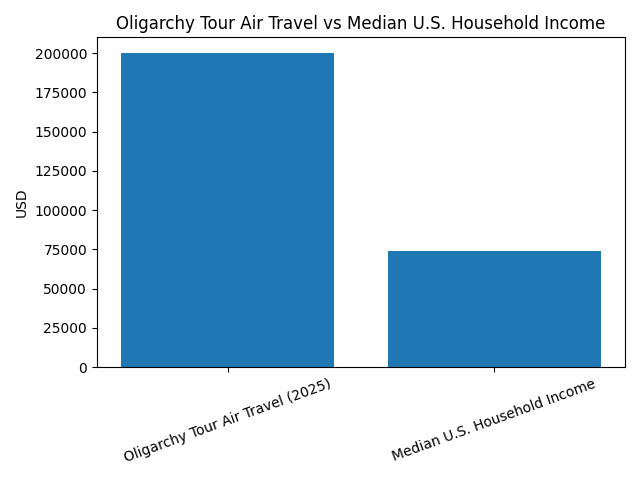
During the 2025 “Fighting Oligarchy” tour, Alexandria Ocasio-Cortez was photographed traveling in a first-class cabin on a flight to a scheduled speaking event. Around the same period, reports indicated that the tour itself had spent more than $200,000 on air travel.
None of this is unusual for national political figures. Travel, logistics, and security all come at a cost. But it illustrates something more important than the expense itself.
If the central argument is that elite privilege and concentrated advantage are corrupting forces, then the use of those same advantages raises an obvious question. Is the objection to the system itself, or simply to who controls it?
This distinction goes to the heart of it. It is the difference between opposing a method and seeking to inherit it.
Flying for Someone Else’s Fight
The El Salvador episode made the same point in a different way.
In April 2025, Democrat lawmakers traveled to El Salvador to advocate in the case of an illegal alien, Kilmar Abrego Garcia, after his deportation. Reuters reported that Senator Chris Van Hollen met with him there, and the Associated Press reported that four House Democrats later made the same trip, framing the matter as one of due process and accountability.
Set aside, for the moment, the particulars of that case. The more revealing issue is political priority.
The United States is not lacking in domestic burdens. The Federal Reserve reported in 2025 that only 63 percent of adults said they could cover a hypothetical $400 emergency expense using cash or its equivalent. The same year, the Census Bureau reported that median monthly owner costs for homeowners with a mortgage rose to $2,035 in 2024, up from $1,960 in 2023. Harvard’s Joint Center for Housing Studies estimated that 43.5 million households were cost-burdened in 2024, meaning they spent more than 30 percent of income on housing.
Those are large problems affecting tens of millions of Americans. Yet what generated the overseas trip, the dramatic visuals, and the instant moral urgency was a deportation case.
If urgency were determined by scale, then the daily pressures crushing ordinary Americans would dominate political theater. But that is not what we see. Urgency is often determined by symbolism. What can be turned into an accusation. What can be presented as a morality play. What allows the Democrat Party to look compassionate without having to solve any of the larger and more difficult problems at home.
This is not broad humanitarian concern. It is selective moral staging.
The Protest Circuit
The same pattern appears in protest culture.
People still speak as though modern protests are simply bursts of local conscience, as if citizens in one place spontaneously arrive at the same slogans, same graphics, and same language as citizens thousands of miles away. That notion collapses the moment one looks at how these events are actually organized.
Reuters reported on March 28, 2026 that “No Kings” rallies were planned in all 50 states, with more than 3,200 events tied to the mobilization. Reuters also identified Indivisible as a central organizing force behind the demonstrations. The Washington Post separately reported more than 3,300 rallies across all 50 states in that same wave of protests.
None of this makes protest illegitimate. Free people have every right to assemble, complain, and try to persuade others. The issue is not whether protest should be allowed. The issue is whether it should be romanticized as if it were always a purely organic expression of grassroots sentiment.
Once large-scale activism becomes institutionalized, it develops the same features as any other institution. It has funders, staffers, communications strategies, repeat performers, and professional incentives. Some people in the crowd may be sincere, and many are. But sincerity below does not prevent orchestration above. In fact, sincere people are often the easiest to channel, because they provide the emotional energy while others provide the structure.
That is one reason the left can so often appear to move as a single body. It is not that every protester is paid, and it is not that every event is fake. It is that grievance, once professionalized, becomes scalable.
Exporting the Narrative
In recent years, members of Congress and aligned public figures have increasingly used foreign interviews, overseas appearances, and international forums to frame domestic political conflicts in stark moral terms.
American political figures now carry domestic factional rhetoric overseas and repeat it in foreign settings as though the country’s internal partisan struggles were simply a matter for international consumption. The United States is described abroad not just as a nation with disagreements, but as a nation endangered by the moral depravity of whichever side happens to be in office.
That habit is not merely vulgar. It is costly.
A country’s prestige, credibility, and bargaining position are not abstractions. Foreign governments, investors, allies, and adversaries all interpret what they hear. When members of an American political faction travel abroad and portray their own country as uniquely lawless or unstable, they are not acting as disinterested truth tellers. They are exporting domestic propaganda for factional gain.
Some will call this honesty. It is more often vanity mixed with opportunism. There is no courage in denouncing your own country to foreign audiences when the practical effect is to weaken the very nation whose institutions make your political career possible.
The traveling rant does not stop at state lines because grievance politics rarely respects limits when publicity is available.
Crisis Tourism
Then there is crisis tourism, which may be the most revealing form of all.
A disaster strikes, a scandal breaks, or a public tragedy erupts. Soon enough the same public figures appear. They deliver statements, assign blame, broadcast indignation, and then move on. If this were mainly about solving problems, one would expect more attention to oversight, competence, and institutional reform. Instead, much of the performance is symbolic.
The FEMA case is a good example because it briefly stripped away the usual language. NPR and PBS both reported that FEMA supervisor Marn’i Washington was fired after directing workers responding to Hurricane Milton to avoid homes displaying Trump signs. FEMA Administrator Deanne Criswell publicly called the conduct reprehensible and said it violated agency policy.
Now notice what is and is not established by that fact. It does not prove that FEMA had a national written policy to discriminate against Trump voters. But it does prove something else, and something important. It proves that conduct of that kind occurred inside a large federal bureaucracy and had to be exposed before it was decisively addressed.
Many institutions now defend themselves this way. They answer the wrong question. “It was not policy.” Fine. Perhaps it was not. But the more relevant question is how many abuses continue below the level of formal doctrine until public embarrassment makes denial impossible.
People understand that instinctively. That is why public trust keeps collapsing. They know that not every wrongdoing is written in a handbook. Culture, incentives, and ideology can shape conduct long before formal policy ever enters the picture. When institutions reply with technical distinctions after exposure, the public often hears not reassurance, but evasion.
The Architecture of Delegated Failure
People at the apex of power rarely need to issue an explicit order to produce corrupt or lawless outcomes. They need only cultivate an environment in which politically useful conduct is treated as morally urgent and administrative restraint is treated as moral failure.
The command is never “break the law.” The command is “help the vulnerable.” In a bureaucracy, that shift in language is all that is required to dissolve accountability.
Leadership choices reveal priorities, not only for what they signal publicly, but for what they permit internally. When individuals preside over administrative failures without meaningful consequence, it establishes a precedent. It tells others within the system that outcomes matter less than alignment. Over time, that erodes accountability in ways no written policy ever needs to.
It is a familiar template: selecting a partner who provides a comforting, aesthetic mask for a radical institutional shift.
The public understands this instinctively, which is why trust in these institutions continues to crater. They know that wrongdoing is rarely written into a formal handbook. Instead, culture, incentives, and ideology shape conduct long before a policy memo is ever drafted. When leaders respond to exposure with technical distinctions and claims of “it wasn’t official policy,” the public does not hear a defense; they hear the cold language of evasion.
The Grift Behind the Rants
This brings us to the grift.
Too many people imagine corruption in simplistic terms. They picture a direct order, a suitcase of cash, a single villain. Modern political corruption is often more diffuse than that. It lives in tolerated incompetence, weak oversight, selective enforcement, nonprofit opacity, public contracts, moral camouflage, and endless excuses made in the name of noble causes.
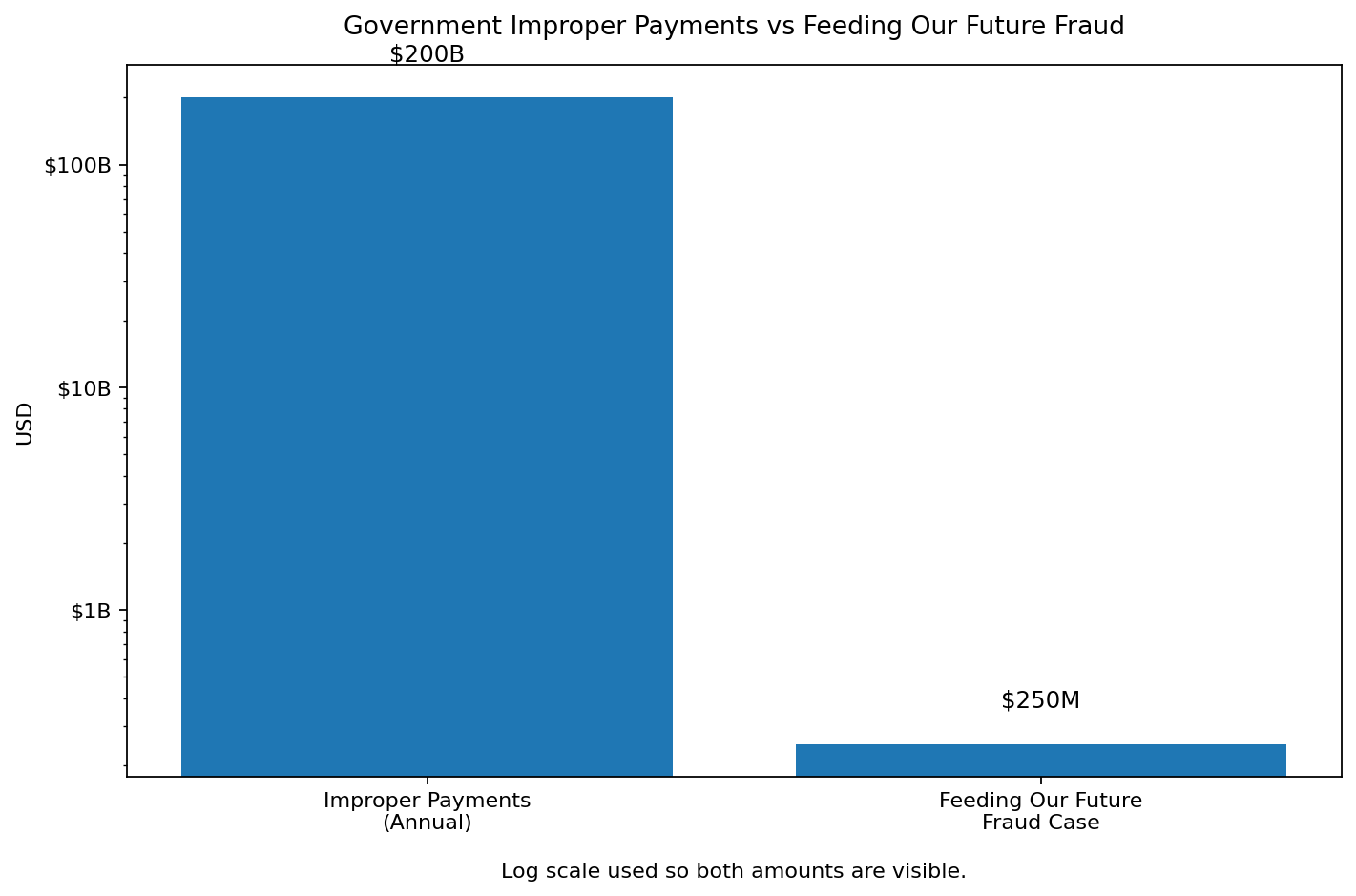
The Feeding Our Future scandal in Minnesota is a far better example of contemporary grift than the cartoon version of corruption. The Department of Justice said in 2025 that two defendants were convicted in a $250 million fraud scheme involving a federally funded child nutrition program. The Associated Press reported in 2024 that Minnesota’s own watchdog found the state agency’s lax oversight and failure to act on red flags helped create the opportunity for the theft. Reuters reported in January 2026 that Governor Tim Walz said the state’s welfare system had become a crisis and later reported on his proposal to address fraud.
This is where serious people have to stop thinking like children. No one at the top needs to stand up and say, “Go commit fraud.” That is not how many failing systems work. They work by creating conditions in which fraud can flourish. Warnings are ignored. Oversight is weak. Politicians fear bad optics more than bad administration. Bureaucracies protect themselves. Activists provide moral distraction. By the time the scandal is undeniable, the money is gone and the language of compassion remains.
That is how a grift culture survives. It does not need a villain twirling a mustache. It only needs a structure in which accountability is late, selective, and easily buried beneath louder narratives.
What Actually Binds It Together
So what ties all of this together?
Victimhood is part of it, but not in the childish sense that every Democrat voter sees himself as a victim. The more important point is that the Democrat Party has built a political language in which more and more groups are addressed primarily through grievance. Blacks, women, gays, immigrants, climate activists, and others are repeatedly spoken to as if the central fact of their political existence is disadvantage, exclusion, or threat.
That language is politically efficient because it is modular. The same emotional architecture can be applied almost anywhere. There is always someone being harmed. There is always someone to blame. There is always a need for advocates, brokers, experts, and protectors. And somehow those protectors are always the same class of people who gain visibility, donations, institutional standing, and career advancement from keeping the drama alive.
If these methods produced unusual competence, one could at least defend them on practical grounds. But often they produce the opposite. They enlarge bureaucracies, multiply middlemen, reward performative outrage, and create incentives to preserve the very conditions that justify continued agitation.
That is why the traveling rant keeps traveling. Not because it solves much, but because it organizes loyalty, channels emotion, and protects a professional grievance class whose status depends on perpetual dissatisfaction.
Why the Rant Travels
The victimhood of the traveling rants is not just a clever title. It describes a political style and, increasingly, a business model.
It moves because movement is rewarded. It moralizes because moral language hides self-interest. It survives because too many people still judge political actors by the sentiments they express rather than the systems they build.
Once you stop staring at the slogans and start looking at the incentives, the whole performance becomes easier to understand. The same people who denounce power are often busy accumulating their own. The same people who claim to defend victims often build careers by keeping others locked in a politics of grievance. And the same people who arrive in every new setting with righteous fury are rarely around long enough to live with the consequences of what they have endorsed.
That is why the rant travels.
Because the destination was never the point.
If This Work Matters, Help Keep It Going
I’m not backed by a media company.
I’m not funded by an institution.
There is no grant, no NGO, no hidden support system behind this.
It’s just me doing the work.
Researching. Writing. Connecting the dots.
And right now, it’s being built under real pressure.
This only continues if readers decide it should.
Become a Paid Subscriber
If you read these pieces and think, “more people need to see this,” this is how you make sure it keeps happening.
Even a few dollars a month stabilizes this and allows me to go deeper instead of rushing to keep up.
Make a One-Time Contribution
If a subscription doesn’t make sense right now, a one-time contribution helps more than you think.
Join The Resistance Core
This is for people who fully back what I’m building.
If you’ve been reading for a while and want to help push this forward in a serious way:
What Your Support Actually Does
It doesn’t fund a lifestyle.
It funds time to research instead of rushing, deeper investigations instead of surface posts, and consistency instead of gaps.
Right now, everything is being built while juggling real-world constraints.
Support changes that.
If You Can’t Contribute
You can still help in a real way.
Share the post. Send it to someone directly. Talk about it.
That’s how this grows without being controlled.
The Bottom Line
There’s no machine behind this.
That’s the point.
But it also means this only works if enough people decide it’s worth supporting.
If this piece made you think, question something, or see a pattern more clearly, help keep it going.
Excellent essay! I had to search the meaning of "grift" because I thought you were getting grift & graft confused. However, after the search, I reexamined your bar chart and it became clearer to me. The scale of "Improper Payments" ($2 Billion) constitutes "Graft!" whereas the "Feeding the Future" scam, although huge ($250 million), would be properly labeled as "street level theft," or "grift" accordingly. Sadly, the entire misappropriation of our public tax dollars now requires a scale to be properly understood.
Lord have mercy on us all as we have allowed our once great republic to morph into an unaccountable bureaucracy through unrestrained growth. All the self-serving special pleading (lobbying) has now brought us to the point-of-no-return. All this while we have been asleep at the wheel. Too few are beginning to wake up, and those few see we are careening headlong off a cliff.