


“America does not have an information shortage. It has an attention shortage.”
Every few weeks, someone tells me my essays are too long. They are right, at least literally. Some of them are very long. The more useful question is: too long for what?
If I were trying to beat CNN, Fox News, or some blue-haired TikTok historian to this morning’s controversy, most of what I write would be ridiculous. I could summarize the accepted version of events, toss in a few angry adjectives, add a headline, and have the whole thing forgotten by Thursday.
Once in a while, something happens that deserves an immediate response. Most of the time, I am trying to create something closer to a reference guide, an essay readers can still use after the headline disappears and the people who confidently repeated the original story have forgotten what they said.
That requires more than an opinion. It takes history, definitions, data, context, competing explanations, and enough documentation for a skeptical reader to follow the trail and decide whether I am right. Sometimes I am. Sometimes the evidence forces me to narrow the claim. Occasionally, I find that the argument I started with does not hold up as well as I expected. That is part of the work too.
These essays remain free because information meant to challenge powerful institutions does little good when most people cannot access it. But free to the reader does not mean free to produce. Research takes time, and time eventually collides with housing, groceries, electricity, software, and families who cannot eat a footnote.
So this is not merely an explanation of why I write long articles. It is also an honest question about whether enough readers value this kind of work to help keep it going.
More Information, Less Understanding
We have access to more information than any population in human history. A device in our pocket can retrieve Supreme Court opinions, census tables, congressional testimony, military records, scientific studies, economic data, historical newspapers, university lectures, and books that once required access to a major library.
By any reasonable expectation, this should have produced the most knowledgeable population the world has ever seen. Instead, we consume information from the moment we wake up until we fall asleep while understanding surprisingly little of it.
We know who insulted whom, which celebrity is getting divorced, what went viral before lunch, and which politician committed today’s most unforgivable offense. Ask how the government is structured, how inflation works, or what the First Amendment protects, and the confidence often outlasts the knowledge.
The 2025 Annenberg Civics Knowledge Survey found that 70 percent of American adults could name all three branches of government. That was an improvement. Fewer than half, however, could name any First Amendment freedom other than speech. Religion was mentioned by 48 percent, assembly by 36 percent, freedom of the press by 34 percent, and the right to petition the government by only 12 percent.
Even naming the executive, legislative, and judicial branches does not tell us whether someone understands what they do. A person can memorize three labels without understanding federalism, due process, judicial review, the separation of powers, or why the Founders divided authority in the first place.
The educational trend is no more comforting. The average reading score for American twelfth-graders in 2024 was three points below 2019 and ten points below the first comparable assessment in 1992. The declines since 2019 reached nearly every measured performance level.
The problem follows students into adulthood. In the OECD’s 2023 Survey of Adult Skills, 28 percent of Americans ages 16 to 65 scored at Level 1 or below in literacy. Thirty-four percent were at or below Level 1 in numeracy. People at those levels may handle simple and familiar material but struggle as a text becomes denser, a graph requires interpretation, or a problem involves several steps.
That does not mean 28 percent of Americans cannot read a menu. It means a large part of the population has trouble with the skills needed to examine a government report, compare two conflicting arguments, interpret a chart, or notice that a statistic does not prove what the headline claims.
We are not suffering from a shortage of information. We are losing the patience, discipline, and skill needed to use it.
Old school examinations periodically circulate online, usually followed by adults wondering whether they could pass a middle-school final from the 1950s. I suspect many of us could not, although the comparison is easy to exaggerate. Curricula change, and some older tests covered agricultural or regional knowledge suited to a different economy.
We do not need to romanticize old schools to notice the difference in expectations. Earlier generations were commonly required to memorize material, read sustained passages, write complete answers, perform arithmetic without immediately reaching for a machine, and remain focused without being entertained every fifteen seconds.
They were expected to tolerate some mental discomfort. Learning often involves not understanding something, sitting with it, and wrestling with the problem until it begins to make sense.
We have spent decades reducing that discomfort. The calculator supplies the number. The search engine supplies the fact. The summary supplies the book. The video supplies the summary. Artificial intelligence can now supply the conclusion before the student knows enough to understand the question.
None of those tools is automatically bad. A calculator in the hands of someone who understands arithmetic is useful. In the hands of someone who never learned arithmetic, it can create the appearance of competence right up until the problem changes. Information tools work much the same way.
People who never lift anything heavy should not be surprised when they lose strength. Someone who rarely reads anything longer than a caption should not be shocked when ten pages feel exhausting. The brain adapts to what we repeatedly ask it to do, and increasingly we are training ours to swipe.
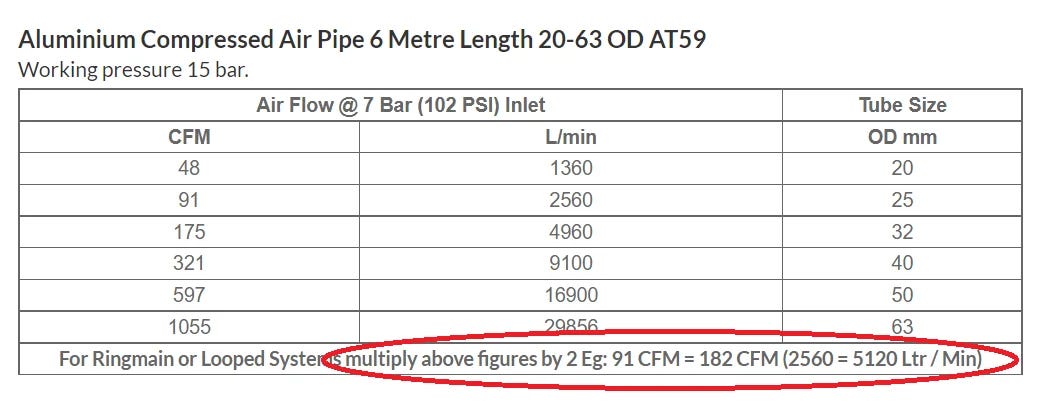
Then: calculate airflow through a ring-main compressed-air system.
Now: do not drink the battery fluid.
The Business of Distraction
This did not happen entirely by accident, although no conspiracy is necessary.
An enormous economy now depends upon capturing attention, measuring it, dividing it into marketable pieces, and learning how to keep it from wandering away. Social-media platforms, streaming companies, advertisers, game developers, political campaigns, and news organizations all compete for the same limited resource.
They generally do not make more money because you understood a subject and left satisfied. They earn more when you stay, react, refresh, click another link, watch another video, and return tomorrow.
The Federal Trade Commission has examined what it calls the attention economy, including the ways online products exploit children’s developmental vulnerabilities and use design features to hold their attention. Its 2025 workshop focused specifically on how technology companies capture children’s time and what that does to families.
The endless scroll has no natural stopping point. Notifications interrupt concentration before boredom has a chance to become thought. Algorithms learn that fear, anger, sex, envy, and tribal conflict usually hold attention better than a calm explanation of marginal tax rates.
No secret coordination is required. Thousands of organizations can produce the same cultural result when their incentives point in the same direction.
That does not make us helpless. The casino wants the gambler to keep pulling the lever, but the gambler still chooses to remain in the casino.
Americans age 15 and older averaged about 5.2 hours a day on leisure and sports activities in 2025. Television alone consumed 2.6 hours, roughly half of all leisure time. There is nothing wrong with recreation. Sometimes the brain needs to watch something that does not require a bibliography. I waste time too.
Still, we should stop pretending time is the problem.
Only 48.5 percent of American adults reported reading even one book during 2022, down from 52.7 percent in 2017 and 54.6 percent in 2012. Apparently, we have forty-five minutes to watch someone review a sandwich, but twenty minutes explaining the federal budget is asking too much.
We have also started treating anything that resists instant understanding as poorly designed. A complicated argument must be shortened. A long article must be summarized. A difficult book must be converted into ten lessons. If a subject cannot be understood during a trip to the bathroom, someone must have made it unnecessarily confusing.
AI is accelerating the habit. Google now summarizes search results, and Gmail can summarize messages before we bother to read them. Even our correspondence is being reduced to the part a machine thinks we need.
Reality received no vote in this arrangement.
When Instant Gratification Reaches Washington
A population trained to expect immediate satisfaction eventually carries that expectation into politics. We want the benefit now and the cost later, preferably after another election and under enough layers of accounting that nobody remembers where the bill came from. Government is remarkably good at providing this service.
Borrow money today and send the bill to taxpayers who are still in elementary school. Expand money or credit to relieve immediate pressure, then act surprised when purchasing power declines. Subsidize a product to make it appear cheaper while moving the cost into taxes, debt, or higher prices somewhere else.
We demand affordable housing while opposing construction. We demand inexpensive energy while restricting its production and transportation. We demand generous benefits, low taxes, stable prices, high wages, cheap credit, and no unpleasant tradeoffs.
The real world does not offer that package, although politics will continue selling it until the election is over.
Thomas Sowell famously summarized the problem by observing that there are no solutions, only tradeoffs. Every policy consumes scarce resources. Every benefit must be produced by somebody. Every rule changes incentives, including incentives that were never mentioned at the press conference.
Understanding public policy requires more than asking what a proposal intends to do. We must ask what it costs, who pays, what behavior it rewards, what alternatives were rejected, and what happened when something similar was tried elsewhere. Those questions take time, and they tend to spoil the sales pitch.
Debt and inflation are instant gratification translated into public policy. A short-attention-span society is easy to sell because it remembers the promise long enough to vote and forgets the result before the same promise returns under a new name.
A free society cannot survive on good intentions and legal permission to speak. It also needs citizens capable of judging and understanding what they hear.
The people debating the Constitution did not settle the question with a slogan. Hamilton, Madison, and Jay produced 85 essays totaling nearly 190,000 words. Most ran between roughly 1,000 and 3,500 words, while several were considerably longer. They wrote about factions, taxation, courts, executive authority, national defense, federalism, and the division of power between the states and the proposed federal government.
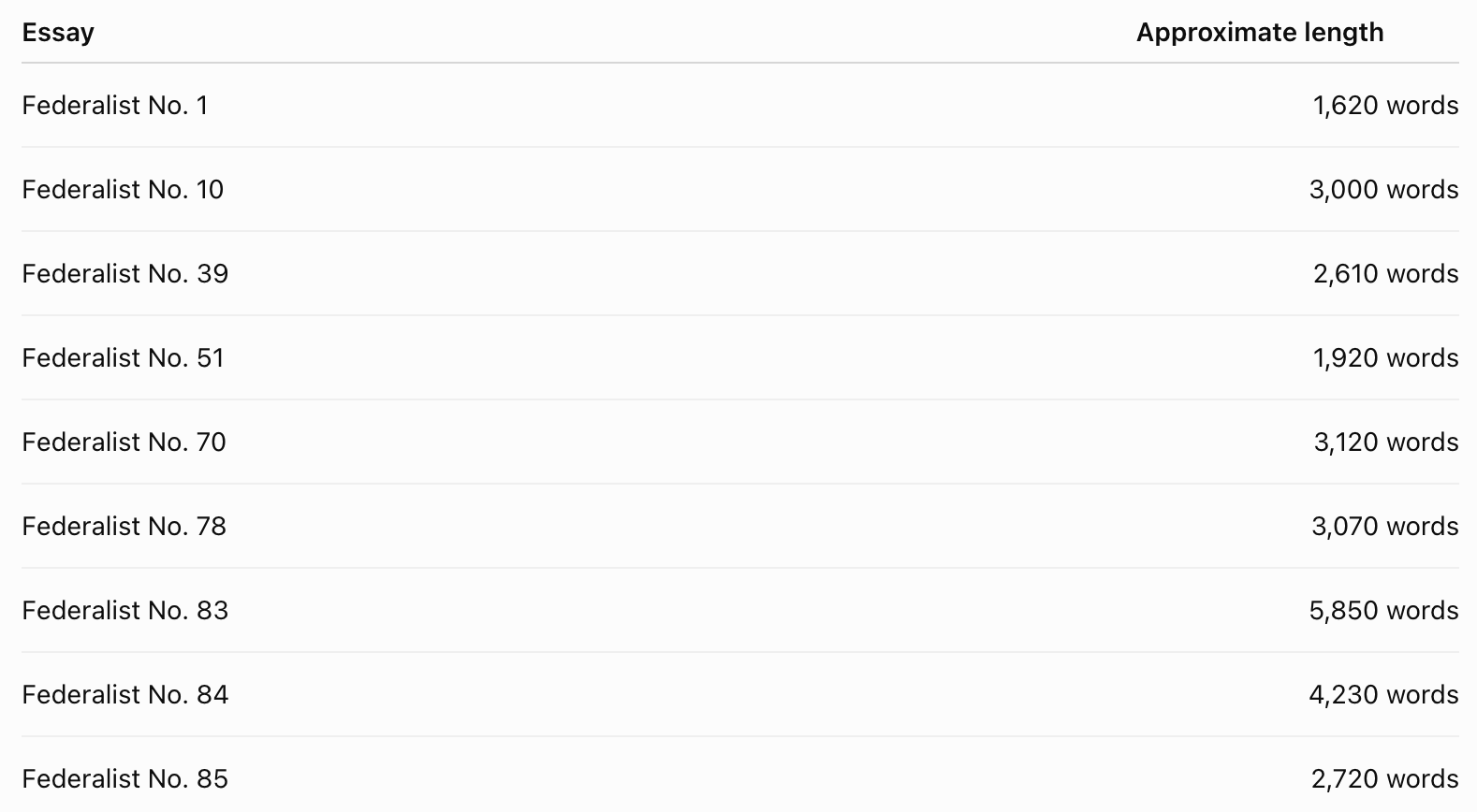
Eighteenth-century America was not an intellectual paradise. Education was limited, and much of the population was excluded from political life. The narrower point is that serious persuasion assumed complicated questions might require extended arguments.
Today, even educated people often demand that immigration, war, taxation, crime, race, education, religion, and constitutional law be compressed into a few approved phrases. Once the evidence has been removed to make the argument convenient, the slogan is judged as though nothing important was lost.
That creates an opening for institutions willing to perform the thinking for us.
Programming the Next Generation Not to Think
The danger becomes more serious when the audience consists of children.
Adults at least have life experience, established beliefs, and some ability to recognize that institutions can be wrong. Children enter a classroom with a reasonable assumption: the adults, books, and tools presented by the school are there to educate them.
A teacher’s assignment carries authority. A school library carries credibility. Educational software looks neutral because it arrives through an institution the child has been trained to trust.
That trust is necessary. A seven-year-old cannot independently verify everything a teacher says about multiplication, colonial history, or the solar system. Necessary trust can still become a route for ideological conditioning when students are taught which sources deserve respect before they learn how to judge a source for themselves.
NewsGuard is a useful current example. The company describes itself as a media-literacy service for citizens, librarians, educators, and students. It says more than 800 public libraries worldwide offer its browser extension. Its school resources include educator guides, student exercises, classroom materials, and lessons aligned with Common Core and ISTE standards.
The stated purpose is understandable. The internet contains fraudulent medical advice, fabricated stories, foreign propaganda, copied articles, fake experts, and websites that repeatedly publish claims they know are false. Students should not treat every webpage as equally trustworthy.
The issue is what they are being taught to do instead.
NewsGuard places scores and credibility labels beside publications. Its system evaluates outlets under a series of criteria and assigns rating categories ranging from credible to various levels of caution. NewsGuard also provides longer explanations describing how it reached its conclusions.
Some of that may be useful. Ownership, correction policies, deceptive headlines, and a record of repeated falsehoods are reasonable things to consider.
The trouble begins when the label becomes a substitute for reading. Genuine media literacy teaches a student to identify the claim, locate the original evidence, examine what was omitted, compare opposing accounts, distinguish fact from opinion, and decide whether the conclusion follows from the facts.
A credibility score offers a faster route: check the label and borrow the judgment.
A highly rated publication can still produce a misleading article. A poorly rated publication can still publish an accurate report supported by documents. News organizations employ different writers and editors, cover thousands of subjects, and change over time. Truth does not permanently attach itself to a corporate logo because the organization once received a favorable score.
The student should evaluate the article. Instead, he may learn to inherit the reputation assigned to the outlet. Rather than being taught how to judge information, he is taught whose judgment to borrow.
NewsGuard extended this model in June 2026 with the launch of NewsGuard AI. The chatbot draws its answers exclusively from roughly 12,000 publishers NewsGuard has approved as reliable. The company says it has rated more than 36,000 sources and built the tool with 41 editorial safeguards intended to produce cited and evenhanded responses while excluding propaganda, healthcare hoaxes, conspiracy sites, and other material it considers unreliable.
Those qualifications deserve to be acknowledged. NewsGuard is not openly advertising a plan to brainwash children, and an AI system that repeats every fabricated claim on the internet is not improved merely by calling itself open-minded.
But look at the sequence. Students encounter NewsGuard’s judgments through classrooms, libraries, and educational materials. They are then offered an answer engine that consults only sources that passed the same company’s test. NewsGuard says partner schools and universities will provide enrolled students with free access to the chatbot.
The student may believe the machine reviewed the available evidence and weighed competing accounts. The machine may never have been permitted to read one side of the dispute.
This does not resemble a dystopian movie. Nobody straps children into chairs while propaganda flashes on a screen. It works more quietly. Students learn that respectable information carries institutional approval, disfavored sources need not be considered, and the safest way to reach the accepted answer is to remain inside boundaries drawn by someone else.
The most dangerous form of brainwashing does not need to dictate every conclusion. It only needs to teach children who is authorized to think for them.
NewsGuard may get many ratings right. It may get most of them right. The basic question remains: Why should one private company’s analysts establish the boundaries of a student’s available research?
Education should teach children to examine the gatekeeper along with the source. Otherwise, media literacy can become obedience wearing a name tag.
What I Am Actually Building
News tells you that something happened. Knowledge tries to explain why it happened, what came before it, how it was measured, and whether the story being told fits the evidence.
News reports that prices increased. Knowledge asks what happened to production, demand, government spending, money, regulation, labor, transportation, and competition.
News reports that crime rose or fell. Knowledge asks which crimes, during which years, in which places, using arrests or victim reports, and whether reporting practices changed.
News reports that a government program helped 100,000 people. Knowledge asks what the program cost, what would have happened without it, who was excluded from the count, what alternatives were available, and whether the program changed behavior in ways that produced another problem.
News gives you the numerator. Knowledge asks for the denominator.
Ten articles about the same controversy do not necessarily produce understanding. Often, they repeat the same facts, quote the same officials, and react to the same claims. Volume can create the appearance of depth while adding very little.
Drive-by political writing is usually attached to an event. It tells readers what happened today and what attitude they should adopt before tomorrow. That has value. People need timely information. It simply is not what I am primarily trying to do.
Most of my essays begin with something I have seen, experienced, or noticed. Sometimes it is a contradiction between what people publicly claim and how they behave. Sometimes it is a political story that does not fit the available facts. Sometimes it is a cultural pattern I have watched repeat for decades while respectable people insist it is not happening.
Life experience can reveal the question, but it cannot settle the answer. “I saw this, therefore it must be universally true” is an anecdote. “I saw this repeatedly, wondered whether the larger evidence confirmed it, and then tested it against data” is analysis.
I start with the question and look for the numbers. I check government reports, studies, historical records, demographic tables, court documents, archived articles, and the strongest argument on the other side. When definitions change, I try to explain the difference. When evidence is incomplete, I say so. When a statistic can reasonably be interpreted more than one way, the reader should know that before being asked to accept my conclusion.
When I wrote about Thomas Sowell, the real question was not whether he was smart. It was why a man who spent decades writing about race, economics, education, migration, discrimination, culture, and government remained largely unknown among many Americans most affected by those subjects.
When I wrote about the 1924 Democrat Convention, the point was not to find an old photograph and shout “Klan.” The subject required political history, religious conflict, immigration, prohibition, party rules, and an explanation of why some events receive endless attention while others vanish from popular memory.
When I wrote about Indian immigration, the issue could not be answered honestly with “immigration good” or “immigration bad.” It required population data, student visas, H-1B numbers, labor markets, household income, demographic change, and the difference between national averages and local effects.
The same applies when I examine lotteries, media gatekeeping, racial language, crime, Islam, election procedures, public spending, or education. I am not trying to hand the reader an opinion to borrow. I am trying to build enough of the case for him to inspect the foundation.
That is why the essays are long.
Length is not automatically a virtue. A badly researched 8,000-word essay is simply a larger waste of time. I sometimes repeat myself. Occasionally, I include a detail that could have been cut or take too long reaching a point. Every paragraph still has to earn its place.
Most complaints about length, however, do not identify an unnecessary paragraph. They begin with the assumption that the subject itself should have been made easier to consume.
Some questions cannot be answered honestly in 700 words. By the time a writer provides the relevant history, defines what the statistics measure, acknowledges contrary evidence, and answers the obvious objections, he may already be over the limit imposed by the modern attention span.
Reality does not become simpler because our patience becomes shorter.
Short posts, memes, Notes, tweets, and brief comments serve a purpose. They attract attention, raise a question, and may persuade someone to look deeper. They are road signs, not the destination.
I do not expect every reader to finish every essay in one sitting or care equally about every subject. A detailed article on immigration may sit unread for six months until a new proposal appears, an argument breaks out at work, or a family member repeats a claim that does not sound right. At that point, the essay is there to be searched, bookmarked, quoted, challenged, corrected, or forwarded to someone who finally wants more than the slogan.
Wikipedia is useful for a similar reason. Nobody reads every article. People value knowing the reference system exists when they need it.
In its 2023 to 2024 fiscal year, the Wikimedia Foundation reported about $185.4 million in support and revenue. Eight million donors from more than 200 countries contributed during that year, and the foundation said the vast majority of its revenue came from donors.
I am not trying to recreate Wikipedia, and I certainly do not have its staff, donors, or infrastructure. I have a laptop, a stubborn streak, a healthy relationship with facts, and readers who keep returning.
The purpose is similar. I am trying to build an independent reference library, one researched essay at a time.
The Part Readers Do Not See
A finished essay arrives in an inbox looking almost effortless. Readers do not see the hours spent locating a primary record after dozens of articles cited one another in a circle. They do not see datasets using different definitions, studies whose headlines barely resemble their findings, government links that quietly disappear, or charts checked three times because one misplaced decimal point can discredit everything around it.
They do not see drafts being reorganized, claims being removed because the evidence was weaker than expected, or paragraphs rewritten for people encountering the subject for the first time. Nor do they see the work required after publication. Writing something does not mean anyone will find it. The essay has to be promoted, excerpted, discussed, answered, reposted, and kept alive long enough to escape the algorithmic graveyard.
I do all of that on top of the work that pays our household bills.
Most days, I begin around six in the morning and continue until midnight, seven days a week, with very little downtime. Some of those hours go toward clients and the work supporting my family. The rest go into researching, writing, editing, publishing, and promoting this project.
I am not saying that because I expect sympathy. I chose to do this because I believe the work should exist. Belief, however, does not create more hours in the day.
No one can work eighteen hours a day, seven days a week forever. Eventually, the body, the family, the paying work, or the publication absorbs the cost. Sometimes I genuinely wonder how long I can keep doing both.
In a perfect world, I would have one demanding job instead of trying to carry two full-time jobs on the same back. I could spend the day researching and writing without constantly switching between the work I believe is important and the work required to keep us afloat.
That is not a request for luxury. I am not trying to retire to a beach and send the occasional political thought between umbrella drinks. I am trying to reach the point where doing this work no longer requires working myself into the ground.
Who Pays for a Free Library?
Every institution that shapes public knowledge has a funding model. Universities have tuition, donors, foundations, and government support. Think tanks have benefactors. Newspapers have subscriptions, advertisers, wealthy owners, sponsors, or some combination of them. Activist organizations have grant networks. Public broadcasters have government funding, foundations, corporate underwriting, and viewers.
Even free artificial-intelligence systems are financed by companies and investors expecting something in return.
The question is never whether knowledge will be funded. The real questions are who supplies the money, what incentives the arrangement creates, and whether the writer remains free to follow the evidence somewhere the funder would rather not go.
Advertising rewards clicks and constant traffic, pushing writers toward daily outrage, sensational headlines, and quantity. Political organizations may provide money but expect loyalty. Foundations can support useful work while bringing institutional priorities. Corporate sponsorship creates dependencies that become obvious when the subject of an essay is the corporation writing the check.
A hard paywall solves part of the problem by making readers pay directly. It also hides the information from people who cannot afford it or will not subscribe before knowing whether they trust the work.
The model I prefer is simpler. A smaller group of paid subscribers makes it possible for a much larger group to read the work for free. Paid subscribers are not purchasing a private version of the truth. They are helping keep the public version alive.
Their subscriptions buy research time. They help pay for tools, data, graphics, hosting, and the hours needed to verify the work. They reduce the amount of outside client work required to keep the household running and make it more likely that this library will still be growing next year.
NPR and PBS offer a useful lesson. Congress rescinded $1.1 billion in previously approved funding for the Corporation for Public Broadcasting. CPB began winding down and voted in January 2026 to dissolve after 58 years. The loss hit many smaller and rural stations especially hard because they depended more heavily on federal support than the national organizations did.
Yet NPR and PBS remained.
In April 2026, NPR received two gifts totaling $113 million. Connie Ballmer gave $80 million, the largest gift from a living donor in NPR’s history, while an anonymous donor contributed another $33 million to support the network. PBS continues through roughly 330 member stations, local contributions, grants, planned gifts, and the PBS Foundation.
Private gifts did not replace every lost federal dollar, and local stations still faced serious consequences. That is not the lesson I am drawing from it. The lesson is that these institutions remained standing because people who valued them were willing to fund them.
Whatever one thinks of NPR and PBS, their supporters understand a basic fact that conservatives often ignore: institutions survive through organization, money, repetition, and commitment. Praise does not pay the staff. Complaining that the other side controls the culture does not build a competing institution.
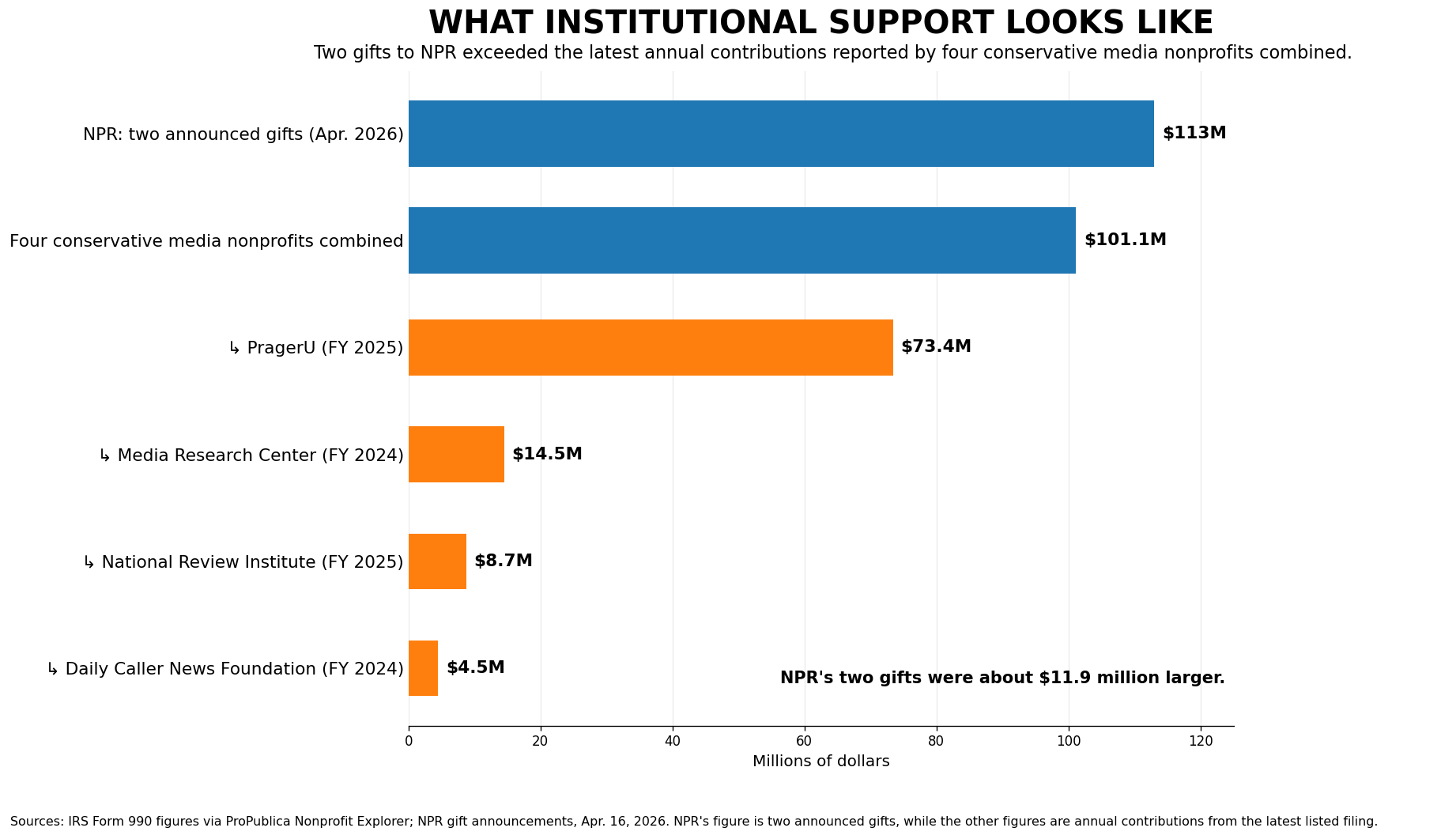
The political left has spent generations supporting universities, foundations, legal organizations, activist networks, media outlets, and research operations. Conservatives frequently complain about the results while hesitating when asked to spend the price of lunch supporting a voice they say they value.
Institutions are not defeated by complaints. They are replaced by better institutions.
That does not mean every reader must pay. Some cannot, and I understand financial strain better than I would like. Read the essays. Share them. Send one to a friend. Restack it. Quote the research. Those things help the work travel.
Readers who can afford to support the publication should understand what their subscription actually does. It buys time, not leisure or prestige, but time to research, verify, write, revise, and preserve information that may become much harder to find later.
A paid subscription does more than finance another essay. It buys the time required to find out whether the essay is true.
One Essay at a Time
Information does not have to be censored or deleted to disappear. Search rankings change. Links die. Terminology is revised. Algorithms favor newer material. Artificial-intelligence systems consult selected databases and quietly ignore everything outside them. The record may technically remain online while becoming practically invisible to people who depend upon search engines and chatbots to find it.
Many assume the truth will always be there when they finally decide to look. That is a dangerous assumption, especially when people have been trained to expect knowledge without effort and institutions are offering to remove the burden by selecting the trustworthy sources for them.
That arrangement is convenient. It is also a good way to produce generations of people who know how to retrieve conclusions but never learned how to test them.
Fighting back does not require smashing every television and reading eighteenth-century tax records by candlelight. It requires rebuilding habits we should never have abandoned. Read beyond the headline. Follow the source. Check the denominator. Examine the opposing argument. Ask who selected the information placed in front of you and what was excluded before you arrived.
Do not reject every authority simply because it is an authority. That is another form of laziness. But do not surrender your judgment merely because an institution offers convenience.
A society that loses the habit of deep thinking does not merely become easier to entertain. It becomes easier to govern, manipulate, and mislead.
I do not expect everyone who opens this publication to become a paid subscriber. Some cannot afford it. Some will read only one essay. Others will disagree with half of what I write, which may be a sign that they are still thinking.
The work is supposed to be used, examined, challenged, and shared. But some readers can support it and may not realize how much their support could change what is possible.
I have done everything I know how to do to keep this publication alive through work, stubbornness, and more hours than I probably have any business working. I need readers who believe this reference library should exist to help carry some of the weight.
Most political commentary tells us what happened today. I want these essays to explain why it happened, what came before it, which incentives produced it, how the argument was built, and where the evidence can still be found after the outrage has passed.
I do not write to satisfy today’s attention span. I write so that when someone finally decides he wants the truth, he will know where to look.
I am not trying to win today’s news cycle. I am trying to build tomorrow’s reference library, one essay at a time.
Help Build the Library
These essays remain free because information meant to challenge powerful institutions does little good when most people cannot access it. But free to read does not mean free to research, verify, write, publish, and preserve.
There are several ways to help, and each serves a different purpose.
Become a paid subscriber: $80 per year
Support the publication
Paid subscribers provide the foundation. Eighty dollars a year is less than seven dollars a month, but across enough readers it pays for research tools, data, graphics, hosting, and the ordinary costs of keeping this publication alive. Just as important, paid subscribers help ensure that readers who cannot afford to pay can continue accessing the entire library.
Make a one-time contribution
Contribute directly
Not everyone wants another subscription. A one-time contribution helps cover an immediate research expense, replace a few hours of client work, or support a particularly important essay. Every contribution gives me more time to follow the evidence instead of rushing to the next paying obligation.
Prefer Venmo?
Send support through Venmo
Venmo is simply the fastest direct option for readers who want to contribute without creating another account or recurring commitment.
Join the Resistance Core: $100 per month or $1,200 per year
Become a Resistance Core supporter
Resistance Core is the sustaining level. These subscribers are not merely helping pay for another article. They are helping replace the outside client hours that currently compete with this publication for nearly every working day.
A handful of Resistance Core supporters can fund the time required for deeper research, longer investigations, better charts, stronger sourcing, corrections, and a more permanent archive. They also make it possible for the work to remain free for thousands of readers who may never be able to contribute themselves.
The standard paid subscription builds the floor. Resistance Core helps carry the roof.
I understand that not everyone can give financially. Read the essays. Challenge them. Share them. Send them to someone who needs the information. That helps too.
But readers who can support this work should understand what their contribution buys. It buys time to research, verify, and preserve information that may become much harder to find later.
Paid subscribers are not purchasing a private version of the truth. They are helping keep the public version alive.
Institutions are not defeated by complaints. They are replaced by better institutions.
Love your work my friend.
Thank you for your dedication. I know I am guilty of headline searching and not analyzing. Appreciate the reminder that hard work is still necessary.