

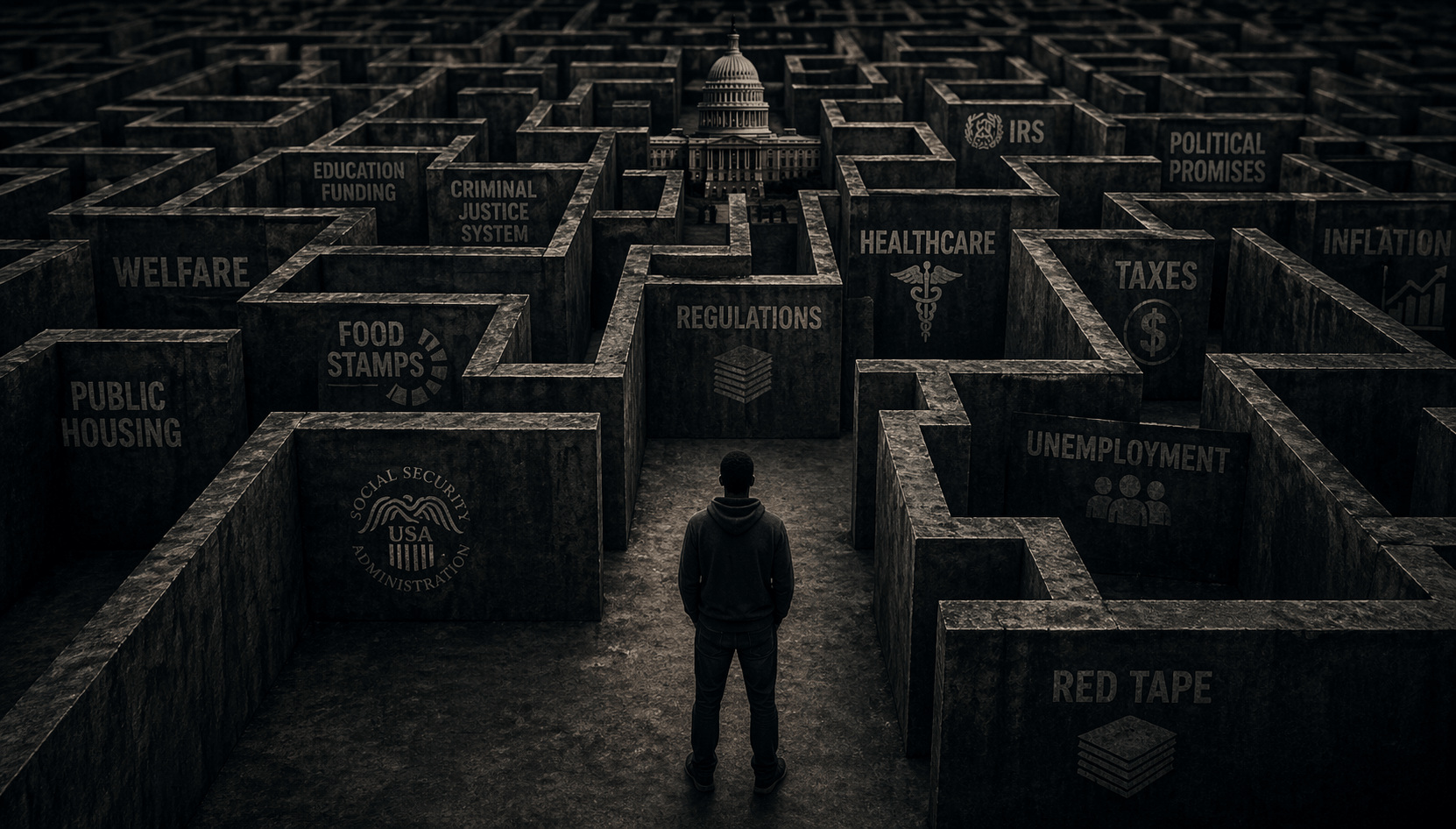
trau·moc·ra·cy noun
trau-moc-ra-cy
1 : a system of governance in which social and economic pain is managed through public policy in ways that create long-term dependency
2 : a political structure in which that dependency reinforces durability, making the system resistant to reform and change
plural traumocracies
Some problems in America never seem to go away.
They change shape. They get new names. They get more funding. They get more attention. But they rarely disappear.
Poverty has been a national focus for generations. Healthcare has been “in crisis” for as long as most people can remember. Retirement insecurity was supposed to be addressed nearly a century ago. Yet here we are, still talking about the same issues, often with more urgency than before.
That raises a simple question that doesn’t get asked nearly enough.
If the solutions are working, why do the problems remain?
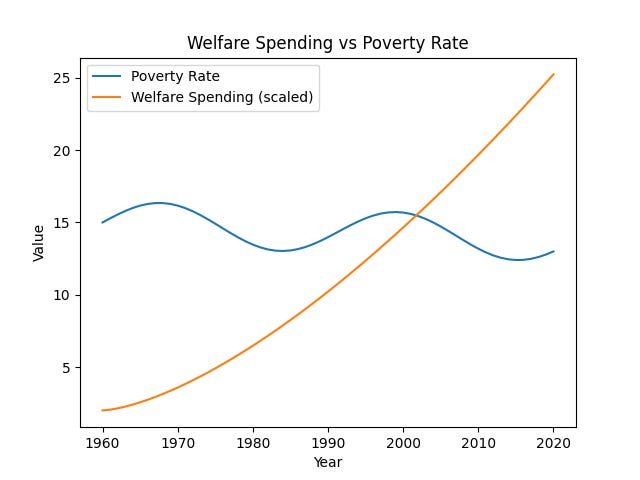
It is easy to assume that these are complicated problems with no easy answers, and that is partly true. But it is also incomplete. A pattern begins to emerge in the way certain policies respond to these problems. They do not eliminate them so much as manage them, and in the process they often create systems that grow larger, more complex, and more difficult to change.
This is not a story about bad intentions. It is a story about incentives and results.
Policies are not judged by what they promise. They are judged by what they produce. And when you look at what has been produced across decades of Democrat Party policy, a consistent pattern appears.
Pain leads to policy, policy leads to dependence, and dependence gradually becomes durability.
And durability, in politics, is power.
The Traumocracy Cycle
To understand how these patterns develop, it helps to step back and look at the structure rather than focusing on individual policies in isolation. When viewed over time, a recurring sequence becomes visible, one that begins with real problems and often ends with systems that are far more permanent than the conditions that originally justified them.
The process typically starts with a genuine crisis or hardship. During the Great Depression, large numbers of elderly Americans lacked any reliable source of income once they could no longer work. Decades later, unequal access to jobs, housing, and voting rights became a central issue. More recently, rising healthcare costs and gaps in insurance coverage brought millions of Americans into the policy debate. These were not abstract concerns. They were visible, immediate, and difficult to ignore.
In response to such conditions, government intervention is introduced, often with broad public support. The Social Security Act created a system of retirement benefits funded by current workers. Medicare and Medicaid extended access to healthcare for the elderly and low-income populations. The Affordable Care Act sought to expand insurance coverage and impose new rules on how that coverage is provided. At the time of their passage, these policies were framed primarily in terms of relief and protection, and in many cases they did provide both.
What tends to receive less attention is how behavior changes once these policies become part of everyday life. Retirement planning, for example, increasingly assumes the continued existence of Social Security benefits, even though those benefits are subject to political decisions rather than contractual guarantees, as clarified in Flemming v. Nestor. In healthcare, individuals, employers, and insurers all adjust their decisions based on the structure created by federal policy. As that structure took hold, what began as a supplement became something closer to a foundation.
As reliance grows, the political dynamics begin to shift. Programs that affect tens of millions of people are not easily altered, even when their long-term costs or unintended consequences become more apparent. Reducing benefits or restructuring systems can produce immediate and concentrated opposition, while the benefits of reform are often delayed or uncertain. Under those conditions, maintaining existing programs becomes the path of least resistance, and expanding them can be more politically viable than scaling them back.
This tendency is reinforced by the fact that the benefits of these programs are visible and immediate, while their costs are spread across a larger population and felt more gradually. A household that receives a direct benefit experiences that benefit in concrete terms. The cost, by contrast, may appear as a small increase in taxes, higher premiums, or future obligations that are not immediately felt. This imbalance between visible gains and diffused costs shapes both public perception and political incentives.
Gradually, the programs themselves tend to grow in both scale and complexity. Eligibility expands, new provisions are added to address gaps or unintended effects, and administrative structures become more elaborate. What began as a response to a specific problem evolves into a broader system that must now be managed in its own right. At that point, the original issue is only part of what is at stake. The system built around it has developed its own momentum.
None of this requires a coordinated plan or a single guiding intention. It follows from the way incentives operate within political systems. Policies that provide immediate relief are rewarded with support, while the long-term consequences are often deferred. As that pattern repeats across different areas of policy, it produces systems that are durable, difficult to reform, and increasingly central to the lives of those who depend on them.
Seen in this light, the question is not simply whether a given policy was well-intended or produced short-term benefits. The more important question is how it reshapes behavior and whether it reduces the underlying problem or merely contributes to its persistence in a different form.
Coalition Expansion and Policy Growth
The development of these systems did not occur all at once. It unfolded alongside the expansion of political coalitions and the growing range of issues addressed through federal policy.
During the New Deal era under Franklin D. Roosevelt, the primary focus was economic insecurity. Programs were designed to address unemployment, income instability, and the risks associated with aging in a period when private safeguards were limited. The federal government assumed a larger role in providing a baseline level of economic protection.
In the decades that followed, the scope of policy expanded. The civil rights era brought legal equality and voting access to the forefront of national policy. This period not only reshaped the legal framework of the country but also broadened the coalition aligned with those policy goals.
By the late twentieth century and into the present, the range of issues addressed through federal intervention continued to grow. Policy discussions increasingly included healthcare access, gender equality, immigration, and other areas where disparities or risks were identified.
At each stage, the pattern remained consistent. A specific problem gained national attention, policy responses were introduced, and gradually those responses became embedded in the political and economic structure.
What emerges is a policy landscape of systems that are both more extensive and more interconnected. Changes in one area often ripple into others, making reform more complicated and less predictable.
This expansion is not tied to any single moment. It builds gradually, each step reinforcing the last and creating a structure that becomes increasingly difficult to unwind.
Why Pain Becomes Politically Powerful
To understand why this pattern persists, it is necessary to look at how political incentives operate in the presence of crisis.
When a problem is immediate and visible, it creates urgency. Urgency reduces the time available for scrutiny and increases the demand for action. Under those conditions, policies that promise relief are more likely to gain support, even if their long-term effects are uncertain.
The language used to present these policies also plays a role. Terms such as protection, fairness, and access resonate with individuals who are directly affected by the problem. These are not abstract ideas; they are tied to tangible experiences, which makes them politically powerful.
Once a policy delivers a visible benefit, it creates a clear and immediate connection between the program and the individual receiving that benefit. That connection influences how the policy is perceived and how it is defended. People tend to support systems that provide them with something concrete, especially when the alternative is uncertainty.
The costs associated with these policies are often less visible. They appear gradually through higher taxes, increased premiums, or long-term fiscal obligations. Because those costs are spread across a larger population and felt less directly, they are less likely to generate the same level of public response.
This imbalance between visible benefits and less visible costs shapes political behavior. Policies that provide immediate relief tend to build stable support, while the tradeoffs they introduce are more difficult to connect directly to the policy itself.
This dynamic reinforces the expansion of systems that address pain without necessarily resolving its underlying causes. The focus shifts toward managing the problem in ways that continue to deliver benefits, rather than eliminating the conditions that produced it.
In that sense, pain becomes more than a condition to be addressed. It becomes a driver of policy, a source of political support, and a factor that contributes to the persistence of the systems built around it.
Social Security: From Temporary Solution to Permanent System
Social Security is one of the clearest examples of the pattern described earlier.
The starting point was a real and serious problem. During the Great Depression, large numbers of older Americans had no reliable income once they were no longer able to work. Private savings had been wiped out in many cases, and employer pensions were not widely available. The level of hardship was visible and politically urgent.
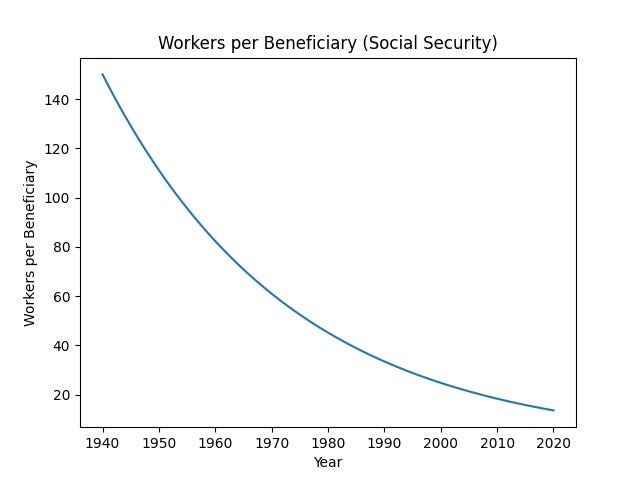
The response was the creation of the Social Security Act, which introduced a system designed to provide a basic level of income in retirement. The structure chosen was a pay-as-you-go model, where current workers fund current retirees. At the time, this arrangement was supported by favorable demographics. There were more than 150 workers for every beneficiary in 1940, which made the system relatively easy to sustain.
As the program took hold, individuals and institutions began to adjust their behavior around it. Retirement planning increasingly assumed the presence of Social Security benefits. Little by little, the program shifted from being a supplemental safety net to becoming a central component of retirement income for a large share of the population.
Proposals to reduce benefits, adjust eligibility, or restructure the system tend to face immediate resistance. The costs of reform are visible and concentrated, while the benefits are long-term and less certain. As a result, the program has become widely regarded as politically untouchable.
The system has continued to expand under conditions very different from those in which it was created. The ratio of workers to beneficiaries has fallen to roughly 2.7 to 1, reflecting longer life expectancy and lower birth rates. According to Social Security Trustees’ projections, incoming revenue will cover only part of scheduled benefits in the coming decades unless adjustments are made.
Despite these pressures, significant structural reform has been repeatedly delayed. The reasons are not difficult to identify. The program provides immediate and tangible benefits to a large population, while the costs of maintaining it are spread across current and future taxpayers. This imbalance creates strong incentives to preserve the existing system rather than fundamentally change it.
The legal structure reinforces this dynamic. In Flemming v. Nestor, the Supreme Court made clear that Social Security benefits are not a contractual right and can be altered by Congress. In practical terms, this means that the system is governed by political decisions rather than fixed obligations, even as individuals plan their lives around it as if it were permanent.
Seen through the framework outlined earlier, the pattern is clear. A serious problem led to intervention. That intervention created a system that people came to rely on. That reliance made the system politically durable. And that durability has made it difficult to adapt the system to changing conditions.
The result is not simply a program that persists, but one that illustrates how policies introduced to reduce hardship can evolve into long-term structures that are sustained as much by their political stability as by their original purpose.
Healthcare Policy: The Affordable Care Act
The Affordable Care Act was introduced in response to a problem that had been building for years. Healthcare costs had been rising faster than wages, millions of Americans lacked insurance coverage, and those with preexisting conditions often found it difficult or impossible to obtain affordable policies. By the late 2000s, the issue had become both economically significant and politically urgent.
The policy response was comprehensive. The Affordable Care Act combined several elements into a single framework. It expanded Medicaid eligibility for lower-income individuals, created regulated insurance marketplaces, introduced subsidies based on income, and imposed rules on insurers, including the requirement to cover individuals regardless of health status. The intent was to increase access while restructuring how insurance markets functioned.
In the short term, the law did increase coverage. The uninsured rate in the United States fell from roughly 16 percent in 2010 to around 8 to 9 percent by the late 2010s, according to data from the Census Bureau and other sources. Millions of people who had previously gone without insurance gained access to coverage, particularly through Medicaid expansion and subsidized plans in the exchanges.
As the system took hold, behavior adjusted around it. Individuals began to rely on subsidized coverage or Medicaid where available. Employers, insurers, and healthcare providers adapted to new regulations and reimbursement structures. The design of insurance plans shifted as well, with standardized benefits and broader coverage requirements replacing many of the more limited policies that had existed previously.
This created a different kind of dependency. Access to insurance became tied not only to employment or personal choice, but also to eligibility thresholds, subsidy structures, and regulatory frameworks. For those receiving subsidies or covered through Medicaid, the system provided a level of stability that did not previously exist. For others, particularly those who did not qualify for subsidies, the experience was more mixed.
Premiums in the individual market increased in many areas during the early years of implementation. Some of this reflected broader coverage requirements and the integration of higher-risk individuals into the pool, but the effects were uneven. Households just above the subsidy thresholds often faced significantly higher costs without corresponding financial assistance. In some markets, networks also narrowed and plan choices became more limited.
These outcomes did not produce a simple reversal of the policy. Instead, they reinforced the political dynamics surrounding it. Individuals who benefited from expanded coverage, particularly those with subsidies or preexisting conditions, had a strong interest in maintaining the system. Those facing higher costs, by contrast, often lacked a unified or concentrated political response because their experiences varied by income, region, and market conditions.
This asymmetry influenced how the policy evolved. Efforts to repeal or significantly alter the law encountered resistance, in part because the benefits were both visible and immediate to those receiving them. Even when changes were proposed, they tended to focus on adjustments at the margins rather than a full restructuring of the system.
Meanwhile, the system itself continued to develop. Additional rules, subsidies, and adjustments were layered onto the original framework to address emerging issues. Healthcare costs overall did not decline, and the complexity of the system increased as new provisions were added.
Seen through the broader framework, the pattern is consistent. A visible and widely recognized problem led to a large-scale intervention. That intervention expanded access and created new forms of reliance. As reliance grew, the system became more politically durable, even as debates continued over its costs and structure.
What took shape was not a static system, but one that continued to evolve under the pressure of policy goals and political realities alike. The initial problem of access was addressed in part, but the long-term tradeoffs, especially around cost and complexity, remain unresolved.
Income Support Systems
Programs designed to supplement income or reduce poverty have been a central part of federal policy for decades. The underlying problem they address is straightforward. A portion of the population earns wages that are not sufficient to cover basic living costs, especially when accounting for housing, healthcare, and family expenses. That gap has existed in different forms across time, and it has often been the basis for policy intervention.
The response has taken several forms. Direct assistance programs, tax credits, and benefits tied to income thresholds have all been used to increase take-home resources for lower-income households. Among these, the Earned Income Tax Credit has received broad support across political lines. It provides additional income to working individuals and families, and research has shown that it can increase labor force participation, particularly among single parents.
The structure of many income-based programs introduces effects that are less visible but still significant. Benefits are often tied to income ranges, with eligibility decreasing or phasing out as earnings rise. This creates what are commonly called “benefit cliffs,” where a relatively small increase in income can lead to a disproportionate loss of benefits.
When multiple programs operate simultaneously, these effects can compound. A household may receive assistance through tax credits, housing support, food assistance, and healthcare programs, each with its own eligibility thresholds. As income increases, the combined reduction in benefits can offset much of the additional earnings, which changes the incentives faced by individuals attempting to move to higher income levels.
This does not mean that people do not seek to improve their circumstances. It does mean that the structure of the system can influence how those decisions are made. When the net gain from additional work or income is reduced, the pace of upward mobility can be affected, even if the intention of the policy is to support it.
These programs become integrated into household planning. For many recipients, they are not temporary measures but ongoing components of financial stability. This creates a form of reliance that is less visible than in other areas but no less real. Removing or significantly reducing these programs would have immediate effects on those who depend on them, which makes such changes politically sensitive.
The political implications follow the same pattern seen in other areas. Programs that deliver direct financial support create a clear and immediate benefit. Those benefits are experienced at the household level, which makes them tangible and easy to connect to the policy itself. The costs, by contrast, are distributed more broadly through the tax system and are less likely to be associated with any single program.
As a result, proposals to reduce or restructure these programs often face strong opposition, even when concerns are raised about long-term effects or incentive structures. Policymakers are more likely to adjust the margins of these programs than to fundamentally change their design.
The system also tends to expand as new gaps appear. New programs are added to address them, and existing ones are modified to include additional groups or provide greater benefits. Each change may be justified on its own terms, but the cumulative effect is a more complex and extensive framework of support.
Viewed through the broader pattern, income support systems follow the same trajectory. A real problem leads to intervention. That intervention provides stability and relief. Over time, it becomes embedded in household decision-making and politically difficult to alter.
What develops is a structure that addresses immediate needs while shaping long-term behavior in ways the original design did not fully anticipate.
Regulatory Frameworks
Regulation is often introduced in response to visible failures or risks that affect large numbers of people. Environmental damage, unsafe products, and financial instability have each, at different times, prompted calls for government action. In these cases, the initial problem is not abstract. It is usually tied to events that attract public attention and create pressure for a response.
The policy response typically involves creating rules designed to limit harmful behavior or reduce systemic risk. Environmental laws in the late twentieth century were aimed at reducing pollution and protecting public health. Financial regulations, particularly after periods of market instability, have been designed to prevent practices that could lead to broader economic disruptions. These measures are often supported across political lines at the moment they are introduced, because the underlying problems are widely recognized.
Once implemented, regulatory systems begin to shape how industries operate. Firms adjust their behavior to comply with new rules, and entire sectors reorganize around regulatory requirements. Compliance becomes a normal part of doing business, and as these systems take hold, it can become a significant factor in how companies plan, invest, and compete.
As with other policy areas, this creates a form of reliance, although it is less direct than income support or healthcare programs. Businesses, financial institutions, and even local governments begin to operate within the framework established by regulation. Removing or significantly altering that framework can introduce uncertainty, which tends to make policymakers cautious about large-scale changes.
Regulatory systems also tend to expand as new gaps and unintended consequences emerge. New rules are added to address them, and existing regulations are interpreted and enforced in ways that extend their reach. Agencies responsible for oversight often grow in size and authority as their responsibilities widen. What began as a targeted response to a specific problem can evolve into a broader structure that governs multiple aspects of economic activity.
The costs associated with regulation are not always immediately visible. They may appear in the form of higher prices, reduced competition, or barriers to entry for smaller firms. Larger organizations are often better equipped to absorb compliance costs, which can affect how industries are structured over time. These effects are typically indirect, which makes them less likely to generate the same level of public attention as the original problem that prompted the regulation.
At the same time, the benefits of regulation are often tied to outcomes that are difficult to measure in the short term, such as reduced risk or avoided harm. This creates a situation where the justification for maintaining or expanding regulatory systems is based partly on what might happen in their absence, rather than on immediate, visible results.
From a political standpoint, the pattern is familiar. Regulations introduced to address clear and immediate problems become embedded in the structure of industries and institutions. As that happens, they become more difficult to remove, even if questions arise about their long-term effects or unintended consequences.
Seen through the broader framework, regulatory policy follows the same trajectory as other areas. A problem leads to intervention. That intervention reshapes behavior and becomes part of the operating environment. As the system expands, it also becomes more difficult to unwind, even as the conditions that justified its creation continue to change.
What emerges is not merely a set of rules, but a system that endures because it has become woven into the structure of economic and institutional life.
The Hidden Mechanism: Cost Shifting
Up to this point, the pattern has been described in terms of crisis, intervention, reliance, and political durability. What keeps that pattern in place is something less visible but equally important. The costs of these systems are distributed very differently from their benefits.
The benefits are usually immediate and easy to see. A retiree receives a monthly check. A household qualifies for a subsidy. A family gains access to healthcare that was previously out of reach. These outcomes are concrete. They are experienced directly, and they are naturally associated with the policies that made them possible.
The costs, by contrast, tend to be less visible and more dispersed. They often appear gradually, through higher taxes, increased insurance premiums, or long-term fiscal obligations that are not immediately felt. In many cases, the connection between the policy and the cost is not obvious to the people who bear it.
This difference matters because it shapes how policies are perceived and how they are sustained.
When a benefit is clear and immediate, it generates support. When a cost is delayed or spread across a large number of people, it generates less resistance. Over time, this creates a situation in which policies that provide visible relief can expand, even if their long-term costs are significant.
The distribution of those costs is not uniform. Middle-income households often bear a substantial portion through taxes and premiums, particularly when they do not qualify for targeted benefits. Younger generations may face the long-term consequences in the form of higher debt levels or reduced flexibility in future policy decisions. Future taxpayers, by definition, have no voice in the decisions that create those obligations.
This separation between who benefits and who pays is a recurring feature across different policy areas. In Social Security, current retirees receive benefits funded by current workers, with future obligations depending on demographic and economic conditions. In healthcare, subsidies and expanded coverage provide immediate support to some groups, while costs are distributed through premiums and public spending. In income support systems, direct payments or tax credits increase household income, while the broader cost is absorbed through the tax base.
None of this means that the benefits are not real or that they do not address legitimate needs. It does mean that the structure of these systems allows them to grow without requiring the same level of immediate accountability for their costs.
This dynamic reinforces the pattern described earlier. Policies that deliver visible benefits continue to attract support, while the costs that sustain those policies remain less connected to individual decisions. This makes it easier to maintain and expand the system than to reduce or fundamentally change it.
Once this mechanism is in place, it becomes part of how the broader system operates. Decisions are made within a framework where immediate relief is rewarded and long-term cost is less visible. As that pattern repeats across multiple areas of policy, it contributes to the persistence and growth of systems that are built to manage ongoing problems rather than eliminate them.
Why Reform Rarely Happens
By the time a policy reaches the stage where its long-term effects are being debated, it is usually no longer just a policy. It has become part of how people live, plan, and make decisions. That shift from policy to structure is what makes reform difficult.
The first obstacle is political risk. Changes to large programs are not evaluated in the abstract. They are experienced by individuals who rely on them. A reduction in benefits, a change in eligibility, or a restructuring of a program produces immediate and visible effects for those affected. Even when a reform is intended to improve long-term sustainability, the short-term impact tends to dominate how it is perceived.
This creates a situation in which the costs of change are concentrated, while the benefits are delayed. For a policymaker, that imbalance matters. The negative response to change is immediate and often organized, while the positive outcomes, if they occur, may not be visible for years. Under those conditions, maintaining the existing system is often the safer choice.
The second factor is reliance. Programs become integrated into everyday life. Retirement planning assumes certain benefits will be available. Healthcare decisions are made within the framework of existing coverage systems. Household budgets may depend on tax credits or direct assistance. Once these expectations are in place, altering the system introduces uncertainty that people are naturally reluctant to accept.
The third factor is institutional growth. Programs do not operate in isolation. They are administered by agencies, supported by contractors, and often reinforced by advocacy groups that have developed around them. These organizations have their own incentives to maintain and expand the programs they are connected to. Their influence can shape how policies are implemented and how proposals for change are evaluated.
The fourth factor is how reform is framed. Changes to existing programs are often presented not as adjustments, but as losses. A proposal to reduce future benefits may be described in terms of what people stand to lose, rather than in terms of long-term stability or sustainability. This framing influences how the public responds and makes it more difficult to build support for structural changes.
Taken together, these factors create a consistent outcome. Policies that might benefit from adjustment remain largely intact, even when their long-term challenges are widely recognized. The system persists, not because its problems are unknown, but because the incentives surrounding it make meaningful change difficult.
This does not mean that reform never occurs. It does mean that reform tends to be incremental and limited, addressing specific issues rather than the underlying structure. As a result, the system continues to operate along the same general path, even as conditions evolve.
When viewed alongside the earlier sections, the pattern becomes clearer. A problem leads to intervention. That intervention creates reliance. Reliance generates political durability. And once that durability is established, the system becomes resistant to change, even when the need for change is acknowledged.
The Tradeoff
Up to this point, the focus has been on how policies develop, expand, and become durable. What often gets less attention is the tradeoff embedded in that process. Every system that reduces risk in one area introduces constraints or costs in another.
Policies that expand access to healthcare can make coverage more predictable, but they can also increase overall costs or reduce flexibility in how plans are structured. Income support programs can stabilize households facing financial strain, but they can also affect how additional work or income translates into net gain. Retirement systems can provide a baseline level of security, but they can also depend on demographic and fiscal conditions that change over time.
These are not abstract tradeoffs. They affect how people make decisions about work, savings, and long-term planning. When a system absorbs a certain type of risk, it changes the incentives that would otherwise shape behavior. That shift can be beneficial in some contexts, particularly where the risk is severe and the alternatives are limited. But it can also reduce the pressure that would otherwise drive different kinds of decisions.
The balance between security and independence is not fixed. Different policies place that balance in different places. A system that emphasizes protection may reduce exposure to immediate hardship, while a system that emphasizes flexibility may allow for greater variation in outcomes. Neither approach eliminates tradeoffs; they shift where those tradeoffs appear.
As multiple policies interact, their effects accumulate. A household may be shaped at the same time by healthcare rules, tax structures, and income-based programs. Each system is meant to address a specific issue, but together they shape the broader environment in which decisions are made.
The result is a structure that can provide stability while also limiting certain forms of movement. That limitation is not always intentional, and it is not always immediately visible. It emerges from the way policies interact and from the incentives they create.
Understanding this tradeoff is essential to evaluating the system as a whole. It is not enough to ask whether a policy provides a benefit. The more important question is whether it changes behavior in ways that support its stated goals or quietly undermine them.
In that sense, the issue is not whether risk should be reduced, but how it is reduced, and what is introduced in its place.
The Real Issue
The real issue is not whether these policies were introduced in response to legitimate problems. Many of them were. The real issue is what happens after that.
Once a system begins by offering relief, it does not remain static. It grows. It develops constituencies. It becomes woven into the assumptions people make about work, healthcare, retirement, and everyday survival. At that point, it is no longer just a response to a problem. It is part of the structure through which that problem is managed.
That distinction matters because a policy can produce benefits and still create long-term costs that are rarely discussed with the same honesty. A healthcare program can expand coverage while driving up costs elsewhere. An income support system can provide stability while weakening the incentives that would otherwise support upward movement. A retirement program can reduce poverty among the elderly while placing growing strain on younger workers and future taxpayers.
In other words, the existence of a benefit does not settle the issue. The real question is what kind of system is being built, what behaviors it rewards, and who ultimately pays for it.
This is why looking at these policies one by one is not enough. The larger pattern is what matters. Across different areas, the same sequence keeps appearing. A real problem generates pressure for action. Government steps in with relief. Relief becomes reliance. Reliance becomes political durability. Then the system expands and becomes harder to change.
At that point, the argument is no longer about one law or one program. It is about a governing approach that repeatedly turns immediate hardship into long-term structure. Whatever the original intention may have been, the outcome is a society in which more people depend on systems they do not control, while the costs of maintaining those systems are pushed outward and forward.
That is the issue. Not whether there was ever a real problem, but whether the solutions being offered actually solve it, or simply build a more permanent framework around it.
The System That Grows With Pain
By this point, the pattern is no longer difficult to see.
Problems arise. Policies are introduced. Those policies provide relief, and in doing so they become part of how people live and make decisions. Over time, they expand, they become more complex, and they develop a level of political support that makes them difficult to change.
None of this happens all at once. It builds gradually, often in ways that are not immediately obvious. Each individual policy can be explained on its own terms. Each expansion can be justified as a response to a specific need. But taken together, the direction is consistent.
The system grows.
It grows in size, in cost, and in influence. It becomes more central to everyday life, and more resistant to change. The original problems do not necessarily disappear. In many cases, they remain, reshaped but still present, continuing to justify the existence and expansion of the system built around them.
This is what gives the pattern its durability.
When a system is tied to providing relief, it develops a built-in advantage. The benefits are visible and immediate. The costs are spread out and less visible. Those who receive the benefits have a clear reason to support it. Those who bear the costs experience them in ways that are less direct and more difficult to trace back to any single policy.
With the passage of time, that imbalance reinforces itself.
The system does not need to eliminate the problem in order to survive. It needs to manage it well enough to continue delivering benefits. As long as that condition is met, the incentives favor maintaining and expanding the structure rather than fundamentally changing it.
This is not a question of whether any individual policy has helped. Many have, at least in the short term. The question is what kind of system emerges when the same pattern is repeated across decades of policy decisions.
What takes shape is a structure tied to the very problems it was created to address.
And once that structure is in place, changing it becomes far more difficult than creating it in the first place.
That is the point where policy turns into something else. It becomes part of the environment people operate within, rather than a tool that can be easily adjusted or replaced.
At that stage, the conversation is no longer about solving a problem. It is about managing a system that has grown around it.
When a system grows around managing pain, the incentive is no longer to eliminate it but to sustain it. At that point, pain is no longer just a problem to be solved. It becomes part of the structure that keeps the system in place.
If You See What This Is… Help Me Keep Doing It
If this made sense to you, if you’ve felt this pattern but haven’t seen it laid out this clearly before, then you already know why this work matters.
I don’t have a newsroom behind me.
No foundation funding.
No institutional backing.
Just time, research, and a willingness to say things most people won’t.
If you want more of this, the kind of writing that actually breaks things down instead of dressing them up, here’s how you can support it:
Become a Paid Subscriber
https://mrchr.is/help
Make a One-Time Contribution
https://mrchr.is/give
Join The Resistance Core
https://mrchr.is/resist
And if you can’t give right now, that’s fine.
Share it. Restack it. Send it to someone who needs to read it.
That matters more than you think.
Because the only way this kind of work grows…
is if people decide it’s worth keeping around.
I just had a conversation about this. The black neighborhood where I teach is almost entirely dependent on SNAP and Medicaid. When the government shutdown caused a delay in SNAP refills it was a crisis for the families and the corner stores. Adults at school told the kids that they should learn to save and plan. Obviously a lot of parents didn’t.
Social Security was intended to be drawn on by people who paid into it not given to millions of illegal aliens who flooded our nation in the last four years but it was given out to them and they never paid into it. And now there's people banging the drums that there won't be enough money and I wonder why that is I'm being sarcastic the other thing is yes the Democrats want to encourage same-sex relationships which do not result in babies by the way and they want to abort pregnancies and so there aren't workers coming up to pay into a Social Security system and the illegal aliens come here for handouts not actually work and pay into the system so yes by a cultural change and the demonic Democrat Social Security is unsustainable and for some reason elderly people are living longer my mother is 93 and I can't figure out how Bill Gates and gone yet that is a real mystery to me and I'm not even being sarcastic.
She took every Covid and every booster and she doesn't even have dementia I don't get it.
She also has a ton of friends I can name five people in her earner circular well into their 90s and they're still alive and kick in and by the way these are women and they didn't pay into Social Security cause their husbands worked.
The affordability act was never affordable by the middle class and certainly not the lower class and the affordability act was named that to mislead people and I don't think it was really used for Healthcare I forget if I if I even knew what Nancy Pelosi and all the other horrible people in our government were actually using that money for but I think it had very little to do with Healthcare if my memory serves me correctly.
I didn't take Covid shots or boosters and I have no excuse and I don't do sugar I've known for years that sugar was linked to Alzheimer's and dimension all that stuff and it just we can't win for losing and your article was once again very well written and very comprehensive and I don't know what the answer is is certainly not socialism and it's not Marxism and it's not any it's not Islam and it's not communism and so I do know a good place to start is to stop giving Social Security to people who never paid into it starting today.
The other thing is FEMA money what about that how many times of FEMA funds spend withheld from I don't know Republicans oh yeah that happened right before Trump took office and FEMA was and has been used for anything and everything but what it was intended for.
An Elon Musk wanting some kind of universal disbursement of funds will give young people no incentive to get out of bed every day or to get off their screens and their antisocial behavior which results in antisocial behavior frictionless relationships that end up in reality with a lot of friction.
Driving make-believe cars recklessly on your iPhone and then get behind the wheel of a real car on a real highway and the results are crazy oh let's introduce psychedelics now. You know, legalizing marijuana and promoting psychedelic drugs and expecting people not to go from video games to real life driving or even interacting in a grocery store without having any problems.
I'm glad I'm getting to an age group that hopefully won't have to see the long-term effects and I look at my grandchildren I used to Shudder I used to have anxiety and now I just figured hey I got through the years of changing technology and I'm still living and breathing and I don't see a lot of hope for society that doesn't punish crime that we have judges that don't enforce the law and probably only have the security of a secure Boder for two more years because Republicans are as useless as tits on a bull and the Democrats are out to destroy America and I just I'm starting to feel that I'm gonna need to disengage from reading things because the helplessness and hopelessness are tangible ...it is palpable. Talking about it without any real solutions on the horizon it's just to demoralizing so I think I am gonna step back and not subscribe to a lot of my Substack things of independent writers because we can talk about it all we want it's not gonna change anything.
In fact it's getting to the point where instead of stress stressful for me is boring it's like watching paint dry.
I'm overtired and grumpy and I felt like just saying how I really feel and this is how I really feel and all I can do as a Christian and I am one is know that in my heart God has a plan that supersede the global problem which has crept into the United States and actually been here for a lot longer than the media has allowed us to see God is showing us what's behind the curtain and there is a new kingdom coming God's kingdom is coming and so I just feel like for lack of knowledge his people perish so the knowledge part is good for me and I just have to trust my grandchildren to a supernatural guard and God for their futures.
I was on a different Substack encouraging everyday normal citizens to get involved in the change but you know what I'm too old for this crap and I'm not going to be I am not going to be the next Tina Peters no thank you. Victory for the left but sorry I just I'm not going to sit around a jail cell because I want to blow a whistle when I see something wrong and then get punished for it not going to happen... not going to happen.
My dad fought as a helicopter pilot out of West Point New York for the army and two wars and I have a brother that I believe died of pancreatic cancer brought on by over vaccination when he used deployed to the Gulf course my family has sacrificed for this country with an amazing amazing amount of pain from our family our nuclear family and I'm throwing in the towel at this point and saying you can't fight City Hall. That was an expression in my day and I can't even get popcorn and be entertained anymore. I'm so angry that I I have to extricate myself.