


“The world prefers a weaker America. It forgets that without America, the world it enjoys would not exist.”
Americans are often told that we live in a global community. We hear that nations cooperate for mutual benefit, that international institutions exist to solve shared problems, and that trade binds us together in peaceful interdependence. It is a pleasant story. It is also incomplete.
Nations do not behave like neighbors sharing sugar. They behave like competitors protecting their advantage. History does not show us a world governed by goodwill. It shows us a world governed by incentives, power, and self-interest. When Americans forget that, they become vulnerable.
The United States today sits at the center of a global system that depends heavily on American strength while often resenting American dominance. That tension is not emotional. It is structural. Understanding that tension is the beginning of clarity.
It’s not whether America is loved or hated. It’s whether America is positioned to remain strong in a world that rewards weakness with dependency and strength with resistance.
To answer that, we have to examine both the global landscape and our internal political direction.
The Illusion of Global Harmony
International trade is frequently described as a win-win exchange. In theory, that is true. In practice, trade is also a form of leverage.
The United States runs persistent trade deficits. In 2024, the goods and services deficit was roughly in the high hundreds of billions, and 2025 remained in that same broad range. Those figures fluctuate, but the pattern has been consistent for decades. The United States consumes more than it produces in certain sectors, particularly manufactured goods. That imbalance creates dependency.
Tariffs can change where the United States buys goods and raise revenue for the Treasury, but they do not automatically erase structural imbalances. In 2025, the overall goods and services trade deficit remained very large, even as imports and exports both moved month to month. Tariffs often shift trade patterns, narrowing deficits with some partners while expanding them with others, but the underlying gap between domestic consumption and domestic production can remain.
Consider semiconductors. Advanced chip production is heavily concentrated in Taiwan and South Korea, with Taiwan central to leading-edge fabrication. The COVID-era chip shortage showed what bottlenecks look like even without war. Production delays forced automakers to idle plants, reduce output, and raise prices. If a blockade, cyberattack, or conflict disrupts those flows, the damage would spread across defense, healthcare, and the core industry.
Energy tells a similar story. The United States became a net exporter of energy in recent years due to shale production. Yet policy decisions affect how durable that position remains. In 2023 and 2024, federal leasing slowdowns and regulatory changes reduced new drilling permits on federal land compared to prior years. Meanwhile, Europe’s energy crisis following the Russia-Ukraine war demonstrated what happens when a continent becomes dependent on an adversarial supplier. Germany relied on Russian natural gas for more than half of its supply before 2022. When that pipeline shut down, industrial production fell sharply, and energy prices surged.
Interdependence is not peace. It is a balancing act.
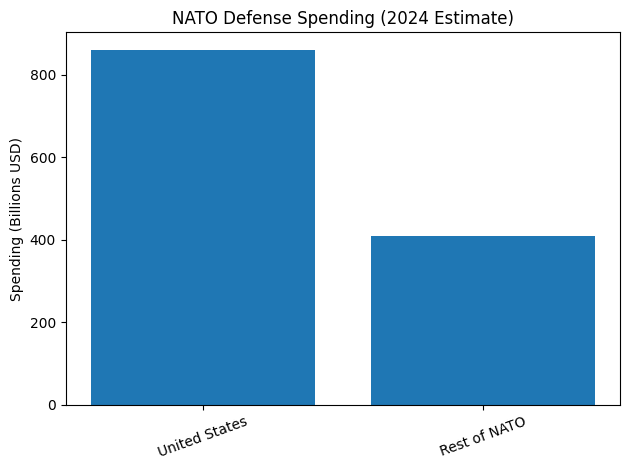
International institutions operate similarly. NATO relies on the United States for the bulk of its funding and military capability. In 2024, the United States accounted for roughly 68 percent of total NATO defense spending. Many European nations continue to spend below the 2 percent of GDP target.
Leverage, Dependency, and the Hidden Costs of Comfort
People talk about trade deficits as if they were merely a scoreboard. Imports bad, exports good. That is a child’s way of looking at an adult problem. The strategic question is what you import, how concentrated the supply is, and whether you can replace it quickly when the world stops being polite.
Start with the dollar. The United States can run large external deficits because the dollar is still the primary reserve currency. Central banks hold dollars because they need liquid assets, deep markets, and a place to park reserves without political chaos. A large share of global foreign exchange reserves remain in dollars, and most foreign exchange transactions involve the dollar on at least one side. Oil and many other commodities are still priced in dollars. That arrangement is not charity. It is leverage.
But leverage cuts both ways. The United States can sanction adversaries because the world uses the dollar. That also means the world is constantly looking for ways to reduce exposure to that lever. After sanctions on Russia escalated, Russia shifted trade settlement away from dollars where possible. China has promoted yuan settlement in bilateral deals and expanded swap lines with other central banks. BRICS discussions about alternative settlement systems come and go, but they exist for a reason. The threat is not that the dollar disappears in a year. The threat is that the premium we enjoy slowly shrinks, and the cost of borrowing rises across decades.
Now look at what the United States actually imports. Consumer goods are one thing. Strategic inputs are another. Active pharmaceutical ingredients are a quiet vulnerability. Shortages of basic medications in recent years were a reminder that a wealthy nation can still find itself scrambling for things it assumed would always be on the shelf. You do not want to discover dependence during a crisis.
Rare earths are another case. The minerals themselves exist in many places. The processing capacity is the choke point. China dominates processing and has shown in past disputes that it understands what a choke point is. Even a temporary restriction can force companies to pay more, delay production, or move operations. When a nation controls processing, it controls timing, and timing is often the difference between resilience and panic.
Energy independence needs the same realism. Americans hear that the United States produces record amounts of oil. That is true, but production is only one link. Refining capacity matters. Pipeline capacity matters. Port capacity matters. Regulatory uncertainty matters because multi-billion-dollar projects require stable assumptions. A nation can produce crude and still face regional fuel price spikes if refining capacity is constrained or distribution is bottlenecked.
Europe learned this lesson the hard way after Russia invaded Ukraine. Germany built an economy around cheap Russian gas and then acted surprised when cheap gas came with strategic strings. When the strings tightened, industry stumbled, and governments scrambled. Energy is not merely a commodity. It is the foundation under every other industry.
Now, bring this back to institutions. NATO is an alliance, but it is also a ledger. The United States supplies a disproportionate share of spending and capabilities. Many European nations expanded welfare commitments while depending on American security. When Europeans lecture Americans about policy choices while relying on American defense, it is not moral superiority. It is the comfort of subsidized security.
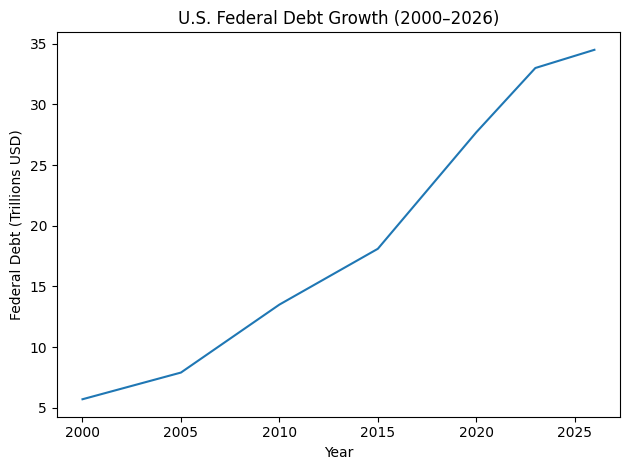
That same pattern shows up at home in a different form. The growth of federal spending from the early 2000s to the mid 2020s is not a matter of opinion. Outlays rose from under two trillion to over six trillion. Debt rose past thirty-four trillion. People argue about the reasons, but math is an exact science. Interest payments rise when rates rise. Interest is the one line item you do not negotiate with. It is the price of yesterday’s choices.
Entitlements are the long fuse. Social Security and Medicare grow with demographics. With the worker-to-retiree ratio declining from roughly 5-to-1 in the 1960s to closer to 2.5-to-1 today, immigration can partially offset labor force shrinkage. But the fiscal impact depends on employment rates, skill levels, and long-term earnings relative to benefit usage. That is not politics. That is biology and arithmetic. You can reform benefits, raise taxes, raise retirement ages, or borrow more. You cannot vote the ratio back to what it was in 1965.
Immigration is often discussed as if it were either a pure blessing or a pure curse. Reality is more specific. High-skilled immigration tends to boost innovation and tax revenues. Low-skilled immigration can add labor supply but also impose near-term costs on schools, hospitals, and local services. In high-inflow districts, school systems must expand English learner programs, hire additional support staff, and increase per-pupil spending before long-term tax contributions materialize. Those costs are often borne locally even when the policies are national. Assimilation historically occurred through labor market participation, language acquisition, and civic integration within a generation. When inflows exceed the pace at which schools, labor markets, and communities can absorb newcomers, integration slows and social fragmentation increases. You get parallel systems.
Emergency rooms and public hospitals in border states have reported periodic strain when uninsured migrant populations increase faster than reimbursement mechanisms adjust. When uncompensated care rises, costs are either absorbed by taxpayers or shifted through higher premiums.
Manufacturing decline fits into the same story. The United States still produces a great deal, and productivity per worker is high. But the ecosystem has thinned. Supplier networks have moved. Tooling expertise has aged out. Apprenticeships declined. The industrial commons, the dense web of small and mid-sized firms that support big production, is harder to rebuild than people realize. When a crisis arrives, you cannot simply declare capacity into existence.
History is full of nations that assumed their position was permanent. Rome debased coinage when fiscal stress rose. That bought time and reduced trust. Britain’s empire rested on industrial leadership and naval power. When competitors caught up and wars drained the treasury, commitments exceeded capacity. In both cases, the decline was gradual until it was undeniable.
The lesson is not that America is Rome. The lesson is that arithmetic outlasts rhetoric. If production erodes, if debt grows faster than capacity, and if institutions lose credibility, then even a rich nation finds itself constrained. Sovereignty becomes a word you use rather than a condition you possess.
Whether the world likes us is secondary. The question is whether the United States is building the kind of strength that does not require permission.
Domestic Distraction and Institutional Escalation
While global competition intensifies, American politics grows more volatile.
The conflict between the Republican Party and the Democrat Party is often presented as a routine contest between policy preferences. Increasingly, it resembles something more structural.
In recent years, we have seen aggressive use of investigations, prosecutions, and bureaucratic authority tied to political disputes. That pattern did not begin in 2025. It accelerated after 2016 and intensified after 2020.
The 2018 midterm elections produced a wave of Democrat Party candidates who openly campaigned on investigations of the sitting president. That was not unusual in itself. What was unusual was the degree to which investigative power became central to campaign messaging.
By 2024 and 2025, public discussion around prosecutorial action against political figures, including debates over National Guard deployment and executive authority, signaled something deeper. When legal institutions become arenas for partisan escalation, trust erodes.
Trust is not a sentimental concept. It is foundational to economic stability. According to Gallup polling in 2025, public trust in major institutions such as Congress, the media, and even the Supreme Court remained below historical averages. Trust in Congress hovered near 15 percent. That is not a healthy baseline for a constitutional republic.
Low trust does not just change how people feel. It changes how they behave. When law enforcement and legal institutions are widely perceived as politicized, compliance weakens and instability rises. Investors demand higher risk premiums. Businesses delay long-term commitments. Allies hedge. Rivals test boundaries. A nation does not need to lose a war to lose momentum. It only needs to lose confidence in its own system.
When citizens view institutions as weapons rather than neutral arbiters, political competition turns existential.
This is where rhetoric about being “cooked” if one party retakes power needs clarification. It is not about disagreement over tax rates. It is about whether federal authority continues expanding into domains that were once limited by cultural restraint.
The growth of federal spending provides context. In 2000, federal outlays were approximately $1.8 trillion. By 2024, that number exceeded $6 trillion. Even adjusting for inflation, the expansion is dramatic. Federal debt surpassed $34 trillion by early 2026. Interest payments alone have become one of the largest line items in the federal budget, exceeding defense spending in certain projections.
The concern is not partisan emotion. It is structural arithmetic.
Immigration is one of the clearest places where structural arithmetic meets political reality, because policy determines both the scale of inflow and the distribution of costs.
Immigration enforcement policy is not simply a moral debate. It is a question of incentives and fiscal capacity. When unlawful entry results in extended processing timelines, work authorization during review, and access to housing, education, and healthcare systems, those services are financed by taxpayers already inside the system. Several major cities have reported billions of dollars in unplanned expenditures related to migrant shelter programs, emergency housing contracts, and school system expansion over the past two years. Local budgets are not abstract instruments. They are finite.
When new obligations arise without corresponding federal reimbursement or structural reform, trade-offs follow. Infrastructure projects are deferred. Public safety hiring slows. Classroom sizes increase. Taxes rise, or debt accumulates. The immediate beneficiaries are recent arrivals granted provisional access. The immediate costs are distributed across existing residents. That redistribution may be defended as humanitarian, but it remains redistribution.
Policy signals matter beyond the border. Large-scale migration flows respond to perceived probability of entry, work, and prolonged residence. When enforcement is inconsistent and processing backlogs stretch for years, the distinction between lawful and unlawful entry blurs in practice. Over time, blurred distinctions erode public confidence in the rule of law itself. A sovereign state can welcome immigrants. It cannot sustain ambiguity about legal status and entitlement without weakening institutional credibility.
How Internal Weakness Becomes External Leverage
Foreign competitors do not need to defeat the United States in a conventional war to benefit from American weakness. They can profit from our distractions. They can study our politics, map our pressure points, and push at the seams. A nation that argues about everything eventually struggles to do anything.
One of the clearest pressure points is institutional trust. A functioning republic does not require universal agreement. It requires enough shared faith in process that losing a contest does not feel like losing a country. When trust collapses, politics becomes warfare by other means. Courts become battlefields. Bureaucracies become instruments. Elections become existential dramas rather than routine transfers of authority.
The damage is not limited to culture. It changes investment behavior. It changes corporate planning. It affects whether companies believe regulatory rules will remain stable across an election cycle. When uncertainty rises, capital becomes cautious. Projects are delayed. Risk premiums rise. That may sound abstract until you remember that national power rests on economic output. When output slows, everything else becomes harder to fund.
Fiscal strain amplifies the problem. A country with rising debt has fewer options in a crisis. If the next recession or war requires rapid spending, the cost of borrowing is relevant. If interest expense consumes a larger share of the budget, the state has less room to maneuver. It is not that the United States will “run out of money” like a household. It is that borrowing becomes more expensive, and expensive borrowing diminishes productive investment.
This is why the phrase “we are cooked” needs translation. It is not a prophecy. It is a warning about direction. When a political class treats spending as a substitute for production, it consumes the seed corn. It buys present comfort at the expense of future capacity. Nations can do that for a while. They cannot do it forever.
Now connect this to the outside world.
America’s allies watch American elections because American elections determine whether American commitments remain steady. If Washington looks unstable, allies hedge. They sign deals with rivals. They diversify suppliers. They seek security guarantees elsewhere. That is not betrayal. It is rational behavior.
America’s rivals do the same calculation from the other side. They look for moments when the United States is divided, distracted, or financially strained. They test boundaries. They run cyber operations. They exploit information channels. They push narratives that intensify domestic conflict. They do it because it is cheaper than tanks.
China’s approach illustrates the point. It invests in ports, telecom networks, and mineral supply chains in developing nations. It offers loans with terms that create leverage. It builds political relationships through commercial dependence. It does not need to invade a country to influence it. It simply needs that country to owe money, rely on Chinese technology, or depend on Chinese markets.
Russia has used a different model, leaning on energy dependence, disinformation, and opportunistic aggression. The Ukraine war showed that Europe’s earlier energy choices were not just economic. They were strategic vulnerabilities waiting to be exploited. When the exploitation came, Europe paid in inflation, industrial contraction, and political tension.
These are not exotic foreign plots. They are what nations do.
This is where American cultural distinctiveness is significant. The United States historically paired liberty with productivity. Americans tolerated risk because the payoff was real. They accepted inequality because upward mobility seemed achievable. They worked hard because work translated into ownership, not merely survival. That cultural bargain is not guaranteed. It depends on opportunity, not rhetoric.
When opportunity narrows, people reach for government as replacement. That is not because they suddenly love bureaucracy. It is because they are trying to survive. This is how a society drifts toward dependency without announcing it.
So the internal argument about the role of the federal state is also an argument about national strength. A large administrative state can distribute benefits, but it can also slow innovation through regulation, raise costs through compliance, and distort incentives through subsidies. If policy rewards consumption over production, you get the appearance of compassion and the reality of stagnation.
You can see this in the contrast with slower growing regions. Countries that accumulate heavy regulations often find that young people leave, businesses relocate, and investment slows. This does not make those countries evil. It makes them less competitive. In a competitive age, being less competitive is not a neutral condition.
The discipline required is not cruelty. It is realism. If the United States wants sovereignty, it must maintain what sovereignty requires: production, credibility, and cohesion. Without those, leadership becomes a word used in speeches while other nations shape the terms of reality.
The European Model as Contrast
Europe offers a useful comparison because it represents an alternative model of governance that many American policymakers openly admire.
European nations generally maintain higher tax burdens. In 2024, total tax revenue as a percentage of GDP exceeded 40 percent in many Western European countries, while the United States remained closer to 25 percent at the federal level. That difference is not abstract. It translates into lower disposable income and slower capital accumulation.
Over the past decade, U.S. GDP growth has consistently outpaced the eurozone average. That divergence widened after the 2022 energy shock. By 2025, U.S. GDP per capita hovered near $80,000. Germany remained closer to $55,000. The United Kingdom was near $50,000. A gap of $25,000 per person compounded over decades affects household savings, business investment, and long-term pension sustainability. Growth is not just about bragging rights. It determines how much margin a society has when crises arrive.
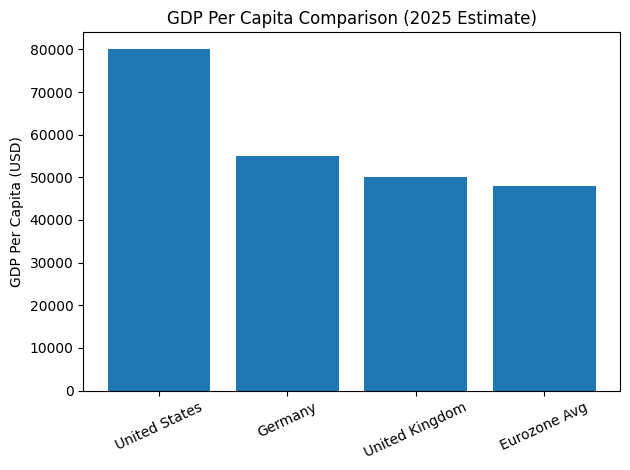
GDP is simply the size of the country’s economic output, the total value of what it produces in a year. GDP per capita takes that output and divides it by the number of people, which gives a rough sense of how much economic capacity exists per person. It does not tell you everything about quality of life, but it does tell you how much room a society has to pay its bills, invest, and absorb shocks.
Demographics intensify the contrast. Many European nations face fertility rates near 1.3 children per woman, far below replacement. That means fewer workers supporting more retirees. Pension systems built for expanding populations must now function in shrinking ones. The result is higher tax pressure on a smaller workforce, slower economic expansion, and increased reliance on immigration to stabilize the labor base. That reliance introduces its own integration challenges.
Energy policy revealed another structural vulnerability. Germany’s dependence on Russian natural gas before 2022 was framed as efficient interdependence. When Russia invaded Ukraine and gas flows tightened, German industrial output contracted and energy prices surged. Manufacturing firms faced input costs that American producers did not. What had looked like cost optimization became strategic exposure.
Defense spending tells a similar story. For years, several major European economies spent well below the NATO guideline of 2 percent of GDP on defense. When the war in Ukraine required rapid replenishment of artillery shells and military equipment, production capacity proved limited. The United States supplied a disproportionate share of matériel and logistics. Alliances function, but disparities become visible during stress.
These are not moral judgments. They are consequences of policy choices. Europe prioritized social insurance and regulatory caution. The United States prioritized growth, capital markets, and defense scale. The result is not that Europe collapses. The result is that it moves more slowly and depends more heavily on American security guarantees.
The contrast counts because it shows how policy accumulates. Higher taxation, aging populations, constrained energy strategy, and underinvestment in defense do not produce immediate decline. They produce gradual narrowing of strategic margin.
In a competitive world, margin is everything.
Strategic Vulnerabilities and Industrial Capacity
The strongest argument for American independence lies in production.
The United States imports a substantial share of critical minerals used in electronics, renewable energy systems, and defense technologies. China controls a significant portion of global rare earth processing capacity, exceeding 60 percent in some estimates. If geopolitical conflict disrupts that supply, American manufacturing would face immediate strain.
The CHIPS and Science Act of 2022 attempted to address semiconductor vulnerability by allocating tens of billions of dollars to domestic fabrication plants. By 2025, several new facilities were under construction in Arizona, Texas, and Ohio. That is progress. It also reflects how far supply chains had drifted.
Industrial strength is not nostalgia. It is security.
During World War II, the United States converted automobile factories into aircraft production lines. That flexibility existed because capacity existed. A post-industrial economy dependent on distant suppliers lacks that agility.
Energy independence remains equally critical. American oil production reached record levels in 2023 and 2024, exceeding 13 million barrels per day. Yet regulatory uncertainty affects long-term investment. Nuclear energy, which provides roughly 19 percent of U.S. electricity, has seen limited expansion despite its reliability and low emissions profile.
A nation that cannot power itself cannot lead.
Leadership, Not Domination
When some argue that America must become the world’s master, the phrase invites misunderstanding. Mastery implies coercion without consent. Leadership implies strength combined with legitimacy.
The United States has led before. After 1945, America helped rebuild Europe through the Marshall Plan, established institutions such as the IMF and World Bank, and anchored a system that reduced great power war for decades.
That leadership worked because it was backed by unmatched industrial and military power.
Today, leadership requires the same foundation.
It does not require apology for national interest. Every nation pursues its interest. The difference is that American interest historically aligned with expanding trade, open markets, and relative stability.
If America retreats from strength, others will fill the vacuum. China’s Belt and Road Initiative demonstrates that clearly. Infrastructure investments across Africa, Asia, and Latin America expand influence through economic dependency.
China’s leverage is not limited to ports, rail lines, or diplomatic forums. It extends deep into the physical infrastructure of modern life. Lithium-ion batteries power electric vehicles, grid storage systems, military communications equipment, and nearly every personal device. Chinese firms control large portions of the global battery supply chain, from mineral refining to cathode and anode production. In solar panel manufacturing, Chinese producers account for a dominant share of global output, in some segments exceeding 70 percent. That concentration shapes pricing power, technological standards, and supply availability.
This is important because energy systems are no longer just fuel. They are storage, distribution, and digital management. If a single country dominates the processing and manufacturing layers of those systems, leverage follows naturally. Nations seeking rapid energy transition find themselves purchasing inputs from the same supplier they are attempting to compete with strategically. That is not conspiracy. It is industrial positioning.
The lesson is straightforward. Sovereignty in the twenty-first century is measured not only in troop strength but in production capacity. A nation that cannot manufacture its own critical energy infrastructure must negotiate its autonomy through supply contracts.
The Real Choice
The debate in America is not simply about spending levels or social policy. It is about whether the United States remains a production-driven economy with strong cultural confidence or becomes a high-debt administrative state that manages consumption while its productive base narrows.
In recent years, the Democrat Party has advanced policies that expand federal authority across energy, finance, healthcare, environmental regulation, and labor markets. The stated goals are equity, climate stabilization, and economic security. The structural question is not the goal. It is the incentive effect.
Energy policy provides a clear example. Slower federal leasing, expanded environmental review layers, and regulatory uncertainty increase long-term capital risk. Large-scale industrial investment requires predictability. When energy development becomes politically unstable, investment becomes cautious. A country that complicates its own energy production raises its own cost structure.
Administrative expansion compounds the effect. The more sectors governed through agency rulemaking rather than legislation, the more economic decision-making shifts from markets to bureaucratic interpretation. Regulatory complexity favors large firms that can absorb compliance costs. Smaller firms face higher barriers. Over time, entry slows and concentration rises.
Fiscal policy follows the same pattern. Federal outlays have more than tripled since 2000. Debt now exceeds $34 trillion. Interest payments are projected to surpass $1 trillion annually within the next decade if current trajectories persist. Borrowing can cushion emergencies. It cannot permanently substitute for growth. When borrowing becomes routine rather than exceptional, future flexibility contracts.
A society can redistribute income temporarily. It cannot redistribute productivity that does not exist. Policies that raise the cost of domestic production while expanding permanent commitments narrow the country’s margin for error. In a competitive world, that margin is sovereignty.
Entitlement spending already accounts for the majority of federal expenditures. Demographic pressure ensures those obligations grow automatically unless reformed.
A young reader should understand this plainly. When a nation spends more than it produces year after year, the bill arrives. It arrives through inflation, taxation, or stagnation.
The Future of American Leadership
If the United States intends to remain influential in a competitive world, the requirements are not mysterious. They are structural.
Energy is the first layer. A modern economy rests on abundant and reliable power. Oil production may reach record levels, but production alone does not guarantee resilience. Refining capacity, pipeline infrastructure, regulatory stability, and long-term investment certainty determine whether energy abundance translates into durable advantage. Nuclear power, which already provides a substantial share of American electricity, offers reliability that intermittent sources cannot. If energy becomes constrained or politicized to the point of instability, industrial capacity and military readiness narrow with it.
Industrial strength is the second layer. The United States does not need to produce everything. But it cannot afford to lose the ability to produce critical things. Semiconductors, rare earth processing, pharmaceuticals, defense components, and heavy manufacturing capacity form the backbone of strategic autonomy. Incentives that reward domestic production, research, and skilled labor development strengthen sovereignty more effectively than subsidies that reward consumption. A nation that cannot scale production in a crisis does not control its own fate.
Fiscal discipline is the third layer. Federal spending expanded dramatically in the past two decades, and debt now exceeds levels that would once have been politically unimaginable. Borrowing can cushion emergencies. It cannot permanently substitute for growth. When interest payments consume an increasing share of the federal budget, future choices narrow. Reforming entitlement trajectories, prioritizing growth over redistribution, and limiting structural deficits are not ideological preferences. They are preconditions for long-term flexibility.
Cultural confidence forms the fourth layer. The American system has historically depended on a belief that effort leads to advancement. When citizens view opportunity as attainable, they tolerate inequality and risk because the system feels dynamic rather than fixed. If cultural narratives shift toward permanent grievance or permanent dependency, the incentives that drive innovation weaken. Economic vitality requires more than capital. It requires a population that believes effort is worthwhile.
Alliances are the final layer. Leadership does not require domination, but it does require capacity. Partnerships with other democratic nations amplify American influence, particularly when confronting authoritarian powers. Yet alliances function best when contributions are proportional and commitments credible. If American strength declines, alliances become obligations rather than multipliers.
None of these elements exist in isolation. Energy enables industry. Industry supports defense. Fiscal stability sustains both. Cultural cohesion underwrites all of it. When these systems reinforce one another, leadership emerges naturally. When they weaken simultaneously, leadership becomes rhetorical.
Strength Is a Choice
The United States is not destined to decline. It is also not insulated from it. Nations rise and fall based on the incentives they create and the capacities they maintain.
Global competition is not sentimental. Supply chains do not care about speeches. Debt does not negotiate. Demographics do not pause for political cycles. Institutions either retain credibility or they do not.
For decades, American strength rested on a combination of industrial scale, fiscal flexibility, cultural confidence, and military capability. That foundation allowed the country to absorb shocks, lead alliances, and shape global outcomes. It did not eliminate competition. It made competition manageable.
If production erodes, if debt compounds faster than growth, if energy becomes unstable, and if institutions lose public trust, sovereignty narrows. Leadership becomes conditional. Influence becomes reactive rather than shaping.
The world does not operate on affection. It operates on leverage. Countries align with strength and hedge against weakness. That is not hostility. It is strategy.
The real choice before the United States is not between isolation and empire. It is between discipline and drift. Between maintaining the structural advantages that built prosperity or assuming those advantages will persist without reinforcement.
Decline rarely announces itself. It arrives gradually, through accumulated concessions to convenience and comfort.
History does not move quickly. But it does move consistently.
A nation that cannot enforce its borders, balance its incentives, and manufacture what it needs is not sovereign. It is managed.
If America Is the Load-Bearing Wall, Back the Work That Says So
Everyone likes to talk about “the global community.”
Most of the world treats America less like a partner and more like a utility. They want the protection, the markets, the dollar, the stability. They also want us smaller, weaker, quieter, and easier to manage.
That is not cynicism. It is how nations behave.
This piece is about leverage, dependency, and how the world benefits from American strength while resenting it. It is also about what happens when America weakens itself from within through debt, distraction, and institutional decay.
I do not have corporate sponsors. No institutional backers. No foundation grants.
This publication runs on readers who understand that independence has a cost, and that clarity is worth paying for.
Paid subscriptions make long-form work like this possible.
There are more than 2,450 readers here. Only a fraction are paid.
Substack’s visibility rankings are driven directly by paid subscribers. Support is not symbolic. It determines whether work like this gets amplified or buried.
If even a modest percentage decides that American sovereignty is worth eight dollars a month, this work becomes durable and harder to sideline.
If you want this voice to stay independent when pressure rises, now is the moment to act.
Become a Paid Subscriber:
Make a One-Time Gift:
Join The Resistance Core:
America does not stay strong because the world wants it to.
It stays strong because Americans decide it will.
Late Friday Evening Greetings CHRIS!
Well, you have done it again by cranking out one of your best writings about America and its important role to thrive & survive in relationship to its competitors & allies..
as well as not sparing the page from having any blank spaces..meaning you gave us a book to read instead which is your "makers mark" as it were of course.
Thx and keep up your great work & relevant content!
William in Savannah~
Late Friday Evening Greetings CHRIS!
Well, you have done it again by cranking out one of your best writings about America and its important role to thrive & survive in relationship to its competitors & allies..
as well as not sparing the page from having any blank spaces..meaning you gave us a book to read instead which is your "makers mark" as it were of course.
Thx and keep up your great work & relevant content!
William in Savannah~